Market selection (Country selection)
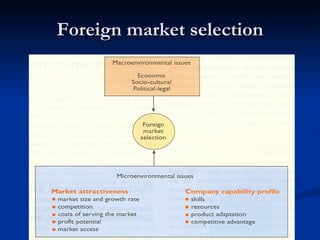
Foreign market selection
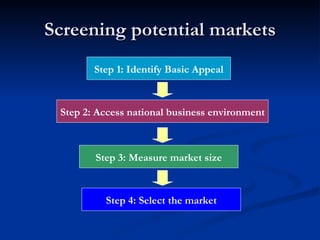
Screening potential markets Step 1: Identify Basic Appeal Step 2: Access national business environment Step 3: Measure market size Step 4: Select the market
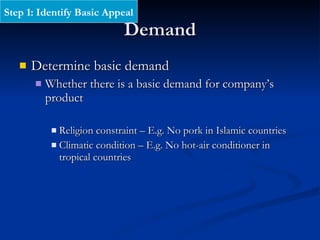
Demand Determine basic demand Whether there is a basic demand for company’s product Religion constraint – E.g. No pork in Islamic countries Climatic condition – E.g. No hot-air conditioner in tropical countries Step 1: Identify Basic Appeal
Resource availability Determine resource availability Raw materials Labor Capital Land Step 1: Identify Basic Appeal
Cultural & local forces Cultural forces Language, attitude toward business, religious belief and custom Product adaptation Some products can be sold worldwide Some products need local customization E.g. KFC, books and magazine Step 2: Access national business environment
Political & legal forces Political and legal forces Political stability  Government regulation Government’s attitude toward trade and investment Types of restriction on import and export Investment barriers Business ownership E.g. 51% of local ownership Step 2: Access national business environment
Government regulation Restrict remitting profit out of country Strict environmental regulation – Strict pollution standard which may increase cost of production Require that companies divulge ceratin trade information – E.g. Coca-cola left India because it refused to disclose its secret Coke formula Political & legal forces Step 2: Access national business environment
Economic forces Economic forces Fiscal and monetary policies Interest rate - Can cause high inflation Currency devaluation – Can affect export Other forces Transportation Infrastructure Step 2: Access national business environment
Data & Information Information Industrial market data Consumer data Emerging market Data may not be readily available Step 3: Measure market size
Market variables Market size Market growth rate Consumption capacity E.g. % of middle class population Commercial infrastructure E.g. Number of TVs, phones, PCs, cars etc Step 3: Measure market size
Market variables Economic freedom E.g Government’s trade policies Market receptivity Volume of international trade as a % of GDP Step 3: Measure market size
Field trip Competitor analysis Step 4: Select the market
Opportunities and risks Evaluation
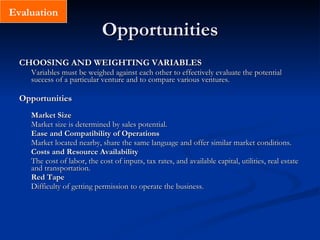
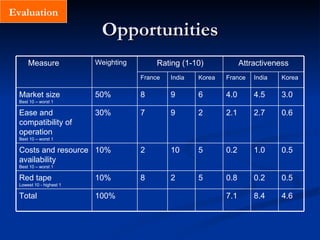
Opportunities CHOOSING AND WEIGHTING VARIABLES Variables must be weighed against each other to effectively evaluate the potential success of a particular venture and to compare various ventures. Opportunities Market Size Market size is determined by sales potential. Ease and Compatibility of Operations Market located nearby, share the same language and offer similar market conditions. Costs and Resource Availability The cost of labor, the cost of inputs, tax rates, and available capital, utilities, real estate and transportation.  Red Tape Difficulty of getting permission to operate the business. Evaluation
Opportunities Evaluation 4.6 8.4 7.1 100% Total 10% 10% 30% 50% Weighting Attractiveness Rating (1-10) 0.5 0.2 0.8 5 2 8 Red tape Lowest 10 - highest 1 0.5 1.0 0.2 5 10 2 Costs and resource availability Best 10 – worst 1 0.6 2.7 2.1 2 9 7 Ease and compatibility of operation Best 10 – worst 1 3.0 4.5 4.0 6 9 8 Market size Best 10 – worst 1 Korea India France Korea India France Measure
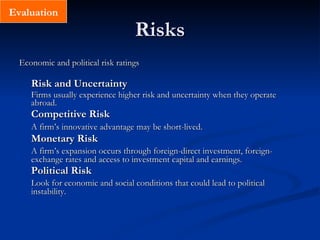
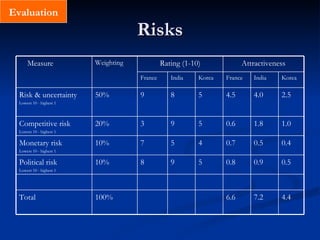
Risks Economic and political risk ratings Risk and Uncertainty Firms usually experience higher risk and uncertainty when they operate abroad.  Competitive Risk A firm’s innovative advantage may be short-lived.   Monetary Risk A firm’s expansion occurs through foreign-direct investment, foreign-exchange rates and access to investment capital and earnings.  Political Risk Look for economic and social conditions that could lead to political instability. Evaluation
Risks Evaluation 0.5 0.9 0.8 5 9 8 10% Political risk Lowest 10 - highest 1 4.4 7.2 6.6 100% Total 10% 20% 50% Weighting Attractiveness Rating (1-10) 0.4 0.5 0.7 4 5 7 Monetary risk Lowest 10 - highest 1 1.0 1.8 0.6 5 9 3 Competitive risk Lowest 10 - highest 1 2.5 4.0 4.5 5 8 9 Risk & uncertainty Lowest 10 - highest 1 Korea India France Korea India France Measure
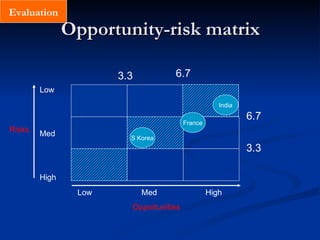
Opportunity-risk matrix 3.3 6.7 Low Med High Opportunities Low Med High Risks India France S Korea 6.7 3.3 Evaluation

Market selection

  • 1.
  • 2.
  • 3.
    Screening potential marketsStep 1: Identify Basic Appeal Step 2: Access national business environment Step 3: Measure market size Step 4: Select the market
  • 4.
    Demand Determine basicdemand Whether there is a basic demand for company’s product Religion constraint – E.g. No pork in Islamic countries Climatic condition – E.g. No hot-air conditioner in tropical countries Step 1: Identify Basic Appeal
  • 5.
    Resource availability Determineresource availability Raw materials Labor Capital Land Step 1: Identify Basic Appeal
  • 6.
    Cultural & localforces Cultural forces Language, attitude toward business, religious belief and custom Product adaptation Some products can be sold worldwide Some products need local customization E.g. KFC, books and magazine Step 2: Access national business environment
  • 7.
    Political & legalforces Political and legal forces Political stability Government regulation Government’s attitude toward trade and investment Types of restriction on import and export Investment barriers Business ownership E.g. 51% of local ownership Step 2: Access national business environment
  • 8.
    Government regulation Restrictremitting profit out of country Strict environmental regulation – Strict pollution standard which may increase cost of production Require that companies divulge ceratin trade information – E.g. Coca-cola left India because it refused to disclose its secret Coke formula Political & legal forces Step 2: Access national business environment
  • 9.
    Economic forces Economicforces Fiscal and monetary policies Interest rate - Can cause high inflation Currency devaluation – Can affect export Other forces Transportation Infrastructure Step 2: Access national business environment
  • 10.
    Data & InformationInformation Industrial market data Consumer data Emerging market Data may not be readily available Step 3: Measure market size
  • 11.
    Market variables Marketsize Market growth rate Consumption capacity E.g. % of middle class population Commercial infrastructure E.g. Number of TVs, phones, PCs, cars etc Step 3: Measure market size
  • 12.
    Market variables Economicfreedom E.g Government’s trade policies Market receptivity Volume of international trade as a % of GDP Step 3: Measure market size
  • 13.
    Field trip Competitoranalysis Step 4: Select the market
  • 14.
  • 15.
    Opportunities CHOOSING ANDWEIGHTING VARIABLES Variables must be weighed against each other to effectively evaluate the potential success of a particular venture and to compare various ventures. Opportunities Market Size Market size is determined by sales potential. Ease and Compatibility of Operations Market located nearby, share the same language and offer similar market conditions. Costs and Resource Availability The cost of labor, the cost of inputs, tax rates, and available capital, utilities, real estate and transportation. Red Tape Difficulty of getting permission to operate the business. Evaluation
  • 16.
    Opportunities Evaluation 4.68.4 7.1 100% Total 10% 10% 30% 50% Weighting Attractiveness Rating (1-10) 0.5 0.2 0.8 5 2 8 Red tape Lowest 10 - highest 1 0.5 1.0 0.2 5 10 2 Costs and resource availability Best 10 – worst 1 0.6 2.7 2.1 2 9 7 Ease and compatibility of operation Best 10 – worst 1 3.0 4.5 4.0 6 9 8 Market size Best 10 – worst 1 Korea India France Korea India France Measure
  • 17.
    Risks Economic andpolitical risk ratings Risk and Uncertainty Firms usually experience higher risk and uncertainty when they operate abroad. Competitive Risk A firm’s innovative advantage may be short-lived. Monetary Risk A firm’s expansion occurs through foreign-direct investment, foreign-exchange rates and access to investment capital and earnings. Political Risk Look for economic and social conditions that could lead to political instability. Evaluation
  • 18.
    Risks Evaluation 0.50.9 0.8 5 9 8 10% Political risk Lowest 10 - highest 1 4.4 7.2 6.6 100% Total 10% 20% 50% Weighting Attractiveness Rating (1-10) 0.4 0.5 0.7 4 5 7 Monetary risk Lowest 10 - highest 1 1.0 1.8 0.6 5 9 3 Competitive risk Lowest 10 - highest 1 2.5 4.0 4.5 5 8 9 Risk & uncertainty Lowest 10 - highest 1 Korea India France Korea India France Measure
  • 19.
    Opportunity-risk matrix 3.36.7 Low Med High Opportunities Low Med High Risks India France S Korea 6.7 3.3 Evaluation