International Marketing
15th edition
Philip R. Cateora, Mary C. Gilly, and John L. Graham
Global Marketing
Management
• The trend back toward localization
– Caused by the new efficiencies of customization
– Made possible by the Internet
– Increasingly flexible manufacturing processes
• From the marketing perspective customization is
always best
• Global markets continue to homogenize and
diversify simultaneously
– Best companies will avoid trap of focusing on
country as the primary segmentation variable
Benefits of Global Marketing
• When large market segments can be identified
– Economies of scale in production and marketing is
important competitive advantages for global companies
• Transfer of experience and know-how
– Across countries through improved coordination and
integration of marketing activities
• Marketing globally
– Ensures that marketers have access to the toughest
customers (Testing ground))
– Market diversity carries with it additional financial
benefits
– Firms are able to take advantage of changing financial
circumstances
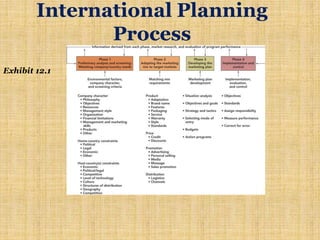
International Planning
Process
Exhibit 12.1
Phase 1: Preliminary analysis and screening –
matching company and country needs
• Evaluation of potential market  doesn’t matter
whether New or heavily involved in international
marketing.
• Company’s strength, weakness, products,
philosophies, modes of operation and objective
must be matched.
• Screening out unpromising possibilities.
• Emerging Market special problem inadequate
marketing infrastructure, underdeveloped
distribution channels.
Phase 1: Preliminary analysis and screening –
matching company and country needs
• it is important to determine the reasons for
entering a foreign market and the returns
expected from the investment.
• Evaluation criteria; such as, minimum market
potential, minimum profit, ROI, acceptable
competitive levels, standard of political stability,
legal requirements.
• Environmental analysis (Uncontrollable both
home and host)
Phase 2: Defining target markets and adapting the
marketing mix accordingly
• A more detailed examination of the components
of the marketing mix is the purpose phase 2.
• Once target markets are selected, the marketing
mix must be evaluated in light of data generated
in phase 1.
• Incorrect decisions  inappropriate product or
costly mistakes in pricing, advertising and
promotion.
• Primary goal  marketing mix adjusted to the
cultural constraints.
Phase 2: Defining target markets and adapting the marketing
mix accordingly
• The answers to three major questions are
generated in Phase 2:
1. Are there identifiable market segments that allow
for common marketing mix tactics across
countries?
2. Which cultural/environmental adaptations are
necessary for successful acceptance of the
marketing mix?
3. Will adaptation costs allow profitable market
entry?
Phase 3: Developing the Marketing Plan
• Marketing plan is developed for the target
market – whether it is a single country or a
global market set.
• The plan starts with –situation analysis, selection
of entry mode, and specific action program for
the market.
• What is to be done, by whom, how it is to be
done, and when.
Phase 4: Implementing and Control
• The go decision in phase 3 triggers
implementation of specific plans and
anticipation of successful marketing.
• All marketing plans need coordination and
control during the period of implementation.
• The planning process is a dynamic, continuous
set of interacting variables with information
continuously building among phases.
Alternative Market-Entry
Strategies (1 of 2)
• An entry strategy into international market should reflect
on analysis
– Market characteristics
• Potential sales
• Strategic importance
• Strengths of local resources
• Cultural differences
• Country restrictions
– Company capabilities and characteristics
• Degree of near-market knowledge
• Marketing involvement
• Management commitment
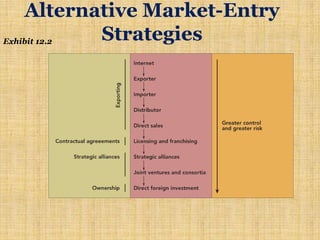
Alternative Market-Entry
Strategies
Exhibit 12.2
• Companies most often begin with modest export
involvement
• A company has four different modes of foreign
market entry
– Exporting
– Contractual agreements
– Strategic international alliances
– Direct foreign investments
Alternative Market-Entry
Strategies (2 of 2)
Exporting
• Exporting can be either Direct or Indirect.
• Internet
• Direct sales: setting up an office with local or
expatriate managers and staffs.
Contractual Agreement
(1 of 2)
• Contractual agreements
– Long-term,
– Nonequity association between a company and another in
a foreign market
– Transfer of technology, processes, trademark, human
skills.
• Licensing
– A means of establishing a foothold in foreign markets
without large capital outlays
– A favorite strategy for small and medium-sized companies
– Legitimate means of capitalizing on intellectual property in
a foreign market
Contractual Agreement
(2 of 2)
• Franchising
– Franchiser provides a standard package of
products, systems, and management services
– Franchise provides market knowledge, capital,
and personal involvement in management
– Expected to be the fastest-growing market-
entry strategy
Strategic International
Alliances
• Four characteristics define joint ventures:
– JVs are established, separate, legal entities
– The acknowledged intent by the partners to share
in the management of the JV
– There are partnerships between legally
incorporated entities such as companies,
chartered organizations, or governments, and not
between individuals
– Equity positions are held by each of the partners
Strategic International
Alliances
• Consortia
– Similar to joint ventures and could be classified as
such except for two unique characteristics
• Typically involve a large number of
participants
• Frequently operate in a country or market in
which none of the participants
is currently active
– Consortia are developed to pool financial and
managerial resources and to lessen risks
– Sematech (R&D in Texas by IBM, Intel, HP,
Motorola)
Direct Foreign Investment
• Factors that influence the structure and
performance of direct investments
– Timing (First movers have advantages but Risky)
– The growing complexity and contingencies of
contracts
– Transaction cost structures
– Technology transfer
– Degree of product differentiation
– The previous experiences and cultural diversity of
acquired firms
– Advertising and reputation barriers
The End

Chapter_11Global Marketing Planning

  • 1.
    International Marketing 15th edition PhilipR. Cateora, Mary C. Gilly, and John L. Graham
  • 2.
    Global Marketing Management • Thetrend back toward localization – Caused by the new efficiencies of customization – Made possible by the Internet – Increasingly flexible manufacturing processes • From the marketing perspective customization is always best • Global markets continue to homogenize and diversify simultaneously – Best companies will avoid trap of focusing on country as the primary segmentation variable
  • 3.
    Benefits of GlobalMarketing • When large market segments can be identified – Economies of scale in production and marketing is important competitive advantages for global companies • Transfer of experience and know-how – Across countries through improved coordination and integration of marketing activities • Marketing globally – Ensures that marketers have access to the toughest customers (Testing ground)) – Market diversity carries with it additional financial benefits – Firms are able to take advantage of changing financial circumstances
  • 4.
  • 5.
    Phase 1: Preliminaryanalysis and screening – matching company and country needs • Evaluation of potential market  doesn’t matter whether New or heavily involved in international marketing. • Company’s strength, weakness, products, philosophies, modes of operation and objective must be matched. • Screening out unpromising possibilities. • Emerging Market special problem inadequate marketing infrastructure, underdeveloped distribution channels.
  • 6.
    Phase 1: Preliminaryanalysis and screening – matching company and country needs • it is important to determine the reasons for entering a foreign market and the returns expected from the investment. • Evaluation criteria; such as, minimum market potential, minimum profit, ROI, acceptable competitive levels, standard of political stability, legal requirements. • Environmental analysis (Uncontrollable both home and host)
  • 7.
    Phase 2: Definingtarget markets and adapting the marketing mix accordingly • A more detailed examination of the components of the marketing mix is the purpose phase 2. • Once target markets are selected, the marketing mix must be evaluated in light of data generated in phase 1. • Incorrect decisions  inappropriate product or costly mistakes in pricing, advertising and promotion. • Primary goal  marketing mix adjusted to the cultural constraints.
  • 8.
    Phase 2: Definingtarget markets and adapting the marketing mix accordingly • The answers to three major questions are generated in Phase 2: 1. Are there identifiable market segments that allow for common marketing mix tactics across countries? 2. Which cultural/environmental adaptations are necessary for successful acceptance of the marketing mix? 3. Will adaptation costs allow profitable market entry?
  • 9.
    Phase 3: Developingthe Marketing Plan • Marketing plan is developed for the target market – whether it is a single country or a global market set. • The plan starts with –situation analysis, selection of entry mode, and specific action program for the market. • What is to be done, by whom, how it is to be done, and when.
  • 10.
    Phase 4: Implementingand Control • The go decision in phase 3 triggers implementation of specific plans and anticipation of successful marketing. • All marketing plans need coordination and control during the period of implementation. • The planning process is a dynamic, continuous set of interacting variables with information continuously building among phases.
  • 11.
    Alternative Market-Entry Strategies (1of 2) • An entry strategy into international market should reflect on analysis – Market characteristics • Potential sales • Strategic importance • Strengths of local resources • Cultural differences • Country restrictions – Company capabilities and characteristics • Degree of near-market knowledge • Marketing involvement • Management commitment
  • 12.
  • 13.
    • Companies mostoften begin with modest export involvement • A company has four different modes of foreign market entry – Exporting – Contractual agreements – Strategic international alliances – Direct foreign investments Alternative Market-Entry Strategies (2 of 2)
  • 14.
    Exporting • Exporting canbe either Direct or Indirect. • Internet • Direct sales: setting up an office with local or expatriate managers and staffs.
  • 15.
    Contractual Agreement (1 of2) • Contractual agreements – Long-term, – Nonequity association between a company and another in a foreign market – Transfer of technology, processes, trademark, human skills. • Licensing – A means of establishing a foothold in foreign markets without large capital outlays – A favorite strategy for small and medium-sized companies – Legitimate means of capitalizing on intellectual property in a foreign market
  • 16.
    Contractual Agreement (2 of2) • Franchising – Franchiser provides a standard package of products, systems, and management services – Franchise provides market knowledge, capital, and personal involvement in management – Expected to be the fastest-growing market- entry strategy
  • 17.
    Strategic International Alliances • Fourcharacteristics define joint ventures: – JVs are established, separate, legal entities – The acknowledged intent by the partners to share in the management of the JV – There are partnerships between legally incorporated entities such as companies, chartered organizations, or governments, and not between individuals – Equity positions are held by each of the partners
  • 18.
    Strategic International Alliances • Consortia –Similar to joint ventures and could be classified as such except for two unique characteristics • Typically involve a large number of participants • Frequently operate in a country or market in which none of the participants is currently active – Consortia are developed to pool financial and managerial resources and to lessen risks – Sematech (R&D in Texas by IBM, Intel, HP, Motorola)
  • 19.
    Direct Foreign Investment •Factors that influence the structure and performance of direct investments – Timing (First movers have advantages but Risky) – The growing complexity and contingencies of contracts – Transaction cost structures – Technology transfer – Degree of product differentiation – The previous experiences and cultural diversity of acquired firms – Advertising and reputation barriers
  • 20.