ASIA PACIFIC
ECONOMIC
COOPERATION
APEC
 The Asia-Pacific Economic Cooperation (APEC) is a regional economic forum
established in 1989 to leverage the growing interdependence of the Asia-Pacific
 APEC's 21 members aim to create greater prosperity for the people of the region by
promoting balanced, inclusive, sustainable, innovative and secure growth and by
accelerating regional economic integration
 APEC has 21 member economies with a population of over 2.6 billion which accounts
for more than 40% of the world’s population.
 APEC countries have a combined GDP of 21 trillion US dollars which is more than half
of world GDP.
 APEC accounts for nearly half of world trade.
MEMBER ECONOMIES
* Australia * Malaysia
* Brunei Darussalam * Mexico
* Canada * New Zealand
* Chile * Papua New Guinea
* People's Republic of China * Peru
* The Republic of the Philippines * Hong Kong, China
* The Russian Federation * Japan
* United States of America * Indonesia
* Chinese Taipei * Singapore
* Republic of Korea * Viet Nam
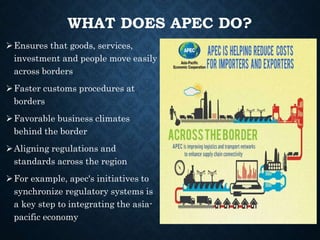
WHAT DOES APEC DO?
Ensures that goods, services,
investment and people move easily
across borders
Faster customs procedures at
borders
Favorable business climates
behind the border
Aligning regulations and
standards across the region
For example, apec's initiatives to
synchronize regulatory systems is
a key step to integrating the asia-
pacific economy
HISTORY OF APEC
• APEC begins as an informal Ministerial-level dialogue group in Canberra, Australia in
1989. It is a 21 member economic forum at present.
• Founding members are
• Australia, New Zealand
• 6 ASEAN economies
• Japan and South Korea
• Canada and the United States
• Later the co-operation expanded to China, Taiwan, & Hong Kong in1991 Mexico & Papua
New Guinea in 1993 ,Chile (1994 ) , Russia, Vietnam, Peru in 1998.
• India, Mangolia, Pakistan, Laos, Bangladesh, Costa Rica, Colombia, Panama and Ecuador
are among a dozen countries seeking membership in APEC.
MISSION & VISION
 To support sustainable economic growth and prosperity in
Asia-Pacific region
 To build a dynamic and harmonious Asia-Pacific
community
 Decrease number of obstacles in trade and also reduce tariffs
across APEC nations
 Set it’s eye on achieving ‘Bogor goals’ by the year 2010
 To encourage the flow of goods, services, capital, and
technology
 To develop and strengthen the multilateral trading
APEC Relations
ASEAN and APEC
• ASEAN has been at APEC's core from the very beginning and is doing its part to advance APEC's
purposes and is consistent with APEC goals.
• ASEAN Free Trade Area (AFTA) can be said to be a building block for the fulfillment of the goals that
APEC set for eventual free trade among its members.
• It can be said that the two organizations could be seen as complementing, and not competing with
each other.
NAFTA and APEC
• Accomplishment of Bogor goals and free trade among APEC member economies leads to significant
trade diversion from western countries to APEC member economies.
• Western economies trying to maintain balance of power between east and west in APEC
decisions by restricting Asian countries into economic co-operation.
APEC and India
 India tried for membership in APEC. It was initially supported by United States, Japan
Australia but was denied later.
 India would have been had an undue advantage in trade if it is a member of APEC.
Reasons :
o Decision was made not to admit more members until 2010 till Bogor goals are accomplished.
o India does not border the Pacific Ocean, which all current members do
o There is a concern among Western countries that India's entry might tilt the balance of
power shifts in favour of India.
APEC Secretariat
• APEC secretariat operates as the core support mechanism for the APEC process.
• It provides coordination, technical and advisory support as well as information
management, communications and public outreach services.
• It performs a central project management role
• It is based in Singapore
• The APEC Secretariat is headed by an Executive Director and a Deputy Executive Director
• Muhamad Noor Yacob is the present Executive Director
HOW APEC OPERATES
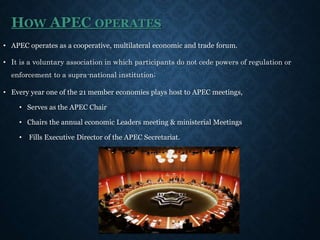
• APEC operates as a cooperative, multilateral economic and trade forum.
• It is a voluntary association in which participants do not cede powers of regulation or
enforcement to a supra-national institution;
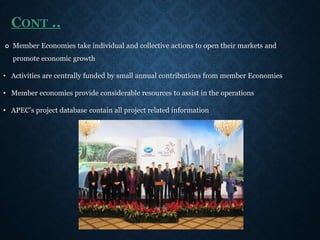
• Every year one of the 21 member economies plays host to APEC meetings,
• Serves as the APEC Chair
• Chairs the annual economic Leaders meeting & ministerial Meetings
• Fills Executive Director of the APEC Secretariat.
CONT ..
 Member Economies take individual and collective actions to open their markets and
promote economic growth
• Activities are centrally funded by small annual contributions from member Economies
• Member economies provide considerable resources to assist in the operations
• APEC’s project database contain all project related information
STRENGTHS OF APEC
• A supporter of the of the multilateral trade negotiations, apply pressure to key
countries, suggest visionary initiatives and monitor compliances.
• APEC has considerable experience in the reform process and can act as a model
or demonstration to the rest of the world.
• APEC is a large group of countries that could be extremely influential if adopted
a common approach and joint bargaining objectives.
WEAKNESSES OF APEC
• Absence of priorities- The effort in trade reform within APEC has been
diffused across too many areas and there is need for more focus.
• Shortfalls in member commitments- Many countries have gone no further
than their existing pledges.
• Weak evaluation procedures- there is lack of outside scrutiny of individual
members’ progress in implementing reforms
• Dearth of specific APEC incentives- APEC operates by consensus and there is
no mechanism for enforcing group decisions.
international marketing- Apec

international marketing- Apec

  • 1.
  • 3.
    APEC  The Asia-PacificEconomic Cooperation (APEC) is a regional economic forum established in 1989 to leverage the growing interdependence of the Asia-Pacific  APEC's 21 members aim to create greater prosperity for the people of the region by promoting balanced, inclusive, sustainable, innovative and secure growth and by accelerating regional economic integration  APEC has 21 member economies with a population of over 2.6 billion which accounts for more than 40% of the world’s population.  APEC countries have a combined GDP of 21 trillion US dollars which is more than half of world GDP.  APEC accounts for nearly half of world trade.
  • 4.
    MEMBER ECONOMIES * Australia* Malaysia * Brunei Darussalam * Mexico * Canada * New Zealand * Chile * Papua New Guinea * People's Republic of China * Peru * The Republic of the Philippines * Hong Kong, China * The Russian Federation * Japan * United States of America * Indonesia * Chinese Taipei * Singapore * Republic of Korea * Viet Nam
  • 5.
    WHAT DOES APECDO? Ensures that goods, services, investment and people move easily across borders Faster customs procedures at borders Favorable business climates behind the border Aligning regulations and standards across the region For example, apec's initiatives to synchronize regulatory systems is a key step to integrating the asia- pacific economy
  • 6.
    HISTORY OF APEC •APEC begins as an informal Ministerial-level dialogue group in Canberra, Australia in 1989. It is a 21 member economic forum at present. • Founding members are • Australia, New Zealand • 6 ASEAN economies • Japan and South Korea • Canada and the United States • Later the co-operation expanded to China, Taiwan, & Hong Kong in1991 Mexico & Papua New Guinea in 1993 ,Chile (1994 ) , Russia, Vietnam, Peru in 1998. • India, Mangolia, Pakistan, Laos, Bangladesh, Costa Rica, Colombia, Panama and Ecuador are among a dozen countries seeking membership in APEC.
  • 7.
    MISSION & VISION To support sustainable economic growth and prosperity in Asia-Pacific region  To build a dynamic and harmonious Asia-Pacific community  Decrease number of obstacles in trade and also reduce tariffs across APEC nations  Set it’s eye on achieving ‘Bogor goals’ by the year 2010  To encourage the flow of goods, services, capital, and technology  To develop and strengthen the multilateral trading
  • 8.
    APEC Relations ASEAN andAPEC • ASEAN has been at APEC's core from the very beginning and is doing its part to advance APEC's purposes and is consistent with APEC goals. • ASEAN Free Trade Area (AFTA) can be said to be a building block for the fulfillment of the goals that APEC set for eventual free trade among its members. • It can be said that the two organizations could be seen as complementing, and not competing with each other. NAFTA and APEC • Accomplishment of Bogor goals and free trade among APEC member economies leads to significant trade diversion from western countries to APEC member economies. • Western economies trying to maintain balance of power between east and west in APEC decisions by restricting Asian countries into economic co-operation.
  • 9.
    APEC and India India tried for membership in APEC. It was initially supported by United States, Japan Australia but was denied later.  India would have been had an undue advantage in trade if it is a member of APEC. Reasons : o Decision was made not to admit more members until 2010 till Bogor goals are accomplished. o India does not border the Pacific Ocean, which all current members do o There is a concern among Western countries that India's entry might tilt the balance of power shifts in favour of India.
  • 10.
    APEC Secretariat • APECsecretariat operates as the core support mechanism for the APEC process. • It provides coordination, technical and advisory support as well as information management, communications and public outreach services. • It performs a central project management role • It is based in Singapore • The APEC Secretariat is headed by an Executive Director and a Deputy Executive Director • Muhamad Noor Yacob is the present Executive Director
  • 11.
    HOW APEC OPERATES •APEC operates as a cooperative, multilateral economic and trade forum. • It is a voluntary association in which participants do not cede powers of regulation or enforcement to a supra-national institution; • Every year one of the 21 member economies plays host to APEC meetings, • Serves as the APEC Chair • Chairs the annual economic Leaders meeting & ministerial Meetings • Fills Executive Director of the APEC Secretariat.
  • 12.
    CONT ..  MemberEconomies take individual and collective actions to open their markets and promote economic growth • Activities are centrally funded by small annual contributions from member Economies • Member economies provide considerable resources to assist in the operations • APEC’s project database contain all project related information
  • 13.
    STRENGTHS OF APEC •A supporter of the of the multilateral trade negotiations, apply pressure to key countries, suggest visionary initiatives and monitor compliances. • APEC has considerable experience in the reform process and can act as a model or demonstration to the rest of the world. • APEC is a large group of countries that could be extremely influential if adopted a common approach and joint bargaining objectives.
  • 14.
    WEAKNESSES OF APEC •Absence of priorities- The effort in trade reform within APEC has been diffused across too many areas and there is need for more focus. • Shortfalls in member commitments- Many countries have gone no further than their existing pledges. • Weak evaluation procedures- there is lack of outside scrutiny of individual members’ progress in implementing reforms • Dearth of specific APEC incentives- APEC operates by consensus and there is no mechanism for enforcing group decisions.