Dole Foods International Expansion   Live case-based skill development exercise
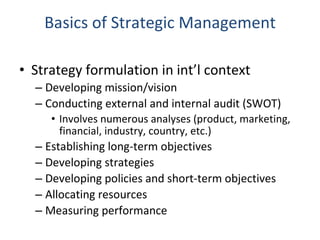
Basics of Strategic Management Strategy formulation in int’l context Developing mission/vision Conducting external and internal audit (SWOT) Involves numerous analyses (product, marketing, financial, industry, country, etc.) Establishing long-term objectives Developing strategies Developing policies and short-term objectives Allocating resources Measuring performance
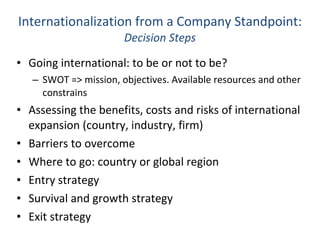
Internationalization from a Company Standpoint: Decision Steps Going international: to be or not to be? SWOT => mission, objectives. Available resources and other constrains Assessing the benefits, costs and risks of international expansion (country, industry, firm) Barriers to overcome Where to go: country or global region Entry strategy Survival and growth strategy Exit strategy
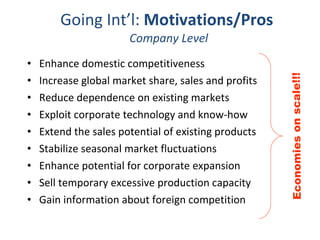
Going Int’l:  Motivations/Pros   Company Level Enhance domestic competitiveness  Increase global market share, sales and profits  Reduce dependence on existing markets  Exploit corporate technology and know-how  Extend the sales potential of existing products  Stabilize seasonal market fluctuations  Enhance potential for corporate expansion  Sell temporary excessive production capacity  Gain information about foreign competition  Economies on scale!!!
Going Int’l:  Reservations/Cons   Company Level Develop new promotional material  Subordinate short-term profits to long-term gains  Incur added administrative costs  Allocate personnel for travel  Wait longer for payments  Modify your product or packaging  Apply for additional financing  Obtain special export licenses  Overcome trade barriers and numerous other obstacles
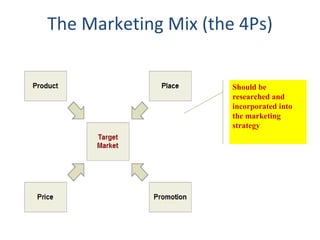
The Marketing Mix (the 4Ps) Should be researched and  incorporated into the marketing strategy
Key Considerations and Options in International Expansion Decision A firm expanding internationally must decide :  Which markets to enter When (early/late) to enter them and on what scale (small/large) How to enter them (the choice of entry mode) Available Entry Options : Exporting Licensing or franchising to host country firms Setting up a joint venture with a host country firm Setting up a wholly owned subsidiary in the host country to serve that market
Enter Which Foreign Markets? There are more than 200 world’s nations Each one’s attractiveness to a particular firm as a particular market depends on: The firm’s  objectives A  balance of  benefits, costs, and risks : short- term and long-term Industry dynamics and competition  in which a firm operates A  country  which a firm is about to enter Depending on the goals of the expansion (e.g.  manufacturing vs. marketing ) the selection criteria differ Manufacturing : cheap labor, minerals, energy and other resources  Marketing : high GDP per capita, population density
Timing of Entry Fist-mover  advantages Preempt rivals; establish strong brand name; capture demand Build sales volume; ride down experience curve ahead of competitors; gain cost advantage Create switching costs for that tie customers to 1st mover’s products Establish social ties ahead of following foreign competitors important in high-context cultures
Timing of Entry First-mover  disadvantages ; pioneering costs Time spent to learn dos-don’ts; competitors can learn from 1st mover If 1st mover introducing a new industry, it is often compelled to build infrastructure 1st mover “trains” customers for followers/ competition Break through host country’s adjustment to “foreignness” issues Regulations may change as a result of 1st mover’s entry
Scale of Entry Resources to commit:  large vs. small  amount How much resources can firm afford to commit? A strategic commitment is difficult to reverse Has a long-term  impact (sunk costs/investments) Means that the resources cannot be used elsewhere 1st mover advantages and large scale are linked Small scale entry allows learning at low risk Entry in small or large potential market may require the same level of initial resources
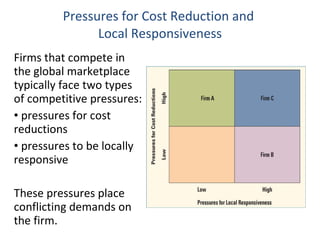
Pressures for Cost Reduction and  Local Responsiveness Firms that compete in the global marketplace typically face two types of competitive pressures: pressures for cost reductions pressures to be locally responsive These pressures place conflicting demands on the firm.
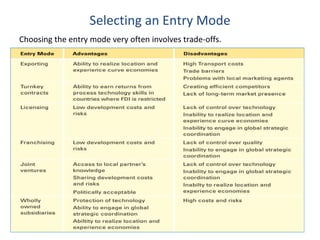
Selecting an Entry Mode Choosing the entry mode very often involves trade-offs.
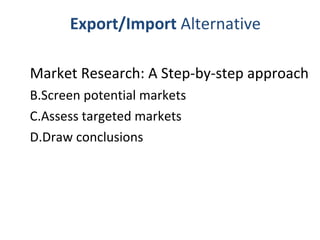
Export/Import  Alternative Market Research: A Step-by-step approach  Screen potential markets Assess targeted markets Draw conclusions
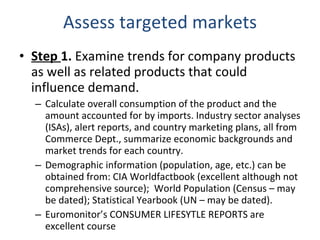
Assess targeted markets Step  1.  Examine trends for company products as well as related products that could influence demand.  Calculate overall consumption of the product and the amount accounted for by imports. Industry sector analyses (ISAs), alert reports, and country marketing plans, all from Commerce Dept., summarize economic backgrounds and market trends for each country.  Demographic information (population, age, etc.) can be obtained from: CIA Worldfactbook (excellent although not comprehensive source);  World Population (Census – may be dated); Statistical Yearbook (UN – may be dated). Euromonitor’s CONSUMER LIFESYTLE REPORTS are excellent course
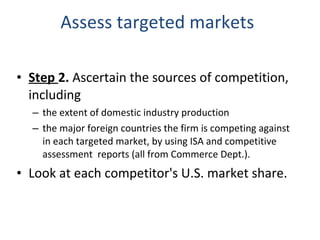
Assess targeted markets Step  2.  Ascertain the sources of competition, including the extent of domestic industry production the major foreign countries the firm is competing against in each targeted market, by using ISA and competitive assessment  reports (all from Commerce Dept.).  Look at each competitor's U.S. market share.
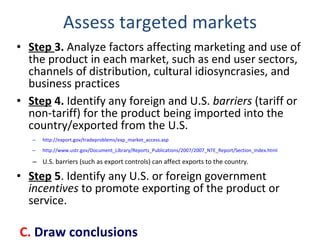
Assess targeted markets Step  3.  Analyze factors affecting marketing and use of the product in each market, such as end user sectors, channels of distribution, cultural idiosyncrasies, and business practices Step  4.  Identify any foreign and U.S.  barriers  (tariff or non-tariff) for the product being imported into the country/exported from the U.S.  http:// export.gov/tradeproblems/exp_market_access.asp   http://www.ustr.gov/Document_Library/Reports_Publications/2007/2007_NTE_Report/Section_Index.html   U.S. barriers (such as export controls) can affect exports to the country.  Step  5 . Identify any U.S. or foreign government  incentives  to promote exporting of the product or service. C.  Draw conclusions
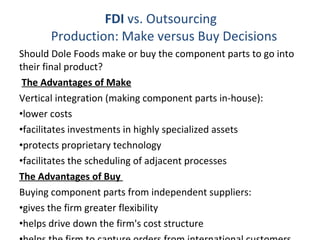
FDI  vs. Outsourcing  Production: Make versus Buy Decisions Should Dole Foods make or buy the component parts to go into their final product? The Advantages of Make   Vertical integration (making component parts in-house): lower costs facilitates investments in highly specialized assets protects proprietary technology facilitates the scheduling of adjacent processes The Advantages of Buy  Buying component parts from independent suppliers: gives the firm greater flexibility helps drive down the firm's cost structure helps the firm to capture orders from international customers
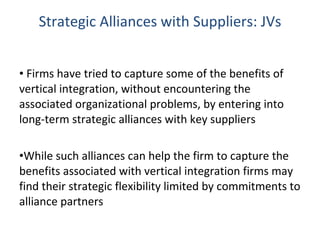
Strategic Alliances with Suppliers: JVs Firms have tried to capture some of the benefits of vertical integration, without encountering the associated organizational problems, by entering into long-term strategic alliances with key suppliers While such alliances can help the firm to capture the benefits associated with vertical integration firms may find their strategic flexibility limited by commitments to alliance partners

Live case based exercise dole ib

  • 1.
    Dole Foods InternationalExpansion Live case-based skill development exercise
  • 2.
    Basics of StrategicManagement Strategy formulation in int’l context Developing mission/vision Conducting external and internal audit (SWOT) Involves numerous analyses (product, marketing, financial, industry, country, etc.) Establishing long-term objectives Developing strategies Developing policies and short-term objectives Allocating resources Measuring performance
  • 3.
    Internationalization from aCompany Standpoint: Decision Steps Going international: to be or not to be? SWOT => mission, objectives. Available resources and other constrains Assessing the benefits, costs and risks of international expansion (country, industry, firm) Barriers to overcome Where to go: country or global region Entry strategy Survival and growth strategy Exit strategy
  • 4.
    Going Int’l: Motivations/Pros Company Level Enhance domestic competitiveness Increase global market share, sales and profits Reduce dependence on existing markets Exploit corporate technology and know-how Extend the sales potential of existing products Stabilize seasonal market fluctuations Enhance potential for corporate expansion Sell temporary excessive production capacity Gain information about foreign competition Economies on scale!!!
  • 5.
    Going Int’l: Reservations/Cons Company Level Develop new promotional material Subordinate short-term profits to long-term gains Incur added administrative costs Allocate personnel for travel Wait longer for payments Modify your product or packaging Apply for additional financing Obtain special export licenses Overcome trade barriers and numerous other obstacles
  • 6.
    The Marketing Mix(the 4Ps) Should be researched and incorporated into the marketing strategy
  • 7.
    Key Considerations andOptions in International Expansion Decision A firm expanding internationally must decide : Which markets to enter When (early/late) to enter them and on what scale (small/large) How to enter them (the choice of entry mode) Available Entry Options : Exporting Licensing or franchising to host country firms Setting up a joint venture with a host country firm Setting up a wholly owned subsidiary in the host country to serve that market
  • 8.
    Enter Which ForeignMarkets? There are more than 200 world’s nations Each one’s attractiveness to a particular firm as a particular market depends on: The firm’s objectives A balance of benefits, costs, and risks : short- term and long-term Industry dynamics and competition in which a firm operates A country which a firm is about to enter Depending on the goals of the expansion (e.g. manufacturing vs. marketing ) the selection criteria differ Manufacturing : cheap labor, minerals, energy and other resources Marketing : high GDP per capita, population density
  • 9.
    Timing of EntryFist-mover advantages Preempt rivals; establish strong brand name; capture demand Build sales volume; ride down experience curve ahead of competitors; gain cost advantage Create switching costs for that tie customers to 1st mover’s products Establish social ties ahead of following foreign competitors important in high-context cultures
  • 10.
    Timing of EntryFirst-mover disadvantages ; pioneering costs Time spent to learn dos-don’ts; competitors can learn from 1st mover If 1st mover introducing a new industry, it is often compelled to build infrastructure 1st mover “trains” customers for followers/ competition Break through host country’s adjustment to “foreignness” issues Regulations may change as a result of 1st mover’s entry
  • 11.
    Scale of EntryResources to commit: large vs. small amount How much resources can firm afford to commit? A strategic commitment is difficult to reverse Has a long-term impact (sunk costs/investments) Means that the resources cannot be used elsewhere 1st mover advantages and large scale are linked Small scale entry allows learning at low risk Entry in small or large potential market may require the same level of initial resources
  • 12.
    Pressures for CostReduction and Local Responsiveness Firms that compete in the global marketplace typically face two types of competitive pressures: pressures for cost reductions pressures to be locally responsive These pressures place conflicting demands on the firm.
  • 13.
    Selecting an EntryMode Choosing the entry mode very often involves trade-offs.
  • 14.
    Export/Import AlternativeMarket Research: A Step-by-step approach Screen potential markets Assess targeted markets Draw conclusions
  • 15.
    Assess targeted marketsStep 1. Examine trends for company products as well as related products that could influence demand. Calculate overall consumption of the product and the amount accounted for by imports. Industry sector analyses (ISAs), alert reports, and country marketing plans, all from Commerce Dept., summarize economic backgrounds and market trends for each country. Demographic information (population, age, etc.) can be obtained from: CIA Worldfactbook (excellent although not comprehensive source); World Population (Census – may be dated); Statistical Yearbook (UN – may be dated). Euromonitor’s CONSUMER LIFESYTLE REPORTS are excellent course
  • 16.
    Assess targeted marketsStep 2. Ascertain the sources of competition, including the extent of domestic industry production the major foreign countries the firm is competing against in each targeted market, by using ISA and competitive assessment reports (all from Commerce Dept.). Look at each competitor's U.S. market share.
  • 17.
    Assess targeted marketsStep 3. Analyze factors affecting marketing and use of the product in each market, such as end user sectors, channels of distribution, cultural idiosyncrasies, and business practices Step 4. Identify any foreign and U.S. barriers (tariff or non-tariff) for the product being imported into the country/exported from the U.S. http:// export.gov/tradeproblems/exp_market_access.asp http://www.ustr.gov/Document_Library/Reports_Publications/2007/2007_NTE_Report/Section_Index.html U.S. barriers (such as export controls) can affect exports to the country. Step 5 . Identify any U.S. or foreign government incentives to promote exporting of the product or service. C. Draw conclusions
  • 18.
    FDI vs.Outsourcing Production: Make versus Buy Decisions Should Dole Foods make or buy the component parts to go into their final product? The Advantages of Make Vertical integration (making component parts in-house): lower costs facilitates investments in highly specialized assets protects proprietary technology facilitates the scheduling of adjacent processes The Advantages of Buy Buying component parts from independent suppliers: gives the firm greater flexibility helps drive down the firm's cost structure helps the firm to capture orders from international customers
  • 19.
    Strategic Alliances withSuppliers: JVs Firms have tried to capture some of the benefits of vertical integration, without encountering the associated organizational problems, by entering into long-term strategic alliances with key suppliers While such alliances can help the firm to capture the benefits associated with vertical integration firms may find their strategic flexibility limited by commitments to alliance partners