



MARKET SEGMENT AND BASES
FOR MARKET SEGMENTATION
PRESENTED BY : DIVYANSHU
IRFAN
JAGDISH
What Is Market Segmentation?
• Market segmentation is the activity of dividing a broad consumer or
business market, normally consisting of existing and potential customers,
into sub-groups of consumers (known as segments) based on some type of
shared characteristics.
• “Market Segmentation is the sub-dividing of customers into homogenous
sub-set of customers where any sub-set may conceivably selected as market
target to be reached with distinct Marketing Mix” – Philip Kotler
• “Market segmentation is the process of splitting customers, or potential
customers, in a market into different groups, or segments”
• Segmentation is essentially the identification of subsets of buyers within a
market that share similar needs and demonstrate similar buyer behaviour.
The world is made up of billions of buyers with their own sets of needs and
behaviour. Segmentation aims to match groups of purchasers with the same
set of needs and buyer behaviour. Such a group is known as a 'segment’.
Importance of Market Segmentation
• To develop marketing activities
• Increase marketing effectiveness
• Generate greater customer satisfaction
• Create savings
• To identify strategic opportunities and niches
• Allocation of marketing budget
• Adjustment of product to the market need
• To estimate the level of sales in the market
• To overcome competition effectively
• To develop effective marketing programmes
• To contribute towards achieving company goals
A market/consumer population for a product can be a
segmented using a several bases. The major ones includes.
1. Geographic
2. Demographic
3. Psychographic
4. Behavioral
Bases for marketing segmentation
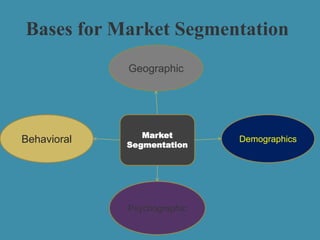
Bases for Market Segmentation
Geographic
Behavioral Demographics
Psychographic
Market
Segmentation
Geographic segmentation
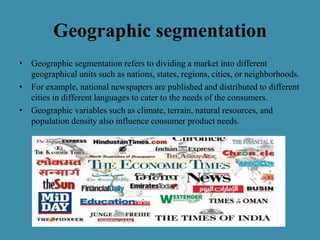
• Geographic segmentation refers to dividing a market into different
geographical units such as nations, states, regions, cities, or neighborhoods.
• For example, national newspapers are published and distributed to different
cities in different languages to cater to the needs of the consumers.
• Geographic variables such as climate, terrain, natural resources, and
population density also influence consumer product needs.
Geographic segmentation
 Regions : By continent, country, state or even neighborhood
 Size of the area : segmented according to size of population
 Climate : According to weather patterns common to certain
geographic regions
 Population Density : often classified as Urban, Suburban or
Rural
Demographic segmentation
• Demographic segmentation divides the markets into groups based on
variables such as age, gender, family size, income, occupation, education,
religion, race and nationality.
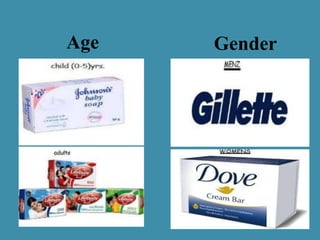
• Age
Markets that are commonly segmented by age includes clothing, toys, music,
automobiles, soaps, shampoos and foods.
• Gender
Gender segmentation is used in clothing, cosmetics and magazines.
• Income
Income includes housing, furniture, automobile, clothing, alcoholic, beverages,
food, sporting goods, luxury goods, financial services and travel.
• Family Cycle
Social class can be divided into upper class, middle class and lower class.
Age Gender
Psychographic segmentation
• Psychographic segmentation pertains to lifestyle and personality traits. In
the case of certain products, buying behaviour predominantly depends on
lifestyle and personality characteristics.
• Personality Characteristics
Here markets are segmented according to competitiveness, introvert, extrovert,
ambitious, aggressiveness, etc.
This type of segmentation is used when a product is similar to many competing
products, and consumer needs for products are not affected by other segmentation
variables.
• Lifestyle
It is the manner in which people live and spend their time and money
Companies making cosmetics, alcoholic beverages and furniture’s segment market
according to the lifestyle.
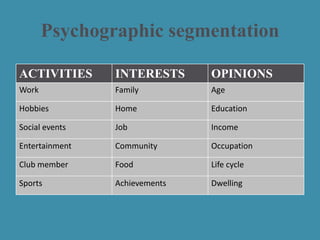
Psychographic segmentation
ACTIVITIES INTERESTS OPINIONS
Work Family Age
Hobbies Home Education
Social events Job Income
Entertainment Community Occupation
Club member Food Life cycle
Sports Achievements Dwelling
Behavioural segmentation
In behavioural segmentation, buyers are divided into groups on the basis of
their knowledge of, attitude towards, use of, or response to a product.
Behavioural segmentation includes segmentation on the basis of occasions,
user status, usage rate loyalty status, buyer-readiness stage and attitude.
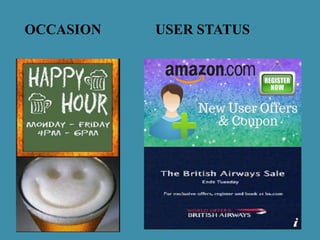
• Occasion
• User Status
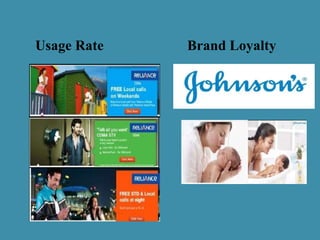
• Usage Rate
• Brand Loyalty
OCCASION USER STATUS
Usage Rate Brand Loyalty
THANK YOU
THE END

Market segmentation and bases for segmentation

  • 1.
    MARKET SEGMENT ANDBASES FOR MARKET SEGMENTATION PRESENTED BY : DIVYANSHU IRFAN JAGDISH
  • 2.
    What Is MarketSegmentation? • Market segmentation is the activity of dividing a broad consumer or business market, normally consisting of existing and potential customers, into sub-groups of consumers (known as segments) based on some type of shared characteristics. • “Market Segmentation is the sub-dividing of customers into homogenous sub-set of customers where any sub-set may conceivably selected as market target to be reached with distinct Marketing Mix” – Philip Kotler • “Market segmentation is the process of splitting customers, or potential customers, in a market into different groups, or segments” • Segmentation is essentially the identification of subsets of buyers within a market that share similar needs and demonstrate similar buyer behaviour. The world is made up of billions of buyers with their own sets of needs and behaviour. Segmentation aims to match groups of purchasers with the same set of needs and buyer behaviour. Such a group is known as a 'segment’.
  • 3.
    Importance of MarketSegmentation • To develop marketing activities • Increase marketing effectiveness • Generate greater customer satisfaction • Create savings • To identify strategic opportunities and niches • Allocation of marketing budget • Adjustment of product to the market need • To estimate the level of sales in the market • To overcome competition effectively • To develop effective marketing programmes • To contribute towards achieving company goals
  • 4.
    A market/consumer populationfor a product can be a segmented using a several bases. The major ones includes. 1. Geographic 2. Demographic 3. Psychographic 4. Behavioral Bases for marketing segmentation
  • 5.
    Bases for MarketSegmentation Geographic Behavioral Demographics Psychographic Market Segmentation
  • 6.
    Geographic segmentation • Geographicsegmentation refers to dividing a market into different geographical units such as nations, states, regions, cities, or neighborhoods. • For example, national newspapers are published and distributed to different cities in different languages to cater to the needs of the consumers. • Geographic variables such as climate, terrain, natural resources, and population density also influence consumer product needs.
  • 7.
    Geographic segmentation  Regions: By continent, country, state or even neighborhood  Size of the area : segmented according to size of population  Climate : According to weather patterns common to certain geographic regions  Population Density : often classified as Urban, Suburban or Rural
  • 8.
    Demographic segmentation • Demographicsegmentation divides the markets into groups based on variables such as age, gender, family size, income, occupation, education, religion, race and nationality. • Age Markets that are commonly segmented by age includes clothing, toys, music, automobiles, soaps, shampoos and foods. • Gender Gender segmentation is used in clothing, cosmetics and magazines. • Income Income includes housing, furniture, automobile, clothing, alcoholic, beverages, food, sporting goods, luxury goods, financial services and travel. • Family Cycle Social class can be divided into upper class, middle class and lower class.
  • 9.
  • 10.
    Psychographic segmentation • Psychographicsegmentation pertains to lifestyle and personality traits. In the case of certain products, buying behaviour predominantly depends on lifestyle and personality characteristics. • Personality Characteristics Here markets are segmented according to competitiveness, introvert, extrovert, ambitious, aggressiveness, etc. This type of segmentation is used when a product is similar to many competing products, and consumer needs for products are not affected by other segmentation variables. • Lifestyle It is the manner in which people live and spend their time and money Companies making cosmetics, alcoholic beverages and furniture’s segment market according to the lifestyle.
  • 11.
    Psychographic segmentation ACTIVITIES INTERESTSOPINIONS Work Family Age Hobbies Home Education Social events Job Income Entertainment Community Occupation Club member Food Life cycle Sports Achievements Dwelling
  • 12.
    Behavioural segmentation In behaviouralsegmentation, buyers are divided into groups on the basis of their knowledge of, attitude towards, use of, or response to a product. Behavioural segmentation includes segmentation on the basis of occasions, user status, usage rate loyalty status, buyer-readiness stage and attitude. • Occasion • User Status • Usage Rate • Brand Loyalty
  • 13.
  • 14.
  • 15.