PRODUCT MANAGEMENT
TOPICS
Product policy
Product lifecycle
New product demand forecast model
PRODUCT POLICY
A strategic rule or rules covering how a good
or service is promoted to
potential consumers. A typical product policy
created by a business for a manufactured
product might attempt to manage how the
item will be perceived by its target
Market and could also
contain information about how durable the
product is.
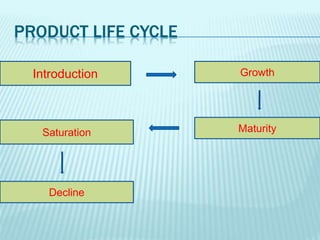
PRODUCT LIFE CYCLE
A product has its life. Industrial goods may
have longer life than that of consumer
goods. Product life cycle may short for some
product and long for some other product. The
period may differ from product to product.
PRODUCT LIFE CYCLE
Introduction Growth
MaturitySaturation
Decline
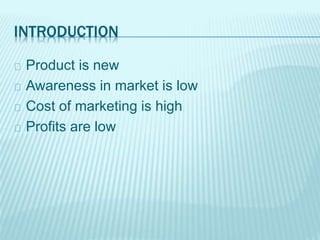
INTRODUCTION
Product is new
Awareness in market is low
Cost of marketing is high
Profits are low
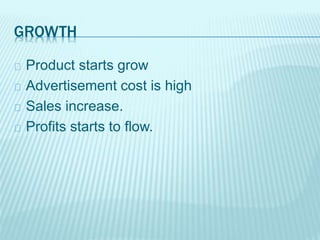
GROWTH
Product starts grow
Advertisement cost is high
Sales increase.
Profits starts to flow.
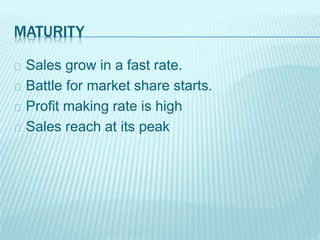
MATURITY
Sales grow in a fast rate.
Battle for market share starts.
Profit making rate is high
Sales reach at its peak
SATURATION
Sales are not growing anymore
High rate of battle for market share
Try to strong brand loyalty
Reduce price
DECLINE
Profit starts to fall
Future of the product does not look healthy
DEMAND FORECASTING FOR A NEW PRODUCT
Demand forecasting for new products is quite
different from that for established products.
Here the firms will not have any past
experience or past data for this purpose. An
intensive study of the economic and
competitive characteristics of the product
should be made to make efficient forecasts.
Professor Joel Dean, however, has
suggested a few guidelines to make
forecasting of demand for new products.
IT INCLUDES
Evolutionary approach
Substitute approach
Opinion Poll approach
Sales experience approach
Growth Curve approach
Vicarious approach
EVOLUTIONARY APPROACH
The demand for the new product may be
considered as an outgrowth of an existing
product
Thus when a new product is evolved from
the old product, the demand conditions of the
old product can be taken as a basis for
forecasting the demand for the new product.
SUBSTITUTE APPROACH
If the new product developed serves as
substitute for the existing product, the
demand for the new product may be worked
out on the basis of a market share. After that,
a portion of the market can be sliced out for
the new product
OPINION POLL APPROACH
Under this approach the potential buyers are
directly contacted, or through the use of
samples of the new product and their
responses are found out. These are finally
blown up to forecast the demand for the new
product.
SALES EXPERIENCE APPROACH
Offer the new product for sale in a sample
market; Say supermarkets or big bazaars in
big cities, which are also big marketing
centers
GROWTH CURVE APPROACH
According to this, the rate of growth and the
ultimate level of demand for the new product
are estimated on the basis of the pattern of
growth of established products
VICARIOUS APPROACH
This is last but very important method for
demand forecasting. A firm will survey
consumers reactions to a new product
indirectly through getting in touch with some
specialized and informed dealers who have
good knowledge about the market, about the
different varieties of the product already
available in the market, the consumers
preferences etc.
CONCLUSION
A strategic rule or rules covering how a good
or service is promoted to
potential consumers is called product policy.
A product has its life. Industrial goods may
have longer life than that of consumer
goods.
Demand forecasting for new products is quite
different from that for established products.
Here the firms will not have any past
experience or past data for this purpose
Product policy, Product Life cycle & New Product Demand Forecasting model

Product policy, Product Life cycle & New Product Demand Forecasting model

  • 1.
  • 2.
    TOPICS Product policy Product lifecycle Newproduct demand forecast model
  • 3.
    PRODUCT POLICY A strategicrule or rules covering how a good or service is promoted to potential consumers. A typical product policy created by a business for a manufactured product might attempt to manage how the item will be perceived by its target Market and could also contain information about how durable the product is.
  • 4.
    PRODUCT LIFE CYCLE Aproduct has its life. Industrial goods may have longer life than that of consumer goods. Product life cycle may short for some product and long for some other product. The period may differ from product to product.
  • 5.
    PRODUCT LIFE CYCLE IntroductionGrowth MaturitySaturation Decline
  • 6.
    INTRODUCTION Product is new Awarenessin market is low Cost of marketing is high Profits are low
  • 7.
    GROWTH Product starts grow Advertisementcost is high Sales increase. Profits starts to flow.
  • 8.
    MATURITY Sales grow ina fast rate. Battle for market share starts. Profit making rate is high Sales reach at its peak
  • 9.
    SATURATION Sales are notgrowing anymore High rate of battle for market share Try to strong brand loyalty Reduce price
  • 10.
    DECLINE Profit starts tofall Future of the product does not look healthy
  • 11.
    DEMAND FORECASTING FORA NEW PRODUCT Demand forecasting for new products is quite different from that for established products. Here the firms will not have any past experience or past data for this purpose. An intensive study of the economic and competitive characteristics of the product should be made to make efficient forecasts. Professor Joel Dean, however, has suggested a few guidelines to make forecasting of demand for new products.
  • 12.
    IT INCLUDES Evolutionary approach Substituteapproach Opinion Poll approach Sales experience approach Growth Curve approach Vicarious approach
  • 13.
    EVOLUTIONARY APPROACH The demandfor the new product may be considered as an outgrowth of an existing product Thus when a new product is evolved from the old product, the demand conditions of the old product can be taken as a basis for forecasting the demand for the new product.
  • 14.
    SUBSTITUTE APPROACH If thenew product developed serves as substitute for the existing product, the demand for the new product may be worked out on the basis of a market share. After that, a portion of the market can be sliced out for the new product
  • 15.
    OPINION POLL APPROACH Underthis approach the potential buyers are directly contacted, or through the use of samples of the new product and their responses are found out. These are finally blown up to forecast the demand for the new product.
  • 16.
    SALES EXPERIENCE APPROACH Offerthe new product for sale in a sample market; Say supermarkets or big bazaars in big cities, which are also big marketing centers
  • 17.
    GROWTH CURVE APPROACH Accordingto this, the rate of growth and the ultimate level of demand for the new product are estimated on the basis of the pattern of growth of established products
  • 18.
    VICARIOUS APPROACH This islast but very important method for demand forecasting. A firm will survey consumers reactions to a new product indirectly through getting in touch with some specialized and informed dealers who have good knowledge about the market, about the different varieties of the product already available in the market, the consumers preferences etc.
  • 19.
    CONCLUSION A strategic ruleor rules covering how a good or service is promoted to potential consumers is called product policy. A product has its life. Industrial goods may have longer life than that of consumer goods. Demand forecasting for new products is quite different from that for established products. Here the firms will not have any past experience or past data for this purpose

Editor's Notes