Sanjay Sharma
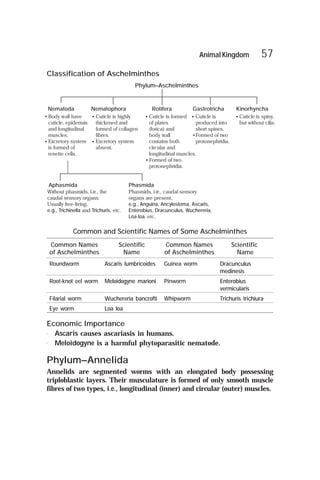
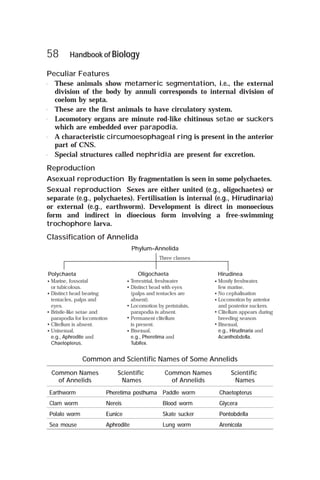
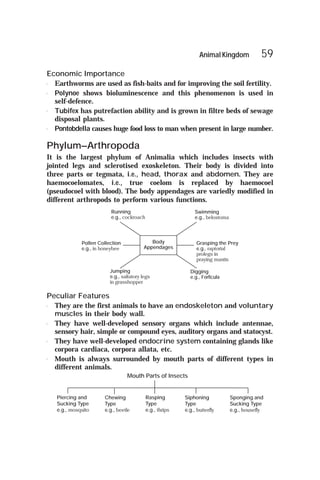
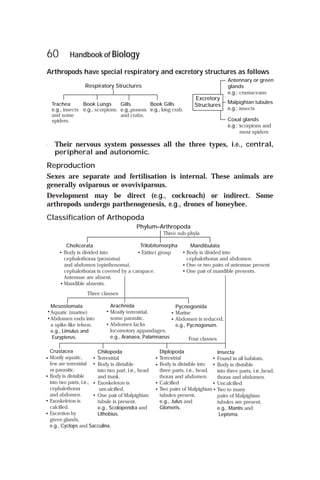
ARIHANT PRAKASHAN, (SERIES) MEERUT
handbook
KEY NOTES TERMS
DEFINITIONS FLOW CHARTS
Highly Useful for Class XI & XII Students,
Medical Entrances and Other Competitions
Biology
Supported by
Kavita Agarwal
Navraj Bharadwaj
© Publisher
No part of this publication may be re-produced, stored in a retrieval system or distributed
in any form or by any means, electronic, mechanical, photocopying, recording, scanning,
web or otherwise without the written permission of the publisher. Arihant has obtained
all the information in this book from the sources believed to be reliable and true. However,
Arihant or its editors or authors or illustrators don’t take any responsibility for the absolute
accuracy of any information published and the damages or loss suffered there upon.
Head Office
Kalindi, TP Nagar, Meerut (UP) - 250002
Tele: 0121-2401479, 2512970, 4004199; Fax: 0121-2401648
For further information about the books published by Arihant
log on to www.arihantbooks.com or email to info@arihantbooks.com
Regd. Office
‘Ramchhaya’4577/15, Agarwal Road, Darya Ganj, New Delhi -110002
Tele: 011- 47630600, 43518550; Fax: 011- 23280316
Administrative & Production Offices
Agra, Ahmedabad, Bengaluru, Bareilly, Chennai, Delhi, Guwahati,
Hyderabad, Jaipur, Jhansi, Kolkata, Lucknow, Meerut, Nagpur & Pune
All disputes subject to Meerut (UP) jurisdiction only.
Arihant Prakashan (Series), Meerut
/arihantpub /@arihantpub Arihant Publications /arihantpub
Sales & Support Offices
ISBN : 978-93-13196-51-8
Published by Arihant Publications (India) Ltd.
All Rights Reserved
Handbook means reference book listing brief facts on a subject.
So, to facilitate the students in this we have released this
Handbook of Biology. This book has been prepared to serve
the special purpose of the students, to rectify any query or any
concern point of a particular subject.
This book will be of highly use whether students are looking
for a quick revision before the board exams or just before other
Medical Entrances.
This handbook can even be used for revision of a subject in the
time between two shift of the exams, even this handbook can
be used while travelling to Examination Centre or whenever
you have time, less sufficient or more.
— To give confidence to the students just before they attempt
important examinations.
The objectives of publishing this handbook are :
— To provide a focus to students to clear up their doubts about
particular concepts which were not clear to them earlier.
The format of this handbook has been developed particularly so
that it can be carried around by the students conveniently.
However, we have put our best efforts in preparing this book,
but if any error or what so ever has been skipped out, we will
by heart welcome your suggestions. Apart from all those who
helped in the compilation of this book, a special note of thanks
goes to Miss Akansha Tomar of Arihant Publications.
— To support students in their revision of a subject just before
an examination.
Authors
PREFACE
1. 1-6
The LivingWorld
— CharacteristicsofLivingBeings — Taxonomy
— Systematics
— TaxonomicalAids
— Biodiversity
2. 7-23
Biological Classification
— Classification of Living Organisms
— Kingdom–Protista
— Biology : Nature and Scope — Kingdom–Fungi
— Kingdom–Monera
— Kingdom–Plantae
— Kingdom–Animalia
— Viruses andViroids
CONTENTS
3. 24-42
4. 43-73
Plant Kingdom
Animal Kingdom
— Bryophyta
— Pteridophyta
— Angiospermae
— Algae
— Alternation of generations
— Plants : Producers of Ecosystem — Gymnospermae
— Phylum–Annelida
— Phylum–Coelenterata(Cnidaria)
— Phylum–Porifera
— Phylum–Arthropoda
— Phylum–Hemichordata
— BasisofClassification
— Phylum–Echinodermata
— Phylum–Aschelminthes — Phylum–Chordata
— Phylum–Mollusca
— Phylum–Platyhelminthes
5. 74-103
Morphology of Flowering Plants
— Seed
— Flower
— Fruit
— Stem
— Leaf
— Inflorescence
— Plant Morphology :An Overview
6. 104-121
Anatomy of Flowering Plants
— Anatomy of Dicot and Monocot
Plants
— Secondary Growth in Plants
— The tissues
— Plant Tissue System
7. 122-151
Structural Organisation in Animals
— Cockroach
— EpithelialTissue(ByRuysch)
— Tissue — NeuralTissue
— ConnectiveTissue
— MuscularTissue
— Earthworm
— Frog
8. 152-166
Cell : The Unit of Life
— Components of a Cell
— Cell
— Cell Theory
— Structure and Components of
Eukaryotic Cell
9. 167-188
Biomolecules
10. 189-194
Cell Cycle and Cell Division
— NucleicAcids
— How to Analyse Chemical
Composition? — DNA
— Proteins
— Lipids
— Biomolecules
— Carbohydrates(Saccharides) — Enzymes
— RNA
— Metabolites
— Amitosis
— CellCycle
— SignificanceofCellCycle
— DividingorM-phase
11. 195-206
Transport in Plants
— Absorption of Water by Plants
— Plant-Water Relation
— Long Distance Transport of Water
— Uptake and Transport of Mineral
Nutrients
— Upward Water Movement in a
Plant
— Translocation and Storage of Food
in Plants (Phloem Transport)
— Process Involved in Passive
Transport
12. 207-214
Mineral Nutrition in Plants
— Classification of Mineral Nutrients
— Deficiency Symptoms of Essential
Mineral Nutrients
— Metabolism of Nitrogen
— Hydroponics
13. 215-227
Photosynthesis in Higher Plants
— Chemistry and Thermodynamics
of Photosynthesis
— Chloroplast : Photosynthetic
Organ of Cell
— Factors Affecting Photosynthesis
— Photorespiration
14. 228-238
15. 239-248
Respiration in Plants
Plant Growth and Development
— Factors Affecting Respiration
— Anaerobic Cellular Respiration
— Cellular Respiration
— Aerobic Respiration
— Pentose Phosphate Pathway (PPP)
— Plant Hormones/Phytohormones/
Plant Growth Regulators (PGRs)
— Photoperiodism
— Growth
— Development
— Seed Dormancy
— Abscission of Plant Parts
16. 249-264
Digestion andAbsorption
— DigestiveEnzymes
— HumanDigestiveSystem
— PhysiologyofDigestion
— DisorderofDigestiveSystem
— DigestiveGlands
— DigestiveHormones
— AlimentaryCanal
17. 265-275
Breathing and Exchange of Gases
— RegulationofRespiration
— ExchangeofGases
— HumanRespiratorySystem
— Respiration
— Lungs
— TransportofGases
— DisordersofRespiratorySystem
18. 276-296
20. 307-329
19. 297-306
Body Fluids and Circulation
Locomotion and Movement
Excretory Products and Their Elimination
— Body Fluids
— Lymph
— Blood
— Circulatory System
— BloodVascular System
— Portal System
— Human Circulatory System
— Specialised Muscle Phenomena
— Disorders of Muscular and
Skeletal System
— Movement
— Muscle
— Locomotion — Skeletal System
— Joints
— Micturition
— Mechanism of Filtrate
Concentration
— Excretion
— Human Excretory System
— Excretory Products
— Role of Other Organs in Excretion
— Regulation of Kidney Function
21. 330-359
Neural Control and Coordination
— Spinal Cord
— Nerve Impulse
— TheVisual Sense-The Eye
— Human Ear-Organ of Hearing and
Balance
— Central Nervous System
— Sense Organs
— Reflex Arc
— Brain
— Reflex Action
— Synapse
— Human Neural System
— BrainVentricles
22. 360-370
Chemical Coordination and Integration
— Glands
— Major Hormones of Human
Endocrine System
— Hormones
— Mechanism of HormoneAction
— Regulation of HormoneAction
— Human Endocrine System
23. 371-375
Reproduction in Organisms
— Reproduction in Plants
— Reproduction in Animals
— Events in Sexual Reproduction of
Both Plants andAnimals
24. 376-390
Sexual Reproduction in Flowering Plants
— Pollination
— Fertilisation
— Post-fertilisation Events
— Flowers
— Pre-fertilisation : Structures and
Events — Development of
Embryo/Embryogenesis
25. 391-414
Human Reproduction
— Lactation
— Embryonic Development
— Male Reproductive System
— Spermatogenesis
— Structure of Sperm
— The Menstrual Cycle
— Foetal Development
— Placenta
— Female Reproductive System
— Gametogenesis
— Fertilisation
— Implantation
26. 415-425
Reproductive Health
— Sexually Transmitted Diseases
— Assisted Reproductive Technology
— Strategies to Improve
Reproductive Health
— Medical Termination of Pregnancy
— Infertility
— Detection of Foetal Disorders
during Early Pregnancy
— Acquired Immuno Deficiency
Syndrome
— Problems Related to Reproductive
Health
— Population Explosion
27. 426-449
Principles of Inheritance andVariation
— Gregor Johann Mendel
— Sex-Determination
— Linkage
— Mendel's Laws of Inheritance
— Chromosomal Theory of
Inheritance
— Mutation
— Pedigree Analysis
— Heredity
— Variations
28. 450-468
Molecular Basis of Inheritance
— Human Genome Project
— DNA Fingerprinting
— Wobble Hypothesis
— Regulation of Gene Expression
— Genetic Code
— RNA
— Gene Expression
— DNA
— DNA as Genetic Material
29. 469-499
Evolution
— Mechanism of Evolution
— Mutation Theory
— Origin of Life
— Origin of Universe
— Evidences of Evolution
— Theories of Evolution
— Darwinism
— Human and Other Primates
— Evolution of Human
30. 500-521
Human Health and Diseases
— Adolescence
— Autoimmunity
— Drugs
— Cancer
— De-addiction
— Acquired Immuno Deficiency
Syndrome
— Addiction
— Complement System
— Human Health
— Common Diseases in Humans
— Vaccination and Immunisation
— Immunity and Immune System
— Allergies
31. 522-537
Strategies for Enhancement in Food Production
— LacCulture
— AnimalHusbandry
— PlantBreeding
— SingleCellProtein
— Apiculture/Bee-Farming
— Improvement of Animals through
Breeding
— Pisciculture/FishFarming/Culture
Fishery
— Sericulture
32. 538-547
Microbes in Human Welfare
— Microbes in Industrial Products
— Biopesticides
— Microbes in Household Products — Bioherbicides
— Microbes in Sewage Treatment
— Bioinsecticides
33. 548-561
Biotechnology : Principles and Processes
— Genetic Engineering/Recombinant
DNA Technology — Downstream Processing
— Bioreactors
— Principle of Biotechnology — Gel Electrophoresis
— Tools of rDNA Technology
36. 586-603
35. 575-585
Ecosystem
Organisms and Population
— Ecosystem
— Food Web
— Features of Ecosystem
— Ecosystem: Structure and
Characteristics
— Components of Ecosystem — Food Chain
— Ecosystem Services
— Population and Community
— Organism and its Environment
— Responses to Abiotic Factors
— Adaptations
— Characteristics of Population
34. 562-574
Biotechnology and ItsApplications
— Applications of Biotechnology in
Plant Tissue Culture
— Applications of Biotechnology in
Medicine
— Types of Biotechnology — Applications of Biotechnology in
Industry and Environment
37. 604-617
Biodiversity and Conservation
— IUCN and Red List Categories
— Levels of Biodiversity
— Importance of Biodiversity — Biodiversity Conservation
— Loss of Biodiversity
— Patterns of Biodiversity
38. 618-639
Environmental Issues
— Ozone Layer Depletion
— Global Warming
— Greenhouse Effect
— Acid Rain
— Degradation by Improper
Resource Utilisation and
Maintenance
— Pollution
Appendix 640-644
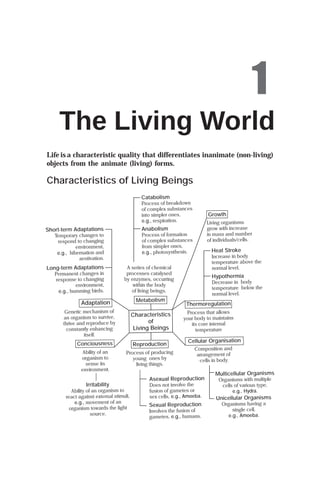
Life is a characteristic quality that differentiates inanimate (non-living)
objects from the animate (living) forms.
Characteristics of Living Beings
1
The Living World
Metabolism
Thermoregulation
Cellular Organisation
Composition and
arrangement of
·cells in body.
Process that allows
your body to maintains
its core internal
temperature
Reproduction
Conciousness
Adaptation
Process of producing
young ones by
living things.
Ability of an
organism to
sense its
environment.
Genetic mechanism of
an organism to survive,
thrive and reproduce by
constantly enhancing
itself.
Heat Stroke
Increase in body
temperature above the
normal level.
Hypothermia
Decrease in body
temperature below the
normal level.
Multicellular Organisms
Organisms with multiple
cells of various type,
, .
e.g. Hydra
Asexual Reproduction
Does not involve the
fusion of gametes or
sex cells, e.g., Amoeba.
Sexual Reproduction
Involves the fusion of
gametes, humans.
e.g.,
Catabolism
Process of breakdown
of complex substances
into simpler ones,
respiration.
e.g.,
Anabolism
Process of formation
of complex substances
from simpler ones,
photosynthesis.
e.g.,
Short-term Adaptations
Temporary changes to
respond to changing
environment,
hibernation and
aestivation.
e.g.,
Long-term Adaptations
Permanent changes in
response to changing
environment,
humming birds.
e.g.,
Irritability
Ability of an organism to
react against external stimuli,
movement of an
organism towards the light
source.
e.g.,
A series of chemical
processes catalysed
by enzymes, occurring
within the body
of living beings.
Characteristics
of
Living Beings
Unicellular Organisms
Organisms having a
single cell,
, .
e.g. Amoeba
Growth
Living organisms
grow with increase
in mass and number
of individuals/cells.
Biodiversity
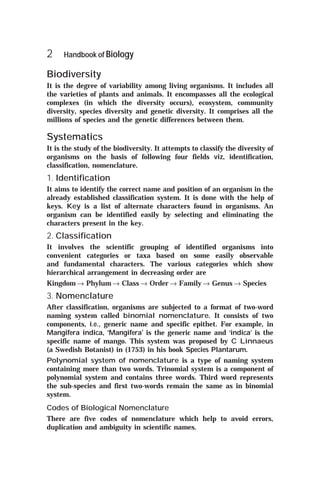
It is the degree of variability among living organisms. It includes all
the varieties of plants and animals. It encompasses all the ecological
complexes (in which the diversity occurs), ecosystem, community
diversity, species diversity and genetic diversity. It comprises all the
millions of species and the genetic differences between them.
Systematics
It is the study of the biodiversity. It attempts to classify the diversity of
organisms on the basis of following four fields viz, identification,
classification, nomenclature.
1. Identification
It aims to identify the correct name and position of an organism in the
already established classification system. It is done with the help of
keys. Key is a list of alternate characters found in organisms. An
organism can be identified easily by selecting and eliminating the
characters present in the key.
2. Classification
It involves the scientific grouping of identified organisms into
convenient categories or taxa based on some easily observable
and fundamental characters. The various categories which show
hierarchical arrangement in decreasing order are
Kingdom → Phylum → Class → Order → Family → Genus → Species
3. Nomenclature
After classification, organisms are subjected to a format of two-word
naming system called binomial nomenclature. It consists of two
components, i.e., generic name and specific epithet. For example, in
Mangifera indica, ‘Mangifera’ is the generic name and ‘indica’ is the
specific name of mango. This system was proposed by C Linnaeus
(a Swedish Botanist) in (1753) in his book Species Plantarum.
Polynomial system of nomenclature is a type of naming system
containing more than two words. Trinomial system is a component of
polynomial system and contains three words. Third word represents
the sub-species and first two-words remain the same as in binomial
system.
Codes of Biological Nomenclature
There are five codes of nomenclature which help to avoid errors,
duplication and ambiguity in scientific names.
2 Handbook of Biology
The Living World 3
These codes are as follows
ICBN International Code of Botanical Nomenclature
ICZN International Code of Zoological Nomenclature
ICVN International Code of Viral Nomenclature
ICNB International Code for Nomenclature of Bacteria
ICNCP International Code for Nomenclature for Cultivated Plants
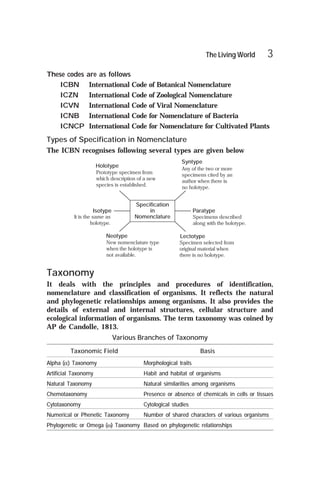
Types of Specification in Nomenclature
The ICBN recognises following several types are given below
Taxonomy
It deals with the principles and procedures of identification,
nomenclature and classification of organisms. It reflects the natural
and phylogenetic relationships among organisms. It also provides the
details of external and internal structures, cellular structure and
ecological information of organisms. The term taxonomy was coined by
AP de Candolle, 1813.
Various Branches of Taxonomy
Taxonomic Field Basis
Alpha ( )
α Taxonomy Morphological traits
Artificial Taxonomy Habit and habitat of organisms
Natural Taxonomy Natural similarities among organisms
Chemotaxonomy Presence or absence of chemicals in cells or tissues
Cytotaxonomy Cytological studies
Numerical or Phenetic Taxonomy Number of shared characters of various organisms
Phylogenetic or Omega ( )
ω Taxonomy Based on phylogenetic relationships
Neotype
Holotype
Lectotype
Isotype Paratype
Specimens described
along with the holotype.
New nomenclature type
when the holotype is
not available.
Prototype specimen from
which description of a new
species is established.
Specimen selected from
original material when
there is no holotype.
It is the same as
holotype.
Syntype
Any of the two or more
specimens cited by an
author when there is
no holotype.
Specification
in
Nomenclature
Classical Taxonomy
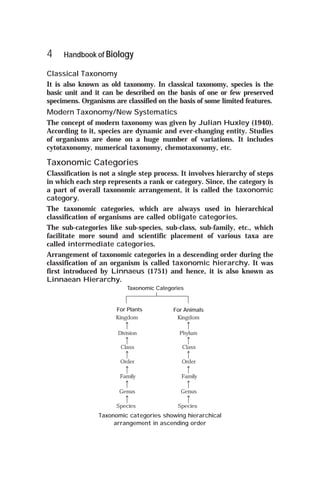
It is also known as old taxonomy. In classical taxonomy, species is the
basic unit and it can be described on the basis of one or few preserved
specimens. Organisms are classified on the basis of some limited features.
Modern Taxonomy/New Systematics
The concept of modern taxonomy was given by Julian Huxley (1940).
According to it, species are dynamic and ever-changing entity. Studies
of organisms are done on a huge number of variations. It includes
cytotaxonomy, numerical taxonomy, chemotaxonomy, etc.
Taxonomic Categories
Classification is not a single step process. It involves hierarchy of steps
in which each step represents a rank or category. Since, the category is
a part of overall taxonomic arrangement, it is called the taxonomic
category.
The taxonomic categories, which are always used in hierarchical
classification of organisms are called obligate categories.
The sub-categories like sub-species, sub-class, sub-family, etc., which
facilitate more sound and scientific placement of various taxa are
called intermediate categories.
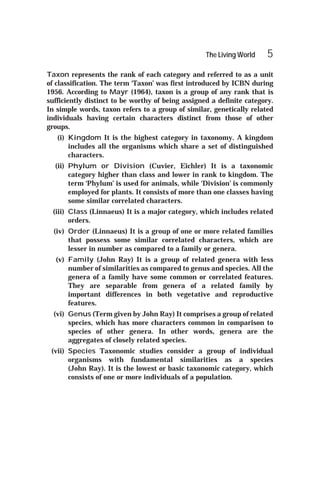
Arrangement of taxonomic categories in a descending order during the
classification of an organism is called taxonomic hierarchy. It was
first introduced by Linnaeus (1751) and hence, it is also known as
Linnaean Hierarchy.
4 Handbook of Biology
Taxonomic Categories
For Plants For Animals
Kingdom
Kingdom
Phylum
Division
Class
Class
Order
Order
Family
Family
Genus
Genus
Species
Species
Taxonomic categories showing hierarchical
arrangement in ascending order
Taxon represents the rank of each category and referred to as a unit
of classification. The term ‘Taxon’ was first introduced by ICBN during
1956. According to Mayr (1964), taxon is a group of any rank that is
sufficiently distinct to be worthy of being assigned a definite category.
In simple words, taxon refers to a group of similar, genetically related
individuals having certain characters distinct from those of other
groups.
(i) Kingdom It is the highest category in taxonomy. A kingdom
includes all the organisms which share a set of distinguished
characters.
(ii) Phylum or Division (Cuvier, Eichler) It is a taxonomic
category higher than class and lower in rank to kingdom. The
term ‘Phylum’ is used for animals, while ‘Division’ is commonly
employed for plants. It consists of more than one classes having
some similar correlated characters.
(iii) Class (Linnaeus) It is a major category, which includes related
orders.
(iv) Order (Linnaeus) It is a group of one or more related families
that possess some similar correlated characters, which are
lesser in number as compared to a family or genera.
(v) Family (John Ray) It is a group of related genera with less
number of similarities as compared to genus and species. All the
genera of a family have some common or correlated features.
They are separable from genera of a related family by
important differences in both vegetative and reproductive
features.
(vi) Genus (Term given by John Ray) It comprises a group of related
species, which has more characters common in comparison to
species of other genera. In other words, genera are the
aggregates of closely related species.
(vii) Species Taxonomic studies consider a group of individual
organisms with fundamental similarities as a species
(John Ray). It is the lowest or basic taxonomic category, which
consists of one or more individuals of a population.
The Living World 5
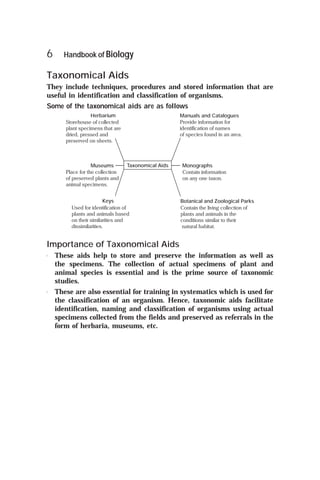
Taxonomical Aids
They include techniques, procedures and stored information that are
useful in identification and classification of organisms.
Some of the taxonomical aids are as follows
Importance of Taxonomical Aids
l These aids help to store and preserve the information as well as
the specimens. The collection of actual specimens of plant and
animal species is essential and is the prime source of taxonomic
studies.
l These are also essential for training in systematics which is used for
the classification of an organism. Hence, taxonomic aids facilitate
identification, naming and classification of organisms using actual
specimens collected from the fields and preserved as referrals in the
form of herbaria, museums, etc.
6 Handbook of Biology
Herbarium
Storehouse of collected
plant specimens that are
dried, pressed and
preserved on sheets.
Manuals and Catalogues
Provide information for
identification of names
of species found in an area.
Museums
Place for the collection
of preserved plants and
animal specimens.
Monographs
Contain information
on any one taxon.
Keys
Used for identification of
plants and animals based
on their similarities and
dissimilarities.
Botanical and Zoological Parks
Contain the living collection of
plants and animals in the
conditions similar to their
natural habitat.
Taxonomical Aids
2
Biological
Classification
Biology : Nature and Scope
Biology (L. bios – life; logos – knowledge) is the branch of science,
which deals with the study of living organisms and their life processes.
Aristotle is called the Father of Biology, but the term ‘Biology’ was
first coined by Lamarck and Treviranus in 1802. It has two main
branches, i e
. ., Botany (study of plants) and Zoology (study of animals).
l
Father of Botany Theophrastus
l
Father of Zoology Aristotle
Classification of Living Organisms
Classification is an arrangement of living organisms according to their
common characteristics and placing the group within taxonomic
hierarchy.
The branch of science which deals with description, nomenclature,
identification and classification of organisms is called taxonomy.
Some major branches of taxonomy are
(i) Numerical taxonomy It is based on all observable
characteristics. Number and codes are assigned to characters
and data is processed through computers.
(ii) Cytotaxonomy In this taxonomy, the detailed cytological
information is used to categorise organisms.
(iii) Chemotaxonomy The chemical constituents are taken as
the basis for classification of organisms.
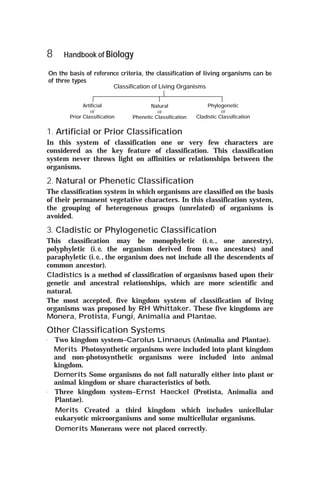
On the basis of reference criteria, the classification of living organisms can be
of three types
1. Artificial or Prior Classification
In this system of classification one or very few characters are
considered as the key feature of classification. This classification
system never throws light on affinities or relationships between the
organisms.
2. Natural or Phenetic Classification
The classification system in which organisms are classified on the basis
of their permanent vegetative characters. In this classification system,
the grouping of heterogenous groups (unrelated) of organisms is
avoided.
3. Cladistic or Phylogenetic Classification
This classification may be monophyletic (i e
. ., one ancestry),
polyphyletic (i e
. . the organism derived from two ancestors) and
paraphyletic (i e
. ., the organism does not include all the descendents of
common ancestor).
Cladistics is a method of classification of organisms based upon their
genetic and ancestral relationships, which are more scientific and
natural.
The most accepted, five kingdom system of classification of living
organisms was proposed by RH Whittaker. These five kingdoms are
Monera, Protista, Fungi, Animalia and Plantae.
Other Classification Systems
l
Two kingdom system–Carolus Linnaeus (Animalia and Plantae).
Merits Photosynthetic organisms were included into plant kingdom
and non-photosynthetic organisms were included into animal
kingdom.
Demerits Some organisms do not fall naturally either into plant or
animal kingdom or share characteristics of both.
l
Three kingdom system–Ernst Haeckel (Protista, Animalia and
Plantae).
Merits Created a third kingdom which includes unicellular
eukaryotic microorganisms and some multicellular organisms.
Demerits Monerans were not placed correctly.
8 Handbook of Biology
Artificial
Prior Classification
or
Classification of Living Organisms
Natural
Phenetic Classification
or
Phylogenetic
Cladistic Classification
or
l Four kingdom system–Copeland (Monera, Protista, Animalia and
Plantae).
Merits Monerans were placed separately along with other kingdoms.
Demerits Monerans were not subdivided in Archaebacteria and
Eubacteria.
l Six kingdom system–Carl Woese (Archaebacteria, Eubacteria,
Protista, Fungi, Animalia and Plantae).
Merits Archaebacteria and Eubacteria were separately placed.
A. Kingdom–Monera (Prokaryotic, Unicellular Organisms)
It includes all prokaryotes such as bacteria, archaebacteria,
mycoplasma, actinomycetes, cyanobacteria and rickettsia.
1. Bacteria
These unicellular, prokaryotic organisms contain cell wall (feature of
plant cells only). These are approximately 4000 species of bacteria,
with cosmopolitan occurrence. Bacteria can be regarded both friends
and foes on the basis of interaction with human beings.
An average weight human (~ 70 kg) has about 2.5 kg of bacteria in the
form of gut microflora to supplement the proper digestion and other
metabolic functions.
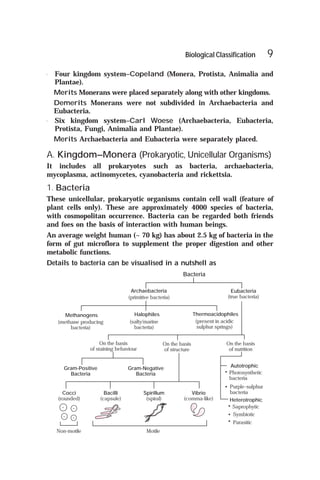
Details to bacteria can be visualised in a nutshell as
Biological Classification 9
Non-motile
Bacteria
On the basis
of staining behaviour
Cocci
(rounded)
On the basis
of structure
Bacilli
(capsule)
On the basis
of nutrition
Spirillum
(spiral)
Vibrio
(comma-like)
Methanogens Halophiles
Eubacteria
(true bacteria)
Gram-Negative
Bacteria
Thermoacidophiles
(methane producing
bacteria)
(salty/marine
bacteria)
(present in acidic
sulphur springs)
Archaebacteria
Gram-Positive
Bacteria
Autotrophic
Heterotrophic
Photosynthetic
bacteria
Saprophytic
Purple-sulphur
bacteria
Symbiotic
Parasitic
•
•
•
•
•
Motile
(primitive bacteria)
(i) Archaebacteria
These are the group of most primitive prokaryotes. They have a cell
wall, made up of protein and non-cellulosic polysaccharides. The
presence of 16 srRNA, makes them unique and helps in placing in a
separate domain called archaea between bacteria and eukarya.
Archaebacteria can live under extreme hostile conditions like salt
pans, salt marshes and hot sulphur springs. They are also known as
living fossils, because they represent the earliest form of life on earth.
Archaebacteria can be used for
(a) Experimentation for absorption of solar radiation.
(b) Production of gobar gas from dung and sewage.
(c) Fermentation of cellulose in ruminants.
(ii) Eubacteria
Eubacteria are ‘true bacteria’ which lack nucleus and membrane bound
organalles like mitochondria, chloroplasts, etc. Eubacteria are usually
divided into five phylums– Spirochetes, Chlamydias, Gram- positive
bacteria, Cyanobacteria and Proteobacteria.
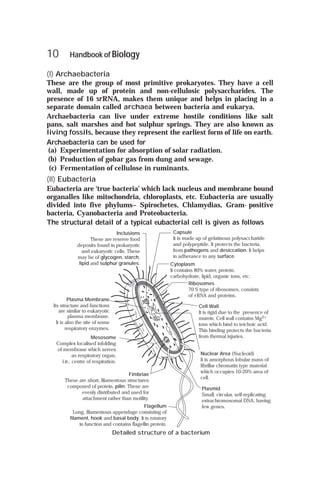
The structural detail of a typical eubacterial cell is given as follows
10 Handbook of Biology
Capsule
pathogens desiccation
surface
It is made up of gelatinous polysaccharide
and polypeptide. It protects the bacteria,
from and . It helps
in adherance to any .
Cytoplasm
It contains 80% water, protein,
carbohydrate, lipid, organic ions, etc.
Ribosomes
70 S type of ribosomes, consists
of RNA and proteins.
r
Cell Wall
It is rigid due to the presence of
murein. Cell wall contains Mg
ions which bind to teichoic acid.
This binding protects the bacteria
from thermal injuries.
2+
Nuclear Area (Nucleoid)
It is amorphous lobular mass of
fibrillar chromatin type material
which occupies 10-20% area of
cell.
Plasmid
Small, circular, self-replicating
extrachromosomal DNA, having
few genes.
Flagellum
filament hook basal body
Long, filamentous appendage consisting of
, and . It is rotatory
in function and contains flagellin protein.
Inclusions
glycogen starch
lipid sulphur granules
These are reserve food
deposits found in prokaryotic
and eukaryotic cells. These
may be of , ,
and .
Plasma Membrane
Its structure and functions
are similar to eukaryotic
plasma membrane.
It is also the site of some
respiratory enzymes.
Fimbriae
pilin.
These are short, filamentous structures
composed of protein, These are
evenly distributed and used for
attachment rather than motility.
Mesosome
Complex localised infolding
of membrane which serves
as respiratory organ,
., centre of respiration.
i.e
Detailed structure of a bacterium
Nutrition in Bacteria
The process of acquiring energy and nutrients., is called nutrition.
On the basis of mode of nutrition, bacteria are of two types–
autotrophic and heterotrophic. About 1% bacteria show autotrophic
mode of nutrition and the rest are of heterotrophic habit.
Chemosynthetic bacteria oxidise various inorganic substances such as
nitrates, nitrites and ammonia and use the released energy for their
ATP production.
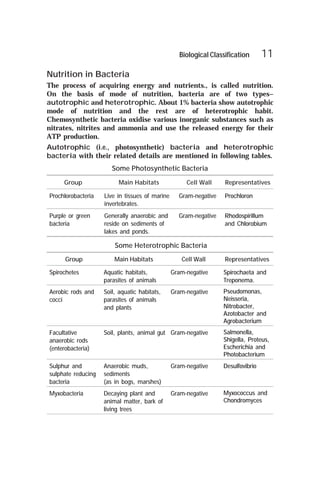
Autotrophic (i.e., photosynthetic) bacteria and heterotrophic
bacteria with their related details are mentioned in following tables.
Some Photosynthetic Bacteria
Group Main Habitats Cell Wall Representatives
Prochlorobacteria Live in tissues of marine
invertebrates.
Gram-negative Prochloron
Purple or green
bacteria
Generally anaerobic and
reside on sediments of
lakes and ponds.
Gram-negative Rhodospirillum
and Chlorobium
Some Heterotrophic Bacteria
Group Main Habitats Cell Wall Representatives
Spirochetes Aquatic habitats,
parasites of animals
Gram-negative Spirochaeta and
Treponema.
Aerobic rods and
cocci
Soil, aquatic habitats,
parasites of animals
and plants
Gram-negative Pseudomonas,
Neisseria,
Nitrobacter,
Azotobacter and
Agrobacterium
Facultative
anaerobic rods
(enterobacteria)
Soil, plants, animal gut Gram-negative Salmonella,
Shigella, Proteus,
Escherichia and
Photobacterium
Sulphur and
sulphate reducing
bacteria
Anaerobic muds,
sediments
(as in bogs, marshes)
Gram-negative Desulfovibrio
Myxobacteria Decaying plant and
animal matter, bark of
living trees
Gram-negative Myxococcus and
Chondromyces
Biological Classification 11
Group Main Habitats Cell Wall Representatives
Mycoplasmas Parasites of plants
and animals
Cell wall absent Mycoplasma
Gram-positive
cocci
Soil, skin and mucous
membranes of animals
Gram-positive Staphylococcus
and
Streptococcus
Endospore-forming
rods and cocci
Soil; animal gut Gram-positive Bacillus and
Clostridium
Non-sporulating
rods
Fermenting plant and
animal material,
human oral cavity, gut,
vaginal tract
Gram-positive Lactobacillus and
Listeria
Chemoautotrophes Soil, aquatic habitat Gram-negative Halothiobacillus
and
Acidothiobacillus
Respiration in Bacteria
Respiration occurs in the plasma membrane of bacteria. Glucose is
broken down into carbon dioxide and water using oxygen in aerobic
cellular respiration and other molecules such as nitrate (NO )
3 in
anaerobic cellular respiration.
Reproduction in Bacteria
Bacteria reproduce asexually and sexually both.
Asexual Methods
Asexually, bacteria reproduce by following methods
l
Fission Bacteria divide both laterally and longitudinally.
l
Budding Vegetative outgrowths result into new organisms after
maturity.
l
Spore formation Non-motile spores like conidia, oidia and
endospores are formed.
Sexual Methods
Although sexes are not differentiated in bacteria, following methods of
genetic recombination are categorised under sexual reproduction in
bacteria.
l
Transformation F Griffith (1928), Genetic material of one
bacteria is transferred to other through conjugation tube.
12 Handbook of Biology
l Conjugation Lederberg and Tatum (1946), Transfer of genetic
material occurs through sex pili.
l Transduction Zinder and Lederberg (1952), Transfer of genetic
material occurs by bacteriophage.
Economic Importance of Bacteria
Economically, some bacteria are useful in producing various useful
substances like curd, cheese, antibiotics and vinegar, etc. While other
bacteria cause several chronic diseases in humans, plants and other
animals, etc.
Other Monerans
These are as follows
1. Mycoplasma
l It was discovered by Nocard and Roux in 1898. These are cell wall
less, aerobic and non-motile organisms. Due to the absence of cell wall
and pleomorphic nature, they are commonly called as jokers of living
world.
l
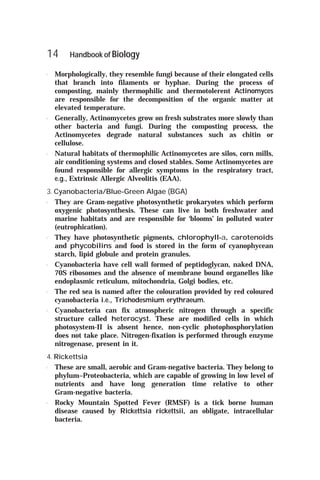
The mycoplasmas are also known as Pleuro Pneumonia Like
Organisms (PPLO). These are the smallest living cells, yet
discovered, can survive without oxygen and are typically about
0.1 µm in diameter.
2. Actinomycetes
l
The members of a heterogeneous group of Gram-positive, are
generally anaerobic bacteria noted for a filamentous and branching
growth pattern. It results in most forms in an extensive colony or
mycelium.
Biological Classification 13
Lipoprotein membrane
(3 layers)
Ribosomes
DNA
Soluble RNA
Structure of Mycoplasma
l Morphologically, they resemble fungi because of their elongated cells
that branch into filaments or hyphae. During the process of
composting, mainly thermophilic and thermotolerent Actinomyces
are responsible for the decomposition of the organic matter at
elevated temperature.
l Generally, Actinomycetes grow on fresh substrates more slowly than
other bacteria and fungi. During the composting process, the
Actinomycetes degrade natural substances such as chitin or
cellulose.
l Natural habitats of thermophilic Actinomycetes are silos, corn mills,
air conditioning systems and closed stables. Some Actinomycetes are
found responsible for allergic symptoms in the respiratory tract,
e.g., Extrinsic Allergic Alveolitis (EAA).
3. Cyanobacteria/Blue-Green Algae (BGA)
l They are Gram-negative photosynthetic prokaryotes which perform
oxygenic photosynthesis. These can live in both freshwater and
marine habitats and are responsible for ‘blooms’ in polluted water
(eutrophication).
l
They have photosynthetic pigments, chlorophyll-a, carotenoids
and phycobilins and food is stored in the form of cyanophycean
starch, lipid globule and protein granules.
l
Cyanobacteria have cell wall formed of peptidoglycan, naked DNA,
70S ribosomes and the absence of membrane bound organelles like
endoplasmic reticulum, mitochondria, Golgi bodies, etc.
l
The red sea is named after the colouration provided by red coloured
cyanobacteria i.e., Trichodesmium erythraeum.
l
Cyanobacteria can fix atmospheric nitrogen through a specific
structure called heterocyst. These are modified cells in which
photosystem-II is absent hence, non-cyclic photophosphorylation
does not take place. Nitrogen-fixation is performed through enzyme
nitrogenase, present in it.
4. Rickettsia
l
These are small, aerobic and Gram-negative bacteria. They belong to
phylum–Proteobacteria, which are capable of growing in low level of
nutrients and have long generation time relative to other
Gram-negative bacteria.
l
Rocky Mountain Spotted Fever (RMSF) is a tick borne human
disease caused by Rickettsia rickettsii, an obligate, intracellular
bacteria.
14 Handbook of Biology
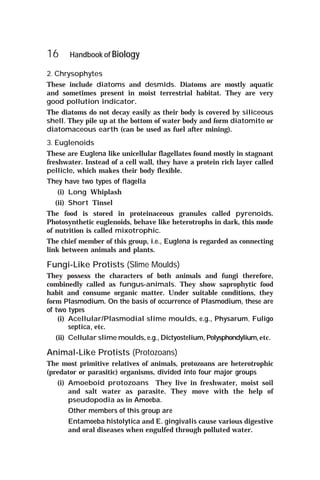
B. Kingdom–Protista (Eukaryotic, Unicellular Organisms)
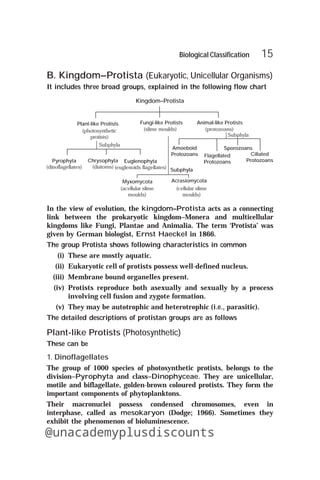
It includes three broad groups, explained in the following flow chart
In the view of evolution, the kingdom–Protista acts as a connecting
link between the prokaryotic kingdom–Monera and multicellular
kingdoms like Fungi, Plantae and Animalia. The term ‘Protista’ was
given by German biologist, Ernst Haeckel in 1866.
The group Protista shows following characteristics in common
(i) These are mostly aquatic.
(ii) Eukaryotic cell of protists possess well-defined nucleus.
(iii) Membrane bound organelles present.
(iv) Protists reproduce both asexually and sexually by a process
involving cell fusion and zygote formation.
(v) They may be autotrophic and heterotrophic (i.e., parasitic).
The detailed descriptions of protistan groups are as follows
Plant-like Protists (Photosynthetic)
These can be
1. Dinoflagellates
The group of 1000 species of photosynthetic protists, belongs to the
division–Pyrophyta and class–Dinophyceae. They are unicellular,
motile and biflagellate, golden-brown coloured protists. They form the
important components of phytoplanktons.
Their macronuclei possess condensed chromosomes, even in
interphase, called as mesokaryon (Dodge; 1966). Sometimes they
exhibit the phenomenon of bioluminescence.
Biological Classification 15
Kingdom–Protista
Animal-like Protists
Euglenophyta
(euglenoids flagellates)
Ciliated
Protozoans
Fungi-like Protists
Pyrophyta
(dinoflagellates)
Amoeboid
Protozoans
Acrasiomycota
Plant-like Protists
Myxomycota
(acellular slime
moulds)
(cellular slime
moulds)
(photosynthetic
protists)
(slime moulds) (protozoans)
Chrysophyta
(diatoms)
Flagellated
Protozoans
Subphyla
Sporozoans
Subphyla
Subphyla
@unacademyplusdiscounts
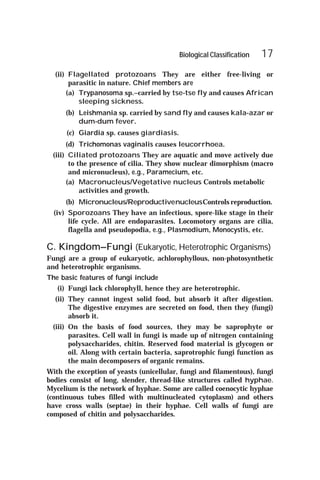
2. Chrysophytes
These include diatoms and desmids. Diatoms are mostly aquatic
and sometimes present in moist terrestrial habitat. They are very
good pollution indicator.
The diatoms do not decay easily as their body is covered by siliceous
shell. They pile up at the bottom of water body and form diatomite or
diatomaceous earth (can be used as fuel after mining).
3. Euglenoids
These are Euglena like unicellular flagellates found mostly in stagnant
freshwater. Instead of a cell wall, they have a protein rich layer called
pellicle, which makes their body flexible.
They have two types of flagella
(i) Long Whiplash
(ii) Short Tinsel
The food is stored in proteinaceous granules called pyrenoids.
Photosynthetic euglenoids, behave like heterotrophs in dark, this mode
of nutrition is called mixotrophic.
The chief member of this group, i.e., Euglena is regarded as connecting
link between animals and plants.
Fungi-Like Protists (Slime Moulds)
They possess the characters of both animals and fungi therefore,
combinedly called as fungus-animals. They show saprophytic food
habit and consume organic matter. Under suitable conditions, they
form Plasmodium. On the basis of occurrence of Plasmodium, these are
of two types
(i) Acellular/Plasmodial slime moulds, e.g., Physarum, Fuligo
septica, etc.
(ii) Cellular slime moulds, e.g., Dictyostelium, Polysphondylium,etc.
Animal-Like Protists (Protozoans)
The most primitive relatives of animals, protozoans are heterotrophic
(predator or parasitic) organisms, divided into four major groups
(i) Amoeboid protozoans They live in freshwater, moist soil
and salt water as parasite. They move with the help of
pseudopodia as in Amoeba.
Other members of this group are
Entamoeba histolytica and E. gingivalis cause various digestive
and oral diseases when engulfed through polluted water.
16 Handbook of Biology
(ii) Flagellated protozoans They are either free-living or
parasitic in nature. Chief members are
(a) Trypanosoma sp.–carried by tse-tse fly and causes African
sleeping sickness.
(b) Leishmania sp. carried by sand fly and causes kala-azar or
dum-dum fever.
(c) Giardia sp. causes giardiasis.
(d) Trichomonas vaginalis causes leucorrhoea.
(iii) Ciliated protozoans They are aquatic and move actively due
to the presence of cilia. They show nuclear dimorphism (macro
and micronucleus), e.g., Paramecium, etc.
(a) Macronucleus/Vegetative nucleus Controls metabolic
activities and growth.
(b) Micronucleus/ReproductivenucleusControls reproduction.
(iv) Sporozoans They have an infectious, spore-like stage in their
life cycle. All are endoparasites. Locomotory organs are cilia,
flagella and pseudopodia, e.g., Plasmodium, Monocystis, etc.
C. Kingdom–Fungi (Eukaryotic, Heterotrophic Organisms)
Fungi are a group of eukaryotic, achlorophyllous, non-photosynthetic
and heterotrophic organisms.
The basic features of fungi include
(i) Fungi lack chlorophyll, hence they are heterotrophic.
(ii) They cannot ingest solid food, but absorb it after digestion.
The digestive enzymes are secreted on food, then they (fungi)
absorb it.
(iii) On the basis of food sources, they may be saprophyte or
parasites. Cell wall in fungi is made up of nitrogen containing
polysaccharides, chitin. Reserved food material is glycogen or
oil. Along with certain bacteria, saprotrophic fungi function as
the main decomposers of organic remains.
With the exception of yeasts (unicellular, fungi and filamentous), fungi
bodies consist of long, slender, thread-like structures called hyphae.
Mycelium is the network of hyphae. Some are called coenocytic hyphae
(continuous tubes filled with multinucleated cytoplasm) and others
have cross walls (septae) in their hyphae. Cell walls of fungi are
composed of chitin and polysaccharides.
Biological Classification 17
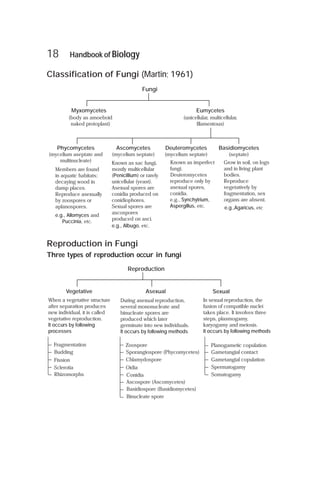
Classification of Fungi (Martin; 1961)
Reproduction in Fungi
Three types of reproduction occur in fungi
18 Handbook of Biology
Reproduction
Vegetative Asexual Sexual
Fragmentation Zoospore
Conidia
Planogametic copulation
Budding Sporangiospore (Phycomycetes)
Ascospore (Ascomycetes)
Gametangial contact
Fission Chlamydospore
Basidiospore (Basidiomycetes)
Gametangial copulation
Sclerotia Oidia
Binucleate spore
Spermatogamy
Rhizomorphs Somatogamy
When a vegetative structure
after separation produces
new individual, it is called
vegetative reproduction.
It occurs by following
processes
During asexual reproduction,
several mononucleate and
binucleate spores are
produced which later
germinate into new individuals.
It occurs by following methods
In sexual reproduction, the
fusion of compatible nuclei
takes place. It involves three
steps, plasmogamy,
karyogamy and meiosis.
It occurs by following methods
Fungi
Myxomycetes
(body as amoeboid
naked protoplast)
Eumycetes
(unicellular, multicellular,
filamentous)
Phycomycetes
(mycelium aseptate and
multinucleate)
Ascomycetes
(mycelium septate)
Deuteromycetes
(mycelium septate)
Basidiomycetes
(septate)
e.g., Allomyces
Puccinia
and
, etc.
l
l
Members are found
in aquatic habitats;
decaying wood in
damp places.
Reproduce asexually
by zoospores or
aplanospores.
l
l
l
Known as sac fungi,
mostly multicellular
( ) or rarely
unicellular (yeast).
Asexual spores are
conidia produced on
conidiophores.
Sexual spores are
ascospores
produced on asci.
Penicillium
e.g., Albugo, etc.
l
l
Known as imperfect
fungi.
Deuteromycetes
reproduce only by
asexual spores,
conidia.
e.g., ,
, etc.
Synchytrium
Aspergillus e.g.,Agaricus, etc
l
l
Grow in soil, on logs
and in living plant
bodies.
Reproduce
vegetatively by
fragmentation, sex
organs are absent.
Life Cycles of Some Fungi
These can be described as follows
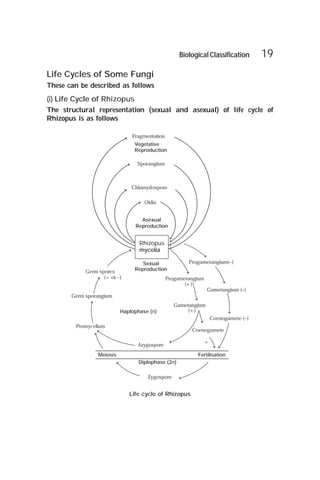
(i) Life Cycle of Rhizopus
The structural representation (sexual and asexual) of life cycle of
Rhizopus is as follows
Biological Classification 19
Vegetative
Reproduction
Fragmentation
Oidia
Sporangium
Azygospore
Meiosis
Rhizopus
mycelia
Germ spores
(+ or –)
Germ sporangium
Promycelium
Fertilisation
Diplophase (2 )
n
Zygospore
Haplophase ( )
n
Gametangium
Progametangium
Progametangium(–)
Sexual
Reproduction
Gametangium (–)
Coenogamete (–)
(+)
+
Chlamydospore
Asexual
Reproduction
Coenogamete
(+)
Life cycle of Rhizopus
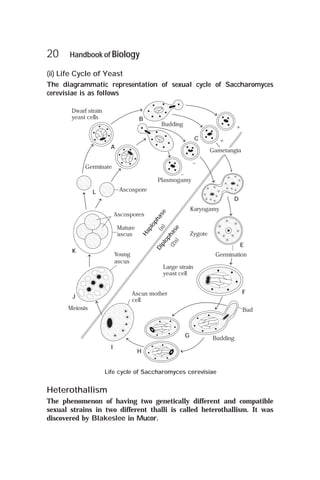
(ii) Life Cycle of Yeast
The diagrammatic representation of sexual cycle of Saccharomyces
cerevisiae is as follows
Heterothallism
The phenomenon of having two genetically different and compatible
sexual strains in two different thalli is called heterothallism. It was
discovered by Blakeslee in Mucor.
20 Handbook of Biology
Budding
Gametangia
Plasmogamy
Ascospore
Ascospores
Germinate
Mature
ascus
Young
ascus
Meiosis
Ascus mother
cell
Large strain
yeast cell
Budding
Bud
Germination
Zygote
Karyogamy
H
a
p
l
o
p
h
a
s
e
D
i
p
l
o
p
h
a
s
e
Dwarf strain
yeast cells
(
n
)
(
2
n
)
D
E
F
G
H
J
K
L
A
B
C +
+
–
–
I
Life cycle of Saccharomyces cerevisiae
Mushroom and Fairy Rings
Agaricus compestris is an edible mushroom. It is also called white
button mushroom. The fruiting body of Agaricus, arises in concentric
rings (called fairy rings or fungal flowers) from the mycelium present
in the soil.
Lichens
They have composite structure and consist of two dissimilar organisms
forming a symbiotic relationship between them.
Lichens are formed by
l Algal Part — Phycobiont — Provide food to fungi
l Fungal part — Mycobiont — Provide shelter to algae
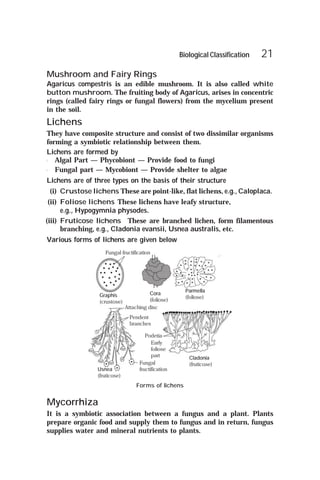
Lichens are of three types on the basis of their structure
(i) Crustose lichens These are point-like, flat lichens, e.g., Caloplaca.
(ii) Foliose lichens These lichens have leafy structure,
e.g., Hypogymnia physodes.
(iii) Fruticose lichens These are branched lichen, form filamentous
branching, e.g., Cladonia evansii, Usnea australis, etc.
Various forms of lichens are given below
Mycorrhiza
It is a symbiotic association between a fungus and a plant. Plants
prepare organic food and supply them to fungus and in return, fungus
supplies water and mineral nutrients to plants.
Biological Classification 21
Cora
(foliose)
Parmella
(foliose)
Cladonia
(fruticose)
Graphis
(crustose)
Attaching disc
Fungal
fructification
Pendent
branches
Fungal fructification
Usnea
(fruticose)
Podetia
Early
foliose
part
Forms of lichens
D. Kingdom–Plantae (Eukaryotic, Chlorophyllous Organisms)
These are chlorophyllous and embryo forming organisms. Mostly
non-motile and function as the producers in ecosystem as they can fix
solar energy into chemical energy through the process of
photosynthesis. The cell wall in plants is cellulosic and stored food
material is in the form of starch.
A detailed account of plant kingdom is given in chapter 6.
E. Kingdom–Animalia (Multicellular, Eukaryotic Organisms)
The heterotrophic, eukaryotic organisms which are multicellular and
lack cell wall, present in this kingdom. Animals have advanced level of
tissue organisation, in which the division of labour is highly specific.
The two main groups among animals are Non-chordata and Chordata,
divided on the basis of the presence of notochord in them.
A detailed account of animal kingdom is given in chapter 7.
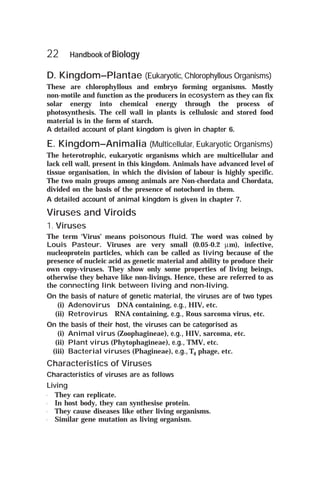
Viruses and Viroids
1. Viruses
The term ‘Virus’ means poisonous fluid. The word was coined by
Louis Pasteur. Viruses are very small (0.05-0.2 µm), infective,
nucleoprotein particles, which can be called as living because of the
presence of nucleic acid as genetic material and ability to produce their
own copy-viruses. They show only some properties of living beings,
otherwise they behave like non-livings. Hence, these are referred to as
the connecting link between living and non-living.
On the basis of nature of genetic material, the viruses are of two types
(i) Adenovirus DNA containing, e.g., HIV, etc.
(ii) Retrovirus RNA containing, e.g., Rous sarcoma virus, etc.
On the basis of their host, the viruses can be categorised as
(i) Animal virus (Zoophagineae), e.g., HIV, sarcoma, etc.
(ii) Plant virus (Phytophagineae), e.g., TMV, etc.
(iii) Bacterial viruses (Phagineae), e.g., T4 phage, etc.
Characteristics of Viruses
Characteristics of viruses are as follows
Living
l
They can replicate.
l
In host body, they can synthesise protein.
l
They cause diseases like other living organisms.
l
Similar gene mutation as living organism.
22 Handbook of Biology
Non-living
l Do not have protoplasm, and do not perform metabolism.
l These can be crystallised.
l They do not respire.
l In vitro culture is not possible.
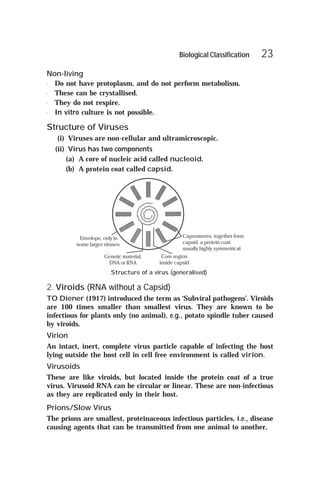
Structure of Viruses
(i) Viruses are non-cellular and ultramicroscopic.
(ii) Virus has two components
(a) A core of nucleic acid called nucleoid.
(b) A protein coat called capsid.
2. Viroids (RNA without a Capsid)
TO Diener (1917) introduced the term as ‘Subviral pathogens’. Viroids
are 100 times smaller than smallest virus. They are known to be
infectious for plants only (no animal), e.g., potato spindle tuber caused
by viroids.
Virion
An intact, inert, complete virus particle capable of infecting the host
lying outside the host cell in cell free environment is called virion.
Virusoids
These are like viroids, but located inside the protein coat of a true
virus. Virusoid RNA can be circular or linear. These are non-infectious
as they are replicated only in their host.
Prions/Slow Virus
The prions are smallest, proteinaceous infectious particles, i.e., disease
causing agents that can be transmitted from one animal to another.
Biological Classification 23
Genetic material,
DNA or RNA
Core region
inside capsid
Capsomeres, together form
capsid, a protein coat
usually highly symmetrical.
Envelope, only in
some larger viruses.
Structure of a virus (generalised)
3
Plant Kingdom
Plants : Producers of the Ecosystem
Plants are multicellular, photoautotrophic and embryo forming
(excluding algae) organisms placed in kingdom–Plantae. They have
cell wall, which is made up of cellulose and reserve food material in the
form of starch (sometimes fat as in seeds).
Plants are referred to as producers, because they have unique ability to
fix solar energy in the form of chemical energy, through the process of
photosynthesis. They supply the energy in ecosystem to other living
organisms, hence they are referred to as producers.
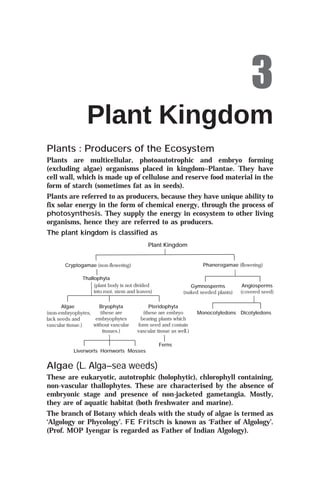
The plant kingdom is classified as
Algae (L. Alga–sea weeds)
These are eukaryotic, autotrophic (holophytic), chlorophyll containing,
non-vascular thallophytes. These are characterised by the absence of
embryonic stage and presence of non-jacketed gametangia. Mostly,
they are of aquatic habitat (both freshwater and marine).
The branch of Botany which deals with the study of algae is termed as
‘Algology or Phycology’. FE Fritsch is known as ‘Father of Algology’.
(Prof. MOP Iyengar is regarded as Father of Indian Algology).
Angiosperms
(covered seed)
Dicotyledons
Gymnosperms
(naked seeded plants)
Monocotyledons
Plant Kingdom
Cryptogamae (non-flowering) Phanerogamae (flowering)
Algae
Thallophyta
Bryophyta
(these are
embryophytes
without vascular
tissues.)
Pteridophyta
(these are embryo
bearing plants which
form seed and contain
vascular tissue as well.)
Liverworts Hornworts Mosses
Ferns
(non-embryophytes,
lack seeds and
vascular tissue.)
(plant body is not divided
into root, stem and leaves)
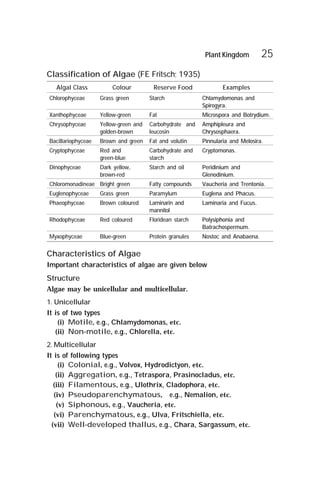
Classification of Algae (FE Fritsch; 1935)
Algal Class Colour Reserve Food Examples
Chlorophyceae Grass green Starch Chlamydomonas and
Spirogyra.
Xanthophyceae Yellow-green Fat Microspora and Botrydium.
Chrysophyceae Yellow-green and
golden-brown
Carbohydrate and
leucosin
Amphipleura and
Chrysosphaera.
Bacillariophyceae Brown and green Fat and volutin Pinnularia and Melosira.
Cryptophyceae Red and
green-blue
Carbohydrate and
starch
Cryptomonas.
Dinophyceae Dark yellow,
brown-red
Starch and oil Peridinium and
Glenodinium.
Chloromonadineae Bright green Fatty compounds Vaucheria and Trentonia.
Euglenophyceae Grass green Paramylum Euglena and Phacus.
Phaeophyceae Brown coloured Laminarin and
mannitol
Laminaria and Fucus.
Rhodophyceae Red coloured Floridean starch Polysiphonia and
Batrachospermum.
Myxophyceae Blue-green Protein granules Nostoc and Anabaena.
Characteristics of Algae
Important characteristics of algae are given below
Structure
Algae may be unicellular and multicellular.
1. Unicellular
It is of two types
(i) Motile, e.g., Chlamydomonas, etc.
(ii) Non-motile, e.g., Chlorella, etc.
2. Multicellular
It is of following types
(i) Colonial, e.g., Volvox, Hydrodictyon, etc.
(ii) Aggregation, e.g., Tetraspora, Prasinocladus, etc.
(iii) Filamentous, e.g., Ulothrix, Cladophora, etc.
(iv) Pseudoparenchymatous, e.g., Nemalion, etc.
(v) Siphonous, e.g., Vaucheria, etc.
(vi) Parenchymatous, e.g., Ulva, Fritschiella, etc.
(vii) Well-developed thallus, e.g., Chara, Sargassum, etc.
Plant Kingdom 25
Nutrition
Mostly algae are autotrophic, due to the presence of chlorophyll. Some
are parasitic, e.g., Cephaleuros that causes rust of tea.
Reproduction
Algae reproduce by
(i) Vegetative methods
(ii) Asexual methods
(iii) Sexual methods
Vegetative Reproduction
Algae reproduce vegetatively by two methods
(i) Fragmentation, e.g., Fucus, Chara, etc.
(ii) By hormogones, e.g., Oscillatoria, Nostoc, etc.
Asexual Reproduction
In this process, some cells form motile or non-motile spores. After
release, these spores give rise to new plants. Following spores are
involved
(i) By zoospore, e.g., Ulothrix, Oedogonium, etc.
(ii) By aplanospore, e.g., Chlorella, etc.
(iii) By hypnospore, e.g., Vaucheria, etc.
(iv) By palmella stage, e.g., Chlamydomonas, Ulothrix, etc.
(v) By endospore, e.g., Anabaena, Nostoc, etc.
(vi) By akinete, e.g., Chara, Oedogonium, etc.
Sexual Reproduction
On the basis of shape, size, morphology and behaviour of gametes,
the sexual reproduction is of following types
26 Handbook of Biology
Isogamous
(similar gametes,
morphologically),
e.g., Spirogyra.
Anisogamous
(gametes are dissimilar
morphologically),
sp.
e.g., Chlamydomonas
Oogamous
(gametes are different
both morphologically and
physiologically),
e.g.,Volvox.
Sexual Reproduction
Life Cycle of Algae
Various algae show different types of life cycles. Life cycles of
Spirogyra and Ulothrix are discussed here.
Life cycle of Spirogyra It is a green alga of filamentous shape.
The detailed life cycle is given below.
Plant Kingdom 27
Aplanospore
Azygospore
Akinete
Asexual reproduction
Pyrenoids
Cell wall
Vegetative cell
Vegetative
filament
Three degenerating nuclei
Functional
nucleus
Sexual reproduction
Haploid phase ( )
n
Four haploid nuclei
(
M
e
i
o
s
i
s
)
Diploid
phase (2 )
n
Male
gamete
( )
n
Conjugation
tube
Female
gamete
( )
n
Zygospore (2 )
n
Zygote (2 )
n
S
c
a
l
a
r
i
f
o
r
m
c
o
n
j
u
g
a
t
i
o
n
11
10
9
8
7
6
5
4
3
2
1
Chloroplast
Cytoplasm
Nucleus
Life cycle of Spirogyra
Life cycle of Ulothrix The diagrammatic representation of life cycle
of Ulothrix is given below.
28 Handbook of Biology
Palmella stage
Akinete
Hypnospore
Macrozoospores
Microzoospore
Aplanospore
Asexual reproduction
Chloroplast
Nucleus
Vacuole
Vegetative cell
Gametangium
Isogametes
Vesicle
Syngamy
Quariflagellate
zygospore
Vegetative
filament
Sexual reproduction
Haploid phase ( )
n
1
2
3
4
5
6
7
8
9
+
–
10
11
12 Reduction division
Resting
13
Zygospore (2 )
Phase (2 )
n
n
14
15
Hold
fast
Zoospores
Liberations of
gametes
Life cycle of Ulothrix
Economic Importance
Algae can be both useful and harmful. Several useful algal species with
their uses are mentioned here
Algin, Carrageenan and Agar
l
Algin, used as artificial fibre to control blood flow in surgery and
in production of non-inflammable films, is extracted from marine
brown algae.
l
Carrageenan, extracted from seaweeds is used in cosmetics, boot
polish, ice cream, paints, etc.
l
Agar, extracted from Gelidium and Gracilaria is used in culture
medium, biscuits for diabetic patients, etc.
– Sargassum is used as food and fodder.
– Laminaria, Fucus are used in extraction of iodine, bromine and
potash.
Harmful Algae
Group of algae like Microcystis, Oscillatoria and Anabaena cause water
blooms (eutrophication) and death and reduction of aquatic organisms.
Bryophyta (L. Bryon–leaf-like; phyton–plant body)
It is the simplest and primitive group of land plants. They are also
known as amphibians of plant kingdom because of their habitat
adaptability in both aquatic and terrestrial environment. They are the
connecting link between algae and pteridophytes. Bryophytes
Plant Kingdom 29
As Medicine
As Food
Ulva, Sargassum, Laminaria,
Porphyra, Nostoc Laurencia.
and
Chlorella
Nitella
gives chlorellin
(antibiotic), is used
as mosquito repellent.
In Industries
Diatoms,
are used in paints, cosmetics, etc.
Chondrus,
Polysiphonia, Gracilaria
Source of Minerals
Laminaria, Polysiphonia
Ascophyllum
and
are used in
extraction of minerals.
In Agriculture
Nostoc, Anabaena, help in
nitrogen-fixation, hence
used as biofertilisers.
In Biological Research
Algae like planktons are used as
food by others and stabilise
the ecosystem.
Chlorella,Scenedesmus
Acetabularia
and
are used as tools
for biological research.
Ecological Significance
Algae
Useful applications of algae
are autotrophic, non-seeded, cryptogamic plants. The plant body is
gametophytic and may be differentiated into stem, leaves and rhizoids.
l Bryophytes do not have true vascular tissue (xylem and phloem),
but some of them have hydroids (similar to xylem) and leptoids
(similar to phloem) which help in the conduction of water and food,
respectively.
l The sex organs in bryophytes are multicellular, male sex organ is
called antheridium and female sex organ is called archegonium.
Sexual reproduction in bryophytes is mainly oogamous type.
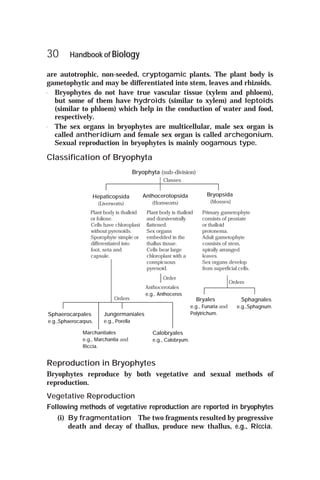
Classification of Bryophyta
Reproduction in Bryophytes
Bryophytes reproduce by both vegetative and sexual methods of
reproduction.
Vegetative Reproduction
Following methods of vegetative reproduction are reported in bryophytes
(i) By fragmentation The two fragments resulted by progressive
death and decay of thallus, produce new thallus, e.g., Riccia.
30 Handbook of Biology
Sphaerocarpales
e.g.,Sphaerocarpus.
Jungermaniales
e.g., Porella
Calobryales
e.g., Calobryum.
Bryophyta (sub-division)
Hepaticopsida
(Liverworts)
Anthocerotopsida
(Hornworts)
Bryopsida
(Mosses)
Bryales
e.g., Funaria
Polytrichum.
and
Sphagnales
e.g.,Sphagnum.
Classes
Orders
Marchantiales
e.g., Marchantia
Riccia.
and
Order
Anthocerotales
,
e.g. Anthoceros
Orders
l
l
l
Plant body is thalloid
or foliose.
Cells have chloroplast
without pyrenoids.
Sporophyte simple or
differentiated into
foot, seta and
capsule.
l
l
l
Plant body is thalloid
and dorsiventrally
flattened.
Sex organs
embedded in the
thallus tissue.
Cells bear large
chloroplast with a
conspicuous
pyrenoid.
l
l
l
Primary gametophyte
consists of prostate
or thalloid
protonema.
Adult gametophyte
consists of stem,
spirally arranged
leaves.
Sex organs develop
from superficial cells.
(ii) By adventitious branches Special adventitious branches
arise from the mid-ventral surface of the thallus, e.g., Riccia
fluitans.
(iii) By tubers Some species form perennating tubers at the apices
of thallus, e.g., Riccia, Marchantia, etc.
(iv) By persistent apices The underground part of thallus in soil
remains living and grows into plant, e.g., Riccia, Pellia, etc.
Sexual Reproduction
The sex organs are highly differentiated and well-developed in
bryophytes. The antherozoids or sperms (minute, slender, curved
body, having two whiplash flagella) are released from antheridium and
reach to archegonium through neck canal cells. The antherozoid fuses
with egg cell to produce sporophytic generation.
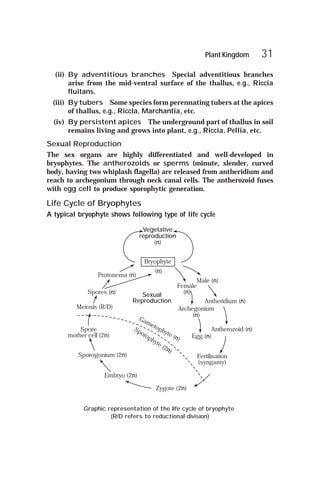
Life Cycle of Bryophytes
A typical bryophyte shows following type of life cycle
Plant Kingdom 31
Vegetative
reproduction
( )
n
Bryophyte
Protonema ( )
n
( )
n
Sexual
Reproduction
Female
( )
n
Male ( )
n
Spores ( )
n
Meiosis (R/D)
Spore
mother cell (2 )
n
Antheridium ( )
n
Archegonium
( )
n
Antherozoid ( )
n
Egg ( )
n
Fertilisation
(syngamy)
Zygote (2 )
n
Embryo (2 )
n
Sporogonium (2 )
n
Gametophyte ( )
n
Sporophyte (2
)
n
Graphic representation of the life cycle of bryophyte
(R/D refers to reductional division)
Economic Importance
Bryophytes have limited economic importance, they can be used in
following ways
(i) They help in soil formation (pedogenesis) and act as agent
for biological succession.
(ii) Peat from Sphagnum can be used as fuel and in preparation of
ethyl alcohol.
(iii) They help in protecting soil from erosion.
(iv) Some bryophytes are used as fodder for cattle.
(v) Due to high water retention capacity, Sphagnum can be
used in preserving living materials and used in grafting of
plants.
Pteridophyta ( L. pteron–feather; phyton–plant)
Pteridophytes are seedless, vascular cryptogams. They reproduce by
means of spores and can reach to the tree-like heights (30-40 feets).
General Characteristics
(i) The plant body is differentiated into root, stem and leaves.
(ii) The stem may be aerial or underground and is generally
herbaceous, rarely solid and stout.
(iii) Vascular tissues consist of xylem (without vessels) and phloem
(without companion cells).
(iv) Alternation of generations is found here, gametophyte is
autotrophic and independent.
(v) Sporangia containing leaves are called sporophylls.
(vi) Antherozoids (flagellated male gametes) are formed in
antheridia.
(vii) Reproduction is of both vegetative and sexual types.
(viii) On the basis of development of sporangia, they are of two
types
(a) Eusporangiate From a group of superficial initial cells.
(b) Leptosporangiate From a single superficial initial cell.
32 Handbook of Biology
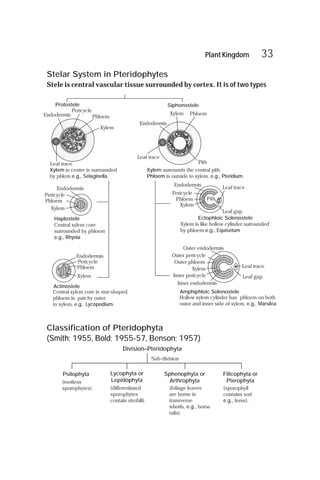
Stelar System in Pteridophytes
Stele is central vascular tissue surrounded by cortex. It is of two types
Classification of Pteridophyta
(Smith; 1955, Bold; 1955-57, Benson; 1957)
Plant Kingdom 33
Division–Pteridophyta
Psilophyta Lycophyta or
Lepidophyta
Sphenophyta or
Arthrophyta
Filicophyta or
Pterophyta
(foliage leaves
are borne in
transverse
whorls, horse
tails).
e.g.,
(differentiated
sporophytes
contain strobili).
(sporophyll
contains sori
ferns).
e.g.,
(rootless
sporophytes).
Sub-division
Endodermis Leaf trace
Pericycle
Phloem
Xylem
Leaf gap
Pith
Endodermis
Pericycle
Phloem
Xylem
Haplostele
Outer endodermis
Outer pericycle
Outer phloem
Inner pericycle
Xylem
Inner endodermis
Leaf trace
Leaf gap
Xylem
Phloem
Pericycle
Endodermis
Actinostele
Leaf trace
Xylem Phloem
Endodermis
Pith
Endodermis
Pericycle
Phloem
Xylem
Leaf trace
Xylem in centre is surrounded
by phlem e.g., Selaginella.
Xylem
Phloem
surrounds the central pith.
is outside to xylem, e.g., Pteridium.
Central xylem core
surrounded by phloem
e.g., Rhynia
Central xylem core is star-shaped
phloem is patchy outer
to xylem, .,
e.g Lycopodium.
Ectophloic Solenostele
Xylem is like hollow cylinder surrounded
by phloem e.g., Equisetum
Amphiphloic Solenostele
Hollow xylem cylinder has phloem on both
outer and inner side of xylem, e.g., Marsilea
Protostele Siphonostele
Reproduction
Pteridophytes reproduce by vegetative, asexual and sexual methods.
Vegetative Reproduction
It takes place by two methods
(i) Death and decay of older tissues lead to separation of new
branches, which can grow into new plants.
(ii) Adventitious buds develop from petiole and later on rooting
takes place and get separated.
Asexual Reproduction
It occurs by meiospores
When pteridophytic plants get mature, the special spore bearing
structures develop under the surface of pinnules.
These structures are
(i) Sporangium These are differentiated into capsule and the
stalk. Capsule has a single layer of thick wall, which consists of
specialised cell along with the normal wall cells.
(ii) Spores These are minute, bilateral bodies of brown
colour. The spore coat is two layered, i.e., thick exine and thin
intine.
Sexual Reproduction
It is of advanced type, in which the multicellular sex organs
(i.e., antheridia and archegonia) are borne on the underside of
prothallus. The mucilaginous substance oozes out from archegonia,
which contains malic acid. After diffusing into water, it attracts
antherozoids through chemotaxis. The male nucleus fuses with the
egg nucleus and forms zygote.
34 Handbook of Biology
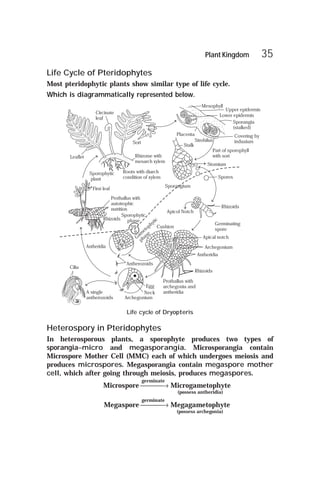
Life Cycle of Pteridophytes
Most pteridophytic plants show similar type of life cycle.
Which is diagrammatically represented below.
Heterospory in Pteridophytes
In heterosporous plants, a sporophyte produces two types of
sporangia–micro and megasporangia. Microsporangia contain
Microspore Mother Cell (MMC) each of which undergoes meiosis and
produces microspores. Megasporangia contain megaspore mother
cell, which after going through meiosis, produces megaspores.
Microspore Microgametophyte
germinate
(possess an
→
theridia)
Megaspore Megagametophyte
germinate
(possess arch
→
egonia)
Plant Kingdom 35
Circinate
leaf
Sori
Leaflet
Roots with diarch
condition of xylem
Lower epidermis
Sporangia
(stalked)
Upper epidermis
Rhizoids
Apicol Notch
Germinating
spore
Apical notch
Archegonium
Antheridia
Rhizoids
Prothallus with
archegonia and
antheridia
Egg
Neck
Archegonium
A single
antherozoids
Cilia
Antherozoids
Antheridia
Rhizoids
Prothallus with
autotrophic
nutrition
First leaf
Cushion
2n
n
G
am
etophytic
phase
Sporophytic
plant
Sporophytic
phase
Rhizome with
mesarch xylem
Sporangium
Stomium
Spores
Part of sporophyll
with sori
Covering by
indusium
Stalk
Strobilus
Mesophyll
Placenta
Life cycle of Dryopteris
The differentiation between male and female gametophytes ensures
cross fertilisation. This set of conditions occurs in Marsiliaceae and
Salviniaceae.
Economic Importance
Pteridophytes are economically important group of plants.
Some of them are
(i) Pteridophytes are used in horticulture, since they resist
wilting so can be used in cut flower arrangements.
(ii) Some ferns are used in handicrafts and basketery.
(iii) Pteridium leaves are used in making green dyes.
(iv) Club mosses are used for making industrial lubricant since
their spores contain non-volatile oils. These spores are also used
as fingerprint powder in forensic investigation.
(v) Some pteridophytes are used as biofertiliser (Azolla) due to
their nitrogen-fixing ability.
(vi) Some pteridophytes are eaten as food.
Gymnospermae (L. gymnos – naked; sperma – seed)
Gymnosperms are naked seeded plants, which evolved earlier than the
flowering plants. They have their seeds exposed on the
megasporophylls, i.e., carpels. Probably, they are the first surviving
seed plants (evolved during Jurassic period).
General Characteristics
(i) Plants are sporophytic, differentiated into root, stem and leaves.
(ii) Always heterosporous, i.e., contains two types of spores
(one spore (microspore) produces male gametophyte and other
(megaspore) produces female gametophyte after germination).
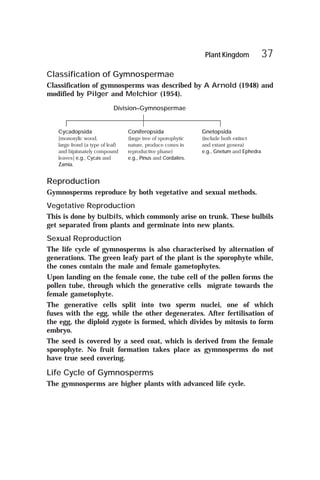
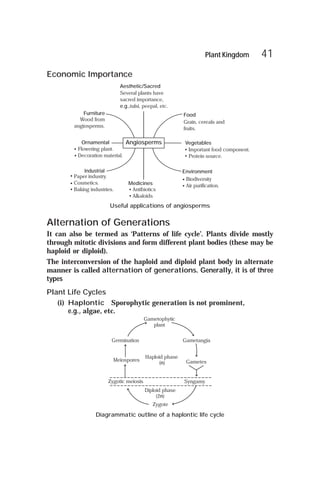
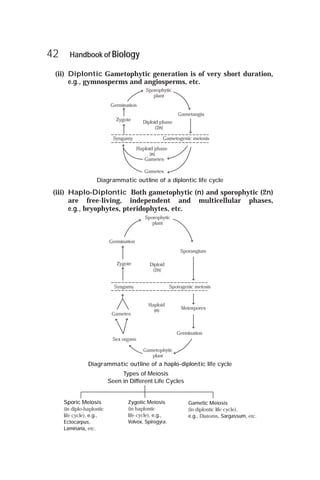
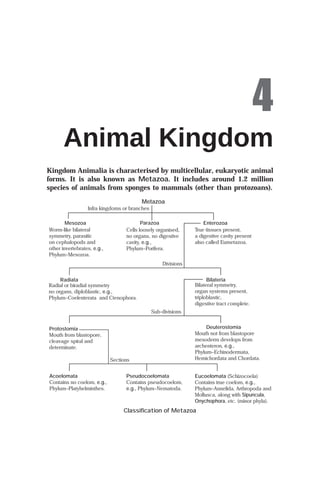
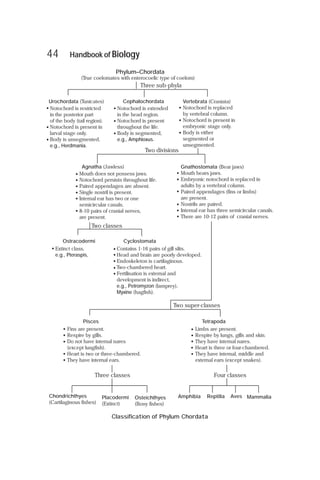
(iii) Root system is well-developed, i.e., tap root system, some have
coralloid roots (e.g., Cycas).
(iv) Form various structures through symbiotic relationships,
i.e., coralloid root (with algae) and mycorrhizae (with fungi).
(v) Leaves are dimorphic. They are of two types
(a) Foliage leaves Green, simple, needle-shaped and pinnately
compound.
(b) Scaly leaves Minute and deciduous.
(vi) Flowers are unisexual, simple, reduced and naked, i.e., without
perianth (except Gnetum).
36 Handbook of Biology
Classification of Gymnospermae
Classification of gymnosperms was described by A Arnold (1948) and
modified by Pilger and Melchior (1954).
Reproduction
Gymnosperms reproduce by both vegetative and sexual methods.
Vegetative Reproduction
This is done by bulbils, which commonly arise on trunk. These bulbils
get separated from plants and germinate into new plants.
Sexual Reproduction
The life cycle of gymnosperms is also characterised by alternation of
generations. The green leafy part of the plant is the sporophyte while,
the cones contain the male and female gametophytes.
Upon landing on the female cone, the tube cell of the pollen forms the
pollen tube, through which the generative cells migrate towards the
female gametophyte.
The generative cells split into two sperm nuclei, one of which
fuses with the egg, while the other degenerates. After fertilisation of
the egg, the diploid zygote is formed, which divides by mitosis to form
embryo.
The seed is covered by a seed coat, which is derived from the female
sporophyte. No fruit formation takes place as gymnosperms do not
have true seed covering.
Life Cycle of Gymnosperms
The gymnosperms are higher plants with advanced life cycle.
Plant Kingdom 37
Division–Gymnospermae
Cycadopsida
[monoxylic wood,
large frond (a type of leaf)
and bipinnately compound
leaves] and
e.g., Cycas
Zamia.
Coniferopsida
(large tree of sporophytic
nature, produce cones in
reproductive phase)
and
e.g., Pinus Cordaites.
Gnetopsida
(include both extinct
and extant genera)
and
e.g., Gnetum Ephedra.
38 Handbook of Biology
The descriptive account of life cycle of both Cycas and Pinus are as follows
Life Cycle of Cycas
Life Cycle of Pinus
Male plant
Staminate cone
Microsporophyll
Microsporangium
(pollen sac)
Microspore
mother cell
Microspore
(pollen grain)
Microgametophyte
Body cell
Male gamete
(antherozoid)
Oospore
(zygote)
Development
of embryo
Seed
Female plant
Megasporophyll
Megasporangium
(ovule)
Megaspore
mother cell
Megaspore
Megagametophyte
(endosperm)
Archegonium
Female gamete
(oosphere)
Sporophyte (2 )
n
Syngamy
Gametophyte
( )
n
Meiosis
G
erm
ination
Germination
Cycas : Topographical representation of life cycle
Female strobilus
Megasporophylls
Megasporangia
(ovules)
Megaspore
mother cells
Meiosis
Megaspore
Embryo
(within a seed)
Oospore
Fertilisation
(siphonogamous)
Archegonia
Oosphere
(female gamete)
Female prothallus
(endosperm)
Pinus tree
Male strobilus
Microsporophylls
Microsporangia
(pollen sacs)
Microspore
mother cells
Meiosis
Microspores
(pollen grains shed)
Male prothallus
(vestigial)
Body cell
Male gamete
(Monoecious)
Diploid
(2 )
n
Haploid
( )
n
Pinus : Topographical representation of life cycle
Economic Importance
Angiospermae
(Gk. Angion–vessel; sperma–seed)
Angiosperms constitute a distinct group of flowering plants, which form
covered seeds. With about 2,50,000 species, it can be regarded as the
most successful group of plants. They arose in middle of Cretaceous
period.
General Characteristics
(i) Angiosperms range from microscopic Wolffia to the largest tree
such as Eucalyptus.
(ii) The pollen grains and ovules develop in their flowers and the
seeds are formed within the fruits.
(iii) Nutritionally, they may be autotrophic (wheat, corn, etc.),
parasitic (Cuscuta, Santalum, etc.), saprophytic (Monotrapa,
etc.) and insectivorous (Drosera, Utricularia, etc.).
(iv) They may be herb, shrub and trees.
(v) Their lifetimes may be ephemeral, annual, biennial and
perennial.
(vi) Angiosperms are adapted to various habitats, as they may be
hydrophytes, xerophytes and mesophytes.
(vii) A flower is a modified shoot comprising of four whorls, i e
. .,
sepal, petal, androecium and gynoecium.
Plant Kingdom 39
•
•
•
Food
Tuber and seeds of
Seeds of sp.
Chilgoza from sp.
Cycas.
Gnetum
Pinus
Industrial Products
•
•
•
amber
Paper from pulp of sp.
Methyl alcohol, terpentine and
resin from sp.
The fossilised resin of
is known as ,
used in jewellery and X-ray sheets.
Pinus
Pinus
Pinus excelsa
Medicines
•
•
•
Resin of is
used to treat ulcers.
Ephedrine from
(treatment of asthma).
Resin of is used in
stomach problem and
to treat gonorrhoea.
C. rumphii
Ephedra
Pinus
Furniture
•
•
Wood of .
Wood of and
are also used.
Pinus
Ephedra
Gnetum
Ornamentals
Almost all gymnosperms
are grown for ornamentation
purpose.
Academic
Both extinct and extant species
of gymnosperms help in
studying the process of evolution.
Gymnosperms
Classification of Angiosperms
A natural system of classification was given by George Bentham and
JD Hooker in 1862-63 in his book Genera Plantarum (3 volumes) in
Latin.
The outline of the above mentioned classification is as follows
Some important plant families with their representative genera are
as follows
Ranunculaceae, Brassicaceae (e.g., mustard), Malvaceae
(e g
. ., gurhal), Asteraceae (e.g., sunflower), Lamiaceae (e.g., tulsi),
Solanaceae (e.g., potato), Leguminosae (e.g., pea), Cucurbitaceae,
Euphorbiaceae, Orchidaceae, Palmae (e.g., cashewnut), Poaceae
(e.g., paddy) and Liliaceae (e.g., onion), etc.
Reproduction in Angiosperms
Angiosperms are plants that bear fruits and flowers. These flowers are
plant’s reproductive structures. Reproduction in angiosperms (mostly
sexual type) occurs when the pollen from an anther is transferred to
stigma.
When the ovules get fertilised, they will develop into seeds.
Non-reproductive structures like petals, sepals etc. of the flowers fall
off leaving only the ovary behind, which will develop into a fruit.
40 Handbook of Biology
Phanerogamia
(seed plants in which sex organs are evident)
Dicotyledonae Gymnospermae Monocotyledonae
Classes
Polypetalae Gamopetalae Monochlamydeae Cycadaceae Coniferae Gnetaceae
Sub-classes Sub-classes
Economic Importance
Alternation of Generations
It can also be termed as ‘Patterns of life cycle’. Plants divide mostly
through mitotic divisions and form different plant bodies (these may be
haploid or diploid).
The interconversion of the haploid and diploid plant body in alternate
manner is called alternation of generations. Generally, it is of three
types
Plant Life Cycles
(i) Haplontic Sporophytic generation is not prominent,
e.g., algae, etc.
Plant Kingdom 41
Gametophytic
plant
Germination Gametangia
Meiospores
Zygotic meiosis
Zygote
Gametes
Syngamy
Haploid phase
( )
n
Diploid phase
(2 )
n
Diagrammatic outline of a haplontic life cycle
Furniture
Wood from
angiosperms.
Food
Grain, cereals and
fruits.
Ornamental
Flowering plant.
Decoration material.
Vegetables
Industrial
Paper industry.
Cosmetics.
Baking industries.
Environment
Biodiversity
Air purification.
Medicines
Antibiotics
Alkaloids
Aesthetic/Sacred
Several plants have
sacred importance,
tulsi, peepal, etc.
e.g.,
Important food component.
Protein source.
•
•
•
•
•
•
•
•
•
Angiosperms
•
•
Useful applications of angiosperms
42 Handbook of Biology
(ii) Diplontic Gametophytic generation is of very short duration,
e.g., gymnosperms and angiosperms, etc.
(iii) Haplo-Diplontic Both gametophytic (n) and sporophytic (2n)
are free-living, independent and multicellular phases,
e.g., bryophytes, pteridophytes, etc.
Diploid
(2 )
n
Haploid
( )
n
Sporophytic
plant
Germination
Sporangium
Zygote
Sporogenic meiosis
Syngamy
Gametes
Sex organs
Meiospores
Germination
Gametophytic
plant
Diagrammatic outline of a haplo-diplontic life cycle
Sporophytic
plant
Zygote
Gametogenic meiosis
Gametes
Gametes
Gametangia
Germination
Syngamy
Diploid phase
(2 )
n
Haploid phase
( )
n
Diagrammatic outline of a diplontic life cycle
Types of Meiosis
Seen in Different Life Cycles
Sporic Meiosis
(in diplo-haplontic
life cycle),
etc.
e.g.,
Ectocarpus,
Laminaria,
Zygotic Meiosis
(in haplontic
life cycle),
.
e.g.,
Volvox, Spirogyra
Gametic Meiosis
(in diplontic life cycle),
Diatoms, etc.
e.g., Sargassum,
4
Animal Kingdom
Kingdom Animalia is characterised by multicellular, eukaryotic animal
forms. It is also known as Metazoa. It includes around 1.2 million
species of animals from sponges to mammals (other than protozoans).
Metazoa
Mesozoa Enterozoa
Radiata Bilateria
Deuterostomia
Parazoa
Worm-like bilateral
symmetry, parasitic
on cephalopods and
other invertebrates,
Phylum–Mesozoa.
e.g.,
Cells loosely organised,
no organs, no digestive
cavity,
Phylum–Porifera.
e.g.,
True tissues present,
a digestive cavity present
also called Eumetazoa.
Bilateral symmetry,
organ systems present,
triploblastic,
digestive tract complete.
Mouth not from blastopore
mesoderm develops from
archenteron,
Phylum–Echinodermata,
Hemichordata and Chordata.
e.g.,
Eucoelomata (Schizocoela)
Contains true coelom,
Phylum–Annelida, Arthropoda and
Mollusca, along with ,
, etc. (minor phyla).
e.g.,
Sipuncula
Onychophora
Divisions
Sub-divisions
Radial or biradial symmetry
no organs, diploblastic,
Phylum–Coelenterata and Ctenophora.
e.g.,
Protostomia
Mouth from blastopore,
cleavage spiral and
determinate.
Acoelomata
Contains no coelom,
Phylum–Platyhelminthes.
e.g.,
Sections
Pseudocoelomata
Contains pseudocoelom,
Phylum–Nematoda.
e.g.,
Infra kingdoms or branches
Classification of Metazoa
44 Handbook of Biology
Ostracodermi Cyclostomata
Two classes
Extinct class,
e.g., Pteraspis,
Contains 1-16 pairs of gill slits.
Head and brain are poorly developed.
Endoskeleton is cartilaginous.
Two-chambered heart.
Fertilisation is external and
development is indirect,
(lamprey),
(hagfish).
e.g., Petromyzon
Myxine
• •
•
•
•
•
Phylum–Chordata
Urochordata (Tunicates) Vertebrata (Craniata)
Notochord is replaced
by vertebral column.
Notochord is present in
embryonic stage only.
Body is either
segmented or
unsegmented.
Cephalochordata
Three sub-phyla
Notochord is restricted
in the posterior part
of the body (tail region).
Notochord is present in
larval stage only.
Body is unsegmented,
e.g., Herdmania.
• • •
•
Notochord is extended
in the head region.
Notochord is present
throughout the life.
Body is segmented,
e.g., Amphioxus.
• •
•
•
•
Agnatha (Jawless) Gnathostomata (Bear jaws)
Mouth bears jaws.
Embryonic notochord is replaced in
adults by a vertebral column.
Paired appendages (fins or limbs)
are present.
Nostrils are paired.
Internal ear has three semicircular canals.
There are 10-12 pairs of cranial nerves.
Mouth does not possess jaws.
Notochord persists throughout life.
Paired appendages are absent.
Single nostril is present.
Internal ear has two or one
semicircular canals.
8-10 pairs of cranial nerves,
are present.
•
•
•
•
•
•
•
Two divisions
•
•
•
•
•
(True coelomates with enterocoelic type of coelom)
Pisces Tetrapoda
Two super-classes
Fins are present.
Respire by gills.
Do not have internal nares
(except lungfish).
Heart is two or three-chambered.
They have internal ears.
Limbs are present.
Respire by lungs, gills and skin.
They have internal nares.
Heart is three or four-chambered.
They have internal, middle and
external ears (except snakes).
• •
•
•
•
•
•
•
•
•
Chondrichthyes
(Cartilaginous fishes)
Aves
Amphibia Reptilia Mammalia
Four classes
Three classes
Placodermi
(Extinct)
Osteichthyes
(Bony fishes)
Classification of Phylum Chordata
Basis of Classification
There are few fundamental common features to various animal groups,
which form the basis of classification. These features are as follows
1. Level of Organisation
Though, all the members of kingdom–Animalia are multicellular, yet
all of them do not exhibit the same pattern of cellular organisation.
Different levels of organisation are discussed below
2. Symmetry
It refers to the correspondence of body parts in all major respect like
size, shape, position, etc., with the parts on opposite side when divided
from the central axis.
Types of symmetry found in animals are
(i) Radial symmetry In radial symmetry, the animal gets
divided into two ‘identical halves’ when any plane passes
through the central axis, e.g., coelenterates, echinoderms.
(ii) Bilateral symmetry In bilateral symmetry, body is divided
into two ‘identical halves’ only when a plane passes through
the median longitudinal axis, e.g., annelids, arthropods, etc.
3. Germ Layers
These are the groups of cells behaving as a unit during early stages of
embryonic development. On the basis of number of germ layers,
animals are placed in two groups, i.e., diploblastic and triploblastic.
These groups are divided at the gastrulation stage.
Animal Kingdom 45
Acellular or
Protoplasmic Level
Body consists of
mass of protoplasm.
All activities are performed
by different cell organelles
and confined within the
limit of plasma membrane,
Protozoa.
e.g.,
Cellular Level
Body consists of
many cells
which either forms
an aggregate or
a colony. It is of
two types
Cellular colony
Protists and some
algae.
Cellular aggregate
Porifera (sponges),
where cells are not
organised into tissue.
Tissue Level
Group of similar
cells forms tissues
which serves
specific functions,
coelenterates.
e.g.,
Organ Level
Some tissues
join and function
as a unit of a
organ,
Stomach
(one of digestive
organs) contains
all tissues,
Platyhelminthes.
e.g.,
e.g.,
Organ-System
Level
Group of
organs working
together to forms
organ system,
Organs such
as stomach,
intestine, etc., aid
in digestion and
constitute digestive
system,
Nemathelminthes
to chordates.
e.g.,
e.g.,
Levels of Organisation
(i)
(ii)
(i) Diploblastic
Embryo is two-layered consisting an outer ectoderm and inner
endoderm, e.g., Hydra, jellyfish, etc.
(ii) Triploblastic
Embryo is three-layered consisting of an outer ectoderm, middle
mesoderm and inner endoderm, e.g., humans.
4. Coelom
It is a large fluid-filled space or cavity lying between the outer body
wall and inner digestive tube.
46 Handbook of Biology
Types of Coelom
Internal body cavity separates digestive tract from outer body wall
Acoelom
parenchyma
There is no body cavity.
Region between the
ectodermal epidermis
and the endodermal
digestive tract is
completely filled with
mesoderm in the
form of a spongy mass
of space filling cells
called
Porifera,
Coelenterata,
Ctenophora and
Platyhelminthes.
e.g.,
.
Pseudocoelom
The presence of false
coelom or perivisceral
cavity. Coelom is not
lined by mesoderm
and directly connected
to archenteron.
Developmentally,
pseudocoelom is the
persistent blastocoel of
blastula stage,
Rotifera, Aschelminthes
and Nematoda.
e.g.,
Eucoelom or True Coelom
True body cavity develops
entirely lined with the mesoderm,
higher invertebrates
(Annelida, Echinodermata
and Chordata).
e.g.,
Schizocoel
Developed as a split in
the mesoderm sheet,
Annelida to
Arthropoda.
Protostomes
are schizocoelous.
e.g.,
Enterocoel
Formed from the
pouches of the
archenteron or
primitive gut.
Echinodermata
and chordata.
Deuterostomes
are enterocoelous.
e.g.,
Coelomate
Pseudocoelomate
Acoelomate
Pseudocoelom
Ectoderm
Ectoderm
Endoderm
Endoderm
Mesoderm
Endoderm
Coelom
Ectoderm
Digrammatic sectional view of coelom
5. Segmentation
It is the serial repetition of similar parts along the length of an animal.
It is of two types
(i) Pseudosegmented (strobilisation) Body is divided into number of
pseudosegments (proglottids) which are independent of each other,
e.g., tapeworms.
(ii) Metameric Linear repetition of body parts (somites), e.g.,
annelids, arthropods and chordates.
6. Notochord
It is a rod-like structure present on the dorsal side of the animal body.
It is derived from the embryonic mesoderm. Based on its presence
and absence, animals are non-chordates (phylum–Porifera to
Echinodermata) and chordates (phylum–Chordata).
Major differences between Chordata and Non-Chordata are as follows
Chordata Non-Chordata
Bilaterally symmetrical. Asymmetrical, radially symmetrical or
bilaterally symmetrical.
True metamerism. Non-segmented, false segmented or true
metamerically segmented.
True coelomates. Acoelomate, pseudocoelomate or true coelomates.
Post-anal tail usually present. It is usually absent.
Triploblastic animals. Cellular, diploblastic or triploblastic animals.
Alimentary canal is always ventrally
placed to nerve cord.
Heart is ventrally placed.
It is always dorsally placed to the nerve
cord.
Heart is dorsal or absent.
Central nervous system is hollow,
dorsal and single.
Central nervous system is ventral, solid
and double.
Pharynx is perforated by gill slits. Gill slits are absent.
Phylum–Porifera
Poriferans bear numerous minute pores called ostia on the body wall,
which leads into a central cavity called spongocoel or paragastric
cavity. The spongocoel opens to outside by osculum.
Animal Kingdom 47
Majority of poriferans (sponges) are marine and sedantry. They are
diploblastic animals and contain an outer dermal layer of pinacocytes
and inner gastral layer of choanocytes.
Canal System (Aquiferous system)
It is a system of interconnected canals through which water circulates
and helps in a number of metabolic activities of a sedentary sponge. In
sponges, canal system is of three types, i e
. ., asconoid, syconoid and
leuconoid.
Different Types of Canal System
Asconoid Canal
System
Syconoid Canal
System
Leuconoid Canal
System
Simplest type with thin
walls.
Complex type with thick
walls.
Much complex type with
highly folded thick walls.
Spongocoel is large and
spacious.
Spongocoel is narrow. Spongocoel is either reduced
or absent.
48 Handbook of Biology
Flagellum
Collar
Protoplasmic processes
Microvilli
Basal granule
Rhizoplast
Blepharoplast
Nucleus
Cytoplasm
Flagellum
(create water current)
Collar microvillus
(filter particles
from water)
Endoplasmic
reticulum
Nucleus
Mitochondrion
Food vacuole
Contractile
vacuole
(b)
(a)
Choanocyte : (a) Light microscopic view
(b) Electron microscopic view
Asconoid Canal
System
Syconoid Canal
System
Leuconoid Canal
System
Choanocytes form the
gastral layer and lines the
whole spongocoel.
Choanocytes are restricted
in radial canals only.
Choanocytes are confined in
the flagellated chambers
which are formed by the
evagination of radial canals.
Route of water is
Outside water 
Dermal
Ostia
Outside ←
Osculum
Spongocoel
e g
. ., Leucosolenia.
Route of water is
Outside water 
Dermal

Prosopyle
Incurrent canal
Radial canal 
Apopyle

Gastral
Ostia
Excurrent canal
Spongocoel →
Osculum
Outside
e.g., Grantia.
Route of water is
Outside water
Ostia
Dermal

 Hypodermalspaces
Incurrent canals
Prosopyle


Apopyle
Flagellated chambers
Excurrent canal 

Osculum
Excurrent spaces
Outside, e g
. ., Plakina.
Reproduction
In sponges, reproduction occurs by both asexual and sexual means.
(i) Asexual reproduction Mainly occurs by budding and
gemmules.
(ii) Sexual reproduction Occurs with the help of amoebocyte or
archeocytes or sometimes through choanocytes.
Classification of Porifera
Animal Kingdom 49
Ostia
Phylum–Porifera
Calcispongiae
or Calcarea
Demospongiae
Hyalospongiae
or Hexactinellida
Three classes
Skeleton of calcareous
spicules.
Large choanocytes.
Small-sized species.
Skeleton of siliceous
spicules.
Small choanocytes.
Moderately-sized
species.
Skeleton of spongin
fibres or may be absent.
Very small choanocytes.
Large-sized species.
• • •
• • •
• • •
Common and Scientific Names of Some Members of Porifera
Common Species of
Porifera
Scientific
Name
Common Species of
Porifera
Scientific
Name
Glass rope sponge Hyalonema Venus flower basket Euplectella
Bath sponge Euspongia Bowl sponge Pheronema
Freshwater sponge Spongilla Dead man’s finger sponge Chalina
Urn sponge Scypha Boring sponge Cliona
Economic Importance
l They are used commercially for bathing/cleaning sponges.
l They help to clean-up the ocean floor by boring into dead shells and
corals releasing chemicals to break them down.
Phylum–Coelenterata (Cnidaria)
Coelenterates are the animals bearing a special body cavity called
coelenteron (gastrovascular cavity). They exhibit dimorphism and
display two major forms namely polyp (sedentary) and medusa
(swimming). They also exhibit trimorphism (e.g., Siphonophora) and
polymorphism (e.g., Porpita).
Body Wall
They are diploblastic animals and their body wall contains several
types of cells, e.g., stinging cells (cnidoblast/nematocyst), interstitial
cells (totipotent cells), sensory cells, nerve cells, etc.
50 Handbook of Biology
(a) (b)
Lasso
Shaft or butt
Barbules Operculum
Nematocyst
Barb
Coiled thread
Muscular
fibrils
Nucleus
Nematoblast
Cnidocil
Lasso Nucleus
Muscular
fibrils
Nematocyst
Operculum
Shaft or butt
Barb
Barbules
Everted
thread
Cnidocil
Cnidoblast Cells : (a) Undischarged (b) Discharged
Skeleton
In coelenterates, skeleton may be endoskeleton, exoskeleton or absent.
l Endoskeleton e.g., Alcyonium (fleshy mesogloea), Pennatula (axial
rod of calcified horn).
l Exoskeleton e.g., Millipore (coenosteum), Gorgonia (gorgorin),
Madrepora (corallum).
l Absent e.g., sea anemones.
Metagenesis
It is like the alternation of generations between the sexual (medusa)
and asexual (polyp) forms. In contrast to alternation of generation in
metagenesis, it is difficult to distinguish between asexual and sexual
forms as both individuals are diploid.
Reproduction
It occurs both by sexual and asexual means.
(i) Asexual reproduction By external budding.
(ii) Sexual reproduction By sexual medusae. The development
is usually indirect which occurs through ephyra, planula and
hydrula larvae.
Classification of Coelenterata
Common and Scientific Names of Some Coelenterates
Common Names of
Coelenterates
Scientific
Name
Common Names of
Coelenterates
Scientific
Name
Sail-by-wind Valella Organ-pipe coral Tubipora
Portuguese man of war Physalia Stag horn coral Madrepora
Stinging coral Millipora Mushroom coral Fungia
Sea anemone Metridium Star coral Astraea
Dead’s man finger coral Alcyonium
Animal Kingdom 51
Phylum–Coelenterata
Hydrozoa Anthozoa (Actinozoa)
Scyphozoa
Three classes
Both polyp and medusa
present. Polyp stage dominant,
medusa stage reduced
or absent.
Velum is present.
Gonads are epidermal in origin.
Larva hydrula, planula,
Medusa form is dominant.
Polyp represented as
scyphistoma stage.
Pseudovelum is present.
Gonads are endodermal
in origin.
Larva ephyra.
Gonads, if present are
endodermal in origin.
Corals and sea anemone.
•
• •
•
•
Medusa form is absent.
Velum is absent.
•
•
•
•
• •
•
Economic Importance
l They take part in the formation of coral reefs, e.g., Millipora
(stinging coral).
l Their skeleton has medicinal value, e.g., Tubipora (organ-pipe coral).
l They have ornamental value, e.g., Astraea (star coral).
Phylum–Ctenophora
The members of this phylum are generally marine, solitary,
free-swimming or pelagic. They are diploblastic animals and acoelomates.
Peculiar Characteristics
A gelatinous mesoglea is present between epidermal and gastrodermal
tissue layers. They are also called comb plates. Colloblast cells are
the sensory and adhesive cells.
Reproduction
Sexes are not separate. All are hermaphrodites. Gonads develop from
endosperm. Fertilisation is internal. Development is indirect through
cydippid larva.
Classification of Ctenophora
Common and Scientific Names of Some Ctenophores
Common Name of Ctenophores Scientific Name
Venus Girdle Velamen
Sea walnut Pleurobrachia
Swimming eye of cat Beroe
Economic Importance
l
They reproduce quickly and are good predators.
l
They can bring down an ecosystem.
52 Handbook of Biology
Phylum–Ctenophora
Tentaculata Nuda
Two classes
Possesses tentacles
Contains two long aboral tentacles
, , etc.
e.g., Ctenoplana Velamen e.g., Beroe, etc.
•
•
•
Does not possess tentacles.
Have a highly branched gastrovascular cavity.
•
•
•
Phylum–Platyhelminthes
They are dorsoventrally flat animals having either unsegmented and
leaf-like (e.g., flukes) or segmented and ribbon-like (Taenia) body. They
are the first animals to have bilateral symmetry and to undergo
cephalisation.
Habitat
They are mostly found as free-living forms, but few of them are
parasitic in their habitat.
Peculiar Features
These are the first animals with triploblastic layers in body wall and
organ system organisation. They are acoelomates due to the
presence of a mesodermal connective tissue, parenchyma, in between
the visceral organs. These animals have ladder-type nervous system
and peculiar cells called flame cells or protonephridia for
excretion. These cells are modified mesenchymal cells.
Animal Kingdom 53
Nucleus
Pseudopodia
Globules of
excretion
Basal granules
Cell lumen
Ciliary flame
Termination of
capillary duct
Flame cell (Solenocyte)
Ectoparasites
( and
)
e.g., Diplozoon
Gyrodactylus
Endoparasites
(
and )
e.g., Echinococcus
Taenia
Parasitic forms
Freshwater
(
and )
e.g., Dugesia
Planaria
Free-living forms
Marine
(
and )
e.g., Convoluta
Thysanozoon
Terrestrial
(
and )
e.g., Bipalium
Geoplana
Platyhelminthes
Reproduction
These animals are generally bisexual. Cross- fertilisation occurs in
trematodes, while self-fertilisation occurs in cestodes. Fertilisation is
always internal. Turbellarians reproduce by transverse fission.
Life Cycle of Taenia solium
54 Handbook of Biology
Fertilised ova (zygotes) in the mature
proglottids capsules containing
zygotes in gravid proglottids.
Adult
tapeworm in
human gut
Onchosphere (larvae) in the
gravid proglottids. It contains
all embryonic membranes
along with a hexacanth
(structure with 6 hooks).
Onchospheres in human
faeces (outside the body).
Faeces containing
onchospheres is eaten by
pig.
Hexacanth
It is the six-hooked larval
stage containing a pair of
penetration glands.
Each cysticercus develops
into young tapeworm in the
human gut.
Cysticercus
Hexacanth reaches heart liver
and finally muscles tongue,
shoulder, neck, thigh and settles
to develop into next larval stage
called cysticercus or bladder
worm within 10 days of infection
of the secondary host.
It is the infective stage of human
when they feed infected meat.
via
Bladder
Neck
showing
strobilation
Rostellar
hooks Scolex
Sucker
(Cysticercus)
Germ layer
(Oncosphere)
Bladder
Hooks
The graphical representation of life cycle of Taenia solium depicting different
larval stages and adult form in the primary and secondary hosts
Life Cycle of Fasciola hepatica
Classification of Plathelminthes
Common and Scientific Names of Some Platyhelminthes
Common Names of
Platyhelminthes
Scientific
Name
Common Names of
Platyhelminthes
Scientific
Name
Liver fluke Fasciola
hepatica
Pork tapeworm Taenia solium
Planarian Dugesia Hydatid worm or dog
tapeworm
Echinococcus
granulosus
Animal Kingdom 55
Phylum–Platyhelminthes
Turbellaria Cestoda
Trematoda
Three classes
Mostly non-parasitic and
free-living.
Unsegmented and flat leaf-like.
Body wall contains
syncytial epidermis with
rod-shaped rhabditis, e.g., Planaria.
Exclusively endoparasites
Segmented and
ribbon-like.
Body wall is lined by microvilli.
e.g., Taenia.
•
•
• • •
•
Ecto or endoparasites.
Unsegmented and flat
leaf-like.
Body wall contains
cuticular spines,
e.g., Fasciola.
•
•
•
Adult in the liver of sheep
Fasciola
Large number of eggs in faecal matter
of sheep. Development of egg into
next larval stage miracidium.
Miracidium First larval stage freely swim
in water with the help of cilia present all
over body. Penetrate secondary host
snail reaches to salivary gland and forms
second larval stage sporocysts.
Sporocyst It is the second larvae of
living in pulmonary tissues
of snail and obtaining nutrition from it
and develops into 5-8 rediae.
Fasciola
Rediae It is the most important larval stage and it
bears an anterior end with a ring of collar, a birth pore
and pair of projections (lappets or procruscula).
During Winter Every rediae
produces, 14-20 cercaria
(next larval stage).
It replicates giving
rise to the same form,
daughter rediae.
During Summer
i.e.,
Cercaria It escapes from the
secondary host through
pulmonary sac. Its tail help in
swimming of the larvae in water.
After 2-3 days, it loses its tail
and becomes incepted on grass
or aquatic plant and is now
called letacercaria.
Metacercaria This is the
encysted infective stage of
the and now infects
vertebrate host (sheep).
Fasciola
Graphical representation of life cycle of Fasciola hepatica
depicting polyembryony along with different larval stages
Economic Importance
l Fasciola causes fascioliosis or liver rot which is characterised by hepatitis.
l Echinococcus causes hydatid disease which is characterised by
enlargement of liver.
Phylum–Aschelminthes
They are long, cylindrical, unsegmented and thread-like animals with
no lateral appendages, so these are commonly called roundworms,
bagworms or threadworms.
Peculiar Features
Body wall of these pseudocoelomate animals is composed of complex
cuticle, syncytial epidermis and only longitudinal muscles. They have
tube-within-tube plan of digestive system.
They have fixed number of cells in every organ of the body (eutylic condition).
Excretory system is H-shaped and contains rennete cells.
Reproduction
Sexual dimorphism is present and males are smaller than females.
Fertilisation is internal and it may be direct or indirect.
56 Handbook of Biology
Females Ova
Males Sperms
→ →
→ →
(4th moult)
Back to intestine
In stomach
In oesophagus
Swallowed into gullet
In pharynx
In trachea
In bronchi
In bronchioles
Fourth stage juvenile
(3rd moult)
Third stage juvenile
(2nd moult)
Bores into lung alveoli
(stays for 10 days)
In lung capillaries
↑
↑
↑
↑
↑
↑
↑
↑
↑
↑
↑
Spiral, determinate cleavage
First stage juvenile or rhabditi-
form larva (first moult)
Second stage juvenile
Embryonated egg
swallowed by
human host
Egg hatches out
in intestine
Bores through intestinal
wall into blood capillaries
In mesenteric vein
In hepatic portal vein
In liver capillaries
In hepatic vein
↓
↓
↓
↓
↓
↓
↓
↓
↓
In pulmonary artery Right auricle In posterior vena cava
← ←
Adults
↑
3-4 days
Liver
Lungs
5 days
(Secondary
Migration)
(Primary
Migration)
3-4 days
Heart
↓
↑
Fertilised eggs
out with
host faeces
↓
Life cycle
of Ascaris
A graphical representation of life cycle of Ascaris
Classification of Aschelminthes
Common and Scientific Names of Some Aschelminthes
Common Names
of Aschelminthes
Scientific
Name
Common Names
of Aschelminthes
Scientific
Name
Roundworm Ascaris lumbricoides Guinea worm Dracunculus
medinesis
Root-knot eel worm Meloidogyne marioni Pinworm Enterobius
vermicularis
Filarial worm Wuchereria bancrofti Whipworm Trichuris trichiura
Eye worm Loa loa
Economic Importance
l
Ascaris causes ascariasis in humans.
l
Meloidogyne is a harmful phytoparasitic nematode.
Phylum–Annelida
Annelids are segmented worms with an elongated body possessing
triploblastic layers. Their musculature is formed of only smooth muscle
fibres of two types, i.e., longitudinal (inner) and circular (outer) muscles.
Animal Kingdom 57
Phylum–Aschelminthes
Nematoda
Body wall have
cuticle, epidermis
and longitudinal
muscles.
Excretory system
is formed of
renette cells.
Nematophora Rotifera Gastrotricha Kinorhyncha
Cuticle is highly
thickened and
formed of collagen
fibres.
Excretory system
absent.
Cuticle is formed
of plates
(lorica) and
body wall
contains both
circular and
longitudinal muscles.
Formed of two
protonephridia.
Cuticle is
produced into
short spines.
Formed of two
protonephridia.
Cuticle is spiny,
but without cilia.
•
•
•
•
•
•
• •
Aphasmida Phasmida
Phasmids, caudal sensory
organs are present,
, , ,
, , ,
, etc.
i.e.,
e.g., Anguina Ancylostoma Ascaris
Enterobius Dracunculus Wuchereria
Loa loa
Without phasmids, the
caudal sensory organs.
Usually free-living,
and , etc.
i.e.,
e.g., Trichinella Trichuris
•
Peculiar Features
l These animals show metameric segmentation, i.e., the external
division of the body by annuli corresponds to internal division of
coelom by septa.
l These are the first animals to have circulatory system.
l Locomotory organs are minute rod-like chitinous setae or suckers
which are embedded over parapodia.
l A characteristic circumoesophageal ring is present in the anterior
part of CNS.
l Special structures called nephridia are present for excretion.
Reproduction
Asexual reproduction By fragmentation is seen in some polychaetes.
Sexual reproduction Sexes are either united (e.g., oligochaetes) or
separate (e.g., polychaetes). Fertilisation is internal (e.g., Hirudinaria)
or external (e.g., earthworm). Development is direct in monoecious
form and indirect in dioecious form involving a free-swimming
trochophore larva.
Classification of Annelida
Common and Scientific Names of Some Annelids
Common Names
of Annelids
Scientific
Names
Common Names
of Annelids
Scientific
Names
Earthworm Pheretima posthuma Paddle worm Chaetopterus
Clam worm Nereis Blood worm Glycera
Polalo worm Eunice Skate sucker Pontobdella
Sea mouse Aphrodite Lung worm Arenicola
58 Handbook of Biology
Phylum–Annelida
Polychaeta Hirudinea
Oligochaeta
Three classes
Marine, fossorial
or tubicolous.
Distinct head bearing
tentacles, palps and
eyes.
Bristle-like setae and
parapodia for locomotion
Clitellum is absent.
Unisexual,
and
e.g., Aphrodite
Chaetopterus.
Mostly freshwater,
few marine.
No cephalisation
Locomotion by anterior
and posterior suckers.
Clitellum appears during
breeding season.
Bisexual,
and
e.g., Hirudinaria
Acanthobdella.
•
•
• • •
•
Terrestrial, freshwater
Distinct head with eyes
(palps and tentacles are
absent).
Locomotion by peristalsis,
parapodia is absent.
Permanent clitellum
is present.
Bisexual,
and
e.g., Pheretima
Tubifex.
•
•
•
•
•
•
•
•
•
Economic Importance
l Earthworms are used as fish-baits and for improving the soil fertility.
l Polynoe shows bioluminescence and this phenomenon is used in
self-defence.
l Tubifex has putrefaction ability and is grown in filtre beds of sewage
disposal plants.
l Pontobdella causes huge food loss to man when present in large number.
Phylum–Arthropoda
It is the largest phylum of Animalia which includes insects with
jointed legs and sclerotised exoskeleton. Their body is divided into
three parts or tegmata, i.e., head, thorax and abdomen. They are
haemocoelomates, i.e., true coelom is replaced by haemocoel
(pseudocoel with blood). The body appendages are variedly modified in
different arthropods to perform various functions.
Peculiar Features
l
They are the first animals to have an endoskeleton and voluntary
muscles in their body wall.
l
They have well-developed sensory organs which include antennae,
sensory hair, simple or compound eyes, auditory organs and statocyst.
l
They have well-developed endocrine system containing glands like
corpora cardiaca, corpora allata, etc.
l
Mouth is always surrounded by mouth parts of different types in
different animals.
Animal Kingdom 59
Body
Appendages
Swimming
belostoma
e.g.,
Running
cockroach
e.g.,
Pollen Collection
e.g., in honeybee
Grasping the Prey
e.g., raptorial
prolegs in
praying mantis
Digging
e.g., Forficula
Jumping
saltatory legs
in grasshopper
e.g.,
Siphoning
Type
butterfly
e.g.,
Sponging and
Sucking Type
housefly
e.g.,
Rasping
Type
thrips
e.g.,
Chewing
Type
beetle
e.g.,
Piercing and
Sucking Type
mosquito
e.g.,
Mouth Parts of Insects
Arthropods have special respiratory and excretory structures as follows
l Their nervous system possesses all the three types, i.e., central,
peripheral and autonomic.
Reproduction
Sexes are separate and fertilisation is internal. These animals are
generally oviparous or ovoviviparous.
Development may be direct (e.g., cockroach) or indirect. Some
arthropods undergo parthenogenesis, e.g., drones of honeybee.
Classification of Arthopoda
60 Handbook of Biology
Antennary or green
glands
crustaceans
e.g.;
Excretory
Structures
Malpighian tubules
e.g.; insects
Coxal glands
corpions and
most spiders
e.g.; s
Book Gills
e.g., king crab.
Gills
prawns
and crabs
e.g.,
.
Trachea
insects
and some
spiders.
e.g.,
Book Lungs
e.g., scorpions.
Respiratory Structures
Phylum–Arthropoda
Chelicerata Mandibulata
Trilobitomorpha
Three sub-phyla
Body is divided into
cephalothorax (prosoma)
and abdomen (opisthosoma),
cephalothorax is covered by a carapace.
Antennae are absent.
Mandible absents.
Body is divided into
cephalothorax and abdomen.
One or two pairs of antennae present.
One pair of mandible presents.
•
Extinct group
•
•
•
•
Three classes
Mesostomata
Aquatic (marine)
Abdomen ends into
a spike-like telson,
e.g., Limulus and
Eurypterus.
Arachnida
Mostly terrestrial,
some parasitic.
Abdomen lacks
locomotory appandages.
e.g., Aranaea, Palamnaeus
Pycnogonida
Marine
Abdomen is reduced,
e.g., Pycnogonum.
Crustacea
Mostly aquatic,
few are terrestrial
or parasitic.
Body is divisible
into two parts,
cephalothorax
and abdomen.
Exoskeleton is
calcified.
Excretion by
green glands,
and
i.e.,
e.g., Cyclops Sacculina.
Chilopoda
Terrestrial
Body is divisible
into two part, head
and trunk.
Exoskeleton is
uncalcified.
One pair of Malpighian
tubule is present,
and
i.e.,
e.g., Scolopendra
Lithobius.
Diplopoda
Terrestrial
Body is divisible into
three parts, head,
thorax and abdomen.
Calcified
Two pairs of Malpighian
tubules present,
and
i.e.,
e.g., Julus
Glomeris.
Insecta
Found in all habitats.
Body is divisible
into three parts, head,
thorax and abdomen.
Uncalcified
Two to many
pairs of Malpighian
tubules are present,
and
i.e.,
e.g., Mantis
Lepisma.
•
•
•
•
•
•
•
•
•
•
•
•
•
•
•
•
•
•
•
•
•
•
•
Four classes
Common and Scientific Names of Some Arthropods
Common Names
of Arthropods
Scientific
Name
Common Names
of Arthropods
Scientific
Name
Walking worm Peripatus Grasshopper Poecilocercus
Prawn Palaemon House cricket Gryllus
Spiny lobster Palinurus Praying mantis Mantis religiosa
Brown crab Cancer Earwig Forficula
Root-headed barnacle Sacculina Dragon fly Sympetrum
Hermit crab Eupagurus Silkmoth Bombyx mori
Goose-barnacle Lepas Yellow wasp Polistes
Rock barnacle Balanus Honeybee Apis indica
Silverfish Lepisma Millipede Thyroglutus
Cockroach Periplaneta Centipede Scolopendra
Desert locust Schistocerca Horseshoe crab Limulus
Economic Importance
l
Limulus is a living fossil.
l
Honeybee produces wax and honey.
l
Peripatus acts as a connecting link between Arthropoda and
Annelida.
l
Prawn and lobster are used as food in many countries.
l
Microtreme (white ant-termite) causes loss to furniture and other
wooden articles.
Phylum–Mollusca
Phylum–Mollusca is the second most abundant phylum which contains
soft-bodied animals usually protected by a calcareous shell and a
ventral muscular foot. The study of molluscs is called Malacology,
while study of molluscan shell is called Concology.
Peculiar Features
l
They generally have an exoskeleton of calcareous shell which may
be internal or absent.
l
Body is divisible into three parts, i.e., head, foot and mantle cavity.
l
A glandular fold called mantle or pallium is present in the body wall.
l
A rasping organ called radula is present in buccal cavity of most of
molluscs.
l
A peculiar sense organ called osphradium check the quality of water.
Animal Kingdom 61
Respiration occurs by the following structures
Excretion occurs by 1 or 2 pairs of metanephridial tubules called
kidneys or organs of Bojanus. Pelecypods also have a large,
reddish-brown Keber’s organ in front of pericardium for excretion.
Nervous system is formed of 3-paired ganglia, i.e., cerebral, pedal and
visceral ganglia.
Reproduction
Sexes are usually dioecious, but some are hermaphrodite, e.g., Doris,
Limax, etc. Most forms are oviparous, but only a few are viviparous
(e.g., Pecten). Fertilisation is external (e.g., Patella) or internal (e.g., Pila).
Development is either direct (e.g., all pulmonates and cephalopods) or
indirect including trochophore, (e.g., Chiton) or glochidium (e.g.,
Unio) or velliger (e.g., Dentalium) larvae.
Classification of Mollusca
62 Handbook of Biology
Respiratory Structures
Gills/Ctenidia,
e.g., Pila, Patella
Pulmonary sac
e.g., Limax.
Gills + Pulmonary sac,
e.g., Pila.
Phylum–Mollusca
Monoplacophora
Limpet-shaped shell
formed of single value.
Head bears tentacles,
but eyes are absent.
Radula is present.
Foot is broad and flat
and has 8 pairs of pedal
retractor muscles,
e.g., Neopilina.
Amphineura
• Shell is formed of 8 plates.
• Head is reduced and lacks
tentancles and eyes.
• Radula is usually present.
• Foot is large, flat and muscular.
• Absent in some forms,
e.g., Chiton.
Scaphopoda
Tusk-like shell opens at both sides.
Head is absent.
Radula is present.
Foot is conical-shaped for digging.
.
e.g., Dentalium
Gastropoda
Spirally coiled shell,
but absent in pulmonates.
Head bears both eyes
and tentancles.
Radula is present.
Foot is large and
flat for creeping
and attachment,
e.g., Pila.
Pelecypoda (Bivalvia)
Two-valved shell.
Head is absent.
Radula is absent.
Foot is wedge-shaped
and muscular for
creeping or burrowing.
Absent in sedentary forms.
e.g., Pecten.
Cephalopoda (Siphonopoda)
Externally spiral shell.
Well-developed, internal or
absent.
Head bears a pair of large
complex eyes.
Radula is present.
Foot is partially modified
into 8-10 suckers and
partially into siphon or funnel.
e.g., Octopus.
•
•
•
•
•
•
•
•
•
•
•
•
•
•
•
•
•
•
•
•
•
•
Common and Scientific Names of Some Molluscs
Common Names of
Molluscans
Scientific
Name
Common Names of
Molluscans
Scientific
Name
Sea mussel Mytilus Sea lemon Doris
Edible oyster Ostrea Grey slug Limax
Cockle Cardium Squid Loligo
Rock-borer Pholas Cuttlefish Sepia
Razor clam Solen Devil fish Octopus
Scallop Pecten Pearly nautilus Nautilus
Ear shell Haliotis Tusk shell Dentalium
True limpet Patella Coat of mail shell Chiton
Sea hare Aplysia
Economic Importance
l
Molluscans like oyster, squid and cuttlefish are used as food in
many countries.
l
Shell of many molluscans is of ornamental value.
l
Dentalium is used as decorative piece.
l
Sepia ink has medicinal value.
Phylum–Echinodermata
It is a group of exclusively marine, spiny-skinned animals. These
triploblastic animals form the only phyla (except Chordata) which
contains true endoskeleton (mesodermal origin).
Peculiar Features
l
Adults with pentamerous radial symmetry, while larval forms with
bilateral symmetry.
l
Great power of autotomy and regeneration.
l
Body surface of five symmetrical radiating areas or ambulacra and
alternating between interambulacra. Ambulacra have tube feet for
locomotion, respiration, etc.
Animal Kingdom 63
64 Handbook of Biology
l The presence of water vascular system of coelomic origin.
Degenerate Characters
l Head, respiratory pigment and excretory organs are absent.
l
Sense organs are poorly developed.
l
Nervous system is formed of nerve plexi.
l
Circulatory system is of open type.
Classification of Echinodermata
Stone canal
Radial canal
Tiedemann’s
body
Ampulla
Podium
Sucker
Perforated by several
minute pores and
acts as water
inlet system.
Lined by cilia or
flagella movement
of which draws
water into the canal.
Rounded, yellowish,
glandular sacs,
total 9 in number in
Filtering device.
Asterias,
Tube Feet
Help in
locomotion
Madreporite
Ring-like vessel lying
around oesophagus
above peristome.
Pentagonal
ring canal
Bears tubefeet,
5 in number.
Lateral
canals
Connects tube feet
with radial canals.
Water vascular system in Asterias
Asteroidea
Star-shaped
body with
pentagonal disc.
5-50 arms
are present.
Bipinnaria larva,
e.g., Asterias.
Ophiuroidea
Star-shaped
body with
rounded disc.
5-7 arms
are present.
Pluteus
larva,
e.g., Ophiothrix.
Echinoidea
Spherical, oval
or heart-shaped
body.
Arms are
absent.
Echinopluteus
larva,
e.g., Echinus.
Holothuroidea
Elongated and
cylindrical body.
Arms are absent.
Auricularia larva,
e.g., Holothuria.
Crinoidea
Contains mostly
extinct forms,
e.g., Antedon.
Phylum–Echinodermata
•
•
•
• • •
• • •
• •
•
•
Five classes
Common and Scientific Names of Some Echinoderms
Common Names
of Echinoderms
Scientific
Name
Common Names
of Echinoderms
Scientific
Name
Starfish Asterias Basket star Gorgonocephalus
Sea urchin Echinus Feather star Antedon
Brittle star Ophiothrix
Economic Importance
l Antedon is supposed to be a living fossil.
l Eggs of sea urchin are used for embryological studies.
l Sea cucumber is used as food in many countries.
Phylum–Hemichordata
It includes acorn worms or tongue worms. These are commonly called
half chordates or pre-chordates. They are exclusively marine,
mostly tubicolous, primitive chordates. They are bilaterally
symmetrical, triploblastic and enterocoelic true coelomates.
Peculiar Features
l
Body is divided into three regions, i.e., proboscis, collar and trunk.
l
Their foregut gives out a thick and stiff outgrowth called
stomochord or buccal diverticulum.
l
Excretion occurs by a proboscis gland or glomerulus present in the
proboscis in front of heart.
l
Nervous system is of primitive type containing sub-epidermal nerve
plexus.
Reproduction
They mainly reproduce by sexual reproduction. Sexes are usually
separate and number of gonads varies from one to several pairs.
Fertilisation is external. Development is direct or indirect with a
free-swimming tornaria larva.
Economic Importance
They show affinities with annelids, echinoderms and chordates.
Phylum–Chordata
Animals belonging to phylum–Chordata are characterised by the
presence of notochord, dorsal tubular nerve cord, gill-clefts and
post-anal tail. These four structures are found in the embryological
stages of all chordates.
Animal Kingdom 65
Notochord
It serves as a primitive internal skeleton. It may persist throughout
life, as in cephalochordata, cyclostomata and some fishes. It may be
replaced partially or completely by a backbone or vertebral column.
Dorsal Tubular Nerve Cord
It lies above the notochord and persists throughout life in most
chordates, but in a few it degenerates before maturity.
Gill Clefts
They appear during the development of every chordate, but in many
aquatic forms, they are lined with vascular lamellae which form gill for
respiration.
Post-anal Tail
An extension of the body that runs past the anal opening.
In terrestrial chordates which never breathe by gills, traces of gill
clefts are present during early development, but disappear before adult
life.
Classification of Chordata
The various sub-phyla and divisions are already explained in the
chapter starting.
Major classes of Chordata are discussed below
66 Handbook of Biology
Chondrichthyes Osteichthyes
Cartilaginous endoskeleton.
Exoskeleton is of placoid
scales (dermal origin).
Mouth is placed ventrally.
External nares are ventral
to head.
Caudal fin is heterocercal.
5-7 pairs of gills are present.
Swim bladder is absent.
Gills are not covered by
operculum.
Electric organs ( )
and poison sting ( )
are present.
Mostly viviparous,
(dog fish),
(saw fish),
(sting ray),
great white shark), (rabbit fish) and
e.g., Torpedo
e.g., Trygon
e.g., Scoliodon
Pristis
Trygon Carcharodon
( Chimaera Rhinobatos.
Bony endoskeleton.
Exoskeleton comprises
cycloid, ctenoid or ganoid
scales (mesodermal origin).
Mouth is terminal.
External nares are dorsal
to head.
Caudal fin is homocercal.
Four pairs of gills are present.
Swim bladder is present.
Gills are covered by operculum.
Electric organs all absent
Mostly oviparous,
(rohu), (magur),
(angel fish),
(fighting fish), and (flying fish).
e.g., Labeo Clarias
Pterophyllum Betta
Catla Exocoetus
•
•
•
•
Three classes
Pisces
Placodermi
Includes earlier fossils
Body is with an external
protective armour of
bony scales or plates
Jaws are primitive with teeth,
,
e.g., Climatius
Palaeospondylus.
•
•
•
•
•
•
•
•
•
•
•
•
•
•
•
•
•
•
•
Amphibia
Class-Amphibia consists of two sub-classes, i e
. ., Stegocephalia
(extinct) and Lissamphibia (modern living amphibians). In contrast
to Stegocephalia whose skin bears scales and bony plates,
Lissamphibians do not possess bony dermal skeleton.
Lissamphibia is further divided into three orders as follows
Animal Kingdom 67
Lissamphibia
Apoda/Gymnophiona/Caecillians Anura/Salientia
Urodela/Caudata
Three orders
Also called .
Long worm-like, burrowing, dermal
scales present in skin.
Tail short or absent, cloaca terminal.
Skull compact, roofed with bone.
Males have protrisible copulatory organ.
Larva has 3 pairs of external gills,
gills also present in adult stage.
(blindworm),
.
limbless amphibians
e.g., lchthyophis
Ureotyphus
Also called tail-less amphibians.
Commonly includes frogs and toads.
Forelimbs shorter than hindlimbs.
Adults without gills.
Skin loosely fitting, scaleless, teeth
present only on upper jaw or absent.
Vertebral column very small of 5-9 procoelous.
Vertebrae and a slender urostyle.
Fertilisation always external.
Full metamorphosis without neotenic forms
and
e.g., Rana, Bufo, Hyla Rhacophorus.
•
•
•
•
•
•
•
•
•
•
Also called
izard-like, limbs two pairs of weak and equal size.
Commonly called newts and salamanders.
Skin devoids of scales and tympanum.
Possesses largest RBC.
Gills permanant or lost in adults.
( , , and Axolotl larva have external gills).
Fertilisation is internal.
Larva aquatic, adult-like with teeth,
and
tailed amphibians.
L
Necturus Proteus Siren
e.g., Nectunes, Salotrandra Ambystoma.
•
•
•
•
•
•
•
•
•
•
•
•
•
Amphibia
Cold-blooded.
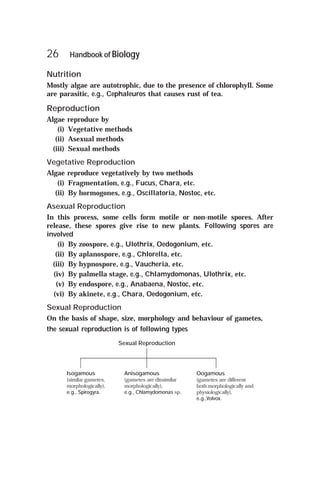
Skin is smooth .
and glandular.
Heart is with two
auricles and one
ventricle.
Respiration
occurs by lungs,
buccopharyngeal
cavity, skin and gills.
RBCs are nucleated.
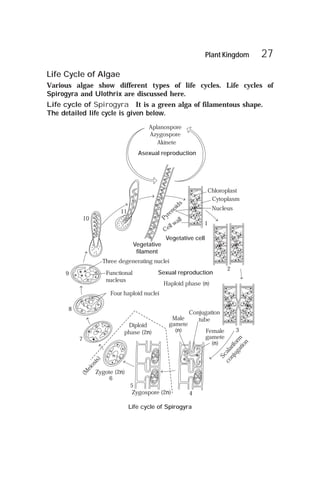
They have largest
RBCs of animal
kingdom.
Two pairs of limbs,
each with five-toes.
Skull is dicondylic.
Fertilisation is
external,
oviparous.
Cold-blooded.
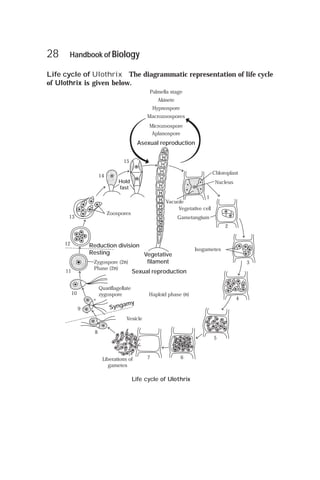
Skin is cornified and
covered with scales.
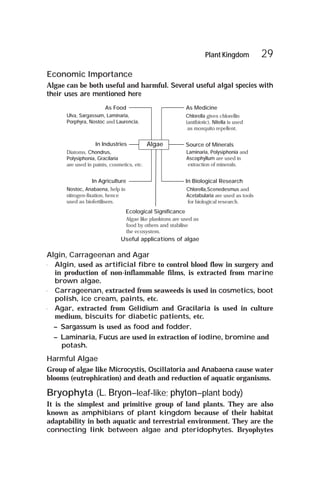
Heart consists of two.
auricles and partly
divided ventricle.
Respiration occurs
by lungs.
RBCs are nucleated.
Two pairs of
pentadactyl limbs,
each with 5 digits
bearing claws
corneoscutes. In
snakes, limbs are
absent.
Skull is monocondylic.
Thecodont teeth.
Fertilisation is
internal,
oviparous.
Warm-blooded.
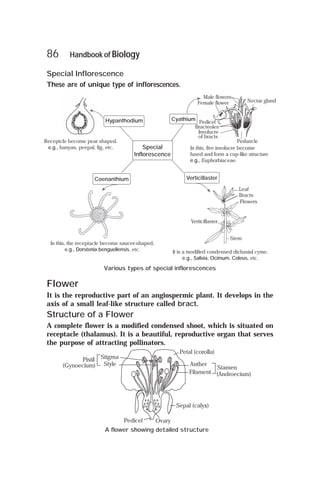
Skin is covered
by feathers,
Heart contains
two auricles and
two ventricles.
Respiration occurs
by lungs provided
by air sacs.
RBCs are nucleated.
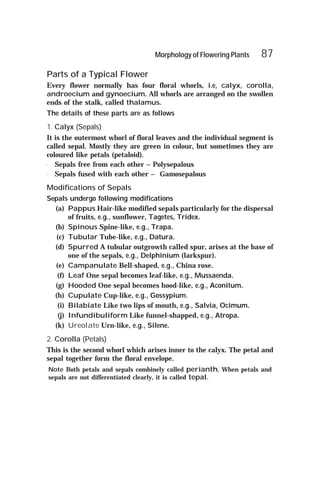
Forelimbs are modified
to wings and hindlimbs
are modified for walking,
swimming and pearching.
Hindlimbs bear claws
and scales.
Skull is monocondylic.
Teeth are absent and
upper and lower jaws
are modified into beak.
Fertilisation is internal,
oviparous.
Warm-blooded.
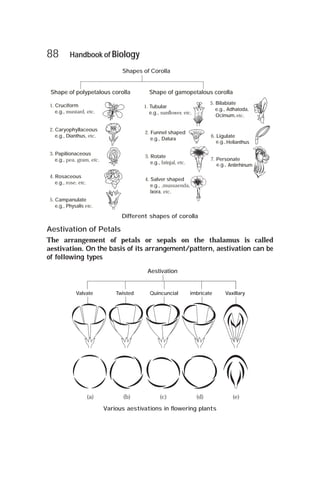
Skin is covered by
epidermal hairs.
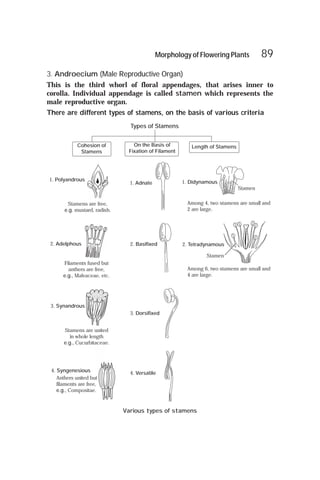
Heart contains two
auricles and two
ventricles.
Respiration occurs
by lungs.
RBCs are
enucleated.
Quadruped limbs
whose digit ends
with claws or nails
or hooves.
In whales and
dolphins, limbs
are absent.
Skull is dicondylic.
Thecodont, heterodont
and diphyodont teeth.
Fertilisation is internal,both
oviparous and viviparous.
•
•
•
•
•
Four classes
Tetrapoda
Reptilia Aves Mammals
•
•
•
•
•
•
•
•
•
•
•
•
•
•
•
• •
•
•
•
•
•
•
•
•
•
•
•
•
•
•
•
•
Reptilia
On the basis of the presence of temporal fossae, class–Reptilia is
sub-divided into three sub-classes, i e
. ., Anapsida, Parapsida and
Diapsida.
These sub-classes are further divided into orders and sub-orders as
follows
Aves
Class–Aves possesses various peculiar characteristics which are not
found in other animal groups. They possess long bones with air
cavities, i.e., pneumatic bones which reduce their body weight and
hence, helpful in flight. Their bones also lack bone marrow.
68 Handbook of Biology
Class–Reptilia
Anapsida Diapsida
Parapsida
Three sub-classes
Temporal fossae absent
(extinct as well as living).
Two temporal fossae
present (extinct as well
as living).
One temporal fossa
presents (extinct only),
and
e.g., Ichthyosaurus,
Protosaurus
Opthalmosaurus.
Two orders
Cotylosauria
e.g., Seymouria
Squamata
Living reptiles, movable
quadrate, vertebrae
procoelous, single-
headed ribs, males
possess paired
copulatory organs
(hemienis).
Terrestrial, semiaquatic
body covered with
carapace. Cloacal
aperture longitudinal
one nasal aperture,
oviparous,
and
e.g.,
Chelone Testudo.
Ophidia
Maxillae palatines, pterygoids movable,
attached by ligaments, tympanum and
nictitating membrane absent, tongue
slender bifid, protrusible, all snakes,
and
e.g., Naja, Crotalus, Python, Bungarus
Vipera.
Lacertilla
Three classes
Aquatic, large-sized, body covered
with scales or body plates, ribs possess
two heads, teeth thecodont, lungs in plural
cavity, four-chambered, heart, diaphragm is
also present.
and
e.g., Crocodilus, Gavialis Aligator.
Rhynchocephalia
Lizard-like, nocturnal,
carnivorous. Vertebra
amphicoelous,
transverse clocal
aperture, no copulatory
organ in males,
e.g., Sphenodon.
(On the basis of temporal fossae)
Chelonia
Two sub-orders
Terrestrial, arboreal or burrowing,
two pairs of limbs, eyelids movable,
all lizards are included in it,
and
e.g., Calotes,
Varanus, Chamaeleon Hemidactylus.
Crocodilia
Their sternum is large and bears a keel for the attachment of flight
muscles. They do not possess skin glands except the cutaneous oil
glands or green glands (or uropygial glands) that are located at the
root of the tail. These glands are absent in parrot and ostrich.
Class–Aves is further divided into sub-classes and orders as follows
Animal Kingdom 69
Odontognathae
(Extinct cretaceous
birds), jaw bears teeth
for catching fish.
e.g., Hesperornis,
Ichthyornis.
(Flight less running
birds)
Wings vestigial or
rudimentary, feathers
without any interlocking
mechanism.
Oil gland is absent
except in
and kiwi.
Sternal keel is
vestigial, flat or
raft-like.
Pygostyle is penis
or reduced.
Syrinx is absent.
Male has a penis,
(African ostrich),
(American ostrich),
(emu),
(cassowary)
(kiwi),
(tinamou).
Tinamus
e.g., Struthio camelus
Rhea americana
Dromaeus
Casurarius
Apteryx Tinamus
The super-order
includes modern
aquatic flightless
birds with paddle-
like wings or flippers.
Feet are webbed.
The skeleton is solid,
air sacs are absent.
The integument is a
fatty insulating layer,
(emperor penguin),
(rock hopper penguin).
e.g., Aptenodytes
Eudyptes
Modern flying birds,
with well-developed
wings and feathers with
interlocking mechanism.
Sternum with
developed keel.
Males have no
copulatory organ.
divers.
albatross.
,
swans, geese
and ducks.
vultures, eagles,
hawks and falkons.
.
pheasants.
,
pigeons.
,
parrots.
,
cuckoo.
,
kingfishers.
,
crow and thrashers.
Some important order
of flying birds are
e.g.,
e.g.,
e.g.,
e.g.,
e.g.,
e.g.,
e.g.,
e.g.,
e.g.,
e.g.,
Gaviiformes,
Procellariiformes,
Anseriformes
Falconiformes,
Gruiformes
Columbiformes
Psittaciformes
Cuculiformes
Coraciiformes
Passeriformes
•
•
•
•
Four super-orders
Palaeognathae Impennae Neognathae (Carinatar)
•
•
•
•
•
•
•
•
•
•
Archaeornithes
(Gk. –ancient; bird)
archios ornithes–
Two sub-classes
Class–Aves
Neonithes
Includes extinct (in Mesozoic era) birds,
homodont (same type of teeth) teeth in
both the jaw, long tapering tail, weak,
vertebrae are amphicoelous, keeled
sternum, non-pneumatic bones, hand
with clawed fingers wings are primitive
with little power of flight,
(ancient or lizard bird) and
.
e.g., Archaeopteryx
lithographica
Archaeornithes
(Includes extinct as well as living birds)
Teeth absent except in some fossil birds,
wings are well-developed and adapted
for flight, tail short and reduced, fingers of
the wings are without claw.
Flight Adaptation in Birds
In birds almost every system is modified to support flight as given
under
l The feathers constitute very smooth covering over the body to reduce
the friction of air. Due to non-conducting nature of these, body
temperature is maintained. Feathers of tail (rectrices) form fan-like
structure and steer the body during flight.
l Wings (remiges) act as main organ of flight with association of
feathers. They are responsible for supporting the bird during the
flight. Remiges are attached by ligament or directly to the bone.
l The bones are light, hollow and provide more space for the muscle
attachment.
Types of Feathers
Body in birds is covered by feathers made up of keratin protein. An
arrangement of feathers on the body of birds is called pterylosis. An
outline of these feathers are as follows
1. Contour feathers These are small feathers that cover the body,
wings and tail. Each contour feather has a central axis and a vane.
2. Flight feathers or Quills These are useful in flights and can be of
following types
(i) Remiges These are large wing feathers and further
categorised to
(a) Primaries which are attached to the bones of the hand.
(b) Secondaries which are attached to the bones of the
forearm.
(c) Tertiaries which are attached to the humerus of upper
arm bone.
(ii) Retrices These are large tail feathers.
(iii) Coverts These are found at the edge of remiges and
rectrices.
3. Filoplumes These are hair-like feathers scattered over body surface
and lie between the contour feathers. These act as sensory organs,
registering pressure and vibration.
4. Bristles Modified filoplumes found in certain birds near nostrils and
eyes. These are used as a touch sensor or funnel that makes the bird
reflexively snap up food.
5. Down feathers Found only in the newly hatched birds. These form
their first feathery covering, which provides insulation.
70 Handbook of Biology
Mammalia
Class–Mammalia is considered to be superior of all animal groups.
This class is further divided into two sub-classes.
The detailed classification of class–Mammalia is as follows
Animal Kingdom 71
Class–Mammalia
Prototheria
(Most primitive mammals)
Marsupialia
(pouched mammals)
(kangaroo),
(kolabear),
(opossum).
e.g., Macropus
Phascolarctos
Didelphys
Sub-classes
Oviparous
No pinna
No nipples
No marsupial pouch
Digestive and urinogenital
tracts open into a cloaca,
cloacal opens outside
through cloacal aperture
Corpus collosum is feebly
developed or absent
Testes abdominal, no
scrotum.
No placenta .
•
•
•
•
•
•
•
•
Metatheria
(Australian mammals)
Eutheria
(Placental mammals)
Viviparous
Pinna usually presents
Nipples abdominal or thoracic
Marsupial pouch absent
Digestive and urinogenital
tracts open out be separate
apertures.
Corpus callosum is well -
developed.
It connects two hemisphere
internally.
Testis extra abdominal, scrotum
lies below to penis.
Placenta is less developed.
Viviparous
Pinna presents
Nipples abdominal
Marsupial or abdominal
pouch often present.
Anus and urinogenital
aperture open into a shallow
cloaca surrounded by a
common sphincter.
Corpus callosum is not
developed or absent.
Testes extra abdominal, scrotum
lies anterior to penis.
Placenta is less developed.
•
•
•
•
•
•
•
Infra-classes
•
•
Theria
Monotremata
(connecting link between
reptile and mammals)
(duck-billed platypus),
or
(spiny anteater)
e.g., Ornithorhynchus
Tachyglossus Echidna
.
Order
•
•
•
•
•
•
•
Order
•
72 Handbook of Biology
Comparative
Analysis
of
Various
Phyla
of
Animal
Kingdom
Phylum
Porifera
Coelenterata
Ctenophora
Platyhelminthes
Aschelminthes
Organisation
level
Cellular
level
Tissue
level
Tissue
level
Organ
and
organ
system
level
Organ
system
level
Symmetry
No
clear
symmetry
Radial
symmetry
Radial
symmetry
Bilateral
symmetry
Bilateral
symmetry
Coelom
Absent
Absent
Absent
Absent
Pseudocoelomate
Segmentation
Absent
Absent
Absent
Absent
Absent
Digestive
system
Absent
Incomplete
Incomplete
Incomplete
Complete
Circulatory
system
Absent
Absent
Absent
Absent
Absent
Respiration
Absent
Absent
Absent
Absent
Absent
Distinctive
feature
Pores
and
canal
system
Cnidoblast
cells
Comb
plate
for
movement
Suckers,
flat
body
and
hooks.
Elongated
worm-like
Example
Sycon,
Spongilla
and
Euspongia.
Physalia,
Adamsia
and
Pennatula.
Ctenoplana
and
Pleurobrachia.
Taenia
and
Fasciola.
Ascaris,
Wuchereria
and
Ancylostoma.
Animal Kingdom 73
Comparative
Analysis
of
Various
Phyla
of
Animal
Kingdom
Annelida
Arthropoda
Mollusca
Echinodermata
Hemichordata
Chordata
Organ
system
level
Organ
system
level
Organ
system
level
Organ
system
level
Organ
system
level
Organ
system
level
Bilateral
symmetry
Bilateral
symmetry
Bilateral
symmetry
Radial
symmetry
Bilateral
symmetry
Bilateral
symmetry
Coelomate
Coelomate
Coelomate
Coelomate
Coelomate
Coelomate
Present
Present
Present
Absent
Absent
Present
Complete
Complete
Complete
Complete
Complete
Complete
Present
Present
Present
Present
Present
Present
Absent
Present
Present
Present
Present
Present
Segmented
body
Joint
appendage
and
exoskeleton
Shell
present
on
body
Radial
body
with
water
vascular
system
Worm-like
body
with
proboscis,
collar
and
trunk
Notochord,
nerve
cord,
gills
and
lungs.
Nereis,
Pheretima
and
Hirudinaria.
Apis,
Bombyx,
Anopheles
and
Locusta.
Pila,
Sepia
and
Octopus.
Asterias,
Echinus,
Cucumaria
and
Ophiura.
Balanoglossus
and
Saccoglossus.
Fish,
birds,
amphibians,
reptiles
and
mammals.
5
Morphology of
Flowering Plants
Plant Morphology : An Overview
Flowering plants or angiosperms show large diversity in external
structures or morphology. A generalised morphology of these plants is
as follows
Flower
Root hair
Root tip
Root cap
Reproductive organ,
contains four whorls as,
and , serves the
purpose of reproduction.
sepal, petal, androecium
gynoecium
Thread-like structures
in root to water
and minerals.
absorb
Contains
, a tissue of
meristematic nature.
root apical
meristem Protects root tip
from damage.
Node
Internode
Shoot tip
(apical bud)
Contains shoot apical
meristematic tissue, which
helps in apical dominance.
Lateral bud
Stem
Grows in underside of leaf
bases, forms new branch.
The main erect axis of
plant, bears almost all
organs like leaf, fruit,
flowers etc.
Primary root
Secondary root
Tap root of plant, carries
the lateral roots and root
Also called fibrous
root, supports the
main root.
Leaf
Photosynthetic organ,
possesses chlorophyll,
mainly of two types–
and ,
and are
main parts.
simple compound
lamina petiole
Seeds Fruit
Fertilised ovary,
protects the seeds and
carry out the pollination.
A typical flowering plant
Various components of plant’s morphology and their structures are
discussed here.
Root
It is generally a non-green, underground, positively geotropic,
positively hydrotropic and negatively phototropic, descending
cylindrical axis of the plant body which develops from the radicle of
the embryo. It is without node, internode, leaves, buds, flowers and
fruits. Its main function includes anchorage to the plant along with
water and mineral absorption.
Structure of Root
Generally, the root in plants is divided into three main regions. These
are
Root cap A smooth cap-shaped structure to provide protection to the
young apical cells against soil particles is called root cap.
Types of Root
There are two types of root
(i) Tap root Primary root further branches into secondary and
tertiary roots, e.g., dicotyledonous root.
(ii) Adventitious root In this, the radicle dies immediately after
germination, hence these roots arise from different portions of
the plant, e.g., monocotyledonous root.
Morphology of Flowering Plants 75
Region of
maturation
It is also known as
. The cells from
this region develop into
permanent tissue.
These have root hair around them.
zone of
differentiation
1
Region of
elongation
The region is just above the
meristematic zone. The cells
of this region are elongated and
contain large vacuole.
2
Region of
meristematic
activity
It is also known as
. The cells are in active state
of division. These are thin-walled,
have dense cytoplasm
and large nucleus.
meristematic
zone
3
Root cap
Root hair
The regions of the root-tip
Modifications of Roots
Both, tap roots and fibrous roots are modified, according to their need.
1. Modifications of Tap Roots
l
Pneumatophores are present in plants of coastal habitat. These
roots absorb oxygen.
l
Nodulated roots in leguminous plants form nodules after
combining with nitrogen-fixing bacteria. They are meant for
nitrogen-fixation.
2. Modifications of Adventitious Roots
(i) Tuberous From the nodes of the stem, e.g., sweet potato.
(ii) Fasciculated Arise in bunches, e.g., Asparagus, Dahlia.
(iii) Beadedroot Swell at different places, e.g., Vitis,. bitter gourd, etc.
(iv) Nodulose Apical portion swells up, e.g., Curcuma, maranta etc.
76 Handbook of Biology
Stem Pneumatophores
Tuber root
Tap Root
Tuberous Fusiform
Nodulated
Pneumatophores
e.g., Rhizophora, etc.
Napiform
Storage root
Secondary root
Tap root
Secondary root
e.g., radish, etc.
e.g., carrot, etc.
e.g., Mirabilis, etc.
e.g., turnip, sugarbeet, etc.
Storage roots
Secondary root
e.g., gram, pea,
peanuts, arhar, etc.
Conical
Pores
Respiratory roots
Nodule
Various modifications of tap root
(v) Annular Ring structure formed, e.g., Psychortia, cephaelis.
(vi) Prop roots Roots hang from branches and penetrate into soil,
e.g., Ficus, banyan.
(vii) Stilt Roots They arise from stem and enter into soil, e g
. ., maize,
sugarcane, etc.
(viii) Climbing roots Arise from nodes, e.g., Pothos, piper bettle.
(ix) Buttress roots Arise from basal part of main stem, e.g., Bombax.
(x) Contractile roots Underground and fleshy, e.g., onion, etc.
(xi) Sucking roots In parasites, e.g., Cuscuta.
(xii) Epiphytic roots Found in epiphytes, e.g., orchids.
(xiii) Floating roots Arise from nodes, help in floating, e.g., Jussiaea.
(xiv) Photosynthetic roots Have chlorophyll, e.g., Trapa, Tinospora.
(xv) Reproductive roots Develop vegetative buds, e.g., Trichosanthes
dioica.
(xvi) Mycorrhizal roots With fungal hyphae, e.g., Pinus.
(xvii) Thorn roots Serves as protective organ, e.g., Pothos.
(xviii) Clinging roots Arise from node and pierce into host plant,
e.g., Orchid, Ivy etc.
(xix) Leaf roots From margin of leaves, e.g., Bryophyllum.
Stem
It is the ascending cylindrical axis of plant body which develops from
the plumule of the embryo and grows by means of terminal bud. This
is usually negatively geotropic and positively phototropic. Its major
function is to conduct water, minerals and photosynthates and to
support the plant body.
Stem Branching
There are two types of branching
Morphology of Flowering Plants 77
Dichotomous
(two similar branches arise)
Lateral
(two different branches arise)
1
3
3
3
3
2
2
1
3
3
3
2
2
2 2
2
Stem Branching
Branching patterns in stem
Types of Stem
Stems are of three types
1. Aerial 2. Sub-aerial 3. Underground
Different types of stems, actually are the modified stem. The
modifications are to serve various purposes like perennation,
vegetative reproduction and storage of food.
1. Aerial/Epiterranean Stem Modifications
These are of following types
(i) Stem tendril In weak plants with weak stem, the apical bud
is modified into tendril for climbing, e.g., Vitis, Passiflora, etc.
(ii) Phylloclade In this, the stem is modified into flat, fleshy and
green leaf-like structure, e.g., Opuntia, Cocoloba, Ruscus, etc.
(iii) Stem thorn Axil of the leaf or apex of the branch is modified
into pointed structure called thorn, e.g., Citrus, Bougainvillea,
etc.
(iv) Cladode Stem is modified into leaf-like structure, e.g.,
Asparagus.
(v) Bulbil A multicellular structure functions as organ of
vegetative reproduction, e.g., Oxalis, Dioscorea, etc.
78 Handbook of Biology
Spiny
leave
Fleshy stem
Stem tendril
(axillary)
Weak stem
Leaf
(a) (b) (c)
(e)
(d)
Leaf
Bulbil
Stem
Spines
Thorn
Aerial stems : (a) Stem tendril in Vitis, (b) Phylloclade of Opuntia,
(c) Stem thorn of Bougainvillea, (d) Cladode in Asparagus,
(e) Bulbil in Dioscorea
2. Sub-Aerial/ Prostrate Stem
These are of following types
3. Underground/Subterrannean Stem
These are of following types
Morphology of Flowering Plants 79
Stem
Runner
Sucker
Offset
Stolon
Adventitious roots
e.g., Cynodon Oxalis Hydrocotyle
, ,
e.g., Colocasia, strawberry, etc.
e.g., Chrysanthemum
rose, mint and
Internode
Stolon
Crown
Scale
leaf
Node
Lamina
Spongy
petiole
Offset
Adventitious
roots
Internode
Node
Roots with
pocket
Sucker
Mother plant
Sucker plant
e.g., Pistia Eichhornia
, , etc.
Leaf
Stem (runner)
Aerial
shoot
Adventitious
roots
Leaves
Sub-aerial modifications in stem
Germinating
eye buds
Eyes
Base of scape
Bulb
Tunic
Adventitious
Roots
e.g., onion, garlic, lilies, etc.
Nodes
Buds
Adventitious
roots
e.g., ginger, turmeric, lotus, etc.
Node
Internode
Scale leaf
Corm
Daughter
corm
Adventitious
roots
e.g. Colocasia,
, etc.
e.g., potato
Stem
Rhizome
Bulb
Tuber
Corm
Roots
Young shoot
Scaly leaves
Underground modifications in stem
80 Handbook of Biology
Leaf
It is an exogenous, lateral, generally flattened outgrowth that arises
from the node of the stem and bears a bud in its axil. The leaves are
the most important vegetative organs for photosynthesis and also
perform gaseous exchange and transpiration.
Parts of Leaves
A typical leaf has three main parts
(i) Leaf base Part of leaf attached to the stem by the leaf base.
(ii) Petiole Part of leaf that connects lamina to stem.
(iii) Lamina or leaf blade Flattened part of the leaves, which
contains veins.
Leaf Venation
The arrangement of veins in lamina is known as venation.
Leaf apex
Leaf margin
Leaf blade
Vein
Midrib
Veinlet
Petiole
Stipule
Leaf base
Leaf lamina
Stem
Node
Typical leaf with its parts
Venation
Pinnate
(single midrib giving
rise to lateral veins)
Parallel
(veins run parallel
to each other within
a lamina)
Palmate
(multiple midribs dividing
into veinlets giving an
extensively reticulated pattern)
In dicots
In monocots
123
Different venation patterns in leaves
Types of Leaves
On the basis of incision of lamina, leaves may be of two types
1. Simple Leaves
In this, there is a single lamina, which is usually entire, e.g., mango,
guava, Cucurbita, etc. fig. (a).
2. Compound Leaves
In this type of leaves, the incision of lamina, reaches up to midrib or
petiole, e.g., rose, neem, lemon, etc.
These are of two types
(i) Pinnately compound leaves (a number of leaflets present on
rachis representing midrib of the leaf) fig. (b).
(ii) Palmately compound leaves (leaflets attached at a common
point, i.e., at the tip of petiole) fig. (c).
Morphology of Flowering Plants 81
Leaflet
Midrib
Lateral bud
Petiole
Stipule
(a) (b)
(c)
Simple leaf of lilac Pinnately compound leaf
of neem
Palmately compound
leaf of strawberry
Types of leaves
On the basis of origin and function, leaves are of the following types
Phyllotaxy
Arrangement of leaves on main stem or branches is known as
phyllotaxy. There are 5 main types of phyllotaxies, reported in plants.
The various phyllotaxies can be understood through following figures
82 Handbook of Biology
Cotyledonary
leaves
Bract leaves
Floral leaves
Foliage leaf
Cotyledonary
Leaves
e.g., Riccinus, Geranium
Bract Leaves
or
Hypophylls
e.g., Euphorbia,
Bougainvillea
Scale Leaves
or
Cataphylls
e.g., ginger
Prophylls
e.g., Agave
Floral Leaves
or
Sporophylls
e.g., sepals, petals, etc.
in most angiosperms.
Foliage Leaves
e.g., green
photosynthetic
leaves in almost
all plants.
Scaly
leaves
Leaves
Types of different functional leaves
(a) (c) (d) (e)
(b)
Types of phyllotaxy (a) Cyclic (b) Alternate (c) Opposite
decussate, (d) Opposite superposed (e) Whorled or verticillate
Modifications of Leaves
Inflorescence
The Shoot Apical Meristem (SAM) changes into floral meristem to form
a flower and this flower bearing branch is called peduncle. The
arrangement of flowers on floral axis is termed as inflorescence.
It can also be defined as ‘system of branches bearing flower.’
Morphology of Flowering Plants 83
e.g., Acacia
Parkinsonia
Australian ,
, etc.
Pitcher
leaves
Phyllode
Leaf tendril
Fleshy leaves
Scale leaves
Leaf hooks
Bladder
shaped
leaves
e.g., Nepenthes,
Sarracenia, etc.
Leaf tendril
e.g., Pisum
Lathyrus
,
, etc.
Fleshy
leaves
e.g., Onion,
garlic, etc.
Leaf
thorn
e.g., Acacia Cactus
, , etc.
e.g., Bignonia,
Asparagus, etc.
Leaf thorn
Leaf bladder
e.g., Utricularia ,etc
Lid
Pitcher
Leaflet
Stem
Phyllode
(Petiole)
Leaves
Leaflets
Stolon
Scale
Leaf
e.g., Hydrilla,
Vallisnaria, etc.
Various leaf modifications
Types of Inflorescence
On the basis of the mode of branching and modification of the
peduncle, the inflorescence is of following types
Racemose/Indeterminate/Indefinite Inflorescence
The peduncle continues to grow, forming new bracts and flowers in
succession (acropetal manner). In this, the oldest flower is near to base
and youngest is near the growing point.
84 Handbook of Biology
Thyrus
(grapevine)
Uniparous or
monochasial cyme
(potato)
Raceme (mustard) Cyathium
( )
Euphorbia
Mixed spadix
(banana)
Biparous or dichasial
cyme (night jasmine)
Panicle (gold mohur)
Verticillaster
( )
Ocimum
Scorpigerus cyme
umbel (onion)
Polychasial or
Multiparous cyme
( )
Dianthus
Corymb (candytuft)
Hypanthodium
(Peepal)
Cymose corymb
( )
Ixora
Cymose head (keekar)
Spike (bottle brush)
Spikelet (wheat)
Catkin (mulberry)
Spadix (palm)
Umbel (coriander)
Capitulum or head
(sunflower)
Strobile (hop)
Coenanthium
( )
Dorstenia
Mixed panicle
( )
Ligustrum
Types of Inflorescence
Recemose or
indeterminate
or indefinite
Cymose or
determinater or
definite
Compund Special type
Scapigerous
Racemose
Inflorescence
Raceme
Panicle
Corymb
Spikelet
Strobile
Umbel
Spadix
Catkin
e.g., mustard
radish, etc.
e.g., Achyranthus
e.g.,
, .
wheat,
rice, bamboo etc
Capitulum
Indeterminate
Determinate
e.g., sunflower, etc.
e.g., gymnospermous
plants
Spike
e.g., Hydrocotyle
Prunus
,
, etc.
spathe
e.g., Colocasia
palm,
musa etc.
e.g., mulberry,
morus, etc.
e.g., goldmohar, etc.
e.g., candytuft, etc.
Various types of racemose inflorescence
Cymose/Determinate/Definite Inflorescence
In this type of inflorescence, the apical meristem of peduncle produces
the first flower while, the other flowers originate from lateral branches
from the axis below. The oldest flower remains in centre and the
youngest towards periphery, this arrangement is called centrifugal or
basipetal sequence.
Compound/Mixed Inflorescence
In this, the peduncle or main axis branches repeatedly once or twice in
racemose or cymose manner.
Morphology of Flowering Plants 85
Mixed Inflorescence
Thyrus Mixed spadix Scorpigerous
cyme umble
Cymose
corymb
Mixed
panicle
The spadices
arranged
acropetaly
banana
e.g.,
An umbellate
Cyme is borne
on a scape.
onion.
e.g.,
e.g., Ixora e.g., Ligustrium
The cluster of cymose
inflorescence arranged
acropetaly, grapevine,
etc.
e.g.,
Various types of compound inflorescences
Uniparous or
Monochasial
Biparous or
dichasial
Cymose
head
Multiparous or
polychasial
e.g., Acacia
Albizzia
,
, etc.
e.g., Calotropis
Hamelia
,
, etc.
e.g., Drosera Ranunculus
Myosotis
, ,
, etc.
e.g., Stellaria Spergula
Dianthus
,
and , etc.
Cymose
Inflorescence
Various types of cymose inflorescences
Special Inflorescence
These are of unique type of inflorescences.
Flower
It is the reproductive part of an angiospermic plant. It develops in the
axis of a small leaf-like structure called bract.
Structure of a Flower
A complete flower is a modified condensed shoot, which is situated on
receptacle (thalamus). It is a beautiful, reproductive organ that serves
the purpose of attracting pollinators.
86 Handbook of Biology
Cyathium
Verticillaster
Hypanthodium
Coenanthium
Special
Inflorescence
In this, five involucre become
fused and form a cup-like structure
Euphorbiaceae.
e.g.,
It is a modified condensed dichasial cyme,
, , , etc.
e.g., Salivia Ocimum Coleus
In this, the receptacle become saucer-shaped,
, etc.
e.g., Dorstenia benguellensis
Nectar gland
Male flowers
Female flower
Pedicel
Bracteoles
Involucre
of bracts
Peduncle
Leaf
Bracts
Flowers
Stem
Verticillaster
Receptcle become pear shaped.
banyan, peepal, fig, etc.
e.g.,
Various types of special inflorescences
Style
Stigma
Anther
Petal (corolla)
Filament
Sepal (calyx)
Ovary
Stamen
Pistil
(Gynoecium)
(Androecium)
Pedicel
A flower showing detailed structure
Parts of a Typical Flower
Every flower normally has four floral whorls, i.e, calyx, corolla,
androecium and gynoecium. All whorls are arranged on the swollen
ends of the stalk, called thalamus.
The details of these parts are as follows
1. Calyx (Sepals)
It is the outermost whorl of floral leaves and the individual segment is
called sepal. Mostly they are green in colour, but sometimes they are
coloured like petals (petaloid).
l Sepals free from each other – Polysepalous
l Sepals fused with each other – Gamosepalous
Modifications of Sepals
Sepals undergo following modifications
(a) Pappus Hair-like modified sepals particularly for the dispersal
of fruits, e.g., sunflower, Tagetes, Tridex.
(b) Spinous Spine-like, e.g., Trapa.
(c) Tubular Tube-like, e.g., Datura.
(d) Spurred A tubular outgrowth called spur, arises at the base of
one of the sepals, e.g., Delphinium (larkspur).
(e) Campanulate Bell-shaped, e.g., China rose.
(f) Leaf One sepal becomes leaf-like, e.g., Mussaenda.
(g) Hooded One sepal becomes hood-like, e.g., Aconitum.
(h) Cupulate Cup-like, e.g., Gossypium.
(i) Bilabiate Like two lips of mouth, e.g., Salvia, Ocimum.
(j) Infundibuliform Like funnel-shapped, e.g., Atropa.
(k) Ureolate Urn-like, e.g., Silene.
2. Corolla (Petals)
This is the second whorl which arises inner to the calyx. The petal and
sepal together form the floral envelope.
Note Both petals and sepals combinely called perianth. When petals and
sepals are not differentiated clearly, it is called tepal.
Morphology of Flowering Plants 87
Aestivation of Petals
The arrangement of petals or sepals on the thalamus is called
aestivation. On the basis of its arrangement/pattern, aestivation can be
of following types
88 Handbook of Biology
1. Cruciform
mustard, etc.
e.g.,
2. Caryophyllaceous
, etc.
Dianthus
e.g.,
3. Papilionaceous
pea, gram, etc.
e.g.,
4. Rosaceous
rose, etc.
e.g.,
5. Campanulate
etc.
Physalis
e.g.,
Shapes of Corolla
Shape of polypetalous corolla Shape of gamopetalous corolla
1. Tubular
sunflower, etc.
e.g.,
5. Bilabiate
,
Adhatoda
etc.
Ocimum,
e.g.,
2. Funnel shaped
Datura
e.g.,
3. Rotate
brinjal, etc.
e.g.,
4. Salver shaped
,mussaenda,
Ixora, etc.
e.g.,
6. Ligulate
Personate
e.g.,Helianthus
e.g., Antirrhinum
7.
7.
Different shapes of corolla
(a) (b) (c) (d) (e)
Aestivation
Valvate Twisted Quincuncial imbricate Vaxillary
Various aestivations in flowering plants
3. Androecium (Male Reproductive Organ)
This is the third whorl of floral appendages, that arises inner to
corolla. Individual appendage is called stamen which represents the
male reproductive organ.
There are different types of stamens, on the basis of various criteria
Morphology of Flowering Plants 89
Types of Stamens
Length of Stamens
Cohesion of
Stamens
1. Adnate
2. Basifixed
3. Dorsifixed
4. Versatile
On the Basis of
Fixation of Filament
Among 4, two stamens are small and
2 are large.
2. Tetradynamous
Stamen
Stamen
1. Polyandrous
Stamens are free,
mustard, radish.
e.g.
2. Adelphous
Filaments fused but
anthers are free,
Malvaceae, etc.
e.g.,
3. Synandrous
Stamens are united
in whole length
Cucurbitaceae.
e.g.,
4. Syngenesious
Anthers united but
filaments are free,
Compositae.
e.g.,
1. Didynamous
Among 6, two stamens are small and
4 are large.
Various types of stamens
4. Gynoecium (Female Reproductive Organ)
It is the innermost floral whorl which acts as female reproductive
organ of the flower. On the basis of number of carpels and their
arrangement, the gynoecium is of following types
Terms Related to Flower Structure
1. Actinomorphic flower When the flower is regular
and radially symmetrical, it is termed as actinomorphic,
e.g., mustard (Cruciferae), onion (Liliaceae), brinjal (Solanaceae).
2. Asymmetric flower Flowers, which cannot be divided into
two equal halves by any vertical division, e.g., Canna.
3. Zygomorphic flower When the flower is bilaterally
symmetrical, i.e., divisible into only two equal halves by a single
vertical plane, it is termed as zygomorphic, e.g., Adhatoda, pea,
larkspur, Ocimum.
90 Handbook of Biology
(a) (b)
Symmetries in flowers (a) Actinomorphic (b) Zygomorphic
Types of Gynoecium
Apocarpous Semicarpous Syncarpous Synstylovarious Unicarpellous
Synovarious
(with free or
separate carpels)
(with fused
ovaries
of adjacent
carpel and
free style and
stigma)
(with fused
carpels)
(ovaries of
adjacent
carpels
are fused,
but their
style and stigma
are separate)
(ovaries
and
style are
fused,
stigma
separate)
(Stylodious)