www.company.comwww.company.com
Cycles of Climatic Change in
Quaternary Period (Glacials and
Interglacials)
By Abdelrhim Eltijani
M.Sc. Applied Geology
2nd semester, roll no. 22
www.company.com
Outlines
• The Quaternary Period
• Quaternary paleogeography
– Definitions
– Background
– The Eemian/Sangamon interglacial, 130-115 ka BP
– The Early-Middle Weichselian/Wisconsin, 115-50 ka BP
– The Last Glacial Maximum (LGM), MIS 2, 20-18 ka BP
www.company.com
The Quaternary Period
• The Quaternary is the most recent geological period of time in
Earth’s history, spanning the last 2 million years and extending
up to the present day. The Quaternary period is subdivided into
the Pleistocene (“Ice Age”), spanning most of the Quaternary
and the Holocene (present warm interval) epochs, covering the
past 10 000 years.
• The Quaternary is characterized by a series of large-scale
environmental changes that have profoundly affected and
shaped both landscapes and life on Earth. One of the most
distinctive features of the Quaternary the periodic build-up of
major continental ice sheets and mountain ice caps during long
lasting glacial stages, divided by warm episodes (interglacials) of
shorter duration, when temperatures were similar to or higher
than today.
www.company.com
The Quaternary Period
• There have been shifts in the frequency of climate oscillations and
amplitude of temperatures and glaciations through the Quaternary.
At the onset of the Quaternary, many arctic areas were
comparatively warm, with trees and bushes growing far north of
the present treeline.
• Prior to about 800 000 years ago each interglacial-glacial cycle
lasted for about 40 000 years, but after that the periodicity shifted
to a prevailing rhythm of about 100 000 years.
• Prior to this shift there was a repeated build-up of relatively small-
to-moderate sized ice sheets at high northern latitudes.
www.company.com
The Quaternary Period
• After 800 000 years ago there occurred a major intensification of
glaciations, with repeated growth of continental-scale ice sheets
reaching mid-latitudes and with ice volumes much larger than
during the earlier Quaternary glaciations.
• There have occurred 8-10 major glaciations during the past 800
000 years. Two of the largest Northern Hemisphere glaciations are
the last one (called the Weichselian/Wisconsin glaciation, 20 000
years ago) and the Saalian/Illinoian glaciation, occurring prior to c.
130 000 years ago.
• During the peak of both glaciations, ice sheets covered extensive
areas north of 40-50oN in both Eurasia and N America. The Saalian
glaciation was particularly extensive in the high Eurasian north,
covering vast areas of N Russia, coastal Arctic Ocean and Siberia.
www.company.com
The Quaternary Period
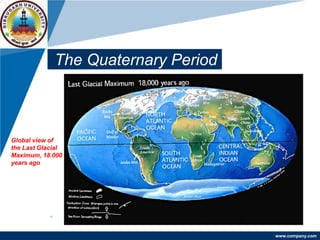
Global view of
the Last Glacial
Maximum, 18.000
years ago
www.company.com
The Quaternary Period
• The repeated Northern Hemisphere Quaternary glaciations have
left a complex of landforms, sediments and landscapes that set the
frame for mid-high latitude life and human activities.
• Human societies rely on natural resources that are products of the
Pleistocene glaciations, like sands and gravels for construction
activities, groundwater magazines in ancient fluvial deltas, fertile
glacial till and outwash planes for forestry and agriculture.
www.company.com
References and further reading
Andersen, B.G. & Borns, H.W.Jr., The Ice Age World, Oslo, Scandinavian University Press,
1994.
Dawson, A., Ice Age Earth, London, Routledge, 1992.
Lowe, J. J. and Walker, M.J.C., Reconstructing Quaternary Environments, Harlow, Longman
Limited, 1997
Nilsson, T., The Pleistocene, Dordrecht, Reidel, 1983.
Williams, M., Dunkerley, D., Decker, P., Kershaw, P. and Chappell, J., Quaternary
Environments, London, Arnolds, 1998.
Wilson, R.C.L., Drury, S.A. and Chapman, J.L., The Great Ice Age: Climate Change and Life,
London, Routledge, 1999.
www.company.com
Quaternary paleogeography
• Paleogeography deals with reconstructing the physical
geography of past geological times, where the focus is on
physical features such as the shifting locations of shorelines,
rivers and drainage systems, tectonics and mountain-building,
paleolatitude and continental drift, location in time and space of
continental shelf areas and other sedimentary basins.
• The field of Quaternary paleogeography broadly includes all
aspects of paleo-map reconstructions through the Quaternary
Period; ice sheet and sea-level fluctuations in time and space;
the delineation of past topographic or bathymetric contours
….etc.
- Definitions
www.company.com
Quaternary paleogeography
• The frame for major global environmental changes is set by
large-scale tectonics and position and configuration of the
continental landmasses. These affect the paths of ocean currents
and air masses and in turn decide the global energy distribution.
• The steady northward drift of Europe, Asia and North America
through the Tertiary Period (65-2 Ma (million years) BP (before
present)) caused the gradual tectonic closing of the connection
between the Pacific Ocean and the Arctic Ocean and reduced
the previously efficient ocean heat transport from equatorial
regions toward the North Pole.
- Background
www.company.com
Quaternary paleogeography
- Background
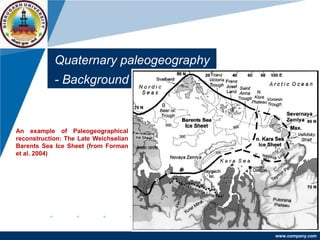
An example of Paleogeographical
reconstruction: The Late Weichselian
Barents Sea Ice Sheet (from Forman
et al. 2004)
www.company.com
Quaternary paleogeography
- Background
• Most Quaternary Paleogeographic reconstructions focus on time
slices through the past ca. 130 ka (kilo-years). That is for the
simple reason that there is ample geological and biological
evidence preserved in the geological record with resolution high
enough to allow for reasonably detailed reconstructions, whereas
evidences of earlier large-scale Quaternary environmental changes
usually are fragmentary.
• During the past 130 ka the climate has changed from interglacial to
glacial and then back to the present-day interglacial, i.e. fluctuated
between end members in the climate-environmental system. It is
assumed that environmental changes through the last interglacial-
glacial cycle have occurred repeatedly through earlier glacial
cycles.
www.company.com
Quaternary paleogeography
- The Eemian/Sangamon interglacial, 130-115 ka BP -
• The beginning of the last interglacial is reflected in the marine
records by abrupt shift to lighter isotope values. The preceding
Saalian/Illinoian glaciation was extremely extensive at both high
and middle latitudes, and the onset of the Eemian/Sangamon
interglacial is marked at many Arctic locations by marine
transgression across isostatically depressed coastal areas.
• Deposits from this marine transgression are particularly
pronounced along the northern Russian and Siberian coastal
lowlands. A range of proxy data suggests that the
Eemian/Sangamon climate optimum summer temperatures were
considerably (2-4oC) warmer than that of the present day, and
that vegetation zones on the continents migrated northwards.
www.company.com
Quaternary paleogeography
- The Eemian/Sangamon interglacial, 130-115 ka BP -
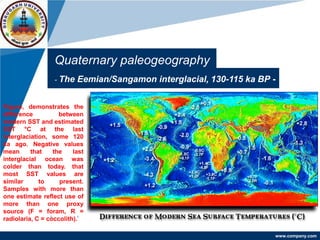
Figure, demonstrates the
difference between
modern SST and estimated
SST °C at the last
interglaciation, some 120
ka ago. Negative values
mean that the last
interglacial ocean was
colder than today. that
most SST values are
similar to present.
Samples with more than
one estimate reflect use of
more than one proxy
source (F = foram, R =
radiolaria, C = coccolith).
www.company.com
Quaternary paleogeography
- The Early-Middle Weichselian/Wisconsin, 115-50 ka BP
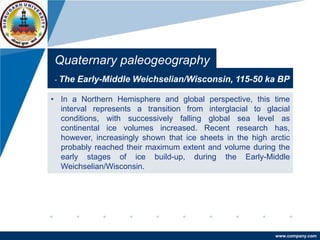
• In a Northern Hemisphere and global perspective, this time
interval represents a transition from interglacial to glacial
conditions, with successively falling global sea level as
continental ice volumes increased. Recent research has,
however, increasingly shown that ice sheets in the high arctic
probably reached their maximum extent and volume during the
early stages of ice build-up, during the Early-Middle
Weichselian/Wisconsin.
www.company.com
Quaternary paleogeography
- The Early-Middle Weichselian/Wisconsin, 115-50 ka BP
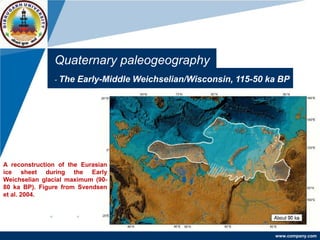
A reconstruction of the Eurasian
ice sheet during the Early
Weichselian glacial maximum (90-
80 ka BP). Figure from Svendsen
et al. 2004.
www.company.com
Quaternary paleogeography
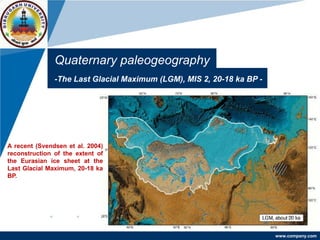
-The Last Glacial Maximum (LGM), MIS 2, 20-18 ka BP -
• LGM is defined as the maximum global ice volume as seen in
marine oxygen isotope records and coinciding with the maximum
extension of middle latitudes Northern Hemisphere ice sheets
during the last glacial cycle. It is generally thought to have
occurred around 20-18 ka BP, but it is, however, acknowledged
that the timing, duration and extent of ice cover at LGM differed
considerably in different regions of the Arctic.
• Recent interpretations of the northern Eurasian glacial record
suggest that most of the mainland of N Russia and Siberia
remained ice-free during the LGM.
www.company.com
Quaternary paleogeography
-The Last Glacial Maximum (LGM), MIS 2, 20-18 ka BP -
A recent (Svendsen et al. 2004)
reconstruction of the extent of
the Eurasian ice sheet at the
Last Glacial Maximum, 20-18 ka
BP.
www.company.com
References and suggested further reading:
Elias, S.A. & Brigham-Grette, J. (eds.), Beringian Paleoenvironments. Festschrift
in Honour of D.M. Hopkins. Quaternary Science Reviews, 20(1-3), 2001.
Forman, S.L. et al. 2004: A review of postglacial emergence on Svalbard, Franz
Josef Land and Novaya Zemlya, northern Eurasia. Quaternary Science Reviews
23, 1391–1434
Frenzel, B., Pécsi, M. & Velichko, A. A. (eds.), Atlas of paleoclimates and
paleoenvironments of the Northern Hemisphere: Late Pleistocene – Holocene.
Budapest, Geographical Research Institute, Hungarian Academy of Science, 1992.
Manley, W.F., 2002, Postglacial Flooding of the Bering Land Bridge: A Geospatial
Animation: INSTAAR, University of Colorado, v1,
http://instaar.colorado.edu/QGISL/bering_land_bridge
Svendsen, J.I. et al. 2004: Late Quaternary ice sheet history of northern Eurasia.
Quaternary Science Reviews, 23, 1229-1271.

Cycles of climatic changes

  • 1.
    www.company.comwww.company.com Cycles of ClimaticChange in Quaternary Period (Glacials and Interglacials) By Abdelrhim Eltijani M.Sc. Applied Geology 2nd semester, roll no. 22
  • 2.
    www.company.com Outlines • The QuaternaryPeriod • Quaternary paleogeography – Definitions – Background – The Eemian/Sangamon interglacial, 130-115 ka BP – The Early-Middle Weichselian/Wisconsin, 115-50 ka BP – The Last Glacial Maximum (LGM), MIS 2, 20-18 ka BP
  • 3.
    www.company.com The Quaternary Period •The Quaternary is the most recent geological period of time in Earth’s history, spanning the last 2 million years and extending up to the present day. The Quaternary period is subdivided into the Pleistocene (“Ice Age”), spanning most of the Quaternary and the Holocene (present warm interval) epochs, covering the past 10 000 years. • The Quaternary is characterized by a series of large-scale environmental changes that have profoundly affected and shaped both landscapes and life on Earth. One of the most distinctive features of the Quaternary the periodic build-up of major continental ice sheets and mountain ice caps during long lasting glacial stages, divided by warm episodes (interglacials) of shorter duration, when temperatures were similar to or higher than today.
  • 4.
    www.company.com The Quaternary Period •There have been shifts in the frequency of climate oscillations and amplitude of temperatures and glaciations through the Quaternary. At the onset of the Quaternary, many arctic areas were comparatively warm, with trees and bushes growing far north of the present treeline. • Prior to about 800 000 years ago each interglacial-glacial cycle lasted for about 40 000 years, but after that the periodicity shifted to a prevailing rhythm of about 100 000 years. • Prior to this shift there was a repeated build-up of relatively small- to-moderate sized ice sheets at high northern latitudes.
  • 5.
    www.company.com The Quaternary Period •After 800 000 years ago there occurred a major intensification of glaciations, with repeated growth of continental-scale ice sheets reaching mid-latitudes and with ice volumes much larger than during the earlier Quaternary glaciations. • There have occurred 8-10 major glaciations during the past 800 000 years. Two of the largest Northern Hemisphere glaciations are the last one (called the Weichselian/Wisconsin glaciation, 20 000 years ago) and the Saalian/Illinoian glaciation, occurring prior to c. 130 000 years ago. • During the peak of both glaciations, ice sheets covered extensive areas north of 40-50oN in both Eurasia and N America. The Saalian glaciation was particularly extensive in the high Eurasian north, covering vast areas of N Russia, coastal Arctic Ocean and Siberia.
  • 6.
    www.company.com The Quaternary Period Globalview of the Last Glacial Maximum, 18.000 years ago
  • 7.
    www.company.com The Quaternary Period •The repeated Northern Hemisphere Quaternary glaciations have left a complex of landforms, sediments and landscapes that set the frame for mid-high latitude life and human activities. • Human societies rely on natural resources that are products of the Pleistocene glaciations, like sands and gravels for construction activities, groundwater magazines in ancient fluvial deltas, fertile glacial till and outwash planes for forestry and agriculture.
  • 8.
    www.company.com References and furtherreading Andersen, B.G. & Borns, H.W.Jr., The Ice Age World, Oslo, Scandinavian University Press, 1994. Dawson, A., Ice Age Earth, London, Routledge, 1992. Lowe, J. J. and Walker, M.J.C., Reconstructing Quaternary Environments, Harlow, Longman Limited, 1997 Nilsson, T., The Pleistocene, Dordrecht, Reidel, 1983. Williams, M., Dunkerley, D., Decker, P., Kershaw, P. and Chappell, J., Quaternary Environments, London, Arnolds, 1998. Wilson, R.C.L., Drury, S.A. and Chapman, J.L., The Great Ice Age: Climate Change and Life, London, Routledge, 1999.
  • 9.
    www.company.com Quaternary paleogeography • Paleogeographydeals with reconstructing the physical geography of past geological times, where the focus is on physical features such as the shifting locations of shorelines, rivers and drainage systems, tectonics and mountain-building, paleolatitude and continental drift, location in time and space of continental shelf areas and other sedimentary basins. • The field of Quaternary paleogeography broadly includes all aspects of paleo-map reconstructions through the Quaternary Period; ice sheet and sea-level fluctuations in time and space; the delineation of past topographic or bathymetric contours ….etc. - Definitions
  • 10.
    www.company.com Quaternary paleogeography • Theframe for major global environmental changes is set by large-scale tectonics and position and configuration of the continental landmasses. These affect the paths of ocean currents and air masses and in turn decide the global energy distribution. • The steady northward drift of Europe, Asia and North America through the Tertiary Period (65-2 Ma (million years) BP (before present)) caused the gradual tectonic closing of the connection between the Pacific Ocean and the Arctic Ocean and reduced the previously efficient ocean heat transport from equatorial regions toward the North Pole. - Background
  • 11.
    www.company.com Quaternary paleogeography - Background Anexample of Paleogeographical reconstruction: The Late Weichselian Barents Sea Ice Sheet (from Forman et al. 2004)
  • 12.
    www.company.com Quaternary paleogeography - Background •Most Quaternary Paleogeographic reconstructions focus on time slices through the past ca. 130 ka (kilo-years). That is for the simple reason that there is ample geological and biological evidence preserved in the geological record with resolution high enough to allow for reasonably detailed reconstructions, whereas evidences of earlier large-scale Quaternary environmental changes usually are fragmentary. • During the past 130 ka the climate has changed from interglacial to glacial and then back to the present-day interglacial, i.e. fluctuated between end members in the climate-environmental system. It is assumed that environmental changes through the last interglacial- glacial cycle have occurred repeatedly through earlier glacial cycles.
  • 13.
    www.company.com Quaternary paleogeography - TheEemian/Sangamon interglacial, 130-115 ka BP - • The beginning of the last interglacial is reflected in the marine records by abrupt shift to lighter isotope values. The preceding Saalian/Illinoian glaciation was extremely extensive at both high and middle latitudes, and the onset of the Eemian/Sangamon interglacial is marked at many Arctic locations by marine transgression across isostatically depressed coastal areas. • Deposits from this marine transgression are particularly pronounced along the northern Russian and Siberian coastal lowlands. A range of proxy data suggests that the Eemian/Sangamon climate optimum summer temperatures were considerably (2-4oC) warmer than that of the present day, and that vegetation zones on the continents migrated northwards.
  • 14.
    www.company.com Quaternary paleogeography - TheEemian/Sangamon interglacial, 130-115 ka BP - Figure, demonstrates the difference between modern SST and estimated SST °C at the last interglaciation, some 120 ka ago. Negative values mean that the last interglacial ocean was colder than today. that most SST values are similar to present. Samples with more than one estimate reflect use of more than one proxy source (F = foram, R = radiolaria, C = coccolith).
  • 15.
    www.company.com Quaternary paleogeography - TheEarly-Middle Weichselian/Wisconsin, 115-50 ka BP • In a Northern Hemisphere and global perspective, this time interval represents a transition from interglacial to glacial conditions, with successively falling global sea level as continental ice volumes increased. Recent research has, however, increasingly shown that ice sheets in the high arctic probably reached their maximum extent and volume during the early stages of ice build-up, during the Early-Middle Weichselian/Wisconsin.
  • 16.
    www.company.com Quaternary paleogeography - TheEarly-Middle Weichselian/Wisconsin, 115-50 ka BP A reconstruction of the Eurasian ice sheet during the Early Weichselian glacial maximum (90- 80 ka BP). Figure from Svendsen et al. 2004.
  • 17.
    www.company.com Quaternary paleogeography -The LastGlacial Maximum (LGM), MIS 2, 20-18 ka BP - • LGM is defined as the maximum global ice volume as seen in marine oxygen isotope records and coinciding with the maximum extension of middle latitudes Northern Hemisphere ice sheets during the last glacial cycle. It is generally thought to have occurred around 20-18 ka BP, but it is, however, acknowledged that the timing, duration and extent of ice cover at LGM differed considerably in different regions of the Arctic. • Recent interpretations of the northern Eurasian glacial record suggest that most of the mainland of N Russia and Siberia remained ice-free during the LGM.
  • 18.
    www.company.com Quaternary paleogeography -The LastGlacial Maximum (LGM), MIS 2, 20-18 ka BP - A recent (Svendsen et al. 2004) reconstruction of the extent of the Eurasian ice sheet at the Last Glacial Maximum, 20-18 ka BP.
  • 19.
    www.company.com References and suggestedfurther reading: Elias, S.A. & Brigham-Grette, J. (eds.), Beringian Paleoenvironments. Festschrift in Honour of D.M. Hopkins. Quaternary Science Reviews, 20(1-3), 2001. Forman, S.L. et al. 2004: A review of postglacial emergence on Svalbard, Franz Josef Land and Novaya Zemlya, northern Eurasia. Quaternary Science Reviews 23, 1391–1434 Frenzel, B., Pécsi, M. & Velichko, A. A. (eds.), Atlas of paleoclimates and paleoenvironments of the Northern Hemisphere: Late Pleistocene – Holocene. Budapest, Geographical Research Institute, Hungarian Academy of Science, 1992. Manley, W.F., 2002, Postglacial Flooding of the Bering Land Bridge: A Geospatial Animation: INSTAAR, University of Colorado, v1, http://instaar.colorado.edu/QGISL/bering_land_bridge Svendsen, J.I. et al. 2004: Late Quaternary ice sheet history of northern Eurasia. Quaternary Science Reviews, 23, 1229-1271.