


Microfossil
Importance In
Temperature
BIBEK CHATERJEE(414er2015)
Contents
 Introduction
 Why are marine microfossils useful?
 Ecology study on microfossils
 Physical environmental factor
 Temperature of the water
1. Influence on distribution
2. Influence on test Morphology
 Role of water depth
 Study of paleotemperature(Using O isotope)
 Case Study
 Reference
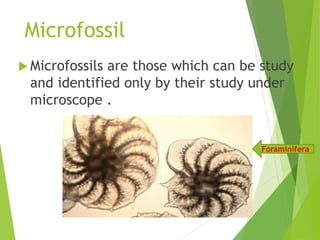
Microfossil
 Microfossils are those which can be study
and identified only by their study under
microscope .
Foraminifera
What are marine microfossils?
 Fossilized remains of small organisms
or tiny hardparts of larger organisms.
 Plankton
 Benthic fauna
 Many different groups representing
animals, and a variety of algae.
Protistan Microfossils
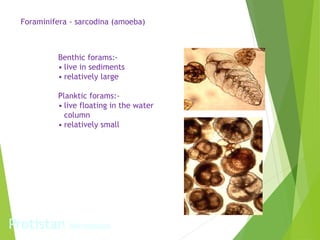
Foraminifera - sarcodina (amoeba)
Benthic forams:-
• live in sediments
• relatively large
Planktic forams:-
• live floating in the water
column
• relatively small
Protistan Microfossils
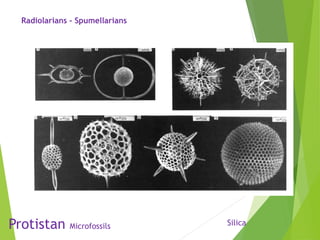
Radiolarians - Spumellarians
Silica
Algal Microfossils
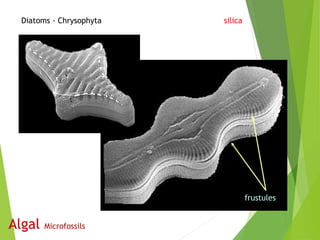
Diatoms - Chrysophyta silica
frustules
Why are marine microfossils
useful?
 Biostratigraphy :- dating rock layers using
fossils.
 Environmental reconstruction :- identifying
different marine environments in the past.
 Paleothermometry :- determining ocean
water temperature in the past.
 Paleoclimatology :- reconstructing climate
change through Earth’s history.
Ecology Study on
Microfossils
 Ecological study of foraminifera play important role in
oceanographic investigations.
 They are preferred to other microfossil group because of there
abundant .In general, foraminifera occurs in all the different
type of marine environment and very rarely in freshwater.
 Most foraminifera's are benthic and hence are controlled by such
factor like depth, temperature, and the nature of the ocean
floor.
 They show change of their distribution pattern with change of
temperature of oceanic water, they also remarkable latitude
variation as regards the abundance of their different groups from
equator to pole.
PHYSICAL ENVIRONMENTAL FACTORS
 TEMPERATURE OF WATER:-
 It is one of the most important factors for all the marine
organisms particularly unicellular ones like foraminifers.
 Classification of temperature zones of the modern oceans:-
 Polar zone -1.9 to +5 °C
 Sub polar zone 5 to 10 °C
 Temperate zone up to 25 °C
 Sub tropical zone 15 to 33 °C
 Tropical zone 25 to 36 °C

Temperature controls the ecology of foraminifers
due to it horizontal(latitudinal,pole to equator) and
vertical distribution(depth or bathymetric zonation).
 The role of temperature affect both the distribution and morphology of
organisms.
 INFLUENCE ON DISTRIBUTION:-
 The surface layer of 200m undergoes a seasonal variation but in the
range of 200-100m or more the temperature decreases rapidly with
the depth.
 In the abyssal plain i.e in the cooler layer of temp is up to 4 °C while
the surface temp up to 28 °C.
 Eventually the cooler layers are characterized by benthic forms
dominated by agglutinated tests but the warmer layers are dominated
by calcareous tests.
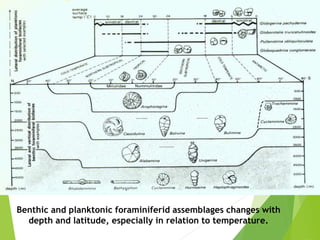
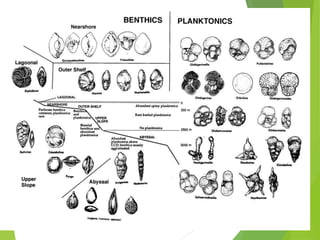
Benthic and planktonic foraminiferid assemblages changes with
depth and latitude, especially in relation to temperature.
 Bathymetric zonation of living forms along the southern California coast has 3
depth zones:-
 0-37m 11.1 - 20.6 °C
 38-74m 9.6 - 14.2 °C
 75-180m 8.0 - 11.1 °C
 INFLUENCE ON TEST MORPHOLOGY:-
 Temperature variation in sea water causes variation in size , number of chambers ,
size and spacing of pores , presence and absence of secondary pores and type of
coiling of many planktonic foraminifers.
 Planktonic foraminifers living in cooler denser water have fewer buoyancy problems
and have lower test porosity than those forms living in warm and shallow water.
 The benthic improve their buoyancy with a high test porosity and prominent spines
those form in warm shallow water.
 Some planktonic species can be distinguished by a predominance of right-handed
(dextral) forms in warm water(GLOBIGERINA PACHYDEMA) and left-handed
(sinistrall) coiled tests in relatively cold water.
Sinisterly and Dextral
coiling:-
SUMMARY:-
1) Temperature controls the vital activities of
foraminifera.
2) Each species have certain tolerance limits as well
as a temperature optimum.
3) A species can only tolerate temperature extremes
for a short period.
4) It is the primary factor which controls the
geographical as well as vertical distribution of
species.
5) It influences the test size and morphology.
ROLE OF WATER DEPTH:-
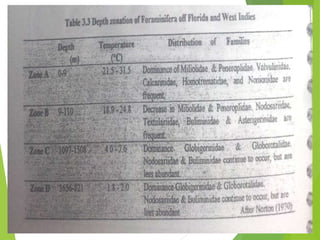
 Water depth controls many factors of marine environment.
 It is indirectly proportional to temperature , light intensity and
oxygen and directly proportional to pressure and carbonate
solubility.
 Due to depth variation the benthic assemblage of littoral , neritic
, bethyal and abyssal environment vary considerably.
 The effects of variation in depth are more pronounced in
calcareous forms in comparison to the agglutinated ones.
 Depth also causes some changes in the morphology of forms i.e
the species may become more rounded , more ornamented or
shorter in size with every considerable increment in depth.
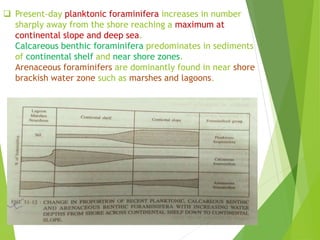
 Present-day planktonic foraminifera increases in number
sharply away from the shore reaching a maximum at
continental slope and deep sea.
Calcareous benthic foraminifera predominates in sediments
of continental shelf and near shore zones.
Arenaceous foraminifers are dominantly found in near shore
brackish water zone such as marshes and lagoons.
STUDY OF
PALAEOTEMPERATURE:-
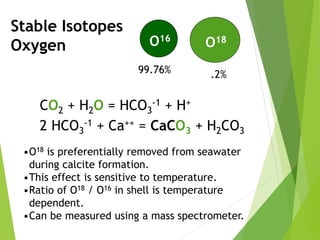
O16
O18
Stable Isotopes
Oxygen
99.76% .2%
CO2 + H2O = HCO3
-1 + H+
2 HCO3
-1 + Ca++ = CaCO3 + H2CO3
•O18 is preferentially removed from seawater
during calcite formation.
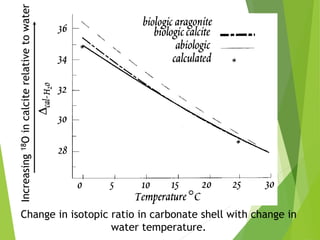
•This effect is sensitive to temperature.
•Ratio of O18 / O16 in shell is temperature
dependent.
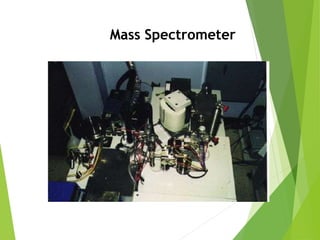
•Can be measured using a mass spectrometer.
Mass Spectrometer
Increasing18Oincalciterelativetowater
Change in isotopic ratio in carbonate shell with change in
water temperature.
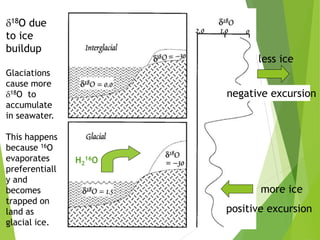
more ice
positive excursion
less ice
negative excursion
d18O due
to ice
buildup
Glaciations
cause more
d18O to
accumulate
in seawater.
This happens
because 16O
evaporates
preferentiall
y and
becomes
trapped on
land as
glacial ice.
H2
16O
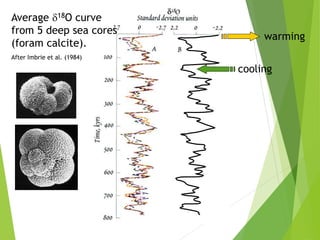
cooling
warming
Average d18O curve
from 5 deep sea cores
(foram calcite).
After Imbrie et al. (1984)
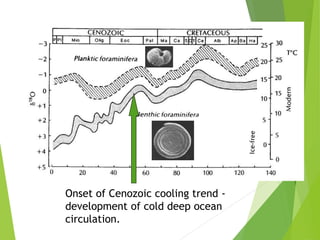
Onset of Cenozoic cooling trend -
development of cold deep ocean
circulation.
Case Study
Reference taken from:-{ OXYGEN ISOTOPES IN
FORAMINIFERA: OVERVIEW AND HISTORICAL REVIEW}
PAUL N. PEARSON,
,
 Foraminifera tests are a common component of many marine
sediments.
 The oxygen isotope ratio o O18 of test calcite is frequently
used to reconstruct aspects of their life environment.
 The δ18O depends mainly on the isotope ratio of the water it
is precipitated from, the temperature of calcification, and, to
a lesser extent, the carbonate ion concentration.
 Deep sea benthic foraminifera oxygen isotopes have revealed
the long history of global climate change over the past 100
million years.
 Planktonic foraminifer oxygen isotopes are used to investigate
the history of past sea surface temperatures.
 The geochemical composition of deep-sea benthic
foraminifera calcite is widely used to reconstruct
seafloor paleoenvironments.
 The oxygen isotopic composition of deep-sea
benthic foraminifera shells entirely calcified under
controlled experimental conditions over a large
temperature range (4to 19 C).
 The oxygen in foraminifera calcite derives from the
seawater in which the organism lived. Hence, the
isotope ratios can pro-vide information about the
composition and history of that water, and the
environmental conditions in which the test was
secreted
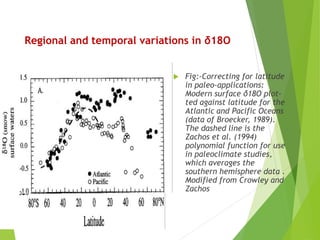
Regional and temporal variations in δ18O
 Fig:-Correcting for latitude
in paleo-applications:
Modern surface δ18O plot-
ted against latitude for the
Atlantic and Pacific Oceans
(data of Broecker, 1989).
The dashed line is the
Zachos et al. (1994)
polynomial function for use
in paleoclimate studies,
which averages the
southern hemisphere data .
Modified from Crowley and
Zachos
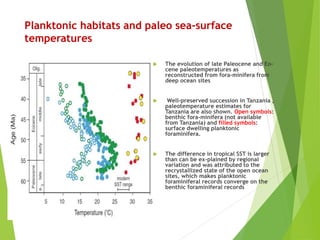
Planktonic habitats and paleo sea-surface
temperatures
 The evolution of late Paleocene and Eo-
cene paleotemperatures as
reconstructed from fora-minifera from
deep ocean sites
 Well-preserved succession in Tanzania ,
paleotemperature estimates for
Tanzania are also shown. Open symbols:
benthic fora-minifera (not available
from Tanzania) and filled symbols:
surface dwelling planktonic
foraminifera.
 The difference in tropical SST is larger
than can be ex-plained by regional
variation and was attributed to the
recrystallized state of the open ocean
sites, which makes planktonic
foraminiferal records converge on the
benthic foraminiferal records
Reference
 Microfossils [Howard Armstrong & Martin Brasier]
 An Introduction to Paleontology [Amal Dasgupta]
 OXYGEN ISOTOPES IN FORAMINIFERA: OVERVIEW AND
HISTORICAL REVIEW [PAUL N. PEARSON]
 Microfossil and their applications [P.K.kathal]
,
 Internate
Microfossil importance in temparature 13

Microfossil importance in temparature 13

  • 1.
  • 2.
    Contents  Introduction  Whyare marine microfossils useful?  Ecology study on microfossils  Physical environmental factor  Temperature of the water 1. Influence on distribution 2. Influence on test Morphology  Role of water depth  Study of paleotemperature(Using O isotope)  Case Study  Reference
  • 3.
    Microfossil  Microfossils arethose which can be study and identified only by their study under microscope . Foraminifera
  • 5.
    What are marinemicrofossils?  Fossilized remains of small organisms or tiny hardparts of larger organisms.  Plankton  Benthic fauna  Many different groups representing animals, and a variety of algae.
  • 6.
    Protistan Microfossils Foraminifera -sarcodina (amoeba) Benthic forams:- • live in sediments • relatively large Planktic forams:- • live floating in the water column • relatively small
  • 7.
  • 8.
    Algal Microfossils Diatoms -Chrysophyta silica frustules
  • 9.
    Why are marinemicrofossils useful?  Biostratigraphy :- dating rock layers using fossils.  Environmental reconstruction :- identifying different marine environments in the past.  Paleothermometry :- determining ocean water temperature in the past.  Paleoclimatology :- reconstructing climate change through Earth’s history.
  • 10.
    Ecology Study on Microfossils Ecological study of foraminifera play important role in oceanographic investigations.  They are preferred to other microfossil group because of there abundant .In general, foraminifera occurs in all the different type of marine environment and very rarely in freshwater.  Most foraminifera's are benthic and hence are controlled by such factor like depth, temperature, and the nature of the ocean floor.  They show change of their distribution pattern with change of temperature of oceanic water, they also remarkable latitude variation as regards the abundance of their different groups from equator to pole.
  • 11.
    PHYSICAL ENVIRONMENTAL FACTORS TEMPERATURE OF WATER:-  It is one of the most important factors for all the marine organisms particularly unicellular ones like foraminifers.  Classification of temperature zones of the modern oceans:-  Polar zone -1.9 to +5 °C  Sub polar zone 5 to 10 °C  Temperate zone up to 25 °C  Sub tropical zone 15 to 33 °C  Tropical zone 25 to 36 °C 
  • 12.
    Temperature controls theecology of foraminifers due to it horizontal(latitudinal,pole to equator) and vertical distribution(depth or bathymetric zonation).  The role of temperature affect both the distribution and morphology of organisms.  INFLUENCE ON DISTRIBUTION:-  The surface layer of 200m undergoes a seasonal variation but in the range of 200-100m or more the temperature decreases rapidly with the depth.  In the abyssal plain i.e in the cooler layer of temp is up to 4 °C while the surface temp up to 28 °C.  Eventually the cooler layers are characterized by benthic forms dominated by agglutinated tests but the warmer layers are dominated by calcareous tests.
  • 13.
    Benthic and planktonicforaminiferid assemblages changes with depth and latitude, especially in relation to temperature.
  • 14.
     Bathymetric zonationof living forms along the southern California coast has 3 depth zones:-  0-37m 11.1 - 20.6 °C  38-74m 9.6 - 14.2 °C  75-180m 8.0 - 11.1 °C  INFLUENCE ON TEST MORPHOLOGY:-  Temperature variation in sea water causes variation in size , number of chambers , size and spacing of pores , presence and absence of secondary pores and type of coiling of many planktonic foraminifers.  Planktonic foraminifers living in cooler denser water have fewer buoyancy problems and have lower test porosity than those forms living in warm and shallow water.  The benthic improve their buoyancy with a high test porosity and prominent spines those form in warm shallow water.  Some planktonic species can be distinguished by a predominance of right-handed (dextral) forms in warm water(GLOBIGERINA PACHYDEMA) and left-handed (sinistrall) coiled tests in relatively cold water.
  • 15.
  • 16.
    SUMMARY:- 1) Temperature controlsthe vital activities of foraminifera. 2) Each species have certain tolerance limits as well as a temperature optimum. 3) A species can only tolerate temperature extremes for a short period. 4) It is the primary factor which controls the geographical as well as vertical distribution of species. 5) It influences the test size and morphology.
  • 17.
    ROLE OF WATERDEPTH:-  Water depth controls many factors of marine environment.  It is indirectly proportional to temperature , light intensity and oxygen and directly proportional to pressure and carbonate solubility.  Due to depth variation the benthic assemblage of littoral , neritic , bethyal and abyssal environment vary considerably.  The effects of variation in depth are more pronounced in calcareous forms in comparison to the agglutinated ones.  Depth also causes some changes in the morphology of forms i.e the species may become more rounded , more ornamented or shorter in size with every considerable increment in depth.
  • 19.
     Present-day planktonicforaminifera increases in number sharply away from the shore reaching a maximum at continental slope and deep sea. Calcareous benthic foraminifera predominates in sediments of continental shelf and near shore zones. Arenaceous foraminifers are dominantly found in near shore brackish water zone such as marshes and lagoons.
  • 21.
  • 22.
    O16 O18 Stable Isotopes Oxygen 99.76% .2% CO2+ H2O = HCO3 -1 + H+ 2 HCO3 -1 + Ca++ = CaCO3 + H2CO3 •O18 is preferentially removed from seawater during calcite formation. •This effect is sensitive to temperature. •Ratio of O18 / O16 in shell is temperature dependent. •Can be measured using a mass spectrometer.
  • 23.
  • 24.
    Increasing18Oincalciterelativetowater Change in isotopicratio in carbonate shell with change in water temperature.
  • 25.
    more ice positive excursion lessice negative excursion d18O due to ice buildup Glaciations cause more d18O to accumulate in seawater. This happens because 16O evaporates preferentiall y and becomes trapped on land as glacial ice. H2 16O
  • 26.
    cooling warming Average d18O curve from5 deep sea cores (foram calcite). After Imbrie et al. (1984)
  • 27.
    Onset of Cenozoiccooling trend - development of cold deep ocean circulation.
  • 28.
    Case Study Reference takenfrom:-{ OXYGEN ISOTOPES IN FORAMINIFERA: OVERVIEW AND HISTORICAL REVIEW} PAUL N. PEARSON, ,
  • 29.
     Foraminifera testsare a common component of many marine sediments.  The oxygen isotope ratio o O18 of test calcite is frequently used to reconstruct aspects of their life environment.  The δ18O depends mainly on the isotope ratio of the water it is precipitated from, the temperature of calcification, and, to a lesser extent, the carbonate ion concentration.  Deep sea benthic foraminifera oxygen isotopes have revealed the long history of global climate change over the past 100 million years.  Planktonic foraminifer oxygen isotopes are used to investigate the history of past sea surface temperatures.
  • 30.
     The geochemicalcomposition of deep-sea benthic foraminifera calcite is widely used to reconstruct seafloor paleoenvironments.  The oxygen isotopic composition of deep-sea benthic foraminifera shells entirely calcified under controlled experimental conditions over a large temperature range (4to 19 C).  The oxygen in foraminifera calcite derives from the seawater in which the organism lived. Hence, the isotope ratios can pro-vide information about the composition and history of that water, and the environmental conditions in which the test was secreted
  • 31.
    Regional and temporalvariations in δ18O  Fig:-Correcting for latitude in paleo-applications: Modern surface δ18O plot- ted against latitude for the Atlantic and Pacific Oceans (data of Broecker, 1989). The dashed line is the Zachos et al. (1994) polynomial function for use in paleoclimate studies, which averages the southern hemisphere data . Modified from Crowley and Zachos
  • 32.
    Planktonic habitats andpaleo sea-surface temperatures  The evolution of late Paleocene and Eo- cene paleotemperatures as reconstructed from fora-minifera from deep ocean sites  Well-preserved succession in Tanzania , paleotemperature estimates for Tanzania are also shown. Open symbols: benthic fora-minifera (not available from Tanzania) and filled symbols: surface dwelling planktonic foraminifera.  The difference in tropical SST is larger than can be ex-plained by regional variation and was attributed to the recrystallized state of the open ocean sites, which makes planktonic foraminiferal records converge on the benthic foraminiferal records
  • 33.
    Reference  Microfossils [HowardArmstrong & Martin Brasier]  An Introduction to Paleontology [Amal Dasgupta]  OXYGEN ISOTOPES IN FORAMINIFERA: OVERVIEW AND HISTORICAL REVIEW [PAUL N. PEARSON]  Microfossil and their applications [P.K.kathal] ,  Internate