JOINT VENTURE & FOREIGN COLLABORATION   GROUP-B PRAVIN AGRAWAL SURJIT SINGH RAJALAKSHMI IYER M.S. MADHU BOSE AMIT KUMAR PANDEY BHAWNA GUPTA
WHAT IS A JOINT VENTURE ? A Joint Venture  is an association of two or more business entities, who combine & pool their respective resources viz. financial, skills, experience, technology etc. for achievement of common goal. Two or more  entities; Pooling of resources; Common objectives;
WHY JOINT VENTURE? NEEDS/BENEFITS TO A JOINT VENTURE PARTNER Build on company’s strength Spreading Cost & risks Improving access to financial resources Economies of scale and advantages of size Access to new technologies and customers Access to innovative managerial practices   Influencing structural evolution of the industry Pre-empting competition Creation of stronger competitive units
BENEFITS TO THE COUNTRY Employment  generation Earning foreign exchange Efficient  utilization of natural resources Creating a world class infrastructure   Reduction in dependence on imports Healthy competition with other local players Cost effective and technology efficient products Helps in bridging the gap between demand and supply WHY JOINT VENTURE?
SOME RECENT J.V.’S IN INDIA BAJAJ- ALLIANZE ICICI-LOMBARD IFFCO-TOKIO  BHARTI-WALLMART TATA MOTORS- FIAT MAHINIDRA- RENAULT TATA -AIG
MAJOR ISSUES IN JOINT VENTURES Business Objects Product Identification Technology Marketing & Distribution Setup Type of Organization Capital Structure Shareholding Pattern Mode of Contribution Composition of Board Quorum and Chairman’s Casting Vote Transfer & Valuation of Shares Duration
Intellectual Property Right Issues Exclusivity Confidentiality Disputes Settlement Mechanism Survival terms after the termination  Jurisdiction Governing Laws MAJOR ISSUES IN JOINT VENTURES (Contd…..)
INDIA’S POLICY ON JOINT VENTURE Liberalised Policy for FDI upto 100% in most of the Sectors without requiring prior RBI/FIBP Approval. Direct Investment Outside India upto 300% of the net worth of the Indian Party permitted under Automatic Route without RBI/FIPB approval on fulfillment of the specified conditions for Automatic Route
BASIC LEGAL & REGULATORY FRAMEWORK  Provisions of Companies Act, 1956 Terms & Conditions of JV Agreement, MoA & AoA Directors’ Voting Rights Govt. Policies on FDI and Investments Outside India RBI Directives / Circulars / Policies Tax laws
FEMA implications for foreign collaborations Direct Investment Outside India [FEM (Transfer or issue of any foreign security) Regs., 2004] Foreign Direct Investment [FEM (Transfer of any security by a PROI) Regs., 2000]
Direct Investment outside India (ODI)  [FEM (Transfer or issue of any foreign security) Regs., 2004] 5 Definitions: Direct Investment outside India: includes investment by way of:  either by market purchase, or private placement or through stock exchange.  (c) market purchase of existing shares of foreign entity;  (b) Subscription to MoA of  foreign entity  (a) Contribution to the  capital;
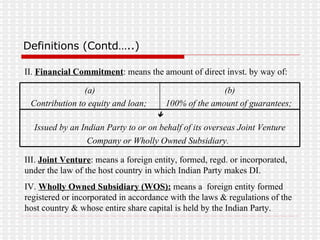
Definitions (Contd…..) II.  Financial Commitment : means the amount of direct invst. by way of: III.  Joint Venture : means a foreign entity, formed, regd. or incorporated, under the law of the host country in which Indian Party makes DI. IV.  Wholly Owned Subsidiary (WOS):  means a  foreign entity formed registered or incorporated in accordance with the laws & regulations of the host country & whose entire share capital is held by the Indian Party.   Issued by an Indian Party to or on behalf of its overseas Joint Venture Company or Wholly Owned Subsidiary.   (b) 100% of the amount of guarantees;  (a) Contribution to equity and loan;
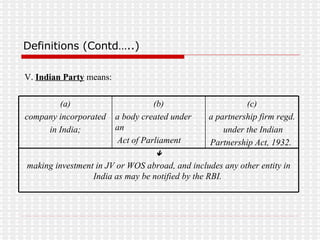
Definitions (Contd…..) V.  Indian Party  means:  making investment in JV or WOS abroad, and includes any other entity in India as may be notified by the RBI.  (c) a partnership firm regd. under the Indian Partnership Act, 1932.  (b) a body created under an Act of Parliament (a) company incorporated in India;
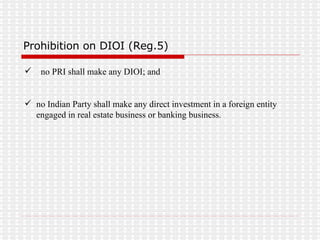
Prohibition on DIOI (Reg.5) no PRI shall make any DIOI; and  no Indian Party shall make any direct investment in a foreign entity engaged in real estate business or banking business.
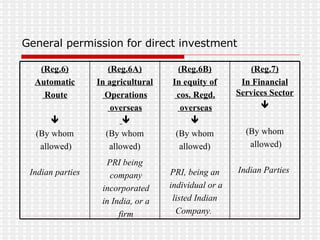
General permission for direct investment (Reg.7) In Financial Services Sector  (By whom allowed) Indian Parties   (Reg.6B) In equity of cos. Regd. overseas  (By whom allowed) PRI, being an individual or a listed Indian  Company.   (Reg.6A) In agricultural Operations overseas  (By whom allowed) PRI being company incorporated in India, or a firm   (Reg.6) Automatic Route  (By whom allowed) Indian parties
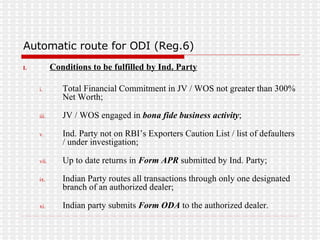
Automatic route for ODI (Reg.6) Conditions to be fulfilled by Ind. Party Total Financial Commitment in JV / WOS not greater than 300% Net Worth; JV / WOS engaged in  bona fide business activity ; Ind. Party not on RBI’s Exporters Caution List / list of defaulters / under investigation; Up to date returns in  Form APR  submitted by Ind. Party; Indian Party routes all transactions through only one designated branch of an authorized dealer; Indian party submits  Form ODA  to the authorized dealer.
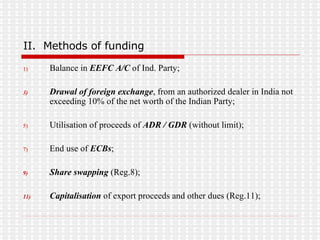
II.  Methods of funding Balance in  EEFC A/C  of Ind. Party; Drawal of foreign exchange , from an authorized dealer in India not exceeding 10% of the net worth of the Indian Party; Utilisation of proceeds of  ADR / GDR  (without limit); End use of  ECBs ; Share swapping  (Reg.8); Capitalisation  of export proceeds and other dues (Reg.11);
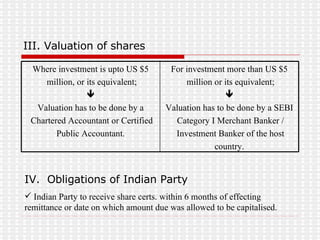
III. Valuation of shares IV.  Obligations of Indian Party Indian Party to receive share certs. within 6 months of effecting remittance or date on which amount due was allowed to be capitalised.  For investment more than US $5 million or its equivalent;  Valuation has to be done by a SEBI Category I Merchant Banker / Investment Banker of the host country.  Where investment is upto US $5 million, or its equivalent;  Valuation has to be done by a Chartered Accountant or Certified Public Accountant.
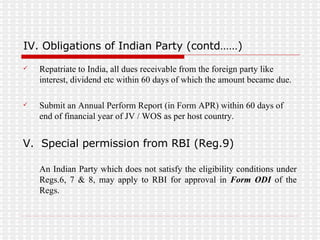
IV. Obligations of Indian Party (contd……) Repatriate to India, all dues receivable from the foreign party like interest, dividend etc within 60 days of which the amount became due. Submit an Annual Perform Report (in Form APR) within 60 days of end of financial year of JV / WOS as per host country. V.  Special permission from RBI (Reg.9) An Indian Party which does not satisfy the eligibility conditions under Regs.6, 7 & 8, may apply to RBI for approval in  Form ODI  of the Regs.
FOREIGN DIRECT INVESTMENT Regulated by FEM (Transfer or Issue of Security by a Person Resident Outside India) Regulations, 2000
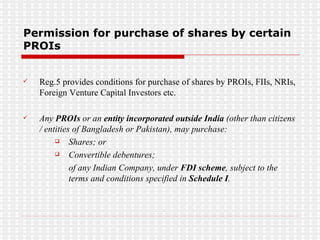
Permission for purchase of shares by certain PROIs Reg.5 provides conditions for purchase of shares by PROIs, FIIs, NRIs, Foreign Venture Capital Investors etc. Any  PROIs  or an  entity incorporated outside India  (other than citizens / entities of Bangladesh or Pakistan), may purchase: Shares; or  Convertible debentures; of any Indian Company, under  FDI scheme , subject to the terms and conditions specified in  Schedule I .
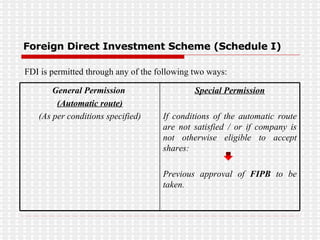
Foreign Direct Investment Scheme (Schedule I) FDI is permitted through any of the following two ways: Special Permission If conditions of the automatic route are not satisfied / or if company is not otherwise eligible to accept shares: Previous approval of  FIPB  to be taken.  General Permission  (Automatic route) (As per conditions specified)
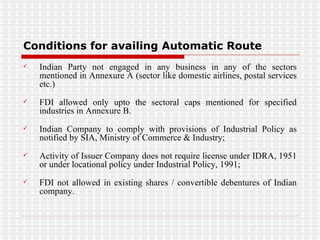
Conditions for availing Automatic Route Indian Party not engaged in any business in any of the sectors mentioned in Annexure A (sector like domestic airlines, postal services etc.) FDI allowed only upto the sectoral caps mentioned for specified industries in Annexure B. Indian Company to comply with provisions of Industrial Policy as notified by SIA, Ministry of Commerce & Industry; Activity of Issuer Company does not require license under IDRA, 1951 or under locational policy under Industrial Policy, 1991; FDI not allowed in existing shares / convertible debentures of Indian company.
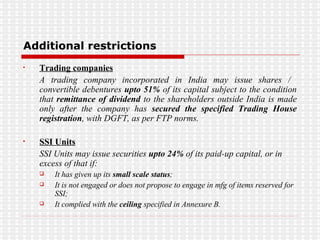
Additional restrictions Trading companies A trading company incorporated in India may issue shares /  convertible debentures  upto 51%  of its capital subject to the condition that  remittance of dividend  to the shareholders outside India is made only after the company has  secured the specified Trading House registration , with DGFT, as per FTP norms. SSI Units SSI Units may issue securities  upto 24%  of its paid-up capital, or in excess of that if: It has given up its  small scale status ; It is not engaged or does not propose to engage in mfg of items reserved for SSI; It complied with the  ceiling  specified in Annexure B.
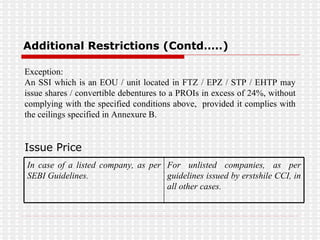
Additional Restrictions (Contd…..) Exception: An SSI which is an EOU / unit located in FTZ / EPZ / STP / EHTP may issue shares / convertible debentures to a PROIs in excess of 24%, without complying with the specified conditions above,  provided it complies with the ceilings specified in Annexure B. Issue Price For unlisted companies, as per guidelines issued by erstshile CCI, in all other cases. In case of a listed company, as per SEBI Guidelines.
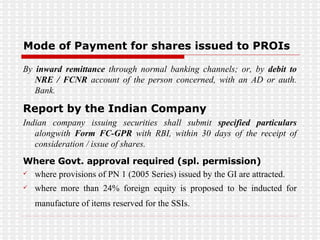
Mode of Payment for shares issued to PROIs By  inward remittance  through normal banking channels; or, by  debit to NRE / FCNR  account of the person concerned, with an AD or auth. Bank. Report by the Indian Company Indian company issuing securities shall submit  specified particulars  alongwith  Form FC-GPR  with RBI, within 30 days of the receipt of consideration / issue of shares.   Where Govt. approval required (spl. permission) where provisions of PN 1 (2005 Series) issued by the GI are attracted. where more than 24% foreign equity is proposed to be inducted for manufacture of items reserved for the SSIs.
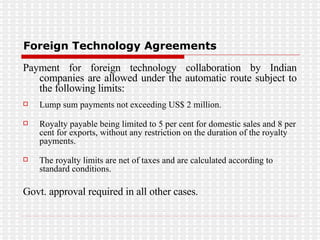
Foreign Technology Agreements Payment for foreign technology collaboration by Indian companies are allowed under the automatic route subject to the following limits: Lump sum payments not exceeding US$ 2 million.  Royalty payable being limited to 5 per cent for domestic sales and 8 per cent for exports, without any restriction on the duration of the royalty payments.  The royalty limits are net of taxes and are calculated according to standard conditions.  Govt. approval required in all other cases.
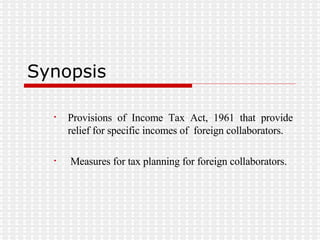
Synopsis Provisions of Income Tax Act, 1961 that provide relief for specific incomes of  foreign collaborators. Measures for tax planning for foreign collaborators.
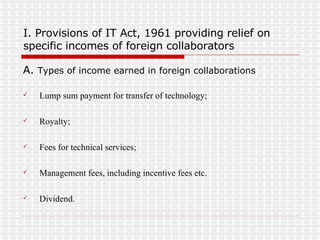
I. Provisions of IT Act, 1961 providing relief on specific incomes of foreign collaborators A.  Types of income earned in foreign collaborations Lump sum payment for transfer of technology; Royalty; Fees for technical services; Management fees, including incentive fees etc. Dividend.
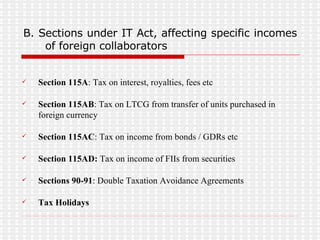
B. Sections under IT Act, affecting specific incomes of foreign collaborators Section 115A : Tax on interest, royalties, fees etc Section 115AB : Tax on LTCG from transfer of units purchased in foreign currency Section 115AC : Tax on income from bonds / GDRs etc Section 115AD:  Tax on income of FIIs from securities Sections 90-91 : Double Taxation Avoidance Agreements Tax Holidays
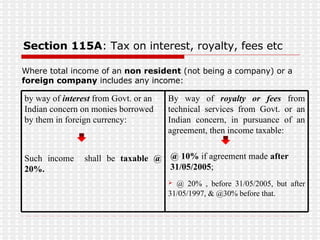
Section 115A : Tax on interest, royalty, fees etc Where total income of an  non resident  (not being a company) or a  foreign company  includes any income: By way of  royalty or fees  from technical services from Govt. or an Indian concern, in pursuance of an agreement, then income taxable:  @ 10%  if agreement made  after  31/05/2005 ; @ 20% , before 31/05/2005, but after 31/05/1997, & @30% before that.  by way of  interest  from Govt. or an Indian concern on monies borrowed by them in foreign currency: Such income  shall be  taxable @ 20%.
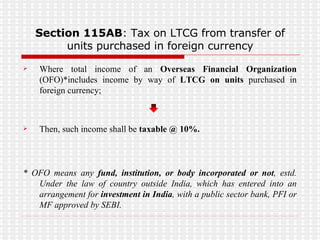
Section 115AB : Tax on LTCG from transfer of units purchased in foreign currency Where total income of an  Overseas Financial Organization  (OFO)*includes income by way of  LTCG on units  purchased in foreign currency; Then, such income shall be  taxable @ 10%. * OFO means any  fund, institution, or body incorporated or not , estd. Under the law of country outside India, which has entered into an arrangement for  investment in India , with a public sector bank, PFI or MF approved by SEBI.
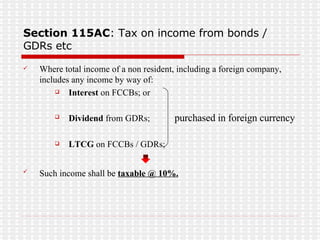
Section 115AC : Tax on income from bonds / GDRs etc Where total income of a non resident, including a foreign company, includes any income by way of: Interest  on FCCBs; or  Dividend  from GDRs;  purchased in foreign currency   LTCG  on FCCBs / GDRs;  Such income shall be  taxable @ 10%.
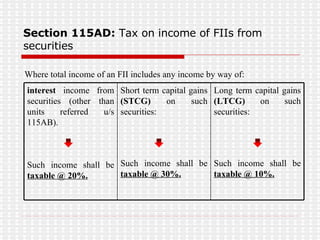
Section 115AD:  Tax on income of FIIs from securities Where total income of an FII includes any income by way of: Long term capital gains  (LTCG)  on such securities: Such income shall be  taxable @ 10%. Short term capital gains  (STCG)  on such securities: Such income shall be  taxable @ 30%. interest  income from securities (other than units referred u/s 115AB). Such income shall be  taxable @ 20%.
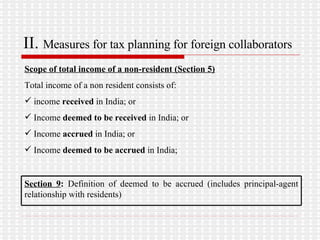
II.  Measures for tax planning for foreign collaborators Scope of total income of a non-resident (Section 5) Total income of a non resident consists of:  income  received  in India; or  Income  deemed to be received  in India; or  Income  accrued  in India; or  Income  deemed to be accrued  in India; Section 9 :  Definition of deemed to be accrued (includes principal-agent relationship with residents)
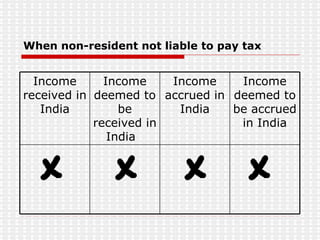
When non-resident not liable to pay tax Income deemed to be accrued in India Income accrued in India Income deemed to be received in India  Income received in India
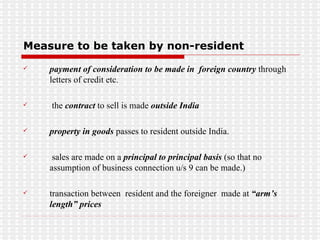
Measure to be taken by non-resident payment of consideration to be made in  foreign country  through letters of credit etc. the  contract  to sell is made  outside India  property in goods  passes to resident outside India.  sales are made on a  principal to principal basis  (so that no assumption of business connection u/s 9 can be made.) transaction between  resident and the foreigner  made at  “arm’s length” prices
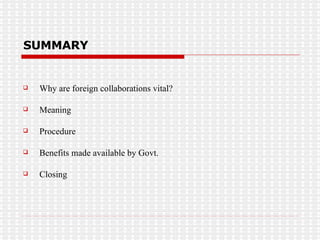
SUMMARY Why are foreign collaborations vital? Meaning Procedure Benefits made available by Govt. Closing
THANK YOU!!!

Joint Ventures & Foreign Coolaborations

  • 1.
    JOINT VENTURE &FOREIGN COLLABORATION GROUP-B PRAVIN AGRAWAL SURJIT SINGH RAJALAKSHMI IYER M.S. MADHU BOSE AMIT KUMAR PANDEY BHAWNA GUPTA
  • 2.
    WHAT IS AJOINT VENTURE ? A Joint Venture is an association of two or more business entities, who combine & pool their respective resources viz. financial, skills, experience, technology etc. for achievement of common goal. Two or more entities; Pooling of resources; Common objectives;
  • 3.
    WHY JOINT VENTURE?NEEDS/BENEFITS TO A JOINT VENTURE PARTNER Build on company’s strength Spreading Cost & risks Improving access to financial resources Economies of scale and advantages of size Access to new technologies and customers Access to innovative managerial practices Influencing structural evolution of the industry Pre-empting competition Creation of stronger competitive units
  • 4.
    BENEFITS TO THECOUNTRY Employment generation Earning foreign exchange Efficient utilization of natural resources Creating a world class infrastructure Reduction in dependence on imports Healthy competition with other local players Cost effective and technology efficient products Helps in bridging the gap between demand and supply WHY JOINT VENTURE?
  • 5.
    SOME RECENT J.V.’SIN INDIA BAJAJ- ALLIANZE ICICI-LOMBARD IFFCO-TOKIO BHARTI-WALLMART TATA MOTORS- FIAT MAHINIDRA- RENAULT TATA -AIG
  • 6.
    MAJOR ISSUES INJOINT VENTURES Business Objects Product Identification Technology Marketing & Distribution Setup Type of Organization Capital Structure Shareholding Pattern Mode of Contribution Composition of Board Quorum and Chairman’s Casting Vote Transfer & Valuation of Shares Duration
  • 7.
    Intellectual Property RightIssues Exclusivity Confidentiality Disputes Settlement Mechanism Survival terms after the termination Jurisdiction Governing Laws MAJOR ISSUES IN JOINT VENTURES (Contd…..)
  • 8.
    INDIA’S POLICY ONJOINT VENTURE Liberalised Policy for FDI upto 100% in most of the Sectors without requiring prior RBI/FIBP Approval. Direct Investment Outside India upto 300% of the net worth of the Indian Party permitted under Automatic Route without RBI/FIPB approval on fulfillment of the specified conditions for Automatic Route
  • 9.
    BASIC LEGAL &REGULATORY FRAMEWORK Provisions of Companies Act, 1956 Terms & Conditions of JV Agreement, MoA & AoA Directors’ Voting Rights Govt. Policies on FDI and Investments Outside India RBI Directives / Circulars / Policies Tax laws
  • 10.
    FEMA implications forforeign collaborations Direct Investment Outside India [FEM (Transfer or issue of any foreign security) Regs., 2004] Foreign Direct Investment [FEM (Transfer of any security by a PROI) Regs., 2000]
  • 11.
    Direct Investment outsideIndia (ODI) [FEM (Transfer or issue of any foreign security) Regs., 2004] 5 Definitions: Direct Investment outside India: includes investment by way of:  either by market purchase, or private placement or through stock exchange. (c) market purchase of existing shares of foreign entity; (b) Subscription to MoA of foreign entity (a) Contribution to the capital;
  • 12.
    Definitions (Contd…..) II. Financial Commitment : means the amount of direct invst. by way of: III. Joint Venture : means a foreign entity, formed, regd. or incorporated, under the law of the host country in which Indian Party makes DI. IV. Wholly Owned Subsidiary (WOS): means a foreign entity formed registered or incorporated in accordance with the laws & regulations of the host country & whose entire share capital is held by the Indian Party.  Issued by an Indian Party to or on behalf of its overseas Joint Venture Company or Wholly Owned Subsidiary. (b) 100% of the amount of guarantees; (a) Contribution to equity and loan;
  • 13.
    Definitions (Contd…..) V. Indian Party means:  making investment in JV or WOS abroad, and includes any other entity in India as may be notified by the RBI. (c) a partnership firm regd. under the Indian Partnership Act, 1932. (b) a body created under an Act of Parliament (a) company incorporated in India;
  • 14.
    Prohibition on DIOI(Reg.5) no PRI shall make any DIOI; and no Indian Party shall make any direct investment in a foreign entity engaged in real estate business or banking business.
  • 15.
    General permission fordirect investment (Reg.7) In Financial Services Sector  (By whom allowed) Indian Parties (Reg.6B) In equity of cos. Regd. overseas  (By whom allowed) PRI, being an individual or a listed Indian Company. (Reg.6A) In agricultural Operations overseas  (By whom allowed) PRI being company incorporated in India, or a firm (Reg.6) Automatic Route  (By whom allowed) Indian parties
  • 16.
    Automatic route forODI (Reg.6) Conditions to be fulfilled by Ind. Party Total Financial Commitment in JV / WOS not greater than 300% Net Worth; JV / WOS engaged in bona fide business activity ; Ind. Party not on RBI’s Exporters Caution List / list of defaulters / under investigation; Up to date returns in Form APR submitted by Ind. Party; Indian Party routes all transactions through only one designated branch of an authorized dealer; Indian party submits Form ODA to the authorized dealer.
  • 17.
    II. Methodsof funding Balance in EEFC A/C of Ind. Party; Drawal of foreign exchange , from an authorized dealer in India not exceeding 10% of the net worth of the Indian Party; Utilisation of proceeds of ADR / GDR (without limit); End use of ECBs ; Share swapping (Reg.8); Capitalisation of export proceeds and other dues (Reg.11);
  • 18.
    III. Valuation ofshares IV. Obligations of Indian Party Indian Party to receive share certs. within 6 months of effecting remittance or date on which amount due was allowed to be capitalised. For investment more than US $5 million or its equivalent;  Valuation has to be done by a SEBI Category I Merchant Banker / Investment Banker of the host country. Where investment is upto US $5 million, or its equivalent;  Valuation has to be done by a Chartered Accountant or Certified Public Accountant.
  • 19.
    IV. Obligations ofIndian Party (contd……) Repatriate to India, all dues receivable from the foreign party like interest, dividend etc within 60 days of which the amount became due. Submit an Annual Perform Report (in Form APR) within 60 days of end of financial year of JV / WOS as per host country. V. Special permission from RBI (Reg.9) An Indian Party which does not satisfy the eligibility conditions under Regs.6, 7 & 8, may apply to RBI for approval in Form ODI of the Regs.
  • 20.
    FOREIGN DIRECT INVESTMENTRegulated by FEM (Transfer or Issue of Security by a Person Resident Outside India) Regulations, 2000
  • 21.
    Permission for purchaseof shares by certain PROIs Reg.5 provides conditions for purchase of shares by PROIs, FIIs, NRIs, Foreign Venture Capital Investors etc. Any PROIs or an entity incorporated outside India (other than citizens / entities of Bangladesh or Pakistan), may purchase: Shares; or Convertible debentures; of any Indian Company, under FDI scheme , subject to the terms and conditions specified in Schedule I .
  • 22.
    Foreign Direct InvestmentScheme (Schedule I) FDI is permitted through any of the following two ways: Special Permission If conditions of the automatic route are not satisfied / or if company is not otherwise eligible to accept shares: Previous approval of FIPB to be taken. General Permission (Automatic route) (As per conditions specified)
  • 23.
    Conditions for availingAutomatic Route Indian Party not engaged in any business in any of the sectors mentioned in Annexure A (sector like domestic airlines, postal services etc.) FDI allowed only upto the sectoral caps mentioned for specified industries in Annexure B. Indian Company to comply with provisions of Industrial Policy as notified by SIA, Ministry of Commerce & Industry; Activity of Issuer Company does not require license under IDRA, 1951 or under locational policy under Industrial Policy, 1991; FDI not allowed in existing shares / convertible debentures of Indian company.
  • 24.
    Additional restrictions Tradingcompanies A trading company incorporated in India may issue shares / convertible debentures upto 51% of its capital subject to the condition that remittance of dividend to the shareholders outside India is made only after the company has secured the specified Trading House registration , with DGFT, as per FTP norms. SSI Units SSI Units may issue securities upto 24% of its paid-up capital, or in excess of that if: It has given up its small scale status ; It is not engaged or does not propose to engage in mfg of items reserved for SSI; It complied with the ceiling specified in Annexure B.
  • 25.
    Additional Restrictions (Contd…..)Exception: An SSI which is an EOU / unit located in FTZ / EPZ / STP / EHTP may issue shares / convertible debentures to a PROIs in excess of 24%, without complying with the specified conditions above, provided it complies with the ceilings specified in Annexure B. Issue Price For unlisted companies, as per guidelines issued by erstshile CCI, in all other cases. In case of a listed company, as per SEBI Guidelines.
  • 26.
    Mode of Paymentfor shares issued to PROIs By inward remittance through normal banking channels; or, by debit to NRE / FCNR account of the person concerned, with an AD or auth. Bank. Report by the Indian Company Indian company issuing securities shall submit specified particulars alongwith Form FC-GPR with RBI, within 30 days of the receipt of consideration / issue of shares. Where Govt. approval required (spl. permission) where provisions of PN 1 (2005 Series) issued by the GI are attracted. where more than 24% foreign equity is proposed to be inducted for manufacture of items reserved for the SSIs.
  • 27.
    Foreign Technology AgreementsPayment for foreign technology collaboration by Indian companies are allowed under the automatic route subject to the following limits: Lump sum payments not exceeding US$ 2 million. Royalty payable being limited to 5 per cent for domestic sales and 8 per cent for exports, without any restriction on the duration of the royalty payments. The royalty limits are net of taxes and are calculated according to standard conditions. Govt. approval required in all other cases.
  • 28.
    Synopsis Provisions ofIncome Tax Act, 1961 that provide relief for specific incomes of foreign collaborators. Measures for tax planning for foreign collaborators.
  • 29.
    I. Provisions ofIT Act, 1961 providing relief on specific incomes of foreign collaborators A. Types of income earned in foreign collaborations Lump sum payment for transfer of technology; Royalty; Fees for technical services; Management fees, including incentive fees etc. Dividend.
  • 30.
    B. Sections underIT Act, affecting specific incomes of foreign collaborators Section 115A : Tax on interest, royalties, fees etc Section 115AB : Tax on LTCG from transfer of units purchased in foreign currency Section 115AC : Tax on income from bonds / GDRs etc Section 115AD: Tax on income of FIIs from securities Sections 90-91 : Double Taxation Avoidance Agreements Tax Holidays
  • 31.
    Section 115A :Tax on interest, royalty, fees etc Where total income of an non resident (not being a company) or a foreign company includes any income: By way of royalty or fees from technical services from Govt. or an Indian concern, in pursuance of an agreement, then income taxable: @ 10% if agreement made after 31/05/2005 ; @ 20% , before 31/05/2005, but after 31/05/1997, & @30% before that. by way of interest from Govt. or an Indian concern on monies borrowed by them in foreign currency: Such income shall be taxable @ 20%.
  • 32.
    Section 115AB :Tax on LTCG from transfer of units purchased in foreign currency Where total income of an Overseas Financial Organization (OFO)*includes income by way of LTCG on units purchased in foreign currency; Then, such income shall be taxable @ 10%. * OFO means any fund, institution, or body incorporated or not , estd. Under the law of country outside India, which has entered into an arrangement for investment in India , with a public sector bank, PFI or MF approved by SEBI.
  • 33.
    Section 115AC :Tax on income from bonds / GDRs etc Where total income of a non resident, including a foreign company, includes any income by way of: Interest on FCCBs; or Dividend from GDRs; purchased in foreign currency LTCG on FCCBs / GDRs; Such income shall be taxable @ 10%.
  • 34.
    Section 115AD: Tax on income of FIIs from securities Where total income of an FII includes any income by way of: Long term capital gains (LTCG) on such securities: Such income shall be taxable @ 10%. Short term capital gains (STCG) on such securities: Such income shall be taxable @ 30%. interest income from securities (other than units referred u/s 115AB). Such income shall be taxable @ 20%.
  • 35.
    II. Measuresfor tax planning for foreign collaborators Scope of total income of a non-resident (Section 5) Total income of a non resident consists of: income received in India; or Income deemed to be received in India; or Income accrued in India; or Income deemed to be accrued in India; Section 9 : Definition of deemed to be accrued (includes principal-agent relationship with residents)
  • 36.
    When non-resident notliable to pay tax Income deemed to be accrued in India Income accrued in India Income deemed to be received in India Income received in India
  • 37.
    Measure to betaken by non-resident payment of consideration to be made in foreign country through letters of credit etc. the contract to sell is made outside India property in goods passes to resident outside India. sales are made on a principal to principal basis (so that no assumption of business connection u/s 9 can be made.) transaction between resident and the foreigner made at “arm’s length” prices
  • 38.
    SUMMARY Why areforeign collaborations vital? Meaning Procedure Benefits made available by Govt. Closing
  • 39.