MARGINAL COSTING
There are mainly two techniques of product costing &
income determination.
The elements of cost can broadly be put into two
categories: Fixed and variable costs. Fixed costs are those
which do not vary but remain constant within a given period
of time in spite of fluctuations in production. The examples
of fixed costs are: rent, insurance charges, management
salaries, etc. On the other hand, variable costs are those
which vary in direct proportion to any change in the volume
of output. The costs of direct material, direct wages etc, can
be put into this category. The cost of a product or process
can be ascertained ( using the different elements of cost) by
any of the following two technique
Absorption Costing Marginal Costing
Absorption Costing/ Traditional costing/
conventional/ full costing
• According to this method, the cost of a product is determined after
considering both fixed and variable costs. The variable costs, such
as those of direct materials, direct labour, etc. are directly charged
to the products, while the fixed costs are apportioned on a suitable
basis over different products manufactured during a period. Thus,
in case of Absorption Costing all costs are identified with the
manufactured products.
• This is a total cost technique under which total cost is charged as
production cost.
• In other wards , Absorption Costing, all manufacturing costs are
absorbed in the cost of the products produced.
• In this system the Factory overhead are absorbed on the basis of a
predetermined overhead rates, based on normal capacity.
• Absorption Costing approach is same as used in cost sheet.
Marginal Costing
• The technique of Marginal Costing is a definite improvement over
the technique of Absorption Costing. According to this technique,
only the variable costs are considered in calculating the cost of the
product, while fixed costs are charged against the revenue of the
period. The revenue arising from the excess of sales over variable
costs is technically known as Contribution under Marginal Costing.
• An alternative to absorption costing is Marginal Costing/ variable
costing/ Direct costing.
• Under this technique, only variable costs are charged as product
costs and included in inventory valuation.
• Fixed manufacturing costs are not to products but are considered as
sand thus charged directly to profit and loss Account of that year.
• Fixed cost also do not enter in stock valuation.
• Both absorption costing and marginal costing treat non-
manufacturing cost( i.e administrative, selling and distribution
overhead) as period costs.
Marginal Costing
• Marginal Costing is the additional cost of producing an additional unit of
product.
• It is the total of all variable costs. It is composed of all direct costs and
variable overheads.
• An important point is that marginal cost per unit remains unchanged,
irrespective of the level of activity.
• The accounting system in which variable costs are charged to cost units
and fixed costs of the period are written off in full, against the aggregate
contribution.
Profit Ascertainment in marginal costing in a multi-product Company
•
less less less
= = =
less =
Sales of
product A
Sales of
product C
Sales of
product B
Marginal cost
of A A
Contribution
of A
Marginal cost
of B
Marginal cost
of C
Contribution
of B
Contribution
of c
Total Contribution
pool
Total fixed cost
Profit
Absorption Costing Vs Marginal Costing
• 1. Treatment of Fixed & variable cost- In marginal costing ,
only variable costs are charged to products. Fixed costs are
treated as period costs and charged to profit and loss Account
of the period.
• In Absorption costing , all costs (both fixed and variable ) are
charged to the product. The fixed factory overhead cost is
absorption in units produced at a rate predetermined.
• 2. Valuation of stock – In marginal costing , stock of WIP and
Finished goods are valued at marginal costing only.
• In Absorption costing , stocks are valued at total cost which
includes both fixed and variable costs.
• Thus stock valuation in Marginal costing is lower than that in
absorption costing.
• 3. Measurement of Profitability- In marginal costing, relative
profitability of products/department is based on a study of
relative contribution made by respective products/
departments . The managerial decisions is guided by
contribution.
• In Absorption costing, relative profitability judged by profit
figure which is also a guiding factor for managerial decision.
Income determination under Marginal costing
and Absorption costing
• The net profit under the two system may be same or may be different.
Difference in profit may be because of the different basis of inventory
valuation.
• in Marginal costing stocks of WIP & finished goods are valued at variable
cost.
• In absorption costing stocks a. re valued at Total cost
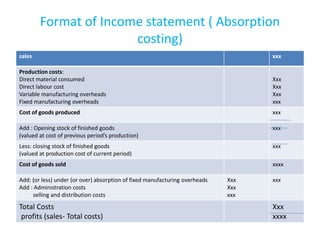
Format of Income statement ( Absorption
costing)
sales xxx
Production costs:
Direct material consumed
Direct labour cost
Variable manufacturing overheads
Fixed manufacturing overheads
Xxx
Xxx
Xxx
xxx
Cost of goods produced xxx
Add : Opening stock of finished goods
(valued at cost of previous period’s production)
xxx
Less: closing stock of finished goods
(valued at production cost of current period)
xxx
Cost of goods sold xxxx
Add: (or less) under (or over) absorption of fixed manufacturing overheads
Add : Administration costs
selling and distribution costs
Xxx
Xxx
xxx
xxx
Total Costs
profits (sales- Total costs)
Xxx
xxxx
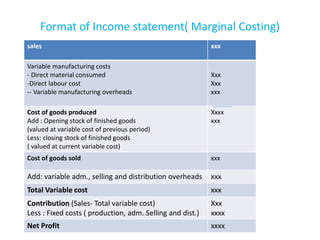
Format of Income statement( Marginal Costing)
sales xxx
Variable manufacturing costs
- Direct material consumed
-Direct labour cost
-- Variable manufacturing overheads
Xxx
Xxx
xxx
Cost of goods produced
Add : Opening stock of finished goods
(valued at variable cost of previous period)
Less: closing stock of finished goods
( valued at current variable cost)
Xxxx
xxx
Cost of goods sold xxx
Add: variable adm., selling and distribution overheads xxx
Total Variable cost xxx
Contribution (Sales- Total variable cost)
Less : Fixed costs ( production, adm. Selling and dist.)
Xxx
xxxx
Net Profit xxxx
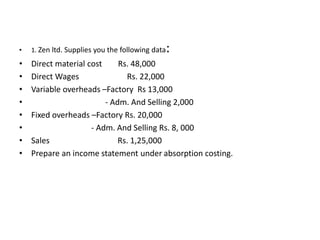
• 1. Zen ltd. Supplies you the following data:
• Direct material cost Rs. 48,000
• Direct Wages Rs. 22,000
• Variable overheads –Factory Rs 13,000
• - Adm. And Selling 2,000
• Fixed overheads –Factory Rs. 20,000
• - Adm. And Selling Rs. 8, 000
• Sales Rs. 1,25,000
• Prepare an income statement under absorption costing.

MARGINAL COSTING -pptx

  • 1.
    MARGINAL COSTING There aremainly two techniques of product costing & income determination. The elements of cost can broadly be put into two categories: Fixed and variable costs. Fixed costs are those which do not vary but remain constant within a given period of time in spite of fluctuations in production. The examples of fixed costs are: rent, insurance charges, management salaries, etc. On the other hand, variable costs are those which vary in direct proportion to any change in the volume of output. The costs of direct material, direct wages etc, can be put into this category. The cost of a product or process can be ascertained ( using the different elements of cost) by any of the following two technique Absorption Costing Marginal Costing
  • 2.
    Absorption Costing/ Traditionalcosting/ conventional/ full costing • According to this method, the cost of a product is determined after considering both fixed and variable costs. The variable costs, such as those of direct materials, direct labour, etc. are directly charged to the products, while the fixed costs are apportioned on a suitable basis over different products manufactured during a period. Thus, in case of Absorption Costing all costs are identified with the manufactured products. • This is a total cost technique under which total cost is charged as production cost. • In other wards , Absorption Costing, all manufacturing costs are absorbed in the cost of the products produced. • In this system the Factory overhead are absorbed on the basis of a predetermined overhead rates, based on normal capacity. • Absorption Costing approach is same as used in cost sheet.
  • 3.
    Marginal Costing • Thetechnique of Marginal Costing is a definite improvement over the technique of Absorption Costing. According to this technique, only the variable costs are considered in calculating the cost of the product, while fixed costs are charged against the revenue of the period. The revenue arising from the excess of sales over variable costs is technically known as Contribution under Marginal Costing. • An alternative to absorption costing is Marginal Costing/ variable costing/ Direct costing. • Under this technique, only variable costs are charged as product costs and included in inventory valuation. • Fixed manufacturing costs are not to products but are considered as sand thus charged directly to profit and loss Account of that year. • Fixed cost also do not enter in stock valuation. • Both absorption costing and marginal costing treat non- manufacturing cost( i.e administrative, selling and distribution overhead) as period costs.
  • 4.
    Marginal Costing • MarginalCosting is the additional cost of producing an additional unit of product. • It is the total of all variable costs. It is composed of all direct costs and variable overheads. • An important point is that marginal cost per unit remains unchanged, irrespective of the level of activity. • The accounting system in which variable costs are charged to cost units and fixed costs of the period are written off in full, against the aggregate contribution.
  • 5.
    Profit Ascertainment inmarginal costing in a multi-product Company • less less less = = = less = Sales of product A Sales of product C Sales of product B Marginal cost of A A Contribution of A Marginal cost of B Marginal cost of C Contribution of B Contribution of c Total Contribution pool Total fixed cost Profit
  • 6.
    Absorption Costing VsMarginal Costing • 1. Treatment of Fixed & variable cost- In marginal costing , only variable costs are charged to products. Fixed costs are treated as period costs and charged to profit and loss Account of the period. • In Absorption costing , all costs (both fixed and variable ) are charged to the product. The fixed factory overhead cost is absorption in units produced at a rate predetermined. • 2. Valuation of stock – In marginal costing , stock of WIP and Finished goods are valued at marginal costing only. • In Absorption costing , stocks are valued at total cost which includes both fixed and variable costs. • Thus stock valuation in Marginal costing is lower than that in absorption costing.
  • 7.
    • 3. Measurementof Profitability- In marginal costing, relative profitability of products/department is based on a study of relative contribution made by respective products/ departments . The managerial decisions is guided by contribution. • In Absorption costing, relative profitability judged by profit figure which is also a guiding factor for managerial decision.
  • 8.
    Income determination underMarginal costing and Absorption costing • The net profit under the two system may be same or may be different. Difference in profit may be because of the different basis of inventory valuation. • in Marginal costing stocks of WIP & finished goods are valued at variable cost. • In absorption costing stocks a. re valued at Total cost
  • 9.
    Format of Incomestatement ( Absorption costing) sales xxx Production costs: Direct material consumed Direct labour cost Variable manufacturing overheads Fixed manufacturing overheads Xxx Xxx Xxx xxx Cost of goods produced xxx Add : Opening stock of finished goods (valued at cost of previous period’s production) xxx Less: closing stock of finished goods (valued at production cost of current period) xxx Cost of goods sold xxxx Add: (or less) under (or over) absorption of fixed manufacturing overheads Add : Administration costs selling and distribution costs Xxx Xxx xxx xxx Total Costs profits (sales- Total costs) Xxx xxxx
  • 10.
    Format of Incomestatement( Marginal Costing) sales xxx Variable manufacturing costs - Direct material consumed -Direct labour cost -- Variable manufacturing overheads Xxx Xxx xxx Cost of goods produced Add : Opening stock of finished goods (valued at variable cost of previous period) Less: closing stock of finished goods ( valued at current variable cost) Xxxx xxx Cost of goods sold xxx Add: variable adm., selling and distribution overheads xxx Total Variable cost xxx Contribution (Sales- Total variable cost) Less : Fixed costs ( production, adm. Selling and dist.) Xxx xxxx Net Profit xxxx
  • 11.
    • 1. Zenltd. Supplies you the following data: • Direct material cost Rs. 48,000 • Direct Wages Rs. 22,000 • Variable overheads –Factory Rs 13,000 • - Adm. And Selling 2,000 • Fixed overheads –Factory Rs. 20,000 • - Adm. And Selling Rs. 8, 000 • Sales Rs. 1,25,000 • Prepare an income statement under absorption costing.