Download to read offline
![THE GIST OF
MAP DATABASES by Andrew Zolnai
Geographic Information Systems (GIS) link graphic and information
databases to produce new, up-to-date maps rapidly.
H ave you ever noticed dragons, com-
pass roses or inconsequent place
names peppering the large empty spaces
on a map? The dragons and other fillers
stem from our phobia for empty spaces.
Meanwhile other areas of the map may be
barely legible for the crowded lettering of
important entries. This problem is
particularly acute in maps which have an
intrinsically erratic distribution of data.
Maps are traditionally kept on individual
sheets in a variety of scales, and the in-
formation displayed is a compromise be-
tween abundant data and limited space.
Any fixed format cripples map handling
if the information is complex, erratically
distributed and rapidly evolving, as it is
in the resource industries. In the north-
ern oil business, for example, a new and
crucial mile-square territory may require
a map containing far more information
than the maps for a thousand square miles
of less prospective tundra. The informa-
tion it holds may change with every seis-
mic test result, and tomorrow's choice of
testing site may depend on correct evalu-
ation of yesterday's tests. With the short
season and high costs of the Arctic, a map-
ping system needs to adapt easily and de-
liver fast. The trick is to devise a com-
puter mapping system that allows mapmak- BEAD NICI JASON
The monolithic map files were difficult
ers to edit and generate maps only as to maintain and took a long time to proc-
needed, at a scale appropriate to the den- ess, and the systems themselves were More powerful microcomputer graph-
sity of the data. hugely expensive. ics and software, now free from the bur-
A Geographic Information System The next step was to apply to graphic den of handling huge files, have opened
(GIS) provides a particularly flexible files the same principles of traditional da- up the field to affordable systems.
means of storage and retrieval of graphic tabase management: storing the graphic
data, by coupling computer databases in- elements separately within an appropri-
telligently with powerful graphic inter- ate framework, controlling file size, and Unit Area vs. Unit Density
faces. The elements of a GIS include a providing links to combine the files in vari- Unit map area is typified by constant-
graphic editor, a database management sys- ous ways. The individual graphic files are area map sheets all drawn to the same
tem (DBMS), various input and output tagged with suitable locators such as grid scale—where, for example. 96 map sheets
systems, and some means to link these references or latitude/longitude to fa- representing one square mile might be re-
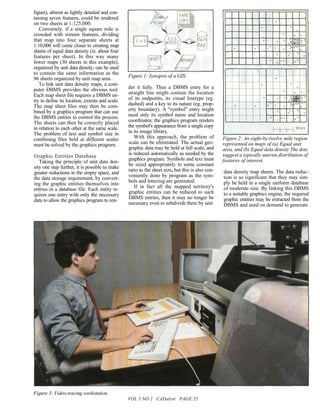
together (fig. 1). cilitate combining them by machine. By quired to depict a twelve-by-eight mile re-
linking individual elements into compos- gion at 1:50.000 (fig. 2a).
Computer Mapping ite graphic files that remain manageable Unit data density suggests that if one-
Early computer mapping systems coped in size and legible in output, one can then half of the region (the west side of fig.
with myriads of points by using huge create maps of target areas and "zoom in" 2b] contains only four features of inter-
graphic files on large mainframe systems. on areas of greatest density. est, a single map sheet at say 1:250.000
may be sufficient to portray it. Another
area (the northeast quadrant of the same
VOL 5 NO 2 CADalyst PAGE 24](https://image.slidesharecdn.com/mar88cadalyst-110907093524-phpapp02/85/Mar88CADalyst-1-320.jpg)
![THE GIST OF
MAP DATABASES by Andrew Zolnai
Geographic Information Systems (GIS) link graphic and information
databases to produce new, up-to-date maps rapidly.
H ave you ever noticed dragons, com-
pass roses or inconsequent place
names peppering the large empty spaces
on a map? The dragons and other fillers
stem from our phobia for empty spaces.
Meanwhile other areas of the map may be
barely legible for the crowded lettering of
important entries. This problem is
particularly acute in maps which have an
intrinsically erratic distribution of data.
Maps are traditionally kept on individual
sheets in a variety of scales, and the in-
formation displayed is a compromise be-
tween abundant data and limited space.
Any fixed format cripples map handling
if the information is complex, erratically
distributed and rapidly evolving, as it is
in the resource industries. In the north-
ern oil business, for example, a new and
crucial mile-square territory may require
a map containing far more information
than the maps for a thousand square miles
of less prospective tundra. The informa-
tion it holds may change with every seis-
mic test result, and tomorrow's choice of
testing site may depend on correct evalu-
ation of yesterday's tests. With the short
season and high costs of the Arctic, a map-
ping system needs to adapt easily and de-
liver fast. The trick is to devise a com-
puter mapping system that allows mapmak- BEAD NICI JASON
The monolithic map files were difficult
ers to edit and generate maps only as to maintain and took a long time to proc-
needed, at a scale appropriate to the den- ess, and the systems themselves were More powerful microcomputer graph-
sity of the data. hugely expensive. ics and software, now free from the bur-
A Geographic Information System The next step was to apply to graphic den of handling huge files, have opened
(GIS) provides a particularly flexible files the same principles of traditional da- up the field to affordable systems.
means of storage and retrieval of graphic tabase management: storing the graphic
data, by coupling computer databases in- elements separately within an appropri-
telligently with powerful graphic inter- ate framework, controlling file size, and Unit Area vs. Unit Density
faces. The elements of a GIS include a providing links to combine the files in vari- Unit map area is typified by constant-
graphic editor, a database management sys- ous ways. The individual graphic files are area map sheets all drawn to the same
tem (DBMS), various input and output tagged with suitable locators such as grid scale—where, for example. 96 map sheets
systems, and some means to link these references or latitude/longitude to fa- representing one square mile might be re-
together (fig. 1). cilitate combining them by machine. By quired to depict a twelve-by-eight mile re-
linking individual elements into compos- gion at 1:50.000 (fig. 2a).
Computer Mapping ite graphic files that remain manageable Unit data density suggests that if one-
Early computer mapping systems coped in size and legible in output, one can then half of the region (the west side of fig.
with myriads of points by using huge create maps of target areas and "zoom in" 2b] contains only four features of inter-
graphic files on large mainframe systems. on areas of greatest density. est, a single map sheet at say 1:250.000
may be sufficient to portray it. Another
area (the northeast quadrant of the same
VOL 5 NO 2 CADalyst PAGE 24](https://image.slidesharecdn.com/mar88cadalyst-110907093524-phpapp02/75/Mar88CADalyst-1-2048.jpg)

This document discusses how Geographic Information Systems (GIS) link graphic and database information to efficiently generate updated maps. A GIS stores map elements like points, lines and polygons separately in a database rather than large graphic files. This allows individual map sheets to be combined into composite maps at varying scales depending on data density. Storing graphic elements as database entries reduces empty space and data storage needs. The document provides an example of using AutoCAD and additional software to implement a GIS that generates maps from a graphic elements database on demand.


