Mapping a Privacy Framework to
a Reference Model of Learning Analytics
Yong-Sang Cho, Tore Hoel and Weiqin Chen
Korea Education & Research Information Service
Yong-Sang Cho, Ph.D
zzosang@keris.or.kr
FB: /zzosang Twitter: @zzosang
LAK 2016 Workshop
April 25, 2016
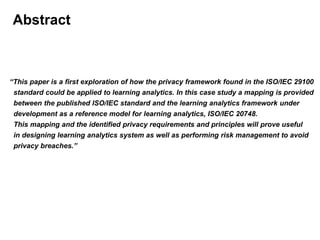
“This paper is a first exploration of how the privacy framework found in the ISO/IEC 29100
standard could be applied to learning analytics. In this case study a mapping is provided
between the published ISO/IEC standard and the learning analytics framework under
development as a reference model for learning analytics, ISO/IEC 20748.
This mapping and the identified privacy requirements and principles will prove useful
in designing learning analytics system as well as performing risk management to avoid
privacy breaches.”
Abstract
Overview ISO/IEC 29100
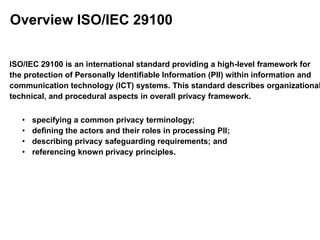
ISO/IEC 29100 is an international standard providing a high-level framework for
the protection of Personally Identifiable Information (PII) within information and
communication technology (ICT) systems. This standard describes organizational
technical, and procedural aspects in overall privacy framework.
• specifying a common privacy terminology;
• defining the actors and their roles in processing PII;
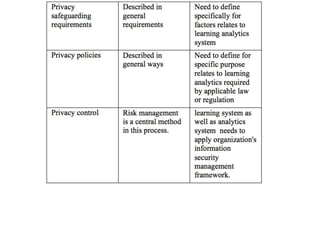
• describing privacy safeguarding requirements; and
• referencing known privacy principles.
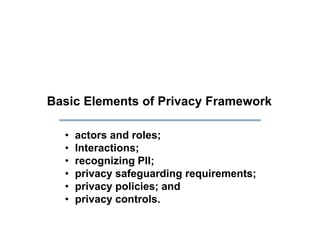
Basic Elements of Privacy Framework
• actors and roles;
• Interactions;
• recognizing PII;
• privacy safeguarding requirements;
• privacy policies; and
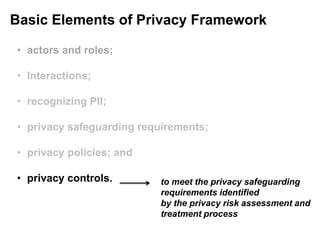
• privacy controls.
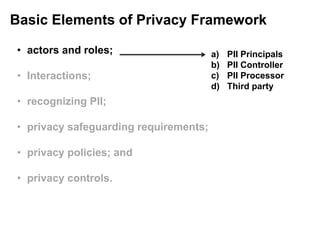
Basic Elements of Privacy Framework
• actors and roles;
• Interactions;
• recognizing PII;
• privacy safeguarding requirements;
• privacy policies; and
• privacy controls.
a) PII Principals
b) PII Controller
c) PII Processor
d) Third party
Basic Elements of Privacy Framework
• actors and roles;
• Interactions;
• recognizing PII;
• privacy safeguarding requirements;
• privacy policies; and
• privacy controls.
Provide PII between actors
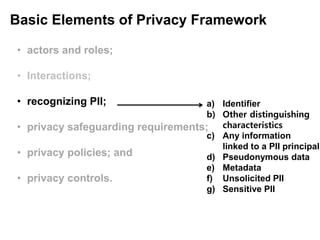
Basic Elements of Privacy Framework
• actors and roles;
• Interactions;
• recognizing PII;
• privacy safeguarding requirements;
• privacy policies; and
• privacy controls.
a) Identifier
b) Other distinguishing
characteristics
c) Any information
linked to a PII principal
d) Pseudonymous data
e) Metadata
f) Unsolicited PII
g) Sensitive PII
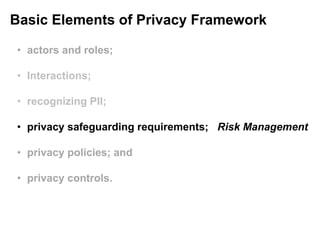
Basic Elements of Privacy Framework
• actors and roles;
• Interactions;
• recognizing PII;
• privacy safeguarding requirements; Risk Management
• privacy policies; and
• privacy controls.
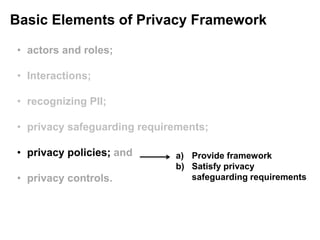
Basic Elements of Privacy Framework
• actors and roles;
• Interactions;
• recognizing PII;
• privacy safeguarding requirements;
• privacy policies; and
• privacy controls.
a) Provide framework
b) Satisfy privacy
safeguarding requirements
Basic Elements of Privacy Framework
• actors and roles;
• Interactions;
• recognizing PII;
• privacy safeguarding requirements;
• privacy policies; and
• privacy controls. to meet the privacy safeguarding
requirements identified
by the privacy risk assessment and
treatment process
Privacy Principles
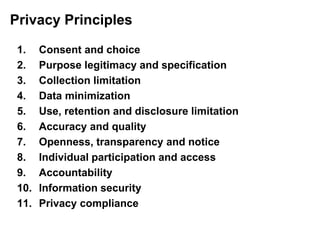
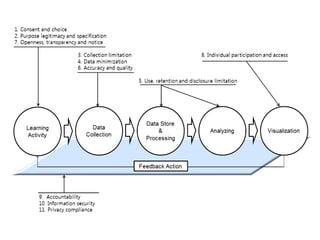
Privacy Principles
1. Consent and choice
2. Purpose legitimacy and specification
3. Collection limitation
4. Data minimization
5. Use, retention and disclosure limitation
6. Accuracy and quality
7. Openness, transparency and notice
8. Individual participation and access
9. Accountability
10. Information security
11. Privacy compliance
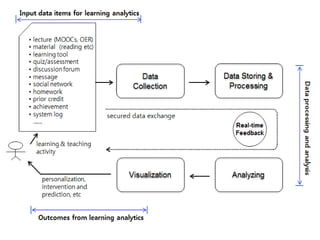
ISO/IEC 29748-1 LAI - Reference Model
Adoption of
Privacy Framework to Learning Analytics
Questions?
Korea Education & Research Information Service
Yong-Sang CHO, Ph.D
zzosang@gmail.com
FB: /zzosang Twitter: @zzosang

Mapping a Privacy Framework to a Reference Model of Learning Analytics

  • 1.
    Mapping a PrivacyFramework to a Reference Model of Learning Analytics Yong-Sang Cho, Tore Hoel and Weiqin Chen Korea Education & Research Information Service Yong-Sang Cho, Ph.D zzosang@keris.or.kr FB: /zzosang Twitter: @zzosang LAK 2016 Workshop April 25, 2016
  • 2.
    “This paper isa first exploration of how the privacy framework found in the ISO/IEC 29100 standard could be applied to learning analytics. In this case study a mapping is provided between the published ISO/IEC standard and the learning analytics framework under development as a reference model for learning analytics, ISO/IEC 20748. This mapping and the identified privacy requirements and principles will prove useful in designing learning analytics system as well as performing risk management to avoid privacy breaches.” Abstract
  • 3.
    Overview ISO/IEC 29100 ISO/IEC29100 is an international standard providing a high-level framework for the protection of Personally Identifiable Information (PII) within information and communication technology (ICT) systems. This standard describes organizational technical, and procedural aspects in overall privacy framework. • specifying a common privacy terminology; • defining the actors and their roles in processing PII; • describing privacy safeguarding requirements; and • referencing known privacy principles.
  • 4.
    Basic Elements ofPrivacy Framework • actors and roles; • Interactions; • recognizing PII; • privacy safeguarding requirements; • privacy policies; and • privacy controls.
  • 5.
    Basic Elements ofPrivacy Framework • actors and roles; • Interactions; • recognizing PII; • privacy safeguarding requirements; • privacy policies; and • privacy controls. a) PII Principals b) PII Controller c) PII Processor d) Third party
  • 6.
    Basic Elements ofPrivacy Framework • actors and roles; • Interactions; • recognizing PII; • privacy safeguarding requirements; • privacy policies; and • privacy controls. Provide PII between actors
  • 7.
    Basic Elements ofPrivacy Framework • actors and roles; • Interactions; • recognizing PII; • privacy safeguarding requirements; • privacy policies; and • privacy controls. a) Identifier b) Other distinguishing characteristics c) Any information linked to a PII principal d) Pseudonymous data e) Metadata f) Unsolicited PII g) Sensitive PII
  • 8.
    Basic Elements ofPrivacy Framework • actors and roles; • Interactions; • recognizing PII; • privacy safeguarding requirements; Risk Management • privacy policies; and • privacy controls.
  • 9.
    Basic Elements ofPrivacy Framework • actors and roles; • Interactions; • recognizing PII; • privacy safeguarding requirements; • privacy policies; and • privacy controls. a) Provide framework b) Satisfy privacy safeguarding requirements
  • 10.
    Basic Elements ofPrivacy Framework • actors and roles; • Interactions; • recognizing PII; • privacy safeguarding requirements; • privacy policies; and • privacy controls. to meet the privacy safeguarding requirements identified by the privacy risk assessment and treatment process
  • 11.
  • 12.
    Privacy Principles 1. Consentand choice 2. Purpose legitimacy and specification 3. Collection limitation 4. Data minimization 5. Use, retention and disclosure limitation 6. Accuracy and quality 7. Openness, transparency and notice 8. Individual participation and access 9. Accountability 10. Information security 11. Privacy compliance
  • 13.
    ISO/IEC 29748-1 LAI- Reference Model
  • 15.
    Adoption of Privacy Frameworkto Learning Analytics
  • 19.
    Questions? Korea Education &Research Information Service Yong-Sang CHO, Ph.D zzosang@gmail.com FB: /zzosang Twitter: @zzosang