Prospect for learning analytics to achieve
adaptive learning model
Research Fellow, KERIS
Yong-Sang CHO, Ph.D
zzosang@keris.or.kr
FB: /zzosang Twitter: @zzosang
e-Learning Conference
September 21, 2016
Table of Contents
• What is an Adaptive Learning
• Reference Model Design for Implementation of Adaptive Learning
• One step further: Exploring Data Flow and Exchange
• One step further: Exploring Curriculum Standards
• Conclusion and Recommendations
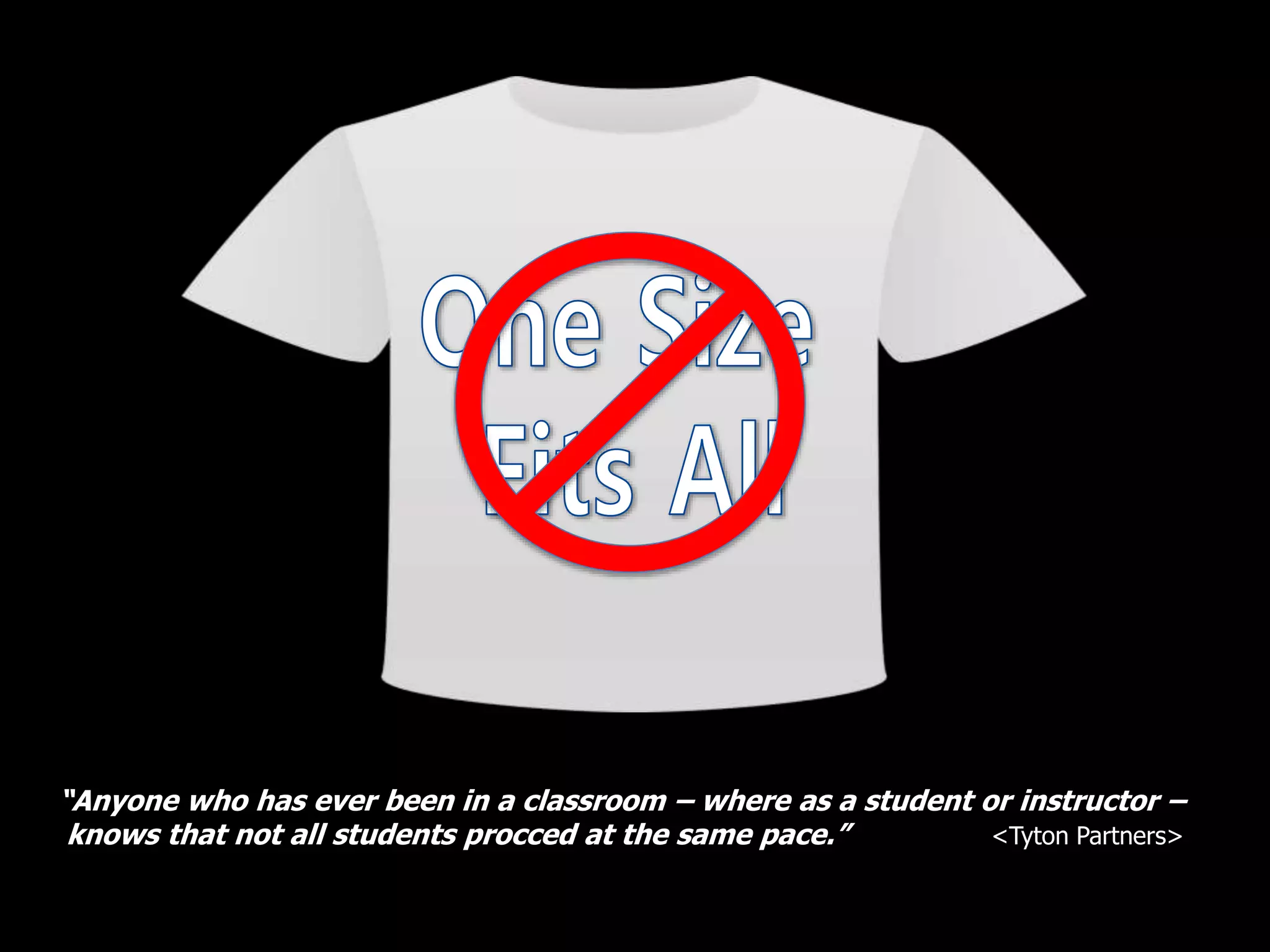
“Anyone who has ever been in a classroom – where as a student or instructor –
knows that not all students procced at the same pace.” <Tyton Partners>
What is an Adaptive Learning?
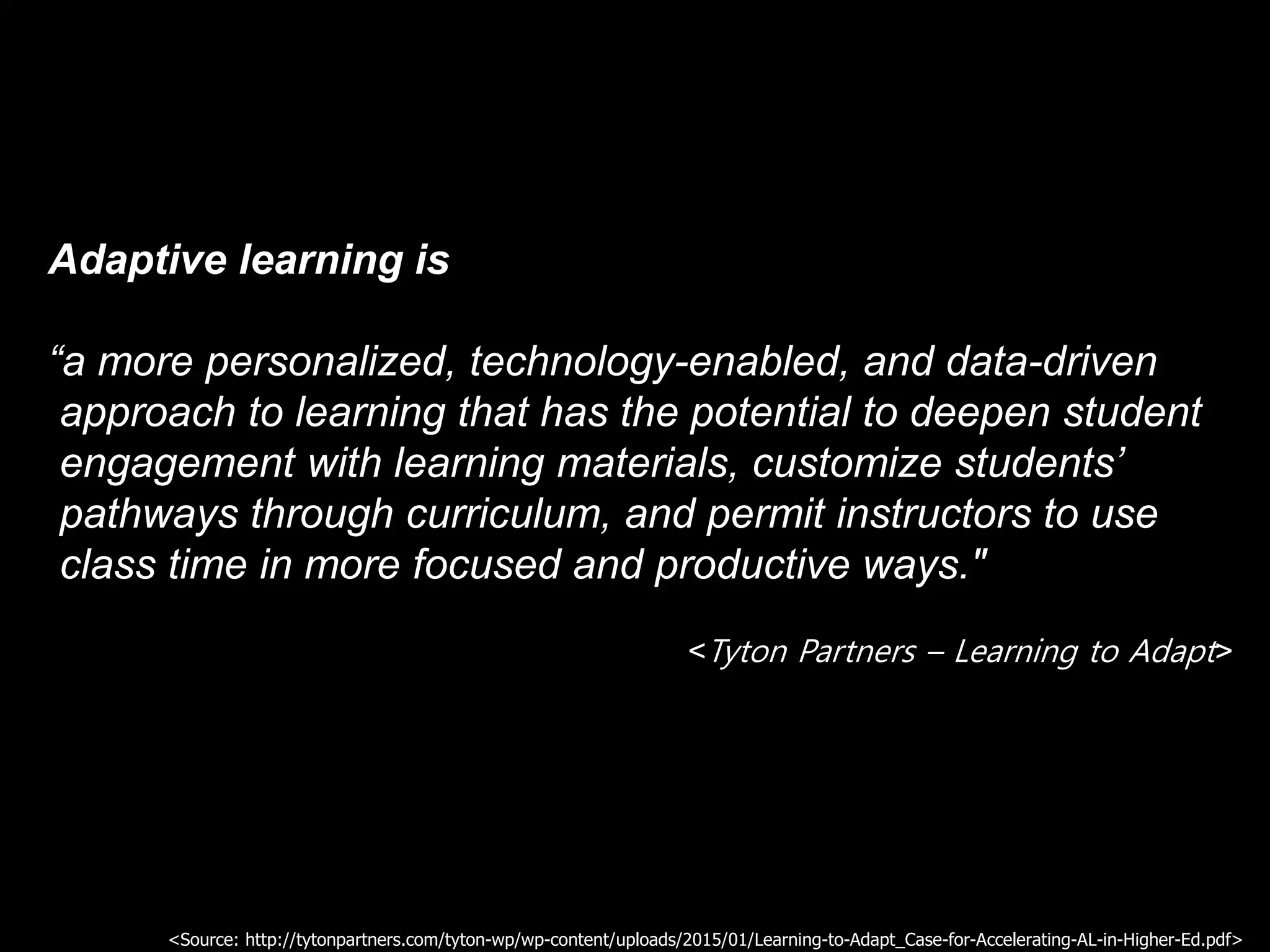
Adaptive learning is
“a more personalized, technology-enabled, and data-driven
approach to learning that has the potential to deepen student
engagement with learning materials, customize students’
pathways through curriculum, and permit instructors to use
class time in more focused and productive ways."
<Tyton Partners – Learning to Adapt>
<Source: http://tytonpartners.com/tyton-wp/wp-content/uploads/2015/01/Learning-to-Adapt_Case-for-Accelerating-AL-in-Higher-Ed.pdf>
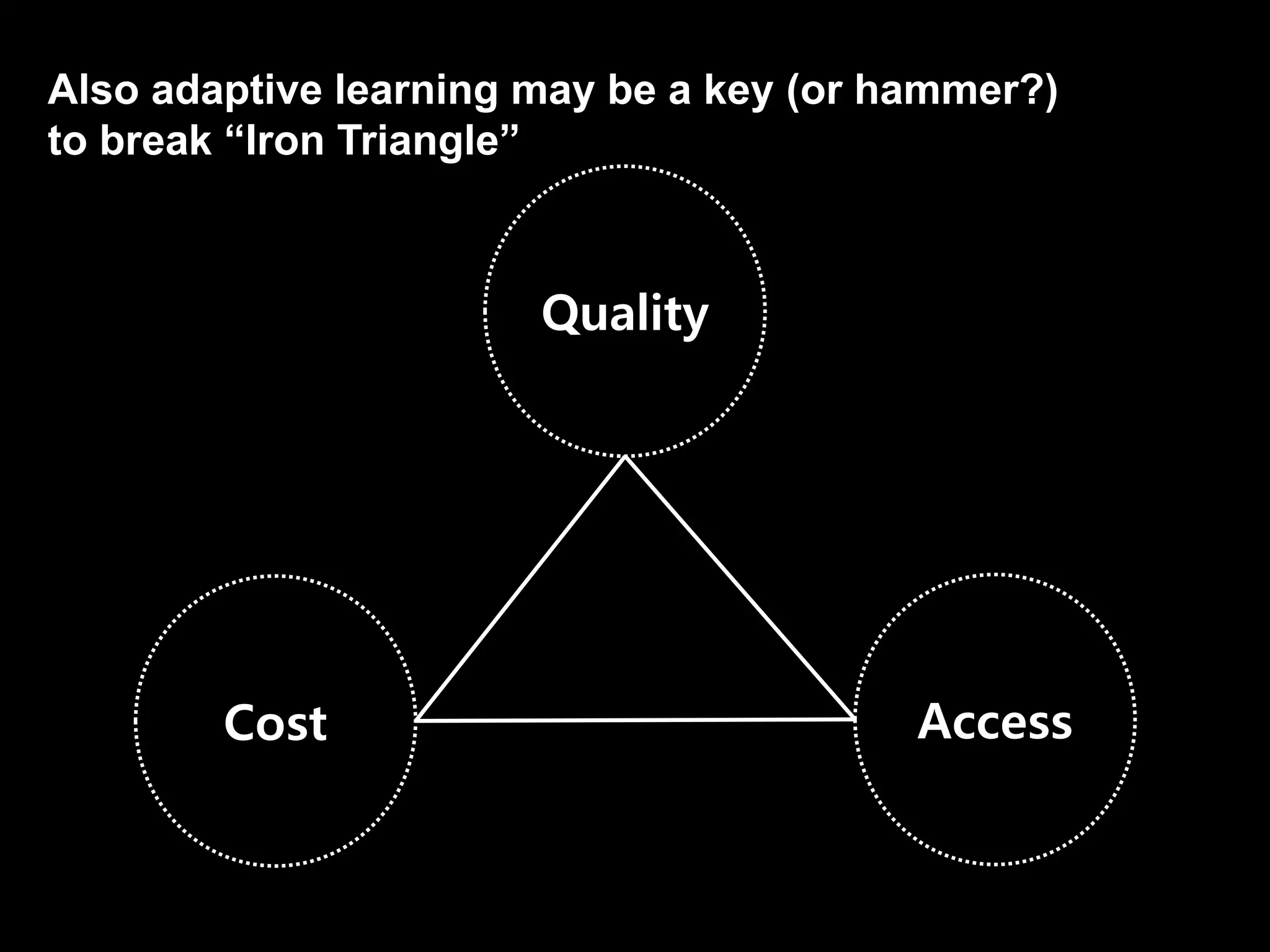
Quality
Cost Access
Also adaptive learning may be a key (or hammer?)
to break “Iron Triangle”
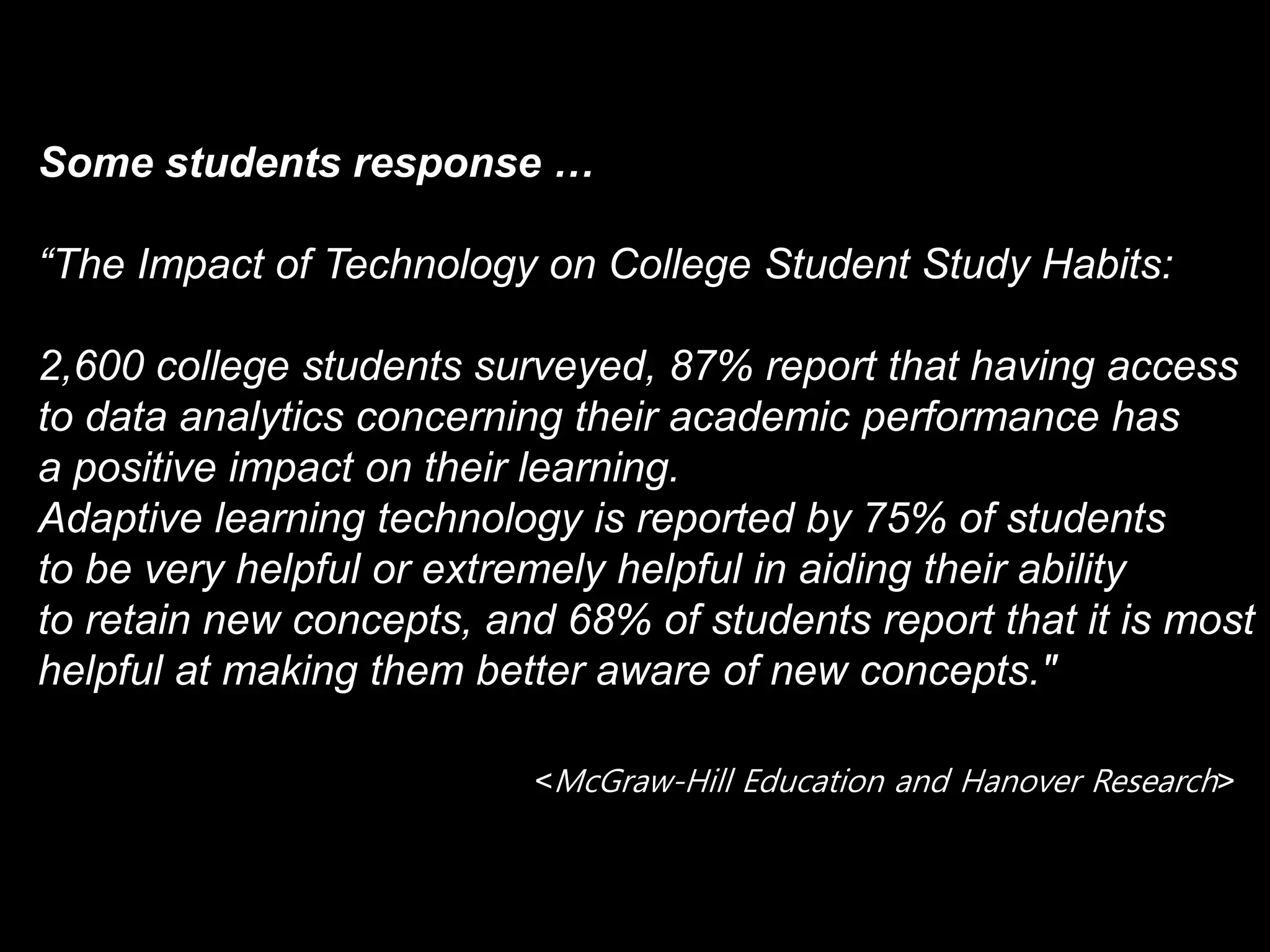
Some students response …
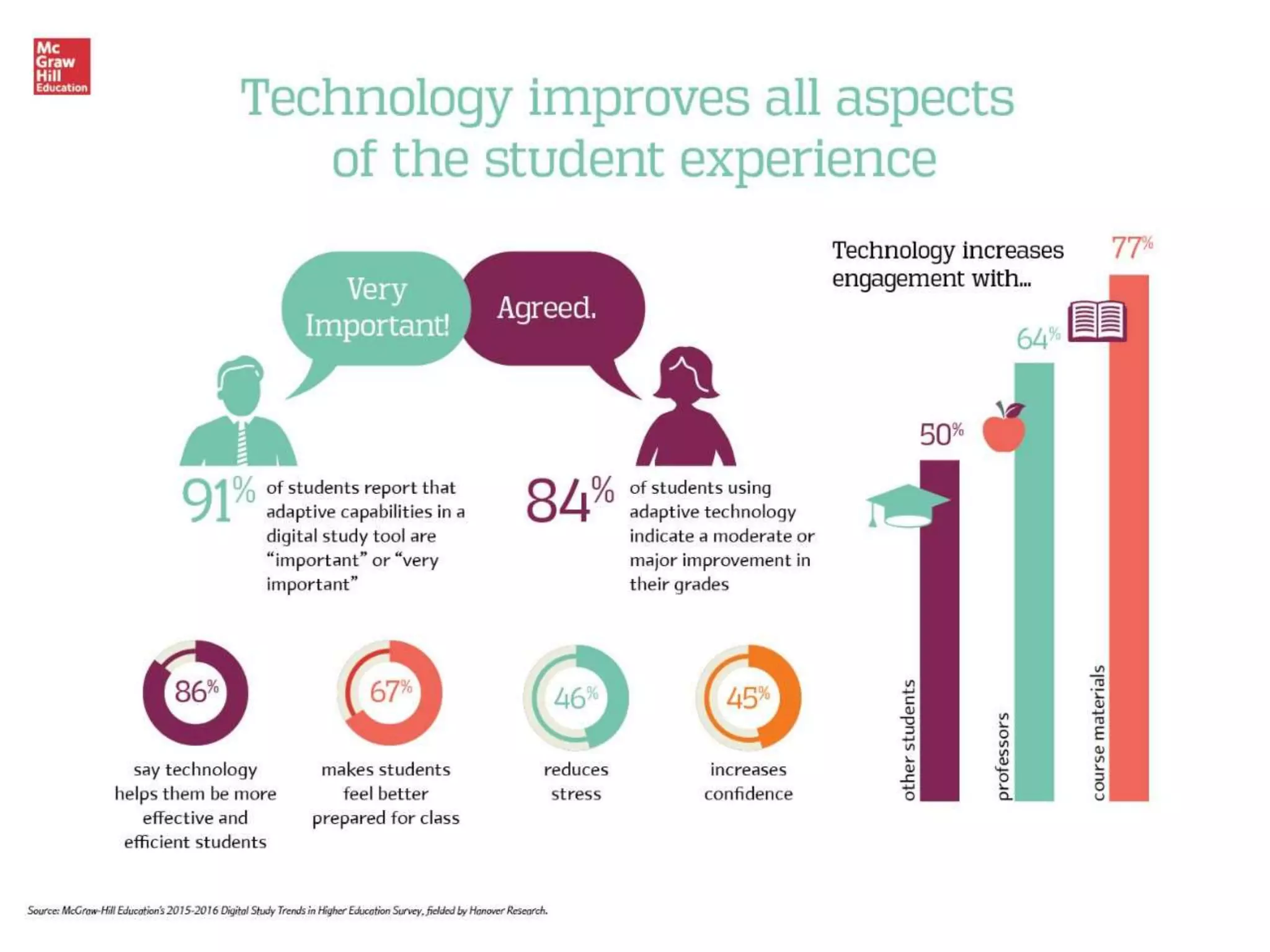
“The Impact of Technology on College Student Study Habits:
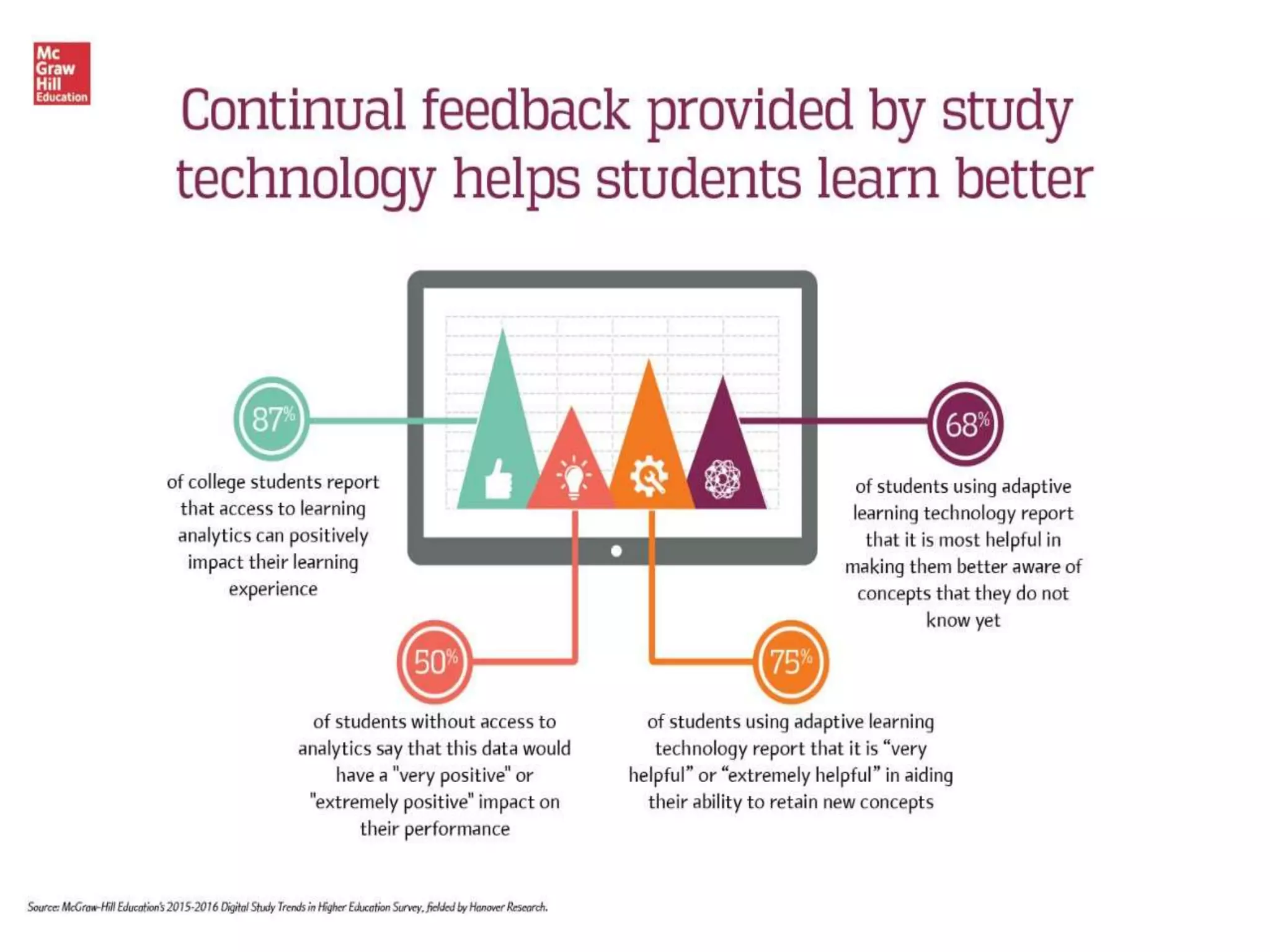
2,600 college students surveyed, 87% report that having access
to data analytics concerning their academic performance has
a positive impact on their learning.
Adaptive learning technology is reported by 75% of students
to be very helpful or extremely helpful in aiding their ability
to retain new concepts, and 68% of students report that it is most
helpful at making them better aware of new concepts."
<McGraw-Hill Education and Hanover Research>
Reference Model Design for
Implementation of Adaptive Learning
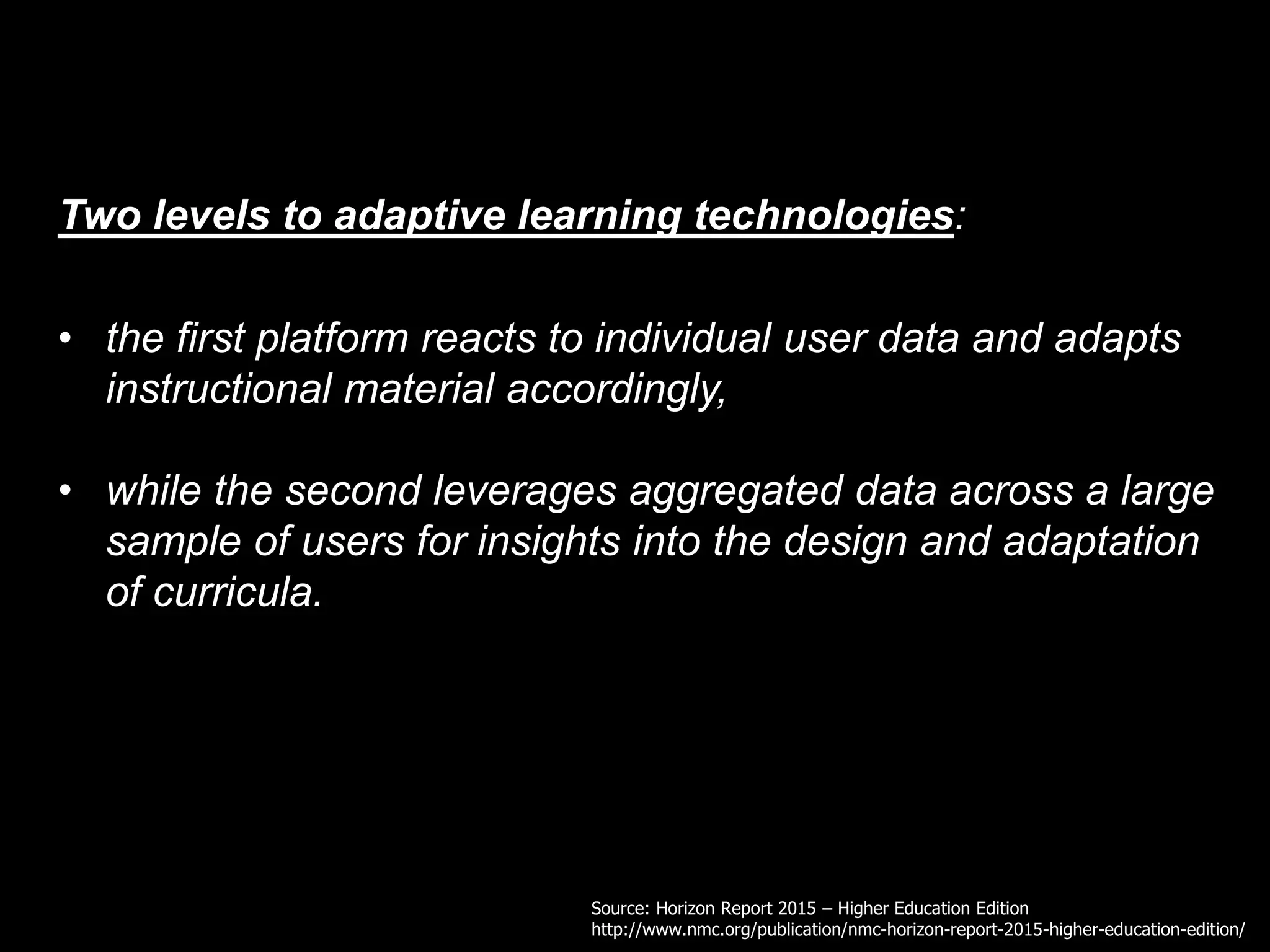
Two levels to adaptive learning technologies:
• the first platform reacts to individual user data and adapts
instructional material accordingly,
• while the second leverages aggregated data across a large
sample of users for insights into the design and adaptation
of curricula.
Source: Horizon Report 2015 – Higher Education Edition
http://www.nmc.org/publication/nmc-horizon-report-2015-higher-education-edition/
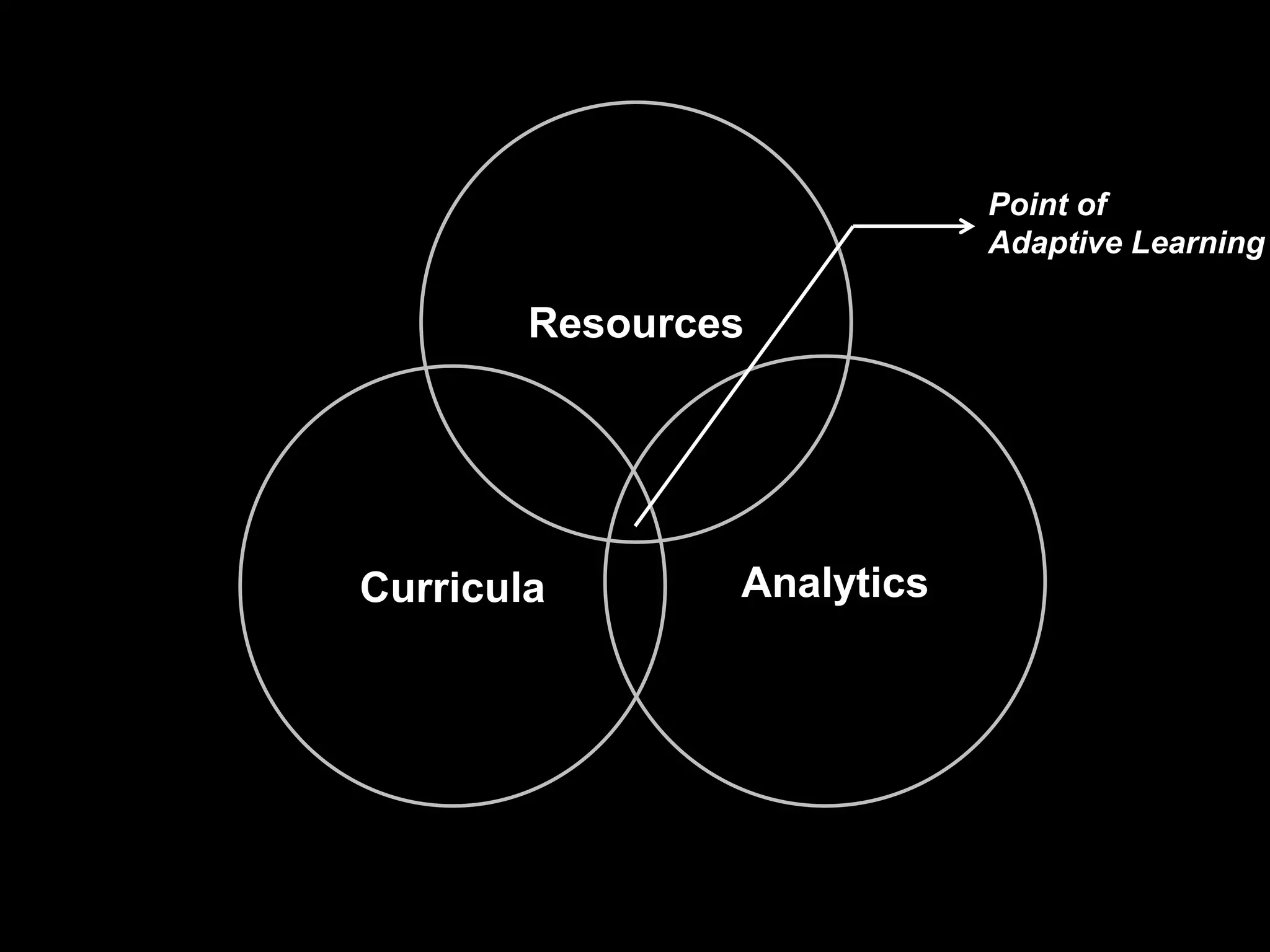
Resources
AnalyticsCurricula
Point of
Adaptive Learning
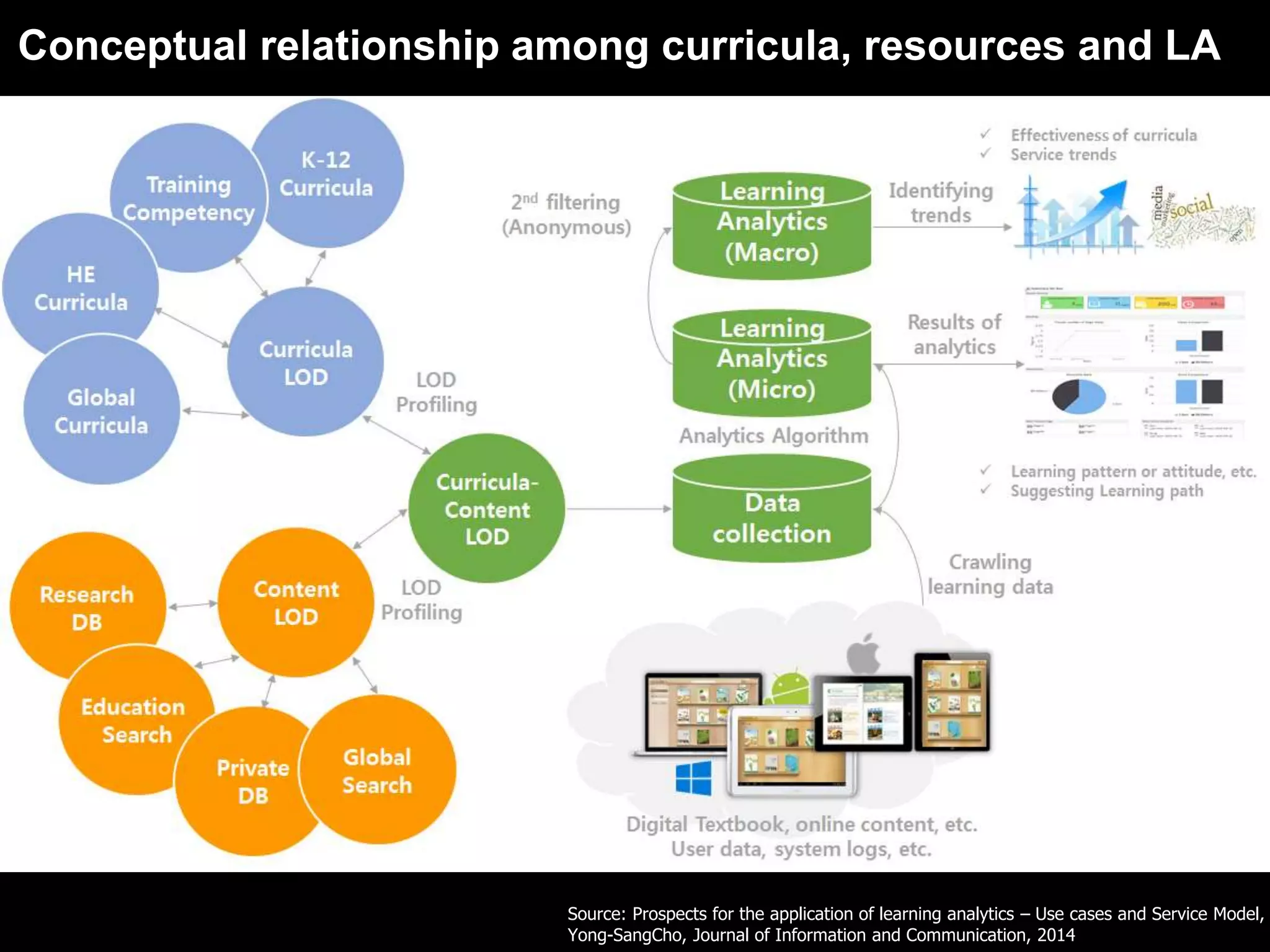
Conceptual relationship among curricula, resources and LA
Source: Prospects for the application of learning analytics – Use cases and Service Model,
Yong-SangCho, Journal of Information and Communication, 2014
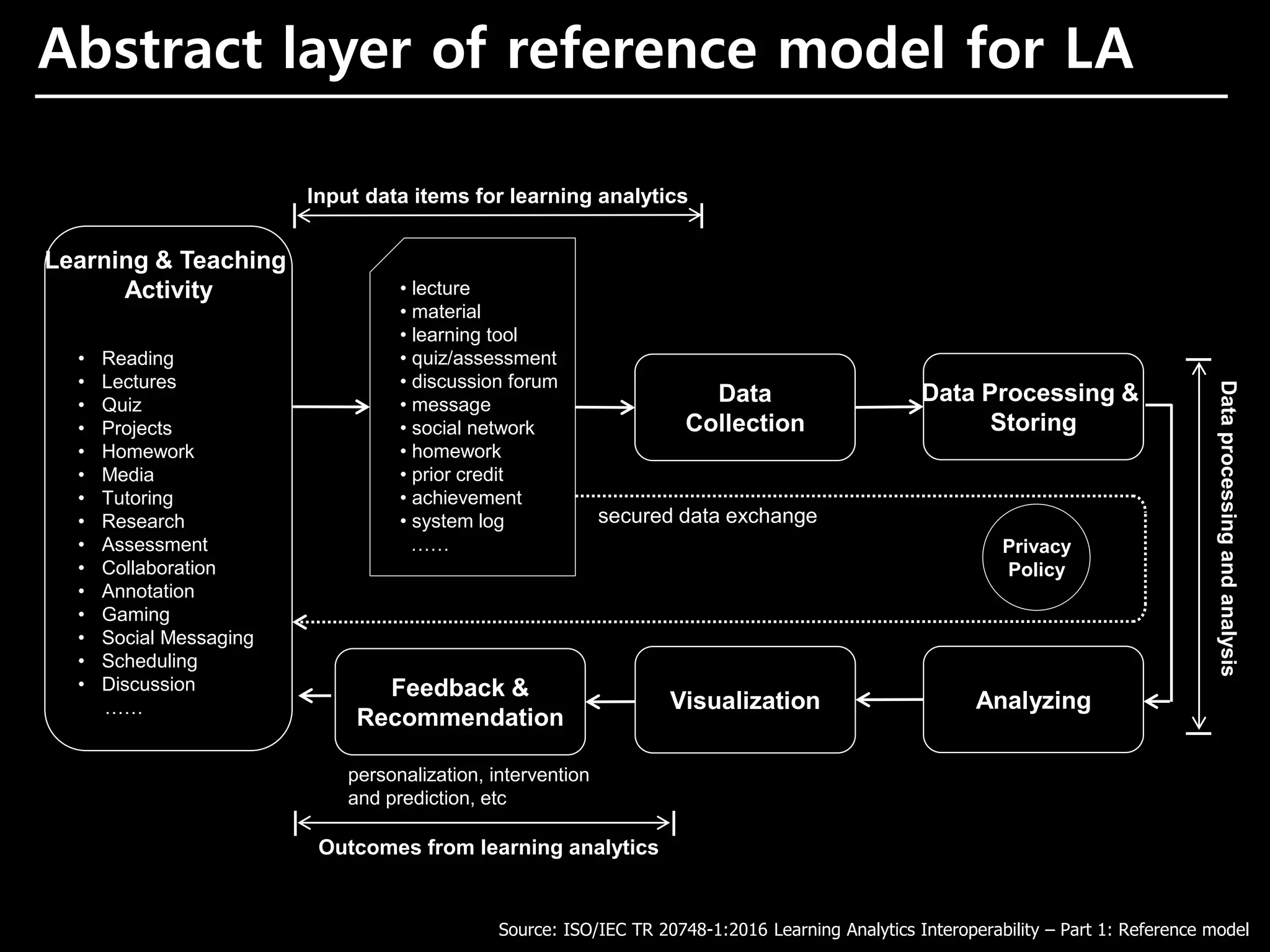
Abstract layer of reference model for LA
Input data items for learning analytics
Data
Collection
Data Processing &
Storing
Visualization Analyzing
Privacy
Policy
• lecture
• material
• learning tool
• quiz/assessment
• discussion forum
• message
• social network
• homework
• prior credit
• achievement
• system log
……
personalization, intervention
and prediction, etc
Outcomes from learning analytics
Dataprocessingandanalysis
secured data exchange
Learning & Teaching
Activity
• Reading
• Lectures
• Quiz
• Projects
• Homework
• Media
• Tutoring
• Research
• Assessment
• Collaboration
• Annotation
• Gaming
• Social Messaging
• Scheduling
• Discussion
……
Feedback &
Recommendation
Source: ISO/IEC TR 20748-1:2016 Learning Analytics Interoperability – Part 1: Reference model
Analytics Data Store
(Micro Data)
Analytics Data Store
(Analyzed Data)
DataManipulation
Data Analysis
Analysis
Interface
Analysis
Algorithm
Analysis
Processing
Output
Generation
Statistic Analysis
Topic Analysis
Network Analysis
Pattern Analysis
Dynamic Modeling
Association Analysis
Constant Information
(Curricula, Learning
Resources, Preferences)
DataControl
Dashboard Integration
Content Recommendation
Learning Path Recommendation
(Curriculum Support)
Social Analysis
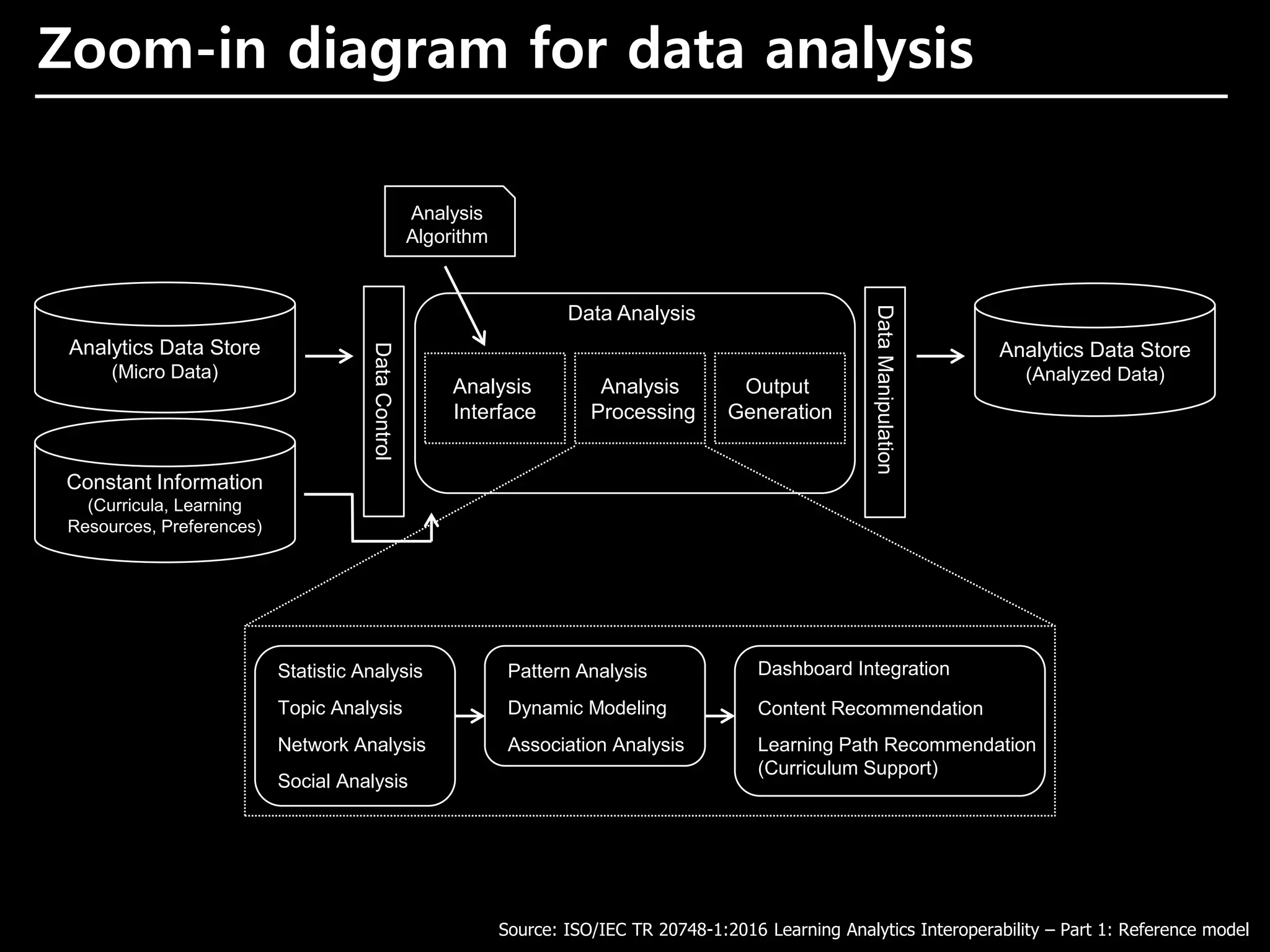
Source: ISO/IEC TR 20748-1:2016 Learning Analytics Interoperability – Part 1: Reference model
Zoom-in diagram for data analysis
One step further:
Exploring Data Flow and Exchange
- Get the data! -
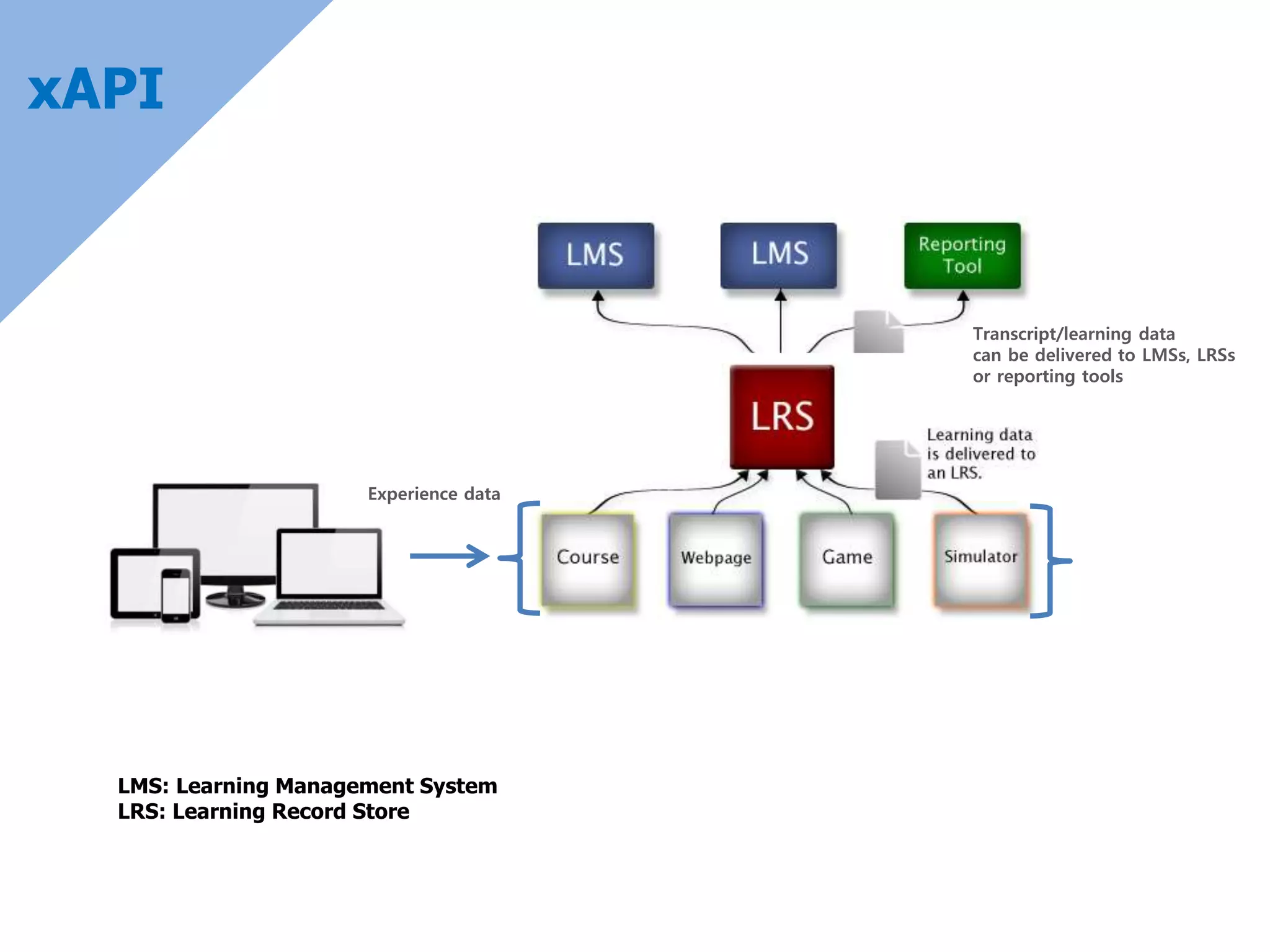
xAPI
Transcript/learning data
can be delivered to LMSs, LRSs
or reporting tools
Experience data
LMS: Learning Management System
LRS: Learning Record Store
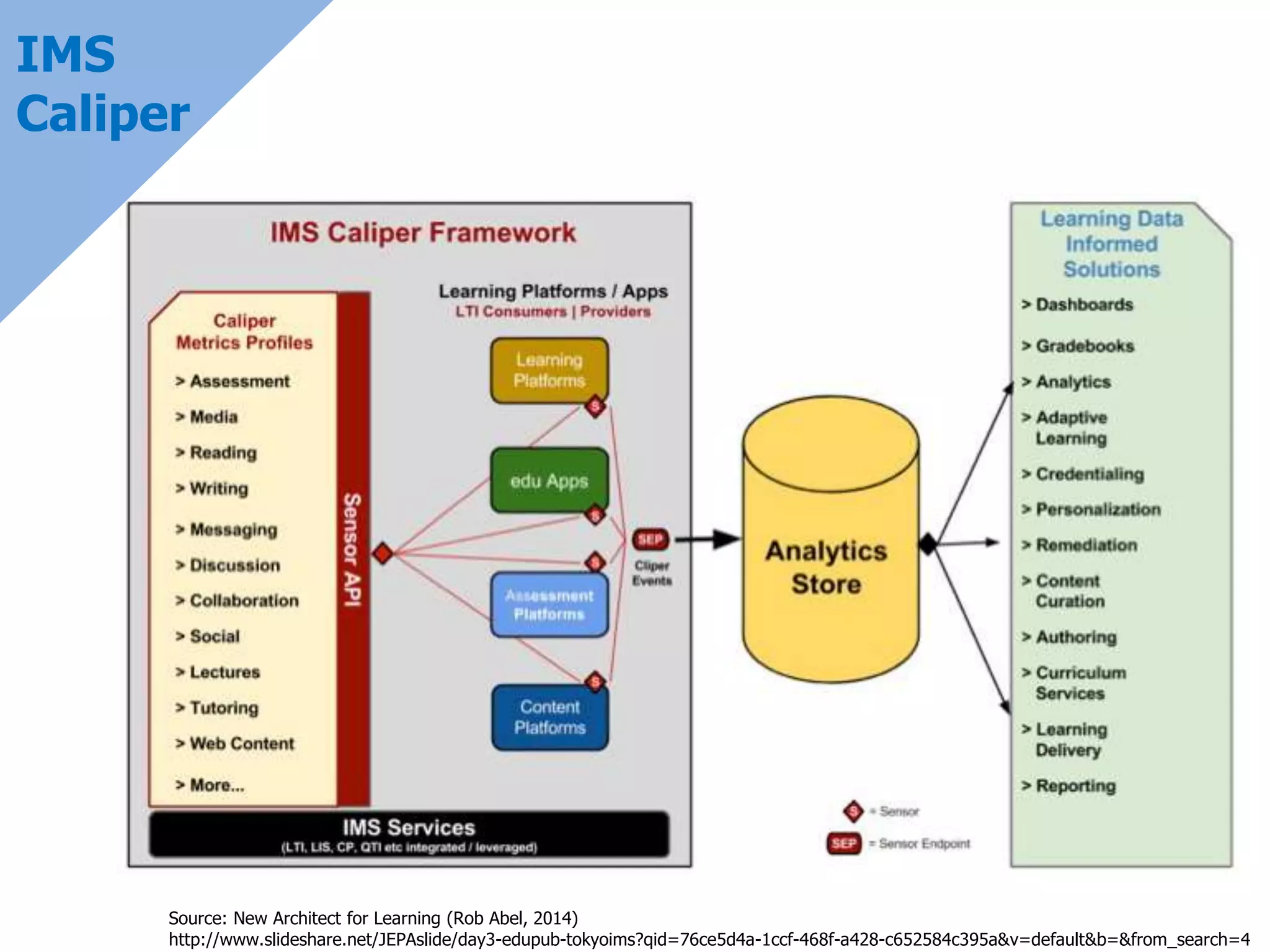
IMS
Caliper
Source: New Architect for Learning (Rob Abel, 2014)
http://www.slideshare.net/JEPAslide/day3-edupub-tokyoims?qid=76ce5d4a-1ccf-468f-a428-c652584c395a&v=default&b=&from_search=4
One step further:
Exploring Curriculum Standards
- Get the topic and competency! -
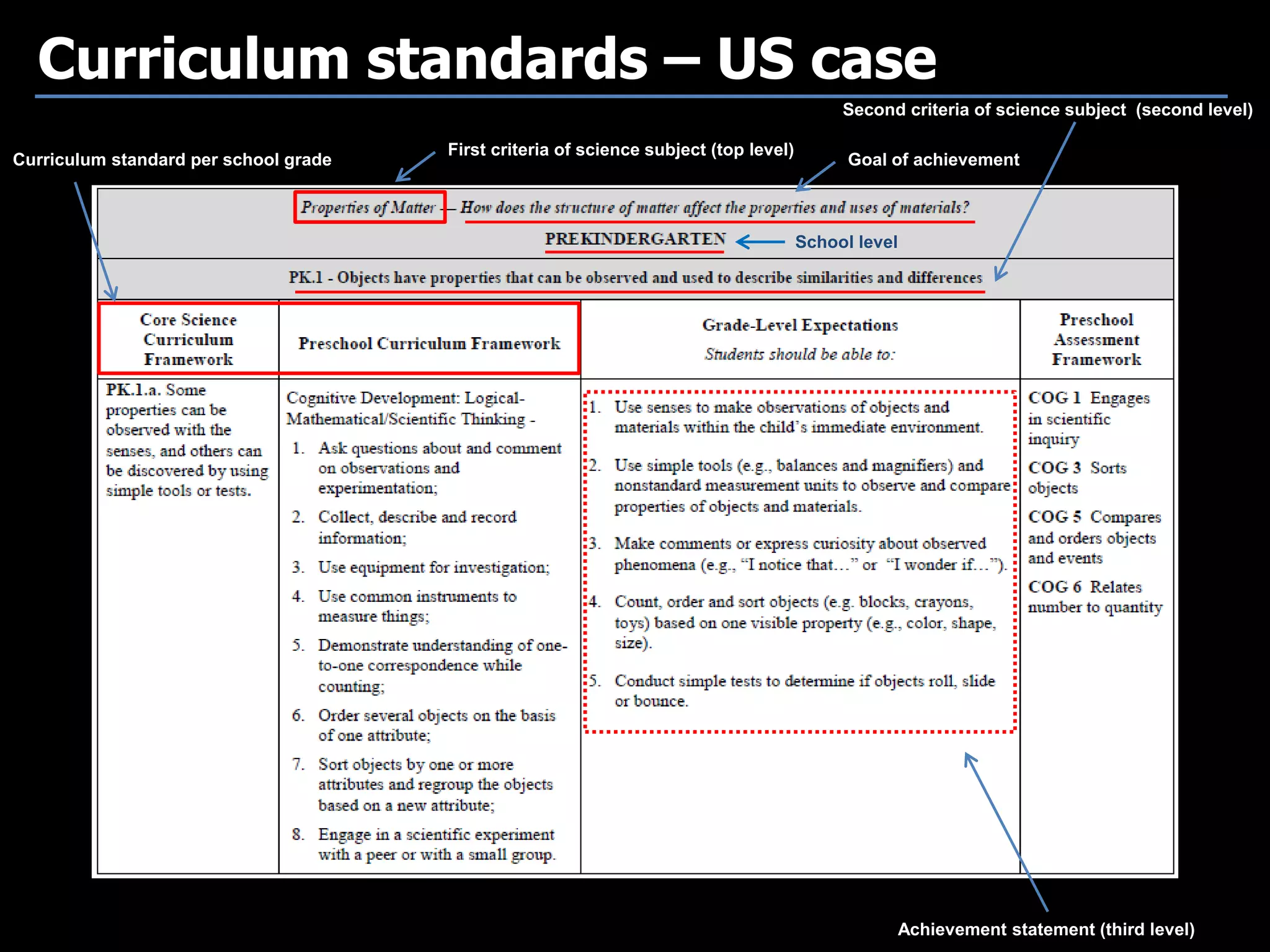
Goal of achievement
School level
Second criteria of science subject (second level)
Curriculum standard per school grade
Achievement statement (third level)
First criteria of science subject (top level)
Curriculum standards – US case
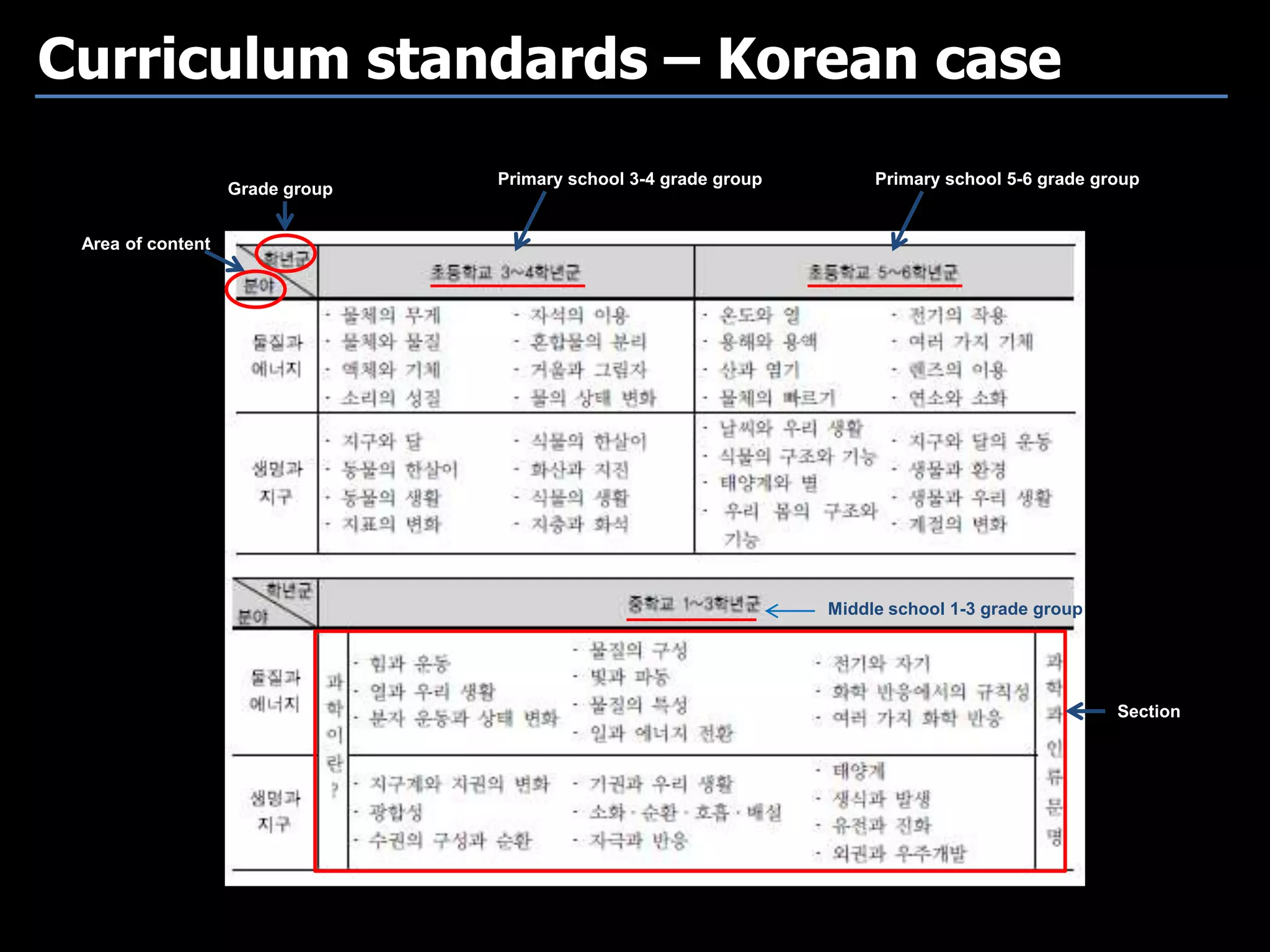
Grade group
Primary school 3-4 grade group Primary school 5-6 grade group
Middle school 1-3 grade group
Section
Curriculum standards – Korean case
Area of content
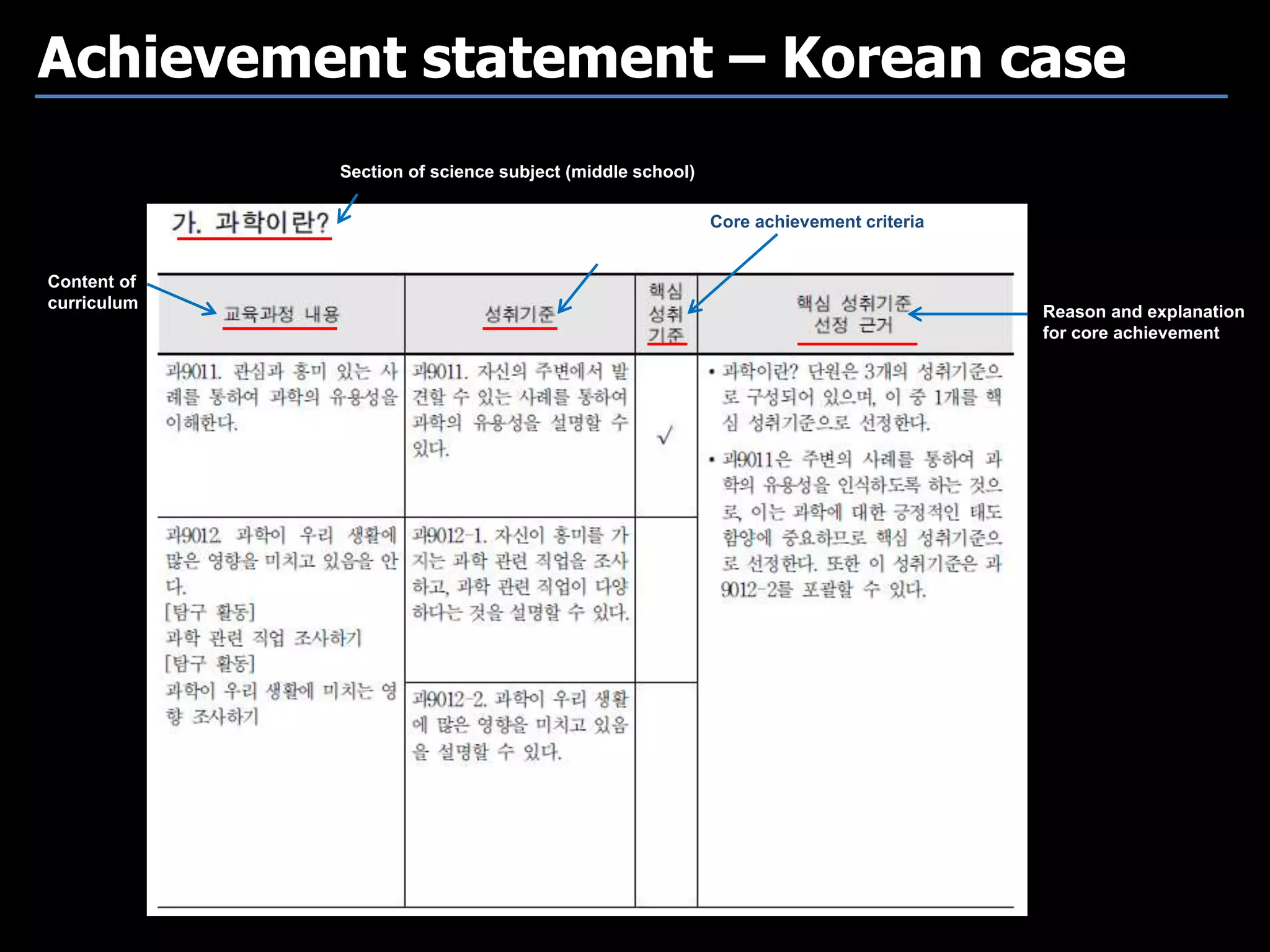
Achievement statement – Korean case
Section of science subject (middle school)
Content of
curriculum
Criteria of achievement
Core achievement criteria
Reason and explanation
for core achievement
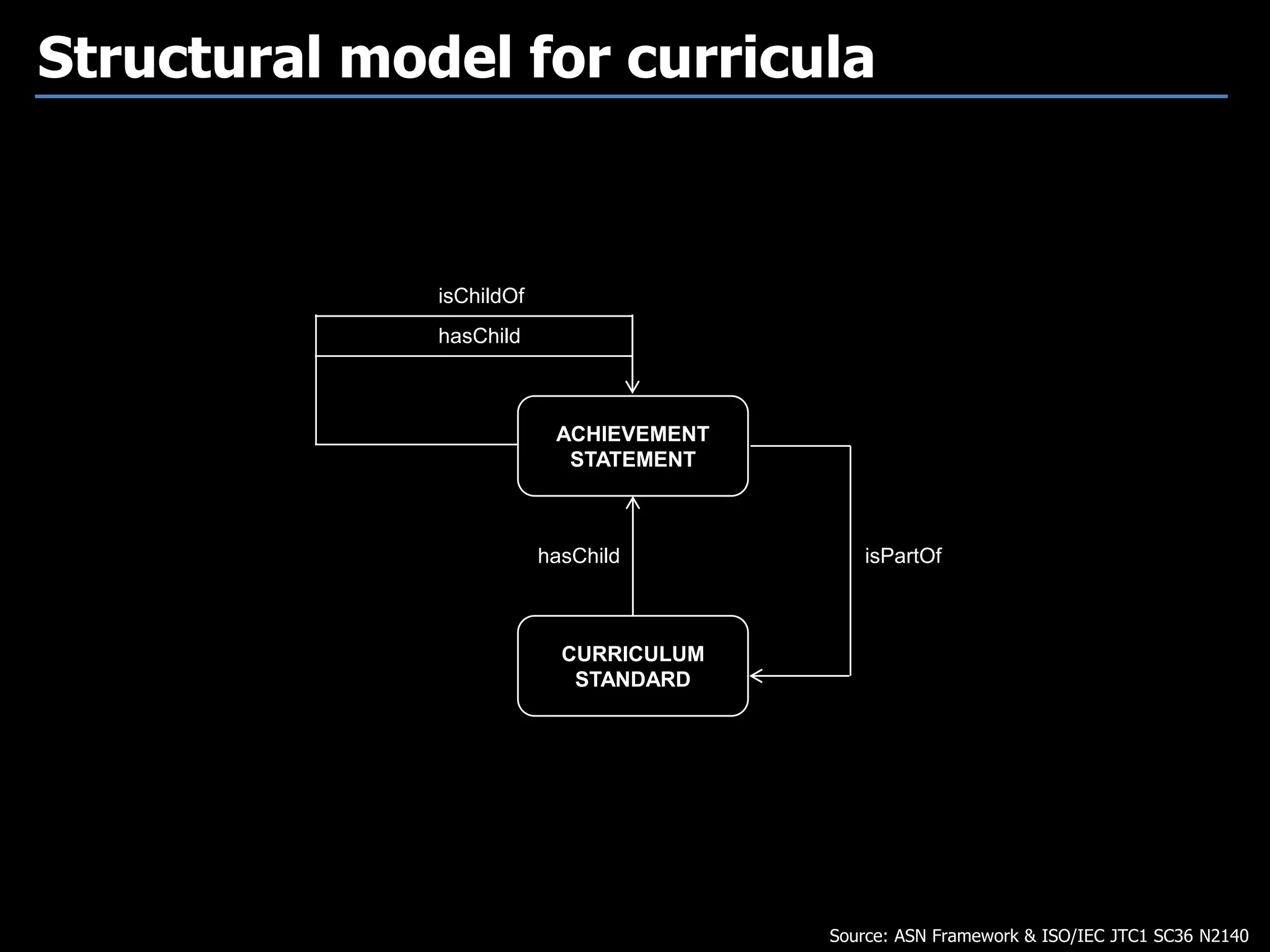
CURRICULUM
STANDARD
ACHIEVEMENT
STATEMENT
hasChild isPartOf
hasChild
isChildOf
Structural model for curricula
Source: ASN Framework & ISO/IEC JTC1 SC36 N2140
CURRICULUM
STANDARD
ACHIEVEMENT
STATEMENT
hasChild isPartOf
alignFrom
alignTo
alignTo
alignFrom
hasChild
isChildOf
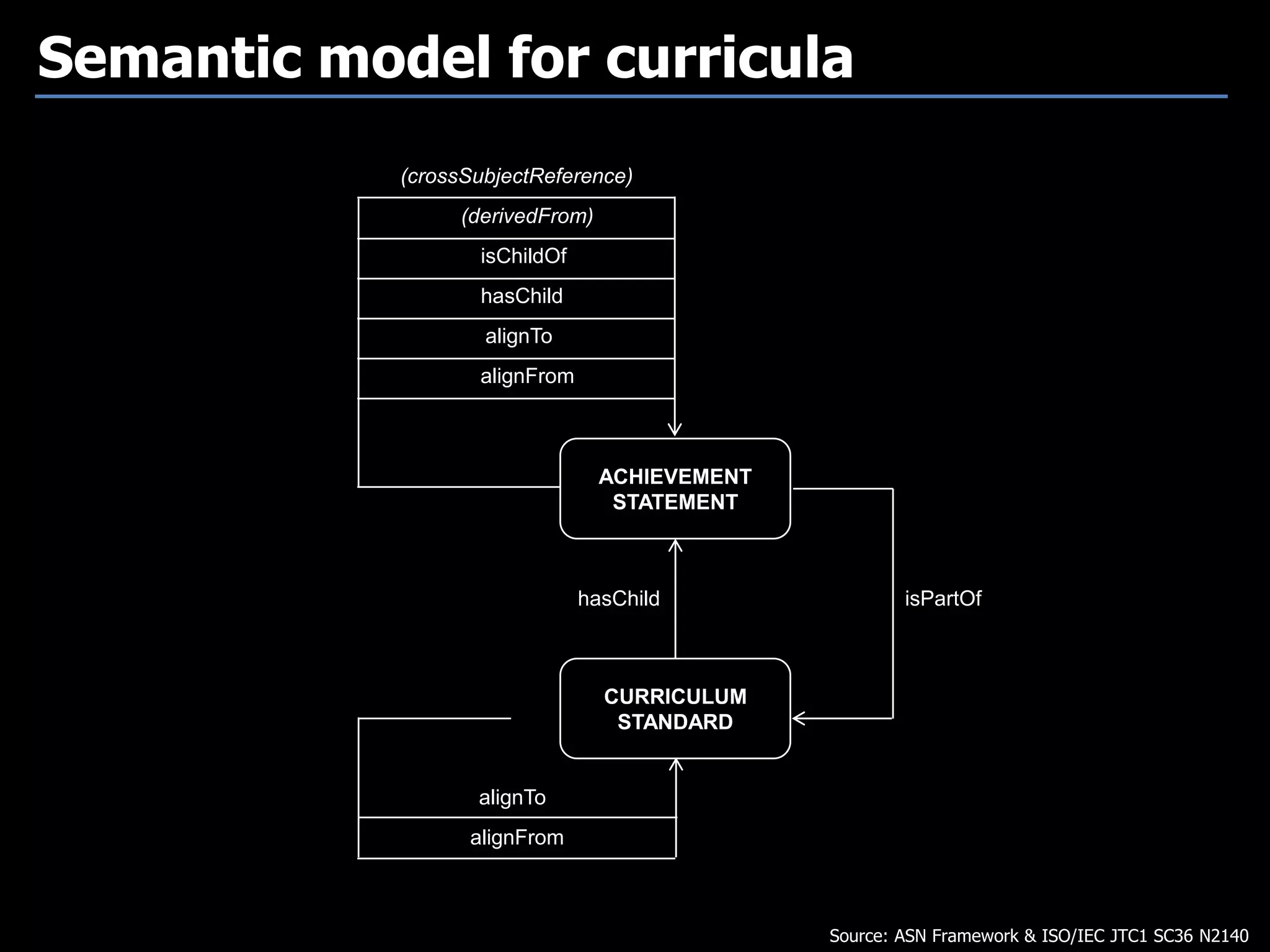
(derivedFrom)
(crossSubjectReference)
Semantic model for curricula
Source: ASN Framework & ISO/IEC JTC1 SC36 N2140
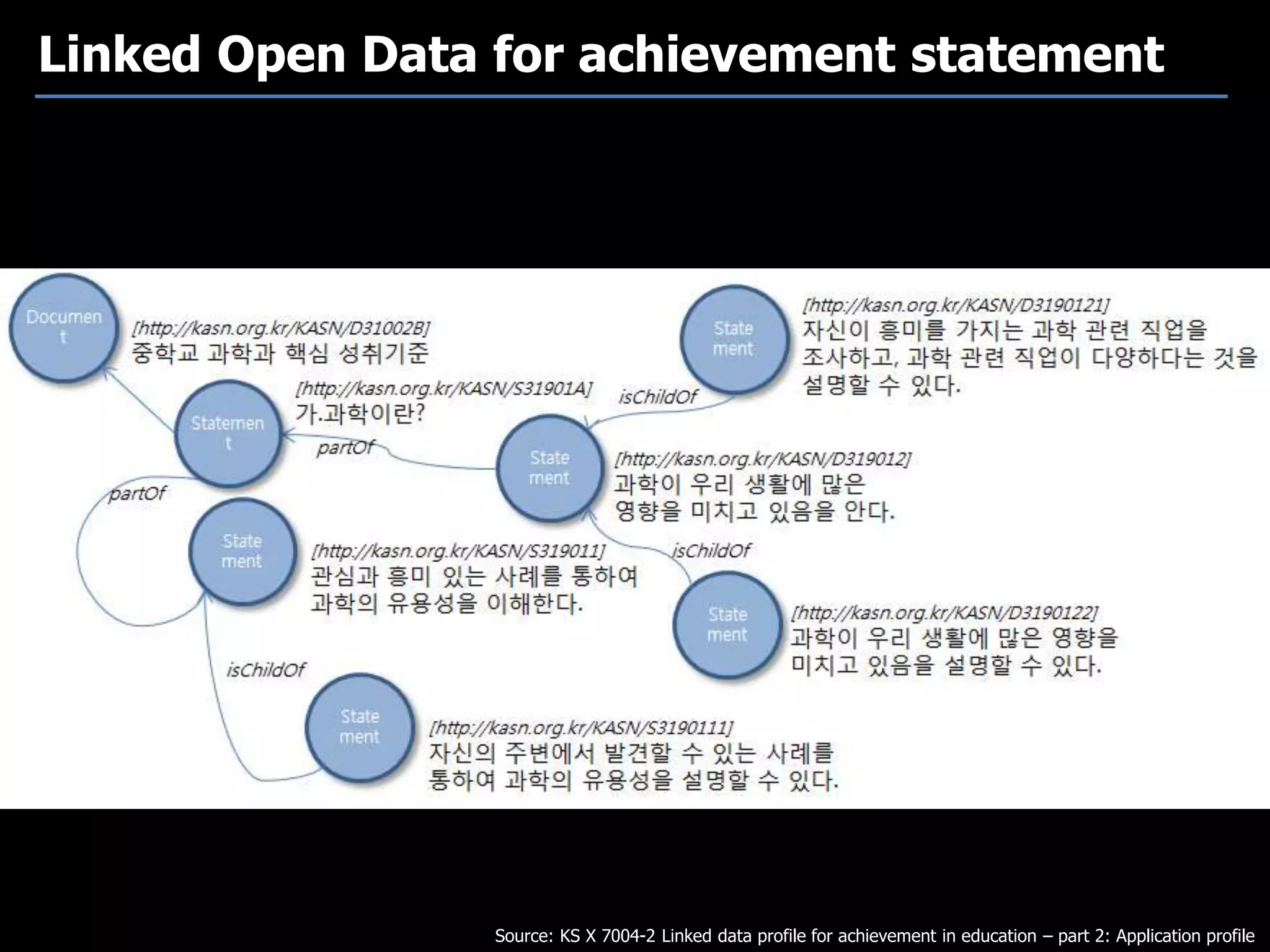
Linked Open Data for achievement statement
Source: KS X 7004-2 Linked data profile for achievement in education – part 2: Application profile
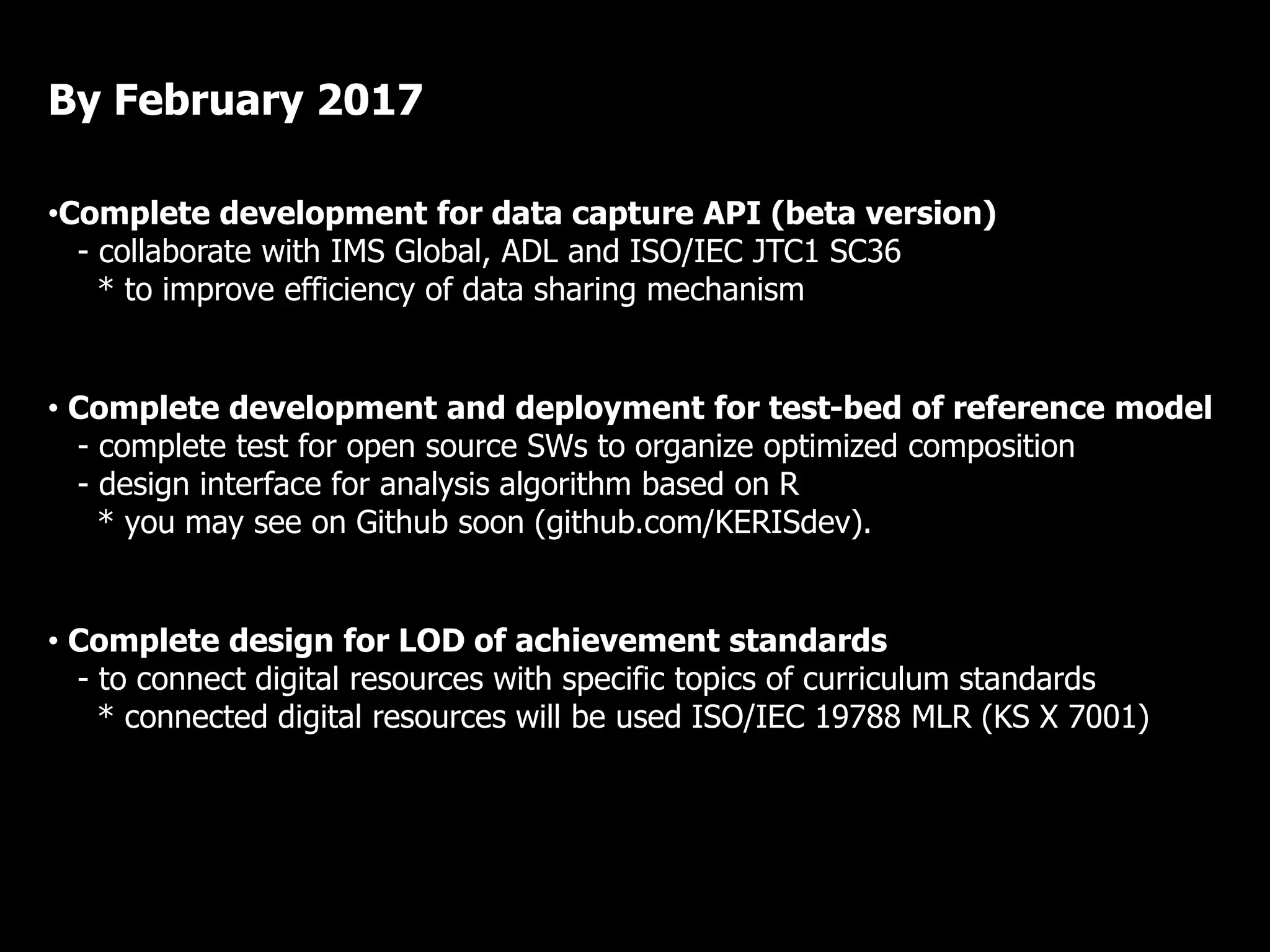
•Complete development for data capture API (beta version)
- collaborate with IMS Global, ADL and ISO/IEC JTC1 SC36
* to improve efficiency of data sharing mechanism
• Complete development and deployment for test-bed of reference model
- complete test for open source SWs to organize optimized composition
- design interface for analysis algorithm based on R
* you may see on Github soon (github.com/KERISdev).
• Complete design for LOD of achievement standards
- to connect digital resources with specific topics of curriculum standards
* connected digital resources will be used ISO/IEC 19788 MLR (KS X 7001)
By February 2017
Conclusion & Recommendations
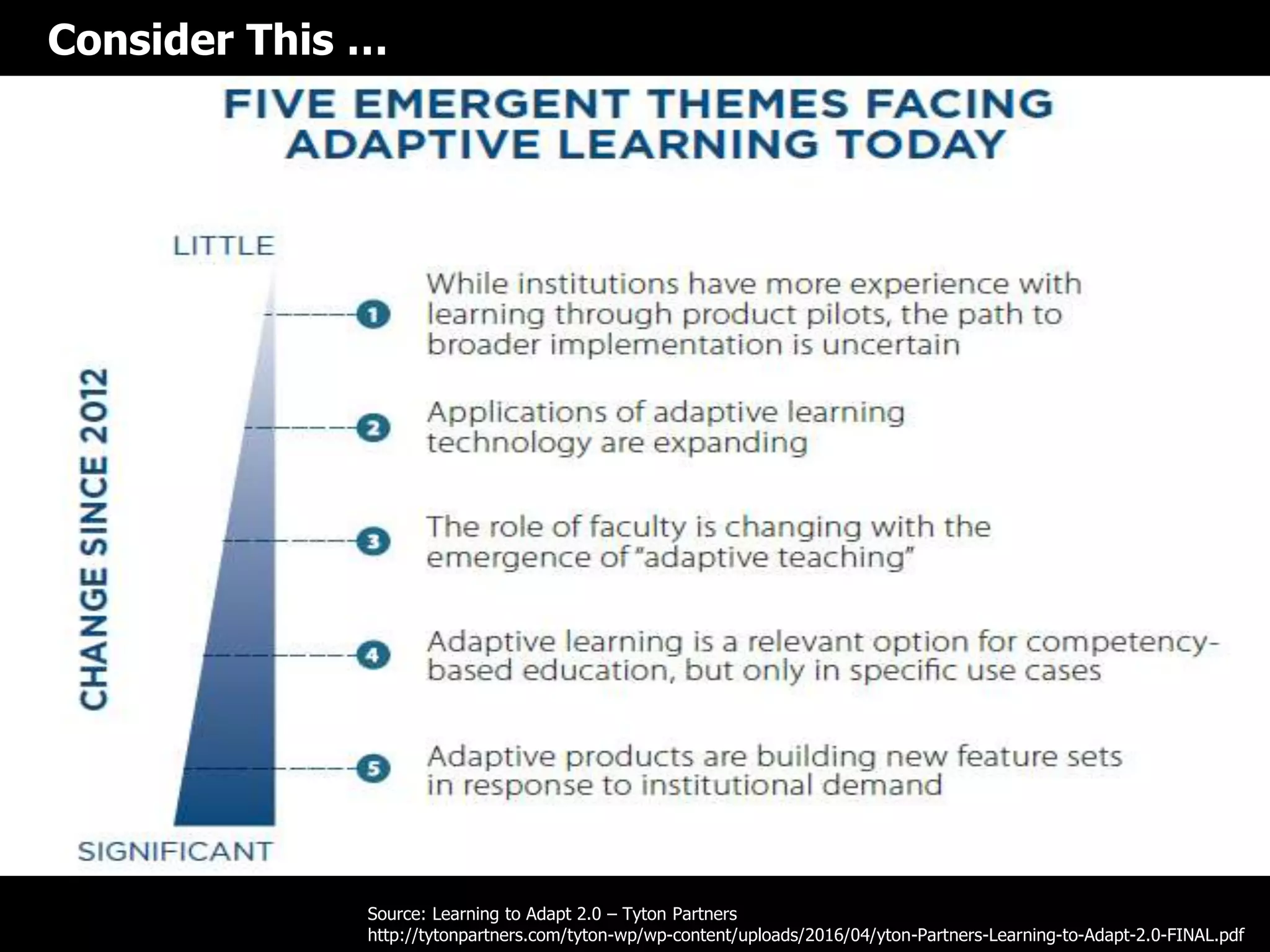
Source: Learning to Adapt 2.0 – Tyton Partners
http://tytonpartners.com/tyton-wp/wp-content/uploads/2016/04/yton-Partners-Learning-to-Adapt-2.0-FINAL.pdf
Consider This …
Thank You !!!
Korea Education & Research Information Service
Yong-Sang CHO, Ph.D
zzosang@keris.or.kr
FB: /zzosang Twitter: @zzosang

Prospect for learning analytics to achieve adaptive learning model

  • 1.
    Prospect for learninganalytics to achieve adaptive learning model Research Fellow, KERIS Yong-Sang CHO, Ph.D zzosang@keris.or.kr FB: /zzosang Twitter: @zzosang e-Learning Conference September 21, 2016
  • 2.
    Table of Contents •What is an Adaptive Learning • Reference Model Design for Implementation of Adaptive Learning • One step further: Exploring Data Flow and Exchange • One step further: Exploring Curriculum Standards • Conclusion and Recommendations
  • 3.
    “Anyone who hasever been in a classroom – where as a student or instructor – knows that not all students procced at the same pace.” <Tyton Partners>
  • 4.
    What is anAdaptive Learning?
  • 5.
    Adaptive learning is “amore personalized, technology-enabled, and data-driven approach to learning that has the potential to deepen student engagement with learning materials, customize students’ pathways through curriculum, and permit instructors to use class time in more focused and productive ways." <Tyton Partners – Learning to Adapt> <Source: http://tytonpartners.com/tyton-wp/wp-content/uploads/2015/01/Learning-to-Adapt_Case-for-Accelerating-AL-in-Higher-Ed.pdf>
  • 6.
    Quality Cost Access Also adaptivelearning may be a key (or hammer?) to break “Iron Triangle”
  • 7.
    Some students response… “The Impact of Technology on College Student Study Habits: 2,600 college students surveyed, 87% report that having access to data analytics concerning their academic performance has a positive impact on their learning. Adaptive learning technology is reported by 75% of students to be very helpful or extremely helpful in aiding their ability to retain new concepts, and 68% of students report that it is most helpful at making them better aware of new concepts." <McGraw-Hill Education and Hanover Research>
  • 10.
    Reference Model Designfor Implementation of Adaptive Learning
  • 11.
    Two levels toadaptive learning technologies: • the first platform reacts to individual user data and adapts instructional material accordingly, • while the second leverages aggregated data across a large sample of users for insights into the design and adaptation of curricula. Source: Horizon Report 2015 – Higher Education Edition http://www.nmc.org/publication/nmc-horizon-report-2015-higher-education-edition/
  • 12.
  • 13.
    Conceptual relationship amongcurricula, resources and LA Source: Prospects for the application of learning analytics – Use cases and Service Model, Yong-SangCho, Journal of Information and Communication, 2014
  • 14.
    Abstract layer ofreference model for LA Input data items for learning analytics Data Collection Data Processing & Storing Visualization Analyzing Privacy Policy • lecture • material • learning tool • quiz/assessment • discussion forum • message • social network • homework • prior credit • achievement • system log …… personalization, intervention and prediction, etc Outcomes from learning analytics Dataprocessingandanalysis secured data exchange Learning & Teaching Activity • Reading • Lectures • Quiz • Projects • Homework • Media • Tutoring • Research • Assessment • Collaboration • Annotation • Gaming • Social Messaging • Scheduling • Discussion …… Feedback & Recommendation Source: ISO/IEC TR 20748-1:2016 Learning Analytics Interoperability – Part 1: Reference model
  • 15.
    Analytics Data Store (MicroData) Analytics Data Store (Analyzed Data) DataManipulation Data Analysis Analysis Interface Analysis Algorithm Analysis Processing Output Generation Statistic Analysis Topic Analysis Network Analysis Pattern Analysis Dynamic Modeling Association Analysis Constant Information (Curricula, Learning Resources, Preferences) DataControl Dashboard Integration Content Recommendation Learning Path Recommendation (Curriculum Support) Social Analysis Source: ISO/IEC TR 20748-1:2016 Learning Analytics Interoperability – Part 1: Reference model Zoom-in diagram for data analysis
  • 16.
    One step further: ExploringData Flow and Exchange - Get the data! -
  • 17.
    xAPI Transcript/learning data can bedelivered to LMSs, LRSs or reporting tools Experience data LMS: Learning Management System LRS: Learning Record Store
  • 18.
    IMS Caliper Source: New Architectfor Learning (Rob Abel, 2014) http://www.slideshare.net/JEPAslide/day3-edupub-tokyoims?qid=76ce5d4a-1ccf-468f-a428-c652584c395a&v=default&b=&from_search=4
  • 20.
    One step further: ExploringCurriculum Standards - Get the topic and competency! -
  • 21.
    Goal of achievement Schoollevel Second criteria of science subject (second level) Curriculum standard per school grade Achievement statement (third level) First criteria of science subject (top level) Curriculum standards – US case
  • 22.
    Grade group Primary school3-4 grade group Primary school 5-6 grade group Middle school 1-3 grade group Section Curriculum standards – Korean case Area of content
  • 23.
    Achievement statement –Korean case Section of science subject (middle school) Content of curriculum Criteria of achievement Core achievement criteria Reason and explanation for core achievement
  • 24.
  • 25.
  • 26.
    Linked Open Datafor achievement statement Source: KS X 7004-2 Linked data profile for achievement in education – part 2: Application profile
  • 27.
    •Complete development fordata capture API (beta version) - collaborate with IMS Global, ADL and ISO/IEC JTC1 SC36 * to improve efficiency of data sharing mechanism • Complete development and deployment for test-bed of reference model - complete test for open source SWs to organize optimized composition - design interface for analysis algorithm based on R * you may see on Github soon (github.com/KERISdev). • Complete design for LOD of achievement standards - to connect digital resources with specific topics of curriculum standards * connected digital resources will be used ISO/IEC 19788 MLR (KS X 7001) By February 2017
  • 28.
  • 29.
    Source: Learning toAdapt 2.0 – Tyton Partners http://tytonpartners.com/tyton-wp/wp-content/uploads/2016/04/yton-Partners-Learning-to-Adapt-2.0-FINAL.pdf Consider This …
  • 31.
    Thank You !!! KoreaEducation & Research Information Service Yong-Sang CHO, Ph.D zzosang@keris.or.kr FB: /zzosang Twitter: @zzosang