Semantic Web in Libraries 2013
25 - 27 November 2013
Hamburg, Germany

AgriVIVO
A Global Ontology-Driven RDF Store
Based on a Distributed Architecture
Valeria Pesce*, John Fereira^, Jon
Corson-Rikert^, Johannes Keizer~
*Global Forum on Agricultural Research
^Cornell University
~Food and Agriculture Organization of the UN
Contents
• What we wanted to do
• Why we chose VIVO*
• How we adapted VIVO and built AgriVIVO
– Ontology
– Importers
– Search interface

• Future plans
* VIVO is a research discovery tool based on semantic technologies
initially developed at Cornell University and now an incubator project
under DuraSpace.org
Semantic Web in Libraries 2013
25 - 27 November 2013
Hamburg, Germany

What we wanted to do
What is “we”
The Global Forum on Agricultural Research
(GFAR)
“Agricultural Knowledge for All” program:
a set of activities to improve information and communications
management in agricultural research for development (ARD)

Cornell University
Initiator of VIVO

Food and Agriculture Organization (FAO)
of the UN
In particular, the Agricultural Information Management Standards
team
What we wanted to achieve
• More effective collaborative research and
networking across countries and regions
• Facilitating capacity strengthening and networking of
skills

• Fostering collaboration and synergy through greater
awareness of ongoing research
• Reducing duplication of research
• Determining strategic trends based on strengths and
weaknesses of the network
• Identifying missing expertise
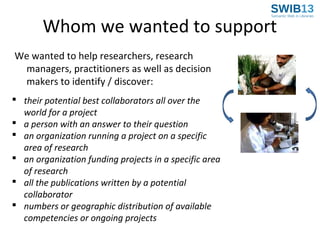
Whom we wanted to support
We wanted to help researchers, research
managers, practitioners as well as decision
makers to identify / discover:
 their potential best collaborators all over the
world for a project
 a person with an answer to their question
 an organization running a project on a specific
area of research
 an organization funding projects in a specific area
of research
 all the publications written by a potential
collaborator
 numbers or geographic distribution of available
competencies or ongoing projects
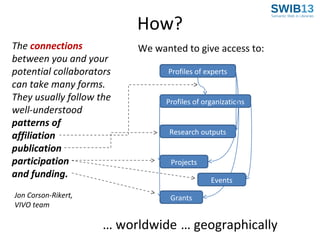
How?
The connections
between you and your
potential collaborators
can take many forms.
They usually follow the
well-understood
patterns of
affiliation
publication
participation
and funding.
Jon Corson-Rikert,
VIVO team

We wanted to give access to:
Profiles of experts

Profiles of organizations

Research outputs

Projects
Events
Grants

… worldwide … geographically
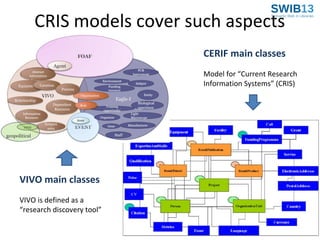
CRIS models cover such aspects
CERIF main classes
Model for “Current Research
Information Systems” (CRIS)

VIVO main classes
VIVO is defined as a
“research discovery tool”
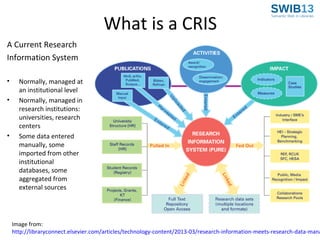
What is a CRIS
A Current Research
Information System
•
•

•

Normally, managed at
an institutional level
Normally, managed in
research institutions:
universities, research
centers
Some data entered
manually, some
imported from other
institutional
databases, some
aggregated from
external sources

Image from:
http://libraryconnect.elsevier.com/articles/technology-content/2013-03/research-information-meets-research-data-mana
How? Some CRIS tools
• Pure (Atira > SciVal)
http://info.scival.com/pure

• Converis (Avedas)
http://www.converis5.com/

• Symplectic Elements (Symplectic)
http://www.symplectic.co.uk/product-tour/

• VIVO (now a DuraSpace Incubator)
https://wiki.duraspace.org/display/VIVO/
Semantic Web in Libraries 2013
25 - 27 November 2013
Hamburg, Germany

Why we chose VIVO
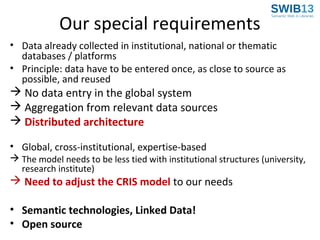
Our special requirements
• Data already collected in institutional, national or thematic
databases / platforms
• Principle: data have to be entered once, as close to source as
possible, and reused

 No data entry in the global system
 Aggregation from relevant data sources
 Distributed architecture
• Global, cross-institutional, expertise-based

 The model needs to be less tied with institutional structures (university,
research institute)

 Need to adjust the CRIS model to our needs
• Semantic technologies, Linked Data!
• Open source
What is VIVO
• VIVO is an open-source semantic publishing platform for
making data about research activities visible and accessible.
– based on semantic technologies initially developed at Cornell
University and now an incubator project under DuraSpace.org

• Organization of data is based on a bundle of ontologies and
data are stored in a triple store.
• When installed and populated with researcher interests,
activities, and accomplishments, it enables the discovery of
research across disciplines at that institution and beyond.
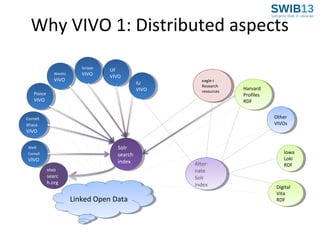
Why VIVO 1: Distributed aspects
• Besides its CRIS model, VIVO can enable the
discovery of researchers across institutions
• See VIVOweb (http://www.vivoweb.org/):
– Participants in the network include institutions with

• local installations of VIVO
• other profiling applications
– The information accessible through VIVO's search and browse
capability will reside and be controlled locally

• See VIVOSearch (http://beta.vivosearch.org/):
– A demonstration of multi-institutional search over several VIVO
installations
Why VIVO 1: Distributed aspects
Scripps
Scripps
WashU
WashU

VIVO
VIVO

VIVO
VIVO

UF
UF
VIVO
VIVO

Ponce
Ponce

IU
IU
VIVO
VIVO

eagle-I
eagle-I
Research
Research
resources
resources

VIVO
VIVO

Harvard
Harvard
Profiles
Profiles
RDF
RDF
Other
Other
VIVOs
VIVOs

Cornell
Cornell
Ithaca
Ithaca

VIVO
VIVO

Solr
Solr
search
search
index
index

Weill
Weill
Cornell
Cornell

VIVO
VIVO

vivo
searc
h.org

Linked Open Data
Linked Open Data

AlterAlternate
nate
Solr
Solr
index
index

Iowa
Iowa
Loki
Loki
RDF
RDF

Digital
Digital
Vita
Vita
RDF
RDF
Distributed architecture: how
• Aggregated Solr index
– If data providers are able to produce custom indexes
based on similar metadata models

• Harvesters
– Allow to parse different types of sources, map their
elements to VIVO metadata and ingest them

• In our project, foreseen data providers manage
data with very basic tools and provide them in
very basic formats
 We chose the harvesters approach
Why VIVO 2: Adaptable model
VIVO has an extensible ontology
• You can extend the ontology without modifying the tool
– Tradeoffs of generality vs. optimal interface*

• The VIVO model can be customized to fit agricultural
research e.g. by
• extending it to include non-academic actors that are
relevant to the agricultural domain (revising the
Organization and Person sub-classes)
• integrating properties for annotation with external
concepts from Agrovoc**
• From the VIVOweb presentation by McIntosh, Cramer, Corson-Rikert: “VIVO Researcher Networking Update”, 2011
** Widely used agricultural thesaurus: http://aims.fao.org/standards/agrovoc/about
Why VIVO 3: standards
•
•
•
•
•

Uses and links to standard vocabularies
Uses RDF
Exposes Linked Data
Is being mapped to other standards (CERIF)
Has been connected to SPARQL endpoints and
Linked Data APIs

• Is open source
• Is widely used and supported
Semantic Web in Libraries 2013
25 - 27 November 2013
Hamburg, Germany

How we adapted VIVO
and built AgriVIVO
What is AgriVIVO

• AgriVIVO is an RDF-based and ontology-driven
global aggregated database harvesting from
distributed directories of experts,
organizations and events in the field of
agriculture.

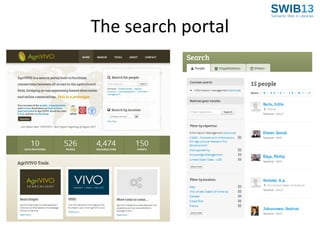
• AgriVIVO is also a search portal giving access
to the AgriVIVO database

• AgriVIVO will broaden its scope to cover the
relationships between people, institutions,
projects, publications and datasets
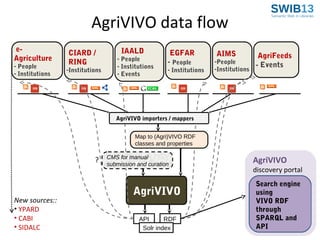
AgriVIVO data flow
eAgriculture
- People
- Institutions

CIARD /
RING

-Institutions

IAALD

- People
- Institutions
- Events

EGFAR
- People

- Institutions

AIMS

-People
-Institutions

AgriFeeds
- Events

AgriVIVO importers / mappers
Map to (Agri)VIVO RDF
classes and properties

?

New sources::
• YPARD
• CABI
• SIDALC

CMS for manual
submission and curation

AgriVIVO
API
RDF
Solr index

AgriVIVO

discovery portal
Search engine
using
VIVO RDF
through
SPARQL and
API
The search portal
Semantic Web in Libraries 2013
25 - 27 November 2013
Hamburg, Germany

How we adapted VIVO
and built AgriVIVO
1. Extension of the ontology
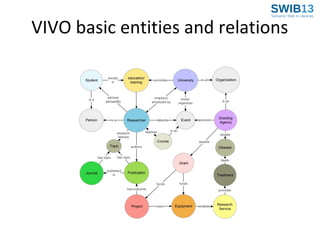
VIVO basic entities and relations
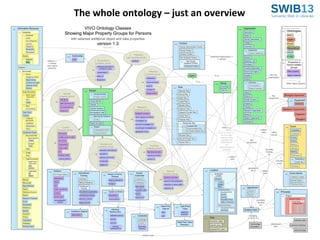
The whole ontology – just an overview
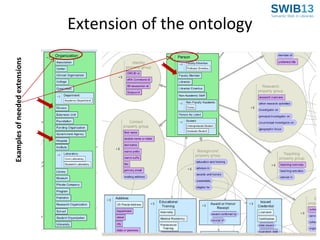
Examples of needed extensions

Extension of the ontology
Examples of needed extensions

Organization

Person and education

Academy

Agricultural researcher

NGO

Farmer

Farmers Organization

Extension / communication agent

International Organization

Policy maker

Position
[Positions] Revise?

Sub-sub-class
Agricultural research
Institute
Sub-sub-class
Agricultural research
center

Senior Officer
Administrative staff
Information manager
Extension of the ontology: where?
• VIVO ontology editor?
 Issues of future compatibility with new versions of the VIVO
ontology

• Ontology extension published independently?
•

If published independently, “domain-specific” or “scope-specific” ontology
extensions (e.g. for libraries) can be re-used by VIVO instances with the
same needs

•

Extensions that are general enough could be considered for inclusion in the
core or as a general-use extension package

•

Extensions can be imported into the VIVO instance

 We created an ontology extension called “agrivivo” and
published it
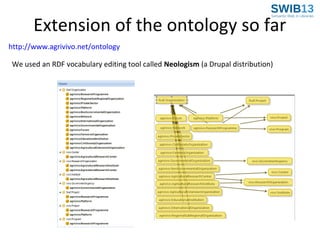
Extension of the ontology so far
http://www.agrivivo.net/ontology
We used an RDF vocabulary editing tool called Neologism (a Drupal distribution)
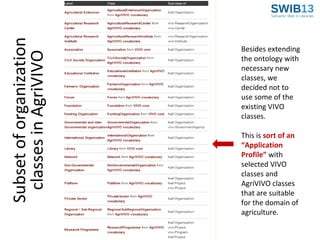
Subset of organization
classes in AgriVIVO

Besides extending
the ontology with
necessary new
classes, we
decided not to
use some of the
existing VIVO
classes.
This is sort of an
“Application
Profile” with
selected VIVO
classes and
AgriVIVO classes
that are suitable
for the domain of
agriculture.
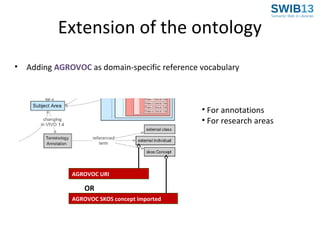
Extension of the ontology
•

Adding AGROVOC as domain-specific reference vocabulary

• For annotations
• For research areas

AGROVOC URI

OR
AGROVOC SKOS concept imported
Semantic Web in Libraries 2013
25 - 27 November 2013
Hamburg, Germany

How we adapted VIVO
and built AgriVIVO
2. Importers
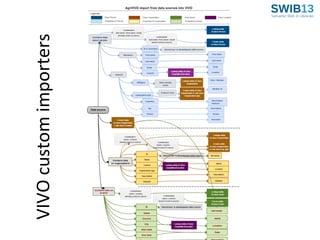
VIVO importers
• VIVO allows for different types of “importers”
to ingest contents from heterogeneous
sources
• Some basic RDF and CSV are available in the
core and can be used via the GUI to ingest
data
• New custom importers can be written
– To allow to parse different types of sources, map
their elements to VIVO metadata and ingest them
VIVO custom importers
Importers: core and extensions
Our approach: One VIVO core with different
extensions
• The same VIVO core with a combination of different
extensions (ontology, importers, languages) instead of local
hard-coded customizations
• Some importers can be packaged as “domain-specific”
extensions and be re-used in the domain-specific
community
• Some importers can be packaged as “scope-specific”
extensions (e.g. importers from HR databases, importers
from library catalogs)
• Importers that are general enough could be considered for
Semantic Web in Libraries 2013
25 - 27 November 2013
Hamburg, Germany

How we adapted VIVO
and built AgriVIVO
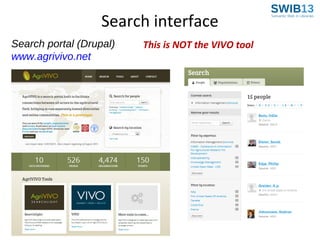
3. Search interface
Search interface
Search portal (Drupal)
www.agrivivo.net

This is NOT the VIVO tool
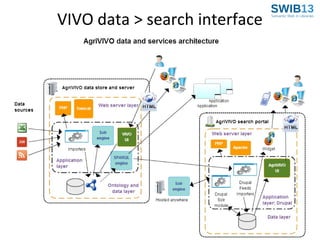
VIVO data > search interface
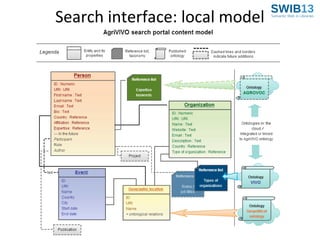
Search interface: local model
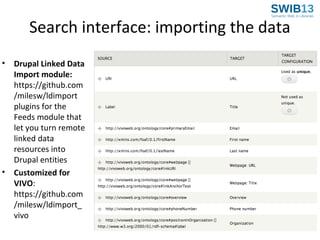
Search interface: importing the data
•

•

Drupal Linked Data
Import module:
https://github.com
/milesw/ldimport
plugins for the
Feeds module that
let you turn remote
linked data
resources into
Drupal entities
Customized for
VIVO:
https://github.com
/milesw/ldimport_
vivo
Semantic Web in Libraries 2013
25 - 27 November 2013
Hamburg, Germany

Future plans
Integration of publications
• Integration of publications
– linked to experts (authors)
– retrieval from open systems (e.g. AGRIS for
agriculture) using universal identifiers
– possibly also manual curation by the experts
themselves
– Essential preliminary step: disambiguation of
authors
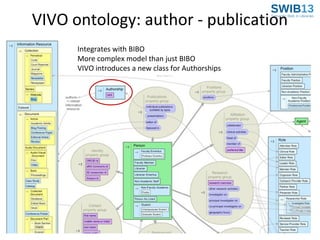
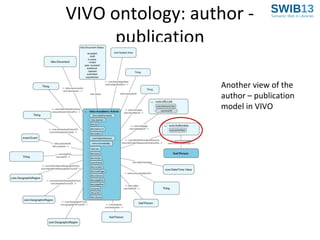
VIVO ontology: author - publication
VIVO introduces
Integrates with BIBO a class for Authorship
More complex model than just BIBO
VIVO introduces a new class for Authorships
VIVO ontology: author publication
Another view of the
author – publication
model in VIVO
Disambiguation and identifiers
AgriVIVO as authority data for agricultural research
actors
Disambiguating authors and researchers, sharing universal IDs
VIVO is collaborating with ORCID (http://orcid.org) and the Publish Trust
Project (http://www.publishtrust.org/)
Disambiguating institutions
Using external naming authorities (VIAF?)
Becoming a subsidiary authority for agricultural institutions
Providing URIs and links between URIs for people’s and institutions’ profiles
E.g. link between a person’s AgriVIVO URI and the corresponding author
URI in AGRIS or the corresponding ORCID
Coordinate with data providers
Work with data providers to improve their data
management environments as a way to improve
overall data quality at the source
• Study the changes that are necessary in order for information
to merge coherently in the RDF store: e.g.:
– map competence/skill information about experts with Agrovoc
– map Institutions’ names with their URLs or other URIs (VIAF?)
– Use identifiers for people; use email addresses to identify people and
help merge duplicates and disambiguate records
Multi-language support
• Both for ontology labels and data
• Support for translations
• How to recognize translations when
harvesting?
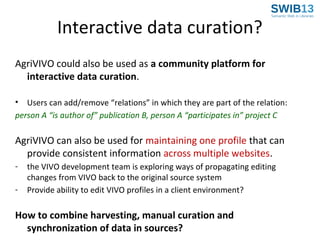
Interactive data curation?
AgriVIVO could also be used as a community platform for
interactive data curation.
• Users can add/remove “relations” in which they are part of the relation:
person A “is author of” publication B, person A “participates in” project C

AgriVIVO can also be used for maintaining one profile that can
provide consistent information across multiple websites.
-

the VIVO development team is exploring ways of propagating editing
changes from VIVO back to the original source system
Provide ability to edit VIVO profiles in a client environment?

How to combine harvesting, manual curation and
synchronization of data in sources?
Getting data re-used
• VIVO’s search functionalities can be integrated in other websites through
remote calls. In this way, specialized and targeted search engines can give
access to and offer highly customized “views” of the data coming from
AgriVIVO

Publication1 > Is about > Topic1
Publication2 > Is about > Topic1
Publication3 > Is about > Topic1
Person1 > Expertise > Topic1
Person2> Expertise > Topic1
Person3> Author of > Publication1
Person4 > Author of > Publication2

[...]
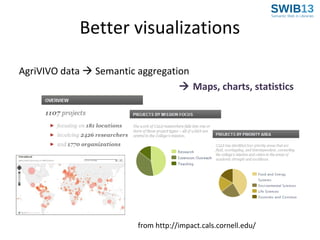
Better visualizations
AgriVIVO data  Semantic aggregation
 Maps, charts, statistics

from http://impact.cals.cornell.edu/
•

AgriVIVO portal: http://www.agrivivo.net

•

AgriVIVO project: http://www.egfar.org/agrivivo

•
•
•

VIVO portal at Cornell: http://vivo.cornell.edu/
VIVOweb: http://vivoweb.org/
VIVO search: http://beta.vivosearch.org/

•
•
•

On VIVO: http://www.dlib.org/dlib/july07/devare/07devare.html
VIVO going national: http://www.news.cornell.edu/stories/Oct09/VIVOweb.ws.html
VIVO at USDA: http://www.usda.gov/wps/portal/usda/usdahome?
contentidonly=true&contentid=2010/10/0507.xml

Contact: agrivivo@gmail.com

AgriVIVO: A Global Ontology-Driven RDF Store Based on a Distributed Architecture. SWIB Conference 2013

  • 1.
    Semantic Web inLibraries 2013 25 - 27 November 2013 Hamburg, Germany AgriVIVO A Global Ontology-Driven RDF Store Based on a Distributed Architecture Valeria Pesce*, John Fereira^, Jon Corson-Rikert^, Johannes Keizer~ *Global Forum on Agricultural Research ^Cornell University ~Food and Agriculture Organization of the UN
  • 2.
    Contents • What wewanted to do • Why we chose VIVO* • How we adapted VIVO and built AgriVIVO – Ontology – Importers – Search interface • Future plans * VIVO is a research discovery tool based on semantic technologies initially developed at Cornell University and now an incubator project under DuraSpace.org
  • 3.
    Semantic Web inLibraries 2013 25 - 27 November 2013 Hamburg, Germany What we wanted to do
  • 4.
    What is “we” TheGlobal Forum on Agricultural Research (GFAR) “Agricultural Knowledge for All” program: a set of activities to improve information and communications management in agricultural research for development (ARD) Cornell University Initiator of VIVO Food and Agriculture Organization (FAO) of the UN In particular, the Agricultural Information Management Standards team
  • 5.
    What we wantedto achieve • More effective collaborative research and networking across countries and regions • Facilitating capacity strengthening and networking of skills • Fostering collaboration and synergy through greater awareness of ongoing research • Reducing duplication of research • Determining strategic trends based on strengths and weaknesses of the network • Identifying missing expertise
  • 6.
    Whom we wantedto support We wanted to help researchers, research managers, practitioners as well as decision makers to identify / discover:  their potential best collaborators all over the world for a project  a person with an answer to their question  an organization running a project on a specific area of research  an organization funding projects in a specific area of research  all the publications written by a potential collaborator  numbers or geographic distribution of available competencies or ongoing projects
  • 7.
    How? The connections between youand your potential collaborators can take many forms. They usually follow the well-understood patterns of affiliation publication participation and funding. Jon Corson-Rikert, VIVO team We wanted to give access to: Profiles of experts Profiles of organizations Research outputs Projects Events Grants … worldwide … geographically
  • 8.
    CRIS models coversuch aspects CERIF main classes Model for “Current Research Information Systems” (CRIS) VIVO main classes VIVO is defined as a “research discovery tool”
  • 9.
    What is aCRIS A Current Research Information System • • • Normally, managed at an institutional level Normally, managed in research institutions: universities, research centers Some data entered manually, some imported from other institutional databases, some aggregated from external sources Image from: http://libraryconnect.elsevier.com/articles/technology-content/2013-03/research-information-meets-research-data-mana
  • 10.
    How? Some CRIStools • Pure (Atira > SciVal) http://info.scival.com/pure • Converis (Avedas) http://www.converis5.com/ • Symplectic Elements (Symplectic) http://www.symplectic.co.uk/product-tour/ • VIVO (now a DuraSpace Incubator) https://wiki.duraspace.org/display/VIVO/
  • 11.
    Semantic Web inLibraries 2013 25 - 27 November 2013 Hamburg, Germany Why we chose VIVO
  • 12.
    Our special requirements •Data already collected in institutional, national or thematic databases / platforms • Principle: data have to be entered once, as close to source as possible, and reused  No data entry in the global system  Aggregation from relevant data sources  Distributed architecture • Global, cross-institutional, expertise-based  The model needs to be less tied with institutional structures (university, research institute)  Need to adjust the CRIS model to our needs • Semantic technologies, Linked Data! • Open source
  • 13.
    What is VIVO •VIVO is an open-source semantic publishing platform for making data about research activities visible and accessible. – based on semantic technologies initially developed at Cornell University and now an incubator project under DuraSpace.org • Organization of data is based on a bundle of ontologies and data are stored in a triple store. • When installed and populated with researcher interests, activities, and accomplishments, it enables the discovery of research across disciplines at that institution and beyond.
  • 14.
    Why VIVO 1:Distributed aspects • Besides its CRIS model, VIVO can enable the discovery of researchers across institutions • See VIVOweb (http://www.vivoweb.org/): – Participants in the network include institutions with • local installations of VIVO • other profiling applications – The information accessible through VIVO's search and browse capability will reside and be controlled locally • See VIVOSearch (http://beta.vivosearch.org/): – A demonstration of multi-institutional search over several VIVO installations
  • 15.
    Why VIVO 1:Distributed aspects Scripps Scripps WashU WashU VIVO VIVO VIVO VIVO UF UF VIVO VIVO Ponce Ponce IU IU VIVO VIVO eagle-I eagle-I Research Research resources resources VIVO VIVO Harvard Harvard Profiles Profiles RDF RDF Other Other VIVOs VIVOs Cornell Cornell Ithaca Ithaca VIVO VIVO Solr Solr search search index index Weill Weill Cornell Cornell VIVO VIVO vivo searc h.org Linked Open Data Linked Open Data AlterAlternate nate Solr Solr index index Iowa Iowa Loki Loki RDF RDF Digital Digital Vita Vita RDF RDF
  • 16.
    Distributed architecture: how •Aggregated Solr index – If data providers are able to produce custom indexes based on similar metadata models • Harvesters – Allow to parse different types of sources, map their elements to VIVO metadata and ingest them • In our project, foreseen data providers manage data with very basic tools and provide them in very basic formats  We chose the harvesters approach
  • 17.
    Why VIVO 2:Adaptable model VIVO has an extensible ontology • You can extend the ontology without modifying the tool – Tradeoffs of generality vs. optimal interface* • The VIVO model can be customized to fit agricultural research e.g. by • extending it to include non-academic actors that are relevant to the agricultural domain (revising the Organization and Person sub-classes) • integrating properties for annotation with external concepts from Agrovoc** • From the VIVOweb presentation by McIntosh, Cramer, Corson-Rikert: “VIVO Researcher Networking Update”, 2011 ** Widely used agricultural thesaurus: http://aims.fao.org/standards/agrovoc/about
  • 18.
    Why VIVO 3:standards • • • • • Uses and links to standard vocabularies Uses RDF Exposes Linked Data Is being mapped to other standards (CERIF) Has been connected to SPARQL endpoints and Linked Data APIs • Is open source • Is widely used and supported
  • 19.
    Semantic Web inLibraries 2013 25 - 27 November 2013 Hamburg, Germany How we adapted VIVO and built AgriVIVO
  • 20.
    What is AgriVIVO •AgriVIVO is an RDF-based and ontology-driven global aggregated database harvesting from distributed directories of experts, organizations and events in the field of agriculture. • AgriVIVO is also a search portal giving access to the AgriVIVO database • AgriVIVO will broaden its scope to cover the relationships between people, institutions, projects, publications and datasets
  • 21.
    AgriVIVO data flow eAgriculture -People - Institutions CIARD / RING -Institutions IAALD - People - Institutions - Events EGFAR - People - Institutions AIMS -People -Institutions AgriFeeds - Events AgriVIVO importers / mappers Map to (Agri)VIVO RDF classes and properties ? New sources:: • YPARD • CABI • SIDALC CMS for manual submission and curation AgriVIVO API RDF Solr index AgriVIVO discovery portal Search engine using VIVO RDF through SPARQL and API
  • 22.
  • 23.
    Semantic Web inLibraries 2013 25 - 27 November 2013 Hamburg, Germany How we adapted VIVO and built AgriVIVO 1. Extension of the ontology
  • 24.
    VIVO basic entitiesand relations
  • 25.
    The whole ontology– just an overview
  • 26.
    Examples of neededextensions Extension of the ontology
  • 27.
    Extension of theontology Examples of needed extensions Organization Person and education Academy Agricultural researcher NGO Farmer Farmers Organization Extension / communication agent International Organization Policy maker Position [Positions] Revise? Sub-sub-class Agricultural research Institute Sub-sub-class Agricultural research center Senior Officer Administrative staff Information manager
  • 28.
    Extension of theontology: where? • VIVO ontology editor?  Issues of future compatibility with new versions of the VIVO ontology • Ontology extension published independently? • If published independently, “domain-specific” or “scope-specific” ontology extensions (e.g. for libraries) can be re-used by VIVO instances with the same needs • Extensions that are general enough could be considered for inclusion in the core or as a general-use extension package • Extensions can be imported into the VIVO instance  We created an ontology extension called “agrivivo” and published it
  • 29.
    Extension of theontology so far http://www.agrivivo.net/ontology We used an RDF vocabulary editing tool called Neologism (a Drupal distribution)
  • 30.
    Subset of organization classesin AgriVIVO Besides extending the ontology with necessary new classes, we decided not to use some of the existing VIVO classes. This is sort of an “Application Profile” with selected VIVO classes and AgriVIVO classes that are suitable for the domain of agriculture.
  • 31.
    Extension of theontology • Adding AGROVOC as domain-specific reference vocabulary • For annotations • For research areas AGROVOC URI OR AGROVOC SKOS concept imported
  • 32.
    Semantic Web inLibraries 2013 25 - 27 November 2013 Hamburg, Germany How we adapted VIVO and built AgriVIVO 2. Importers
  • 33.
    VIVO importers • VIVOallows for different types of “importers” to ingest contents from heterogeneous sources • Some basic RDF and CSV are available in the core and can be used via the GUI to ingest data • New custom importers can be written – To allow to parse different types of sources, map their elements to VIVO metadata and ingest them
  • 34.
  • 35.
    Importers: core andextensions Our approach: One VIVO core with different extensions • The same VIVO core with a combination of different extensions (ontology, importers, languages) instead of local hard-coded customizations • Some importers can be packaged as “domain-specific” extensions and be re-used in the domain-specific community • Some importers can be packaged as “scope-specific” extensions (e.g. importers from HR databases, importers from library catalogs) • Importers that are general enough could be considered for
  • 36.
    Semantic Web inLibraries 2013 25 - 27 November 2013 Hamburg, Germany How we adapted VIVO and built AgriVIVO 3. Search interface
  • 37.
    Search interface Search portal(Drupal) www.agrivivo.net This is NOT the VIVO tool
  • 38.
    VIVO data >search interface
  • 39.
  • 40.
    Search interface: importingthe data • • Drupal Linked Data Import module: https://github.com /milesw/ldimport plugins for the Feeds module that let you turn remote linked data resources into Drupal entities Customized for VIVO: https://github.com /milesw/ldimport_ vivo
  • 41.
    Semantic Web inLibraries 2013 25 - 27 November 2013 Hamburg, Germany Future plans
  • 42.
    Integration of publications •Integration of publications – linked to experts (authors) – retrieval from open systems (e.g. AGRIS for agriculture) using universal identifiers – possibly also manual curation by the experts themselves – Essential preliminary step: disambiguation of authors
  • 43.
    VIVO ontology: author- publication VIVO introduces Integrates with BIBO a class for Authorship More complex model than just BIBO VIVO introduces a new class for Authorships
  • 44.
    VIVO ontology: authorpublication Another view of the author – publication model in VIVO
  • 45.
    Disambiguation and identifiers AgriVIVOas authority data for agricultural research actors Disambiguating authors and researchers, sharing universal IDs VIVO is collaborating with ORCID (http://orcid.org) and the Publish Trust Project (http://www.publishtrust.org/) Disambiguating institutions Using external naming authorities (VIAF?) Becoming a subsidiary authority for agricultural institutions Providing URIs and links between URIs for people’s and institutions’ profiles E.g. link between a person’s AgriVIVO URI and the corresponding author URI in AGRIS or the corresponding ORCID
  • 46.
    Coordinate with dataproviders Work with data providers to improve their data management environments as a way to improve overall data quality at the source • Study the changes that are necessary in order for information to merge coherently in the RDF store: e.g.: – map competence/skill information about experts with Agrovoc – map Institutions’ names with their URLs or other URIs (VIAF?) – Use identifiers for people; use email addresses to identify people and help merge duplicates and disambiguate records
  • 47.
    Multi-language support • Bothfor ontology labels and data • Support for translations • How to recognize translations when harvesting?
  • 48.
    Interactive data curation? AgriVIVOcould also be used as a community platform for interactive data curation. • Users can add/remove “relations” in which they are part of the relation: person A “is author of” publication B, person A “participates in” project C AgriVIVO can also be used for maintaining one profile that can provide consistent information across multiple websites. - the VIVO development team is exploring ways of propagating editing changes from VIVO back to the original source system Provide ability to edit VIVO profiles in a client environment? How to combine harvesting, manual curation and synchronization of data in sources?
  • 49.
    Getting data re-used •VIVO’s search functionalities can be integrated in other websites through remote calls. In this way, specialized and targeted search engines can give access to and offer highly customized “views” of the data coming from AgriVIVO Publication1 > Is about > Topic1 Publication2 > Is about > Topic1 Publication3 > Is about > Topic1 Person1 > Expertise > Topic1 Person2> Expertise > Topic1 Person3> Author of > Publication1 Person4 > Author of > Publication2 [...]
  • 50.
    Better visualizations AgriVIVO data Semantic aggregation  Maps, charts, statistics from http://impact.cals.cornell.edu/
  • 51.
    • AgriVIVO portal: http://www.agrivivo.net • AgriVIVOproject: http://www.egfar.org/agrivivo • • • VIVO portal at Cornell: http://vivo.cornell.edu/ VIVOweb: http://vivoweb.org/ VIVO search: http://beta.vivosearch.org/ • • • On VIVO: http://www.dlib.org/dlib/july07/devare/07devare.html VIVO going national: http://www.news.cornell.edu/stories/Oct09/VIVOweb.ws.html VIVO at USDA: http://www.usda.gov/wps/portal/usda/usdahome? contentidonly=true&contentid=2010/10/0507.xml Contact: agrivivo@gmail.com