Demonstrating a Framework for
KOS-based Recommendations
Systems
Philipp Mayr, Thomas Lüke, Philipp Schaer
philipp.mayr@gesis.org
NKOS workshop @TPDL2013
2013-09-27
Background: Projects IRM I and IRM II
• DFG-funded (2009-2013)
• IRM = Information Retrieval Mehrwertdienste (value-added IR
services)
• Goal: Implementation and evaluation of value-added IR services for
digital library systems
• Main idea: Applying scholarly (science) models for IR
 Co-occurrence analysis of controlled vocabularies (thesauri)
 Bibliometric analysis of core journals (Bradford’s law)
 Centrality in author networks (betweenness)
• In IRM we concentrated on the basic evaluation
• In IRM2 we concentrate on the implementation of reusable (web)
services
2
http://www.gesis.org/en/research/external-funding-projects/archive/irm/
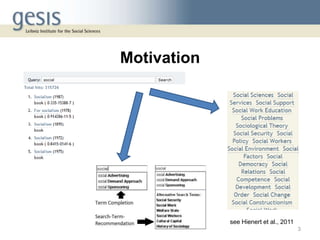
Motivation
3
see Hienert et al., 2011
Why custom KOS-based
recommenders
• The more specific the dataset, the
more specific the recommendations
• Customized for your specific
information need (see Improving Retrieval
Results with Discipline-specific Query
Expansion, TPDL 2012, Lüke et.
Al, http://arxiv.org/abs/1206.2126)
4
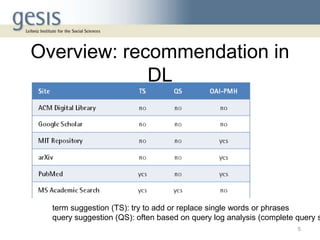
Overview: recommendation in
DL
5
term suggestion (TS): try to add or replace single words or phrases
query suggestion (QS): often based on query log analysis (complete query s
IRSA
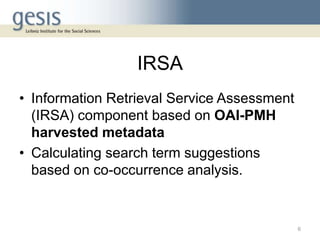
• Information Retrieval Service Assessment
(IRSA) component based on OAI-PMH
harvested metadata
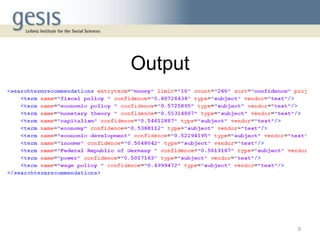
• Calculating search term suggestions
based on co-occurrence analysis.
6
7
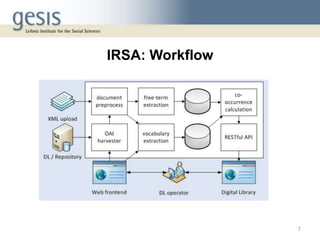
IRSA: Workflow
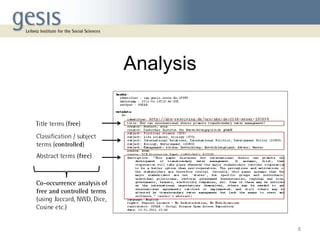
Analysis
8
Output
9
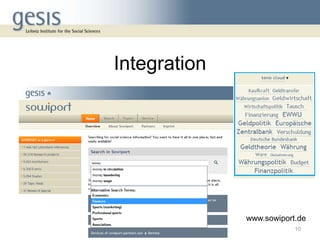
Integration
10
www.sowiport.de
Demo
11
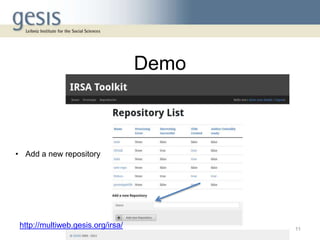
• Add a new repository
http://multiweb.gesis.org/irsa/
Demo
12
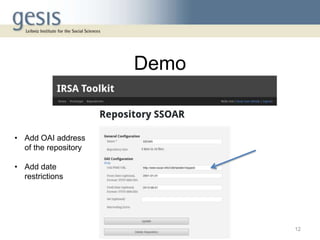
• Add OAI address
of the repository
• Add date
restrictions
Demo
13
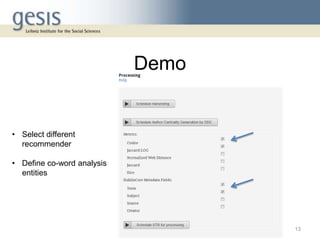
• Select different
recommender
• Define co-word analysis
entities
Demo
14
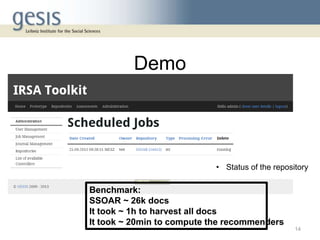
Benchmark:
SSOAR ~ 26k docs
It took ~ 1h to harvest all docs
It took ~ 20min to compute the recommenders
• Status of the repository
Limitations
• Issues with OAI-harvested metadata
• Wrong terms, typos and other ambiguous
information (due to the Open-Access self-
archiving policies of many repositories)
• Mixed up classifications and subject terms in
dc:subject
• Disambiguation issues, abbreviations, etc.
• No clear separation of subsets in OAI
• Huge datasets
15
Using IRSA
16
Check out and get an API key from
 http://multiweb.gesis.org/irsa/IRMPrototype/
 https://sourceforge.net/projects/irsa/
 Open source framework with build-in support
for
• Search term recommendation,
• OAI harvesting, and Solr integration
References
• Lüke, T., Schaer, P., & Mayr, P. (2013). A framework for specific term
recommendation systems. In Proceedings of the 36th international ACM SIGIR
conference on Research and development in information retrieval - SIGIR ’13 (p.
1093). New York, New York, USA: ACM Press. doi:10.1145/2484028.2484207
• Mutschke, P., Mayr, P., Schaer, P., & Sure, Y. (2011). Science models as value-added
services for scholarly information systems. Scientometrics, 89(1), 349–364.
doi:10.1007/s11192-011-0430-x
• Lüke, T., Hoek, W. van, Schaer, P., & Mayr, P. (2012). Creation of custom KOS-based
recommendation systems. In NKOS Workshop 2012. Paphos, Cyprus. Retrieved
from
https://www.comp.glam.ac.uk/pages/research/hypermedia/nkos/nkos2012/abstracts/L
uke.pdf
• Lüke, T., Schaer, P., & Mayr, P. (2012). Improving Retrieval Results with discipline-
specific Query Expansion. In International Conference on Theory and Practice of
Digital Libraries (TPDL 2012) (pp. 408–413). Paphos, Cyprus: Springer Berlin
Heidelberg. doi:10.1007/978-3-642-33290-6_44
• Hienert, D., Schaer, P., Schaible, J., & Mayr, P. (2011). A Novel Combined Term
Suggestion Service for Domain-Specific Digital Libraries. In S. Gradmann, F. Borri, C.
Meghini, & H. Schuldt (Eds.), International Conference on Theory and Practice of
Digital Libraries (TPDL) (pp. 192–203). Berlin: Springer. doi:10.1007/978-3-642-
17

Demonstrating a Framework for KOS-based Recommendations Systems

  • 1.
    Demonstrating a Frameworkfor KOS-based Recommendations Systems Philipp Mayr, Thomas Lüke, Philipp Schaer philipp.mayr@gesis.org NKOS workshop @TPDL2013 2013-09-27
  • 2.
    Background: Projects IRMI and IRM II • DFG-funded (2009-2013) • IRM = Information Retrieval Mehrwertdienste (value-added IR services) • Goal: Implementation and evaluation of value-added IR services for digital library systems • Main idea: Applying scholarly (science) models for IR  Co-occurrence analysis of controlled vocabularies (thesauri)  Bibliometric analysis of core journals (Bradford’s law)  Centrality in author networks (betweenness) • In IRM we concentrated on the basic evaluation • In IRM2 we concentrate on the implementation of reusable (web) services 2 http://www.gesis.org/en/research/external-funding-projects/archive/irm/
  • 3.
  • 4.
    Why custom KOS-based recommenders •The more specific the dataset, the more specific the recommendations • Customized for your specific information need (see Improving Retrieval Results with Discipline-specific Query Expansion, TPDL 2012, Lüke et. Al, http://arxiv.org/abs/1206.2126) 4
  • 5.
    Overview: recommendation in DL 5 termsuggestion (TS): try to add or replace single words or phrases query suggestion (QS): often based on query log analysis (complete query s
  • 6.
    IRSA • Information RetrievalService Assessment (IRSA) component based on OAI-PMH harvested metadata • Calculating search term suggestions based on co-occurrence analysis. 6
  • 7.
  • 8.
  • 9.
  • 10.
  • 11.
    Demo 11 • Add anew repository http://multiweb.gesis.org/irsa/
  • 12.
    Demo 12 • Add OAIaddress of the repository • Add date restrictions
  • 13.
    Demo 13 • Select different recommender •Define co-word analysis entities
  • 14.
    Demo 14 Benchmark: SSOAR ~ 26kdocs It took ~ 1h to harvest all docs It took ~ 20min to compute the recommenders • Status of the repository
  • 15.
    Limitations • Issues withOAI-harvested metadata • Wrong terms, typos and other ambiguous information (due to the Open-Access self- archiving policies of many repositories) • Mixed up classifications and subject terms in dc:subject • Disambiguation issues, abbreviations, etc. • No clear separation of subsets in OAI • Huge datasets 15
  • 16.
    Using IRSA 16 Check outand get an API key from  http://multiweb.gesis.org/irsa/IRMPrototype/  https://sourceforge.net/projects/irsa/  Open source framework with build-in support for • Search term recommendation, • OAI harvesting, and Solr integration
  • 17.
    References • Lüke, T.,Schaer, P., & Mayr, P. (2013). A framework for specific term recommendation systems. In Proceedings of the 36th international ACM SIGIR conference on Research and development in information retrieval - SIGIR ’13 (p. 1093). New York, New York, USA: ACM Press. doi:10.1145/2484028.2484207 • Mutschke, P., Mayr, P., Schaer, P., & Sure, Y. (2011). Science models as value-added services for scholarly information systems. Scientometrics, 89(1), 349–364. doi:10.1007/s11192-011-0430-x • Lüke, T., Hoek, W. van, Schaer, P., & Mayr, P. (2012). Creation of custom KOS-based recommendation systems. In NKOS Workshop 2012. Paphos, Cyprus. Retrieved from https://www.comp.glam.ac.uk/pages/research/hypermedia/nkos/nkos2012/abstracts/L uke.pdf • Lüke, T., Schaer, P., & Mayr, P. (2012). Improving Retrieval Results with discipline- specific Query Expansion. In International Conference on Theory and Practice of Digital Libraries (TPDL 2012) (pp. 408–413). Paphos, Cyprus: Springer Berlin Heidelberg. doi:10.1007/978-3-642-33290-6_44 • Hienert, D., Schaer, P., Schaible, J., & Mayr, P. (2011). A Novel Combined Term Suggestion Service for Domain-Specific Digital Libraries. In S. Gradmann, F. Borri, C. Meghini, & H. Schuldt (Eds.), International Conference on Theory and Practice of Digital Libraries (TPDL) (pp. 192–203). Berlin: Springer. doi:10.1007/978-3-642- 17