

MAPK- JNK
Pathway
KRVS Chaitanya
Atomic structure
of JNK
• Ribbon diagram illustrates the three-dimensional
structure of the inactive (nonphosphorylated) form of
JNK3.
• The active site is occupied by the ATPanalog adenylyl
imidodiphosphate (yellow) and two Mg21 ions
(orange).
• The T-loop is colored red and the two sites of
activating phosphorylation (Thr and Tyr) are
indicated as red balls.
• Disordered regions are indicated with dashes.
•Jun N-terminal kinases (JNKs) belong to the
superfamily of MAP kinases that are involved in
the regulation of cell proliferation, differentiation
and apoptosis.
•Analyses of pathways regulated by JNKs have
shown that JNKs are indispensable for both cell
proliferation and apoptosis.
•Whether the activation of JNKs leads to cell
proliferation or apoptosis is dependent on the
stimuli and the cell type involved in such
activations .
•The JNK family of MAP kinases was initially
identified as ultraviolet (UV)-responsive protein
kinases involved in the transactivation of c-Jun
by phosphorylating the N-terminal Ser63 and
Ser73 residues.
•Although initial studies have shown that JNKs
can be activated by several different stimuli
including growth factors , cytokines and stress
factors.
•The observations that inflammatory cytokines
and many different cytotoxic as well as genotoxic
agents stimulate JNKs unraveled the critical role
of JNKs in mediating apoptotic signaling.
Signaling pathways that initiate apoptosis have
been broadly classified into::
•Extrinsic pathways initiated by death receptors such
as those of tumor necrosis factor (TNF)-a, TRAIL
and FAS-L, and
•Intrinsicpathways initiated by mitochondrial events.
JNK has been observed to have a central role in
both of these pathways.
•To date, multiple splice variants of JNKs encoded
by three distinct genes, namely JNK1, JNK2 and
JNK3, have been identified.
•JNKs form the last tier of the three-tier kinase
module consisting of MAP kinase kinase kinase
(MAP3K), MAP kinase kinase (MAP2K) and
MAP kinase (MAPK).
•In response to specific stimuli, the penultimate
dualspecificity kinase of the tier, either MKK4 or
MKK7, activates JNKs by phosphorylating the
Thr and Tyr residues of the TXY motif within the
activation loop of the respective JNKs.
•While MKK4 can activate both p38MAPK and
JNK, MKK7isspecifically involved in the
activation of JNKs.
•Both antiapoptotic and pro-apoptotic signals
converge on activating MKK4–JNK or MKK7–
JNK signaling nodes through specific MAP3Ks.
• JNKs in turn activate apoptotic signaling either
through the up regulation proapoptotic genes
through the transactivation of specific
transcription factors such as c-Jun or by directly
modulating the activities of mitochondrial pro-
and anti apoptoticproteins through
phosphorylation events.
•Although the apoptoticstimuli can also
involve the stimulation of p38MAPK, this
review specifically analyses our current
understanding of the mechanisms through
which JNK-signaling module is involved in
mediating apoptosis
Role of MAP3Ks in coupling stress stimuli
to JNK
Figure description::
• MAP3Ks and MAP2Ks involved in the activation of JNKs.
• At least 14 MAP3Ks have been shown to activate the MAP2Ks
MKK4 and/or MKK7.
• MKK4 can activate JNKs as well as p38MAPKs, whereas MKK7
specifically activates JNKs.
• MKK4 and MKK7 can activate all of the three isoforms of JNKs
by phosphorylating the Thr and Tyr residues of the TXY motif.
• JNK, Jun N-terminal kinase; MAP2K, MAP kinase kinase;
MAP3K, MAP kinase kinase kinase.
The JNK-Dependent Apoptotic Signaling
Pathway
Figure description::
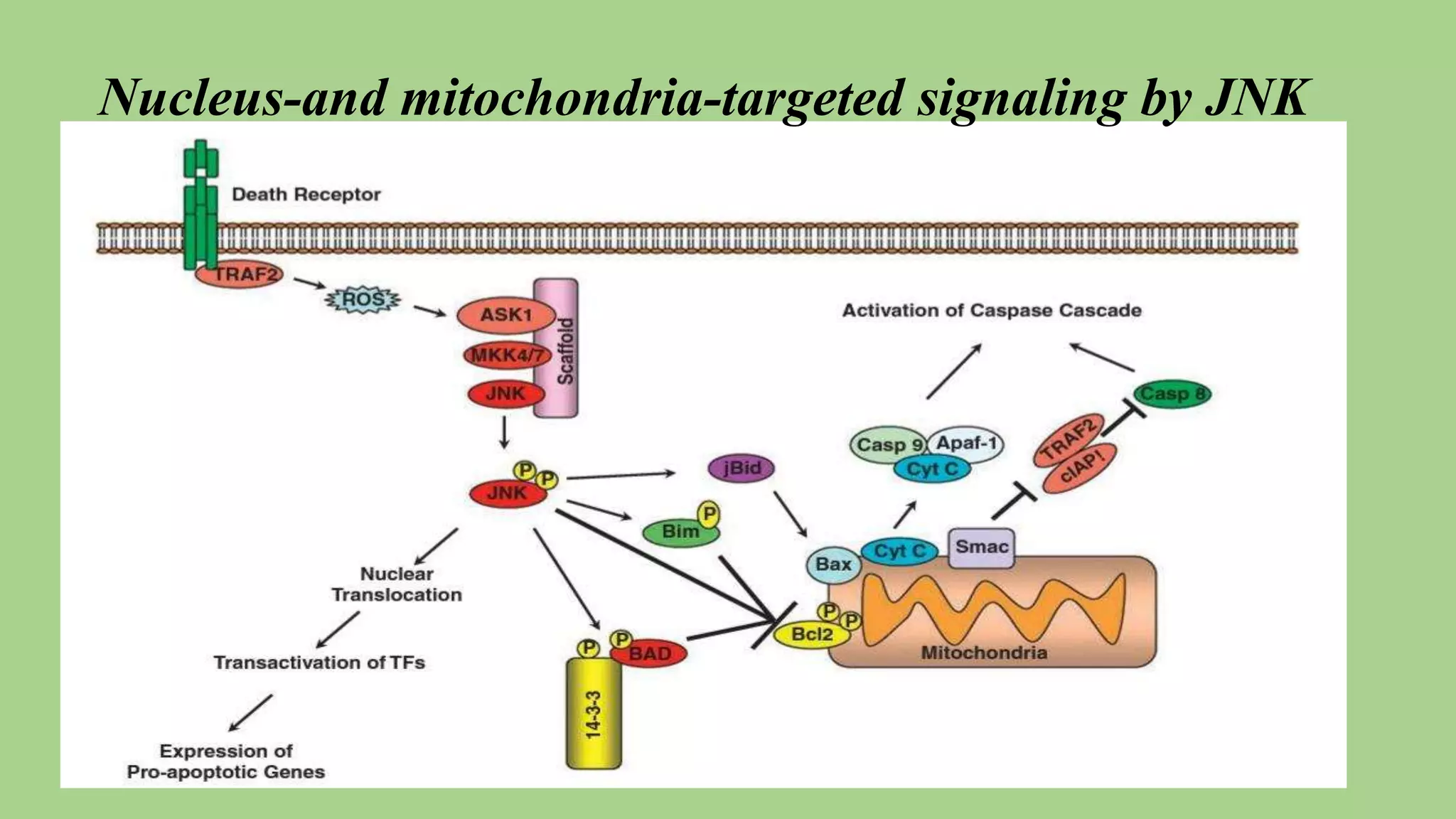
• The caspase apoptotic machinery is illustrated in a simplified
cartoon.
• Effector caspases, including caspase-3, are activated by
initiator caspases that are activated by cell surface death
receptors (caspase-8) and by the mitochondrial pathway
(caspase-9).
• JNK is not required for death receptor signaling, but is
required for caspase-9 activation by the mitochondrial
pathway.
• Potential targets of JNK include members of the Bcl2 group
of apoptotic regulatory proteins
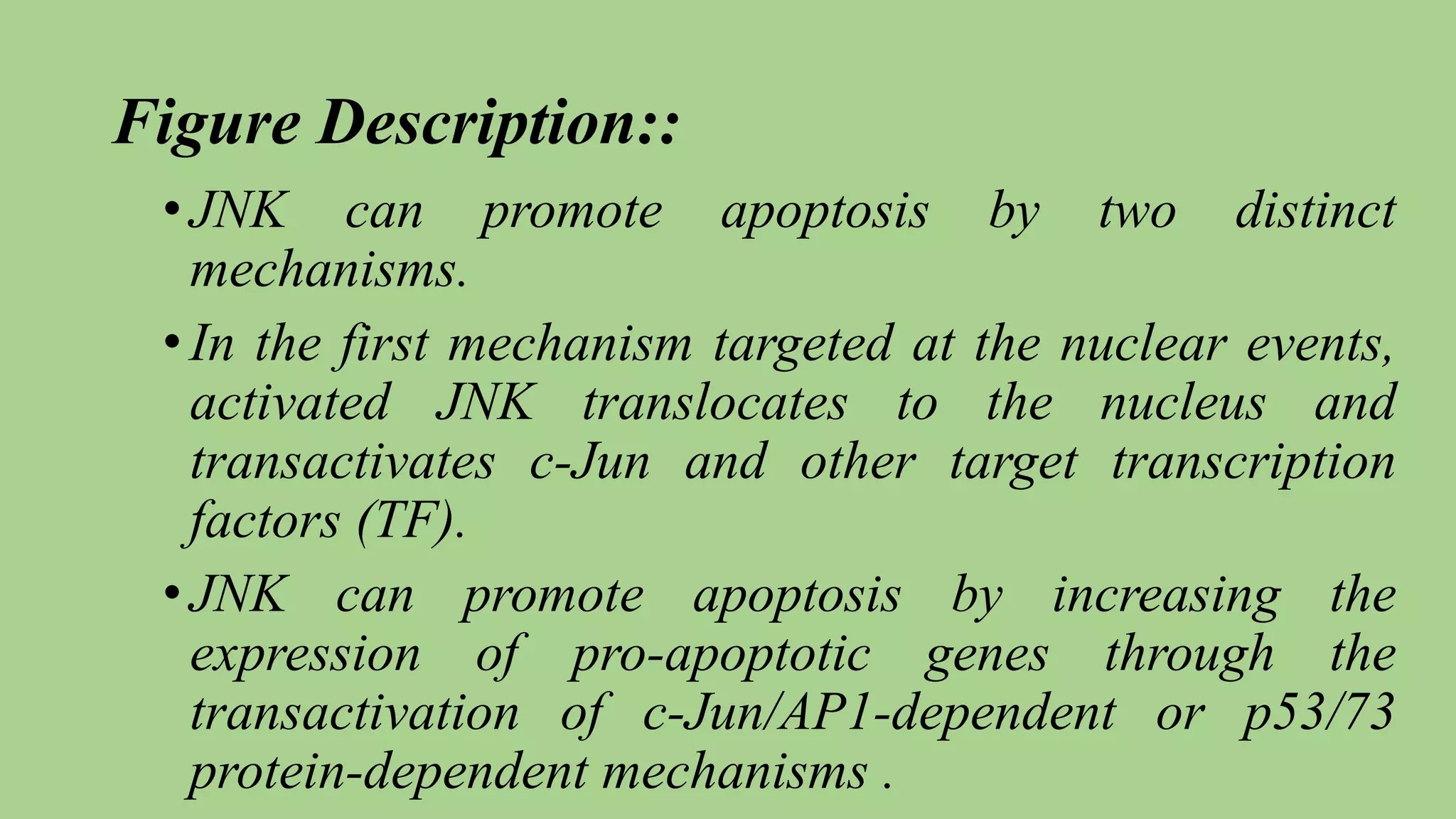
Nucleus-and mitochondria-targeted signaling by JNK
Figure Description::
•JNK can promote apoptosis by two distinct
mechanisms.
•In the first mechanism targeted at the nuclear events,
activated JNK translocates to the nucleus and
transactivates c-Jun and other target transcription
factors (TF).
•JNK can promote apoptosis by increasing the
expression of pro-apoptotic genes through the
transactivation of c-Jun/AP1-dependent or p53/73
protein-dependent mechanisms .
Contd….
• In pathways directed at mitochondrial apoptotic proteins,
activated JNK translocates to mitochondria.
• There, JNK can phosphorylate the BH3-only family of Bcl2
proteins to antagonize the antiapoptotic activity of Bcl2 or
Bcl-XL.
• In addition, JNK can stimulate the release of cytochrome c
(Cyt C) from the mitochondrial inner membrane through a
Bid-Bax-dependent mechanism, promoting the formation of
apoptosomes consisting of cytochrome c, caspase-9 (Casp 9)
and Apaf-1.
Contd….
• This complex initiates the activation of caspase-9-dependent
caspase cascade.
• In another mechanism, JNK can promote the release of
Smac/Diablo (Smac) that can inhibit the TRAF2/IAP1
inhibitory complex, thereby relieving the inhibition on
caspase-8 to initiate caspase activation.
• In addition, by phosphorylating BAD and its sequestering
partner 14-3-3, JNK can promote BAD-mediated
neutralization of the Bcl2 family of antiapoptotic proteins.
Contd….
• Finally, JNK can phosphorylate Bcl2 for suppressing
its antiapoptotic activity.
• These nuclear and mitochondrial events regulated by
JNK need not be mutually exclusive. JNK, Jun N-
terminal kinase; TRAF2, TNF-receptor-associated
factor 2.
Role of JNK Pathway
• JNKs in apoptotic signaling
• Nuclear signaling of JNK in the regulation of
apoptosis
• Mitochondrial signaling of JNK in the regulation of
apoptosis
• JNK in Signaling Cell Survival
Discussion
• An overview of apoptotic pathways indicates that JNK
signaling is involved in the extrinsic apoptotic
pathway initiated by death receptors as well as the
intrinsic pathway initiated at the mitochondria.
• In response to both the extrinsic and intrinsic
apoptotic stimuli, JNK plays an essential role through
its ability to interact and modulate the activities of
diverse pro-and antiapoptotic proteins.
• Through the coordinated regulation of the nuclear and
mitochondrial events, JNK ensures the efficient
execution of apoptosis.
• With the identification of primary apoptotic signaling
nodes regulated by JNK, the finer details of JNK
signaling in apoptosis, specifically in relation to other
growth-stimulating stimuli, are finally emerging and
this should unravel novel therapeutic targets for
diverse pathological conditions such as Alzheimer’s
disease and cancer.
Thank You

MAPK JNK Cell signalling

  • 1.
  • 2.
  • 3.
    • Ribbon diagramillustrates the three-dimensional structure of the inactive (nonphosphorylated) form of JNK3. • The active site is occupied by the ATPanalog adenylyl imidodiphosphate (yellow) and two Mg21 ions (orange). • The T-loop is colored red and the two sites of activating phosphorylation (Thr and Tyr) are indicated as red balls. • Disordered regions are indicated with dashes.
  • 4.
    •Jun N-terminal kinases(JNKs) belong to the superfamily of MAP kinases that are involved in the regulation of cell proliferation, differentiation and apoptosis. •Analyses of pathways regulated by JNKs have shown that JNKs are indispensable for both cell proliferation and apoptosis.
  • 5.
    •Whether the activationof JNKs leads to cell proliferation or apoptosis is dependent on the stimuli and the cell type involved in such activations . •The JNK family of MAP kinases was initially identified as ultraviolet (UV)-responsive protein kinases involved in the transactivation of c-Jun by phosphorylating the N-terminal Ser63 and Ser73 residues.
  • 6.
    •Although initial studieshave shown that JNKs can be activated by several different stimuli including growth factors , cytokines and stress factors. •The observations that inflammatory cytokines and many different cytotoxic as well as genotoxic agents stimulate JNKs unraveled the critical role of JNKs in mediating apoptotic signaling.
  • 7.
    Signaling pathways thatinitiate apoptosis have been broadly classified into:: •Extrinsic pathways initiated by death receptors such as those of tumor necrosis factor (TNF)-a, TRAIL and FAS-L, and •Intrinsicpathways initiated by mitochondrial events. JNK has been observed to have a central role in both of these pathways.
  • 8.
    •To date, multiplesplice variants of JNKs encoded by three distinct genes, namely JNK1, JNK2 and JNK3, have been identified. •JNKs form the last tier of the three-tier kinase module consisting of MAP kinase kinase kinase (MAP3K), MAP kinase kinase (MAP2K) and MAP kinase (MAPK).
  • 9.
    •In response tospecific stimuli, the penultimate dualspecificity kinase of the tier, either MKK4 or MKK7, activates JNKs by phosphorylating the Thr and Tyr residues of the TXY motif within the activation loop of the respective JNKs. •While MKK4 can activate both p38MAPK and JNK, MKK7isspecifically involved in the activation of JNKs.
  • 10.
    •Both antiapoptotic andpro-apoptotic signals converge on activating MKK4–JNK or MKK7– JNK signaling nodes through specific MAP3Ks. • JNKs in turn activate apoptotic signaling either through the up regulation proapoptotic genes through the transactivation of specific transcription factors such as c-Jun or by directly modulating the activities of mitochondrial pro- and anti apoptoticproteins through phosphorylation events.
  • 11.
    •Although the apoptoticstimulican also involve the stimulation of p38MAPK, this review specifically analyses our current understanding of the mechanisms through which JNK-signaling module is involved in mediating apoptosis
  • 12.
    Role of MAP3Ksin coupling stress stimuli to JNK
  • 13.
    Figure description:: • MAP3Ksand MAP2Ks involved in the activation of JNKs. • At least 14 MAP3Ks have been shown to activate the MAP2Ks MKK4 and/or MKK7. • MKK4 can activate JNKs as well as p38MAPKs, whereas MKK7 specifically activates JNKs. • MKK4 and MKK7 can activate all of the three isoforms of JNKs by phosphorylating the Thr and Tyr residues of the TXY motif. • JNK, Jun N-terminal kinase; MAP2K, MAP kinase kinase; MAP3K, MAP kinase kinase kinase.
  • 14.
    The JNK-Dependent ApoptoticSignaling Pathway
  • 15.
    Figure description:: • Thecaspase apoptotic machinery is illustrated in a simplified cartoon. • Effector caspases, including caspase-3, are activated by initiator caspases that are activated by cell surface death receptors (caspase-8) and by the mitochondrial pathway (caspase-9). • JNK is not required for death receptor signaling, but is required for caspase-9 activation by the mitochondrial pathway. • Potential targets of JNK include members of the Bcl2 group of apoptotic regulatory proteins
  • 16.
  • 17.
    Figure Description:: •JNK canpromote apoptosis by two distinct mechanisms. •In the first mechanism targeted at the nuclear events, activated JNK translocates to the nucleus and transactivates c-Jun and other target transcription factors (TF). •JNK can promote apoptosis by increasing the expression of pro-apoptotic genes through the transactivation of c-Jun/AP1-dependent or p53/73 protein-dependent mechanisms .
  • 18.
    Contd…. • In pathwaysdirected at mitochondrial apoptotic proteins, activated JNK translocates to mitochondria. • There, JNK can phosphorylate the BH3-only family of Bcl2 proteins to antagonize the antiapoptotic activity of Bcl2 or Bcl-XL. • In addition, JNK can stimulate the release of cytochrome c (Cyt C) from the mitochondrial inner membrane through a Bid-Bax-dependent mechanism, promoting the formation of apoptosomes consisting of cytochrome c, caspase-9 (Casp 9) and Apaf-1.
  • 19.
    Contd…. • This complexinitiates the activation of caspase-9-dependent caspase cascade. • In another mechanism, JNK can promote the release of Smac/Diablo (Smac) that can inhibit the TRAF2/IAP1 inhibitory complex, thereby relieving the inhibition on caspase-8 to initiate caspase activation. • In addition, by phosphorylating BAD and its sequestering partner 14-3-3, JNK can promote BAD-mediated neutralization of the Bcl2 family of antiapoptotic proteins.
  • 20.
    Contd…. • Finally, JNKcan phosphorylate Bcl2 for suppressing its antiapoptotic activity. • These nuclear and mitochondrial events regulated by JNK need not be mutually exclusive. JNK, Jun N- terminal kinase; TRAF2, TNF-receptor-associated factor 2.
  • 21.
    Role of JNKPathway • JNKs in apoptotic signaling • Nuclear signaling of JNK in the regulation of apoptosis • Mitochondrial signaling of JNK in the regulation of apoptosis • JNK in Signaling Cell Survival
  • 23.
    Discussion • An overviewof apoptotic pathways indicates that JNK signaling is involved in the extrinsic apoptotic pathway initiated by death receptors as well as the intrinsic pathway initiated at the mitochondria. • In response to both the extrinsic and intrinsic apoptotic stimuli, JNK plays an essential role through its ability to interact and modulate the activities of diverse pro-and antiapoptotic proteins.
  • 24.
    • Through thecoordinated regulation of the nuclear and mitochondrial events, JNK ensures the efficient execution of apoptosis. • With the identification of primary apoptotic signaling nodes regulated by JNK, the finer details of JNK signaling in apoptosis, specifically in relation to other growth-stimulating stimuli, are finally emerging and this should unravel novel therapeutic targets for diverse pathological conditions such as Alzheimer’s disease and cancer.
  • 25.