MAPK- P38 Pathway
(Death pathway)
KRVS Chaitanya
•p38a was discovered independently in three
contexts.
•It was found as a tyrosine phosphoprotein
present in extracts of cells treated with
inflammatory cytokines ;
•As the target of a pyridinyl imidazole drug that
blocked production of tumor necrosis factor-a
(TNFa) and as such was called cytokine-
suppressive antiinflammatory drug-binding
protein or CSBP.
•Reactivating kinase for MAP kinaseactivated
protein (MAPKAP) kinase-2.
•Cloning strategies rather than biological
approaches were used to identify the other three
genes that encode members of the p38 subfamily:
p38b (or p38±2), p38g (ERK6 or SAPK3), and
p38d (SAPK4) (137±143). All of these kinases
contain the sequence TGY in their activation
loops.
•A splice variant of p38b lacks the eight-
amino acid insertion unique to b. p38a And
bisoforms are sensitive to pyridinyl
imidazole inhibitors, but g-and d-isoforms
are resistant to these drugs.
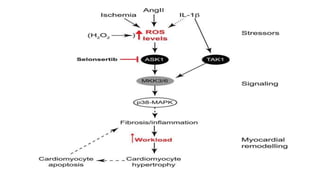
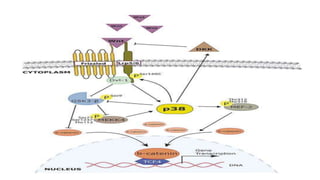
•A variety of agents including cytokines,
hormones, GPCRs, osmotic and heat shock,
and other stresses activate p38 family
members.
•In some contexts p38 family members have
apparently opposite actions.
•Asixth protein, Mxi, is a splice variant of
p38a in which the last 80 residues have been
replaced by a novel 17residue C terminus.
•Mxi was isolated from a twohybrid screen
with the c-Myc binding partner Max.
•Both Mxi and p38a bind Myc.
•The change in the C-terminal residues confers
unique properties on Mxi.
•Unlike p38a, Mxi is activated not only by stresses
but also by growth factors.
•In contrast to p38a, Mxi is relatively insensitive
to pyridinyl imidazole compounds; Mxi also
displays a reduced affinity for p38a substrates.
•Crespo and colleagues showed that deletion of
the 80 C-terminal residues from p38a yielded a
mutant with properties similar to Mxi
•An explanation may be proposed for these
findings from the crystal structures of MAP
kinases.
•In these enzymes the C-terminal residues, deleted
in Mxi, make intimate contacts with the N-
terminal domain of the kinase catalytic core.
•These contacts undoubtedly influence the
interaction with ATP and other compounds that
bind in the ATP pocket, such as pyridinyl
imidazoles.
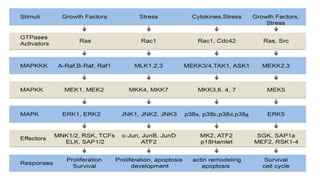
•Two MEK family members, MEK3 and MEK6,
have high activity toward p38 MAP kinases (123,
150±152).
•MEK3 appears to favor phosphorylation of p38a
and p38b isoforms, while MEK6 phosphorylates
all p38 family members well.
•Both will also phosphorylate JNK/SAPK
isoforms.
•MEK6 phosphorylates p38/ERK2 chimeras,
and NLK in vitro, suggesting that it has a
broader specificity than other MEKs.
•The physiological implications of this
broader specificity are not clear at this time.
Thank You

P38 pathway (Death pathway)

  • 1.
    MAPK- P38 Pathway (Deathpathway) KRVS Chaitanya
  • 2.
    •p38a was discoveredindependently in three contexts. •It was found as a tyrosine phosphoprotein present in extracts of cells treated with inflammatory cytokines ;
  • 6.
    •As the targetof a pyridinyl imidazole drug that blocked production of tumor necrosis factor-a (TNFa) and as such was called cytokine- suppressive antiinflammatory drug-binding protein or CSBP. •Reactivating kinase for MAP kinaseactivated protein (MAPKAP) kinase-2.
  • 7.
    •Cloning strategies ratherthan biological approaches were used to identify the other three genes that encode members of the p38 subfamily: p38b (or p38±2), p38g (ERK6 or SAPK3), and p38d (SAPK4) (137±143). All of these kinases contain the sequence TGY in their activation loops.
  • 8.
    •A splice variantof p38b lacks the eight- amino acid insertion unique to b. p38a And bisoforms are sensitive to pyridinyl imidazole inhibitors, but g-and d-isoforms are resistant to these drugs. •A variety of agents including cytokines, hormones, GPCRs, osmotic and heat shock, and other stresses activate p38 family members.
  • 10.
    •In some contextsp38 family members have apparently opposite actions. •Asixth protein, Mxi, is a splice variant of p38a in which the last 80 residues have been replaced by a novel 17residue C terminus.
  • 11.
    •Mxi was isolatedfrom a twohybrid screen with the c-Myc binding partner Max. •Both Mxi and p38a bind Myc.
  • 12.
    •The change inthe C-terminal residues confers unique properties on Mxi. •Unlike p38a, Mxi is activated not only by stresses but also by growth factors. •In contrast to p38a, Mxi is relatively insensitive to pyridinyl imidazole compounds; Mxi also displays a reduced affinity for p38a substrates.
  • 14.
    •Crespo and colleaguesshowed that deletion of the 80 C-terminal residues from p38a yielded a mutant with properties similar to Mxi •An explanation may be proposed for these findings from the crystal structures of MAP kinases.
  • 15.
    •In these enzymesthe C-terminal residues, deleted in Mxi, make intimate contacts with the N- terminal domain of the kinase catalytic core. •These contacts undoubtedly influence the interaction with ATP and other compounds that bind in the ATP pocket, such as pyridinyl imidazoles.
  • 16.
    •Two MEK familymembers, MEK3 and MEK6, have high activity toward p38 MAP kinases (123, 150±152). •MEK3 appears to favor phosphorylation of p38a and p38b isoforms, while MEK6 phosphorylates all p38 family members well. •Both will also phosphorylate JNK/SAPK isoforms.
  • 17.
    •MEK6 phosphorylates p38/ERK2chimeras, and NLK in vitro, suggesting that it has a broader specificity than other MEKs. •The physiological implications of this broader specificity are not clear at this time.
  • 20.