MAP kinase
MAP kinase
(Mitogen-Activated Protein
kinase)
The MAP kinase signalling
pathway that transmits signals
from the cell surface to the
DNA in the nucleus
A.Including growth
B.Proliferation
C.Differentiation, and survival.
There are several MAP kinase
pathways, but the most well-
known is the ERK
(Extracellular signal-
Regulated Kinase) pathway.
Steps in
the MAP
Kinase
Pathway
Receptor Activation
Adaptor Proteins
RAS Activation [Rat Sarcoma]
MEK Activation [Mitogen-Activated Protein
Kinase/Extracellular Signal-Regulated
Kinase]
ERK Activation [Extracellular signal-
Regulated Kinase]
1. Receptor Activation
The pathway is typically initiated by the binding of
a growth factor (like EGF, Epidermal Growth
Factor) to its receptor (e.g., EGFR, Epidermal
Growth Factor Receptor) on the cell membrane.
This receptor is often a Receptor
Tyrosine Kinase (RTK), which auto
phosphorylates upon ligand
binding.
2. Adaptor Proteins
Phosphorylation of the receptor leads to
the recruitment of adaptor proteins such
as Grb2 (Growth factor receptor-bound
protein 2).
Grb2 binds to another protein called SOS
(Son of Sevenless), which is a Guanine
nucleotide Exchange Factor (GEF).
3.RAS
Activati
on
•SOS activates the small
GTPase protein RAS by
facilitating the exchange
of GDP for GTP on RAS,
thereby switching it to its
active form.
4. RAF
Activatio
n:
Active RAS binds to and
activates RAF, which is a
serine/threonine-specific
protein kinase.
RAF
phosphorylates and
activates MEK
(MAPK/ERK kinase).
5.MEK
Activatio
n
•MEK, in turn,
phosphorylates
and activates
ERK
(Extracellular
signal-
Regulated
Kinase), which is
a MAP kinase.
6.ERK
Activati
on
Activated ERK
translocates into the
nucleus
Where it can phosphorylate various
transcription factors such as ELK-1
and others.
These transcription factors then
modulate the expression of genes
involved in
1.Cell division
2.Survival, and
3.Differentiation
Outcomes
MAP kinase pathway can lead to different cellular
responses
1.Such as cell proliferation
2.Differentiation
3.Apoptosis
Dysregulation of this pathway is often associated
with cancer, as it can lead to uncontrolled cell
growth.
P38 kinase
P38 kinase
P38 kinase is a member of the mitogen-activated protein kinase
(MAPK) family, which plays a crucial role in cellular responses to
stress and inflammation.
It is involved in the regulation of various cellular
processes, including
Cell differentiation
Apoptosis (programmed cell death)
Response to external stress signals like
cytokines, UV light, heat shock, and osmotic
shock.
About P38 Kinase
Each isoform has distinct roles and is expressed
in different tissues.
Isoforms: There are four isoforms of p38 MAPKs:
p38α p38β p38γ p38δ.
Activation
•P38 kinases are
activated by dual
phosphorylation on a
Thr-Gly-Tyr motif by
upstream MAP kinase
kinases (MKK3, MKK4,
and MKK6).
• This activation usually
occurs in response to
stress stimuli.
Functions
1.Inflammation: p38
kinase plays a significant
role in inflammatory
responses by regulating
the production of pro-
inflammatory cytokines
like TNF-α and IL-1.
2. Cell Cycle: It can
regulate the cell cycle by
influencing the expression
of cyclins and other cell
cycle regulators.
3. Apoptosis: p38 kinase
can promote apoptosis in
response to cellular stress,
acting as a protective
mechanism to remove
damaged cells.
4. Gene Expression: It
influences gene
expression by activating
transcription factors such
as ATF2, MEF2, and NF-κB.
Clinical
Implication
s
P38 kinase
is a target
for
therapeutic
intervention
s in
diseases
like cancer
CardioVascula
r diseases
Inflammato
ry disorders
due to its
role in
inflammatio
n and cell
death.
Inhibitors of p38
kinase are being
studied for their
potential in treating
conditions like
rheumatoid
arthritis and other
chronic
inflammatory
diseases.
JNK (c-Jun N-terminal
kinase) pathway
JNK (c-Jun
N-
terminal
kinase)
pathway
• The JNK (c-Jun N-terminal
kinase) pathway -plays a
critical role in regulating
various cellular processes,
including
1. Cell growth
2. Differentiation
3. Apoptosis
4. Stress responses.
Pathway Components
• JNKs (c-Jun N-terminal kinases): These are a group of mitogen-
activated protein kinases (MAPKs) that include three isoforms:
JNK1, JNK2, and JNK3.
• MAP Kinase Kinases (MKKs): JNKs are activated by MAP kinase
kinases (MKK4 and MKK7).
• MAP Kinase Kinase Kinases (MKKKs): MKK4 and MKK7 are
activated by upstream MKKKs such as
• ASK1 (Apoptosis signal-regulating kinase 1)
• TAK1[transforming growth factor beta-activated kinase 1]
• MEKK1-4, and others.
Activation
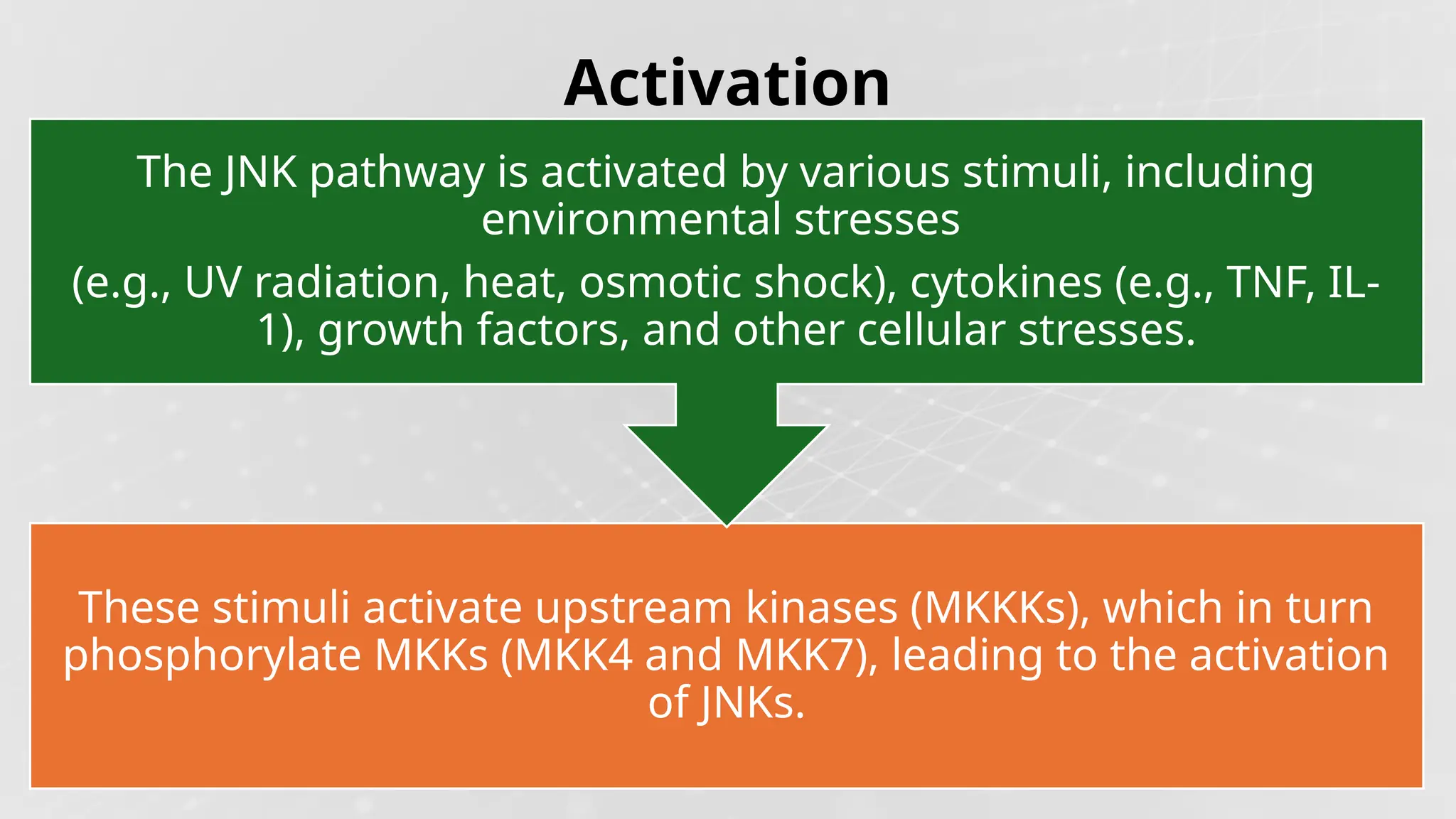
These stimuli activate upstream kinases (MKKKs), which in turn
phosphorylate MKKs (MKK4 and MKK7), leading to the activation
of JNKs.
The JNK pathway is activated by various stimuli, including
environmental stresses
(e.g., UV radiation, heat, osmotic shock), cytokines (e.g., TNF, IL-
1), growth factors, and other cellular stresses.
Functio
n
Once activated, JNKs translocate
to the nucleus, where they
phosphorylate transcription
factors such as c-Jun, ATF-2, and
others.
Phosphorylated c-Jun forms part of
the AP-1 (Activator Protein-1)
transcription factor complex, which
regulates the expression of genes
involved in
• Cell proliferation
• Apoptosis
• Inflammatory responses.
Biological Roles
Apoptosis: JNK activation can promote
apoptosis by upregulating pro-apoptotic genes
and inhibiting anti-apoptotic proteins,
especially under conditions of severe stress.
Cell Survival and Proliferation.
Immune Response: JNK is involved in immune
responses by modulating the expression of
cytokines and other inflammatory mediators.
Development: JNKs play roles in embryonic
development and tissue morphogenesis.
Regulation
JNK activity is tightly
regulated by various
phosphatases (e.g.,
MAP kinase
phosphatases) that
dephosphorylate and
inactivate JNK.
Scaffold proteins, such
as JIP (JNK-interacting
proteins), help
organize and regulate
the components of the
JNK signaling cascade.
Clinical
Significance
• Dysregulation of the JNK
pathway is associated with
various diseases, including
1. Cancer
2. Neurodegenerative
disorders
3. Diabetes
4. Inflammatory
diseases.
MAPK.pptx map kinase pathway pharmacology

MAPK.pptx map kinase pathway pharmacology

  • 2.
  • 3.
    MAP kinase (Mitogen-Activated Protein kinase) TheMAP kinase signalling pathway that transmits signals from the cell surface to the DNA in the nucleus A.Including growth B.Proliferation C.Differentiation, and survival. There are several MAP kinase pathways, but the most well- known is the ERK (Extracellular signal- Regulated Kinase) pathway.
  • 4.
    Steps in the MAP Kinase Pathway ReceptorActivation Adaptor Proteins RAS Activation [Rat Sarcoma] MEK Activation [Mitogen-Activated Protein Kinase/Extracellular Signal-Regulated Kinase] ERK Activation [Extracellular signal- Regulated Kinase]
  • 5.
    1. Receptor Activation Thepathway is typically initiated by the binding of a growth factor (like EGF, Epidermal Growth Factor) to its receptor (e.g., EGFR, Epidermal Growth Factor Receptor) on the cell membrane. This receptor is often a Receptor Tyrosine Kinase (RTK), which auto phosphorylates upon ligand binding.
  • 6.
    2. Adaptor Proteins Phosphorylationof the receptor leads to the recruitment of adaptor proteins such as Grb2 (Growth factor receptor-bound protein 2). Grb2 binds to another protein called SOS (Son of Sevenless), which is a Guanine nucleotide Exchange Factor (GEF).
  • 7.
    3.RAS Activati on •SOS activates thesmall GTPase protein RAS by facilitating the exchange of GDP for GTP on RAS, thereby switching it to its active form.
  • 8.
    4. RAF Activatio n: Active RASbinds to and activates RAF, which is a serine/threonine-specific protein kinase. RAF phosphorylates and activates MEK (MAPK/ERK kinase).
  • 9.
    5.MEK Activatio n •MEK, in turn, phosphorylates andactivates ERK (Extracellular signal- Regulated Kinase), which is a MAP kinase.
  • 10.
    6.ERK Activati on Activated ERK translocates intothe nucleus Where it can phosphorylate various transcription factors such as ELK-1 and others. These transcription factors then modulate the expression of genes involved in 1.Cell division 2.Survival, and 3.Differentiation
  • 11.
    Outcomes MAP kinase pathwaycan lead to different cellular responses 1.Such as cell proliferation 2.Differentiation 3.Apoptosis Dysregulation of this pathway is often associated with cancer, as it can lead to uncontrolled cell growth.
  • 12.
  • 13.
    P38 kinase P38 kinaseis a member of the mitogen-activated protein kinase (MAPK) family, which plays a crucial role in cellular responses to stress and inflammation. It is involved in the regulation of various cellular processes, including Cell differentiation Apoptosis (programmed cell death) Response to external stress signals like cytokines, UV light, heat shock, and osmotic shock.
  • 14.
    About P38 Kinase Eachisoform has distinct roles and is expressed in different tissues. Isoforms: There are four isoforms of p38 MAPKs: p38α p38β p38γ p38δ.
  • 15.
    Activation •P38 kinases are activatedby dual phosphorylation on a Thr-Gly-Tyr motif by upstream MAP kinase kinases (MKK3, MKK4, and MKK6). • This activation usually occurs in response to stress stimuli.
  • 16.
    Functions 1.Inflammation: p38 kinase playsa significant role in inflammatory responses by regulating the production of pro- inflammatory cytokines like TNF-α and IL-1. 2. Cell Cycle: It can regulate the cell cycle by influencing the expression of cyclins and other cell cycle regulators. 3. Apoptosis: p38 kinase can promote apoptosis in response to cellular stress, acting as a protective mechanism to remove damaged cells. 4. Gene Expression: It influences gene expression by activating transcription factors such as ATF2, MEF2, and NF-κB.
  • 17.
    Clinical Implication s P38 kinase is atarget for therapeutic intervention s in diseases like cancer CardioVascula r diseases Inflammato ry disorders due to its role in inflammatio n and cell death. Inhibitors of p38 kinase are being studied for their potential in treating conditions like rheumatoid arthritis and other chronic inflammatory diseases.
  • 18.
  • 19.
    JNK (c-Jun N- terminal kinase) pathway • TheJNK (c-Jun N-terminal kinase) pathway -plays a critical role in regulating various cellular processes, including 1. Cell growth 2. Differentiation 3. Apoptosis 4. Stress responses.
  • 20.
    Pathway Components • JNKs(c-Jun N-terminal kinases): These are a group of mitogen- activated protein kinases (MAPKs) that include three isoforms: JNK1, JNK2, and JNK3. • MAP Kinase Kinases (MKKs): JNKs are activated by MAP kinase kinases (MKK4 and MKK7). • MAP Kinase Kinase Kinases (MKKKs): MKK4 and MKK7 are activated by upstream MKKKs such as • ASK1 (Apoptosis signal-regulating kinase 1) • TAK1[transforming growth factor beta-activated kinase 1] • MEKK1-4, and others.
  • 21.
    Activation These stimuli activateupstream kinases (MKKKs), which in turn phosphorylate MKKs (MKK4 and MKK7), leading to the activation of JNKs. The JNK pathway is activated by various stimuli, including environmental stresses (e.g., UV radiation, heat, osmotic shock), cytokines (e.g., TNF, IL- 1), growth factors, and other cellular stresses.
  • 22.
    Functio n Once activated, JNKstranslocate to the nucleus, where they phosphorylate transcription factors such as c-Jun, ATF-2, and others. Phosphorylated c-Jun forms part of the AP-1 (Activator Protein-1) transcription factor complex, which regulates the expression of genes involved in • Cell proliferation • Apoptosis • Inflammatory responses.
  • 23.
    Biological Roles Apoptosis: JNKactivation can promote apoptosis by upregulating pro-apoptotic genes and inhibiting anti-apoptotic proteins, especially under conditions of severe stress. Cell Survival and Proliferation. Immune Response: JNK is involved in immune responses by modulating the expression of cytokines and other inflammatory mediators. Development: JNKs play roles in embryonic development and tissue morphogenesis.
  • 24.
    Regulation JNK activity istightly regulated by various phosphatases (e.g., MAP kinase phosphatases) that dephosphorylate and inactivate JNK. Scaffold proteins, such as JIP (JNK-interacting proteins), help organize and regulate the components of the JNK signaling cascade.
  • 25.
    Clinical Significance • Dysregulation ofthe JNK pathway is associated with various diseases, including 1. Cancer 2. Neurodegenerative disorders 3. Diabetes 4. Inflammatory diseases.