1
ECONOMIC GEOGRAPHY -AN OUTLINE
By
Prof. A. Balasubramanian
Centre for Advanced Studies in Earth Science,
University of Mysore,
Mysore-6
2
Introduction:
The economy of the world is fast changing during the
recent years.
The changes in primary, secondary and tertiary stages
are dynamic in nature.
In view of this, the objectives of studying economic
geography are to integrate several factors of economic
development to acquaint with the dynamic aspects of
the Scenario.
3
The Subject of Economic Geography is very vast and
wide because, everything in terms of Economic
resources and activities are coming under one roof.
With a variety of approaches, economic geography
has taken into its fold several subject matters.
Many different aspects like the location of industries,
economies of agglomeration, transportation,
international trade and development, real estate,
gentrification, ethnic economies, gendered economies,
core-periphery theory, the economics of urban form,
the relationship between the environment and the
economy and globalization are all included.
4
However, everything can not be put into one branch
of geography. Hence, the economic geography is
divided into 5 parts as:
PART-I : SCOPE & CONCEPTUAL FOUNDATIONS
PART II : TYPES OF RESOURCES
PART III: MAJOR ECONOMIC ACTIVITIES
PART IV: CLASSIFICATION OF INDUSTRIES
PART V : ECONOMIC REGIONALIZATION
About 30 units of study are covered under these five
parts.
5
PART-I:
SCOPE & CONCEPTUAL FOUNDATIONS
1. Economic Geography: An Introduction
Definitions of economic geography;
Development of economic geography;
Scope of economic geography;
There are two approaches to the study this subject;
Systematic approaches & Spatial approaches.
6
The environmental relations of the economy;
Economic geography and economy;
Economics v/s economic geography;
Commercial geography v/s Economic geography;
Economic geography v/s Resource geography are
analysed.
Fundamental concepts in economic geography.
Classification of Economics & Sectors of Economy as
Primary, secondary & tertiary.
7
2. Economy and Economic Systems:
A brief history of the economy;
Operation of the economy;
The economic approach to economy;
Geographical perspectives on the economy;
Types of economic systems.
Historical evolution of the world system, since
primitive economic activities.
8
3. Key Actors in Economic Space are studied.
The State: Functions of the state; Types of states;
Firms/Transnational Corporations (TNCs):
Bases of TNCs: Organizing transnational economic
activities;
Intra-firm relationships; Inter-firm relationships;
Labour/workers:
Approach to labour and labour market; Role of
workers within the capitalist system;
9
Workers as an agent of change; Alternative ways of
working; Consumers:
The consumption process; Consumption spaces;
Market centres;
Central Place Theory and Market Networks; Origin
of market centres;
Periodic and daily marketing;
Sequential development;
Retailing and wholesaling;
Retail and wholesale markets.
10
4. Recent Themes and Concepts in Economic
Geography
 Agglomeration economies;
 Commodity chains; Commodification of Nature;
 Commodification of environmental
degradation;
 Fordism; Alternative production Systems in After
Fordism;
 Rise of placeless production;
 Neo-liberalism;
11
 Rise of ‘soft-capitalism’ Since the Late Twentieth
Century;
 Globalization; Space-shrinking Technologies;
 Off-shore Services in India;
 Transnational Corporations (TNCs);
 Outsourcing;
 Actor-Network Theory (ANT);
 Transitional states;
 Rise of macro-regional economic blocks;
 Ethnicity in economic geography;
 Economic geographies of transnationalism;
12
 Gendered economic geography.
PART II: TYPES OF RESOURCES
5. Definition & Types of Resources
Meaning of resource; Concept of resources;
Resources, resistances and neutral stuffs;
Stocks, resources, reserves and potential resources;
Functional or operational theory of resources;
13
Concept of resources in recent geographical
literature;
Concept of resources adequacy;
Concept of resources scarcity or limits to growth;
Resource process;
Nature and resources;
Man and resources;
Culture and resources;
Role of technology in resource development,
Classification of resources based on: Availability of
resources;
14
Distribution and frequency of occurrence of
resources;
Use of resources;
Classification of resources by Owen, Dasmann;
Resource ecology;
Conservation or resources.
6. Soil Resources
Composition of soil;
Soil formation: Factors affecting soil formation;
Processes in soil formation;
15
Soil profile;
Soil characteristics;
Soil classification;
Land use and soils;
Economic planning of soils;
Agriculture and soil erosion;
Soil erosion and conservation;
Methods of controlling soil erosion;
Measures to restore and maintain soil fertility.
16
7. Water Resources
Underground water resources; Surface water
resources; Inland water resources; Utilization of
inland water resources by man;
Oceanic water resources: Main features of oceans;
Utilization of oceans by man;
Water consumption patterns;
Water pollution;
Conservation of water resources: Techniques of
water conservation.
17
8. Natural Vegetation
Types of natural vegetation;
Forests:
Significance of forests – Economic significance,
Ecological significance; Cultural significance;
Factors of forest development;
Extent of forest cover;
Classification of forests/Grasslands; Desert
vegetation; Tundra Vegetation;
Economic utilization of forests;
18
Deforestation: Deforestation in tropical forests;
Deforestation in temperate forests; Rate and extent of
deforestation; Causes and factors of deforestation:
Immediate causes of deforestation; Indirect
deforestation; Underlying causes of deforestation;
Conservation of forests:
Forest conservation strategies; Reforestation;
monoculture plantations;
Afforestation; Types of forestry; Social forestry;
Agro-forestry.
19
9. Mineral Resources
Types of minerals: Metallic minerals; Non-metallic
minerals; Distribution of minerals and mining regions;
Distribution, production and international trade of
Metallic minerals:
Ferrous metals: Iron ore; Ferro-alloys: Manganese:
Chromium; Nickel: Tungsten: Antimony;
Non-ferrous metals: copper; Bauxite and
Aluminium; Zinc; Lead; Tin:
20
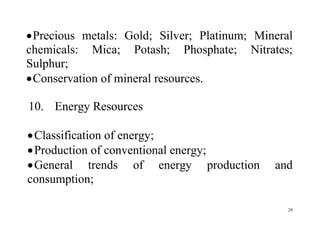
Precious metals: Gold; Silver; Platinum; Mineral
chemicals: Mica; Potash; Phosphate; Nitrates;
Sulphur;
Conservation of mineral resources.
10. Energy Resources
Classification of energy;
Production of conventional energy;
General trends of energy production and
consumption;
21
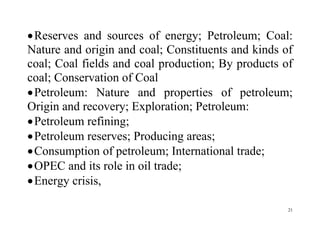
Reserves and sources of energy; Petroleum; Coal:
Nature and origin and coal; Constituents and kinds of
coal; Coal fields and coal production; By products of
coal; Conservation of Coal
Petroleum: Nature and properties of petroleum;
Origin and recovery; Exploration; Petroleum:
Petroleum refining;
Petroleum reserves; Producing areas;
Consumption of petroleum; International trade;
OPEC and its role in oil trade;
Energy crisis,
22
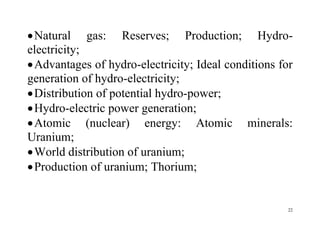
Natural gas: Reserves; Production; Hydro-
electricity;
Advantages of hydro-electricity; Ideal conditions for
generation of hydro-electricity;
Distribution of potential hydro-power;
Hydro-electric power generation;
Atomic (nuclear) energy: Atomic minerals:
Uranium;
World distribution of uranium;
Production of uranium; Thorium;
23
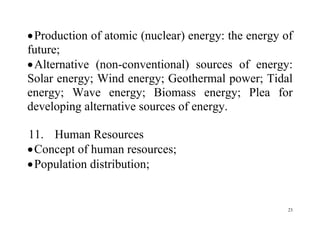
Production of atomic (nuclear) energy: the energy of
future;
Alternative (non-conventional) sources of energy:
Solar energy; Wind energy; Geothermal power; Tidal
energy; Wave energy; Biomass energy; Plea for
developing alternative sources of energy.
11. Human Resources
Concept of human resources;
Population distribution;
24
Factors of population distribution—Physical factors;
Socio-cultural factors; Demographic factors;
World population distribution: ecumene; non-
ecumene;
Continent-wise distribution of population;
Density of population;
Pattern of population density; Population increase
(growth) in the world: Population doubling time;
causes of rapid increase in population; Present trend;
Furture projections;
Determinants of population growth;
25
Natural increase;
Characteristics of population; Age composition;
Population pyramids; Sex composition;
Urbanization; Impact of urbanization; Literacy;
Theories of population growth: Malthusian theory;
Marian theory; Demographic transition theory;
Optimum population; Over- population; Under-
population;
Population problems: Population problems of
developing countries; Population problems of
developed counties;
26
Population dilemma of Europe;
Population Policies: of China, of India.
PROBLEMS OF RESOURCES
12. Resources and Environment
Process of environmental degradation;
Causes of environmental degradation;
Depletion of ozone layer;
Green house effect: Global warming; Acid rains;
Desertification;
Deforestation; Loss of bio-diversity;
27
Environmental degradation due to tourism,
mountaineering and trekking;
Soil erosion and sedimentation;
Energy crisis;
Water scarcity and pollution;
Land pollution/ solid waste pollution;
Radio-active pollution;
Noise pollution;
Population growth and food problem.
28
PART III: MAJOR ECONOMIC ACTIVITIES
Factors of location of economic activities:
Physical, social, economic and cultural;
Concept the techniques of delimitation of agricultural
regions, crop combination and diversification –Von
Thunen’s Model and its modifications.
13. Major Economic Activies
Meaning of economic activities; Varieties of
economic activities;
29
Effect of natural environment on economic activities;
Classification of economic a activities; Categories of
activity.
14. Primary Occupations: Hunting , Grazing, Forestry
Hunting: Hunting in the Tundra and Taiga; Grazing:
Nomadic herding; Commercial grazing: Tropical
grasslands; Temperate grasslands; Forestry:
Lumbering-Lumbering in the tropics; Lumbering in
temperate regions; Global patterns of production and
trade in timber; Gathering.
30
15. Livestock Raising
 Dairygin: Chief characteristics of dairying;
 Milk producing areas;
 International trade of milk products; Cheese;
 Meat industry; Beef, International trade; Mutton:
 Mutton producing areas;
 Goat meat; port (pig meat); Wool: Producing areas;
trade, other sources of wool.
31
16. Fisheries
 Types of fisheries; Commercial fresh water
fisheries; Commercial coastal fisheries; Geographical
factors for commercial fishing;
 Major fishing areas; Minor fishing areas;
 Major fishing nations of the world;
 International trade; Over-exploitation and
sustainability problems of fisheries; Management of
fisheries.
17. Agriculture: Location
32
 Factors affecting agriculture: Physical factors;
Socio-economic factors;
 Diversity of agriculture;
 The role of agriculture in development;
 Location of agriculture:
 Von Thunen’s Theory: Assumptions, Principles;
Model, Criticism; Relevance;
 Application of the Model on India; Sinclair’s theory;
Olof Jonasson’s theory; Game theory.
33
18. Agriculture: Food Crops and Beverages
 Wheat: Conditions of growth; Varieties; Types of
cultivation; Production pattern; International trade;
 Rice: Conditions of growth; Varieties; Methods of
cultivation; Production pattern; International trade;
 Maize (corn): Conditions of growth; Production
pattern; International trade;
 Barley: Conditions of growth; Production pattern;
International trade;
 Oats; Rye; Beverages:
34
 Tea- condition of growth, Production pattern;
International trade;
 Cocoa- conditions of growth; Production pattern;
International trade;
 Tobacco—Conditions of growth; Production pattern;
International trade.
19. Agriculture: Industrial Crops
 Fibre Crops:
 Cotton—Varieties of cotton; Conditions of growth;
Production pattern; International Trade;
35
 Jute—Conditions of growth; Production pattern;
International trade;
 Substitutes of Jute: Glax, Hemp; Abaca, Henequeno;
Sisal;
 Raw Silk-- Production pattern; International trade;
 Natural Rubber—Other sources of rubber,
Plantations in South-east Asia; Production pattern;
International trade;
 Sugarcane—Conditions of growth; Production
pattern; International trade;
36
 Sugarbeet—Conditions of growth; Production
pattern;
 Sugar industry; Sugar consumption; International
trade.
20. Agricultural Systems and Regions
 Schemes of agricultural regionalization:
 Whittlesey’s Classification: Merits; Limitations;
 Classification of world agriculture—Nomadic
herding; Shifting cultivation;
37
 Rudimentary sedentary tillage; Intensive subsistence
tillage—Dominated by wet paddy; Without paddy
dominance;
 Subsistence crop and livestock farming;
 Mediterranean agriculture;
 Livestock ranching;
 Extensive commercial grain farming; Specialized
horticulture and Olericulture; Collective farming;
 Commercial plantation farming;
 Agricultural regions—USA, erstwhile USSR, China.
38
PART IV : CLASSIFICATION OF INDUSTRIES
Classification of Industries; Resource based and
footloose industries, Theories of industrial location-
Weber, Losch and Isard; Case studies of slected
industries Iron and Steel, Aluminum, Chemical, Oil
refining and Petrochemical, Engineering, Textile etc.
21. Manufacturing Industries: Location
 Meaning of manufacturing industry;
 Types of manufacturing;
39
 Approaches to the problem of location of industries;
 Principles of location; Determinants of location of
industries; Industrial location theories:
 Weber’s theory,
 Tord Palander’s theory;
 Edgar Hoover’s theory;
 August Losch’s theory;
 Smith’s theory;
 Harold Hotelling’s theory; Allen Pred’s theory,
 Other locational considerations and controls:
 Agglomeration economies;
40
 Comparative advantages;
 Transnational Corporations;
 Imposed considerations;
 Industrial location in planned economies.
22. Iron and Steel Industry
 Process of iron and steel production;
 Location of iron and steel industry; Early
localization;
 Development of iron manufacture;
41
 Distribution of iron and steel industry;
 Global steel production; International trade; Growth
potential of the steel industry.
23. Textile Industry
 Cotton textile industry: Location of the industry;
Recent trends in localization; Distribution and
production of cotton textiles;
 Woollen textile industry: Location of the industry;
 Silk textile industry:
42
 Raw silk manufacture; Silk textile manufacturing;
Synthetic (artificial) silk industry: Distribution of
man-made fibre and fabrics.
24. Engineering Industries
 Machine tools and machines: Areas of production;
 Industrial machinery:
 Textile machinery;
 Other industrial machinery;
 Agricultural machinery;
43
 Manufacturing of transport equipment:
 Automobile industry; Top 20 (global) vehicle
manufacturing groups by volume; Railway car and
locomotive industry; Shipbuilding; Recent trends;
Aircrafts industry.
25. Chemical Industry
 Classes of chemicals:
 Branches of chemical industry;
 Heavy chemical industry;
44
 Production of acids and alkalies;
 Rise of chemical industry;
 Fertilizer industry: Nitrogen fertilizers; Phosphate
fertilizers; Potash fertilizers;
 Explosives;
 Glass industry:
 Production of glass; Synthetic rubber industry; Pulp
and paper industry; Cement industry; Distribution of
cement industry; Recent trends: Main global
competitors; Petroleum refining industry:
Localization; Site selection;
45
 Siting of petroleum refineries; History of oil
refineries; History of oil refineries; World pattern of
oil refining; Petroleum products.
26. Industrial Regions
 Characteristics of industrial regions;
 Delimitation of an industrial regions;
 Principal industrial regions of the world;
46
 Modes of transportation and transport cost;
accessibility and connectivity: international, inter and
intraregional; comparative cost advantages.
 Typology of markets, market network in rural
societies, market system in urban economy, role of
market in the development of trade and commerce.
27. Transport and Trade Routes
 Importance and development of transport; Means of
transport; Transport costs and economic distance;
47
 Operating costs in transport; Relative importance of
means of transport: Railways, Roads, Pipeline,
Oceans, Air transport; Profits and freight rates;
Government’s transport policy; Transport flows and
networks:
 Flow theory—Complementarity; transferability;
Intervening opportunity; Gravity model; Distance
decay; Network analysis—Single routes; Networks;
 Transport patterns in the world: Oceanic transport;
 Inland waterways
 Railways:
48
 Air transport:
 Pipeline transport;
 Transport costs and specialization; Transport and
trade in the modern era;
 Falling transport costs increase trade between
neighbours; Falling transport costs lead to
concentration within countries;
 Negative externalities of transport.
49
28. International Trade
Evolution of international trade; Types of trade;
Theories of international trade: Classical trade theory
or theory of comparative advantage; Heckscher-Ohlin
theory; Nature of demand; Barriers of international
trade; Inadequacies of classical theories of trade;
General Agreement on Trade and Tariff (GATT);
UNCTAD;
50
Word Trade Organization (WTO); Major trade blocs
of the world: EU, EFTA, COMECON, LAFTA,
ASEAN, SAPTA, OPEC, Commonwealth, African
Blocs; OECD, CIS, APEC, SCO, Multi-Fibre;
Arrangement; World trade flow pattern.
PART V: ECONOMIC REGIONALIZATION
Economic development of India, Regional disparities,
Impact of green revolution on Indian economy,
Globalization and Indian economy and its impact on
environment.
51
29. Economic Development, Patterns and
Regionalization
Socio-economic progress of man; Economic growth
v/s Economic development;
Theories of economic development: Modernizing
theories; Dependency theories; Export based model;
Growth Poles; Basic needs theory; Stage theories;
Core-periphery model;
Sustainable development; Integrated theory of
development; Agents of development: Market v/s
State;
52
Globalization and development; Measures of
economic development; Economic measures; Social
measures; Demographic measures;
Other measures; Environmental factors; Patterns of
economic development; Forms of existing economies;
30. Economic regions and regionalization:
 Regionalization;
 Classification of economies by region and income
(by 2009); OECD countries with developed industrial
and commercial economies; Countries of transitional
economies;
53
 Developing countries; Disparities in developing
countries;
 Centrally planned development region; South-east
Asia and the Pacific; South Asia; Least developed
countries.

Economic geography -an outline

  • 1.
    1 ECONOMIC GEOGRAPHY -ANOUTLINE By Prof. A. Balasubramanian Centre for Advanced Studies in Earth Science, University of Mysore, Mysore-6
  • 2.
    2 Introduction: The economy ofthe world is fast changing during the recent years. The changes in primary, secondary and tertiary stages are dynamic in nature. In view of this, the objectives of studying economic geography are to integrate several factors of economic development to acquaint with the dynamic aspects of the Scenario.
  • 3.
    3 The Subject ofEconomic Geography is very vast and wide because, everything in terms of Economic resources and activities are coming under one roof. With a variety of approaches, economic geography has taken into its fold several subject matters. Many different aspects like the location of industries, economies of agglomeration, transportation, international trade and development, real estate, gentrification, ethnic economies, gendered economies, core-periphery theory, the economics of urban form, the relationship between the environment and the economy and globalization are all included.
  • 4.
    4 However, everything cannot be put into one branch of geography. Hence, the economic geography is divided into 5 parts as: PART-I : SCOPE & CONCEPTUAL FOUNDATIONS PART II : TYPES OF RESOURCES PART III: MAJOR ECONOMIC ACTIVITIES PART IV: CLASSIFICATION OF INDUSTRIES PART V : ECONOMIC REGIONALIZATION About 30 units of study are covered under these five parts.
  • 5.
    5 PART-I: SCOPE & CONCEPTUALFOUNDATIONS 1. Economic Geography: An Introduction Definitions of economic geography; Development of economic geography; Scope of economic geography; There are two approaches to the study this subject; Systematic approaches & Spatial approaches.
  • 6.
    6 The environmental relationsof the economy; Economic geography and economy; Economics v/s economic geography; Commercial geography v/s Economic geography; Economic geography v/s Resource geography are analysed. Fundamental concepts in economic geography. Classification of Economics & Sectors of Economy as Primary, secondary & tertiary.
  • 7.
    7 2. Economy andEconomic Systems: A brief history of the economy; Operation of the economy; The economic approach to economy; Geographical perspectives on the economy; Types of economic systems. Historical evolution of the world system, since primitive economic activities.
  • 8.
    8 3. Key Actorsin Economic Space are studied. The State: Functions of the state; Types of states; Firms/Transnational Corporations (TNCs): Bases of TNCs: Organizing transnational economic activities; Intra-firm relationships; Inter-firm relationships; Labour/workers: Approach to labour and labour market; Role of workers within the capitalist system;
  • 9.
    9 Workers as anagent of change; Alternative ways of working; Consumers: The consumption process; Consumption spaces; Market centres; Central Place Theory and Market Networks; Origin of market centres; Periodic and daily marketing; Sequential development; Retailing and wholesaling; Retail and wholesale markets.
  • 10.
    10 4. Recent Themesand Concepts in Economic Geography  Agglomeration economies;  Commodity chains; Commodification of Nature;  Commodification of environmental degradation;  Fordism; Alternative production Systems in After Fordism;  Rise of placeless production;  Neo-liberalism;
  • 11.
    11  Rise of‘soft-capitalism’ Since the Late Twentieth Century;  Globalization; Space-shrinking Technologies;  Off-shore Services in India;  Transnational Corporations (TNCs);  Outsourcing;  Actor-Network Theory (ANT);  Transitional states;  Rise of macro-regional economic blocks;  Ethnicity in economic geography;  Economic geographies of transnationalism;
  • 12.
    12  Gendered economicgeography. PART II: TYPES OF RESOURCES 5. Definition & Types of Resources Meaning of resource; Concept of resources; Resources, resistances and neutral stuffs; Stocks, resources, reserves and potential resources; Functional or operational theory of resources;
  • 13.
    13 Concept of resourcesin recent geographical literature; Concept of resources adequacy; Concept of resources scarcity or limits to growth; Resource process; Nature and resources; Man and resources; Culture and resources; Role of technology in resource development, Classification of resources based on: Availability of resources;
  • 14.
    14 Distribution and frequencyof occurrence of resources; Use of resources; Classification of resources by Owen, Dasmann; Resource ecology; Conservation or resources. 6. Soil Resources Composition of soil; Soil formation: Factors affecting soil formation; Processes in soil formation;
  • 15.
    15 Soil profile; Soil characteristics; Soilclassification; Land use and soils; Economic planning of soils; Agriculture and soil erosion; Soil erosion and conservation; Methods of controlling soil erosion; Measures to restore and maintain soil fertility.
  • 16.
    16 7. Water Resources Undergroundwater resources; Surface water resources; Inland water resources; Utilization of inland water resources by man; Oceanic water resources: Main features of oceans; Utilization of oceans by man; Water consumption patterns; Water pollution; Conservation of water resources: Techniques of water conservation.
  • 17.
    17 8. Natural Vegetation Typesof natural vegetation; Forests: Significance of forests – Economic significance, Ecological significance; Cultural significance; Factors of forest development; Extent of forest cover; Classification of forests/Grasslands; Desert vegetation; Tundra Vegetation; Economic utilization of forests;
  • 18.
    18 Deforestation: Deforestation intropical forests; Deforestation in temperate forests; Rate and extent of deforestation; Causes and factors of deforestation: Immediate causes of deforestation; Indirect deforestation; Underlying causes of deforestation; Conservation of forests: Forest conservation strategies; Reforestation; monoculture plantations; Afforestation; Types of forestry; Social forestry; Agro-forestry.
  • 19.
    19 9. Mineral Resources Typesof minerals: Metallic minerals; Non-metallic minerals; Distribution of minerals and mining regions; Distribution, production and international trade of Metallic minerals: Ferrous metals: Iron ore; Ferro-alloys: Manganese: Chromium; Nickel: Tungsten: Antimony; Non-ferrous metals: copper; Bauxite and Aluminium; Zinc; Lead; Tin:
  • 20.
    20 Precious metals: Gold;Silver; Platinum; Mineral chemicals: Mica; Potash; Phosphate; Nitrates; Sulphur; Conservation of mineral resources. 10. Energy Resources Classification of energy; Production of conventional energy; General trends of energy production and consumption;
  • 21.
    21 Reserves and sourcesof energy; Petroleum; Coal: Nature and origin and coal; Constituents and kinds of coal; Coal fields and coal production; By products of coal; Conservation of Coal Petroleum: Nature and properties of petroleum; Origin and recovery; Exploration; Petroleum: Petroleum refining; Petroleum reserves; Producing areas; Consumption of petroleum; International trade; OPEC and its role in oil trade; Energy crisis,
  • 22.
    22 Natural gas: Reserves;Production; Hydro- electricity; Advantages of hydro-electricity; Ideal conditions for generation of hydro-electricity; Distribution of potential hydro-power; Hydro-electric power generation; Atomic (nuclear) energy: Atomic minerals: Uranium; World distribution of uranium; Production of uranium; Thorium;
  • 23.
    23 Production of atomic(nuclear) energy: the energy of future; Alternative (non-conventional) sources of energy: Solar energy; Wind energy; Geothermal power; Tidal energy; Wave energy; Biomass energy; Plea for developing alternative sources of energy. 11. Human Resources Concept of human resources; Population distribution;
  • 24.
    24 Factors of populationdistribution—Physical factors; Socio-cultural factors; Demographic factors; World population distribution: ecumene; non- ecumene; Continent-wise distribution of population; Density of population; Pattern of population density; Population increase (growth) in the world: Population doubling time; causes of rapid increase in population; Present trend; Furture projections; Determinants of population growth;
  • 25.
    25 Natural increase; Characteristics ofpopulation; Age composition; Population pyramids; Sex composition; Urbanization; Impact of urbanization; Literacy; Theories of population growth: Malthusian theory; Marian theory; Demographic transition theory; Optimum population; Over- population; Under- population; Population problems: Population problems of developing countries; Population problems of developed counties;
  • 26.
    26 Population dilemma ofEurope; Population Policies: of China, of India. PROBLEMS OF RESOURCES 12. Resources and Environment Process of environmental degradation; Causes of environmental degradation; Depletion of ozone layer; Green house effect: Global warming; Acid rains; Desertification; Deforestation; Loss of bio-diversity;
  • 27.
    27 Environmental degradation dueto tourism, mountaineering and trekking; Soil erosion and sedimentation; Energy crisis; Water scarcity and pollution; Land pollution/ solid waste pollution; Radio-active pollution; Noise pollution; Population growth and food problem.
  • 28.
    28 PART III: MAJORECONOMIC ACTIVITIES Factors of location of economic activities: Physical, social, economic and cultural; Concept the techniques of delimitation of agricultural regions, crop combination and diversification –Von Thunen’s Model and its modifications. 13. Major Economic Activies Meaning of economic activities; Varieties of economic activities;
  • 29.
    29 Effect of naturalenvironment on economic activities; Classification of economic a activities; Categories of activity. 14. Primary Occupations: Hunting , Grazing, Forestry Hunting: Hunting in the Tundra and Taiga; Grazing: Nomadic herding; Commercial grazing: Tropical grasslands; Temperate grasslands; Forestry: Lumbering-Lumbering in the tropics; Lumbering in temperate regions; Global patterns of production and trade in timber; Gathering.
  • 30.
    30 15. Livestock Raising Dairygin: Chief characteristics of dairying;  Milk producing areas;  International trade of milk products; Cheese;  Meat industry; Beef, International trade; Mutton:  Mutton producing areas;  Goat meat; port (pig meat); Wool: Producing areas; trade, other sources of wool.
  • 31.
    31 16. Fisheries  Typesof fisheries; Commercial fresh water fisheries; Commercial coastal fisheries; Geographical factors for commercial fishing;  Major fishing areas; Minor fishing areas;  Major fishing nations of the world;  International trade; Over-exploitation and sustainability problems of fisheries; Management of fisheries. 17. Agriculture: Location
  • 32.
    32  Factors affectingagriculture: Physical factors; Socio-economic factors;  Diversity of agriculture;  The role of agriculture in development;  Location of agriculture:  Von Thunen’s Theory: Assumptions, Principles; Model, Criticism; Relevance;  Application of the Model on India; Sinclair’s theory; Olof Jonasson’s theory; Game theory.
  • 33.
    33 18. Agriculture: FoodCrops and Beverages  Wheat: Conditions of growth; Varieties; Types of cultivation; Production pattern; International trade;  Rice: Conditions of growth; Varieties; Methods of cultivation; Production pattern; International trade;  Maize (corn): Conditions of growth; Production pattern; International trade;  Barley: Conditions of growth; Production pattern; International trade;  Oats; Rye; Beverages:
  • 34.
    34  Tea- conditionof growth, Production pattern; International trade;  Cocoa- conditions of growth; Production pattern; International trade;  Tobacco—Conditions of growth; Production pattern; International trade. 19. Agriculture: Industrial Crops  Fibre Crops:  Cotton—Varieties of cotton; Conditions of growth; Production pattern; International Trade;
  • 35.
    35  Jute—Conditions ofgrowth; Production pattern; International trade;  Substitutes of Jute: Glax, Hemp; Abaca, Henequeno; Sisal;  Raw Silk-- Production pattern; International trade;  Natural Rubber—Other sources of rubber, Plantations in South-east Asia; Production pattern; International trade;  Sugarcane—Conditions of growth; Production pattern; International trade;
  • 36.
    36  Sugarbeet—Conditions ofgrowth; Production pattern;  Sugar industry; Sugar consumption; International trade. 20. Agricultural Systems and Regions  Schemes of agricultural regionalization:  Whittlesey’s Classification: Merits; Limitations;  Classification of world agriculture—Nomadic herding; Shifting cultivation;
  • 37.
    37  Rudimentary sedentarytillage; Intensive subsistence tillage—Dominated by wet paddy; Without paddy dominance;  Subsistence crop and livestock farming;  Mediterranean agriculture;  Livestock ranching;  Extensive commercial grain farming; Specialized horticulture and Olericulture; Collective farming;  Commercial plantation farming;  Agricultural regions—USA, erstwhile USSR, China.
  • 38.
    38 PART IV :CLASSIFICATION OF INDUSTRIES Classification of Industries; Resource based and footloose industries, Theories of industrial location- Weber, Losch and Isard; Case studies of slected industries Iron and Steel, Aluminum, Chemical, Oil refining and Petrochemical, Engineering, Textile etc. 21. Manufacturing Industries: Location  Meaning of manufacturing industry;  Types of manufacturing;
  • 39.
    39  Approaches tothe problem of location of industries;  Principles of location; Determinants of location of industries; Industrial location theories:  Weber’s theory,  Tord Palander’s theory;  Edgar Hoover’s theory;  August Losch’s theory;  Smith’s theory;  Harold Hotelling’s theory; Allen Pred’s theory,  Other locational considerations and controls:  Agglomeration economies;
  • 40.
    40  Comparative advantages; Transnational Corporations;  Imposed considerations;  Industrial location in planned economies. 22. Iron and Steel Industry  Process of iron and steel production;  Location of iron and steel industry; Early localization;  Development of iron manufacture;
  • 41.
    41  Distribution ofiron and steel industry;  Global steel production; International trade; Growth potential of the steel industry. 23. Textile Industry  Cotton textile industry: Location of the industry; Recent trends in localization; Distribution and production of cotton textiles;  Woollen textile industry: Location of the industry;  Silk textile industry:
  • 42.
    42  Raw silkmanufacture; Silk textile manufacturing; Synthetic (artificial) silk industry: Distribution of man-made fibre and fabrics. 24. Engineering Industries  Machine tools and machines: Areas of production;  Industrial machinery:  Textile machinery;  Other industrial machinery;  Agricultural machinery;
  • 43.
    43  Manufacturing oftransport equipment:  Automobile industry; Top 20 (global) vehicle manufacturing groups by volume; Railway car and locomotive industry; Shipbuilding; Recent trends; Aircrafts industry. 25. Chemical Industry  Classes of chemicals:  Branches of chemical industry;  Heavy chemical industry;
  • 44.
    44  Production ofacids and alkalies;  Rise of chemical industry;  Fertilizer industry: Nitrogen fertilizers; Phosphate fertilizers; Potash fertilizers;  Explosives;  Glass industry:  Production of glass; Synthetic rubber industry; Pulp and paper industry; Cement industry; Distribution of cement industry; Recent trends: Main global competitors; Petroleum refining industry: Localization; Site selection;
  • 45.
    45  Siting ofpetroleum refineries; History of oil refineries; History of oil refineries; World pattern of oil refining; Petroleum products. 26. Industrial Regions  Characteristics of industrial regions;  Delimitation of an industrial regions;  Principal industrial regions of the world;
  • 46.
    46  Modes oftransportation and transport cost; accessibility and connectivity: international, inter and intraregional; comparative cost advantages.  Typology of markets, market network in rural societies, market system in urban economy, role of market in the development of trade and commerce. 27. Transport and Trade Routes  Importance and development of transport; Means of transport; Transport costs and economic distance;
  • 47.
    47  Operating costsin transport; Relative importance of means of transport: Railways, Roads, Pipeline, Oceans, Air transport; Profits and freight rates; Government’s transport policy; Transport flows and networks:  Flow theory—Complementarity; transferability; Intervening opportunity; Gravity model; Distance decay; Network analysis—Single routes; Networks;  Transport patterns in the world: Oceanic transport;  Inland waterways  Railways:
  • 48.
    48  Air transport: Pipeline transport;  Transport costs and specialization; Transport and trade in the modern era;  Falling transport costs increase trade between neighbours; Falling transport costs lead to concentration within countries;  Negative externalities of transport.
  • 49.
    49 28. International Trade Evolutionof international trade; Types of trade; Theories of international trade: Classical trade theory or theory of comparative advantage; Heckscher-Ohlin theory; Nature of demand; Barriers of international trade; Inadequacies of classical theories of trade; General Agreement on Trade and Tariff (GATT); UNCTAD;
  • 50.
    50 Word Trade Organization(WTO); Major trade blocs of the world: EU, EFTA, COMECON, LAFTA, ASEAN, SAPTA, OPEC, Commonwealth, African Blocs; OECD, CIS, APEC, SCO, Multi-Fibre; Arrangement; World trade flow pattern. PART V: ECONOMIC REGIONALIZATION Economic development of India, Regional disparities, Impact of green revolution on Indian economy, Globalization and Indian economy and its impact on environment.
  • 51.
    51 29. Economic Development,Patterns and Regionalization Socio-economic progress of man; Economic growth v/s Economic development; Theories of economic development: Modernizing theories; Dependency theories; Export based model; Growth Poles; Basic needs theory; Stage theories; Core-periphery model; Sustainable development; Integrated theory of development; Agents of development: Market v/s State;
  • 52.
    52 Globalization and development;Measures of economic development; Economic measures; Social measures; Demographic measures; Other measures; Environmental factors; Patterns of economic development; Forms of existing economies; 30. Economic regions and regionalization:  Regionalization;  Classification of economies by region and income (by 2009); OECD countries with developed industrial and commercial economies; Countries of transitional economies;
  • 53.
    53  Developing countries;Disparities in developing countries;  Centrally planned development region; South-east Asia and the Pacific; South Asia; Least developed countries.