


Manuscript writing
Dr. Anirudha Potey
Deputy Manager
Clinical Research & Institutional Business
Medical Services,
Emcure Pharmaceuticals Ltd., Pune
What you will learn today
•Let go inertia of starting to write an article
•Tips of writing a good manuscript
•IMRaD format
•Contents of different sections
Introduction
•200-250 words
•Define the disease condition or matter under
consideration
•Global prevalence followed by Indian prevalence
•Current management
•Limitations of current therapy eg. adverse effects
•Some details of your intervention and its
advantages
•Explain rationale – Why this study?
•End of introduction – Objective of study
Methods
•Most important part – Validates your study findings
•If you have done the study, it is very easy to write
•Mention study details –
•design
•setting
•place
•period of data collection
•Patients –
•Inclusion criteria
•exclusion criteria
Methods
•Interventions / Groups
•Variables assessed
•Describe all details in a stepwise/chronological
manner, in an easy understandable language
•1 Para – 1 part of a procedure
•Ethics related issues –
•Permission
•informed consent
•Statistical issues
Statistical Issues
•Sample size calculation
•Sampling procedure
•Randomisation – type and methods
•Data entry in Microsoft excel
•Software used for analysis – details – owner, version
•ITT or per protocol analysis
•Tests of normality used
•Statistical tests used
•Level of significance - <0.05
Methods – what to avoid
•Irrelevant and unnecessary details
•Limit references
•Avoid repeating in another section
•Don’t mention results with procedures
•Omit all explanatory and background information
Results
•Number and screening of patients – if possible,
flowchart
•Descriptive data of patients
•Avoid duplication with data in tables or figures
•However, every table or figure should be mentioned
with a referring sentence
•Do not implicate the findings, just mention them
•Just interpret p value
•Simple results in simple sentences
•Not all results require figures or tables
Tables
•Provide summary of data, allows better
visualisation, reduces word count
•Table number & Title on top – do not use
abbreviations, mention study place and setting
•Headings for columns
•Footnotes – describe any abbreviations, statistical
tests, explain p value,
•Self-explainable without seeing results section
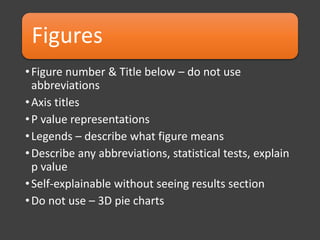
Figures
•Figure number & Title below – do not use
abbreviations
•Axis titles
•P value representations
•Legends – describe what figure means
•Describe any abbreviations, statistical tests, explain
p value
•Self-explainable without seeing results section
•Do not use – 3D pie charts
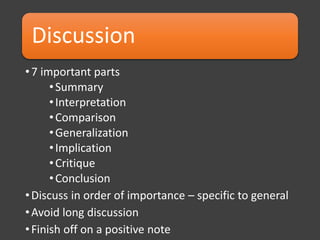
Discussion
•7 important parts
•Summary
•Interpretation
•Comparison
•Generalization
•Implication
•Critique
•Conclusion
•Discuss in order of importance – specific to general
•Avoid long discussion
•Finish off on a positive note
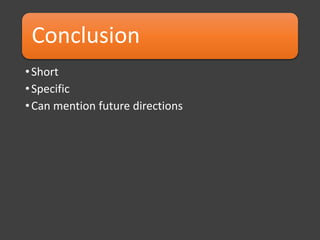
Conclusion
•Short
•Specific
•Can mention future directions
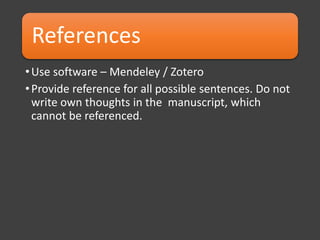
References
•Use software – Mendeley / Zotero
•Provide reference for all possible sentences. Do not
write own thoughts in the manuscript, which
cannot be referenced.
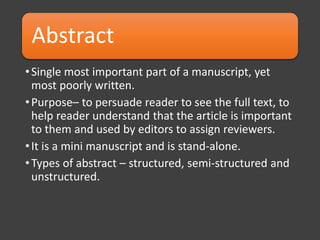
Abstract
•Single most important part of a manuscript, yet
most poorly written.
•Purpose– to persuade reader to see the full text, to
help reader understand that the article is important
to them and used by editors to assign reviewers.
•It is a mini manuscript and is stand-alone.
•Types of abstract – structured, semi-structured and
unstructured.
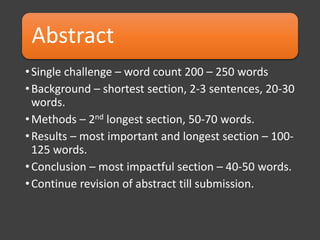
Abstract
•Single challenge – word count 200 – 250 words
•Background – shortest section, 2-3 sentences, 20-30
words.
•Methods – 2nd longest section, 50-70 words.
•Results – most important and longest section – 100-
125 words.
•Conclusion – most impactful section – 40-50 words.
•Continue revision of abstract till submission.
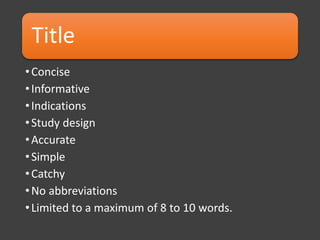
Title
•Concise
•Informative
•Indications
•Study design
•Accurate
•Simple
•Catchy
•No abbreviations
•Limited to a maximum of 8 to 10 words.
Any
Questions?
Manuscript writing

Manuscript writing

  • 1.
    Manuscript writing Dr. AnirudhaPotey Deputy Manager Clinical Research & Institutional Business Medical Services, Emcure Pharmaceuticals Ltd., Pune
  • 2.
    What you willlearn today •Let go inertia of starting to write an article •Tips of writing a good manuscript •IMRaD format •Contents of different sections
  • 3.
    Introduction •200-250 words •Define thedisease condition or matter under consideration •Global prevalence followed by Indian prevalence •Current management •Limitations of current therapy eg. adverse effects •Some details of your intervention and its advantages •Explain rationale – Why this study? •End of introduction – Objective of study
  • 4.
    Methods •Most important part– Validates your study findings •If you have done the study, it is very easy to write •Mention study details – •design •setting •place •period of data collection •Patients – •Inclusion criteria •exclusion criteria
  • 5.
    Methods •Interventions / Groups •Variablesassessed •Describe all details in a stepwise/chronological manner, in an easy understandable language •1 Para – 1 part of a procedure •Ethics related issues – •Permission •informed consent •Statistical issues
  • 6.
    Statistical Issues •Sample sizecalculation •Sampling procedure •Randomisation – type and methods •Data entry in Microsoft excel •Software used for analysis – details – owner, version •ITT or per protocol analysis •Tests of normality used •Statistical tests used •Level of significance - <0.05
  • 7.
    Methods – whatto avoid •Irrelevant and unnecessary details •Limit references •Avoid repeating in another section •Don’t mention results with procedures •Omit all explanatory and background information
  • 8.
    Results •Number and screeningof patients – if possible, flowchart •Descriptive data of patients •Avoid duplication with data in tables or figures •However, every table or figure should be mentioned with a referring sentence •Do not implicate the findings, just mention them •Just interpret p value •Simple results in simple sentences •Not all results require figures or tables
  • 9.
    Tables •Provide summary ofdata, allows better visualisation, reduces word count •Table number & Title on top – do not use abbreviations, mention study place and setting •Headings for columns •Footnotes – describe any abbreviations, statistical tests, explain p value, •Self-explainable without seeing results section
  • 10.
    Figures •Figure number &Title below – do not use abbreviations •Axis titles •P value representations •Legends – describe what figure means •Describe any abbreviations, statistical tests, explain p value •Self-explainable without seeing results section •Do not use – 3D pie charts
  • 11.
    Discussion •7 important parts •Summary •Interpretation •Comparison •Generalization •Implication •Critique •Conclusion •Discussin order of importance – specific to general •Avoid long discussion •Finish off on a positive note
  • 12.
  • 13.
    References •Use software –Mendeley / Zotero •Provide reference for all possible sentences. Do not write own thoughts in the manuscript, which cannot be referenced.
  • 14.
    Abstract •Single most importantpart of a manuscript, yet most poorly written. •Purpose– to persuade reader to see the full text, to help reader understand that the article is important to them and used by editors to assign reviewers. •It is a mini manuscript and is stand-alone. •Types of abstract – structured, semi-structured and unstructured.
  • 15.
    Abstract •Single challenge –word count 200 – 250 words •Background – shortest section, 2-3 sentences, 20-30 words. •Methods – 2nd longest section, 50-70 words. •Results – most important and longest section – 100- 125 words. •Conclusion – most impactful section – 40-50 words. •Continue revision of abstract till submission.
  • 16.
  • 17.