1
INDUSTRIALTOUR
SEMESTER PROJECT REPORT
MATERIALS AND MANUFACTURING PROCESS
Submitted to:
Engr. Arqam Razzaq
Group Members:
Mohammad Asim 18-MCT-02
Moeen Haider 18-MCT-03
Tabish Nawaz 18-MCT-23
Date:
January 28, 2020
2
Table of Contents
Summary:................................................................................................................................. 3
Introduction: ............................................................................................................................ 4
Manufacturing Departments..................................................................................................... 5
Body Department:................................................................................................................ 5
Ball Mill:.......................................................................................................................... 5
Pressing department:............................................................................................................ 6
Kiln department: .................................................................................................................. 7
Glazing department:............................................................................................................. 7
Digital printing department:................................................................................................. 8
Sorting department:.............................................................................................................. 8
Packing department:............................................................................................................. 8
Other Departments................................................................................................................... 9
Polishing department: .......................................................................................................... 9
Nano-polishing:................................................................................................................ 9
Stepwise processes:.................................................................................................................. 9
Double Fired Process ........................................................................................................... 9
Single Fired Process............................................................................................................. 9
Safety Precautions:................................................................................................................. 10
3
Summary:
On December 13, 2019 we visited the Master Tiles Industry located in Gujranwala.
The coordinator was Mr. Faisal Ijaz – Manager Human Resource Department. The
process carried out in the industry was tiles manufacturing. The department involved
in this manufacturing were Body department, pressing department, Kiln department,
polishing department, Digital printing department, sorting department and Packaging
department.
The two methods of manufacturing were:
 Double fire – Old method
 Single fire (Monucoturra) – New method
The types of tiles made were:
 Matt tile
 Polished tile
 Digital printed tile
The departments like Polishing, Digital Printing and Glazing department varied
according to the type of tile to be manufactured.
Some of the departments were semi-automated and others were fully automated.
4
Introduction:
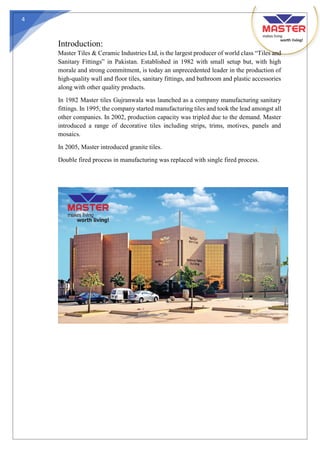
Master Tiles & Ceramic Industries Ltd, is the largest producer of world class “Tiles and
Sanitary Fittings” in Pakistan. Established in 1982 with small setup but, with high
morale and strong commitment, is today an unprecedented leader in the production of
high-quality wall and floor tiles, sanitary fittings, and bathroom and plastic accessories
along with other quality products.
In 1982 Master tiles Gujranwala was launched as a company manufacturing sanitary
fittings. In 1995, the company started manufacturing tiles and took the lead amongst all
other companies. In 2002, production capacity was tripled due to the demand. Master
introduced a range of decorative tiles including strips, trims, motives, panels and
mosaics.
In 2005, Master introduced granite tiles.
Double fired process in manufacturing was replaced with single fired process.
5
On December 13, 2019 we visited Master tiles, Gujranwala. We were received by Mr.
Faisal Ijaz. He explained us about the different manufacturing processes in
chronological order.
It all beings with damp grinding of clays and other raw materials, the process are
carried out in the first of its kind Continuous Ball Mills. Raw material is fed into these
mills at one end to get slip from the other. The slip is separately treated in accordance
with the end product requirement. The process continues either to produce Le
Porcelain range or Granite.
Manufacturing Departments
Body Department:
Dry crushing of raw materials is done outside factory. It is crushed into fine particles.
Material is then piled in form of lumps. Piling is done to mix equal proportion of
material to make good grade product.
Ageing of this crushed material is done for 1-2 months. The material is kept under
controlled conditions in the process of ageing, so that its properties might be enhanced.
The material is then put in the ball mills.
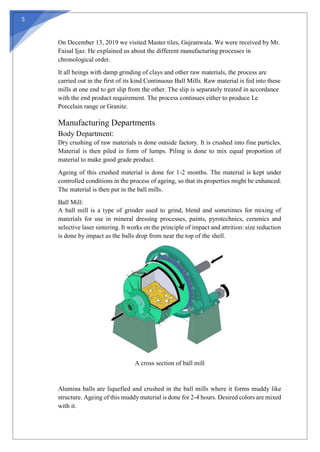
Ball Mill:
A ball mill is a type of grinder used to grind, blend and sometimes for mixing of
materials for use in mineral dressing processes, paints, pyrotechnics, ceramics and
selective laser sintering. It works on the principle of impact and attrition: size reduction
is done by impact as the balls drop from near the top of the shell.
A cross section of ball mill
Alumina balls are liquefied and crushed in the ball mills where it forms muddy like
structure. Ageing of this muddy material is done for 2-4 hours. Desired colors are mixed
with it.
6
The material is then sent to spray dryers where temperature is about 500-600°C. It is
dried and takes granular form. It is then mixed in equal proportions. Homogeneous
mixture is good for strength. 5% moisture is still left intentionally.
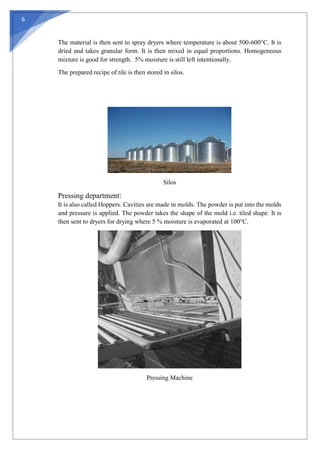
The prepared recipe of tile is then stored in silos.
Silos
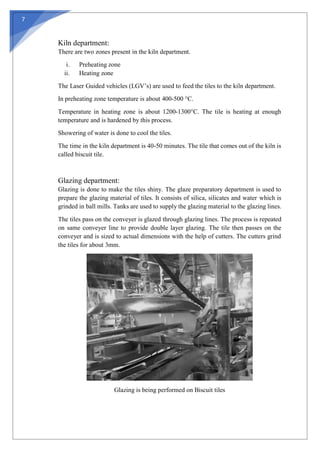
Pressing department:
It is also called Hoppers. Cavities are made in molds. The powder is put into the molds
and pressure is applied. The powder takes the shape of the mold i.e. tiled shape. It is
then sent to dryers for drying where 5 % moisture is evaporated at 100°C.
Pressing Machine
7
Kiln department:
There are two zones present in the kiln department.
i. Preheating zone
ii. Heating zone
The Laser Guided vehicles (LGV’s) are used to feed the tiles to the kiln department.
In preheating zone temperature is about 400-500 °C.
Temperature in heating zone is about 1200-1300°C. The tile is heating at enough
temperature and is hardened by this process.
Showering of water is done to cool the tiles.
The time in the kiln department is 40-50 minutes. The tile that comes out of the kiln is
called biscuit tile.
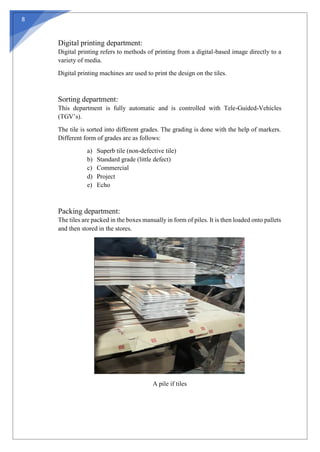
Glazing department:
Glazing is done to make the tiles shiny. The glaze preparatory department is used to
prepare the glazing material of tiles. It consists of silica, silicates and water which is
grinded in ball mills. Tanks are used to supply the glazing material to the glazing lines.
The tiles pass on the conveyer is glazed through glazing lines. The process is repeated
on same conveyer line to provide double layer glazing. The tile then passes on the
conveyer and is sized to actual dimensions with the help of cutters. The cutters grind
the tiles for about 3mm.
Glazing is being performed on Biscuit tiles
8
Digital printing department:
Digital printing refers to methods of printing from a digital-based image directly to a
variety of media.
Digital printing machines are used to print the design on the tiles.
Sorting department:
This department is fully automatic and is controlled with Tele-Guided-Vehicles
(TGV’s).
The tile is sorted into different grades. The grading is done with the help of markers.
Different form of grades are as follows:
a) Superb tile (non-defective tile)
b) Standard grade (little defect)
c) Commercial
d) Project
e) Echo
Packing department:
The tiles are packed in the boxes manually in form of piles. It is then loaded onto pallets
and then stored in the stores.
A pile if tiles
9
Other Departments
Polishing department:
Abrasives are used to polish the tile at high pressure.
Nano-polishing:
Glazed + Polished tile is acquired with the technique of Nano-polishing.
Nano polish is based on Chemical-Nanotechnology, the specially formulated product
contains Functional Nano Particles that are specially linked into a Silicon Matrix in a
Solvent Base.
Such self-organizing Nano components will form an invisible layer on the surface of
vitrified tiles which will have excellent water/dust repellent & anti-bacterial properties.
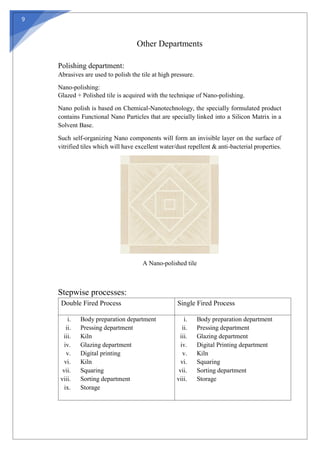
A Nano-polished tile
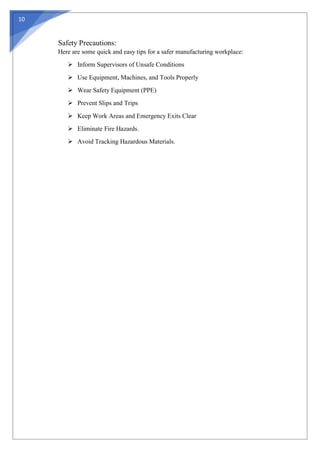
Stepwise processes:
Double Fired Process Single Fired Process
i. Body preparation department
ii. Pressing department
iii. Kiln
iv. Glazing department
v. Digital printing
vi. Kiln
vii. Squaring
viii. Sorting department
ix. Storage
i. Body preparation department
ii. Pressing department
iii. Glazing department
iv. Digital Printing department
v. Kiln
vi. Squaring
vii. Sorting department
viii. Storage
10
Safety Precautions:
Here are some quick and easy tips for a safer manufacturing workplace:
 Inform Supervisors of Unsafe Conditions
 Use Equipment, Machines, and Tools Properly
 Wear Safety Equipment (PPE)
 Prevent Slips and Trips
 Keep Work Areas and Emergency Exits Clear
 Eliminate Fire Hazards.
 Avoid Tracking Hazardous Materials.

Industrial Visit Report

  • 1.
    1 INDUSTRIALTOUR SEMESTER PROJECT REPORT MATERIALSAND MANUFACTURING PROCESS Submitted to: Engr. Arqam Razzaq Group Members: Mohammad Asim 18-MCT-02 Moeen Haider 18-MCT-03 Tabish Nawaz 18-MCT-23 Date: January 28, 2020
  • 2.
    2 Table of Contents Summary:.................................................................................................................................3 Introduction: ............................................................................................................................ 4 Manufacturing Departments..................................................................................................... 5 Body Department:................................................................................................................ 5 Ball Mill:.......................................................................................................................... 5 Pressing department:............................................................................................................ 6 Kiln department: .................................................................................................................. 7 Glazing department:............................................................................................................. 7 Digital printing department:................................................................................................. 8 Sorting department:.............................................................................................................. 8 Packing department:............................................................................................................. 8 Other Departments................................................................................................................... 9 Polishing department: .......................................................................................................... 9 Nano-polishing:................................................................................................................ 9 Stepwise processes:.................................................................................................................. 9 Double Fired Process ........................................................................................................... 9 Single Fired Process............................................................................................................. 9 Safety Precautions:................................................................................................................. 10
  • 3.
    3 Summary: On December 13,2019 we visited the Master Tiles Industry located in Gujranwala. The coordinator was Mr. Faisal Ijaz – Manager Human Resource Department. The process carried out in the industry was tiles manufacturing. The department involved in this manufacturing were Body department, pressing department, Kiln department, polishing department, Digital printing department, sorting department and Packaging department. The two methods of manufacturing were:  Double fire – Old method  Single fire (Monucoturra) – New method The types of tiles made were:  Matt tile  Polished tile  Digital printed tile The departments like Polishing, Digital Printing and Glazing department varied according to the type of tile to be manufactured. Some of the departments were semi-automated and others were fully automated.
  • 4.
    4 Introduction: Master Tiles &Ceramic Industries Ltd, is the largest producer of world class “Tiles and Sanitary Fittings” in Pakistan. Established in 1982 with small setup but, with high morale and strong commitment, is today an unprecedented leader in the production of high-quality wall and floor tiles, sanitary fittings, and bathroom and plastic accessories along with other quality products. In 1982 Master tiles Gujranwala was launched as a company manufacturing sanitary fittings. In 1995, the company started manufacturing tiles and took the lead amongst all other companies. In 2002, production capacity was tripled due to the demand. Master introduced a range of decorative tiles including strips, trims, motives, panels and mosaics. In 2005, Master introduced granite tiles. Double fired process in manufacturing was replaced with single fired process.
  • 5.
    5 On December 13,2019 we visited Master tiles, Gujranwala. We were received by Mr. Faisal Ijaz. He explained us about the different manufacturing processes in chronological order. It all beings with damp grinding of clays and other raw materials, the process are carried out in the first of its kind Continuous Ball Mills. Raw material is fed into these mills at one end to get slip from the other. The slip is separately treated in accordance with the end product requirement. The process continues either to produce Le Porcelain range or Granite. Manufacturing Departments Body Department: Dry crushing of raw materials is done outside factory. It is crushed into fine particles. Material is then piled in form of lumps. Piling is done to mix equal proportion of material to make good grade product. Ageing of this crushed material is done for 1-2 months. The material is kept under controlled conditions in the process of ageing, so that its properties might be enhanced. The material is then put in the ball mills. Ball Mill: A ball mill is a type of grinder used to grind, blend and sometimes for mixing of materials for use in mineral dressing processes, paints, pyrotechnics, ceramics and selective laser sintering. It works on the principle of impact and attrition: size reduction is done by impact as the balls drop from near the top of the shell. A cross section of ball mill Alumina balls are liquefied and crushed in the ball mills where it forms muddy like structure. Ageing of this muddy material is done for 2-4 hours. Desired colors are mixed with it.
  • 6.
    6 The material isthen sent to spray dryers where temperature is about 500-600°C. It is dried and takes granular form. It is then mixed in equal proportions. Homogeneous mixture is good for strength. 5% moisture is still left intentionally. The prepared recipe of tile is then stored in silos. Silos Pressing department: It is also called Hoppers. Cavities are made in molds. The powder is put into the molds and pressure is applied. The powder takes the shape of the mold i.e. tiled shape. It is then sent to dryers for drying where 5 % moisture is evaporated at 100°C. Pressing Machine
  • 7.
    7 Kiln department: There aretwo zones present in the kiln department. i. Preheating zone ii. Heating zone The Laser Guided vehicles (LGV’s) are used to feed the tiles to the kiln department. In preheating zone temperature is about 400-500 °C. Temperature in heating zone is about 1200-1300°C. The tile is heating at enough temperature and is hardened by this process. Showering of water is done to cool the tiles. The time in the kiln department is 40-50 minutes. The tile that comes out of the kiln is called biscuit tile. Glazing department: Glazing is done to make the tiles shiny. The glaze preparatory department is used to prepare the glazing material of tiles. It consists of silica, silicates and water which is grinded in ball mills. Tanks are used to supply the glazing material to the glazing lines. The tiles pass on the conveyer is glazed through glazing lines. The process is repeated on same conveyer line to provide double layer glazing. The tile then passes on the conveyer and is sized to actual dimensions with the help of cutters. The cutters grind the tiles for about 3mm. Glazing is being performed on Biscuit tiles
  • 8.
    8 Digital printing department: Digitalprinting refers to methods of printing from a digital-based image directly to a variety of media. Digital printing machines are used to print the design on the tiles. Sorting department: This department is fully automatic and is controlled with Tele-Guided-Vehicles (TGV’s). The tile is sorted into different grades. The grading is done with the help of markers. Different form of grades are as follows: a) Superb tile (non-defective tile) b) Standard grade (little defect) c) Commercial d) Project e) Echo Packing department: The tiles are packed in the boxes manually in form of piles. It is then loaded onto pallets and then stored in the stores. A pile if tiles
  • 9.
    9 Other Departments Polishing department: Abrasivesare used to polish the tile at high pressure. Nano-polishing: Glazed + Polished tile is acquired with the technique of Nano-polishing. Nano polish is based on Chemical-Nanotechnology, the specially formulated product contains Functional Nano Particles that are specially linked into a Silicon Matrix in a Solvent Base. Such self-organizing Nano components will form an invisible layer on the surface of vitrified tiles which will have excellent water/dust repellent & anti-bacterial properties. A Nano-polished tile Stepwise processes: Double Fired Process Single Fired Process i. Body preparation department ii. Pressing department iii. Kiln iv. Glazing department v. Digital printing vi. Kiln vii. Squaring viii. Sorting department ix. Storage i. Body preparation department ii. Pressing department iii. Glazing department iv. Digital Printing department v. Kiln vi. Squaring vii. Sorting department viii. Storage
  • 10.
    10 Safety Precautions: Here aresome quick and easy tips for a safer manufacturing workplace:  Inform Supervisors of Unsafe Conditions  Use Equipment, Machines, and Tools Properly  Wear Safety Equipment (PPE)  Prevent Slips and Trips  Keep Work Areas and Emergency Exits Clear  Eliminate Fire Hazards.  Avoid Tracking Hazardous Materials.