1
Manufacturing OperationsManufacturing Operations
ManagementManagement
Manufacturing OperationsManufacturing Operations
ManagementManagement
2
ObjectivesObjectives
• Review the ISA 95 standards and how they are being
used in companies like Eli Lilly & Company for shop
floor to top floor integration
– The standards provide a formal model for exchanged data
between business systems and manufacturing systems
– The models also include a definition of Manufacturing
Operations Management, the activities on the shop floor that
take production schedules and perform the actual work
required to manufacture products
• The Manufacturing Operations Management models
are currently being used in the development of
multiple new manufacturing facilities
3
Manufacturing in the Supply ChainManufacturing in the Supply Chain
• “Make” is a significant part of the supply chain and
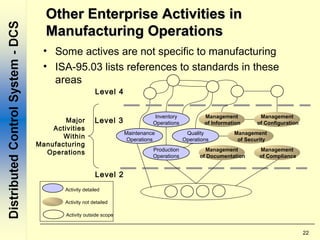
collaborative manufacturing, but is often the last
element to be actually integrated
– Collaboration in “Make” is usually not a “Low Hanging Fruit”
– But can offer very high ROI for high volume, or high cost
products
• However, Business IT and Manufacturing IT
organizations are often at odds as they try to
collaborate
– They have different goals and different success criteria
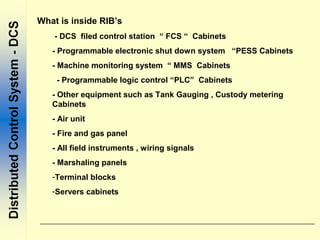
– They use the same terms for different elements and different
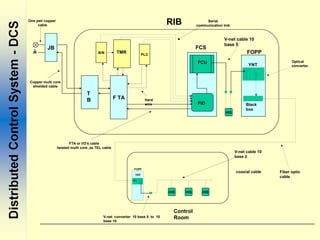
terms for the same elements
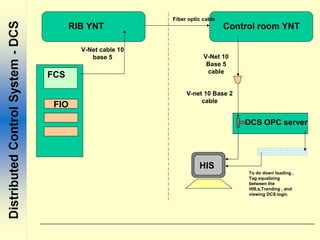
4
Collaborative Manufacturing HelpCollaborative Manufacturing Help
• Fortunately there are multiple standards in
place to help integrating business systems
with manufacturing systems.
– The ISA 95 Enterprise/Control System Integration
standards, also an IEC/ISO standard
– XML Schemas standards for collaborative
manufacturing from the World Batch Forum
• Will show how they are being applied to the
development of manufacturing systems
roadmap
5
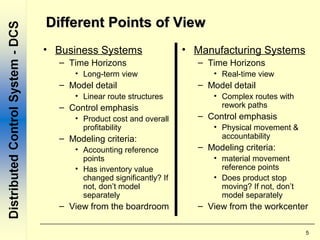
Different Points of ViewDifferent Points of View
• Business Systems
– Time Horizons
• Long-term view
– Model detail
• Linear route structures
– Control emphasis
• Product cost and overall
profitability
– Modeling criteria:
• Accounting reference
points
• Has inventory value
changed significantly? If
not, don’t model
separately
– View from the boardroom
• Manufacturing Systems
– Time Horizons
• Real-time view
– Model detail
• Complex routes with
rework paths
– Control emphasis
• Physical movement &
accountability
– Modeling criteria:
• material movement
reference points
• Does product stop
moving? If not, don’t
model separately
– View from the workcenter
6
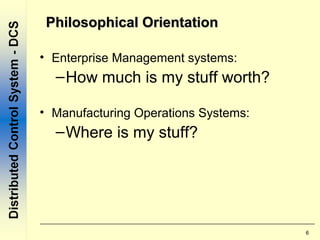
Philosophical OrientationPhilosophical Orientation
• Enterprise Management systems:
–How much is my stuff worth?
• Manufacturing Operations Systems:
–Where is my stuff?
7
ISA 95 Provides DirectionISA 95 Provides Direction
• The ANSI/ISA 95.00.01 “Enterprise - Control
System Integration - Part 1: Models and
Terminology”
– Also Draft International Standard ISO/IEC 62264-1
• ANSI/ISA 95.00.02 “Enterprise - Control
System Integration - Part 2: Object Attributes”
• Draft ISA 95.00.03 “Enterprise - Control
System Integration - Part 3: Activity Models of
Manufacturing Operations Management”
8
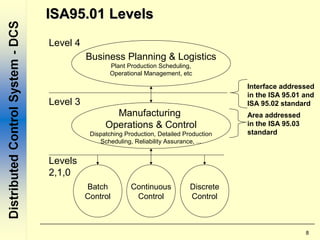
Business Planning & Logistics
Plant Production Scheduling,
Operational Management, etc
Manufacturing
Operations & Control
Dispatching Production, Detailed Production
Scheduling, Reliability Assurance, ...
Batch
Control
Discrete
Control
Continuous
Control
Level 4
Level 3
Levels
2,1,0
ISA95.01 LevelsISA95.01 Levels
Interface addressed
in the ISA 95.01 and
ISA 95.02 standard
Area addressed
in the ISA 95.03
standard
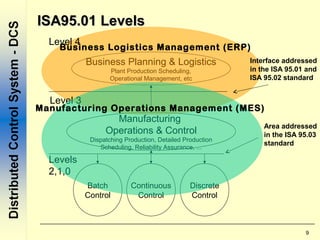
Business Planning & Logistics
Plant Production Scheduling,
Operational Management, etc
Manufacturing
Operations & Control
Dispatching Production, Detailed Production
Scheduling, Reliability Assurance, ...
Business Logistics Management (ERP)
9
Interface addressed
in the ISA 95.01 and
ISA 95.02 standard
Area addressed
in the ISA 95.03
standard
Batch
Control
Discrete
Control
Continuous
Control
Level 4
Level 3
Levels
2,1,0
ISA95.01 LevelsISA95.01 Levels
Manufacturing Operations Management (MES)
10
ISA 95 Part 1 and Part 2ISA 95 Part 1 and Part 2
Exchanged InformationExchanged Information
Information that crosses the boundary between
business systems and manufacturing systems
11
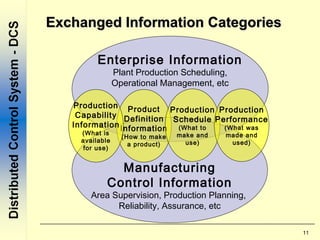
Exchanged Information CategoriesExchanged Information Categories
Enterprise Information
Plant Production Scheduling,
Operational Management, etc
Manufacturing
Control Information
Area Supervision, Production Planning,
Reliability, Assurance, etc
Product
Definition
Information
(How to make
a product)
Production
Capability
Information
(What is
available
for use)
Production
Schedule
(What to
make and
use)
Production
Performance
(What was
made and
used)
12
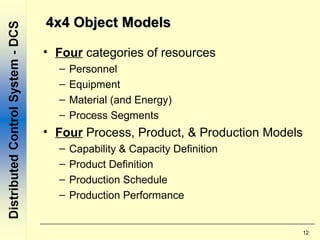
4x4 Object Models4x4 Object Models
• Four categories of resources
– Personnel
– Equipment
– Material (and Energy)
– Process Segments
• Four Process, Product, & Production Models
– Capability & Capacity Definition
– Product Definition
– Production Schedule
– Production Performance
13
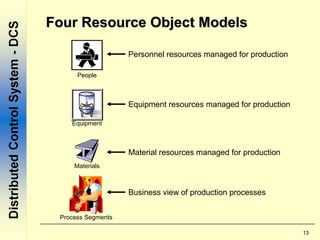
Four Resource Object ModelsFour Resource Object Models
People
Materials
Equipment
Personnel resources managed for production
Equipment resources managed for production
Material resources managed for production
Process Segments
Business view of production processes
14
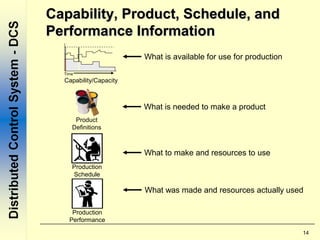
Capability, Product, Schedule, andCapability, Product, Schedule, and
Performance InformationPerformance Information
Product
Definitions
Production
Schedule
Production
Performance
What is available for use for production
What is needed to make a product
What to make and resources to use
What was made and resources actually used
Product
Time
Capability/Capacity
15
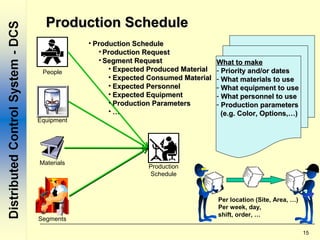
Production ScheduleProduction Schedule
People
Materials
Equipment
Segments
Production
Schedule
What to makeWhat to make
- Priority and/or datesPriority and/or dates
- What materials to useWhat materials to use
- What equipment to useWhat equipment to use
- What personnel to useWhat personnel to use
- Production parametersProduction parameters
(e.g. Color, Options,…)(e.g. Color, Options,…)
Per location (Site, Area, …)
Per week, day,
shift, order, …
• Production ScheduleProduction Schedule
• Production RequestProduction Request
• Segment RequestSegment Request
• Expected Produced MaterialExpected Produced Material
• Expected Consumed MaterialExpected Consumed Material
• Expected PersonnelExpected Personnel
• Expected EquipmentExpected Equipment
• Production ParametersProduction Parameters
• ……
16
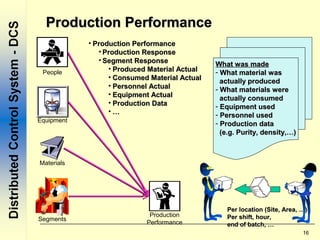
Production PerformanceProduction Performance
People
Materials
Equipment
Segments
Production
Performance
What was madeWhat was made
- What material wasWhat material was
actually producedactually produced
- What materials wereWhat materials were
actually consumedactually consumed
- Equipment usedEquipment used
- Personnel usedPersonnel used
- Production dataProduction data
(e.g. Purity, density,…)(e.g. Purity, density,…)
Per location (Site, Area, …)Per location (Site, Area, …)
Per shift, hour,Per shift, hour,
end of batch, …end of batch, …
• Production PerformanceProduction Performance
• Production ResponseProduction Response
• Segment ResponseSegment Response
• Produced Material ActualProduced Material Actual
• Consumed Material ActualConsumed Material Actual
• Personnel ActualPersonnel Actual
• Equipment ActualEquipment Actual
• Production DataProduction Data
• ……
17
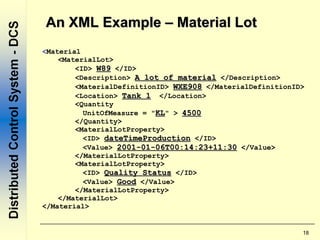
XML Standard for B2M ExchangesXML Standard for B2M Exchanges
• The World Batch Forum has developed XML
Schemas that map to the ANSI/ISA-95
models
• Defines how to represent the ISA-95
information in XML
– Business To Manufacturing Markup Language
– B2MML
• One schema for each object model
• Formal way to exchange information
– www.wbf.org
18
<Material
<MaterialLot>
<ID> W89W89 </ID>
<Description> A lot of materialA lot of material </Description>
<MaterialDefinitionID> WXE908WXE908 </MaterialDefinitionID>
<Location> Tank 1Tank 1 </Location>
<Quantity
UnitOfMeasure = "KLKL" > 45004500
</Quantity>
<MaterialLotProperty>
<ID> dateTimeProductiondateTimeProduction </ID>
<Value> 2001-01-06T00:14:23+11:302001-01-06T00:14:23+11:30 </Value>
</MaterialLotProperty>
<MaterialLotProperty>
<ID> Quality StatusQuality Status </ID>
<Value> GoodGood </Value>
</MaterialLotProperty>
</MaterialLot>
</Material>
An XML Example – Material LotAn XML Example – Material Lot
19
ISA95 Part 3ISA95 Part 3
Activity Models ofActivity Models of
Manufacturing OperationsManufacturing Operations
In Development
Expected Release 2004
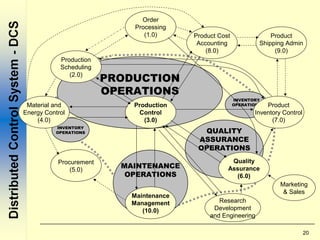
20
INVENTORY
OPERATIONS
INVENTORY
OPERATIONS
MAINTENANCE
OPERATIONS
PRODUCTION
OPERATIONS
QUALITY
ASSURANCE
OPERATIONS
Procurement
(5.0)
Production
Scheduling
(2.0)
Material and
Energy Control
(4.0)
Product
Inventory Control
(7.0)
Product Cost
Accounting
(8.0)
Quality
Assurance
(6.0)
Research
Development
and Engineering
Product
Shipping Admin
(9.0)
Order
Processing
(1.0)
Marketing
& Sales
Production
Control
(3.0)
Maintenance
Management
(10.0)
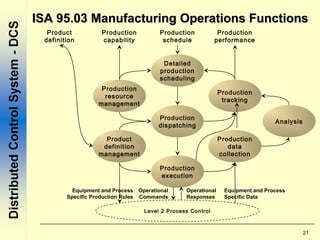
21
ISA 95.03 Manufacturing Operations FunctionsISA 95.03 Manufacturing Operations Functions
Production
resource
management
Production
capability
Analysis
Production
data
collection
Production
execution
Production
dispatching
Production
tracking
Production
performance
Detailed
production
scheduling
Production
schedule
Level 2 Process Control
Product
definition
management
Product
definition
Equipment and Process
Specific Production Rules
Equipment and Process
Specific Data
Operational
Responses
Operational
Commands
22
Major
Activities
Within
Manufacturing
Operations
Quality
Operations
Maintenance
Operations
Production
Operations
Level 4
Level 3
Level 2
Management
of Configuration
Management
of Information
Management
of Security
Management
of Documentation
Management
of Compliance
Inventory
Operations
Other Enterprise Activities inOther Enterprise Activities in
Manufacturing OperationsManufacturing Operations
• Some actives are not specific to manufacturing
• ISA-95.03 lists references to standards in these
areas
Activity detailed
Activity not detailed
Activity outside scope
23
ImplementationsImplementations
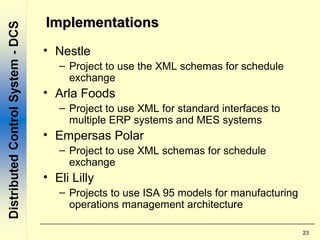
• Nestle
– Project to use the XML schemas for schedule
exchange
• Arla Foods
– Project to use XML for standard interfaces to
multiple ERP systems and MES systems
• Empersas Polar
– Project to use XML schemas for schedule
exchange
• Eli Lilly
– Projects to use ISA 95 models for manufacturing
operations management architecture
24
Building Collaborative ManufacturingBuilding Collaborative Manufacturing
SystemsSystems
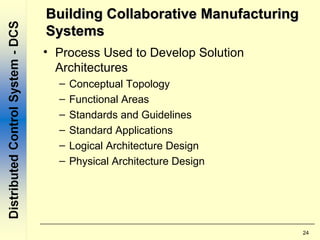
• Process Used to Develop Solution
Architectures
– Conceptual Topology
– Functional Areas
– Standards and Guidelines
– Standard Applications
– Logical Architecture Design
– Physical Architecture Design
25
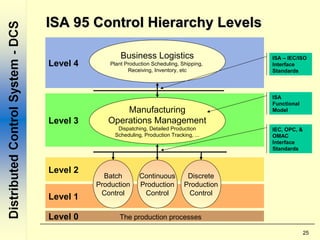
ISA 95 Control Hierarchy LevelsISA 95 Control Hierarchy Levels
Level 4
Level 0
Level 1
Level 2
Level 3
Business Logistics
Plant Production Scheduling, Shipping,
Receiving, Inventory, etc
Manufacturing
Operations Management
Dispatching, Detailed Production
Scheduling, Production Tracking, ...
Batch
Production
Control
Discrete
Production
Control
Continuous
Production
Control
ISA – IEC/ISO
Interface
Standards
IEC, OPC, &
OMAC
Interface
Standards
ISA
Functional
Model
The production processes
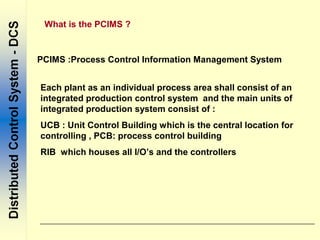
What is the PCIMS ?
PCIMS :Process Control Information Management System
Each plant as an individual process area shall consist of an
integrated production control system and the main units of
integrated production system consist of :
UCB : Unit Control Building which is the central location for
controlling , PCB: process control building
RIB which houses all I/O’s and the controllers
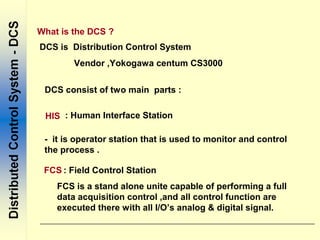
DCS is Distribution Control System
Vendor ,Yokogawa centum CS3000
DCS consist of two main parts :
HIS : Human Interface Station
FCS : Field Control Station
- it is operator station that is used to monitor and control
the process .
FCS is a stand alone unite capable of performing a full
data acquisition control ,and all control function are
executed there with all I/O’s analog & digital signal.
What is the DCS ?
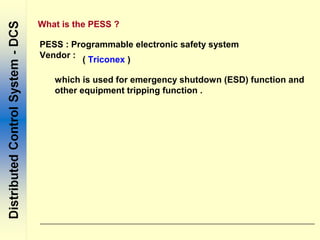
What is the PESS ?
PESS : Programmable electronic safety system
Vendor :
( Triconex )
which is used for emergency shutdown (ESD) function and
other equipment tripping function .
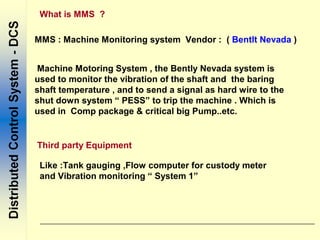
What is MMS ?
MMS : Machine Monitoring system Vendor : ( Bentlt Nevada )
Machine Motoring System , the Bently Nevada system is
used to monitor the vibration of the shaft and the baring
shaft temperature , and to send a signal as hard wire to the
shut down system “ PESS” to trip the machine . Which is
used in Comp package & critical big Pump..etc.
Like :Tank gauging ,Flow computer for custody meter
and Vibration monitoring “ System 1”
Third party Equipment
What is RIB ?
RIB is Remote Instrument Building
The Remote Instrument Building RIB, which will house, the
DCS controller as FCS ,HIS ,PESS / PLC controller and their
cabinets and all other 3rd
party equipment like Tank
gauging ,Vibration monitoring , Flow computer , Power
supply distribution panel ,Fire and Gas panel and
Uninterruptible power supplies (UPS ) .
- DCS filed control station “ FCS “ Cabinets
- Programmable electronic shut down system “PESS Cabinets
- Machine monitoring system “ MMS Cabinets
- Programmable logic control “PLC” Cabinets
- Other equipment such as Tank Gauging , Custody metering
Cabinets
- Air unit
- Fire and gas panel
- All field instruments , wiring signals
- Marshaling panels
-Terminal blocks
-Servers cabinets
What is inside RIB’s
JB
F TA
HIS
T
B
FCU
FIO
HIS HIS HIS
Control
Room
V-net cable 10
base 5
Optical
converter
Fiber optic
cable
V-net cable 10
base 2
coaxial cable
RIB
FCS
B/N TMR PLC
Copper multi core
shielded cable
FTA or I/O's cable
twisted multi core ,as TEL cable
One pair copper
cable
Serial
communication link
Hard
wire
YNT
FOPP
YNT
FOPP
V-net converter 10 base 5 to 10
base 10
Black
box
To do down loading ,
Tag equalizing
between the
HIS,s,Trending , and
viewing DCS logic
DCS OPC server
V-net 10 Base 2
cable
Control room YNT
V-Net 10
Base 5
cable
Fiber optic cable
RIB YNT
V-Net cable 10
base 5
FIO
FCS
HIS
RIB Control Room
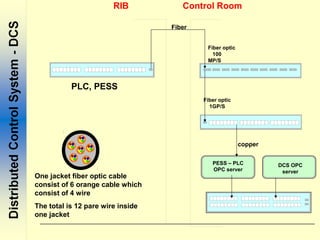
Fiber optic
100
MP/S
Fiber optic
1GP/S
2
copper
Fiber
PLC, PESS
PESS – PLC
OPC server
DCS OPC
server
One jacket fiber optic cable
consist of 6 orange cable which
consist of 4 wire
The total is 12 pare wire inside
one jacket
35
ConclusionsConclusions
• Linked execution systems deliver results!
– Reduced direct costs; increased productivity
– Improved traceability; reduced “witch hunt” expense
– Near-theoretical cycle times: customer responsiveness,
reduced WIP inventory
– Greater agility: smaller lot sizes, more premium products in
the mix, happier customers, happier shareholders!
• S95 defines the currency for manufacturing object
and information exchange
– Faster project implementation cycles
– Flexibility to integrate and realign as corporate structures
change
36
StatusStatus
• ISA95.00.01 & ISA.95.00.02 available
• IEC/ISO 62264-1 available from IEC & ISO
• ISA 95.00.03 in draft
– Still under development in the committee
• World Batch Forum
– Developed XML Schemas for the exchanged
information
• Vendors
– Many currently using ISA-95 models in
development and current products
• Users
– Specifying ISA-95 in their RFPs

Manufacturing operation management

  • 1.
  • 2.
    2 ObjectivesObjectives • Review theISA 95 standards and how they are being used in companies like Eli Lilly & Company for shop floor to top floor integration – The standards provide a formal model for exchanged data between business systems and manufacturing systems – The models also include a definition of Manufacturing Operations Management, the activities on the shop floor that take production schedules and perform the actual work required to manufacture products • The Manufacturing Operations Management models are currently being used in the development of multiple new manufacturing facilities
  • 3.
    3 Manufacturing in theSupply ChainManufacturing in the Supply Chain • “Make” is a significant part of the supply chain and collaborative manufacturing, but is often the last element to be actually integrated – Collaboration in “Make” is usually not a “Low Hanging Fruit” – But can offer very high ROI for high volume, or high cost products • However, Business IT and Manufacturing IT organizations are often at odds as they try to collaborate – They have different goals and different success criteria – They use the same terms for different elements and different terms for the same elements
  • 4.
    4 Collaborative Manufacturing HelpCollaborativeManufacturing Help • Fortunately there are multiple standards in place to help integrating business systems with manufacturing systems. – The ISA 95 Enterprise/Control System Integration standards, also an IEC/ISO standard – XML Schemas standards for collaborative manufacturing from the World Batch Forum • Will show how they are being applied to the development of manufacturing systems roadmap
  • 5.
    5 Different Points ofViewDifferent Points of View • Business Systems – Time Horizons • Long-term view – Model detail • Linear route structures – Control emphasis • Product cost and overall profitability – Modeling criteria: • Accounting reference points • Has inventory value changed significantly? If not, don’t model separately – View from the boardroom • Manufacturing Systems – Time Horizons • Real-time view – Model detail • Complex routes with rework paths – Control emphasis • Physical movement & accountability – Modeling criteria: • material movement reference points • Does product stop moving? If not, don’t model separately – View from the workcenter
  • 6.
    6 Philosophical OrientationPhilosophical Orientation •Enterprise Management systems: –How much is my stuff worth? • Manufacturing Operations Systems: –Where is my stuff?
  • 7.
    7 ISA 95 ProvidesDirectionISA 95 Provides Direction • The ANSI/ISA 95.00.01 “Enterprise - Control System Integration - Part 1: Models and Terminology” – Also Draft International Standard ISO/IEC 62264-1 • ANSI/ISA 95.00.02 “Enterprise - Control System Integration - Part 2: Object Attributes” • Draft ISA 95.00.03 “Enterprise - Control System Integration - Part 3: Activity Models of Manufacturing Operations Management”
  • 8.
    8 Business Planning &Logistics Plant Production Scheduling, Operational Management, etc Manufacturing Operations & Control Dispatching Production, Detailed Production Scheduling, Reliability Assurance, ... Batch Control Discrete Control Continuous Control Level 4 Level 3 Levels 2,1,0 ISA95.01 LevelsISA95.01 Levels Interface addressed in the ISA 95.01 and ISA 95.02 standard Area addressed in the ISA 95.03 standard
  • 9.
    Business Planning &Logistics Plant Production Scheduling, Operational Management, etc Manufacturing Operations & Control Dispatching Production, Detailed Production Scheduling, Reliability Assurance, ... Business Logistics Management (ERP) 9 Interface addressed in the ISA 95.01 and ISA 95.02 standard Area addressed in the ISA 95.03 standard Batch Control Discrete Control Continuous Control Level 4 Level 3 Levels 2,1,0 ISA95.01 LevelsISA95.01 Levels Manufacturing Operations Management (MES)
  • 10.
    10 ISA 95 Part1 and Part 2ISA 95 Part 1 and Part 2 Exchanged InformationExchanged Information Information that crosses the boundary between business systems and manufacturing systems
  • 11.
    11 Exchanged Information CategoriesExchangedInformation Categories Enterprise Information Plant Production Scheduling, Operational Management, etc Manufacturing Control Information Area Supervision, Production Planning, Reliability, Assurance, etc Product Definition Information (How to make a product) Production Capability Information (What is available for use) Production Schedule (What to make and use) Production Performance (What was made and used)
  • 12.
    12 4x4 Object Models4x4Object Models • Four categories of resources – Personnel – Equipment – Material (and Energy) – Process Segments • Four Process, Product, & Production Models – Capability & Capacity Definition – Product Definition – Production Schedule – Production Performance
  • 13.
    13 Four Resource ObjectModelsFour Resource Object Models People Materials Equipment Personnel resources managed for production Equipment resources managed for production Material resources managed for production Process Segments Business view of production processes
  • 14.
    14 Capability, Product, Schedule,andCapability, Product, Schedule, and Performance InformationPerformance Information Product Definitions Production Schedule Production Performance What is available for use for production What is needed to make a product What to make and resources to use What was made and resources actually used Product Time Capability/Capacity
  • 15.
    15 Production ScheduleProduction Schedule People Materials Equipment Segments Production Schedule Whatto makeWhat to make - Priority and/or datesPriority and/or dates - What materials to useWhat materials to use - What equipment to useWhat equipment to use - What personnel to useWhat personnel to use - Production parametersProduction parameters (e.g. Color, Options,…)(e.g. Color, Options,…) Per location (Site, Area, …) Per week, day, shift, order, … • Production ScheduleProduction Schedule • Production RequestProduction Request • Segment RequestSegment Request • Expected Produced MaterialExpected Produced Material • Expected Consumed MaterialExpected Consumed Material • Expected PersonnelExpected Personnel • Expected EquipmentExpected Equipment • Production ParametersProduction Parameters • ……
  • 16.
    16 Production PerformanceProduction Performance People Materials Equipment Segments Production Performance Whatwas madeWhat was made - What material wasWhat material was actually producedactually produced - What materials wereWhat materials were actually consumedactually consumed - Equipment usedEquipment used - Personnel usedPersonnel used - Production dataProduction data (e.g. Purity, density,…)(e.g. Purity, density,…) Per location (Site, Area, …)Per location (Site, Area, …) Per shift, hour,Per shift, hour, end of batch, …end of batch, … • Production PerformanceProduction Performance • Production ResponseProduction Response • Segment ResponseSegment Response • Produced Material ActualProduced Material Actual • Consumed Material ActualConsumed Material Actual • Personnel ActualPersonnel Actual • Equipment ActualEquipment Actual • Production DataProduction Data • ……
  • 17.
    17 XML Standard forB2M ExchangesXML Standard for B2M Exchanges • The World Batch Forum has developed XML Schemas that map to the ANSI/ISA-95 models • Defines how to represent the ISA-95 information in XML – Business To Manufacturing Markup Language – B2MML • One schema for each object model • Formal way to exchange information – www.wbf.org
  • 18.
    18 <Material <MaterialLot> <ID> W89W89 </ID> <Description>A lot of materialA lot of material </Description> <MaterialDefinitionID> WXE908WXE908 </MaterialDefinitionID> <Location> Tank 1Tank 1 </Location> <Quantity UnitOfMeasure = "KLKL" > 45004500 </Quantity> <MaterialLotProperty> <ID> dateTimeProductiondateTimeProduction </ID> <Value> 2001-01-06T00:14:23+11:302001-01-06T00:14:23+11:30 </Value> </MaterialLotProperty> <MaterialLotProperty> <ID> Quality StatusQuality Status </ID> <Value> GoodGood </Value> </MaterialLotProperty> </MaterialLot> </Material> An XML Example – Material LotAn XML Example – Material Lot
  • 19.
    19 ISA95 Part 3ISA95Part 3 Activity Models ofActivity Models of Manufacturing OperationsManufacturing Operations In Development Expected Release 2004
  • 20.
    20 INVENTORY OPERATIONS INVENTORY OPERATIONS MAINTENANCE OPERATIONS PRODUCTION OPERATIONS QUALITY ASSURANCE OPERATIONS Procurement (5.0) Production Scheduling (2.0) Material and Energy Control (4.0) Product InventoryControl (7.0) Product Cost Accounting (8.0) Quality Assurance (6.0) Research Development and Engineering Product Shipping Admin (9.0) Order Processing (1.0) Marketing & Sales Production Control (3.0) Maintenance Management (10.0)
  • 21.
    21 ISA 95.03 ManufacturingOperations FunctionsISA 95.03 Manufacturing Operations Functions Production resource management Production capability Analysis Production data collection Production execution Production dispatching Production tracking Production performance Detailed production scheduling Production schedule Level 2 Process Control Product definition management Product definition Equipment and Process Specific Production Rules Equipment and Process Specific Data Operational Responses Operational Commands
  • 22.
    22 Major Activities Within Manufacturing Operations Quality Operations Maintenance Operations Production Operations Level 4 Level 3 Level2 Management of Configuration Management of Information Management of Security Management of Documentation Management of Compliance Inventory Operations Other Enterprise Activities inOther Enterprise Activities in Manufacturing OperationsManufacturing Operations • Some actives are not specific to manufacturing • ISA-95.03 lists references to standards in these areas Activity detailed Activity not detailed Activity outside scope
  • 23.
    23 ImplementationsImplementations • Nestle – Projectto use the XML schemas for schedule exchange • Arla Foods – Project to use XML for standard interfaces to multiple ERP systems and MES systems • Empersas Polar – Project to use XML schemas for schedule exchange • Eli Lilly – Projects to use ISA 95 models for manufacturing operations management architecture
  • 24.
    24 Building Collaborative ManufacturingBuildingCollaborative Manufacturing SystemsSystems • Process Used to Develop Solution Architectures – Conceptual Topology – Functional Areas – Standards and Guidelines – Standard Applications – Logical Architecture Design – Physical Architecture Design
  • 25.
    25 ISA 95 ControlHierarchy LevelsISA 95 Control Hierarchy Levels Level 4 Level 0 Level 1 Level 2 Level 3 Business Logistics Plant Production Scheduling, Shipping, Receiving, Inventory, etc Manufacturing Operations Management Dispatching, Detailed Production Scheduling, Production Tracking, ... Batch Production Control Discrete Production Control Continuous Production Control ISA – IEC/ISO Interface Standards IEC, OPC, & OMAC Interface Standards ISA Functional Model The production processes
  • 26.
    What is thePCIMS ? PCIMS :Process Control Information Management System Each plant as an individual process area shall consist of an integrated production control system and the main units of integrated production system consist of : UCB : Unit Control Building which is the central location for controlling , PCB: process control building RIB which houses all I/O’s and the controllers
  • 27.
    DCS is DistributionControl System Vendor ,Yokogawa centum CS3000 DCS consist of two main parts : HIS : Human Interface Station FCS : Field Control Station - it is operator station that is used to monitor and control the process . FCS is a stand alone unite capable of performing a full data acquisition control ,and all control function are executed there with all I/O’s analog & digital signal. What is the DCS ?
  • 28.
    What is thePESS ? PESS : Programmable electronic safety system Vendor : ( Triconex ) which is used for emergency shutdown (ESD) function and other equipment tripping function .
  • 29.
    What is MMS? MMS : Machine Monitoring system Vendor : ( Bentlt Nevada ) Machine Motoring System , the Bently Nevada system is used to monitor the vibration of the shaft and the baring shaft temperature , and to send a signal as hard wire to the shut down system “ PESS” to trip the machine . Which is used in Comp package & critical big Pump..etc. Like :Tank gauging ,Flow computer for custody meter and Vibration monitoring “ System 1” Third party Equipment
  • 30.
    What is RIB? RIB is Remote Instrument Building The Remote Instrument Building RIB, which will house, the DCS controller as FCS ,HIS ,PESS / PLC controller and their cabinets and all other 3rd party equipment like Tank gauging ,Vibration monitoring , Flow computer , Power supply distribution panel ,Fire and Gas panel and Uninterruptible power supplies (UPS ) .
  • 31.
    - DCS filedcontrol station “ FCS “ Cabinets - Programmable electronic shut down system “PESS Cabinets - Machine monitoring system “ MMS Cabinets - Programmable logic control “PLC” Cabinets - Other equipment such as Tank Gauging , Custody metering Cabinets - Air unit - Fire and gas panel - All field instruments , wiring signals - Marshaling panels -Terminal blocks -Servers cabinets What is inside RIB’s
  • 32.
    JB F TA HIS T B FCU FIO HIS HISHIS Control Room V-net cable 10 base 5 Optical converter Fiber optic cable V-net cable 10 base 2 coaxial cable RIB FCS B/N TMR PLC Copper multi core shielded cable FTA or I/O's cable twisted multi core ,as TEL cable One pair copper cable Serial communication link Hard wire YNT FOPP YNT FOPP V-net converter 10 base 5 to 10 base 10 Black box
  • 33.
    To do downloading , Tag equalizing between the HIS,s,Trending , and viewing DCS logic DCS OPC server V-net 10 Base 2 cable Control room YNT V-Net 10 Base 5 cable Fiber optic cable RIB YNT V-Net cable 10 base 5 FIO FCS HIS
  • 34.
    RIB Control Room Fiberoptic 100 MP/S Fiber optic 1GP/S 2 copper Fiber PLC, PESS PESS – PLC OPC server DCS OPC server One jacket fiber optic cable consist of 6 orange cable which consist of 4 wire The total is 12 pare wire inside one jacket
  • 35.
    35 ConclusionsConclusions • Linked executionsystems deliver results! – Reduced direct costs; increased productivity – Improved traceability; reduced “witch hunt” expense – Near-theoretical cycle times: customer responsiveness, reduced WIP inventory – Greater agility: smaller lot sizes, more premium products in the mix, happier customers, happier shareholders! • S95 defines the currency for manufacturing object and information exchange – Faster project implementation cycles – Flexibility to integrate and realign as corporate structures change
  • 36.
    36 StatusStatus • ISA95.00.01 &ISA.95.00.02 available • IEC/ISO 62264-1 available from IEC & ISO • ISA 95.00.03 in draft – Still under development in the committee • World Batch Forum – Developed XML Schemas for the exchanged information • Vendors – Many currently using ISA-95 models in development and current products • Users – Specifying ISA-95 in their RFPs

Editor's Notes

  • #8 Explain a little bit about ISA and what it does in the standards area. ISA Is the Instrumentation Systems and Automation society Explain the S95.01 is the draft standard and that SP95 was the committee. Mention that this is a USA standard, under the auspices of ANSI explain the status of the international version and the draft Part 3 work.
  • #9 The figure above is a simplified version of the Purdue model, showing the S95 scope. Level 4 is high level planning and scheduling and logistics. Level 3 is manufacturing control, including operations scheduling - or planning. Level 2 needs a lot of definition. Describe S88.01 and the batch model and how it stops at the process cell. Describe some of the S88.01 models. There are less well-defined models for continuous and discrete processes. Continuous is handled somewhat by S88.01, but without the concept of recipes for products, just recipes for product startup and shutdown. PDXI has a model at least of all of the static information (design of P&amp;IDs) and control loops, but not very dynamic Discrete models SME (Society of Mechanical Engineers has some material, but nothing in the ISA /IEC/ISO arena.
  • #10 The figure above is a simplified version of the Purdue model, showing the S95 scope. Level 4 is high level planning and scheduling and logistics. Level 3 is manufacturing control, including operations scheduling - or planning. Level 2 needs a lot of definition. Describe S88.01 and the batch model and how it stops at the process cell. Describe some of the S88.01 models. There are less well-defined models for continuous and discrete processes. Continuous is handled somewhat by S88.01, but without the concept of recipes for products, just recipes for product startup and shutdown. PDXI has a model at least of all of the static information (design of P&amp;IDs) and control loops, but not very dynamic Discrete models SME (Society of Mechanical Engineers has some material, but nothing in the ISA /IEC/ISO arena.
  • #11 This is the intro slide to the discussion on Part 1 and Part 2 which defines the exchanged information.
  • #15 Once the “WORDS” are agreed to then we can talk about the real exchange of information, things that may change on a regular basis. These correspond to the four bubbles in the VENN diagram previous used: What is available, what is needed for a product, what to do, and what was done.
  • #16 This is what people normally think about when they think about B2M integration. These are the production schedules. There is a formal UML model that defines a production schedule, in terms of the personnel, equipment, material, process segment, and product definitions. It may define priorities, due dates, latest start dates, etc.. It may define what materials to use, what equipment to use, and what personnel to use. (Note, add in the story here about not specifying too much detail, where the ERP system was specifying the bags of sugar, irrespective of their location in the warehouse) Mention options (e.g. such as color, or customer options, such as purity range or filler %)
  • #17 This the last element of shared information, and it is what manufacturing tells the business about what was done. This is what was produced, what was consumed, what consumables where used, what personnel was used, and what equipment was used. PROVIDED THE BUSINESS SYSTEMS ARE READY TO ACCEPT THAT INFORMATION. Mention that only a fraction of a percent of the generated information is actually exchanged. Use the chemical plant as an example, 100 GB of data generated per week, 1 GB of data stored, &amp;gt; 1MB of data exchanged (.000001% of data collected is exchanged).