VIVA-Tech International Journal for Research and Innovation
ISSN(Online): 2581-7280
VIVA Institute of Technology
Volume 1, Issue 6 (2023)
10th
National Conference on Role of Engineers in Nation Building – 2023 (NCRENB-2023)
F-1
www.viva-technology.org/New/IJRI
ETHERNET-Passive Optical Network
Prof. Neha Lodhe1
, Mr. Gitesh Lad2
, Mr. Abhishek Yadav3
1
(MCA, Viva Institute of Technology/Mumbai University, India)
2
(MCA, Viva Institute of Technology/Mumbai University, India)
3
(MCA, Viva Institute of Technology/Mumbai University, India)
______________________________________________________________________________________________
Abstract: Ethernet Passive Optical Network (EPON) is a type of passive optical network technology that allows for
the delivery of high-speed broadband access over a fiber-optic network. EPON technology is widely used in
residential and business environments, as well as in metropolitan area networks, to provide fast and reliable
internet access. In an EPON system, a single optical fiber is shared among multiple users, using passive optical
splitters to distribute the signal. EPON technology uses Ethernet as its medium access control protocol, making it
compatible with existing Ethernet-based networks. This compatibility with standard Ethernet protocols and interfaces
has led to the widespread adoption of EPON technology, particularly in Asia. To prevent service interruptions and
ensure reliable network performance, EPON systems require regular maintenance and upgrades. Network operators
must also ensure the security of the network, as well as the privacy of user data. Ethernet Passive Optical Network
technology is a powerful tool for delivering high-speed internet access to large numbers of users. Its compatibility
with standard Ethernet protocols and interfaces, along with its many benefits, has led to its widespread adoption in
Asia and other regions. However, regular maintenance and upgrades are required to ensure network performance
and security. EPON technology offers many benefits, including high bandwidth, low latency, and low power
consumption. It is an efficient and cost-effective solution for delivering high-speed internet access to large numbers
of users.
Keywords - Next generation networking, Optical fiber devices, Ethernet networks, Passive optical networks,Optical
fiber networks.
I. INTRODUCTION
While in recent years the telecommunications backbone has experienced substantial growth, little has
changed in the access network. The tremendous growth of Internet traffic has accentuated the aggravating lag of
access network capacity. Ethernet Passive Optical Network (EPON) is a category of passive optical network
technology that lets us aim at the delivery of high-speed broadband access over a fiber-optic network. With the
increasing demand for high-speed internet access, EPON technology has gained popularity as an efficient and cost-
effective solution for delivering broadband access to large numbers of users. EPON technology uses Ethernet as its
medium access control protocol, allowing it to support standard Ethernet protocols and interfaces. This
compatibility with existing Ethernet-based networks has led to its widespread adoption in Asia, particularly in
Japan, Korea, and China, where it has been used to provide high-speed broadband access to millions of users.
1.1 EVOLUTION OF THE FIRST MILE
In the early days of fiber-optic technology, the first mile was typically made up of point-to-point
connections, with a dedicated fiber-optic cable running directly from the customer's premises to the service
VIVA-Tech International Journal for Research and Innovation
ISSN(Online): 2581-7280
VIVA Institute of Technology
Volume 1, Issue 6 (2023)
10th
National Conference on Role of Engineers in Nation Building – 2023 (NCRENB-2023)
F-2
www.viva-technology.org/New/IJRI
provider's network. This approach was expensive and inefficient, as it required each customer to have their own
dedicated fiber-optic cable. In the 1990s, EPON technology was introduced, which allowed for the use of passive
optical splitters to distribute the signal from a single fiber-optic cable to multiple customers. This approach reduced
the cost and complexity of deploying fiber-optic networks, while also allowing for efficient use of bandwidth and
the ability to provide high-speed internet access to many customers at once. the early 2000s, the introduction of
Gigabit Ethernet technology further improved the performance of EPON networks, allowing for even faster data
transfer rates and greater bandwidth. This technology allowed EPON networks to provide high-speed internet
access that was comparable to or even faster than traditional copper-based networks. the first mile refers to the
segment of the network that connects the customer's premises to the local exchange or service provider's network.
EPON technology uses fiber-optic cables to transmit data over this segment of the network, offering high-speed
internet access to customers
In recent years, 10G-EPON technology has been introduced, which allows for even faster data transfer
rates and greater bandwidth than Gigabit Ethernet. This technology has allowed EPON networks to keep pace with
the increasing demand for high-speed internet access and support new applications such as 4K video streaming,
virtual reality, and the Internet of Things (IoT).NG-PON2 technology is the next generation of passive optical
networking, which offers even faster data transfer rates and greater bandwidth than 10G-EPON technology. NG-
PON2 technology allows for the transmission of multiple wavelengths of light over a single fiber-optic cable,
enabling the delivery of multiple services to a single customer or business.
II. AN EPON NETWORK
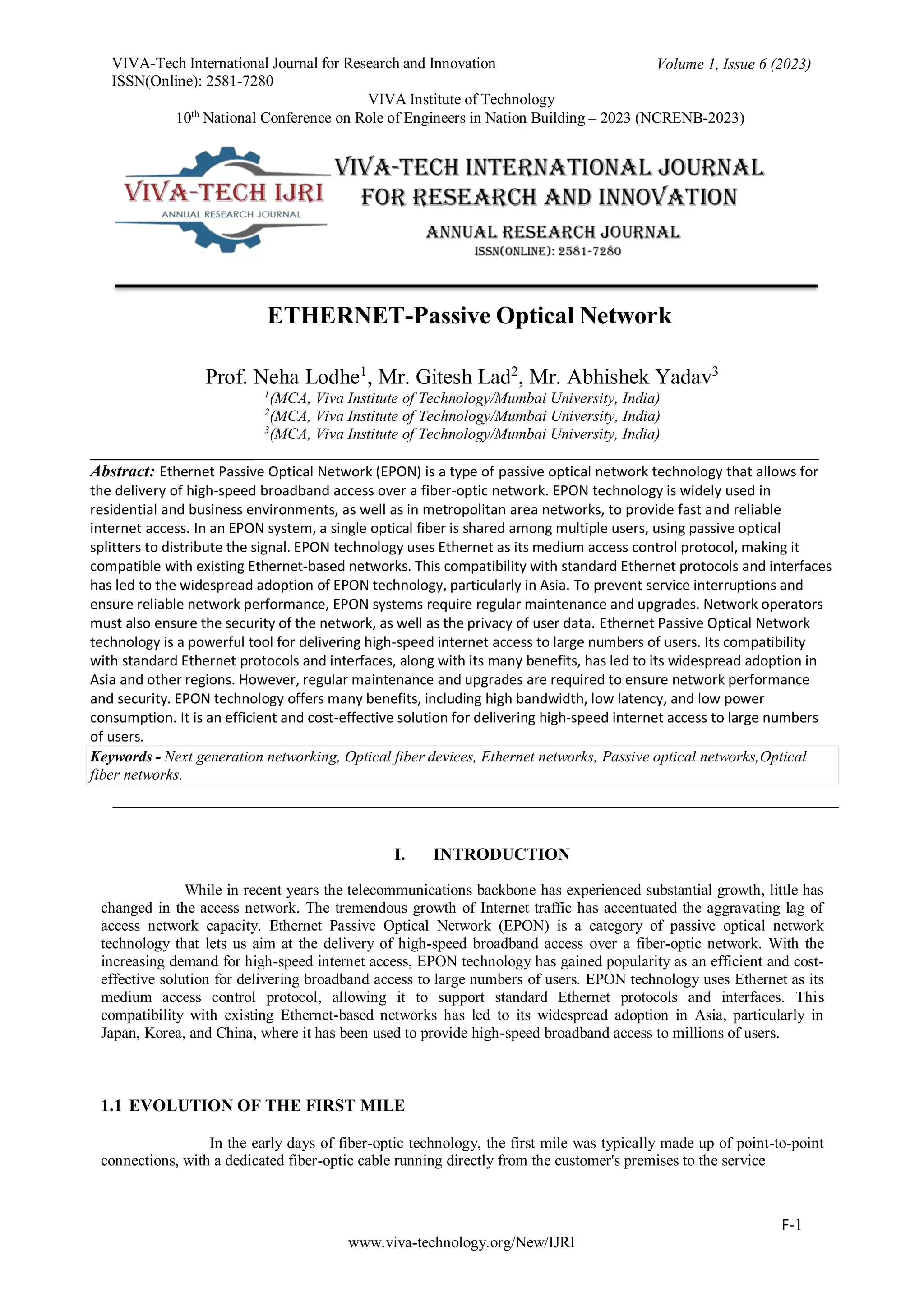
An Ethernet Passive Optical Network (EPON) is a type of passive optical network (PON) that uses
Ethernet protocols to provide high-speed internet access over a fiber-optic network. An EPON network consists of
several key components, including an optical line terminal (OLT), optical network units (ONUs), and passive
optical splitters.
The optical line terminal (OLT) is the central point of the EPON network, which is typically located in
the service provider's central office. The OLT is responsible for managing the communication between the service
provider's network and the ONUs located at the customer's premises. The OLT converts data from the service
provider's network into optical signals that are transmitted over the fiber-optic network to the ONUs.
Fig 1.AN EPON NETWORK
The optical network units (ONUs) are located at the customer's premises and are connected to the OLT via a
fiber-optic cable. The ONUs receives optical signals from the OLT and convert them back into electrical signals that
can be used by the customer's devices. The ONUs also provides additional functionality, such as network
management and security features. Passive optical splitters are used in EPON networks to distribute the optical signal
from the OLT to multiple ONUs. Passive splitters do not require any power, making them a cost-effective and
efficient solution for distributing the signal over long distances. The splitters divide the optical signal into multiple
paths, allowing it to be distributed to multiple ONUs while maintaining the quality of the signal. EPON networks use
Ethernet protocols to provide high-speed internet access to customers. The data is transmitted over the fiber-optic
network using Ethernet frames, which are converted into optical signals by the OLT and transmitted to the ONUs.
VIVA-Tech International Journal for Research and Innovation
ISSN(Online): 2581-7280
VIVA Institute of Technology
Volume 1, Issue 6 (2023)
10th
National Conference on Role of Engineers in Nation Building – 2023 (NCRENB-2023)
F-3
www.viva-technology.org/New/IJRI
The ONUs then convert the optical signals back into Ethernet frames, which can be used by the customer's devices to
access the internet. EPON networks are capable of providing high-speed internet access to a large number of
customers over a single fiber-optic network, making them a cost-effective and efficient solution for service providers.
The use of Ethernet protocols and passive optical splitters also allows for efficient use of bandwidth, making EPON
networks an attractive option for delivering high-speed internet access in areas where traditional broadband access
may be limited or expensive.
2.1 Multiple Access
Multiple access is an important aspect of Ethernet Passive Optical Network (EPON) technology, as it
allows multiple customers to share the same fiber-optic network to access high-speed internet services. There are
two main types of multiple access methods used in EPON networks: time division multiple access (TDMA) and
wavelength division multiple access (WDMA). TDMA is the most common multiple access method used in EPON
networks. In TDMA, the bandwidth of the fiber-optic network is divided into multiple time slots, and each time slot
is assigned to a different ONU. The OLT sends data to each ONU during its assigned time slot, and each ONU
sends data back to the OLT during its assigned time slot. This ensures that each ONU has dedicated time slots to
transmit and receive data, which helps to prevent collisions and ensure reliable communication. WDMA is another
multiple access method used in EPON networks, which allows multiple ONUs to share the same fiber-optic
network by using different wavelengths of light. In WDMA, each ONU is assigned a different wavelength of light,
which it uses to transmit and receive data. This allows multiple ONUs to share the same fiber-optic network without
interfering with each other.
Fig 2.1 Multiple Access
III. METHODOLOGY
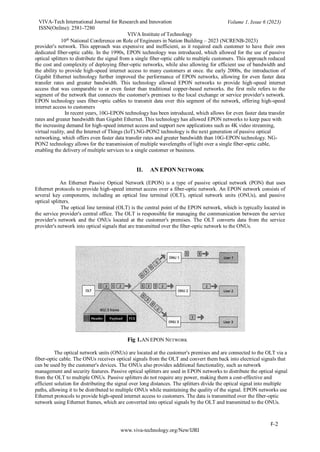
3.1 Traffic Growth
The traffic growth methodology in Ethernet Passive Optical Network (EPON) networks involves several
steps to ensure that the network is capable of handling increasing amounts of data traffic. Capacity planning is the
first step in the traffic growth methodology for EPON networks. It involves analyzing the current network usage
and projecting future growth in demand for network bandwidth. This helps service providers to estimate the
number of ONUs that the network can support and plan for future network expansion. than they did before they
upgraded to a broadband connection [3]. Voice traffic is also increasing, although it is doing so at a considerably
slower rate of 8% each year. Most researchers claim that internet traffic has already surpassed voice traffic.
Speaking traffic, as more subscribers work from home, they need the same level of network performance as
employees of companies with corporate LANS. As the bandwidth used per user rises, more services and new apps
will be made available. (Fig. 3).
VIVA-Tech International Journal for Research and Innovation
ISSN(Online): 2581-7280
VIVA Institute of Technology
Volume 1, Issue 6 (2023)
10th
National Conference on Role of Engineers in Nation Building – 2023 (NCRENB-2023)
F-4
www.viva-technology.org/New/IJRI
Network monitoring is a critical step in the traffic growth methodology for EPON networks. It involves monitoring the
network performance and usage to identify any potential bottlenecks or issues that may affect network upgrade process.
Copper DSL networks can't transmit data at the necessary rates across the necessary distances. The majority of network
operators have realized the need for a new data-centric solution. A system like that would be designed with Internet
Protocol (IP) data transmission in mind. The remaining services, such as voice and video, will converge into a digital
format, and a true full-service network will emerge.
Fig 3.1 Traffic Growth
3.2 THE NEXT-GENERATION ACCESS NETWORK
Beyond 20 km in the subscriber access network, optical fibre can supply bandwidth-intensive integrated
phone, data, and video services. Utilizing a point-to-point (P2P) architecture with dedicated fibre runs from the
local exchange to each end-user subscriber is a logical technique to deploy optical fibre in the local access network
(Fig. 2a). Despite being a straightforward architecture, it is frequently unaffordable due to the need for extensive
outside plant fibre rollout and connection termination space in the local exchange.
Capacity planning is the first step in the NGA network methodology for EPON networks. It involves
analyzing the current network usage and projecting future growth in demand for network bandwidth. This helps
service providers to estimate the number of ONUs that the network can support and plan for future network
expansion to meet the growing demand for higher speeds and greater bandwidth.
To achieve higher speeds and greater bandwidth, new technologies such as wavelength division
multiplexing (WDM), digital signal processing (DSP), and coherent detection can be deployed in the network.
These technologies allow for more efficient use of the fiber-optic network and support higher speeds and greater
bandwidth.
Network monitoring is a critical step in the NGA network methodology for EPON networks. It involves
monitoring the network performance and usage to identify any potential bottlenecks or issues that may affect
network performance. Network monitoring also helps service providers to identify any potential capacity issues
and plan for future network expansion to ensure that the network is capable of handling increasing amounts of data
traffic. Finally, network upgrades are required to support the higher speeds and greater bandwidth of the NGA
network. Upgrades may include increasing the capacity of the OLTs, installing additional ONUs, deploying new
technologies such as WDM and DSP, and upgrading the network architecture or multiple access methods to ensure
that the network is capable of handling the increased traffic.
VIVA-Tech International Journal for Research and Innovation
ISSN(Online): 2581-7280
VIVA Institute of Technology
Volume 1, Issue 6 (2023)
10th
National Conference on Role of Engineers in Nation Building – 2023 (NCRENB-2023)
F-5
www.viva-technology.org/New/IJRI
Therefore, it makes sense to swap out the pricey passive optical component for the protected active curb-
side switch. Many people consider the passive optical network (PON) technology to be an appealing solution to the
first mile issue [4, 5] since PONS reduce the number of optical transceivers, central office terminations, and fibre
deployment. A point-to-multiple-point optical network (PON) lacks any active components in the path of the
signals from source to destination. Passive optical equipment including optical fibre, splices, and splitters are the
only inside elements used in a PON. N + 1 transceivers and L km of fibre are all that are needed for access
networks based on single-fiber PON (Fig. 2c).
Fig 4. NEXT-GENERATION ACCESS NETWORK
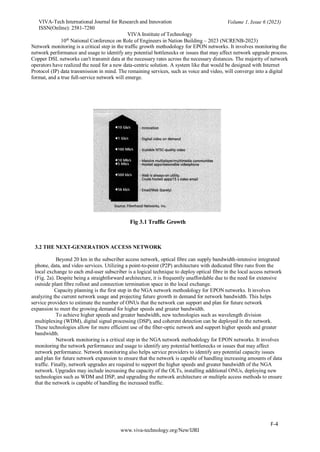
3.3 PON TOPOLOGIES
The most common topology used in EPON networks is the point-to-multipoint (P2MP) topology, where the
Optical Line Terminal (OLT) is connected to multiple Optical Network Units (ONUs) using a single fiber-optic cable.
The OLT acts as a central point that provides the downstream data to all the ONUs in the network, while the ONUs
transmit the upstream data to the OLT. This topology is cost-effective, simple to deploy, and can support a large
number of subscribers.
Another topology used in EPON networks is the point-to-point (P2P) topology, where each ONU is
connected to the OLT using a dedicated fiber-optic cable. This topology provides higher bandwidth and allows for
more flexibility in the network architecture, but it is more expensive to deploy and requires more fiber-optic cables.
The tree topology is a combination of the P2MP and P2P topologies. In this topology, the OLT is connected
to a passive optical splitter, which then distributes the signal to multiple ONUs using dedicated fiber-optic cables.
This topology is suitable for networks with a small number of subscribers, but it can be challenging to manage and
maintain as the network grows.
In the ring topology, the ONUs is connected to the OLT using a fiber-optic ring. The signal travels in
both directions, and each ONU can act as a relay to amplify the signal and pass it on to the next ONU in the ring. This
topology provides redundancy, and if one ONU fails, the signal can still travel in the opposite direction, but it is not
commonly used in EPON networks due to its complexity and high cost.
VIVA-Tech International Journal for Research and Innovation
ISSN(Online): 2581-7280
VIVA Institute of Technology
Volume 1, Issue 6 (2023)
10th
National Conference on Role of Engineers in Nation Building – 2023 (NCRENB-2023)
F-6
www.viva-technology.org/New/IJRI
The hybrid topology is a combination of two or more topologies. For example, a P2MP topology can be combined
with a P2P topology to create a hybrid topology that provides higher bandwidth and more flexibility in the network
architecture.
Fig 5. PON TOPOLOGIES
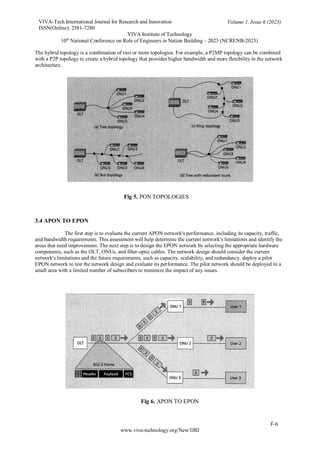
3.4 APON TO EPON
The first step is to evaluate the current APON network's performance, including its capacity, traffic,
and bandwidth requirements. This assessment will help determine the current network's limitations and identify the
areas that need improvement. The next step is to design the EPON network by selecting the appropriate hardware
components, such as the OLT, ONUs, and fiber-optic cables. The network design should consider the current
network's limitations and the future requirements, such as capacity, scalability, and redundancy. deploy a pilot
EPON network to test the network design and evaluate its performance. The pilot network should be deployed in a
small area with a limited number of subscribers to minimize the impact of any issues.
Fig 6. APON TO EPON
VIVA-Tech International Journal for Research and Innovation
ISSN(Online): 2581-7280
VIVA Institute of Technology
Volume 1, Issue 6 (2023)
10th
National Conference on Role of Engineers in Nation Building – 2023 (NCRENB-2023)
F-7
www.viva-technology.org/New/IJRI
One of ATM's shortcomings is the fact that a dropped or corrupted cell will invalidate the entire IP datagram.
However, the remaining cells carrying the portions of the same IP data- gram will propagate further, thus
consuming network resources unnecessarily. Also, ATM imposes a cell tax on variable-length IP packets. For
example, for the trimodal packet size distribution reported in [7], the cell tax is approximately 13 percent; that is, to
send the same amount of user's data an ATM network must transmit 13 percent more bytes.
The migrate the APON network to the EPON network gradually. This process involves upgrading the hardware
components, such as replacing the APON OLT with the EPON OLT, and migrating the ONUs from APON to
EPON. The migration should be done in phases, with each phase covering a specific area or a group of
subscribers.is to integrate the EPON network with other networks, such as the Internet or other local area networks
(LANs). The network integration should consider the compatibility and interoperability issues between the
different networks and ensure seamless connectivity and data exchange.
IV. IEEE 802.3AH STATUS
IEEE 802.3ah is a standard for Ethernet in the first mile (EFM) over passive optical networks (PONs),
including EPON. The standard defines the physical layer and medium access control layer specifications for EPONs,
including the transmission rates, modulation formats, framing, and protocol architecture.
The IEEE 802.3ah standard was first published in 2004, and since then, it has undergone several revisions and updates
to keep up with the advancements in the EPON technology. The standard defines the QoS mechanisms for EPONs,
including the priority and scheduling of different types of traffic.
Ethernet is being introduced to local subscriber loops via the P802.3ah EFM Task Force, with a focus
on both residential and commercial access networks. Although it might seem like an easy operation at first, Ethernet
was actually developed for enterprise administrators, not local exchange carriers, whose needs are very different.
P802.3ah concentrates on four main definitions of standards in order to "evolve" Ethernet for local subscriber networks:
 Ethernet over copper Ethernet over P2P fiber Ethernet over P2MP fiber
 Operation, administration, and maintenance (OAM)
Thus, the EFM Task Force is focused on both copper and fiber standards, optimized for the first mile and
glued together by a common OAM system. This is a particularly strong vision, since it allows a local network operator
a choice of Ethernet flavors using a common hardware and management platform. In each of these subject areas, new
PHY specifications are being dis- cussed to meet the requirements of service providers while preserving the integrity of
Ether- net. Standards for EFM are anticipated by September 2003, with baseline proposals emerging as early as March
2002.
The Ethernet over P2MP track is focusing on the lower layers of an EPON network. This involves a PHY
specification, with possibly minimal modifications to the 802.3 MAC. The standards work for P2MP fiber-based
Ethernet is in progress, with a P2MP protocol framework emerging. This emerging protocol uses MAC control
messaging (similar to the Ethernet PAUSE message) to coordinate multipoint-to- point upstream Ethernet frame
traffic.
4.1 THE MARKET FOR EPONS
Unlike the backbone network, which received an abundance of investment in long-haul fiber routes
during the Internet boom, optical technology has not been widely deployed in the access network. It is possible that
EPONS and P2P optical Ethernetoffer the best possibility of a turnaround in the telecom sector. Service providers
investing in optical access technologies will enable new applications, stimulating revenue growth and driving more
traffic onto backbone routes. The large increase in access network bandwidth provided by EPONS and P2P optical
Ethernet will eventually stimulate renewed investment in metro and long-haul fiber routes.
V. CONCLUSION
Due to technical and equipment limitations, the subscriber access network cannot support high-
bandwidth IP data. Whether riding on shorter copper drops or optical fiber, Ethernet is emerging as the future
broadband protocol
VIVA-Tech International Journal for Research and Innovation
ISSN(Online): 2581-7280
VIVA Institute of Technology
Volume 1, Issue 6 (2023)
10th
National Conference on Role of Engineers in Nation Building – 2023 (NCRENB-2023)
F-8
www.viva-technology.org/New/IJRI
of choice, offering plug and play simplicity, IP efficiency, and low cost. Of particular interest are Ethernet PONS,
which combine low- cost point-to-multipoint optical infrastructure with low-cost high- bandwidth Ethernet. The
future broadband access network is likely to be a combination of point-to-point and point- to-multipoint Ethernet,
optimized for transporting IP data, as well as time critical voice and video.
REFERENCES
[1] RHK-RPT-0548, RHK Telecommun. Industry Analysis, San Francisco, CA, June 2001. "Access Network
Systems: North America - Optical Access. DLC and PON Technology and Market Report."
[2] Internet Growth: Is There a "Moore's Law" for Data Traffic? by K. G. Coffman and A. M. Odlyzko J. Abello, P.
M. Pardalos, and M. G. C. Resende, editors, Handbook of Massive Data Sets, Kluwer, 2001.
[3] Internet 2001, Demand, Supply, Economic, and Industry Dynamics in the U.S.: A Comprehensive Analysis.
Broadband Market, JP Morgan Securities, Inc., April 2001.
[4] "PONS for the Broadband Local Loop," by G. Pesavento and M. Kelsey, appeared in Lightwave, vol. 16, no. 10,
in September 1999, pp. 68–74.
[5] B. Lung, "PON Architecture 'Futureproofs' FTTH," Light- wave, vol. 16, no. 10, Sept. 1999, pp. 104-7.
[6] S. Clavenna, "Metro Optical Ethernet," Lightreading (www.lightreading.com), Nov. 2000.
[7] K. Claffy, G. Miller, and K. Thompson, "The Nature of the Beast: Recent Traffic Measurements from an Internet
Back-bone," Proc. INET '98, Geneva, Switzerland, July 1998; http://www.isoc.org/inet98/proceedings/6g/6g_3.htm
[8] J. L. Hammond and P. J. P. O'Reilly, Performance Analysis of Local Computer Networks, Addison Wesley,
1987. [9] CIBC World Markets, Inc., "Passive Optical Networks Is There Light at the End of Access Tunnel?" Jan.
2001.

ETHERNET-Passive Optical Networkfiber-optic network

  • 1.
    VIVA-Tech International Journalfor Research and Innovation ISSN(Online): 2581-7280 VIVA Institute of Technology Volume 1, Issue 6 (2023) 10th National Conference on Role of Engineers in Nation Building – 2023 (NCRENB-2023) F-1 www.viva-technology.org/New/IJRI ETHERNET-Passive Optical Network Prof. Neha Lodhe1 , Mr. Gitesh Lad2 , Mr. Abhishek Yadav3 1 (MCA, Viva Institute of Technology/Mumbai University, India) 2 (MCA, Viva Institute of Technology/Mumbai University, India) 3 (MCA, Viva Institute of Technology/Mumbai University, India) ______________________________________________________________________________________________ Abstract: Ethernet Passive Optical Network (EPON) is a type of passive optical network technology that allows for the delivery of high-speed broadband access over a fiber-optic network. EPON technology is widely used in residential and business environments, as well as in metropolitan area networks, to provide fast and reliable internet access. In an EPON system, a single optical fiber is shared among multiple users, using passive optical splitters to distribute the signal. EPON technology uses Ethernet as its medium access control protocol, making it compatible with existing Ethernet-based networks. This compatibility with standard Ethernet protocols and interfaces has led to the widespread adoption of EPON technology, particularly in Asia. To prevent service interruptions and ensure reliable network performance, EPON systems require regular maintenance and upgrades. Network operators must also ensure the security of the network, as well as the privacy of user data. Ethernet Passive Optical Network technology is a powerful tool for delivering high-speed internet access to large numbers of users. Its compatibility with standard Ethernet protocols and interfaces, along with its many benefits, has led to its widespread adoption in Asia and other regions. However, regular maintenance and upgrades are required to ensure network performance and security. EPON technology offers many benefits, including high bandwidth, low latency, and low power consumption. It is an efficient and cost-effective solution for delivering high-speed internet access to large numbers of users. Keywords - Next generation networking, Optical fiber devices, Ethernet networks, Passive optical networks,Optical fiber networks. I. INTRODUCTION While in recent years the telecommunications backbone has experienced substantial growth, little has changed in the access network. The tremendous growth of Internet traffic has accentuated the aggravating lag of access network capacity. Ethernet Passive Optical Network (EPON) is a category of passive optical network technology that lets us aim at the delivery of high-speed broadband access over a fiber-optic network. With the increasing demand for high-speed internet access, EPON technology has gained popularity as an efficient and cost- effective solution for delivering broadband access to large numbers of users. EPON technology uses Ethernet as its medium access control protocol, allowing it to support standard Ethernet protocols and interfaces. This compatibility with existing Ethernet-based networks has led to its widespread adoption in Asia, particularly in Japan, Korea, and China, where it has been used to provide high-speed broadband access to millions of users. 1.1 EVOLUTION OF THE FIRST MILE In the early days of fiber-optic technology, the first mile was typically made up of point-to-point connections, with a dedicated fiber-optic cable running directly from the customer's premises to the service
  • 2.
    VIVA-Tech International Journalfor Research and Innovation ISSN(Online): 2581-7280 VIVA Institute of Technology Volume 1, Issue 6 (2023) 10th National Conference on Role of Engineers in Nation Building – 2023 (NCRENB-2023) F-2 www.viva-technology.org/New/IJRI provider's network. This approach was expensive and inefficient, as it required each customer to have their own dedicated fiber-optic cable. In the 1990s, EPON technology was introduced, which allowed for the use of passive optical splitters to distribute the signal from a single fiber-optic cable to multiple customers. This approach reduced the cost and complexity of deploying fiber-optic networks, while also allowing for efficient use of bandwidth and the ability to provide high-speed internet access to many customers at once. the early 2000s, the introduction of Gigabit Ethernet technology further improved the performance of EPON networks, allowing for even faster data transfer rates and greater bandwidth. This technology allowed EPON networks to provide high-speed internet access that was comparable to or even faster than traditional copper-based networks. the first mile refers to the segment of the network that connects the customer's premises to the local exchange or service provider's network. EPON technology uses fiber-optic cables to transmit data over this segment of the network, offering high-speed internet access to customers In recent years, 10G-EPON technology has been introduced, which allows for even faster data transfer rates and greater bandwidth than Gigabit Ethernet. This technology has allowed EPON networks to keep pace with the increasing demand for high-speed internet access and support new applications such as 4K video streaming, virtual reality, and the Internet of Things (IoT).NG-PON2 technology is the next generation of passive optical networking, which offers even faster data transfer rates and greater bandwidth than 10G-EPON technology. NG- PON2 technology allows for the transmission of multiple wavelengths of light over a single fiber-optic cable, enabling the delivery of multiple services to a single customer or business. II. AN EPON NETWORK An Ethernet Passive Optical Network (EPON) is a type of passive optical network (PON) that uses Ethernet protocols to provide high-speed internet access over a fiber-optic network. An EPON network consists of several key components, including an optical line terminal (OLT), optical network units (ONUs), and passive optical splitters. The optical line terminal (OLT) is the central point of the EPON network, which is typically located in the service provider's central office. The OLT is responsible for managing the communication between the service provider's network and the ONUs located at the customer's premises. The OLT converts data from the service provider's network into optical signals that are transmitted over the fiber-optic network to the ONUs. Fig 1.AN EPON NETWORK The optical network units (ONUs) are located at the customer's premises and are connected to the OLT via a fiber-optic cable. The ONUs receives optical signals from the OLT and convert them back into electrical signals that can be used by the customer's devices. The ONUs also provides additional functionality, such as network management and security features. Passive optical splitters are used in EPON networks to distribute the optical signal from the OLT to multiple ONUs. Passive splitters do not require any power, making them a cost-effective and efficient solution for distributing the signal over long distances. The splitters divide the optical signal into multiple paths, allowing it to be distributed to multiple ONUs while maintaining the quality of the signal. EPON networks use Ethernet protocols to provide high-speed internet access to customers. The data is transmitted over the fiber-optic network using Ethernet frames, which are converted into optical signals by the OLT and transmitted to the ONUs.
  • 3.
    VIVA-Tech International Journalfor Research and Innovation ISSN(Online): 2581-7280 VIVA Institute of Technology Volume 1, Issue 6 (2023) 10th National Conference on Role of Engineers in Nation Building – 2023 (NCRENB-2023) F-3 www.viva-technology.org/New/IJRI The ONUs then convert the optical signals back into Ethernet frames, which can be used by the customer's devices to access the internet. EPON networks are capable of providing high-speed internet access to a large number of customers over a single fiber-optic network, making them a cost-effective and efficient solution for service providers. The use of Ethernet protocols and passive optical splitters also allows for efficient use of bandwidth, making EPON networks an attractive option for delivering high-speed internet access in areas where traditional broadband access may be limited or expensive. 2.1 Multiple Access Multiple access is an important aspect of Ethernet Passive Optical Network (EPON) technology, as it allows multiple customers to share the same fiber-optic network to access high-speed internet services. There are two main types of multiple access methods used in EPON networks: time division multiple access (TDMA) and wavelength division multiple access (WDMA). TDMA is the most common multiple access method used in EPON networks. In TDMA, the bandwidth of the fiber-optic network is divided into multiple time slots, and each time slot is assigned to a different ONU. The OLT sends data to each ONU during its assigned time slot, and each ONU sends data back to the OLT during its assigned time slot. This ensures that each ONU has dedicated time slots to transmit and receive data, which helps to prevent collisions and ensure reliable communication. WDMA is another multiple access method used in EPON networks, which allows multiple ONUs to share the same fiber-optic network by using different wavelengths of light. In WDMA, each ONU is assigned a different wavelength of light, which it uses to transmit and receive data. This allows multiple ONUs to share the same fiber-optic network without interfering with each other. Fig 2.1 Multiple Access III. METHODOLOGY 3.1 Traffic Growth The traffic growth methodology in Ethernet Passive Optical Network (EPON) networks involves several steps to ensure that the network is capable of handling increasing amounts of data traffic. Capacity planning is the first step in the traffic growth methodology for EPON networks. It involves analyzing the current network usage and projecting future growth in demand for network bandwidth. This helps service providers to estimate the number of ONUs that the network can support and plan for future network expansion. than they did before they upgraded to a broadband connection [3]. Voice traffic is also increasing, although it is doing so at a considerably slower rate of 8% each year. Most researchers claim that internet traffic has already surpassed voice traffic. Speaking traffic, as more subscribers work from home, they need the same level of network performance as employees of companies with corporate LANS. As the bandwidth used per user rises, more services and new apps will be made available. (Fig. 3).
  • 4.
    VIVA-Tech International Journalfor Research and Innovation ISSN(Online): 2581-7280 VIVA Institute of Technology Volume 1, Issue 6 (2023) 10th National Conference on Role of Engineers in Nation Building – 2023 (NCRENB-2023) F-4 www.viva-technology.org/New/IJRI Network monitoring is a critical step in the traffic growth methodology for EPON networks. It involves monitoring the network performance and usage to identify any potential bottlenecks or issues that may affect network upgrade process. Copper DSL networks can't transmit data at the necessary rates across the necessary distances. The majority of network operators have realized the need for a new data-centric solution. A system like that would be designed with Internet Protocol (IP) data transmission in mind. The remaining services, such as voice and video, will converge into a digital format, and a true full-service network will emerge. Fig 3.1 Traffic Growth 3.2 THE NEXT-GENERATION ACCESS NETWORK Beyond 20 km in the subscriber access network, optical fibre can supply bandwidth-intensive integrated phone, data, and video services. Utilizing a point-to-point (P2P) architecture with dedicated fibre runs from the local exchange to each end-user subscriber is a logical technique to deploy optical fibre in the local access network (Fig. 2a). Despite being a straightforward architecture, it is frequently unaffordable due to the need for extensive outside plant fibre rollout and connection termination space in the local exchange. Capacity planning is the first step in the NGA network methodology for EPON networks. It involves analyzing the current network usage and projecting future growth in demand for network bandwidth. This helps service providers to estimate the number of ONUs that the network can support and plan for future network expansion to meet the growing demand for higher speeds and greater bandwidth. To achieve higher speeds and greater bandwidth, new technologies such as wavelength division multiplexing (WDM), digital signal processing (DSP), and coherent detection can be deployed in the network. These technologies allow for more efficient use of the fiber-optic network and support higher speeds and greater bandwidth. Network monitoring is a critical step in the NGA network methodology for EPON networks. It involves monitoring the network performance and usage to identify any potential bottlenecks or issues that may affect network performance. Network monitoring also helps service providers to identify any potential capacity issues and plan for future network expansion to ensure that the network is capable of handling increasing amounts of data traffic. Finally, network upgrades are required to support the higher speeds and greater bandwidth of the NGA network. Upgrades may include increasing the capacity of the OLTs, installing additional ONUs, deploying new technologies such as WDM and DSP, and upgrading the network architecture or multiple access methods to ensure that the network is capable of handling the increased traffic.
  • 5.
    VIVA-Tech International Journalfor Research and Innovation ISSN(Online): 2581-7280 VIVA Institute of Technology Volume 1, Issue 6 (2023) 10th National Conference on Role of Engineers in Nation Building – 2023 (NCRENB-2023) F-5 www.viva-technology.org/New/IJRI Therefore, it makes sense to swap out the pricey passive optical component for the protected active curb- side switch. Many people consider the passive optical network (PON) technology to be an appealing solution to the first mile issue [4, 5] since PONS reduce the number of optical transceivers, central office terminations, and fibre deployment. A point-to-multiple-point optical network (PON) lacks any active components in the path of the signals from source to destination. Passive optical equipment including optical fibre, splices, and splitters are the only inside elements used in a PON. N + 1 transceivers and L km of fibre are all that are needed for access networks based on single-fiber PON (Fig. 2c). Fig 4. NEXT-GENERATION ACCESS NETWORK 3.3 PON TOPOLOGIES The most common topology used in EPON networks is the point-to-multipoint (P2MP) topology, where the Optical Line Terminal (OLT) is connected to multiple Optical Network Units (ONUs) using a single fiber-optic cable. The OLT acts as a central point that provides the downstream data to all the ONUs in the network, while the ONUs transmit the upstream data to the OLT. This topology is cost-effective, simple to deploy, and can support a large number of subscribers. Another topology used in EPON networks is the point-to-point (P2P) topology, where each ONU is connected to the OLT using a dedicated fiber-optic cable. This topology provides higher bandwidth and allows for more flexibility in the network architecture, but it is more expensive to deploy and requires more fiber-optic cables. The tree topology is a combination of the P2MP and P2P topologies. In this topology, the OLT is connected to a passive optical splitter, which then distributes the signal to multiple ONUs using dedicated fiber-optic cables. This topology is suitable for networks with a small number of subscribers, but it can be challenging to manage and maintain as the network grows. In the ring topology, the ONUs is connected to the OLT using a fiber-optic ring. The signal travels in both directions, and each ONU can act as a relay to amplify the signal and pass it on to the next ONU in the ring. This topology provides redundancy, and if one ONU fails, the signal can still travel in the opposite direction, but it is not commonly used in EPON networks due to its complexity and high cost.
  • 6.
    VIVA-Tech International Journalfor Research and Innovation ISSN(Online): 2581-7280 VIVA Institute of Technology Volume 1, Issue 6 (2023) 10th National Conference on Role of Engineers in Nation Building – 2023 (NCRENB-2023) F-6 www.viva-technology.org/New/IJRI The hybrid topology is a combination of two or more topologies. For example, a P2MP topology can be combined with a P2P topology to create a hybrid topology that provides higher bandwidth and more flexibility in the network architecture. Fig 5. PON TOPOLOGIES 3.4 APON TO EPON The first step is to evaluate the current APON network's performance, including its capacity, traffic, and bandwidth requirements. This assessment will help determine the current network's limitations and identify the areas that need improvement. The next step is to design the EPON network by selecting the appropriate hardware components, such as the OLT, ONUs, and fiber-optic cables. The network design should consider the current network's limitations and the future requirements, such as capacity, scalability, and redundancy. deploy a pilot EPON network to test the network design and evaluate its performance. The pilot network should be deployed in a small area with a limited number of subscribers to minimize the impact of any issues. Fig 6. APON TO EPON
  • 7.
    VIVA-Tech International Journalfor Research and Innovation ISSN(Online): 2581-7280 VIVA Institute of Technology Volume 1, Issue 6 (2023) 10th National Conference on Role of Engineers in Nation Building – 2023 (NCRENB-2023) F-7 www.viva-technology.org/New/IJRI One of ATM's shortcomings is the fact that a dropped or corrupted cell will invalidate the entire IP datagram. However, the remaining cells carrying the portions of the same IP data- gram will propagate further, thus consuming network resources unnecessarily. Also, ATM imposes a cell tax on variable-length IP packets. For example, for the trimodal packet size distribution reported in [7], the cell tax is approximately 13 percent; that is, to send the same amount of user's data an ATM network must transmit 13 percent more bytes. The migrate the APON network to the EPON network gradually. This process involves upgrading the hardware components, such as replacing the APON OLT with the EPON OLT, and migrating the ONUs from APON to EPON. The migration should be done in phases, with each phase covering a specific area or a group of subscribers.is to integrate the EPON network with other networks, such as the Internet or other local area networks (LANs). The network integration should consider the compatibility and interoperability issues between the different networks and ensure seamless connectivity and data exchange. IV. IEEE 802.3AH STATUS IEEE 802.3ah is a standard for Ethernet in the first mile (EFM) over passive optical networks (PONs), including EPON. The standard defines the physical layer and medium access control layer specifications for EPONs, including the transmission rates, modulation formats, framing, and protocol architecture. The IEEE 802.3ah standard was first published in 2004, and since then, it has undergone several revisions and updates to keep up with the advancements in the EPON technology. The standard defines the QoS mechanisms for EPONs, including the priority and scheduling of different types of traffic. Ethernet is being introduced to local subscriber loops via the P802.3ah EFM Task Force, with a focus on both residential and commercial access networks. Although it might seem like an easy operation at first, Ethernet was actually developed for enterprise administrators, not local exchange carriers, whose needs are very different. P802.3ah concentrates on four main definitions of standards in order to "evolve" Ethernet for local subscriber networks:  Ethernet over copper Ethernet over P2P fiber Ethernet over P2MP fiber  Operation, administration, and maintenance (OAM) Thus, the EFM Task Force is focused on both copper and fiber standards, optimized for the first mile and glued together by a common OAM system. This is a particularly strong vision, since it allows a local network operator a choice of Ethernet flavors using a common hardware and management platform. In each of these subject areas, new PHY specifications are being dis- cussed to meet the requirements of service providers while preserving the integrity of Ether- net. Standards for EFM are anticipated by September 2003, with baseline proposals emerging as early as March 2002. The Ethernet over P2MP track is focusing on the lower layers of an EPON network. This involves a PHY specification, with possibly minimal modifications to the 802.3 MAC. The standards work for P2MP fiber-based Ethernet is in progress, with a P2MP protocol framework emerging. This emerging protocol uses MAC control messaging (similar to the Ethernet PAUSE message) to coordinate multipoint-to- point upstream Ethernet frame traffic. 4.1 THE MARKET FOR EPONS Unlike the backbone network, which received an abundance of investment in long-haul fiber routes during the Internet boom, optical technology has not been widely deployed in the access network. It is possible that EPONS and P2P optical Ethernetoffer the best possibility of a turnaround in the telecom sector. Service providers investing in optical access technologies will enable new applications, stimulating revenue growth and driving more traffic onto backbone routes. The large increase in access network bandwidth provided by EPONS and P2P optical Ethernet will eventually stimulate renewed investment in metro and long-haul fiber routes. V. CONCLUSION Due to technical and equipment limitations, the subscriber access network cannot support high- bandwidth IP data. Whether riding on shorter copper drops or optical fiber, Ethernet is emerging as the future broadband protocol
  • 8.
    VIVA-Tech International Journalfor Research and Innovation ISSN(Online): 2581-7280 VIVA Institute of Technology Volume 1, Issue 6 (2023) 10th National Conference on Role of Engineers in Nation Building – 2023 (NCRENB-2023) F-8 www.viva-technology.org/New/IJRI of choice, offering plug and play simplicity, IP efficiency, and low cost. Of particular interest are Ethernet PONS, which combine low- cost point-to-multipoint optical infrastructure with low-cost high- bandwidth Ethernet. The future broadband access network is likely to be a combination of point-to-point and point- to-multipoint Ethernet, optimized for transporting IP data, as well as time critical voice and video. REFERENCES [1] RHK-RPT-0548, RHK Telecommun. Industry Analysis, San Francisco, CA, June 2001. "Access Network Systems: North America - Optical Access. DLC and PON Technology and Market Report." [2] Internet Growth: Is There a "Moore's Law" for Data Traffic? by K. G. Coffman and A. M. Odlyzko J. Abello, P. M. Pardalos, and M. G. C. Resende, editors, Handbook of Massive Data Sets, Kluwer, 2001. [3] Internet 2001, Demand, Supply, Economic, and Industry Dynamics in the U.S.: A Comprehensive Analysis. Broadband Market, JP Morgan Securities, Inc., April 2001. [4] "PONS for the Broadband Local Loop," by G. Pesavento and M. Kelsey, appeared in Lightwave, vol. 16, no. 10, in September 1999, pp. 68–74. [5] B. Lung, "PON Architecture 'Futureproofs' FTTH," Light- wave, vol. 16, no. 10, Sept. 1999, pp. 104-7. [6] S. Clavenna, "Metro Optical Ethernet," Lightreading (www.lightreading.com), Nov. 2000. [7] K. Claffy, G. Miller, and K. Thompson, "The Nature of the Beast: Recent Traffic Measurements from an Internet Back-bone," Proc. INET '98, Geneva, Switzerland, July 1998; http://www.isoc.org/inet98/proceedings/6g/6g_3.htm [8] J. L. Hammond and P. J. P. O'Reilly, Performance Analysis of Local Computer Networks, Addison Wesley, 1987. [9] CIBC World Markets, Inc., "Passive Optical Networks Is There Light at the End of Access Tunnel?" Jan. 2001.