BRIDGING CONCEPTS WITH HANDS AND MINDS:
PEDAGOGICAL APPROACHES AND
MANIPULATIVES IN SECONDARY
MATH
ZOREN C. BINARAO
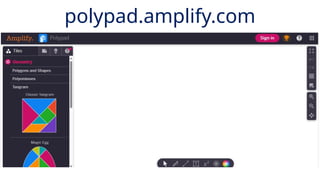
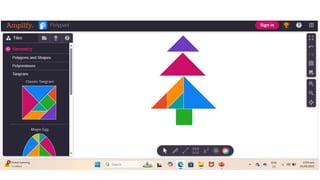
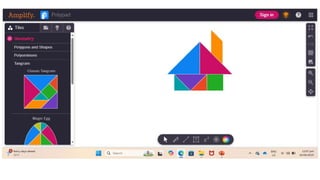
polypad.amplify.com
“If a child can't learn the way
we teach, maybe we should
teach the way they learn.”
– Ignacio Estrada
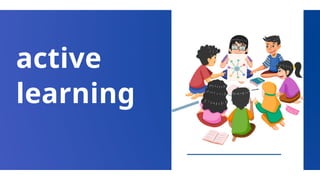
active
learning
hands-on
experiences
explore
manipulative
-based
leaner-
centered
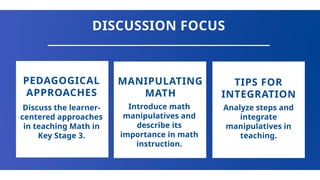
PEDAGOGICAL
APPROACHES
Discuss the learner-
centered approaches
in teaching Math in
Key Stage 3.
RETENTION
DISCUSSION FOCUS
MANIPULATING
MATH
Introduce math
manipulatives and
describe its
importance in math
instruction.
TIPS FOR
INTEGRATION
Analyze steps and
integrate
manipulatives in
teaching.
Pedagogical Approaches
in Math Education
various strategies
and methods
Pedagogical Approaches
in Math Education
conceptual understanding,
problem-solving,
and critical thinking
Concrete-
Pictorial-
Abstract (CPA)
Approach
ENACTIVE
ICONIC
SYMBOLIC
Constructivist
Approach
ACTIVE
ZPD
SCAFFOLDING
Inquiry-Based
Learning
EXPLORATION
QUESTIONING
Collaborative
Learning
GROUP
activities
PEER
explaination
Experiential
and Reflective
Learning
DIRECT
HANDS-ON
REFLECTION
Manipulating Math
actively using physical or
visual tools
Manipulating Math
moving objects
drawing models
using hands-on materials
Manipulating Math
to make abstract math
concepts more concrete
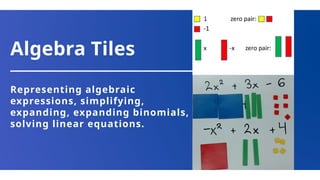
Algebra Tiles
Representing algebraic
expressions, simplifying,
expanding, expanding binomials,
solving linear equations.
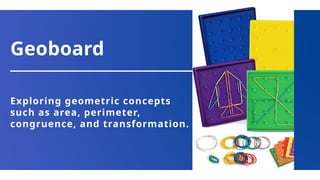
Geoboard
Exploring geometric concepts
such as area, perimeter,
congruence, and transformation.
Geo Strips
Constructing and exploring
properties of polygons.
3D Geometric
Solids
Visualizing surface area and
volume, properties of solids.
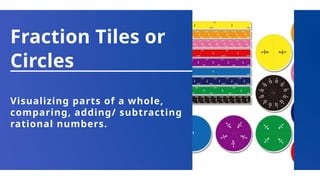
Fraction Tiles or
Circles
Visualizing parts of a whole,
comparing, adding/ subtracting
rational numbers.
Hands-on approach supports deeper
understanding, especially for young
learners who struggle with abstract
concepts.
Improved Concept Understanding
Through hands-on trial and error,
they learn to analyze, test, and refine
their thinking, which strengthens
their reasoning and decision-making
skills.
Enhanced Problem-Solving Skills
Active involvement in learning keeps
students engaged and supports
long-term learning retention.
Engaging and Interactive Learning
HOW to Effectively Integrate
Manipulative-Based Strategies Aligned
with the DepEd curriculum?
The 5 Keys to effective integration:
1. Purpose
2. Match
3. Embed
4. Progress
5. Reflect
Match the manipulative to the math concept and
learners' developmental needs.
PURPOSE
Begin with clear, competency-based learning
goals.
MATCH
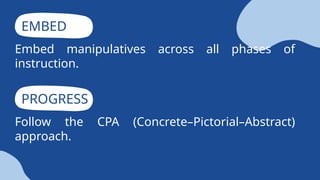
EMBED
Embed manipulatives across all phases of
instruction.
PROGRESS
Follow the CPA (Concrete–Pictorial–Abstract)
approach.
REFLECT
Use manipulatives to promote thinking,
communication, and formative assessment.
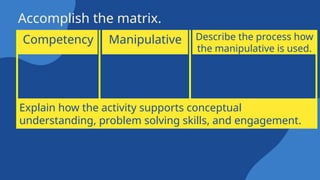
Accomplish the matrix.
RMA Task
Competency Manipulative Describe the process how
the manipulative is used.
Explain how the activity supports conceptual
understanding, problem solving skills, and engagement.
Thank you for your
attention and active
participation.
Zoren Session 2- Batch 4 rapid math assesment.pptx