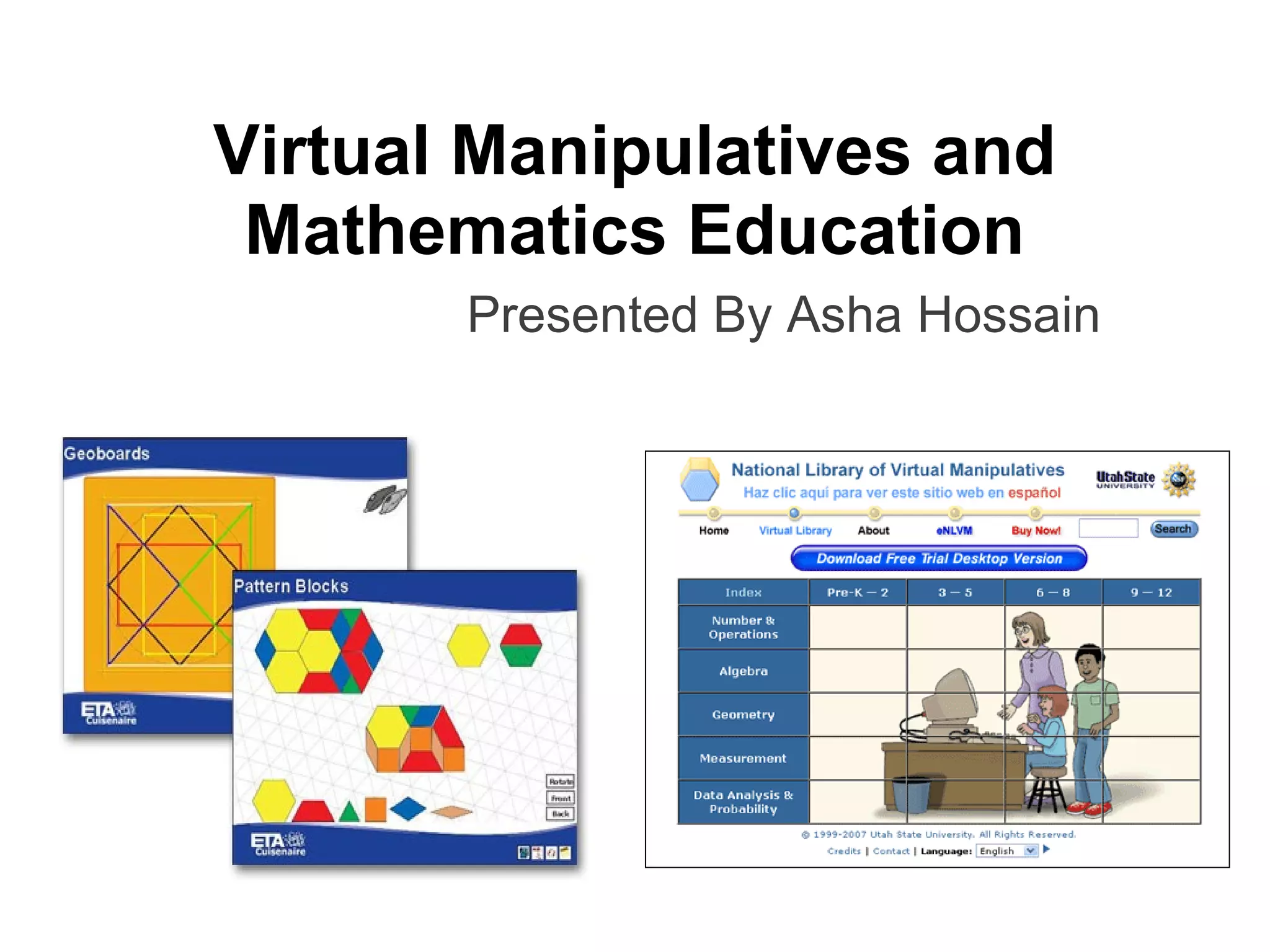
Presented By Asha Hossain Virtual Manipulatives and Mathematics Education
What is Mathematics? Mathematics is the study of -Measurement -Relationships -Properties of quantities  -Sets -Numbers and Symbols
Mathematics Education  Mathematical knowledge and skills can be build through -Exploration -Investigation  -Perseverance on complex tasks
Mathematics and Technology Technology is essential in teaching and learning mathematics as it influences mathematics that is taught and enhances students’ learning. (NCTM, 2000)
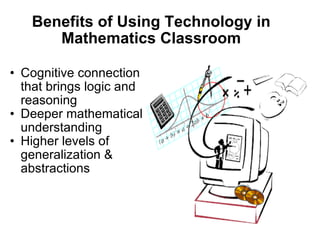
Benefits of Using Technology in Mathematics Classroom Cognitive connection that brings logic and reasoning Deeper mathematical understanding  Higher levels of generalization & abstractions
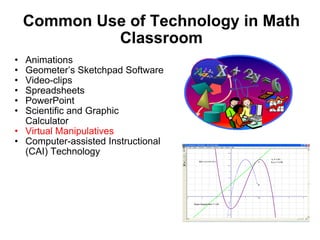
Common Use of Technology in Math Classroom Animations Geometer’s Sketchpad Software Video-clips Spreadsheets  PowerPoint Scientific and Graphic Calculator Virtual Manipulatives Computer-assisted Instructional (CAI) Technology
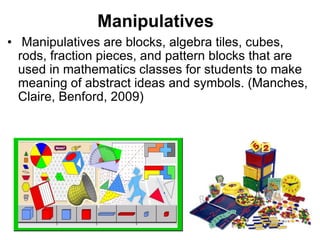
Manipulatives    Manipulatives are blocks, algebra tiles, cubes, rods, fraction pieces, and pattern blocks that are used in mathematics classes for students to make meaning of abstract ideas and symbols. (Manches, Claire, Benford, 2009)
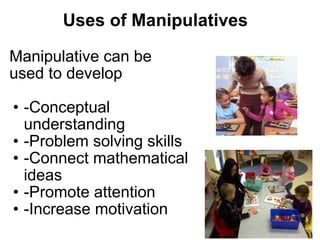
Uses of Manipulatives Manipulative can be used to develop -Conceptual understanding  -Problem solving skills -Connect mathematical ideas -Promote attention  -Increase motivation
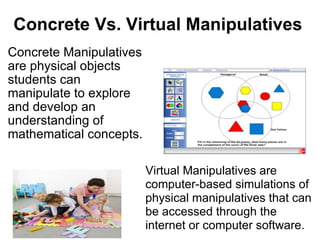
Concrete Vs. Virtual Manipulatives Concrete Manipulatives are physical objects students can manipulate to explore and develop an understanding of mathematical concepts. Virtual Manipulatives are computer-based simulations of physical manipulatives that can be accessed through the internet or computer software.
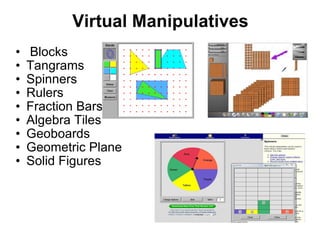
Virtual Manipulatives   Blocks Tangrams Spinners Rulers Fraction Bars Algebra Tiles Geoboards Geometric Plane Solid Figures
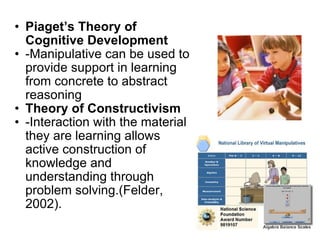
Piaget’s Theory of Cognitive Development -Manipulative can be used to provide support in learning from concrete to abstract reasoning Theory of Constructivism  -Interaction with the material they are learning allows active construction of knowledge and understanding through problem solving.(Felder, 2002).
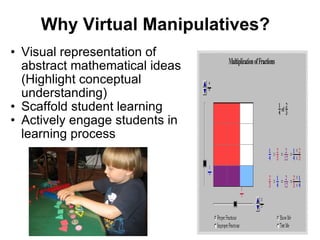
Why Virtual Manipulatives? Visual representation of abstract mathematical ideas (Highlight conceptual understanding) Scaffold student learning Actively engage students in learning process
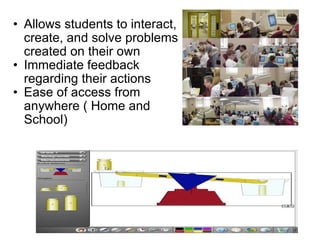
Allows students to interact, create, and solve problems created on their own Immediate feedback regarding their actions Ease of access from anywhere ( Home and School)
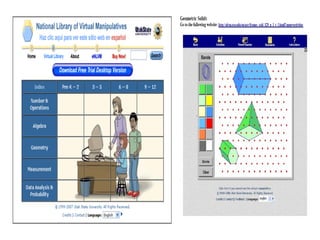
Virtual Manipulatives Websites National Library of Virtual Manipulatives http://nlvm.usu.edu/ -Project of National Science Foundation -Developed in year 1999 -Interactive, web-based virtual manipulatives in the form of Java applets -Created to provide student engagement in mathematics learning, visualize mathematical concepts and relationships
 
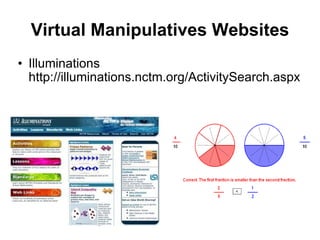
Virtual Manipulatives Websites Illuminations http://illuminations.nctm.org/ActivitySearch.aspx
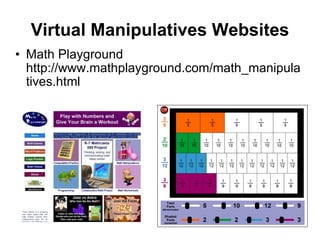
Virtual Manipulatives Websites Math Playground http://www.mathplayground.com/math_manipulatives.html
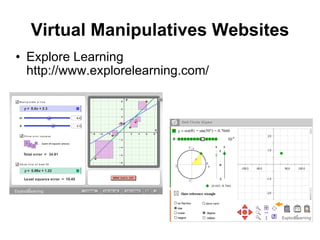
Virtual Manipulatives Websites Explore Learning http://www.explorelearning.com/
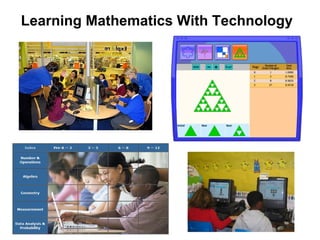
Learning Mathematics With Technology
References Manches, A., Claire O., Malley, Benford S. (2009) The role of physical representations in solving number problems: A comparison of young children’s use of physical and virtual material.  Computer and Education.  54, 622-640. Moyer, P.S. (2001) Are we having fun yet? How teachers use Manipulatives to teacher mathematics . Educational Studies in Mathematics . 47(2), 175-197.   National Council of Teachers of Mathematics (2000). Principles and standards for school mathematics. Reston, VA: Author

Pecha Kucha Presentation Upload

  • 1.
    Presented By AshaHossain Virtual Manipulatives and Mathematics Education
  • 2.
    What is Mathematics?Mathematics is the study of -Measurement -Relationships -Properties of quantities -Sets -Numbers and Symbols
  • 3.
    Mathematics Education Mathematical knowledge and skills can be build through -Exploration -Investigation -Perseverance on complex tasks
  • 4.
    Mathematics and TechnologyTechnology is essential in teaching and learning mathematics as it influences mathematics that is taught and enhances students’ learning. (NCTM, 2000)
  • 5.
    Benefits of UsingTechnology in Mathematics Classroom Cognitive connection that brings logic and reasoning Deeper mathematical understanding Higher levels of generalization & abstractions
  • 6.
    Common Use ofTechnology in Math Classroom Animations Geometer’s Sketchpad Software Video-clips Spreadsheets PowerPoint Scientific and Graphic Calculator Virtual Manipulatives Computer-assisted Instructional (CAI) Technology
  • 7.
    Manipulatives  Manipulatives are blocks, algebra tiles, cubes, rods, fraction pieces, and pattern blocks that are used in mathematics classes for students to make meaning of abstract ideas and symbols. (Manches, Claire, Benford, 2009)
  • 8.
    Uses of ManipulativesManipulative can be used to develop -Conceptual understanding -Problem solving skills -Connect mathematical ideas -Promote attention -Increase motivation
  • 9.
    Concrete Vs. VirtualManipulatives Concrete Manipulatives are physical objects students can manipulate to explore and develop an understanding of mathematical concepts. Virtual Manipulatives are computer-based simulations of physical manipulatives that can be accessed through the internet or computer software.
  • 10.
    Virtual Manipulatives  Blocks Tangrams Spinners Rulers Fraction Bars Algebra Tiles Geoboards Geometric Plane Solid Figures
  • 11.
    Piaget’s Theory ofCognitive Development -Manipulative can be used to provide support in learning from concrete to abstract reasoning Theory of Constructivism -Interaction with the material they are learning allows active construction of knowledge and understanding through problem solving.(Felder, 2002).
  • 12.
    Why Virtual Manipulatives?Visual representation of abstract mathematical ideas (Highlight conceptual understanding) Scaffold student learning Actively engage students in learning process
  • 13.
    Allows students tointeract, create, and solve problems created on their own Immediate feedback regarding their actions Ease of access from anywhere ( Home and School)
  • 14.
    Virtual Manipulatives WebsitesNational Library of Virtual Manipulatives http://nlvm.usu.edu/ -Project of National Science Foundation -Developed in year 1999 -Interactive, web-based virtual manipulatives in the form of Java applets -Created to provide student engagement in mathematics learning, visualize mathematical concepts and relationships
  • 15.
  • 16.
    Virtual Manipulatives WebsitesIlluminations http://illuminations.nctm.org/ActivitySearch.aspx
  • 17.
    Virtual Manipulatives WebsitesMath Playground http://www.mathplayground.com/math_manipulatives.html
  • 18.
    Virtual Manipulatives WebsitesExplore Learning http://www.explorelearning.com/
  • 19.
  • 20.
    References Manches, A.,Claire O., Malley, Benford S. (2009) The role of physical representations in solving number problems: A comparison of young children’s use of physical and virtual material. Computer and Education. 54, 622-640. Moyer, P.S. (2001) Are we having fun yet? How teachers use Manipulatives to teacher mathematics . Educational Studies in Mathematics . 47(2), 175-197.   National Council of Teachers of Mathematics (2000). Principles and standards for school mathematics. Reston, VA: Author

Editor's Notes

  • #6 to explores, conjecture, test and apply mathematics