By Japash Kaur
Exploring the Impact of
Manipulatives vs. Rote
Learning on Conceptual
Understanding in
Mathematics Education
jillianstarrteaching.com
This presentation aims to explore the effectiveness of manipulatives and rote learning for fostering conceptual
understanding in mathematics education. The three key questions that guide our exploration are: How do manipulatives
contribute to conceptual understanding in mathematics education? In contrast, how does rote learning facilitate
conceptual comprehension? Lastly, how can educators seamlessly integrate manipulatives and rote learning to align with
standards, accommodate diverse student needs, and enhance conceptual understanding?
Our investigation reveals that manipulatives not only enhance academic performance but also serve as catalysts for
critical thinking, questioning, and metacognitive development among students. However, the potential misuse of
manipulatives and overlooking students' prior knowledge can yield unfavorable outcomes across all key stages. On the
other hand, while rote learning remains prevalent and effective in UK schools, it may constrain students' ability to
engage deeply with mathematical concepts, especially amidst technological advancements. We advocate for nuanced
approaches beyond rote memorization to facilitate comprehensive conceptual understanding.
Furthermore, we discuss best practices for integrating manipulatives and rote learning, providing educators with guiding
questions to optimize instructional strategies. Additionally, our findings underscore the critical role of instructional
strategies in fostering transferable understanding and that it is imperative for educators to offer explicit guidance,
foster discussions on mathematical principles, and prompt students to explore the connections between concrete
representations and abstract concepts. We highlight the existing gaps in literature, notably the scarcity of research on
the synergistic integration of manipulatives and rote learning. Our presentation advocates for a balanced approach that
harnesses the strengths of both methodologies to enrich mathematics education.
A
B
S
T
R
A
C
T
Contents
1. Introduction
2. Research Questions
3. How manipulatives aid conceptual learning?
4. Complexities of Manipulative Implementation
5. Emerging trends in Manipulative technology
6. Rote Learning
7. Challenges of Rote Memorization
8. Best Practices for Using Manipulatives and Rote Learning
● Select the right manipulative for the task and your students.
● Structure the environment for effective learning.
● Support transfer from concrete to abstract
● Integrate manipulatives effectively and balance with
rote learning strategies.
1. Contrasting classroom experiences: insights from two placements
2. How Will I Apply My Findings in Future Teaching Practices?"
3. Conclusion
4. References
Teachingwithsamanthasnow.com
Introduction
Manipulatives In
Maths Learning
Rote Learning
in Maths neurosciencenews.com
Premiumjoy.com
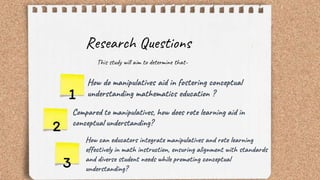
Research Questions
1
2
3
How can educators integrate manipulatives and rote learning
effectively in math instruction, ensuring alignment with standards
and diverse student needs while promoting conceptual
understanding?
Compared to manipulatives, how does rote learning aid in
conceptual understanding?
How do manipulatives aid in fostering conceptual
understanding mathematics education ?
This study will aim to determine that-
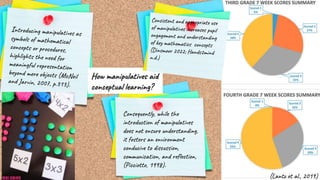
Consequently, while the
introduction of manipulatives
does not ensure understanding,
it fosters an environment
conducive to discussion,
communication, and reflection,
(Picciotto, 1998).
How manipulatives aid
conceptual learning?
(Lantz et al., 2019)
Emerging
Trends in
Manipulative
Pedagogy
Integration
with
Curriculum
Standards
Augmented
Reality (AR) and
Virtual Reality
(VR)
Data-Driven
Insights
Kiddle and Woodham,
2018; Riding et al.,
2023)
Swan and Marshall (2010)
highlight that many students
don’t look at manipulatives
and their connection that a
teacher does, since the
teacher already possesses the
knowledge needed to make
those connections.
In some cases, manipulatives may
be turned into ends in themselves
rather than tools for better
understanding. This happens
when there's an embedded focus
on procedures and products in
teaching, land this leads to
ineffective use of manipulatives
(Hurst, C. and Linsell, C., 2020)
McNeil and Jarvin (2007) point
out that even when students
students successfully make use of
given manipulatives, they still fail
to apply that knowledge to solve
problems unless they are reminded
to think about the manipulatives.
Complexities of
Manipulative
Implementation
Punemirror.com
Homeopathymantra.com
For my own teaching practice, I
align with Stein and Bovalino’s
(2001) point that it is crucial
for educators to adopt a
perspective similar to that of
their students, considering the
content as if encountering it for
the first time.
careers360.com
Brainscape.com
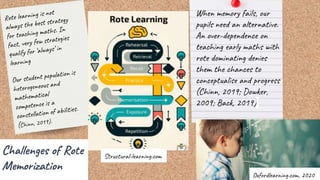
When memory fails, our
pupils need an alternative.
An over-dependence on
teaching early maths with
rote dominating denies
them the chances to
conceptualise and progress
(Chinn, 2019; Dowker,
2009; Back, 2019)
Challenges of Rote
Memorization
Structural-learning.com
Oxfordlearning.com, 2020
Best Practices for Using
Manipulatives and Rote Learning
Schoolyard blog
knilt.arcc.albany.edu.
emile-education.com
Select the right
manipulative for
the task and your
students
Consideration
#2: Student
Needs
(Marley et al, 2014; Fulmer,2017).
Possible
challenges in
finding the
right
manipulatives?
Secondgradesmiles.com
Structure the
environment for
effective
learning.
(Alfieri et al. ,2011; Brown et al., 2009)
Support transfer from concrete to abstract
Establishing
Connections
Promoting
Generalization
Facilitating
Reflective
Practices
Some researchers have
critiqued this notion that
it's not always
straightforward or
automatic (McNeil and
Jarvin , 2007; Moyer,
2001)
(Back, 2019;
Novack et al., 2014;
Kamina and Iyer,
2009; Johnson,
2019)
NCETM,2015
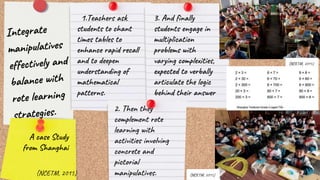
1.Teachers ask
students to chant
times tables to
enhance rapid recall
and to deepen
understanding of
mathematical
patterns.
3. And finally
students engage in
multiplication
problems with
varying complexities,
expected to verbally
articulate the logic
behind their answer
2. Then they
complement rote
learning with
activities involving
concrete and
pictorial
manipulatives.
A case Study
from Shanghai
(NCETM, 2015)
(NCETM, 2015)
(NCETM, 2015)
Contrasting Classroom Experiences: Insights from Two Placements
Montessori Placement:
● Abundant use of manipulatives in the learning
environment.
● Manipulatives integrated for all activities.
● Rooted in Montessori principles of child education.
Primary School Placement:
● Limited use of manipulatives observed.
● Individualized instruction required for comprehension.
● Experimented with rote learning through flashcards.
How Will I Apply My Findings in Future Teaching Practices?"
Adaptation to Student Needs:
Customize manipulative
selection and instructional
strategies to cater to diverse
learning styles and individual
student needs.
Clear Instructional Guidance: Offer
precise instructions and model
effective manipulative use to
ensure students comprehend their
purpose and utility.
Continuous Evaluation and Reflection:
Consistently assess the efficacy of
manipulative-based instruction, solicit
feedback from students and peers, and
engage in reflective practice to pinpoint
areas for enhancement.
Balance Between Rote Learning and
Manipulatives: Strive to maintain
equilibrium between rote learning
practices and manipulative-based
learning approaches, fostering a
comprehensive understanding of
Conclusion
Our analysis of rote learning and manipulatives concludes by emphasising the important roles they play in
promoting conceptual understanding in mathematical education. We have discovered that manipulatives help
students strengthen their metacognitive skills alongside boosting critical thinking. However we've also found
several pitfalls and challenges associated with their implementation, which reinforces the need for using
comprehensive methods of instruction.We have also discovered that while rote memorization has traditionally
been effective with students, the landscape is changing. With advancements in technology and an increasing
number of children with special educational needs, relying solely on rote memorization is no longer feasible. We
have also discussed the best practices with which teachers can use manipulatives in classroom and their
potential limitations which have been proved or not explored much.
The gaps in the literature indicate the urgent need for greater research, especially in addressing the
synergistic combination of rote learning and manipulatives. We advocate for a balanced approach that
effectively leverages the strengths of both methodologies while fostering collaboration and prioritizing
student-centered learning environments. By embracing innovation and addressing these research gaps,
educators can empower students to develop into mathematically literate and critical thinkers.
References
1. Alfieri, L., Brooks, P. J., Aldrich, N. J., & Tenenbaum, H. R. (2011). Does discovery-based instruction enhance learning? Journal of Educational
Psychology, 103, 3–16.
2. Alnassir, H. (2022). Why Math Manipulatives are Important for Kids | Premium Joy. [online] Available at: https://premiumjoy.com/blog/why-math-
manipulatives-are-important-for-kids/.
3. Amanda (2019). Math Manipulatives You’ll Need to Teach Second Grade. [online] Second Grade Smiles. Available at:
https://secondgradesmiles.com/manipulatives-youll-need-to-teach-second-grade-math/.
4. Anon, (2018). Available at: https://files.eric.ed.gov/fulltext/ED581568.pdf [Accessed 4 Feb. 2024].
5. Anon, (2019). Blog - Homeopathy Mantra. [online] Available at: https://www.homeopathymantra.com/blog/ [Accessed 4 Feb. 2024].
6. Anon, (2020). Concrete Pictorial Abstract (CPA)- A Guide for Primary School Teachers. [online] Available at: https://emile-education.com/concrete-
pictorial-abstract-cpa/.
7. Anon, (2020). Printable Math Manipulatives - Teaching with Jillian Starr. [online] Available at: https://jillianstarrteaching.com/printable-math-
manipulatives/ [Accessed 4 Feb. 2024].
8. Back, J. (2019). Manipulatives in the Primary Classroom. [online] NRICH. Available at: https://nrich.maths.org/10461.
9. Brainscape Academy. (2023). How to memorize multiplication tables FAST. [online] Available at: https://www.brainscape.com/academy/memorize-
multiplication-tables/ [Accessed 4 Feb. 2024].
10. Brown, M. C., McNeil, N. M., & Glenberg, A. M. (2009). Using concreteness in education: Real problems, potential solutions. Child Development
Perspectives, 3, 160-164.
11. Chinn, S. (2019). Conceptual Learning - an example using times tables — Steve Chinn. [online] www.stevechinn.co.uk. Available at:
https://www.stevechinn.co.uk/articles/conceptual-learning-an-example-using-times-tables [Accessed 3 Feb. 2024].
12. Dowker, A. (2009). What Works for Children with Mathematical Difficulties?.
13. Fulmer, S. (2017). GUEST POST: Manipulatives – Why They Can Hinder Learning and What You Can Do About It. [online] The Learning Scientists.
Available at: https://www.learningscientists.org/blog/2017/4/4-1.
14. Henry, J. (2011). Times tables key to good maths, inspectors say. [online] www.telegraph.co.uk. Available at:
https://www.telegraph.co.uk/education/primaryeducation/8886480/Times-tables-key-to-good-maths-inspectors-say.html.
15. Johnson, E. (2019). The CPA Approach: What It Is & How to Use It In Primary Maths. [online] Third Space Learning. Available at:
https://thirdspacelearning.com/blog/concrete-pictorial-abstract-maths-cpa/.
16. Kamina, P. and Iyer, N. (2009). Northeastern Educational Research Association (NERA) Annual Conference Fall 10-23-2009 Teaching for Transfer of
Learning when Using Manipulatives. Uconn Library , [online] 6. Available at:
https://digitalcommons.lib.uconn.edu/cgi/viewcontent.cgi?article=1023&context=nera_2009.
17. knilt.arcc.albany.edu. (n.d.). Using Manipulatives - KNILT. [online] Available at: https://knilt.arcc.albany.edu/Using_Manipulatives.
18. Lantz, J. and Miller, C. (2019). BC Digital Commons BC Digital Commons The Effectiveness of Mathematical Manipulatives in One-on-One The
Effectiveness of Mathematical Manipulatives in One-on-One Intervention for Third and Fourth Grade Students Intervention for Third and Fourth Grade
Students. [online] Available at: https://digitalcommons.bridgewater.edu/cgi/viewcontent.cgi?article=1009&context=honors_projects.
19. Looney, S. (n.d.). Same But Different Math: Helping Students Connect Concepts, Build Number Sense, and Deepen Understanding. [online] Routledge &
CRC Press. Available at: https://www.routledge.com/Same-But-Different-Math-Helping-Students-Connect-Concepts-Build-
Number/Looney/p/book/9781032126555 [Accessed 4 Feb. 2024].
20. Marley, S. C., & Carbonneau, K. (2014). Future directions for theory and research with instructional manipulatives: Commentary on the special issue
papers. Educational Psychology Review, 26, 91-100.
21. McNeil, N. M., & Jarvin, L. (2007). When Theories Don’t Add up: Disentangling the Manipulatives Debate. Theory into Practice, 46, 309-316.
http://dx.doi.org/10.1080/00405840701593899
22. Miss Giraffe’s Class. (2015). Miss Giraffe’s Class: How to Teach Arrays. [online] Available at: https://missgiraffesclass.blogspot.com/2015/07/how-to-
teach-arrays.html.
23. Moyer, P. (2001). Are we having fun yet? How teachers use manipulatives to teach mathematics. Educational Studies in Mathematics, 47, 175-197.
24. NCETM (2015). Calculation Guidance for Primary Schools. [online] Available at:https://www.ncetm.org.uk/media/k20boquz/ncetm-calculation-guidance-
october-2015.pdf.
25. News, N. (2014). New Research Sheds Light on How Children’s Brains Memorize Facts. [online] Neuroscience News. Available at:
https://neurosciencenews.com/learning-math-neurodevelopment-hippocampus-1225/ [Accessed 4 Feb. 2024].
26. Novack, M.A., Congdon, E.L., Hemani-Lopez, N. and Goldin-Meadow, S. (2014). From Action to Abstraction. Psychological Science, [online] 25(4),
pp.903–910. doi:https://doi.org/10.1177/0956797613518351.
27. Oxford Learning. (2020). The Role of Failure in Learning. [online] Available at: https://www.oxfordlearning.com/the-role-of-failure-in-learning/.
28. punemirror.com. (2020). PLAN AHEAD: Train with the abacus. [online] Available at: https://punemirror.com/entertainment/unwind/plan-ahead-train-
with-the-abacus/cid5087161.htm [Accessed 4 Feb. 2024].
29. SAMANTHA HENRY. (n.d.). EDUCATION. [online] Available at: http://www.teachingwithsamanthasnow.com/httpswwwinstagramcommrshenryinfirst
[Accessed 4 Feb. 2024].
30. Schoolyard Blog | Teacher Resources | School Specialty. (2017). The Role of Math Manipulatives in the Classroom. [online] Available at:
https://blog.schoolspecialty.com/the-role-of-math-manipulatives-in-the-classroom/.
31. www.hand2mind.com. (n.d.). Hand2mind: Growing Minds with Hands-On Learning. [online] Available at:https://www.hand2mind.com/resources/benefits-
of-manipulatives# [Accessed 3 Feb. 2024].
32. Kiddle, A. and Woodham, L. (2018). Using Digital Manipulatives and Interactivities to Develop Curiosity. [online] nrich.maths.org.
Available at: https://nrich.maths.org/13999 [Accessed 4 Feb. 2024].
33. Riding, K., O'brien, D., Ibrahim, M., Du, W., Li, S., Liu, B. and Clark-Wilson, A. (2023). Augmented reality manipulatives: New
mathematical tools for classrooms. [online] Available at: https://atm.org.uk/write/MediaUploads/Journals/MT287/11.pdf [Accessed 4 Feb.
2024].
34. Bousted, D.M. (2016). England: The home of rote-learning. [online] SecEd. Available at: https://www.sec-
ed.co.uk/content/blogs/england-the-home-of-rote-learning/ [Accessed 6 Feb. 2024].

Manipulatives vs rote learning.pptx

  • 1.
    By Japash Kaur Exploringthe Impact of Manipulatives vs. Rote Learning on Conceptual Understanding in Mathematics Education jillianstarrteaching.com
  • 2.
    This presentation aimsto explore the effectiveness of manipulatives and rote learning for fostering conceptual understanding in mathematics education. The three key questions that guide our exploration are: How do manipulatives contribute to conceptual understanding in mathematics education? In contrast, how does rote learning facilitate conceptual comprehension? Lastly, how can educators seamlessly integrate manipulatives and rote learning to align with standards, accommodate diverse student needs, and enhance conceptual understanding? Our investigation reveals that manipulatives not only enhance academic performance but also serve as catalysts for critical thinking, questioning, and metacognitive development among students. However, the potential misuse of manipulatives and overlooking students' prior knowledge can yield unfavorable outcomes across all key stages. On the other hand, while rote learning remains prevalent and effective in UK schools, it may constrain students' ability to engage deeply with mathematical concepts, especially amidst technological advancements. We advocate for nuanced approaches beyond rote memorization to facilitate comprehensive conceptual understanding. Furthermore, we discuss best practices for integrating manipulatives and rote learning, providing educators with guiding questions to optimize instructional strategies. Additionally, our findings underscore the critical role of instructional strategies in fostering transferable understanding and that it is imperative for educators to offer explicit guidance, foster discussions on mathematical principles, and prompt students to explore the connections between concrete representations and abstract concepts. We highlight the existing gaps in literature, notably the scarcity of research on the synergistic integration of manipulatives and rote learning. Our presentation advocates for a balanced approach that harnesses the strengths of both methodologies to enrich mathematics education. A B S T R A C T
  • 3.
    Contents 1. Introduction 2. ResearchQuestions 3. How manipulatives aid conceptual learning? 4. Complexities of Manipulative Implementation 5. Emerging trends in Manipulative technology 6. Rote Learning 7. Challenges of Rote Memorization 8. Best Practices for Using Manipulatives and Rote Learning ● Select the right manipulative for the task and your students. ● Structure the environment for effective learning. ● Support transfer from concrete to abstract ● Integrate manipulatives effectively and balance with rote learning strategies. 1. Contrasting classroom experiences: insights from two placements 2. How Will I Apply My Findings in Future Teaching Practices?" 3. Conclusion 4. References Teachingwithsamanthasnow.com
  • 4.
    Introduction Manipulatives In Maths Learning RoteLearning in Maths neurosciencenews.com Premiumjoy.com
  • 5.
    Research Questions 1 2 3 How caneducators integrate manipulatives and rote learning effectively in math instruction, ensuring alignment with standards and diverse student needs while promoting conceptual understanding? Compared to manipulatives, how does rote learning aid in conceptual understanding? How do manipulatives aid in fostering conceptual understanding mathematics education ? This study will aim to determine that-
  • 6.
    Consequently, while the introductionof manipulatives does not ensure understanding, it fosters an environment conducive to discussion, communication, and reflection, (Picciotto, 1998). How manipulatives aid conceptual learning? (Lantz et al., 2019)
  • 7.
    Emerging Trends in Manipulative Pedagogy Integration with Curriculum Standards Augmented Reality (AR)and Virtual Reality (VR) Data-Driven Insights Kiddle and Woodham, 2018; Riding et al., 2023)
  • 8.
    Swan and Marshall(2010) highlight that many students don’t look at manipulatives and their connection that a teacher does, since the teacher already possesses the knowledge needed to make those connections. In some cases, manipulatives may be turned into ends in themselves rather than tools for better understanding. This happens when there's an embedded focus on procedures and products in teaching, land this leads to ineffective use of manipulatives (Hurst, C. and Linsell, C., 2020) McNeil and Jarvin (2007) point out that even when students students successfully make use of given manipulatives, they still fail to apply that knowledge to solve problems unless they are reminded to think about the manipulatives. Complexities of Manipulative Implementation Punemirror.com Homeopathymantra.com For my own teaching practice, I align with Stein and Bovalino’s (2001) point that it is crucial for educators to adopt a perspective similar to that of their students, considering the content as if encountering it for the first time.
  • 9.
  • 10.
    When memory fails,our pupils need an alternative. An over-dependence on teaching early maths with rote dominating denies them the chances to conceptualise and progress (Chinn, 2019; Dowker, 2009; Back, 2019) Challenges of Rote Memorization Structural-learning.com Oxfordlearning.com, 2020
  • 11.
    Best Practices forUsing Manipulatives and Rote Learning Schoolyard blog knilt.arcc.albany.edu. emile-education.com
  • 12.
    Select the right manipulativefor the task and your students Consideration #2: Student Needs (Marley et al, 2014; Fulmer,2017). Possible challenges in finding the right manipulatives? Secondgradesmiles.com
  • 13.
  • 14.
    Support transfer fromconcrete to abstract Establishing Connections Promoting Generalization Facilitating Reflective Practices Some researchers have critiqued this notion that it's not always straightforward or automatic (McNeil and Jarvin , 2007; Moyer, 2001) (Back, 2019; Novack et al., 2014; Kamina and Iyer, 2009; Johnson, 2019) NCETM,2015
  • 15.
    1.Teachers ask students tochant times tables to enhance rapid recall and to deepen understanding of mathematical patterns. 3. And finally students engage in multiplication problems with varying complexities, expected to verbally articulate the logic behind their answer 2. Then they complement rote learning with activities involving concrete and pictorial manipulatives. A case Study from Shanghai (NCETM, 2015) (NCETM, 2015) (NCETM, 2015)
  • 16.
    Contrasting Classroom Experiences:Insights from Two Placements Montessori Placement: ● Abundant use of manipulatives in the learning environment. ● Manipulatives integrated for all activities. ● Rooted in Montessori principles of child education. Primary School Placement: ● Limited use of manipulatives observed. ● Individualized instruction required for comprehension. ● Experimented with rote learning through flashcards.
  • 17.
    How Will IApply My Findings in Future Teaching Practices?" Adaptation to Student Needs: Customize manipulative selection and instructional strategies to cater to diverse learning styles and individual student needs. Clear Instructional Guidance: Offer precise instructions and model effective manipulative use to ensure students comprehend their purpose and utility. Continuous Evaluation and Reflection: Consistently assess the efficacy of manipulative-based instruction, solicit feedback from students and peers, and engage in reflective practice to pinpoint areas for enhancement. Balance Between Rote Learning and Manipulatives: Strive to maintain equilibrium between rote learning practices and manipulative-based learning approaches, fostering a comprehensive understanding of
  • 18.
    Conclusion Our analysis ofrote learning and manipulatives concludes by emphasising the important roles they play in promoting conceptual understanding in mathematical education. We have discovered that manipulatives help students strengthen their metacognitive skills alongside boosting critical thinking. However we've also found several pitfalls and challenges associated with their implementation, which reinforces the need for using comprehensive methods of instruction.We have also discovered that while rote memorization has traditionally been effective with students, the landscape is changing. With advancements in technology and an increasing number of children with special educational needs, relying solely on rote memorization is no longer feasible. We have also discussed the best practices with which teachers can use manipulatives in classroom and their potential limitations which have been proved or not explored much. The gaps in the literature indicate the urgent need for greater research, especially in addressing the synergistic combination of rote learning and manipulatives. We advocate for a balanced approach that effectively leverages the strengths of both methodologies while fostering collaboration and prioritizing student-centered learning environments. By embracing innovation and addressing these research gaps, educators can empower students to develop into mathematically literate and critical thinkers.
  • 19.
    References 1. Alfieri, L.,Brooks, P. J., Aldrich, N. J., & Tenenbaum, H. R. (2011). Does discovery-based instruction enhance learning? Journal of Educational Psychology, 103, 3–16. 2. Alnassir, H. (2022). Why Math Manipulatives are Important for Kids | Premium Joy. [online] Available at: https://premiumjoy.com/blog/why-math- manipulatives-are-important-for-kids/. 3. Amanda (2019). Math Manipulatives You’ll Need to Teach Second Grade. [online] Second Grade Smiles. Available at: https://secondgradesmiles.com/manipulatives-youll-need-to-teach-second-grade-math/. 4. Anon, (2018). Available at: https://files.eric.ed.gov/fulltext/ED581568.pdf [Accessed 4 Feb. 2024]. 5. Anon, (2019). Blog - Homeopathy Mantra. [online] Available at: https://www.homeopathymantra.com/blog/ [Accessed 4 Feb. 2024]. 6. Anon, (2020). Concrete Pictorial Abstract (CPA)- A Guide for Primary School Teachers. [online] Available at: https://emile-education.com/concrete- pictorial-abstract-cpa/. 7. Anon, (2020). Printable Math Manipulatives - Teaching with Jillian Starr. [online] Available at: https://jillianstarrteaching.com/printable-math- manipulatives/ [Accessed 4 Feb. 2024]. 8. Back, J. (2019). Manipulatives in the Primary Classroom. [online] NRICH. Available at: https://nrich.maths.org/10461. 9. Brainscape Academy. (2023). How to memorize multiplication tables FAST. [online] Available at: https://www.brainscape.com/academy/memorize- multiplication-tables/ [Accessed 4 Feb. 2024]. 10. Brown, M. C., McNeil, N. M., & Glenberg, A. M. (2009). Using concreteness in education: Real problems, potential solutions. Child Development Perspectives, 3, 160-164. 11. Chinn, S. (2019). Conceptual Learning - an example using times tables — Steve Chinn. [online] www.stevechinn.co.uk. Available at: https://www.stevechinn.co.uk/articles/conceptual-learning-an-example-using-times-tables [Accessed 3 Feb. 2024]. 12. Dowker, A. (2009). What Works for Children with Mathematical Difficulties?. 13. Fulmer, S. (2017). GUEST POST: Manipulatives – Why They Can Hinder Learning and What You Can Do About It. [online] The Learning Scientists. Available at: https://www.learningscientists.org/blog/2017/4/4-1.
  • 20.
    14. Henry, J.(2011). Times tables key to good maths, inspectors say. [online] www.telegraph.co.uk. Available at: https://www.telegraph.co.uk/education/primaryeducation/8886480/Times-tables-key-to-good-maths-inspectors-say.html. 15. Johnson, E. (2019). The CPA Approach: What It Is & How to Use It In Primary Maths. [online] Third Space Learning. Available at: https://thirdspacelearning.com/blog/concrete-pictorial-abstract-maths-cpa/. 16. Kamina, P. and Iyer, N. (2009). Northeastern Educational Research Association (NERA) Annual Conference Fall 10-23-2009 Teaching for Transfer of Learning when Using Manipulatives. Uconn Library , [online] 6. Available at: https://digitalcommons.lib.uconn.edu/cgi/viewcontent.cgi?article=1023&context=nera_2009. 17. knilt.arcc.albany.edu. (n.d.). Using Manipulatives - KNILT. [online] Available at: https://knilt.arcc.albany.edu/Using_Manipulatives. 18. Lantz, J. and Miller, C. (2019). BC Digital Commons BC Digital Commons The Effectiveness of Mathematical Manipulatives in One-on-One The Effectiveness of Mathematical Manipulatives in One-on-One Intervention for Third and Fourth Grade Students Intervention for Third and Fourth Grade Students. [online] Available at: https://digitalcommons.bridgewater.edu/cgi/viewcontent.cgi?article=1009&context=honors_projects. 19. Looney, S. (n.d.). Same But Different Math: Helping Students Connect Concepts, Build Number Sense, and Deepen Understanding. [online] Routledge & CRC Press. Available at: https://www.routledge.com/Same-But-Different-Math-Helping-Students-Connect-Concepts-Build- Number/Looney/p/book/9781032126555 [Accessed 4 Feb. 2024]. 20. Marley, S. C., & Carbonneau, K. (2014). Future directions for theory and research with instructional manipulatives: Commentary on the special issue papers. Educational Psychology Review, 26, 91-100. 21. McNeil, N. M., & Jarvin, L. (2007). When Theories Don’t Add up: Disentangling the Manipulatives Debate. Theory into Practice, 46, 309-316. http://dx.doi.org/10.1080/00405840701593899
  • 21.
    22. Miss Giraffe’sClass. (2015). Miss Giraffe’s Class: How to Teach Arrays. [online] Available at: https://missgiraffesclass.blogspot.com/2015/07/how-to- teach-arrays.html. 23. Moyer, P. (2001). Are we having fun yet? How teachers use manipulatives to teach mathematics. Educational Studies in Mathematics, 47, 175-197. 24. NCETM (2015). Calculation Guidance for Primary Schools. [online] Available at:https://www.ncetm.org.uk/media/k20boquz/ncetm-calculation-guidance- october-2015.pdf. 25. News, N. (2014). New Research Sheds Light on How Children’s Brains Memorize Facts. [online] Neuroscience News. Available at: https://neurosciencenews.com/learning-math-neurodevelopment-hippocampus-1225/ [Accessed 4 Feb. 2024]. 26. Novack, M.A., Congdon, E.L., Hemani-Lopez, N. and Goldin-Meadow, S. (2014). From Action to Abstraction. Psychological Science, [online] 25(4), pp.903–910. doi:https://doi.org/10.1177/0956797613518351. 27. Oxford Learning. (2020). The Role of Failure in Learning. [online] Available at: https://www.oxfordlearning.com/the-role-of-failure-in-learning/. 28. punemirror.com. (2020). PLAN AHEAD: Train with the abacus. [online] Available at: https://punemirror.com/entertainment/unwind/plan-ahead-train- with-the-abacus/cid5087161.htm [Accessed 4 Feb. 2024]. 29. SAMANTHA HENRY. (n.d.). EDUCATION. [online] Available at: http://www.teachingwithsamanthasnow.com/httpswwwinstagramcommrshenryinfirst [Accessed 4 Feb. 2024]. 30. Schoolyard Blog | Teacher Resources | School Specialty. (2017). The Role of Math Manipulatives in the Classroom. [online] Available at: https://blog.schoolspecialty.com/the-role-of-math-manipulatives-in-the-classroom/. 31. www.hand2mind.com. (n.d.). Hand2mind: Growing Minds with Hands-On Learning. [online] Available at:https://www.hand2mind.com/resources/benefits- of-manipulatives# [Accessed 3 Feb. 2024].
  • 22.
    32. Kiddle, A.and Woodham, L. (2018). Using Digital Manipulatives and Interactivities to Develop Curiosity. [online] nrich.maths.org. Available at: https://nrich.maths.org/13999 [Accessed 4 Feb. 2024]. 33. Riding, K., O'brien, D., Ibrahim, M., Du, W., Li, S., Liu, B. and Clark-Wilson, A. (2023). Augmented reality manipulatives: New mathematical tools for classrooms. [online] Available at: https://atm.org.uk/write/MediaUploads/Journals/MT287/11.pdf [Accessed 4 Feb. 2024]. 34. Bousted, D.M. (2016). England: The home of rote-learning. [online] SecEd. Available at: https://www.sec- ed.co.uk/content/blogs/england-the-home-of-rote-learning/ [Accessed 6 Feb. 2024].