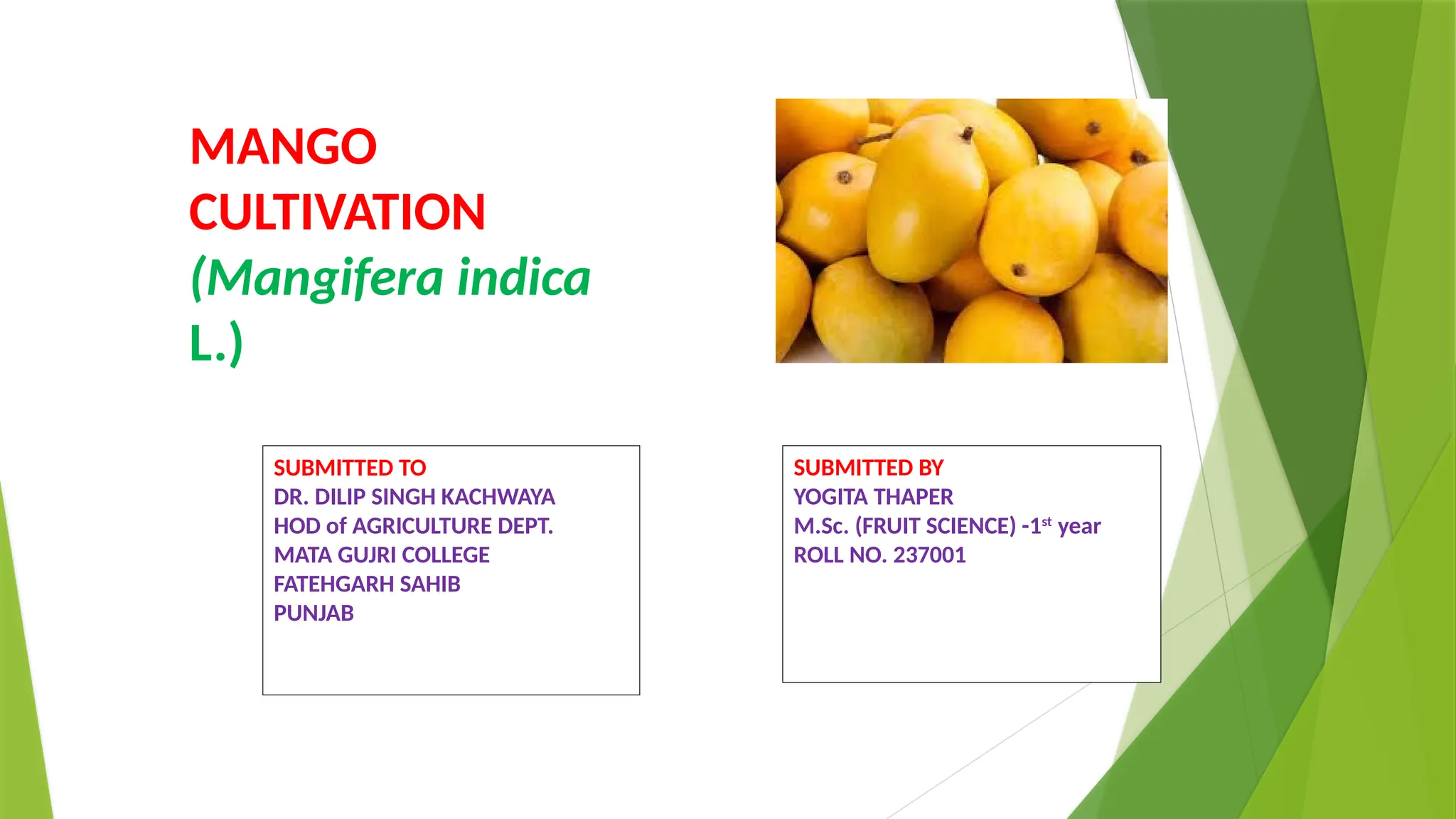
MANGO
CULTIVATION
(Mangifera indica
L.)
SUBMITTED BY
YOGITA THAPER
M.Sc. (FRUIT SCIENCE) -1st
year
ROLL NO. 237001
SUBMITTED TO
DR. DILIP SINGH KACHWAYA
HOD of AGRICULTURE DEPT.
MATA GUJRI COLLEGE
FATEHGARH SAHIB
PUNJAB
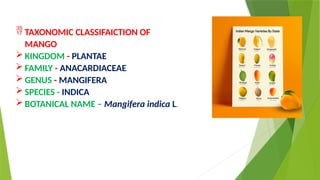
 TAXONOMIC CLASSIFAICTION OF
MANGO
 KINGDOM - PLANTAE
 FAMILY - ANACARDIACEAE
 GENUS - MANGIFERA
 SPECIES - INDICA
 BOTANICAL NAME – Mangifera indica L.
INTRODUCTION
Mango is also known as a king of fruits.
Mango is a national fruit of India.
Mango is cultivated in tropical as well as in sub-
tropical regions.
Origin of Mango – South East Asia/ Indo Burma/ India.
Chromosome number of mango -2n =4x=40.
India is a leading producer of Mango in world.
Edible part of mango is Mesocarp.
Fruit type of mango is Drupe.
Mango has terminal bearing habit.
Highly shade sensitive in nature.
Mango is climacteric fruit.
Mango has high vitamin A (4800 IU).
CONTI
.
MANGO PLANT PARTS OF FRUIT INFLIORESNCE
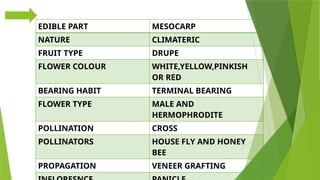
EDIBLE PART MESOCARP
NATURE CLIMATERIC
FRUIT TYPE DRUPE
FLOWER COLOUR WHITE,YELLOW,PINKISH
OR RED
BEARING HABIT TERMINAL BEARING
FLOWER TYPE MALE AND
HERMOPHRODITE
POLLINATION CROSS
POLLINATORS HOUSE FLY AND HONEY
BEE
PROPAGATION VENEER GRAFTING
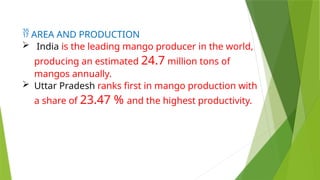
 AREA AND PRODUCTION
 India is the leading mango producer in the world,
producing an estimated 24.7 million tons of
mangos annually.
 Uttar Pradesh ranks first in mango production with
a share of 23.47 % and the highest productivity.
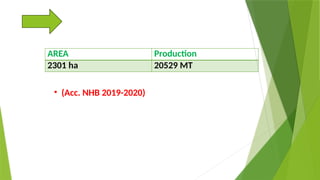
AREA Production
2301 ha 20529 MT
‱ (Acc. NHB 2019-2020)
 IMPORTANCE AND USES
 Mango is a rich source of Vitamin A (4800 IU).
 According to nutritional experts, mango is highly
invigorating (healthy and full of energy), fattening (have
good amount of fat), helps in the improvement of
digestion.
 When mango is in its raw form then we prepare
number of things like chutneys, curries, pickles.
 Ripe mango is used for the table purpose.
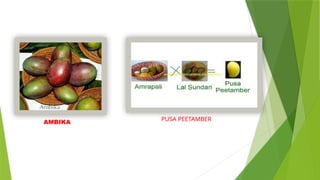
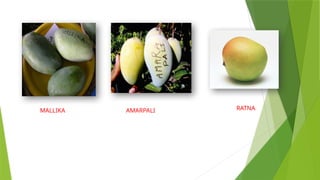
HYBRIDS PARENTS FEATURES
Ambika Amarpali × Janadhan
pasand
Late ripening variety
Pusa peetembar Amrapali × Lal
sundari
Yellow coloured
variety
Mallika Neelam × Dashehari Regular bearing – mid
season
Amrapali Dashehari × Neelam Regular bearing and
desert variety
Sunder Langra Langra × Sunder
prasad
Free from mango
malformation
Ratna Alphonso × Neelam Regular bearer
Sindhu Ratna × Alphonso seedless
‱HYBRIDS OF MANGO
AMBIKA PUSA PEETAMBER
MALLIKA AMARPALI RATNA
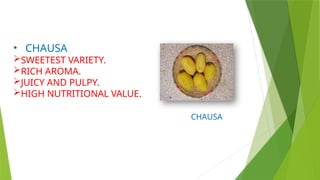
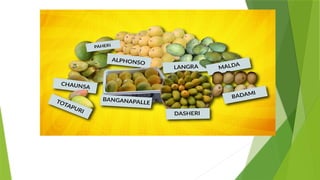
Chausa Sweetest variety
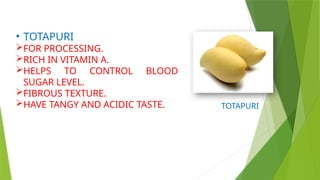
Totapuri Suitable for processing
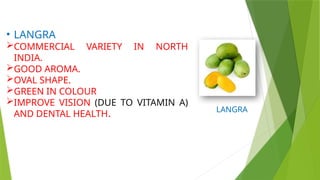
Langra Commercial variety in
North India
Alphonso Exporting variety
Rumani Apple shaped variety
Neelam Late season variety
Dashehari Mid season variety
‱VARIETIES
‱ CHAUSA
SWEETEST VARIETY.
RICH AROMA.
JUICY AND PULPY.
HIGH NUTRITIONAL VALUE.
CHAUSA
‱ TOTAPURI
FOR PROCESSING.
RICH IN VITAMIN A.
HELPS TO CONTROL BLOOD
SUGAR LEVEL.
FIBROUS TEXTURE.
HAVE TANGY AND ACIDIC TASTE. TOTAPURI
‱ LANGRA
COMMERCIAL VARIETY IN NORTH
INDIA.
GOOD AROMA.
OVAL SHAPE.
GREEN IN COLOUR
IMPROVE VISION (DUE TO VITAMIN A)
AND DENTAL HEALTH.
LANGRA
‱ ALPHONSO
EXPORTING VARIETY.
JUICY PULP.
LESS FIBROUS.
CREAMY TEXTURE.
ALPHONSO
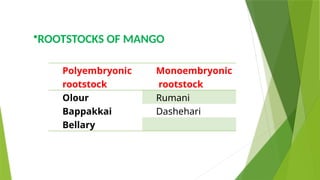
Polyembryonic
rootstock
Monoembryonic
rootstock
Olour Rumani
Bappakkai Dashehari
Bellary
‱ROOTSTOCKS OF MANGO
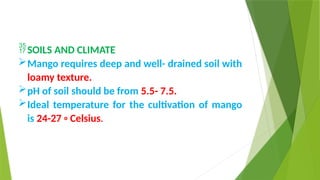
SOILS AND CLIMATE
Mango requires deep and well- drained soil with
loamy texture.
pH of soil should be from 5.5- 7.5.
Ideal temperature for the cultivation of mango
is 24-27 ◩ Celsius.
PLANNING AND PLANTING
There are two seasons for the mango
planting i.e. spring and monsoon.
For mango planting, square and
hexagonal system of planting are
prefer.
Size of pits should 1m×1m×1m.
Spacing - 10×10m (100plants/ha).
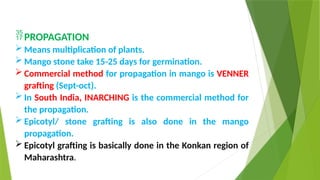
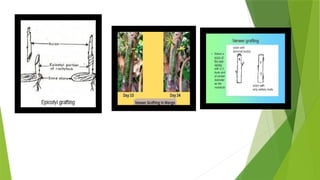
PROPAGATION
 Means multiplication of plants.
 Mango stone take 15-25 days for germination.
 Commercial method for propagation in mango is VENNER
grafting (Sept-oct).
 In South India, INARCHING is the commercial method for
the propagation.
 Epicotyl/ stone grafting is also done in the mango
propagation.
 Epicotyl grafting is basically done in the Konkan region of
Maharashtra.
IRRIGATION
 During first year irrigation should be given after every 10-
15 days in winter and 5-6 days in summer.
 For next two years, irrigation should be given after 12-15
days in winter and 10-12 days in summer.
 During 4th
and 5th
year it should be given after 14-15 days
in winter and 10-14 days in summer.
 No irrigation should be applied in monsoon.
 During fruit development period irrigation should be
applied at 10-15 days intervals.
 It helps for the improvement of fruit size and reduce the
chance of fruit drop.
YEARS DAYS IN
WINTERS
DAYS IN
SUMMAR
1st
year 10-15 days 5-6 days
2nd
and 3rd
year 12-15 days 10-12 days
4th
and 5th
year 14-15 days 10-14 days
‱ IRRIGATION
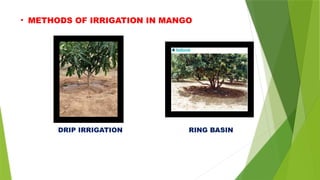
DRIP IRRIGATION RING BASIN
‱ METHODS OF IRRIGATION IN MANGO
 MANURES AND FERTILIZERS
 Manuring is very important part in the mango orchard.
 During first year, 10kg FYM, 300g urea+ 300g SSP+ 100g MOP per plant.
 With increasing the year, the dose should also be increased.
 At the age of 10 years, we should apply 100kg FYM + 3kg urea +3kg SSP.
 Should be applied in two split doses.
 In both young and old orchards followed by irrigation if there is no rain.
 Foliar application of 3% urea in sandy soils is recommended before flowering.
 Well decomposed FYM may be applied every year.
 Micro nutrients may be applied as per the requirement in the form of foliar sprays.
YEARS MANURES FERTILIZERS
1st
year 10kg FYM 300g urea
+300g SSP+
100g MOP
10th
year 100kg FYM 3kg urea +3kg
SSP+ 1kg MOP
MANURES AND FERTILIZERS
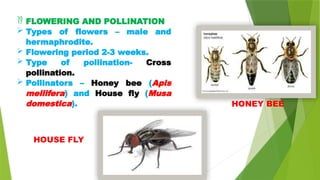
 FLOWERING AND POLLINATION
 Types of flowers – male and
hermaphrodite.
 Flowering period 2-3 weeks.
 Type of pollination- Cross
pollination.
 Pollinators – Honey bee (Apis
mellifera) and House fly (Musa
domestica).
HOUSE FLY
HONEY BEE
TRAINING AND PRUNING
Training is basically done in initial years for
getting better framework.
Central leader and modified centre system of
training are used .
Pruning is less required in the mango.
Heading back is done after four years in Nov
and dec.
 SPECIAL TECHNIQUES USED IN
MANGO
 Bottom heat root technique – is used for
the enhancement of rooting in mango
and was developed by REDDY and
MAJUMDER (1975).
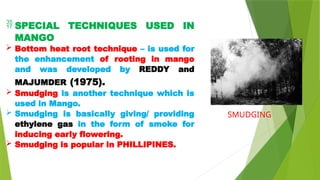
 Smudging is another technique which is
used in Mango.
 Smudging is basically giving/ providing
ethylene gas in the form of smoke for
inducing early flowering.

 Smudging is popular in PHILLIPINES.
SMUDGING
BOTTOM HEAT TECHNIQUE
HARVESTING
 Harvesting at proper maturity is an important
aspect from the quality and shelf- life points of
view.
 Maturity signs-
 Slight colour development.
 When one or two fruits fall from the plant
naturally.
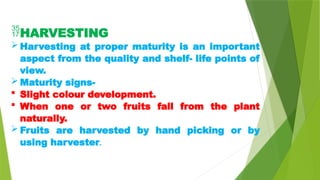
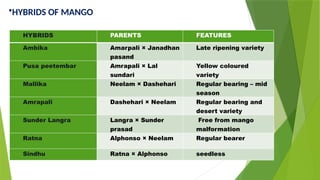
 Fruits are harvested by hand picking or by
using harvester.
CONT..
MANUAL
HARVESTER
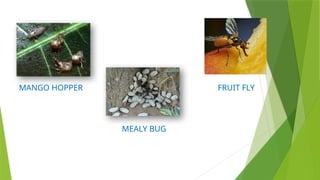
NAME SCIENTIFIC NAME MANAGEMAENT
MANGO HOPPER Idioscopus
niveoparus
1. Avoid close planting.
2. Spray monocrotophos 0.05%
at fruit setting stage.
MEALY BUG Drosicha mangiferae 1. Proper weeding.
2. Use methylparathion 1ml/l .
MANGO FRUIT FLY Bactrocera dorsalis 1.Avoid summer ploughing.
2.Use BAIT spray (one
insecticide + 10g/l jaggery
or molasses).
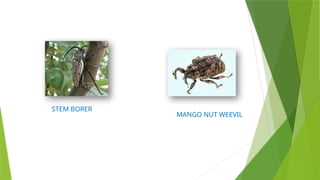
MANGO
STEMBORER
Batocera
rufomaculata
1.Apply carbofuran 3G 5g
per hole and plug with mud.
MANGO NUT
WEEVIL
Sternochetus
mangifera
1.Use predators –
Rhizoglyphus sp.
‱PEST OF MANGO
MANGO HOPPER
MEALY BUG
FRUIT FLY
MANGO NUT WEEVIL
STEM BORER
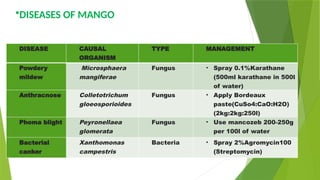
DISEASE CAUSAL
ORGANISM
TYPE MANAGEMENT
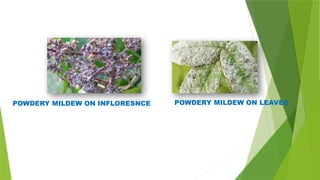
Powdery
mildew
Microsphaera
mangiferae
Fungus ‱ Spray 0.1%Karathane
(500ml karathane in 500l
of water)
Anthracnose Colletotrichum
gloeosporioides
Fungus ‱ Apply Bordeaux
paste(CuSo4:CaO:H2O)
(2kg:2kg:250l)
Phoma blight Peyronellaea
glomerata
Fungus ‱ Use mancozeb 200-250g
per 100l of water
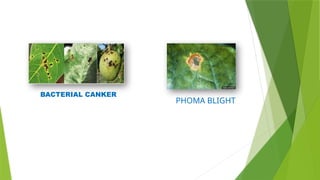
Bacterial
canker
Xanthomonas
campestris
Bacteria ‱ Spray 2%Agromycin100
(Streptomycin)
‱DISEASES OF MANGO
POWDERY MILDEW ON INFLORESNCE POWDERY MILDEW ON LEAVES
BACTERIAL CANKER
PHOMA BLIGHT
DISORDER CAUSE MANAGEMAENT
Alternate
bearing
Hereditary  Use
paclobutrazol@5
g per tree
Fruit drop Abscission  Spray 20ppm of
2,4-D (2g in
100l of water)
Black tip Brick kilns and
boron
deficiency
 Spray 0.6%
borax and
maintain
distance from
‱DISORDERS OF MANGO
BLACK TIP OF MANGO
ALTERNATE BEARING
mango cultivation, mango taxonomy, varieties, diseases

mango cultivation, mango taxonomy, varieties, diseases

  • 1.
    MANGO CULTIVATION (Mangifera indica L.) SUBMITTED BY YOGITATHAPER M.Sc. (FRUIT SCIENCE) -1st year ROLL NO. 237001 SUBMITTED TO DR. DILIP SINGH KACHWAYA HOD of AGRICULTURE DEPT. MATA GUJRI COLLEGE FATEHGARH SAHIB PUNJAB
  • 2.
     TAXONOMIC CLASSIFAICTIONOF MANGO  KINGDOM - PLANTAE  FAMILY - ANACARDIACEAE  GENUS - MANGIFERA  SPECIES - INDICA  BOTANICAL NAME – Mangifera indica L.
  • 3.
    INTRODUCTION Mango is alsoknown as a king of fruits. Mango is a national fruit of India. Mango is cultivated in tropical as well as in sub- tropical regions. Origin of Mango – South East Asia/ Indo Burma/ India. Chromosome number of mango -2n =4x=40.
  • 4.
    India is aleading producer of Mango in world. Edible part of mango is Mesocarp. Fruit type of mango is Drupe. Mango has terminal bearing habit. Highly shade sensitive in nature. Mango is climacteric fruit. Mango has high vitamin A (4800 IU). CONTI
.
  • 5.
    MANGO PLANT PARTSOF FRUIT INFLIORESNCE
  • 6.
    EDIBLE PART MESOCARP NATURECLIMATERIC FRUIT TYPE DRUPE FLOWER COLOUR WHITE,YELLOW,PINKISH OR RED BEARING HABIT TERMINAL BEARING FLOWER TYPE MALE AND HERMOPHRODITE POLLINATION CROSS POLLINATORS HOUSE FLY AND HONEY BEE PROPAGATION VENEER GRAFTING
  • 7.
     AREA ANDPRODUCTION  India is the leading mango producer in the world, producing an estimated 24.7 million tons of mangos annually.  Uttar Pradesh ranks first in mango production with a share of 23.47 % and the highest productivity.
  • 8.
    AREA Production 2301 ha20529 MT ‱ (Acc. NHB 2019-2020)
  • 9.
     IMPORTANCE ANDUSES  Mango is a rich source of Vitamin A (4800 IU).  According to nutritional experts, mango is highly invigorating (healthy and full of energy), fattening (have good amount of fat), helps in the improvement of digestion.  When mango is in its raw form then we prepare number of things like chutneys, curries, pickles.  Ripe mango is used for the table purpose.
  • 10.
    HYBRIDS PARENTS FEATURES AmbikaAmarpali × Janadhan pasand Late ripening variety Pusa peetembar Amrapali × Lal sundari Yellow coloured variety Mallika Neelam × Dashehari Regular bearing – mid season Amrapali Dashehari × Neelam Regular bearing and desert variety Sunder Langra Langra × Sunder prasad Free from mango malformation Ratna Alphonso × Neelam Regular bearer Sindhu Ratna × Alphonso seedless ‱HYBRIDS OF MANGO
  • 11.
  • 12.
  • 13.
    Chausa Sweetest variety TotapuriSuitable for processing Langra Commercial variety in North India Alphonso Exporting variety Rumani Apple shaped variety Neelam Late season variety Dashehari Mid season variety ‱VARIETIES
  • 14.
    ‱ CHAUSA SWEETEST VARIETY. RICHAROMA. JUICY AND PULPY. HIGH NUTRITIONAL VALUE. CHAUSA
  • 15.
    ‱ TOTAPURI FOR PROCESSING. RICHIN VITAMIN A. HELPS TO CONTROL BLOOD SUGAR LEVEL. FIBROUS TEXTURE. HAVE TANGY AND ACIDIC TASTE. TOTAPURI
  • 16.
    ‱ LANGRA COMMERCIAL VARIETYIN NORTH INDIA. GOOD AROMA. OVAL SHAPE. GREEN IN COLOUR IMPROVE VISION (DUE TO VITAMIN A) AND DENTAL HEALTH. LANGRA
  • 17.
    ‱ ALPHONSO EXPORTING VARIETY. JUICYPULP. LESS FIBROUS. CREAMY TEXTURE. ALPHONSO
  • 19.
  • 20.
    SOILS AND CLIMATE Mangorequires deep and well- drained soil with loamy texture. pH of soil should be from 5.5- 7.5. Ideal temperature for the cultivation of mango is 24-27 ◩ Celsius.
  • 21.
    PLANNING AND PLANTING Thereare two seasons for the mango planting i.e. spring and monsoon. For mango planting, square and hexagonal system of planting are prefer. Size of pits should 1m×1m×1m. Spacing - 10×10m (100plants/ha).
  • 22.
    PROPAGATION  Means multiplicationof plants.  Mango stone take 15-25 days for germination.  Commercial method for propagation in mango is VENNER grafting (Sept-oct).  In South India, INARCHING is the commercial method for the propagation.  Epicotyl/ stone grafting is also done in the mango propagation.  Epicotyl grafting is basically done in the Konkan region of Maharashtra.
  • 24.
    IRRIGATION  During firstyear irrigation should be given after every 10- 15 days in winter and 5-6 days in summer.  For next two years, irrigation should be given after 12-15 days in winter and 10-12 days in summer.  During 4th and 5th year it should be given after 14-15 days in winter and 10-14 days in summer.  No irrigation should be applied in monsoon.  During fruit development period irrigation should be applied at 10-15 days intervals.  It helps for the improvement of fruit size and reduce the chance of fruit drop.
  • 25.
    YEARS DAYS IN WINTERS DAYSIN SUMMAR 1st year 10-15 days 5-6 days 2nd and 3rd year 12-15 days 10-12 days 4th and 5th year 14-15 days 10-14 days ‱ IRRIGATION
  • 26.
    DRIP IRRIGATION RINGBASIN ‱ METHODS OF IRRIGATION IN MANGO
  • 27.
     MANURES ANDFERTILIZERS  Manuring is very important part in the mango orchard.  During first year, 10kg FYM, 300g urea+ 300g SSP+ 100g MOP per plant.  With increasing the year, the dose should also be increased.  At the age of 10 years, we should apply 100kg FYM + 3kg urea +3kg SSP.  Should be applied in two split doses.  In both young and old orchards followed by irrigation if there is no rain.  Foliar application of 3% urea in sandy soils is recommended before flowering.  Well decomposed FYM may be applied every year.  Micro nutrients may be applied as per the requirement in the form of foliar sprays.
  • 28.
    YEARS MANURES FERTILIZERS 1st year10kg FYM 300g urea +300g SSP+ 100g MOP 10th year 100kg FYM 3kg urea +3kg SSP+ 1kg MOP MANURES AND FERTILIZERS
  • 29.
     FLOWERING ANDPOLLINATION  Types of flowers – male and hermaphrodite.  Flowering period 2-3 weeks.  Type of pollination- Cross pollination.  Pollinators – Honey bee (Apis mellifera) and House fly (Musa domestica). HOUSE FLY HONEY BEE
  • 30.
    TRAINING AND PRUNING Trainingis basically done in initial years for getting better framework. Central leader and modified centre system of training are used . Pruning is less required in the mango. Heading back is done after four years in Nov and dec.
  • 32.
     SPECIAL TECHNIQUESUSED IN MANGO  Bottom heat root technique – is used for the enhancement of rooting in mango and was developed by REDDY and MAJUMDER (1975).  Smudging is another technique which is used in Mango.  Smudging is basically giving/ providing ethylene gas in the form of smoke for inducing early flowering.  Smudging is popular in PHILLIPINES. SMUDGING
  • 33.
  • 34.
    HARVESTING  Harvesting atproper maturity is an important aspect from the quality and shelf- life points of view.  Maturity signs-  Slight colour development.  When one or two fruits fall from the plant naturally.  Fruits are harvested by hand picking or by using harvester.
  • 35.
  • 36.
    NAME SCIENTIFIC NAMEMANAGEMAENT MANGO HOPPER Idioscopus niveoparus 1. Avoid close planting. 2. Spray monocrotophos 0.05% at fruit setting stage. MEALY BUG Drosicha mangiferae 1. Proper weeding. 2. Use methylparathion 1ml/l . MANGO FRUIT FLY Bactrocera dorsalis 1.Avoid summer ploughing. 2.Use BAIT spray (one insecticide + 10g/l jaggery or molasses). MANGO STEMBORER Batocera rufomaculata 1.Apply carbofuran 3G 5g per hole and plug with mud. MANGO NUT WEEVIL Sternochetus mangifera 1.Use predators – Rhizoglyphus sp. ‱PEST OF MANGO
  • 37.
  • 38.
  • 39.
    DISEASE CAUSAL ORGANISM TYPE MANAGEMENT Powdery mildew Microsphaera mangiferae Fungus‱ Spray 0.1%Karathane (500ml karathane in 500l of water) Anthracnose Colletotrichum gloeosporioides Fungus ‱ Apply Bordeaux paste(CuSo4:CaO:H2O) (2kg:2kg:250l) Phoma blight Peyronellaea glomerata Fungus ‱ Use mancozeb 200-250g per 100l of water Bacterial canker Xanthomonas campestris Bacteria ‱ Spray 2%Agromycin100 (Streptomycin) ‱DISEASES OF MANGO
  • 40.
    POWDERY MILDEW ONINFLORESNCE POWDERY MILDEW ON LEAVES
  • 41.
  • 42.
    DISORDER CAUSE MANAGEMAENT Alternate bearing Hereditary Use paclobutrazol@5 g per tree Fruit drop Abscission  Spray 20ppm of 2,4-D (2g in 100l of water) Black tip Brick kilns and boron deficiency  Spray 0.6% borax and maintain distance from ‱DISORDERS OF MANGO
  • 43.
    BLACK TIP OFMANGO ALTERNATE BEARING