
Biodiversity in Mango
Presented By:- Shashwat P. Mahalle
Course No.:- FSC-503
Guided By:- Prof. Dr. U. A. Raut
What is Biodiversity?
• Biodiversity refers to the variety and variability among living
organism and eco-system complexes in which they occur.
• The whole word BIODIVERSITY generally therefore means:
VARIETY OF LIFE.
Why biodiversity important?
• Organisms are dependent to each other for survive.
• Each species of vegetation and each creature has a place on the earth
and plays a vital role in the circle of life.
• Food, shelter, wood, medicines and drugs are come from the
different plants on this earth.
• Greater species diversity ensures natural sustainability for all life
forms.
Mango
Common name :- Mango
Botanical name :- Mangifera indica L.
Family:- Anacardiaceae
Chromosome number: 2n = 2x = 40
Origin:- Indo-burma
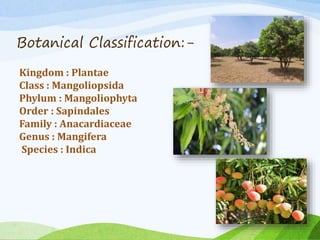
Botanical Classification:-
Kingdom : Plantae
Class : Mangoliopsida
Phylum : Mangoliophyta
Order : Sapindales
Family : Anacardiaceae
Genus : Mangifera
Species : Indica
INTRODUCTION:-
Mango is 'King of Fruits', in India. Mango fruit is utilized at all
stages of its development. It is also a rich source of vitamin A and
some other vital nutrients. The raw/ unripe fruits, because of their
acidic taste, are used for preparing pickle, chutney, drinks and
amchur.
The ripe fruits besides being consumed as table purpose are also
processed for preparing juice, nectar, squash, jam, cereal flakes,
mango leather and toffee. The fruits are also preserved as slices
and canned in syrup.
From the nutritional point of view the mango is rich source of
vitamin 'A' (4880 IU) almost as rich as butter. Also it has fair
amount of vitamin 'C' The carotene pigments, B carotene, increase
with ripening, whereas Vitamin 'C' had a sharp fall on ripening.
Origin, Distribution and History
• Mango is Native to South East Asia (Indo-Berma) specially
India.
• The name Mangifera is given by "Botinus" first time in 1658.
• Indo-Burma region is believed to be the primary centre of
mango.
• The name Mangifera indica is given by Linnaeus in 1753.
• Mango is one of the choicest fruits of India, grown over an
area of 1.23 million hectares in the country.
• Mango occupies the prime position in India and mango is
acclaimed as ‘King of fruits’.
• In India Uttar Pradesh is the leading mango producing state
followed by A.P.
AREA AND PRODUCTION
Mango occupies on an area of 1.17 million hectares with a total
annual production of 9.64 million metric tons contributing 42.64%
of total area under fruit crops, and 40% of the total production of
the fruits in India. It ranks third after banana and citrus in respect
of world fruit production and acreage. The state of U.P. is the
leading state in mango cultivation (0.493 million hectares
contributing 44% of total area under this crop) followed by Andhra
Pradesh (14.5%) and Bihar (13.2%). The present area of mango
crop under cultivation in Maharashtra is 35400 ha with an annual
production of 194700 tonnes. India has a major share 70% in
world production of mango of 13.44 million metric tones.
Centers of Mango Diversity and Distribution in India
1. Humid Tropical region-Manipur, Tripura, Mizoram and
S. Assam
2. Chota Nagpur Plateau-Trijunction of Orissa, Bihar and
Madhya Pradesh
3. Santal Paraganas in Bihar
4. South Madhya Pradesh adjoining Orissa and Andhra
Pradesh
5. Dhar Plateau of Madhya Pradesh adjoining Gujarat and
Maharashtra
6. Humid Tropical South Peninsular India
7. Andaman and Nicobar Islands
Germplasm resources
• India is the home of mango germplasm where more than
thousand varieties are existing.
• Central Institute for Subtropical Horticulture, (CISH) Lucknow
has the largest collection of mango (633 accessions in the national
repository) and they have greater genetic variability with respect
to fruit shape, skin colour, stone size, period and time of maturity,
pulp thickness, colour, bearing habit, yield and quality parameters
(Anon., 2002).
• Further, IIHR,Bangalore, IARI, Pusa, New Delhi, Sabour (Bihar),
Fruit Research station Sangareddy (Andhra Pradesh) etc. are also
maintaining the germplasm of mango.
• Almost all the commercial cultivars of mango are related to a
single species Mangifera indica.
• The Mangifera indica germplasm is divided into two
groups.
• 1. Seedling races
• 2. Horticultural races
• Seedling races are wild and cultivated types, which are
most common in Tropical Asia and almost all
commercial cultivars of mango are from this type.
• Horticultural races:- these are vegetatively propagating
types. These include both Mono and Polyembryonic
types.
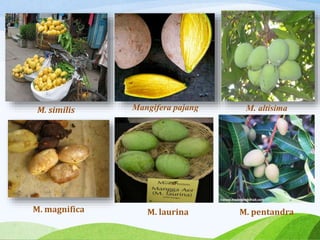
Wild Species
• Mangifera pajang :- Largest Fruit, Easily peeled
• M. similis:- Free stone Mango Species
• M. magnifica - Free from fiber
• M. laurina - Resistance to anthracnose
• M. odorata :- Highest TSS
• M. altissima - Resistance to leaf hopper
• M. rufocostat - Off season bearing
• M. indica: commonly cultivated species
• M. pentandra :- Good polliniser
M. similis Mangifera pajang M. altisima
M. magnifica M. laurina M. pentandra
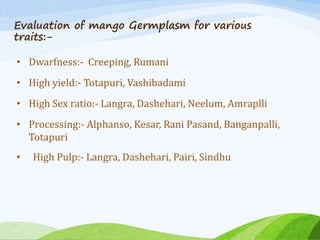
Evaluation of mango Germplasm for various
traits:-
• Dwarfness:- Creeping, Rumani
• High yield:- Totapuri, Vashibadami
• High Sex ratio:- Langra, Dashehari, Neelum, Amraplli
• Processing:- Alphanso, Kesar, Rani Pasand, Banganpalli,
Totapuri
• High Pulp:- Langra, Dashehari, Pairi, Sindhu
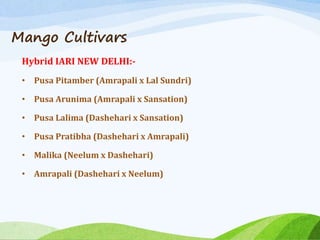
Mango Cultivars
Hybrid IARI NEW DELHI:-
• Pusa Pitamber (Amrapali x Lal Sundri)
• Pusa Arunima (Amrapali x Sansation)
• Pusa Lalima (Dashehari x Sansation)
• Pusa Pratibha (Dashehari x Amrapali)
• Malika (Neelum x Dashehari)
• Amrapali (Dashehari x Neelum)
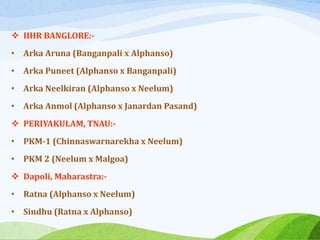
 IIHR BANGLORE:-
• Arka Aruna (Banganpali x Alphanso)
• Arka Puneet (Alphanso x Banganpali)
• Arka Neelkiran (Alphanso x Neelum)
• Arka Anmol (Alphanso x Janardan Pasand)
 PERIYAKULAM, TNAU:-
• PKM-1 (Chinnaswarnarekha x Neelum)
• PKM 2 (Neelum x Malgoa)
 Dapoli, Maharastra:-
• Ratna (Alphanso x Neelum)
• Sindhu (Ratna x Alphanso)
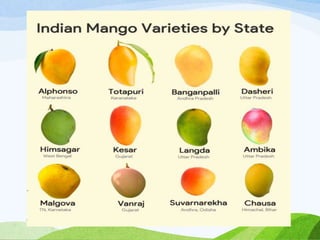
Different Varieties with their use:-
 Processing:- Alphonso, Rani Pasand, SabibPasand, Banganpalli, Totapari,
Hyder Sahib, PeddaRasam, AlifLaila, Probha Shankar, Kesar, Arka Anmol,
Arka Puneet.
 Pickle Purpose:- Amlette, Chandrakaran, Karanjio, Ramkela, Kharbooja,
Ashwina, Kokan Ruchi
 Regular Bearing Variety:- Banglora, Neelum, Totapuri, Rumani,
Amrapalli, Mallika
 Table Purpose:- Alphanso, Kesar, Dasheri, Amrapalli
 Polyembryonic:- Bappakai, Olure, and Villiacolumban etc.
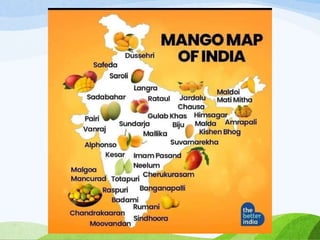
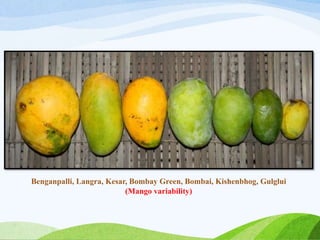
Benganpalli, Langra, Kesar, Bombay Green, Bombai, Kishenbhog, Gulglui
(Mango variability)
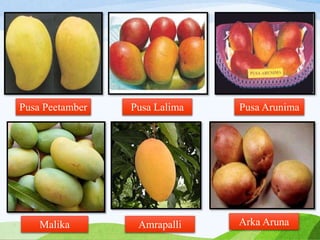
Pusa Peetamber Pusa Lalima Pusa Arunima
Malika Amrapalli Arka Aruna
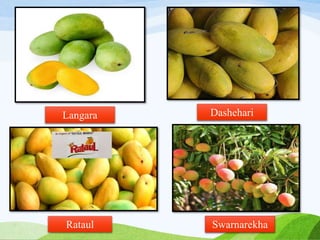
Langara Dashehari
Rataul Swarnarekha
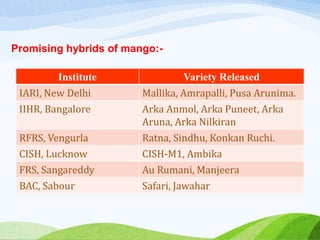
Promising hybrids of mango:-
Institute Variety Released
IARI, New Delhi Mallika, Amrapalli, Pusa Arunima.
IIHR, Bangalore Arka Anmol, Arka Puneet, Arka
Aruna, Arka Nilkiran
RFRS, Vengurla Ratna, Sindhu, Konkan Ruchi.
CISH, Lucknow CISH-M1, Ambika
FRS, Sangareddy Au Rumani, Manjeera
BAC, Sabour Safari, Jawahar
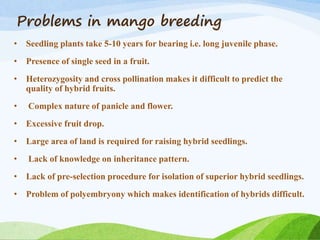
Problems in mango breeding
• Seedling plants take 5-10 years for bearing i.e. long juvenile phase.
• Presence of single seed in a fruit.
• Heterozygosity and cross pollination makes it difficult to predict the
quality of hybrid fruits.
• Complex nature of panicle and flower.
• Excessive fruit drop.
• Large area of land is required for raising hybrid seedlings.
• Lack of knowledge on inheritance pattern.
• Lack of pre-selection procedure for isolation of superior hybrid seedlings.
• Problem of polyembryony which makes identification of hybrids difficult.
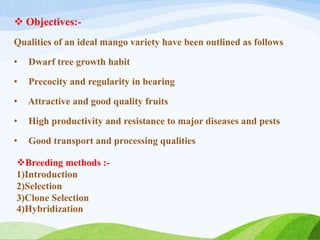
 Objectives:-
Qualities of an ideal mango variety have been outlined as follows
• Dwarf tree growth habit
• Precocity and regularity in bearing
• Attractive and good quality fruits
• High productivity and resistance to major diseases and pests
• Good transport and processing qualities
Breeding methods :-
1)Introduction
2)Selection
3)Clone Selection
4)Hybridization
 Biodiversity in Mango.pptx

Biodiversity in Mango.pptx

  • 1.
    Biodiversity in Mango PresentedBy:- Shashwat P. Mahalle Course No.:- FSC-503 Guided By:- Prof. Dr. U. A. Raut
  • 2.
    What is Biodiversity? •Biodiversity refers to the variety and variability among living organism and eco-system complexes in which they occur. • The whole word BIODIVERSITY generally therefore means: VARIETY OF LIFE. Why biodiversity important? • Organisms are dependent to each other for survive. • Each species of vegetation and each creature has a place on the earth and plays a vital role in the circle of life. • Food, shelter, wood, medicines and drugs are come from the different plants on this earth. • Greater species diversity ensures natural sustainability for all life forms.
  • 3.
    Mango Common name :-Mango Botanical name :- Mangifera indica L. Family:- Anacardiaceae Chromosome number: 2n = 2x = 40 Origin:- Indo-burma
  • 4.
    Botanical Classification:- Kingdom :Plantae Class : Mangoliopsida Phylum : Mangoliophyta Order : Sapindales Family : Anacardiaceae Genus : Mangifera Species : Indica
  • 5.
    INTRODUCTION:- Mango is 'Kingof Fruits', in India. Mango fruit is utilized at all stages of its development. It is also a rich source of vitamin A and some other vital nutrients. The raw/ unripe fruits, because of their acidic taste, are used for preparing pickle, chutney, drinks and amchur. The ripe fruits besides being consumed as table purpose are also processed for preparing juice, nectar, squash, jam, cereal flakes, mango leather and toffee. The fruits are also preserved as slices and canned in syrup. From the nutritional point of view the mango is rich source of vitamin 'A' (4880 IU) almost as rich as butter. Also it has fair amount of vitamin 'C' The carotene pigments, B carotene, increase with ripening, whereas Vitamin 'C' had a sharp fall on ripening.
  • 6.
    Origin, Distribution andHistory • Mango is Native to South East Asia (Indo-Berma) specially India. • The name Mangifera is given by "Botinus" first time in 1658. • Indo-Burma region is believed to be the primary centre of mango. • The name Mangifera indica is given by Linnaeus in 1753. • Mango is one of the choicest fruits of India, grown over an area of 1.23 million hectares in the country. • Mango occupies the prime position in India and mango is acclaimed as ‘King of fruits’. • In India Uttar Pradesh is the leading mango producing state followed by A.P.
  • 7.
    AREA AND PRODUCTION Mangooccupies on an area of 1.17 million hectares with a total annual production of 9.64 million metric tons contributing 42.64% of total area under fruit crops, and 40% of the total production of the fruits in India. It ranks third after banana and citrus in respect of world fruit production and acreage. The state of U.P. is the leading state in mango cultivation (0.493 million hectares contributing 44% of total area under this crop) followed by Andhra Pradesh (14.5%) and Bihar (13.2%). The present area of mango crop under cultivation in Maharashtra is 35400 ha with an annual production of 194700 tonnes. India has a major share 70% in world production of mango of 13.44 million metric tones.
  • 8.
    Centers of MangoDiversity and Distribution in India 1. Humid Tropical region-Manipur, Tripura, Mizoram and S. Assam 2. Chota Nagpur Plateau-Trijunction of Orissa, Bihar and Madhya Pradesh 3. Santal Paraganas in Bihar 4. South Madhya Pradesh adjoining Orissa and Andhra Pradesh 5. Dhar Plateau of Madhya Pradesh adjoining Gujarat and Maharashtra 6. Humid Tropical South Peninsular India 7. Andaman and Nicobar Islands
  • 10.
    Germplasm resources • Indiais the home of mango germplasm where more than thousand varieties are existing. • Central Institute for Subtropical Horticulture, (CISH) Lucknow has the largest collection of mango (633 accessions in the national repository) and they have greater genetic variability with respect to fruit shape, skin colour, stone size, period and time of maturity, pulp thickness, colour, bearing habit, yield and quality parameters (Anon., 2002). • Further, IIHR,Bangalore, IARI, Pusa, New Delhi, Sabour (Bihar), Fruit Research station Sangareddy (Andhra Pradesh) etc. are also maintaining the germplasm of mango. • Almost all the commercial cultivars of mango are related to a single species Mangifera indica.
  • 11.
    • The Mangiferaindica germplasm is divided into two groups. • 1. Seedling races • 2. Horticultural races • Seedling races are wild and cultivated types, which are most common in Tropical Asia and almost all commercial cultivars of mango are from this type. • Horticultural races:- these are vegetatively propagating types. These include both Mono and Polyembryonic types.
  • 12.
    Wild Species • Mangiferapajang :- Largest Fruit, Easily peeled • M. similis:- Free stone Mango Species • M. magnifica - Free from fiber • M. laurina - Resistance to anthracnose • M. odorata :- Highest TSS • M. altissima - Resistance to leaf hopper • M. rufocostat - Off season bearing • M. indica: commonly cultivated species • M. pentandra :- Good polliniser
  • 13.
    M. similis Mangiferapajang M. altisima M. magnifica M. laurina M. pentandra
  • 14.
    Evaluation of mangoGermplasm for various traits:- • Dwarfness:- Creeping, Rumani • High yield:- Totapuri, Vashibadami • High Sex ratio:- Langra, Dashehari, Neelum, Amraplli • Processing:- Alphanso, Kesar, Rani Pasand, Banganpalli, Totapuri • High Pulp:- Langra, Dashehari, Pairi, Sindhu
  • 15.
    Mango Cultivars Hybrid IARINEW DELHI:- • Pusa Pitamber (Amrapali x Lal Sundri) • Pusa Arunima (Amrapali x Sansation) • Pusa Lalima (Dashehari x Sansation) • Pusa Pratibha (Dashehari x Amrapali) • Malika (Neelum x Dashehari) • Amrapali (Dashehari x Neelum)
  • 16.
     IIHR BANGLORE:- •Arka Aruna (Banganpali x Alphanso) • Arka Puneet (Alphanso x Banganpali) • Arka Neelkiran (Alphanso x Neelum) • Arka Anmol (Alphanso x Janardan Pasand)  PERIYAKULAM, TNAU:- • PKM-1 (Chinnaswarnarekha x Neelum) • PKM 2 (Neelum x Malgoa)  Dapoli, Maharastra:- • Ratna (Alphanso x Neelum) • Sindhu (Ratna x Alphanso)
  • 17.
    Different Varieties withtheir use:-  Processing:- Alphonso, Rani Pasand, SabibPasand, Banganpalli, Totapari, Hyder Sahib, PeddaRasam, AlifLaila, Probha Shankar, Kesar, Arka Anmol, Arka Puneet.  Pickle Purpose:- Amlette, Chandrakaran, Karanjio, Ramkela, Kharbooja, Ashwina, Kokan Ruchi  Regular Bearing Variety:- Banglora, Neelum, Totapuri, Rumani, Amrapalli, Mallika  Table Purpose:- Alphanso, Kesar, Dasheri, Amrapalli  Polyembryonic:- Bappakai, Olure, and Villiacolumban etc.
  • 18.
    Benganpalli, Langra, Kesar,Bombay Green, Bombai, Kishenbhog, Gulglui (Mango variability)
  • 19.
    Pusa Peetamber PusaLalima Pusa Arunima Malika Amrapalli Arka Aruna
  • 20.
  • 22.
    Promising hybrids ofmango:- Institute Variety Released IARI, New Delhi Mallika, Amrapalli, Pusa Arunima. IIHR, Bangalore Arka Anmol, Arka Puneet, Arka Aruna, Arka Nilkiran RFRS, Vengurla Ratna, Sindhu, Konkan Ruchi. CISH, Lucknow CISH-M1, Ambika FRS, Sangareddy Au Rumani, Manjeera BAC, Sabour Safari, Jawahar
  • 23.
    Problems in mangobreeding • Seedling plants take 5-10 years for bearing i.e. long juvenile phase. • Presence of single seed in a fruit. • Heterozygosity and cross pollination makes it difficult to predict the quality of hybrid fruits. • Complex nature of panicle and flower. • Excessive fruit drop. • Large area of land is required for raising hybrid seedlings. • Lack of knowledge on inheritance pattern. • Lack of pre-selection procedure for isolation of superior hybrid seedlings. • Problem of polyembryony which makes identification of hybrids difficult.
  • 24.
     Objectives:- Qualities ofan ideal mango variety have been outlined as follows • Dwarf tree growth habit • Precocity and regularity in bearing • Attractive and good quality fruits • High productivity and resistance to major diseases and pests • Good transport and processing qualities Breeding methods :- 1)Introduction 2)Selection 3)Clone Selection 4)Hybridization