1 
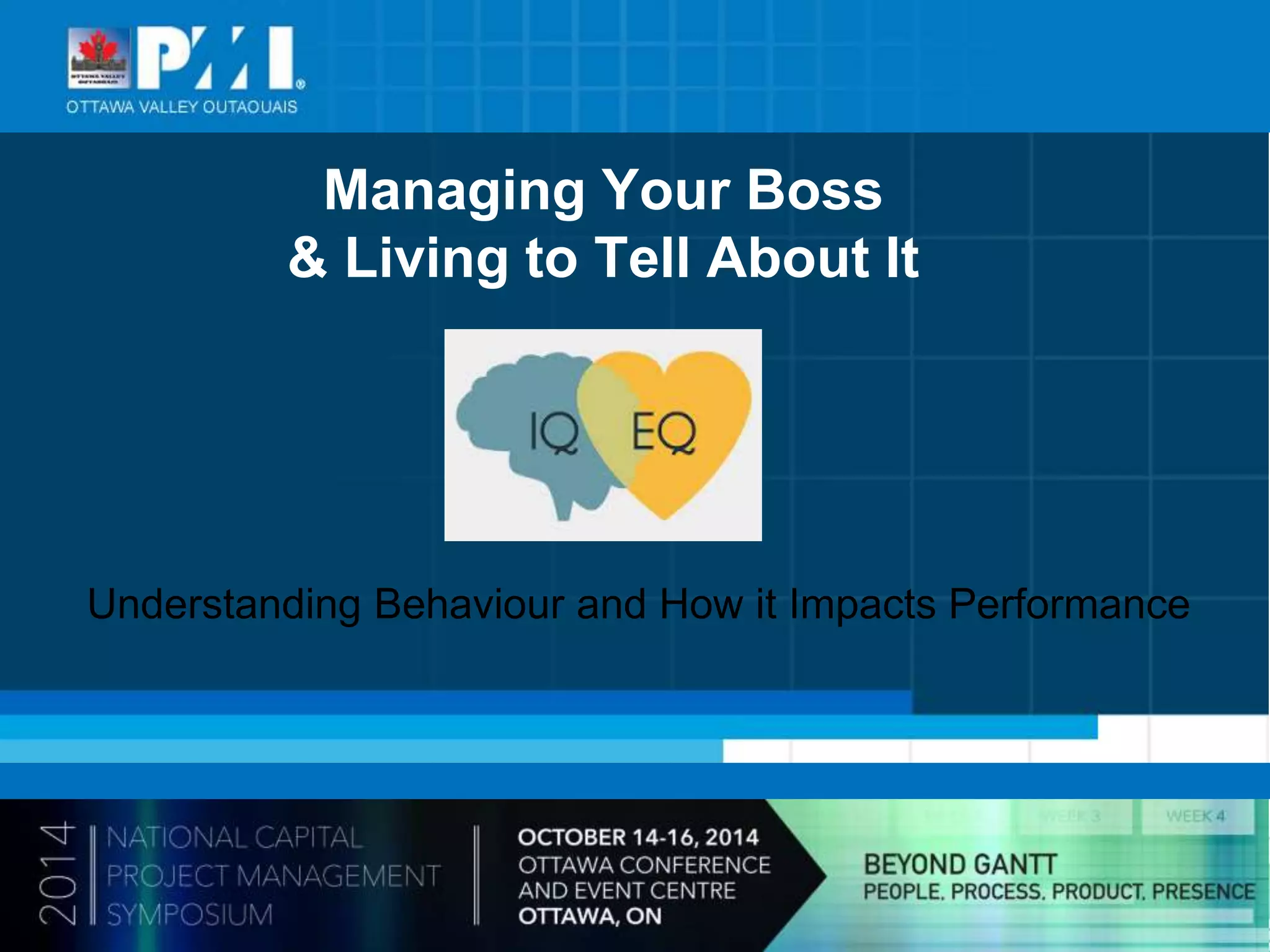
Managing Your Boss 
& Living to Tell About It 
Understanding Behaviour and How it Impacts Performance
2 
Copyright Notice 
• The contents of this presentation are Copyright © 2014 by the 
presenter and PMI OVOC. 
• Permission is granted for participants to print the presentation handouts 
for use during the conference and later personal reference. 
• PMI OVOC reserves the right to store this content for archival purposes 
as a record of conference proceedings and to publish this content 
electronically for the purpose of disseminating conference proceedings 
to conference participants. 
• All other use, storage, retrievable, distribution, or reproduction must be 
authorized in advance, in writing. 
2014 National Capital Project Management Symposium
3 
Key Learning Points 
1. Learn the key to working with others by working with them in a 
style that they like 
2. Deepen your understanding of your own management and 
leadership style 
3. Learn how to communicate and interact more effectively up, 
down and across the organization 
2014 National Capital Project Management Symposium
4 
Your Presenter 
• Brian Smith – Power Link Dynamics 
o Management Expert, Author and Speaker 
o Specializes in soft-skills training & leadership development 
• Certified Train-the-Trainer 
o Teaching Adult Life Long Learners 
o DISC Certified Practioner 
o Trained Behaviorist 
2014 National Capital Project Management Symposium
5 
Seminar Goals 
• Understand your behavioural tendencies and develop an 
understanding of how your behaviour affects others 
• Respect, appreciate, understand, and value individual 
differences 
• Learn how to communicate and interact more effectively 
• Increase your effectiveness by improving your relationships with 
others 
• Learn how to motivate others by understanding their strengths 
and limitations 
2014 National Capital Project Management Symposium
6 
Introductions 
• Name: 
• Position: 
• What behaviour do you find most frustrating when working with 
others? 
2014 National Capital Project Management Symposium
7 
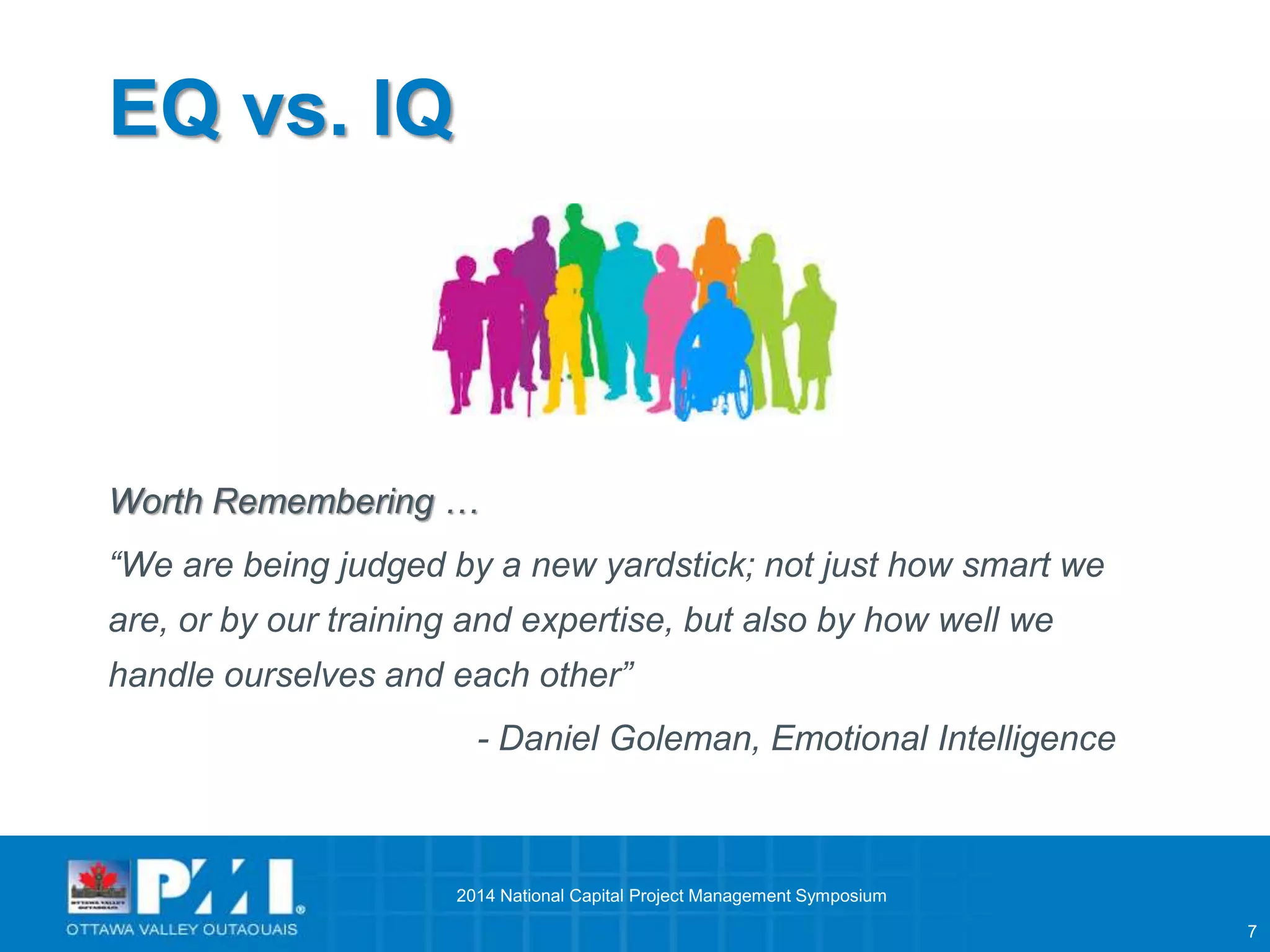
EQ vs. IQ 
Worth Remembering … 
“We are being judged by a new yardstick; not just how smart we 
are, or by our training and expertise, but also by how well we 
handle ourselves and each other” 
- Daniel Goleman, Emotional Intelligence 
2014 National Capital Project Management Symposium
8 
The Motivation Equation 
Personal Need 
+ 
Goal Directed Behaviour 
= 
WIIFM 
2014 National Capital Project Management Symposium
9 
The Attitude Challenge 
Question: 
• Who is in control of your attitude? 
2014 National Capital Project Management Symposium
10 
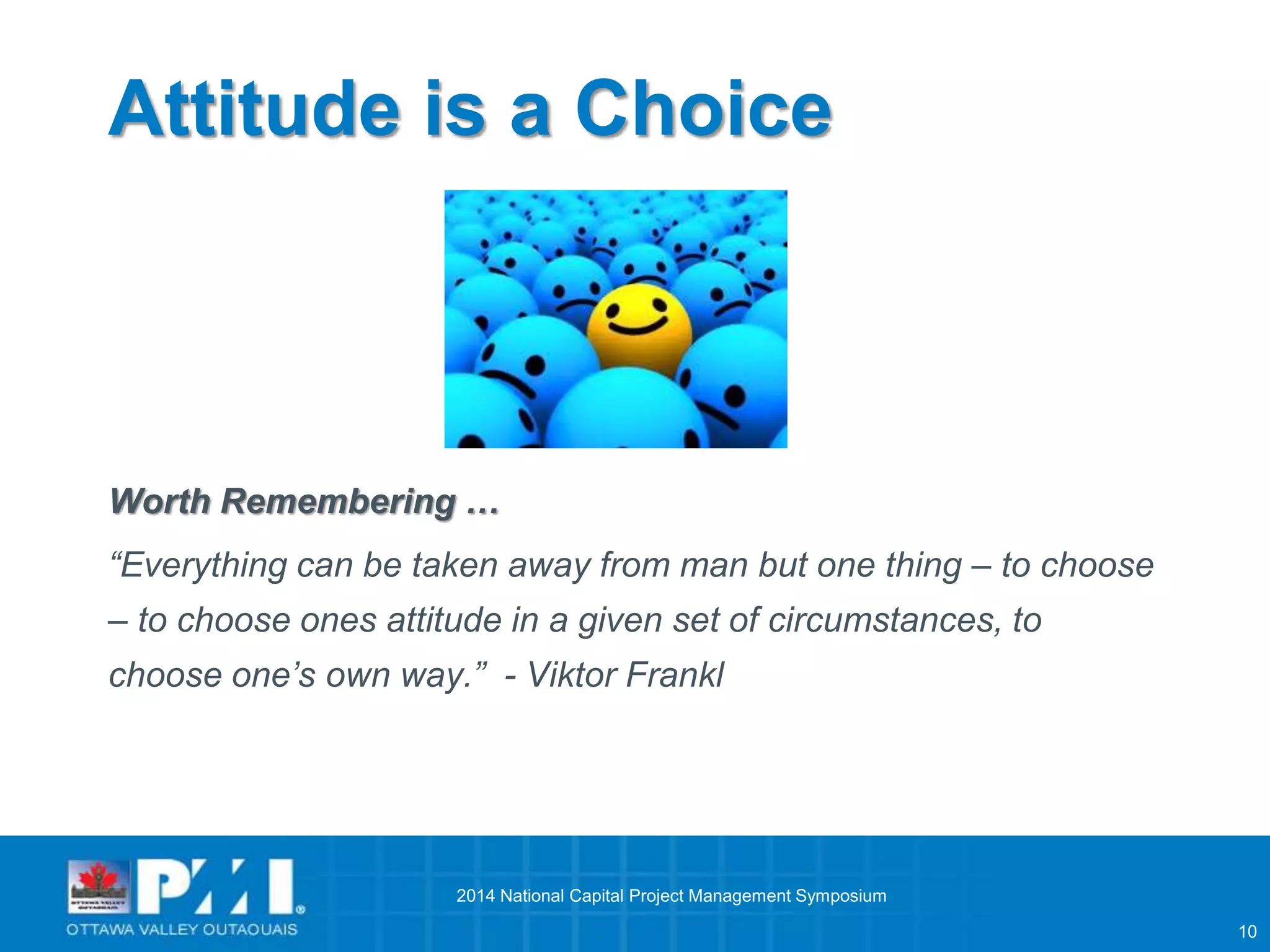
Attitude is a Choice 
Worth Remembering … 
“Everything can be taken away from man but one thing – to choose 
– to choose ones attitude in a given set of circumstances, to 
choose one’s own way.” - Viktor Frankl 
2014 National Capital Project Management Symposium
11 
More About Attitude 
• Everybody has one 
• Not two are exactly the same 
• It’s 100% in your control 
• It’s a matter of choice 
• How would the people you work with and interact with rate your 
attitude? 
2014 National Capital Project Management Symposium
12 
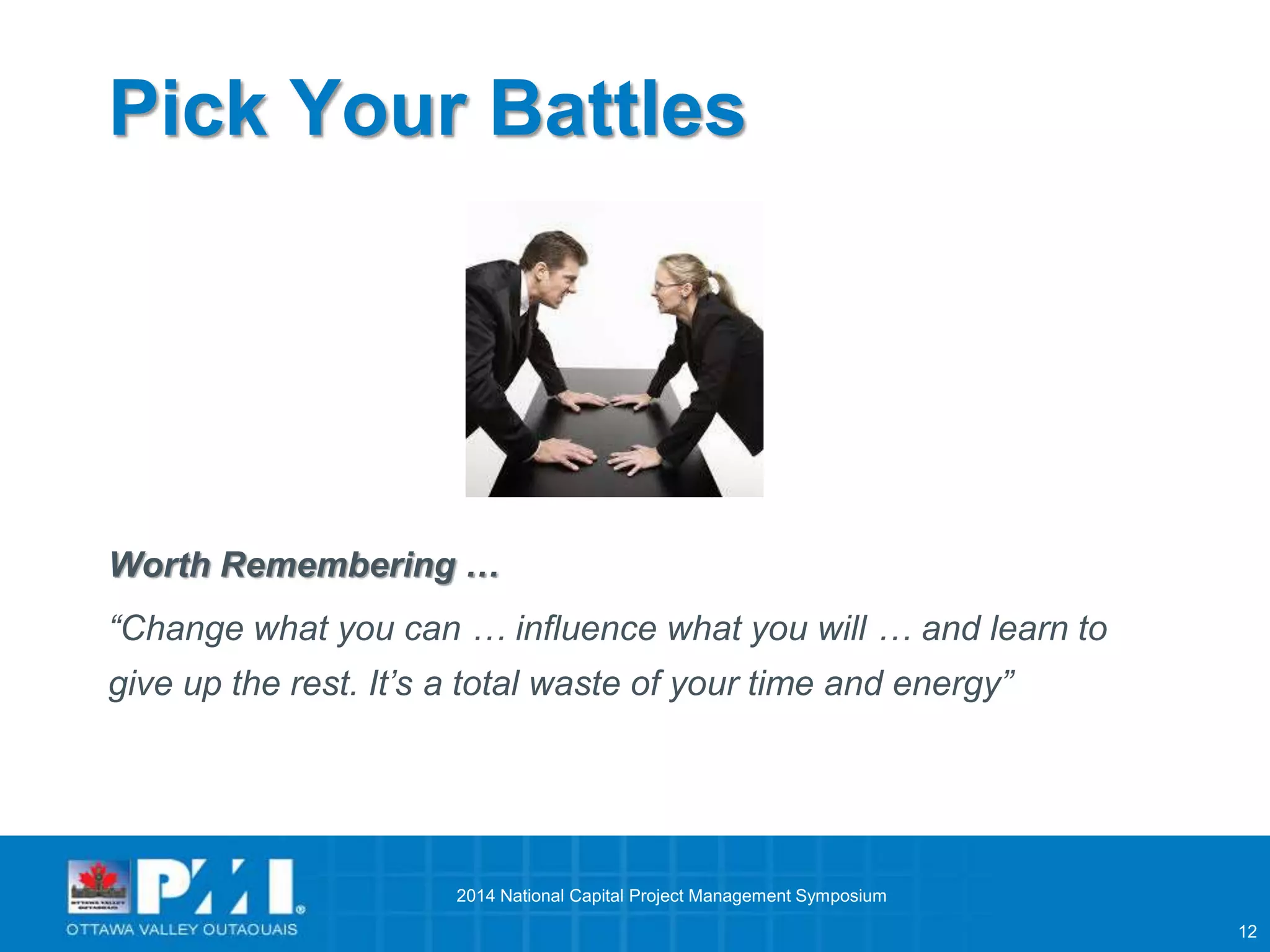
Pick Your Battles 
Worth Remembering … 
“Change what you can … influence what you will … and learn to 
give up the rest. It’s a total waste of your time and energy” 
2014 National Capital Project Management Symposium
13 
Understanding Behaviour 
Worth Remembering … 
“Humans are the only creatures who refuse to be who they are. “ 
- Albert Camus 
2014 National Capital Project Management Symposium
14 
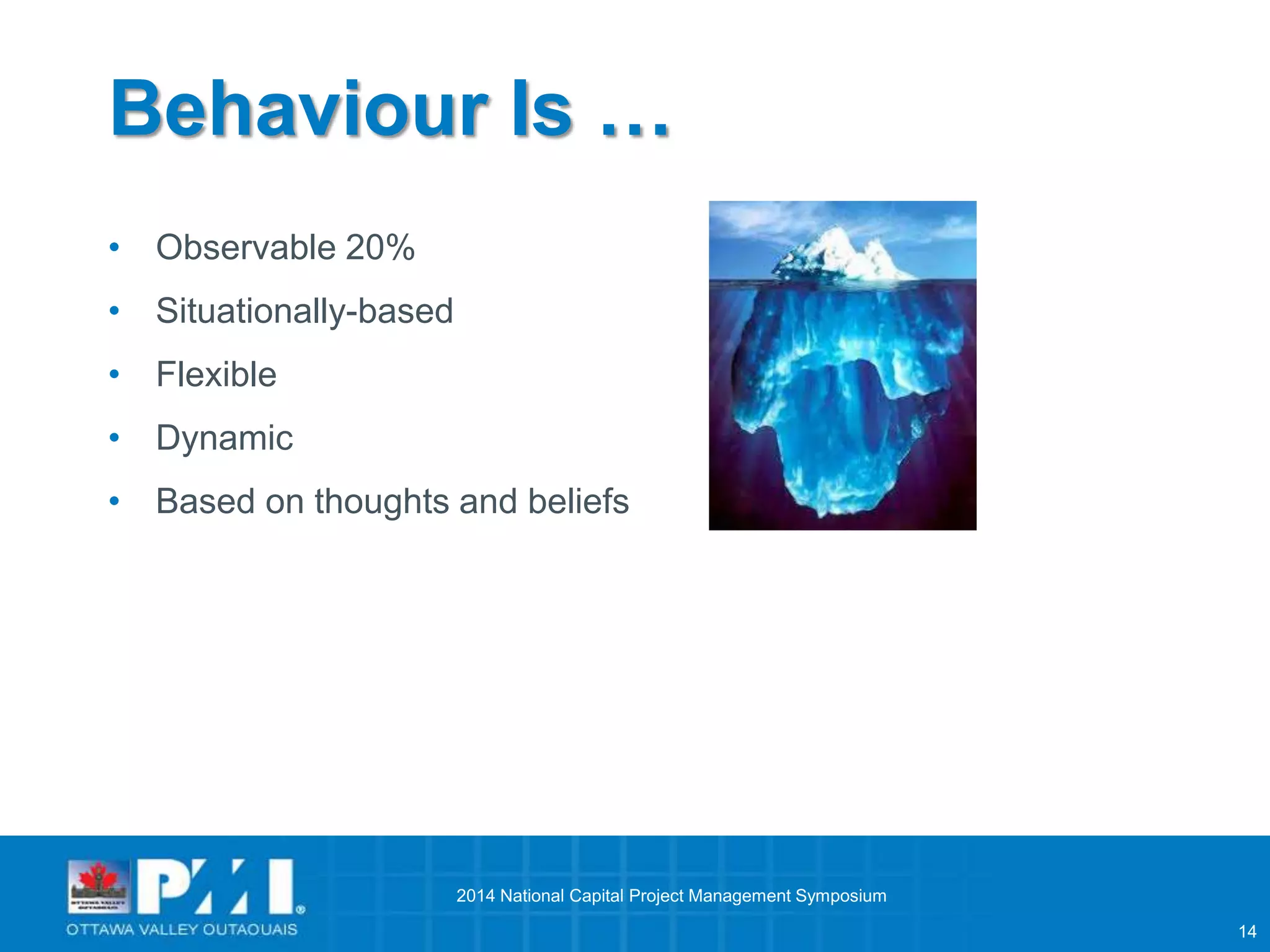
Behaviour Is … 
• Observable 20% 
• Situationally-based 
• Flexible 
• Dynamic 
• Based on thoughts and beliefs 
2014 National Capital Project Management Symposium
15 
Analyzing Your Boss 
• If you could change just one thing about your Boss what would it 
be? 
2014 National Capital Project Management Symposium
16 
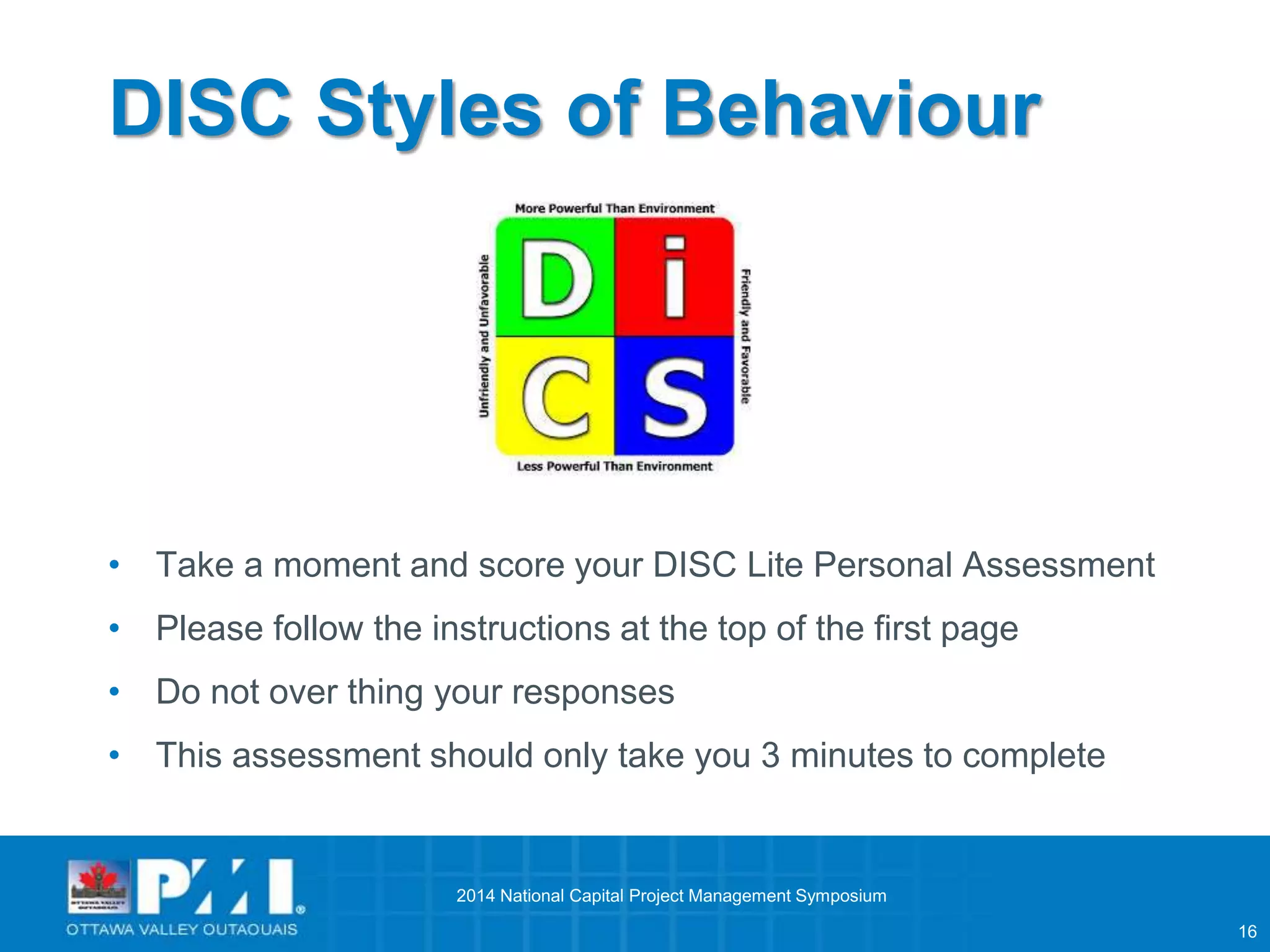
DISC Styles of Behaviour 
• Take a moment and score your DISC Lite Personal Assessment 
• Please follow the instructions at the top of the first page 
• Do not over thing your responses 
• This assessment should only take you 3 minutes to complete 
2014 National Capital Project Management Symposium
17 
An Ah-Ha Moment 
Awareness 
Brings 
Effectiveness 
2014 National Capital Project Management Symposium
18 
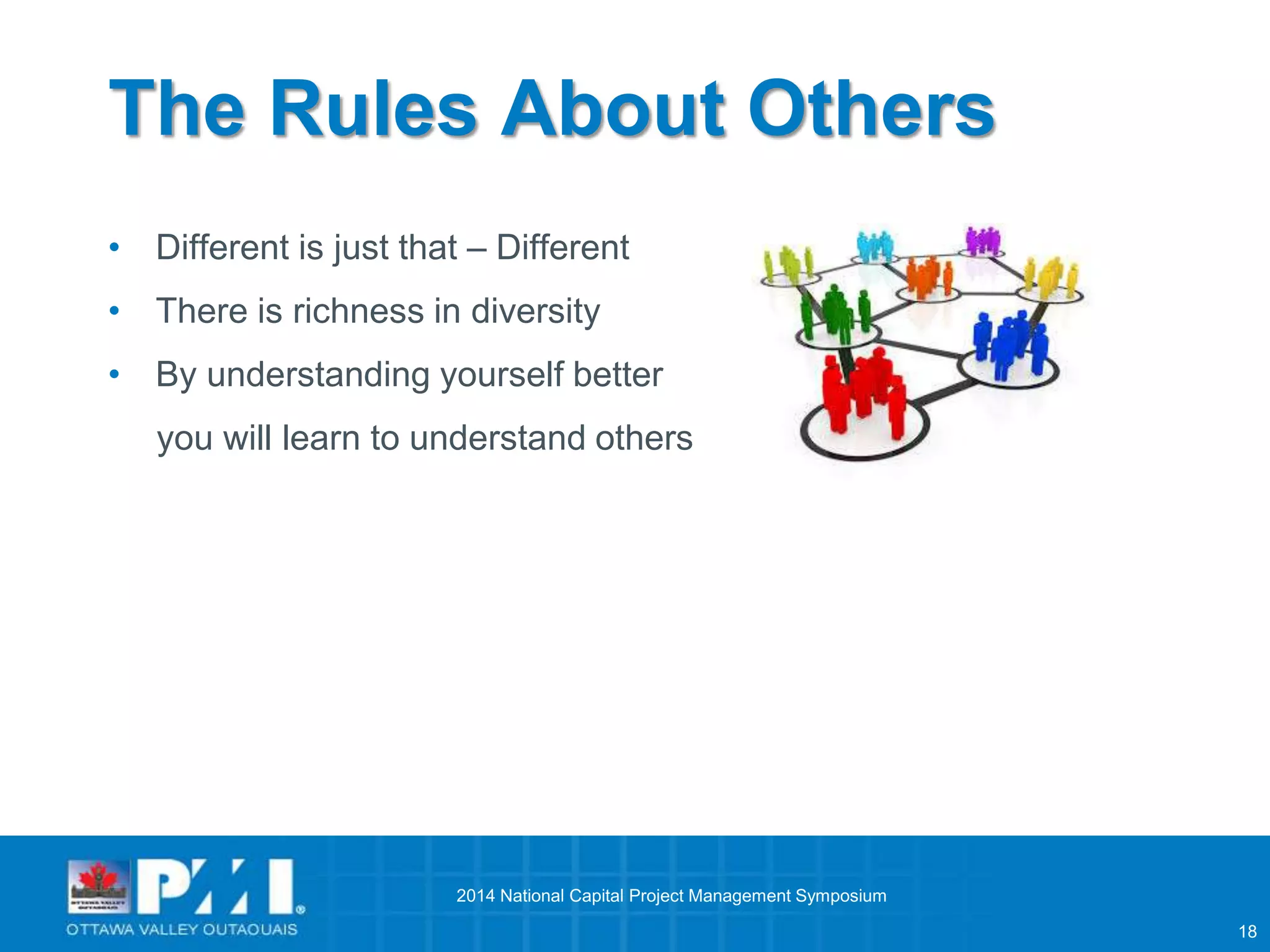
The Rules About Others 
• Different is just that – Different 
• There is richness in diversity 
• By understanding yourself better 
you will learn to understand others 
2014 National Capital Project Management Symposium
19 
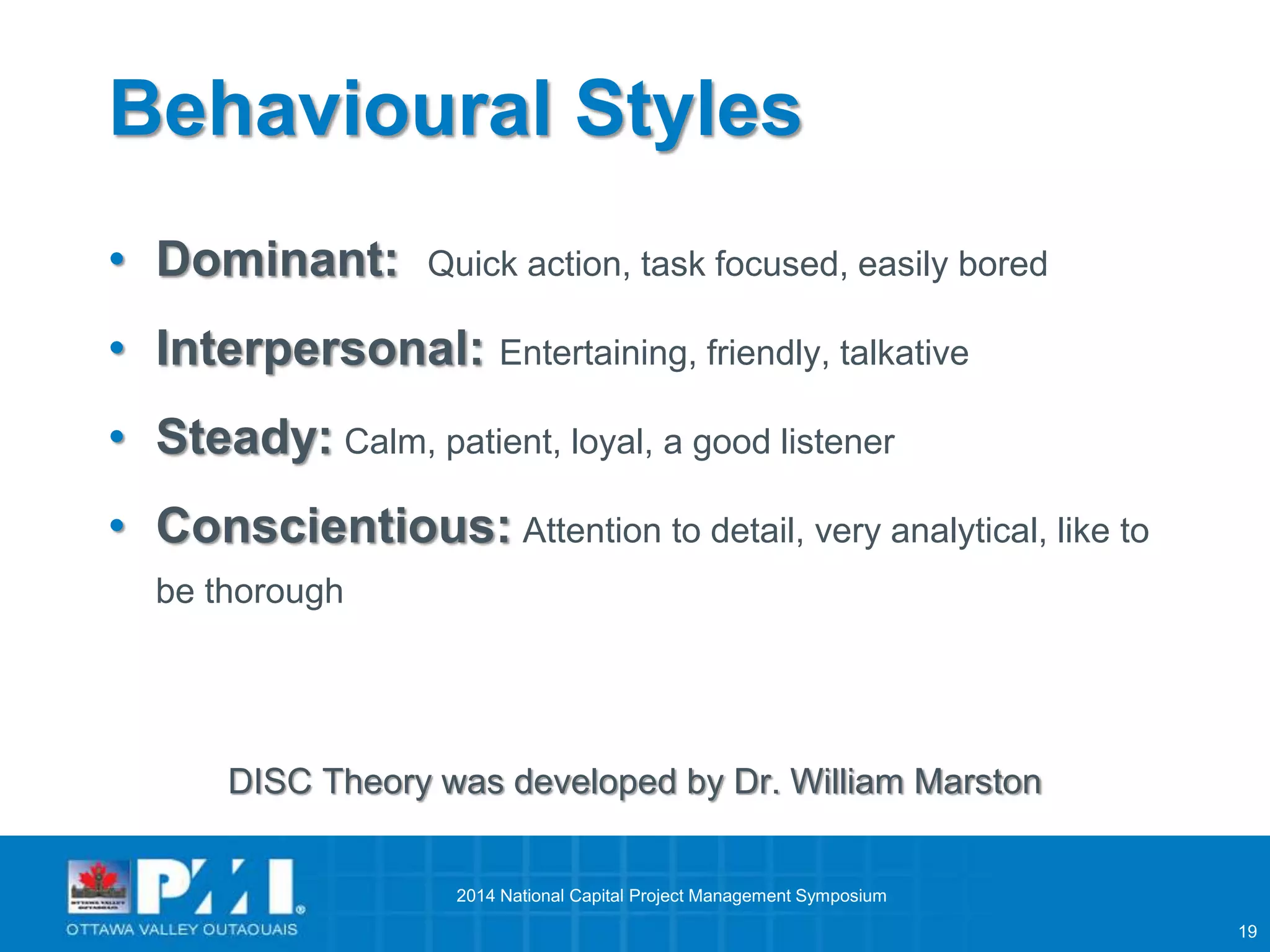
Behavioural Styles 
• Dominant: Quick action, task focused, easily bored 
• Interpersonal: Entertaining, friendly, talkative 
• Steady: Calm, patient, loyal, a good listener 
• Conscientious: Attention to detail, very analytical, like to 
be thorough 
DISC Theory was developed by Dr. William Marston 
2014 National Capital Project Management Symposium
20 
More About D’s 
Shapes the environment by overcoming opposition to accomplish 
results. 
Tendencies: 
• Getting immediate results 
• Accepting challenges 
• Making quick decisions 
• Taking authority 
• Questioning the status quo 
• Solving problems 
2014 National Capital Project Management Symposium
21 
Limitations 
• May come across as unapproachable 
• Can be insensitive to others 
• Show impatience with others 
• Try to move the team or individual before they are ready 
• May seem intimidating 
• Blunt, demanding approaches 
• Little social interaction 
2014 National Capital Project Management Symposium
22 
Preferred Environment 
• Power and authority 
• Prestige and challenge 
• Direct answers 
• A wide scope of operations 
• Opportunities for individual accomplishments 
• Opportunities for advancement 
• Freedom from controls and supervision 
• Many new and varied activities 
2014 National Capital Project Management Symposium
23 
Increase Your Effectiveness 
• Develop more patience 
• Toning down your directness and asking more questions 
• Work on your body language to seem more approachable and 
offering more encouragement in conversation 
• Spend more time with those you direct 
2014 National Capital Project Management Symposium
24 
More About I’s 
Shapes the environment by influencing or persuading others 
Tendencies: 
• Contacting people 
• Making a good impression 
• Being articulate 
• Creating a motivational environment 
• Entertaining people 
• Being optimistic 
• Participating in a group 
2014 National Capital Project Management Symposium
25 
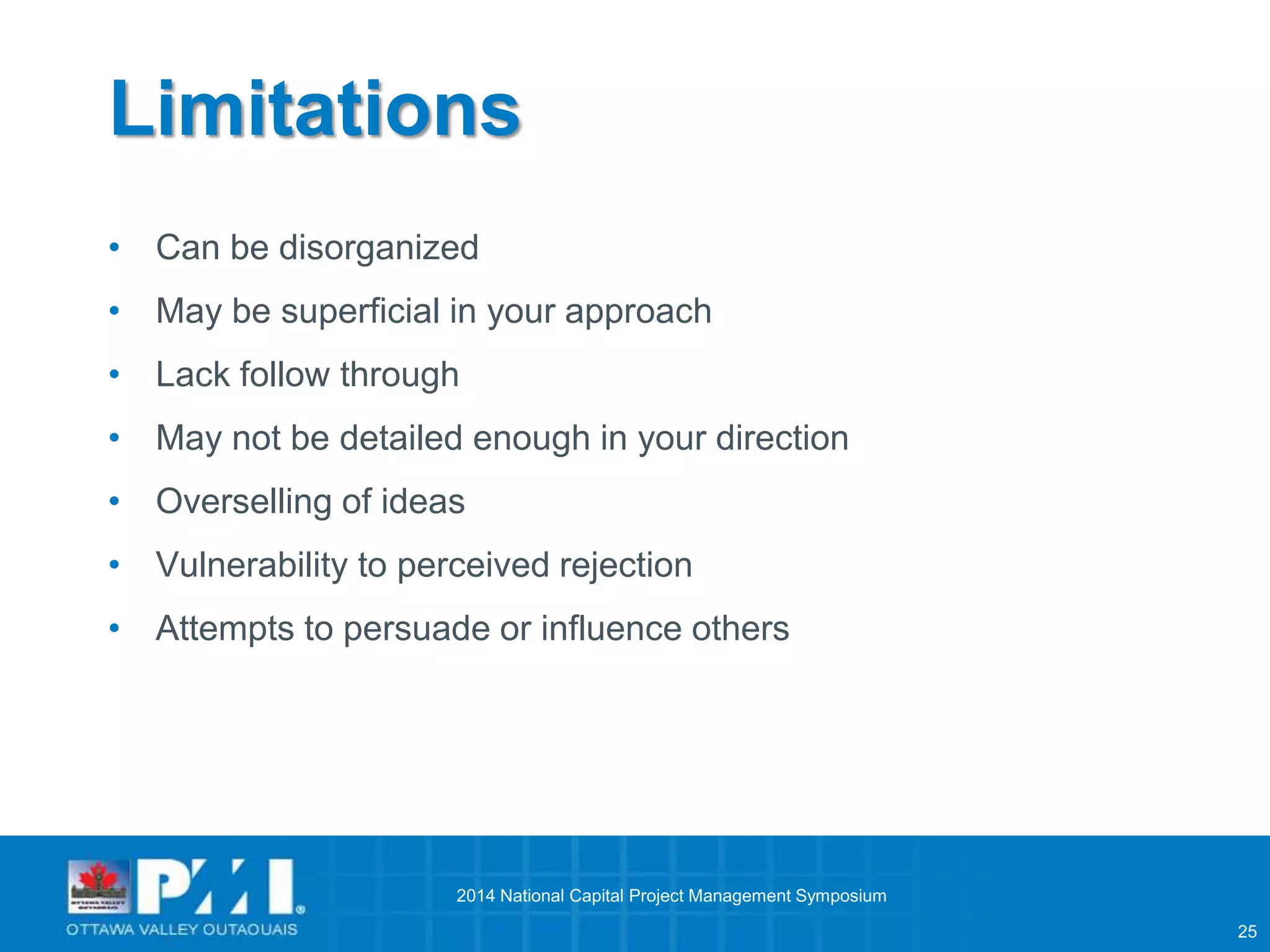
Limitations 
• Can be disorganized 
• May be superficial in your approach 
• Lack follow through 
• May not be detailed enough in your direction 
• Overselling of ideas 
• Vulnerability to perceived rejection 
• Attempts to persuade or influence others 
2014 National Capital Project Management Symposium
26 
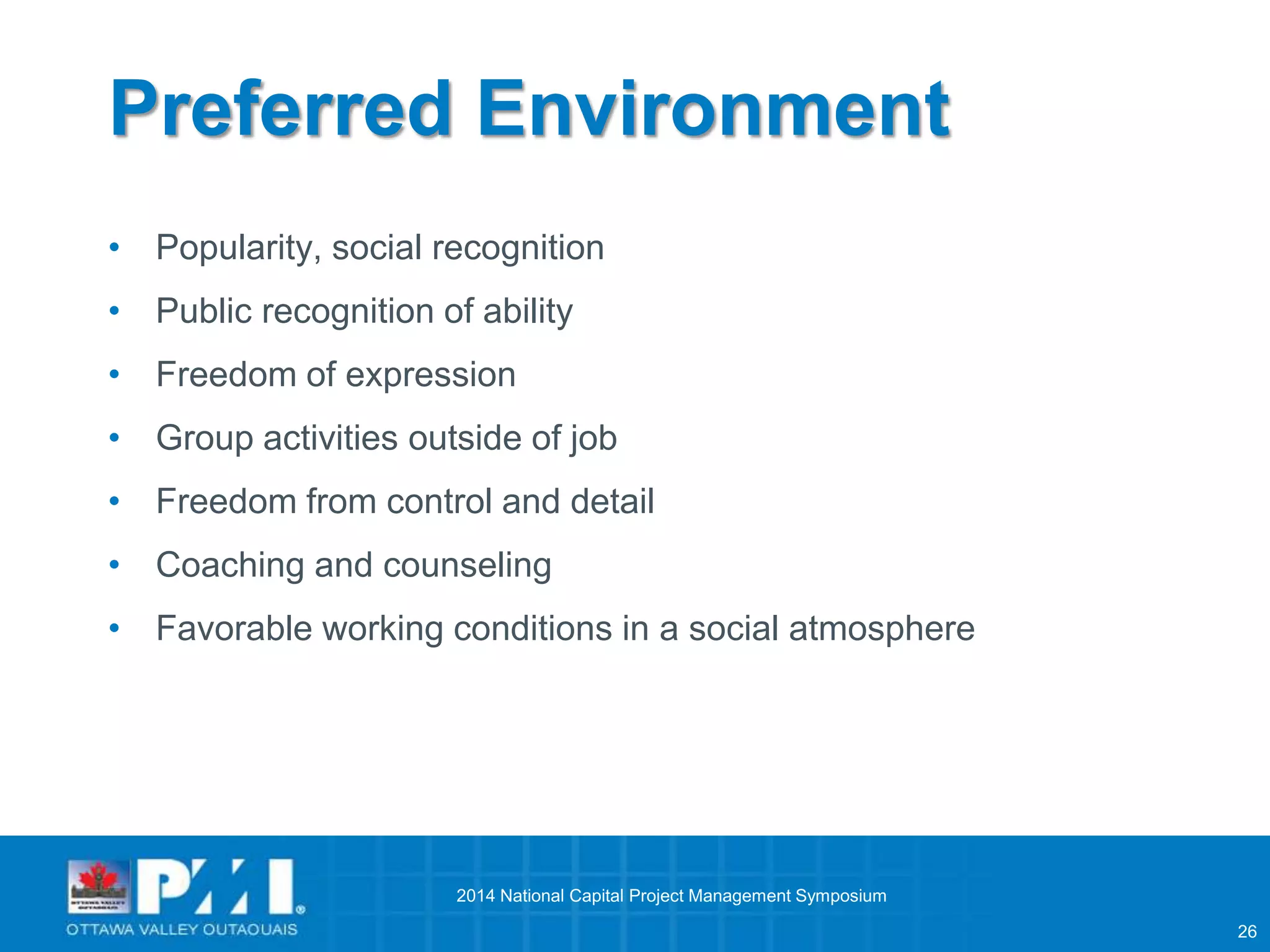
Preferred Environment 
• Popularity, social recognition 
• Public recognition of ability 
• Freedom of expression 
• Group activities outside of job 
• Freedom from control and detail 
• Coaching and counseling 
• Favorable working conditions in a social atmosphere 
2014 National Capital Project Management Symposium
27 
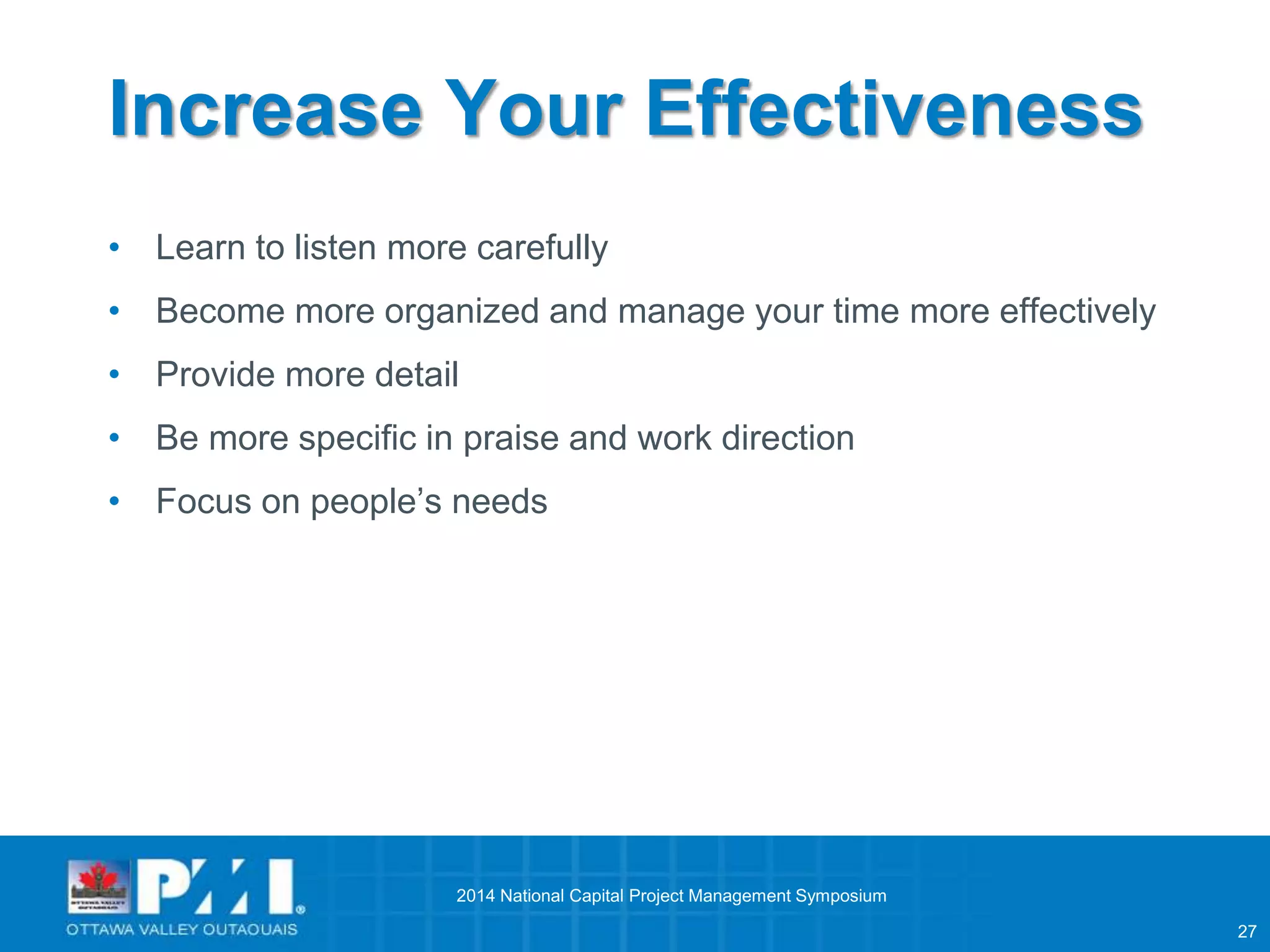
Increase Your Effectiveness 
• Learn to listen more carefully 
• Become more organized and manage your time more effectively 
• Provide more detail 
• Be more specific in praise and work direction 
• Focus on people’s needs 
2014 National Capital Project Management Symposium
28 
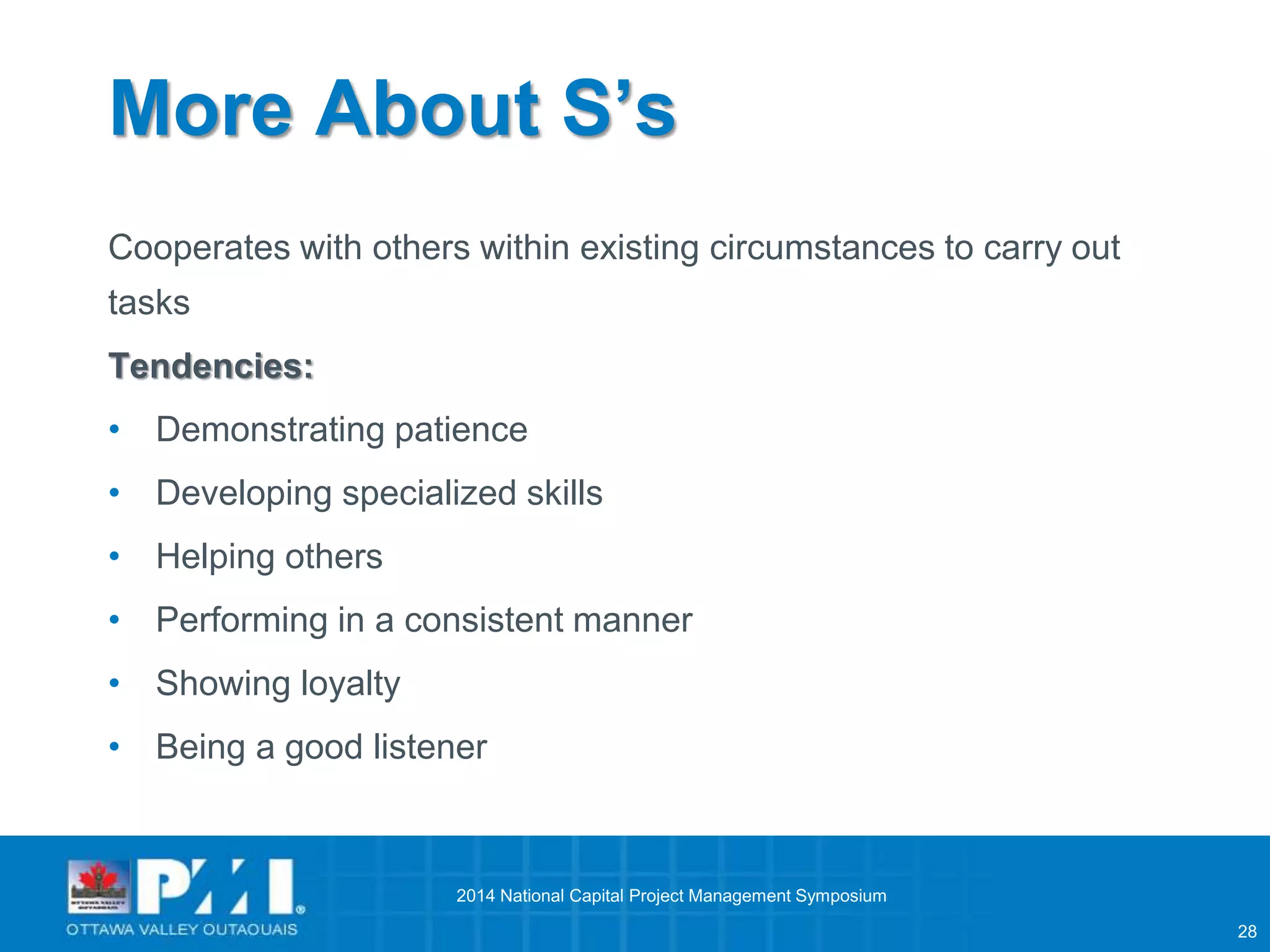
More About S’s 
Cooperates with others within existing circumstances to carry out 
tasks 
Tendencies: 
• Demonstrating patience 
• Developing specialized skills 
• Helping others 
• Performing in a consistent manner 
• Showing loyalty 
• Being a good listener 
2014 National Capital Project Management Symposium
29 
Limitations 
• Can be indecisive 
• May be indirect 
• Resist change 
• May be hesitant to implement needed change 
• Difficulty identifying priorities 
• Difficulty with deadlines 
2014 National Capital Project Management Symposium
30 
Preferred Environment 
• Maintenance of status quo 
• Predictable routines 
• Credit for work accomplished 
• Minimal work infringement on home life 
• Sincere appreciation 
• Identification with a group 
• Minimal conflict 
2014 National Capital Project Management Symposium
31 
Increase Your Effectiveness 
• Become more assertive and direct 
• Learn to cope better with change 
• Try to not carry the burden of everyone else’s problems 
2014 National Capital Project Management Symposium
32 
More About C’s 
Works conscientiously within existing circumstances to ensure 
accuracy and quality. 
Tendencies: 
• Concentrating on key details 
• Being diplomatic 
• Checking for accuracy 
• Adhering to key directives and standards 
• Thinking analytically 
• Using a systematic approach to situations 
2014 National Capital Project Management Symposium
33 
Limitations 
• Can be overly concerned with perfection 
• Act aloof 
• Tend to hamper other’s creativity by sticking to the rules 
• Discomfort with ambiguity 
• Resistance to vague or general information 
• Desires to double check for accuracy 
• Little need for affiliation with others 
2014 National Capital Project Management Symposium
34 
Preferred Environment 
• Control of those factors that affect their performance 
• Clearly defined performance expectations 
• Values on quality and accuracy 
• A reserve, business like atmosphere 
• Recognition for specific skills and accomplishments 
2014 National Capital Project Management Symposium
35 
Increase Your Effectiveness 
• Accept the differences in others 
• Be more open 
• Focus on communicating and interacting more effectively 
• Encourage others creativity 
2014 National Capital Project Management Symposium
36 
Strength or Weakness? 
Dominant: Good at directing and deciding, but may become 
autocratic. 
Interactive / Interpersonal: Good at promoting and persuading, 
but may oversell and manipulate 
Steadiness: Good at being steady and agreeable, but may give in 
despite their needs 
Conscientious: Good at analyzing and checking, but may 
become perfectionistic and indecisive 
2014 National Capital Project Management Symposium
37 
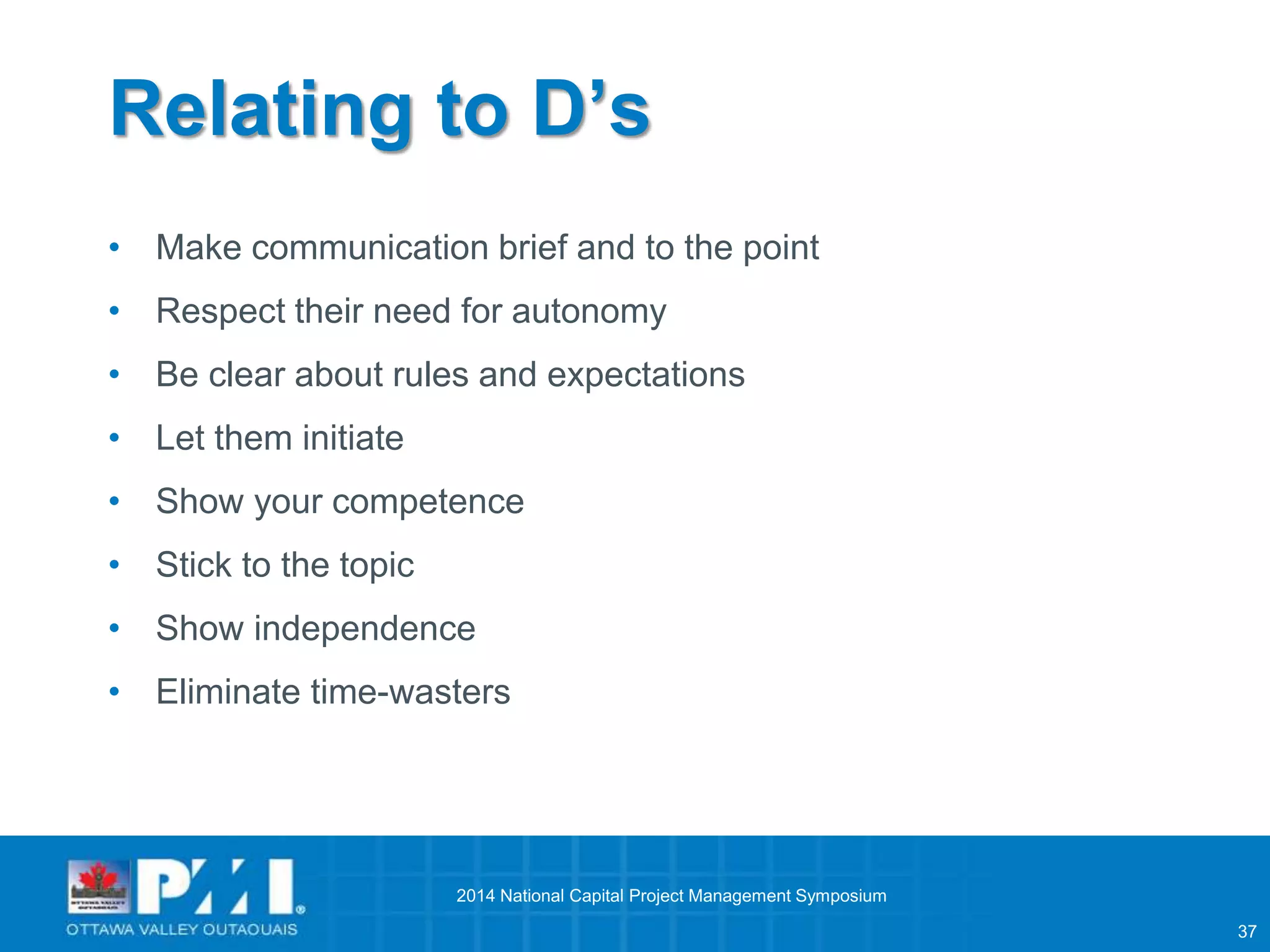
Relating to D’s 
• Make communication brief and to the point 
• Respect their need for autonomy 
• Be clear about rules and expectations 
• Let them initiate 
• Show your competence 
• Stick to the topic 
• Show independence 
• Eliminate time-wasters 
2014 National Capital Project Management Symposium
38 
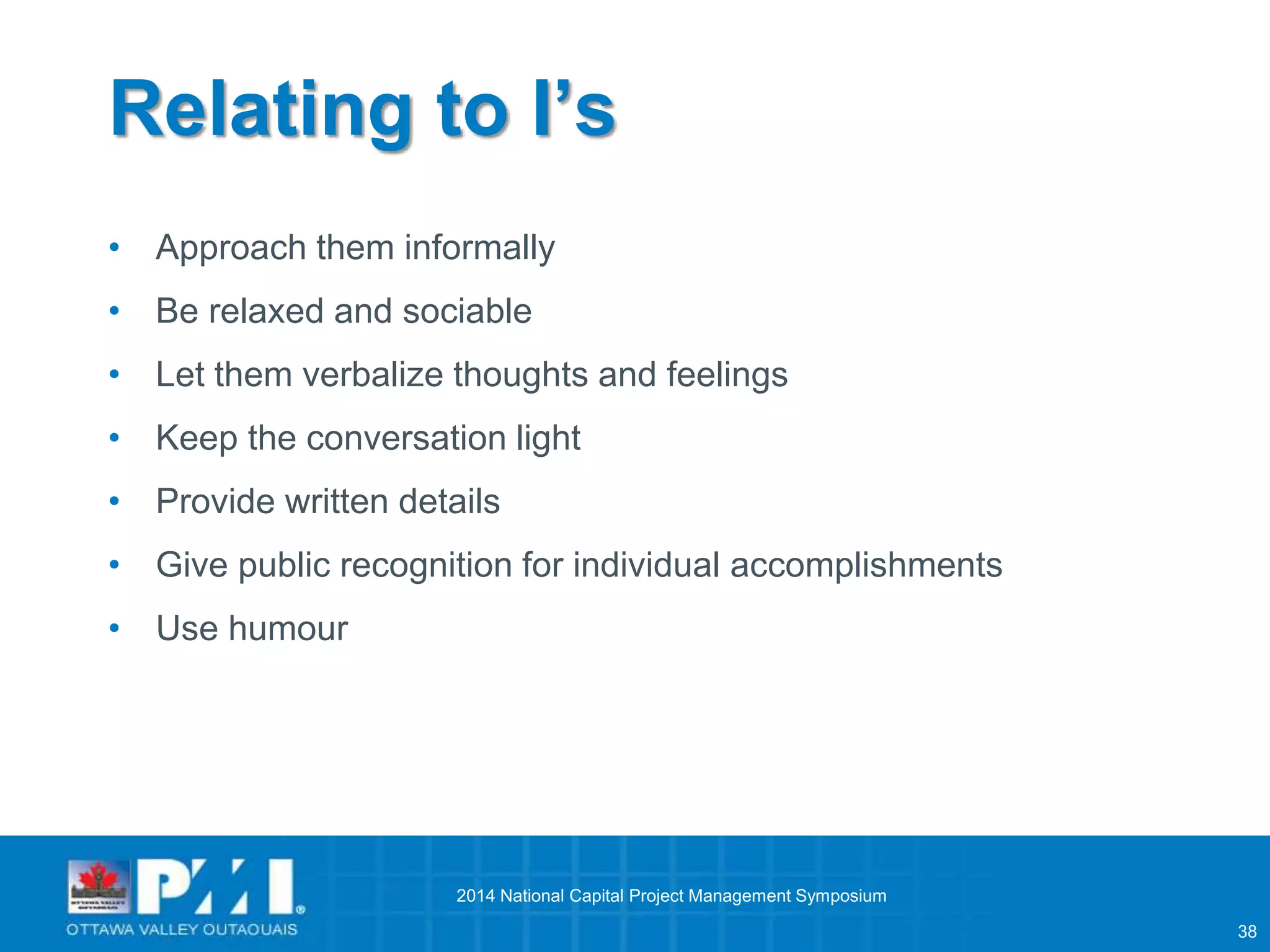
Relating to I’s 
• Approach them informally 
• Be relaxed and sociable 
• Let them verbalize thoughts and feelings 
• Keep the conversation light 
• Provide written details 
• Give public recognition for individual accomplishments 
• Use humour 
2014 National Capital Project Management Symposium
39 
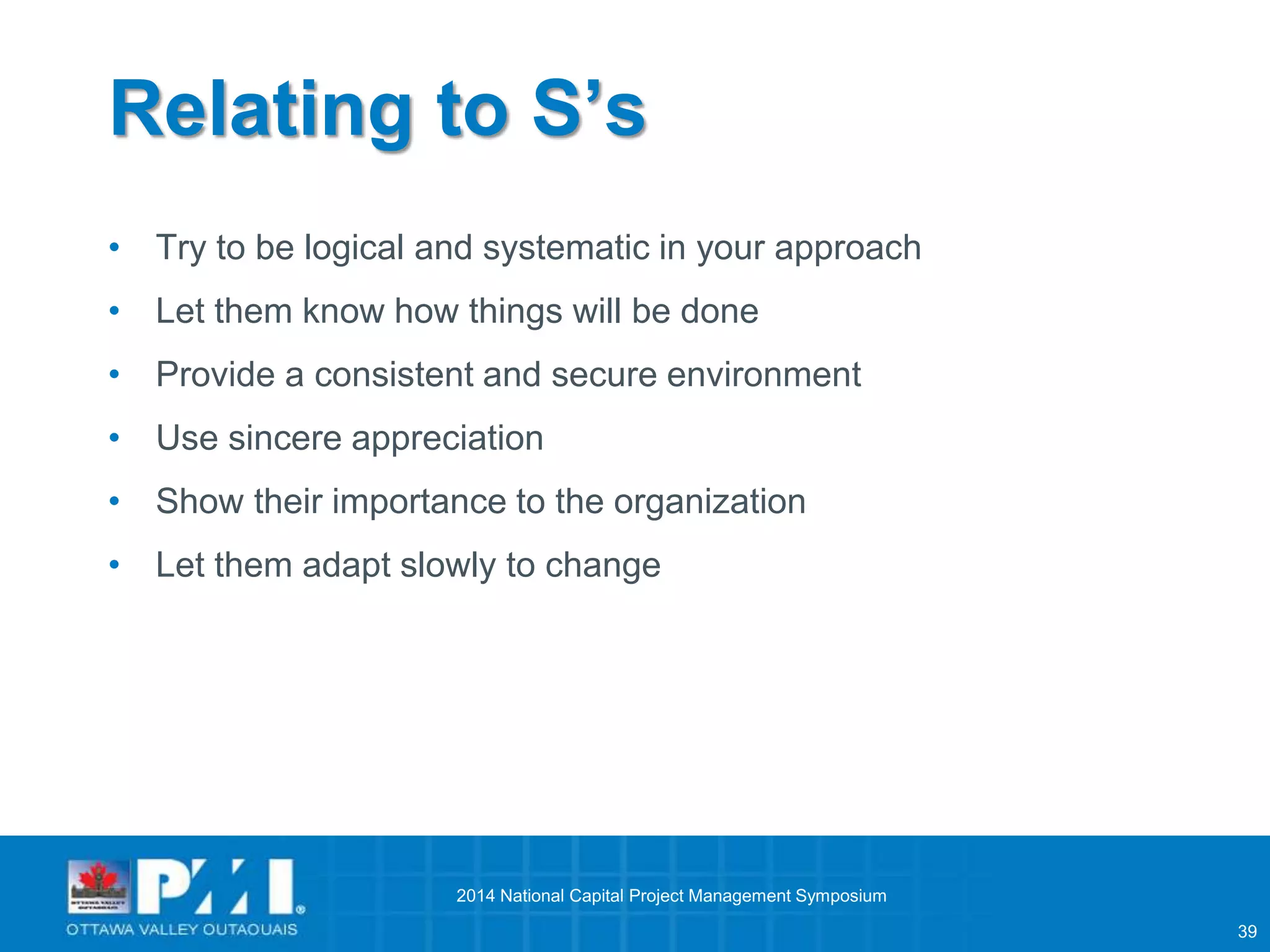
Relating to S’s 
• Try to be logical and systematic in your approach 
• Let them know how things will be done 
• Provide a consistent and secure environment 
• Use sincere appreciation 
• Show their importance to the organization 
• Let them adapt slowly to change 
2014 National Capital Project Management Symposium
40 
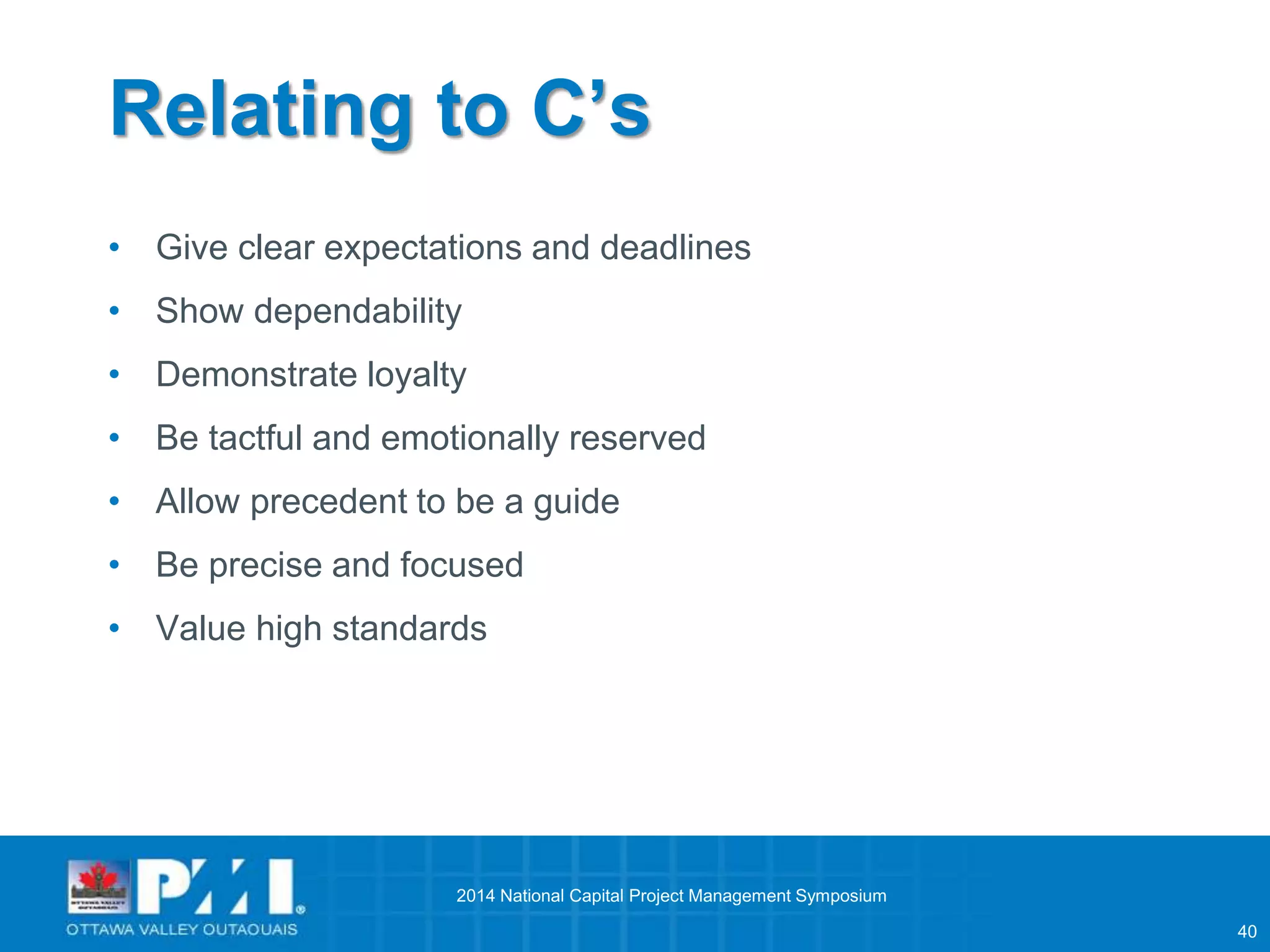
Relating to C’s 
• Give clear expectations and deadlines 
• Show dependability 
• Demonstrate loyalty 
• Be tactful and emotionally reserved 
• Allow precedent to be a guide 
• Be precise and focused 
• Value high standards 
2014 National Capital Project Management Symposium
41 
Good Habits = Good Results 
Worth Remembering … 
“Excellence is not an act but a habit. The things you do the most 
are the things you do the best.” 
- Marva Collins 
2014 National Capital Project Management Symposium
42 
New Beginnings 
C – Commit to a new beginning 
H – Habits. Stop one, start another 
A – Action not words 
N – Never give up 
G – Goal oriented. Set targets 
E – Evaluate your plan 
2014 National Capital Project Management Symposium
43 
Think It - Act It - Become It 
• What do you need to do to adapt your style to be more in tune 
with your bosses style? 
• What changes need to be made at work or at home to help you 
cope with stress? 
• What challenges do you need to overcome so you can deal with 
difficult people and challenging situations better? 
• What new skills will you need to learn so you can communicate 
and interact more effectively with others? 
2014 National Capital Project Management Symposium
44 
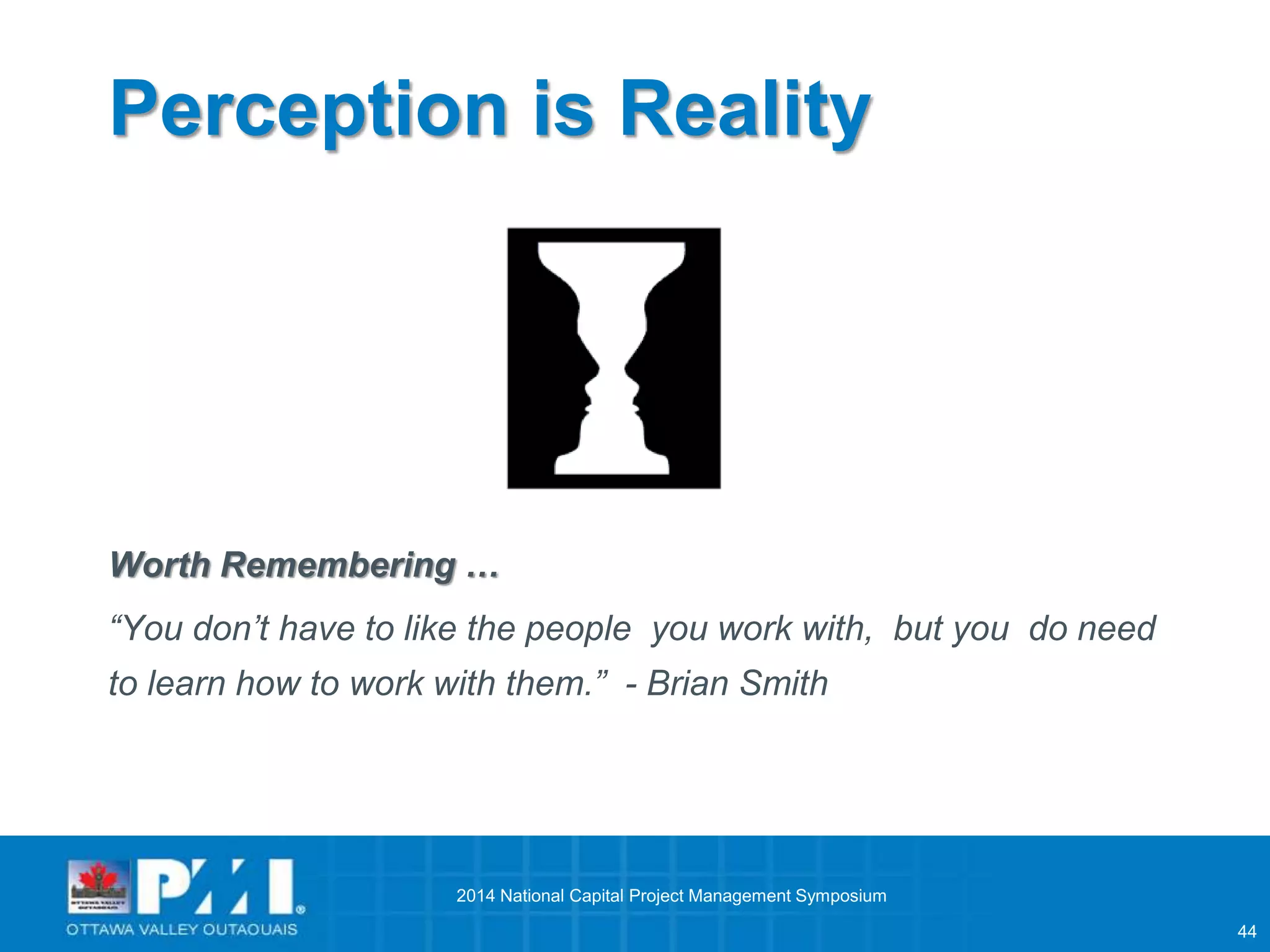
Perception is Reality 
Worth Remembering … 
“You don’t have to like the people you work with, but you do need 
to learn how to work with them.” - Brian Smith 
2014 National Capital Project Management Symposium
45 
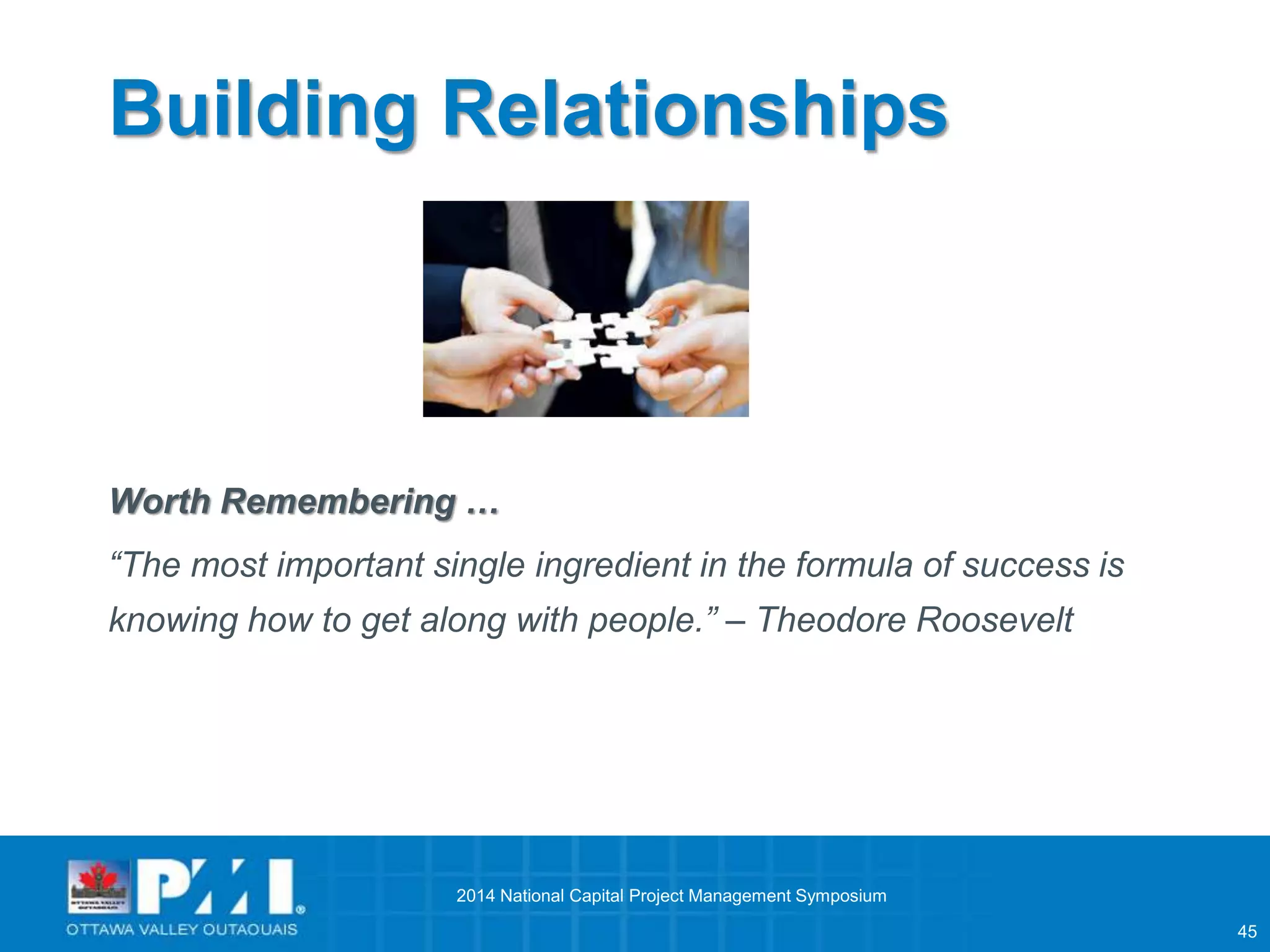
Building Relationships 
Worth Remembering … 
“The most important single ingredient in the formula of success is 
knowing how to get along with people.” – Theodore Roosevelt 
2014 National Capital Project Management Symposium
46 
The 3 R’s 
R– Rapport : Get to know them for more than the work they do. 
What do they like to do outside of work? 
R– Relationship: You can’t develop a relationship with 
someone until you have established rapport 
R – Respect : You won’t respect anyone that you haven’t 
established a relationship with first. 
2014 National Capital Project Management Symposium
47 
Managing Your Boss 
According to John J. Gabarro and John P. Kotter in a recent article 
published in the Harvard Business Review they believe there are 
four key components to developing and managing a relationship 
with your Boss. 
1. Compatible Work Styles 
2. Mutual expectations 
3. Dependability and honesty 
4. Good use of time and resources 
2014 National Capital Project Management Symposium
48 
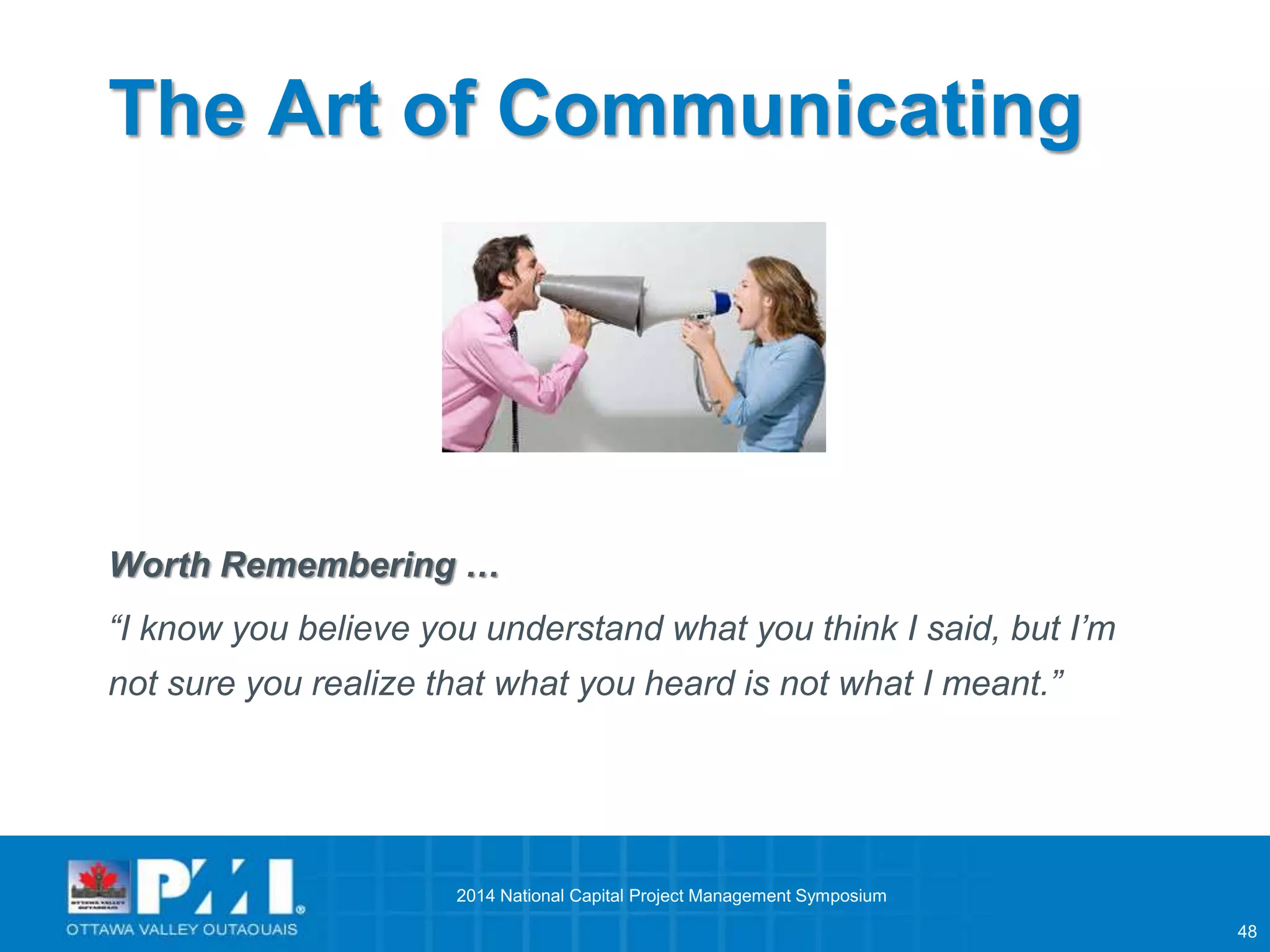
The Art of Communicating 
Worth Remembering … 
“I know you believe you understand what you think I said, but I’m 
not sure you realize that what you heard is not what I meant.” 
2014 National Capital Project Management Symposium
49 
Questions Worth Answering 
• What skills does it take to be a good communicator? 
• What are some of the road blocks to good communication? 
2014 National Capital Project Management Symposium
50 
Communication Realities 
• You cannot not communicate 
• When ever contact is made communication occurs 
• Meanings are in people not in words 
• All types of communications are received but 70 to 90% are 
screened out or changed by the receiver 
• You communicate 93% of the time non-verbally 
• Most people perceive the non-verbal as being more accurate 
Based on the research of Dr. Ralph Nichols. “Are You Listening” 
2014 National Capital Project Management Symposium
51 
Communication Styles 
• How can you communicate more effectively with a “D” 
• How can you communicate more effectively with a “I” 
• How can you communicate more effectively with a “S” 
• How can you communicate more effectively with a “C” 
2014 National Capital Project Management Symposium
52 
Tune Out or Turned Off? 
• Humans have the ability to listen at a rate of 
____________ words a minute 
• Humans have the ability to speak at a rate of 
____________ words a minute 
• Based on those two numbers ____________ words a 
minute are lost in translation 
Based on the research of Dr. Ralph Nichols “Are You Listening” 
2014 National Capital Project Management Symposium
53 
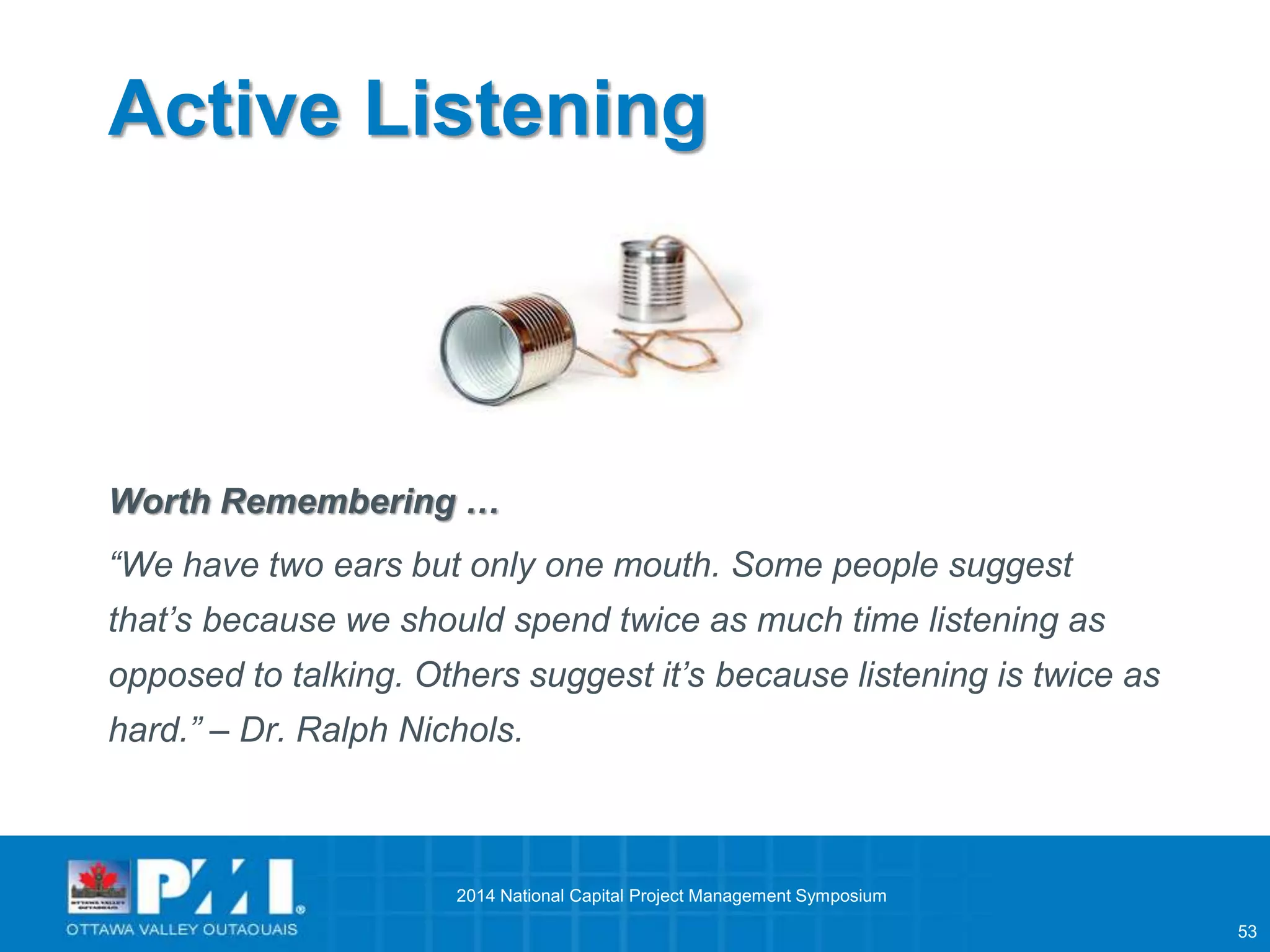
Active Listening 
Worth Remembering … 
“We have two ears but only one mouth. Some people suggest 
that’s because we should spend twice as much time listening as 
opposed to talking. Others suggest it’s because listening is twice as 
hard.” – Dr. Ralph Nichols. 
2014 National Capital Project Management Symposium
54 
Questions Worth Answering 
• What skills does it take to be a good listener? 
• What gets in the way of being a good listener? 
2014 National Capital Project Management Symposium
55 
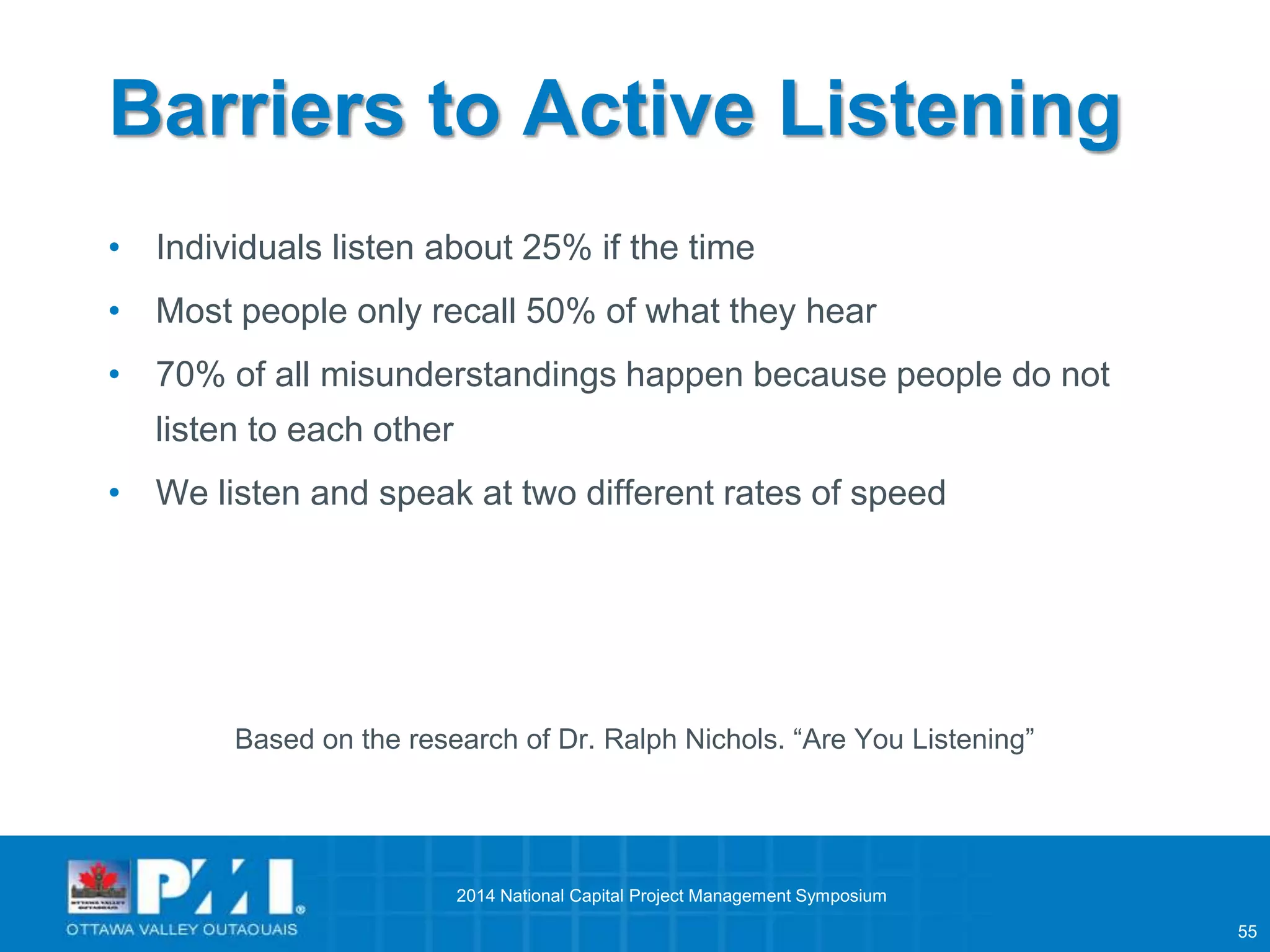
Barriers to Active Listening 
• Individuals listen about 25% if the time 
• Most people only recall 50% of what they hear 
• 70% of all misunderstandings happen because people do not 
listen to each other 
• We listen and speak at two different rates of speed 
Based on the research of Dr. Ralph Nichols. “Are You Listening” 
2014 National Capital Project Management Symposium
56 
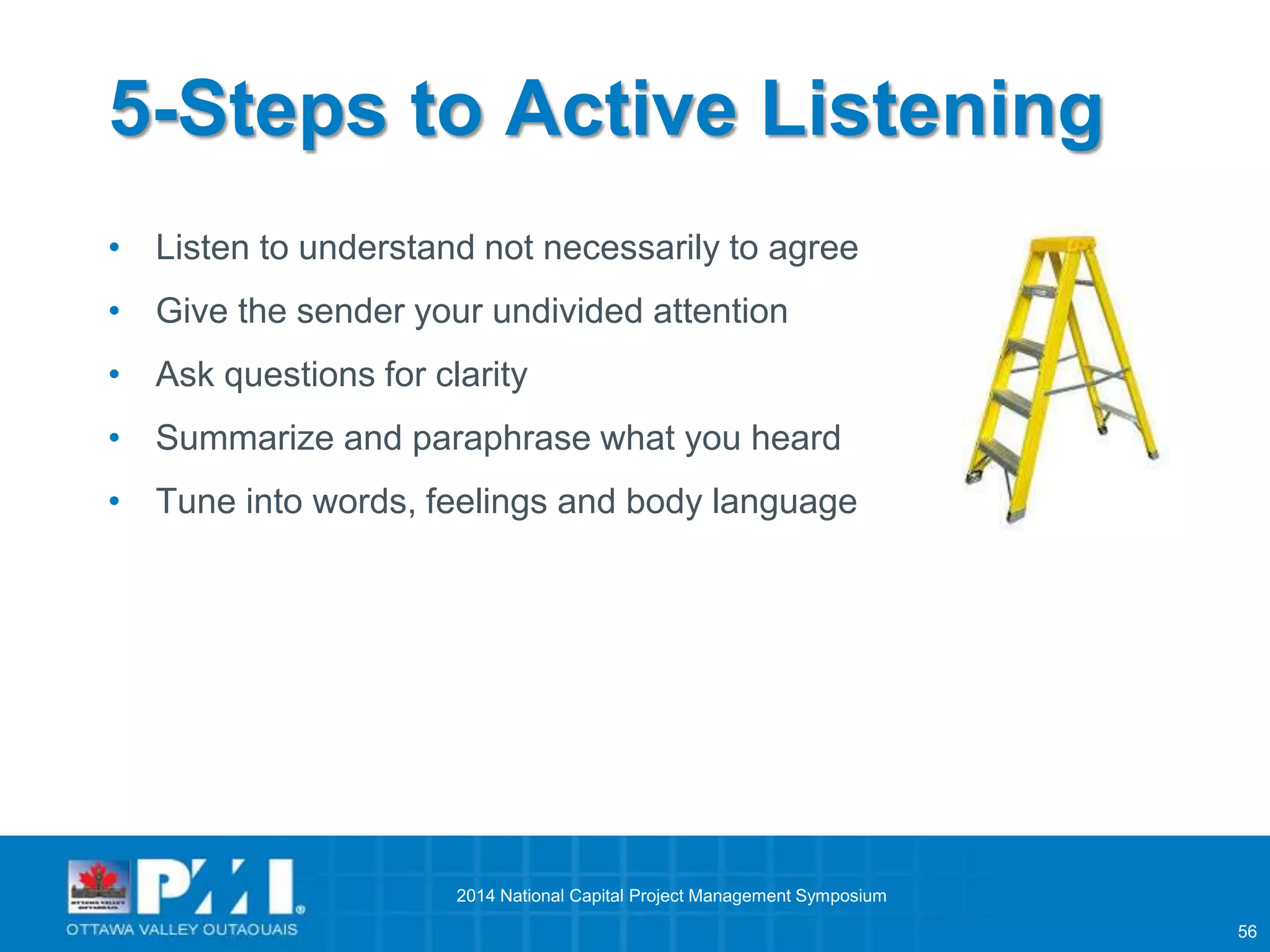
5-Steps to Active Listening 
• Listen to understand not necessarily to agree 
• Give the sender your undivided attention 
• Ask questions for clarity 
• Summarize and paraphrase what you heard 
• Tune into words, feelings and body language 
2014 National Capital Project Management Symposium
57 
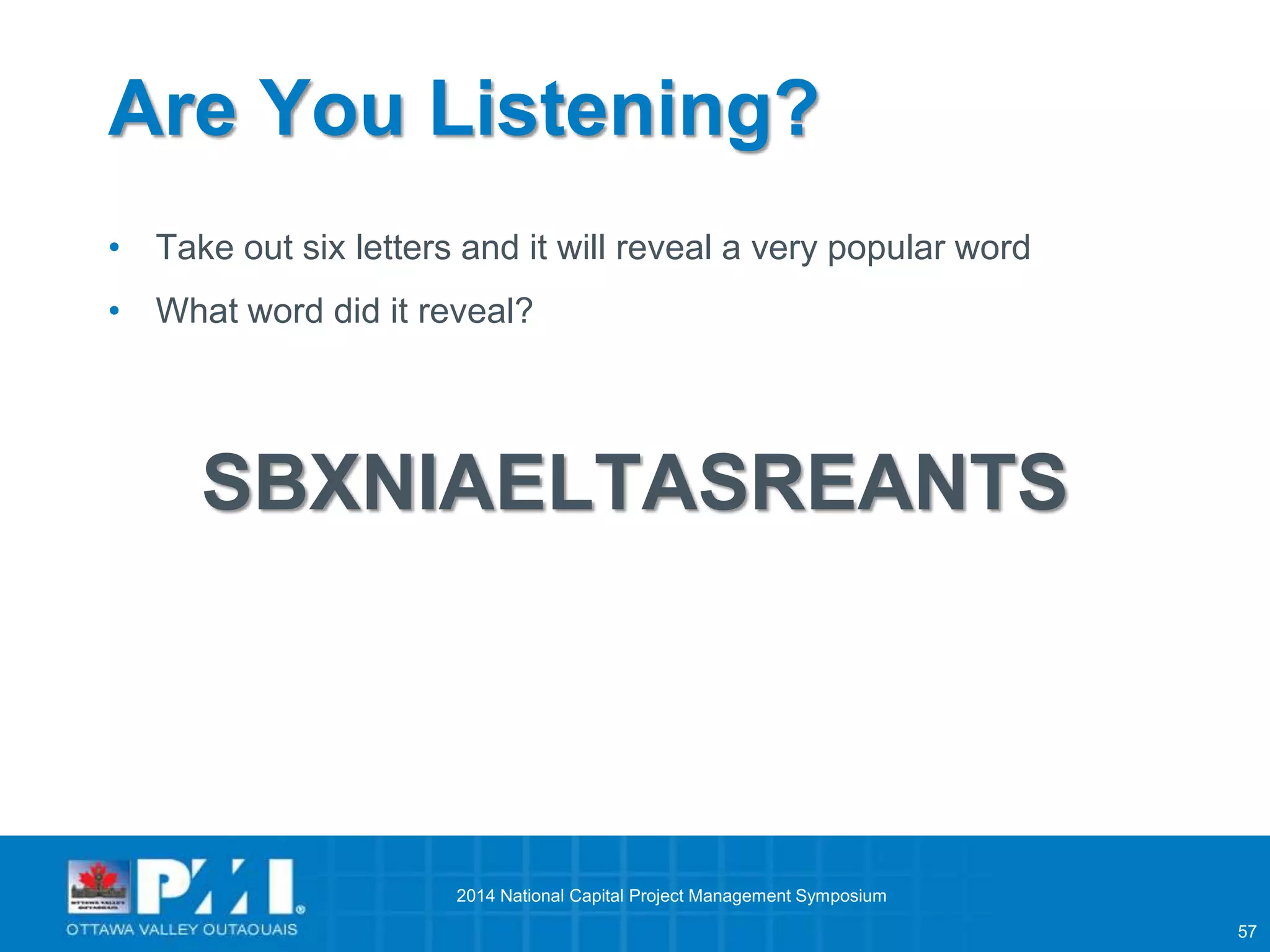
Are You Listening? 
• Take out six letters and it will reveal a very popular word 
• What word did it reveal? 
SBXNIAELTASREANTS 
2014 National Capital Project Management Symposium
58 
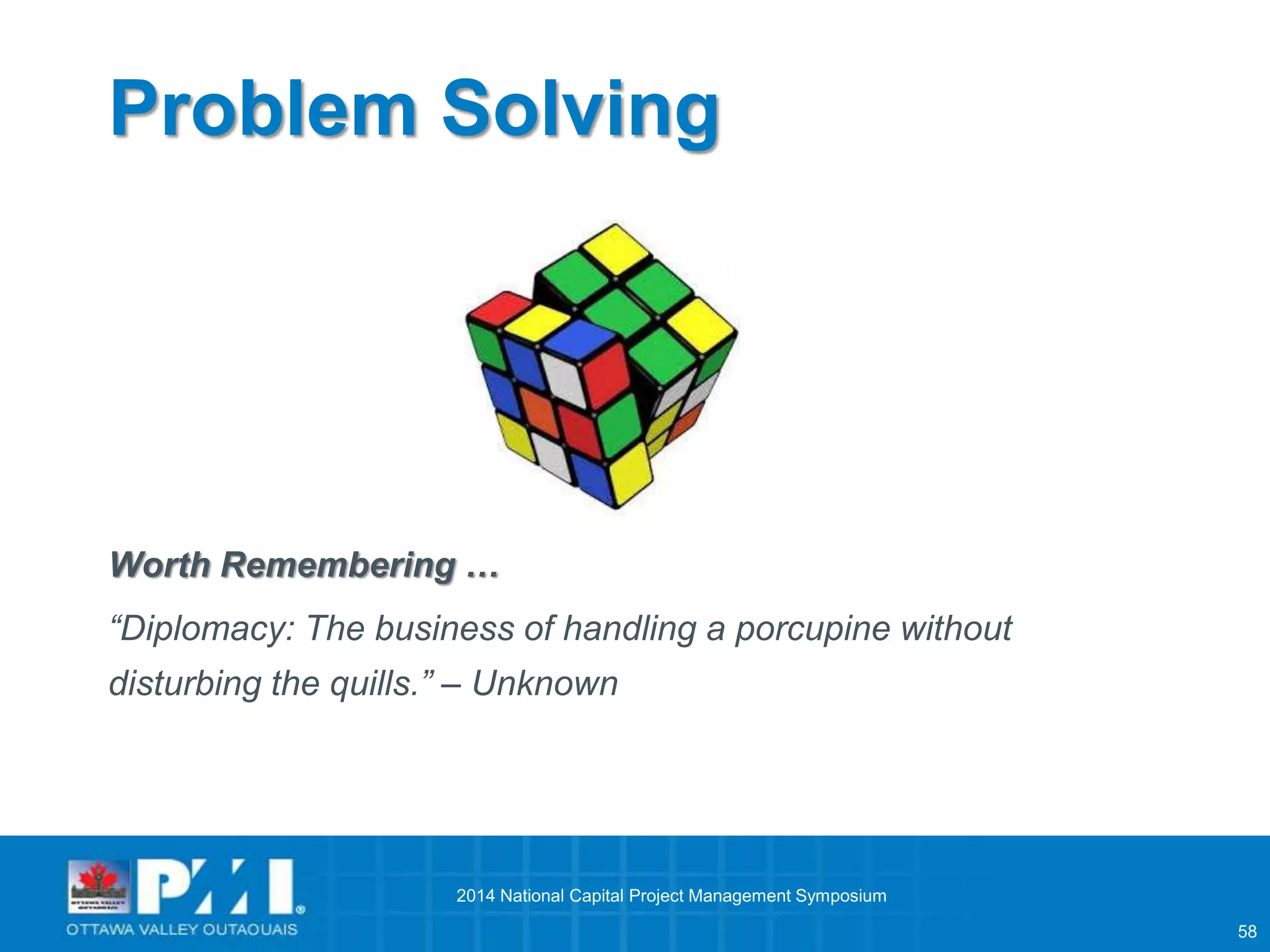
Problem Solving 
Worth Remembering … 
“Diplomacy: The business of handling a porcupine without 
disturbing the quills.” – Unknown 
2014 National Capital Project Management Symposium
59 
Problem Solving Skills 
• Deal with the problem immediately 
• Define the problem carefully 
• Separate people from the problem 
• Determine the desired outcome 
• Make a list of practical solutions 
• Don’t get trapped into thinking there is only one resolution. 
Solicit input – get buy-in 
2014 National Capital Project Management Symposium
60 
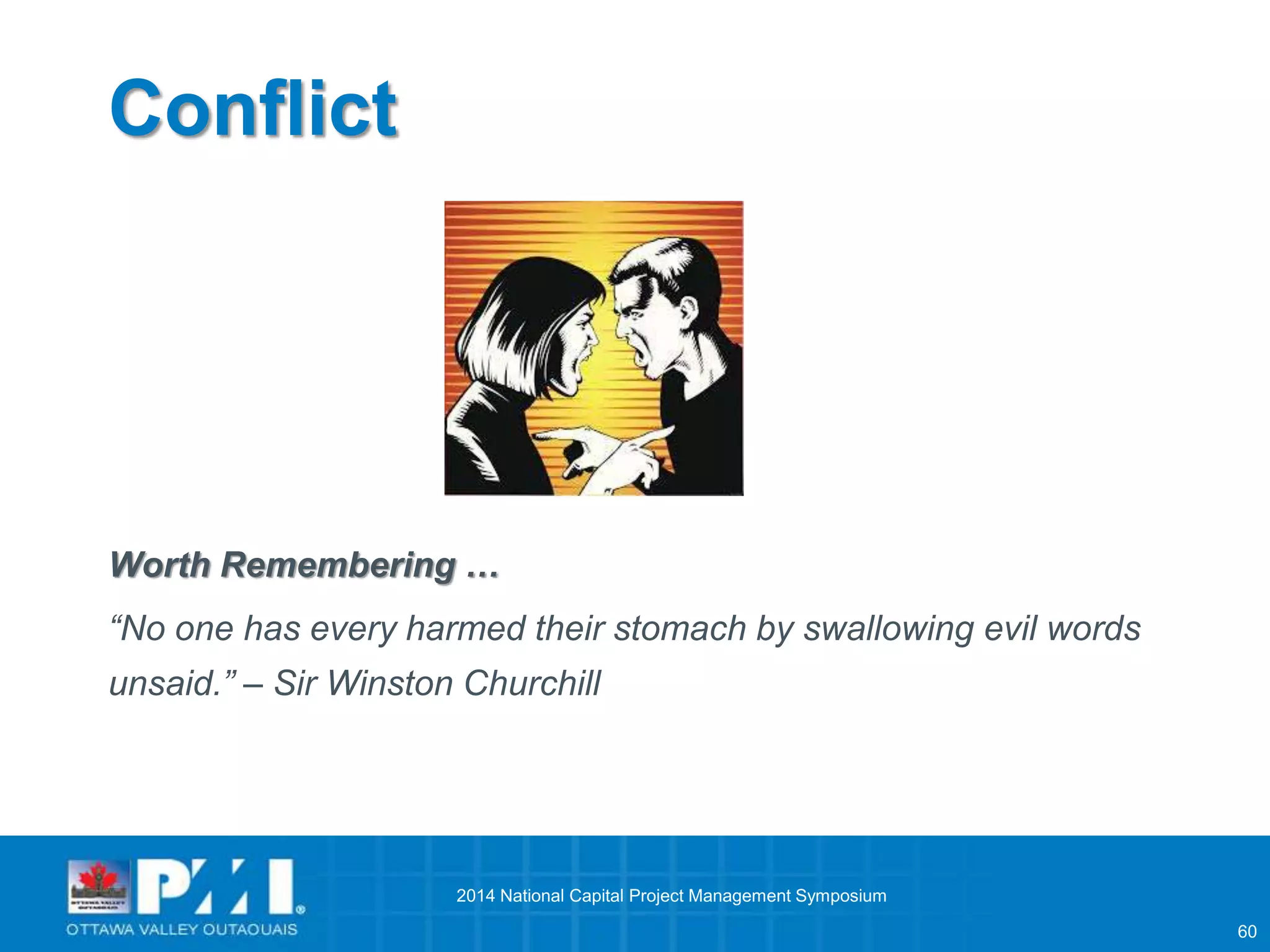
Conflict 
Worth Remembering … 
“No one has every harmed their stomach by swallowing evil words 
unsaid.” – Sir Winston Churchill 
2014 National Capital Project Management Symposium
61 
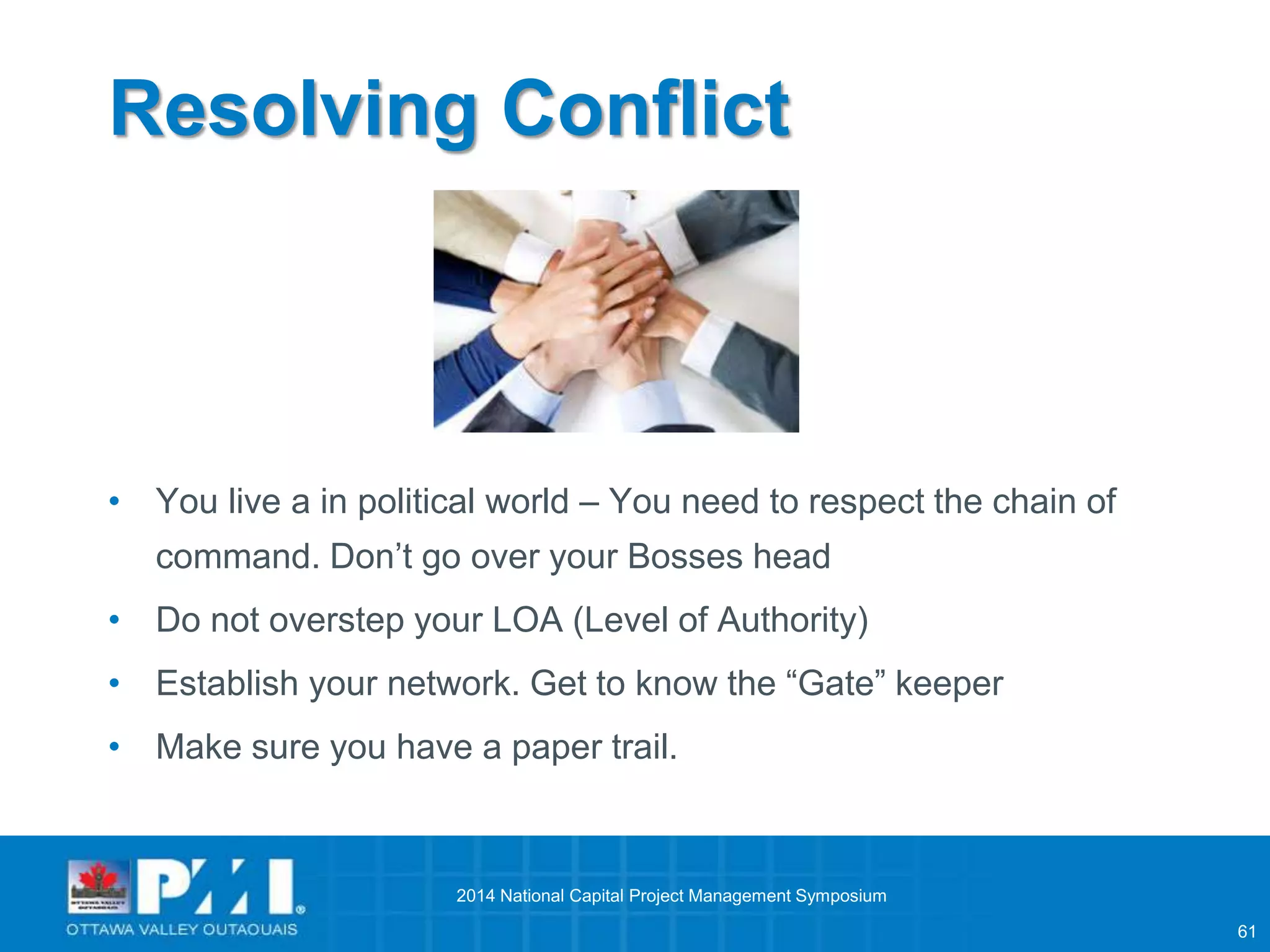
Resolving Conflict 
• You live a in political world – You need to respect the chain of 
command. Don’t go over your Bosses head 
• Do not overstep your LOA (Level of Authority) 
• Establish your network. Get to know the “Gate” keeper 
• Make sure you have a paper trail. 
2014 National Capital Project Management Symposium
62 
Adapting to Others 
I will adapt my behaviour in the following ways. 
D - _________________________________________________ 
I - _________________________________________________ 
S - _________________________________________________ 
C - _________________________________________________ 
2014 National Capital Project Management Symposium
63 
Thank You for Participating 
I hope You Got Your WIIFM Today! 
2014 National Capital Project Management Symposium
64 
For more information… 
• Brian’s available for key note speeches and seminars 
• For more information on the contents of this 
presentation, please feel free to contact me as 
follows: 
o Brian Smith - PLD 
o Power Link Dynamics 
o Email: brian@briansmithpld.com 
o Web: http://briansmithpld.com 
o Phone: 613.323.4470 
2014 National Capital Project Management Symposium

Managing Your Boss and Living To Tell About It

  • 1.
    1 Managing YourBoss & Living to Tell About It Understanding Behaviour and How it Impacts Performance
  • 2.
    2 Copyright Notice • The contents of this presentation are Copyright © 2014 by the presenter and PMI OVOC. • Permission is granted for participants to print the presentation handouts for use during the conference and later personal reference. • PMI OVOC reserves the right to store this content for archival purposes as a record of conference proceedings and to publish this content electronically for the purpose of disseminating conference proceedings to conference participants. • All other use, storage, retrievable, distribution, or reproduction must be authorized in advance, in writing. 2014 National Capital Project Management Symposium
  • 3.
    3 Key LearningPoints 1. Learn the key to working with others by working with them in a style that they like 2. Deepen your understanding of your own management and leadership style 3. Learn how to communicate and interact more effectively up, down and across the organization 2014 National Capital Project Management Symposium
  • 4.
    4 Your Presenter • Brian Smith – Power Link Dynamics o Management Expert, Author and Speaker o Specializes in soft-skills training & leadership development • Certified Train-the-Trainer o Teaching Adult Life Long Learners o DISC Certified Practioner o Trained Behaviorist 2014 National Capital Project Management Symposium
  • 5.
    5 Seminar Goals • Understand your behavioural tendencies and develop an understanding of how your behaviour affects others • Respect, appreciate, understand, and value individual differences • Learn how to communicate and interact more effectively • Increase your effectiveness by improving your relationships with others • Learn how to motivate others by understanding their strengths and limitations 2014 National Capital Project Management Symposium
  • 6.
    6 Introductions •Name: • Position: • What behaviour do you find most frustrating when working with others? 2014 National Capital Project Management Symposium
  • 7.
    7 EQ vs.IQ Worth Remembering … “We are being judged by a new yardstick; not just how smart we are, or by our training and expertise, but also by how well we handle ourselves and each other” - Daniel Goleman, Emotional Intelligence 2014 National Capital Project Management Symposium
  • 8.
    8 The MotivationEquation Personal Need + Goal Directed Behaviour = WIIFM 2014 National Capital Project Management Symposium
  • 9.
    9 The AttitudeChallenge Question: • Who is in control of your attitude? 2014 National Capital Project Management Symposium
  • 10.
    10 Attitude isa Choice Worth Remembering … “Everything can be taken away from man but one thing – to choose – to choose ones attitude in a given set of circumstances, to choose one’s own way.” - Viktor Frankl 2014 National Capital Project Management Symposium
  • 11.
    11 More AboutAttitude • Everybody has one • Not two are exactly the same • It’s 100% in your control • It’s a matter of choice • How would the people you work with and interact with rate your attitude? 2014 National Capital Project Management Symposium
  • 12.
    12 Pick YourBattles Worth Remembering … “Change what you can … influence what you will … and learn to give up the rest. It’s a total waste of your time and energy” 2014 National Capital Project Management Symposium
  • 13.
    13 Understanding Behaviour Worth Remembering … “Humans are the only creatures who refuse to be who they are. “ - Albert Camus 2014 National Capital Project Management Symposium
  • 14.
    14 Behaviour Is… • Observable 20% • Situationally-based • Flexible • Dynamic • Based on thoughts and beliefs 2014 National Capital Project Management Symposium
  • 15.
    15 Analyzing YourBoss • If you could change just one thing about your Boss what would it be? 2014 National Capital Project Management Symposium
  • 16.
    16 DISC Stylesof Behaviour • Take a moment and score your DISC Lite Personal Assessment • Please follow the instructions at the top of the first page • Do not over thing your responses • This assessment should only take you 3 minutes to complete 2014 National Capital Project Management Symposium
  • 17.
    17 An Ah-HaMoment Awareness Brings Effectiveness 2014 National Capital Project Management Symposium
  • 18.
    18 The RulesAbout Others • Different is just that – Different • There is richness in diversity • By understanding yourself better you will learn to understand others 2014 National Capital Project Management Symposium
  • 19.
    19 Behavioural Styles • Dominant: Quick action, task focused, easily bored • Interpersonal: Entertaining, friendly, talkative • Steady: Calm, patient, loyal, a good listener • Conscientious: Attention to detail, very analytical, like to be thorough DISC Theory was developed by Dr. William Marston 2014 National Capital Project Management Symposium
  • 20.
    20 More AboutD’s Shapes the environment by overcoming opposition to accomplish results. Tendencies: • Getting immediate results • Accepting challenges • Making quick decisions • Taking authority • Questioning the status quo • Solving problems 2014 National Capital Project Management Symposium
  • 21.
    21 Limitations •May come across as unapproachable • Can be insensitive to others • Show impatience with others • Try to move the team or individual before they are ready • May seem intimidating • Blunt, demanding approaches • Little social interaction 2014 National Capital Project Management Symposium
  • 22.
    22 Preferred Environment • Power and authority • Prestige and challenge • Direct answers • A wide scope of operations • Opportunities for individual accomplishments • Opportunities for advancement • Freedom from controls and supervision • Many new and varied activities 2014 National Capital Project Management Symposium
  • 23.
    23 Increase YourEffectiveness • Develop more patience • Toning down your directness and asking more questions • Work on your body language to seem more approachable and offering more encouragement in conversation • Spend more time with those you direct 2014 National Capital Project Management Symposium
  • 24.
    24 More AboutI’s Shapes the environment by influencing or persuading others Tendencies: • Contacting people • Making a good impression • Being articulate • Creating a motivational environment • Entertaining people • Being optimistic • Participating in a group 2014 National Capital Project Management Symposium
  • 25.
    25 Limitations •Can be disorganized • May be superficial in your approach • Lack follow through • May not be detailed enough in your direction • Overselling of ideas • Vulnerability to perceived rejection • Attempts to persuade or influence others 2014 National Capital Project Management Symposium
  • 26.
    26 Preferred Environment • Popularity, social recognition • Public recognition of ability • Freedom of expression • Group activities outside of job • Freedom from control and detail • Coaching and counseling • Favorable working conditions in a social atmosphere 2014 National Capital Project Management Symposium
  • 27.
    27 Increase YourEffectiveness • Learn to listen more carefully • Become more organized and manage your time more effectively • Provide more detail • Be more specific in praise and work direction • Focus on people’s needs 2014 National Capital Project Management Symposium
  • 28.
    28 More AboutS’s Cooperates with others within existing circumstances to carry out tasks Tendencies: • Demonstrating patience • Developing specialized skills • Helping others • Performing in a consistent manner • Showing loyalty • Being a good listener 2014 National Capital Project Management Symposium
  • 29.
    29 Limitations •Can be indecisive • May be indirect • Resist change • May be hesitant to implement needed change • Difficulty identifying priorities • Difficulty with deadlines 2014 National Capital Project Management Symposium
  • 30.
    30 Preferred Environment • Maintenance of status quo • Predictable routines • Credit for work accomplished • Minimal work infringement on home life • Sincere appreciation • Identification with a group • Minimal conflict 2014 National Capital Project Management Symposium
  • 31.
    31 Increase YourEffectiveness • Become more assertive and direct • Learn to cope better with change • Try to not carry the burden of everyone else’s problems 2014 National Capital Project Management Symposium
  • 32.
    32 More AboutC’s Works conscientiously within existing circumstances to ensure accuracy and quality. Tendencies: • Concentrating on key details • Being diplomatic • Checking for accuracy • Adhering to key directives and standards • Thinking analytically • Using a systematic approach to situations 2014 National Capital Project Management Symposium
  • 33.
    33 Limitations •Can be overly concerned with perfection • Act aloof • Tend to hamper other’s creativity by sticking to the rules • Discomfort with ambiguity • Resistance to vague or general information • Desires to double check for accuracy • Little need for affiliation with others 2014 National Capital Project Management Symposium
  • 34.
    34 Preferred Environment • Control of those factors that affect their performance • Clearly defined performance expectations • Values on quality and accuracy • A reserve, business like atmosphere • Recognition for specific skills and accomplishments 2014 National Capital Project Management Symposium
  • 35.
    35 Increase YourEffectiveness • Accept the differences in others • Be more open • Focus on communicating and interacting more effectively • Encourage others creativity 2014 National Capital Project Management Symposium
  • 36.
    36 Strength orWeakness? Dominant: Good at directing and deciding, but may become autocratic. Interactive / Interpersonal: Good at promoting and persuading, but may oversell and manipulate Steadiness: Good at being steady and agreeable, but may give in despite their needs Conscientious: Good at analyzing and checking, but may become perfectionistic and indecisive 2014 National Capital Project Management Symposium
  • 37.
    37 Relating toD’s • Make communication brief and to the point • Respect their need for autonomy • Be clear about rules and expectations • Let them initiate • Show your competence • Stick to the topic • Show independence • Eliminate time-wasters 2014 National Capital Project Management Symposium
  • 38.
    38 Relating toI’s • Approach them informally • Be relaxed and sociable • Let them verbalize thoughts and feelings • Keep the conversation light • Provide written details • Give public recognition for individual accomplishments • Use humour 2014 National Capital Project Management Symposium
  • 39.
    39 Relating toS’s • Try to be logical and systematic in your approach • Let them know how things will be done • Provide a consistent and secure environment • Use sincere appreciation • Show their importance to the organization • Let them adapt slowly to change 2014 National Capital Project Management Symposium
  • 40.
    40 Relating toC’s • Give clear expectations and deadlines • Show dependability • Demonstrate loyalty • Be tactful and emotionally reserved • Allow precedent to be a guide • Be precise and focused • Value high standards 2014 National Capital Project Management Symposium
  • 41.
    41 Good Habits= Good Results Worth Remembering … “Excellence is not an act but a habit. The things you do the most are the things you do the best.” - Marva Collins 2014 National Capital Project Management Symposium
  • 42.
    42 New Beginnings C – Commit to a new beginning H – Habits. Stop one, start another A – Action not words N – Never give up G – Goal oriented. Set targets E – Evaluate your plan 2014 National Capital Project Management Symposium
  • 43.
    43 Think It- Act It - Become It • What do you need to do to adapt your style to be more in tune with your bosses style? • What changes need to be made at work or at home to help you cope with stress? • What challenges do you need to overcome so you can deal with difficult people and challenging situations better? • What new skills will you need to learn so you can communicate and interact more effectively with others? 2014 National Capital Project Management Symposium
  • 44.
    44 Perception isReality Worth Remembering … “You don’t have to like the people you work with, but you do need to learn how to work with them.” - Brian Smith 2014 National Capital Project Management Symposium
  • 45.
    45 Building Relationships Worth Remembering … “The most important single ingredient in the formula of success is knowing how to get along with people.” – Theodore Roosevelt 2014 National Capital Project Management Symposium
  • 46.
    46 The 3R’s R– Rapport : Get to know them for more than the work they do. What do they like to do outside of work? R– Relationship: You can’t develop a relationship with someone until you have established rapport R – Respect : You won’t respect anyone that you haven’t established a relationship with first. 2014 National Capital Project Management Symposium
  • 47.
    47 Managing YourBoss According to John J. Gabarro and John P. Kotter in a recent article published in the Harvard Business Review they believe there are four key components to developing and managing a relationship with your Boss. 1. Compatible Work Styles 2. Mutual expectations 3. Dependability and honesty 4. Good use of time and resources 2014 National Capital Project Management Symposium
  • 48.
    48 The Artof Communicating Worth Remembering … “I know you believe you understand what you think I said, but I’m not sure you realize that what you heard is not what I meant.” 2014 National Capital Project Management Symposium
  • 49.
    49 Questions WorthAnswering • What skills does it take to be a good communicator? • What are some of the road blocks to good communication? 2014 National Capital Project Management Symposium
  • 50.
    50 Communication Realities • You cannot not communicate • When ever contact is made communication occurs • Meanings are in people not in words • All types of communications are received but 70 to 90% are screened out or changed by the receiver • You communicate 93% of the time non-verbally • Most people perceive the non-verbal as being more accurate Based on the research of Dr. Ralph Nichols. “Are You Listening” 2014 National Capital Project Management Symposium
  • 51.
    51 Communication Styles • How can you communicate more effectively with a “D” • How can you communicate more effectively with a “I” • How can you communicate more effectively with a “S” • How can you communicate more effectively with a “C” 2014 National Capital Project Management Symposium
  • 52.
    52 Tune Outor Turned Off? • Humans have the ability to listen at a rate of ____________ words a minute • Humans have the ability to speak at a rate of ____________ words a minute • Based on those two numbers ____________ words a minute are lost in translation Based on the research of Dr. Ralph Nichols “Are You Listening” 2014 National Capital Project Management Symposium
  • 53.
    53 Active Listening Worth Remembering … “We have two ears but only one mouth. Some people suggest that’s because we should spend twice as much time listening as opposed to talking. Others suggest it’s because listening is twice as hard.” – Dr. Ralph Nichols. 2014 National Capital Project Management Symposium
  • 54.
    54 Questions WorthAnswering • What skills does it take to be a good listener? • What gets in the way of being a good listener? 2014 National Capital Project Management Symposium
  • 55.
    55 Barriers toActive Listening • Individuals listen about 25% if the time • Most people only recall 50% of what they hear • 70% of all misunderstandings happen because people do not listen to each other • We listen and speak at two different rates of speed Based on the research of Dr. Ralph Nichols. “Are You Listening” 2014 National Capital Project Management Symposium
  • 56.
    56 5-Steps toActive Listening • Listen to understand not necessarily to agree • Give the sender your undivided attention • Ask questions for clarity • Summarize and paraphrase what you heard • Tune into words, feelings and body language 2014 National Capital Project Management Symposium
  • 57.
    57 Are YouListening? • Take out six letters and it will reveal a very popular word • What word did it reveal? SBXNIAELTASREANTS 2014 National Capital Project Management Symposium
  • 58.
    58 Problem Solving Worth Remembering … “Diplomacy: The business of handling a porcupine without disturbing the quills.” – Unknown 2014 National Capital Project Management Symposium
  • 59.
    59 Problem SolvingSkills • Deal with the problem immediately • Define the problem carefully • Separate people from the problem • Determine the desired outcome • Make a list of practical solutions • Don’t get trapped into thinking there is only one resolution. Solicit input – get buy-in 2014 National Capital Project Management Symposium
  • 60.
    60 Conflict WorthRemembering … “No one has every harmed their stomach by swallowing evil words unsaid.” – Sir Winston Churchill 2014 National Capital Project Management Symposium
  • 61.
    61 Resolving Conflict • You live a in political world – You need to respect the chain of command. Don’t go over your Bosses head • Do not overstep your LOA (Level of Authority) • Establish your network. Get to know the “Gate” keeper • Make sure you have a paper trail. 2014 National Capital Project Management Symposium
  • 62.
    62 Adapting toOthers I will adapt my behaviour in the following ways. D - _________________________________________________ I - _________________________________________________ S - _________________________________________________ C - _________________________________________________ 2014 National Capital Project Management Symposium
  • 63.
    63 Thank Youfor Participating I hope You Got Your WIIFM Today! 2014 National Capital Project Management Symposium
  • 64.
    64 For moreinformation… • Brian’s available for key note speeches and seminars • For more information on the contents of this presentation, please feel free to contact me as follows: o Brian Smith - PLD o Power Link Dynamics o Email: brian@briansmithpld.com o Web: http://briansmithpld.com o Phone: 613.323.4470 2014 National Capital Project Management Symposium

Editor's Notes

  • #2 PMI OVOC Symposium Speaker presentations must comply with the layout of this template.