MANAGING THE
PRODUCT
4TH UNIT SYLLABUS
 Managing the Product: Concept, product
hierarchy, product line, product mix, product
mix strategies, Product life cycle and its
strategies, New Product Development,
packing as a marketing tool, Role of labeling
in packing.
WHAT IS PRODUCT
 A product is anything that can be offered to a
market for attention, acquisition, use or
consumption that might satisfy a want or need
 A product is a bundle of utilities consisting of
various features and accompanying services
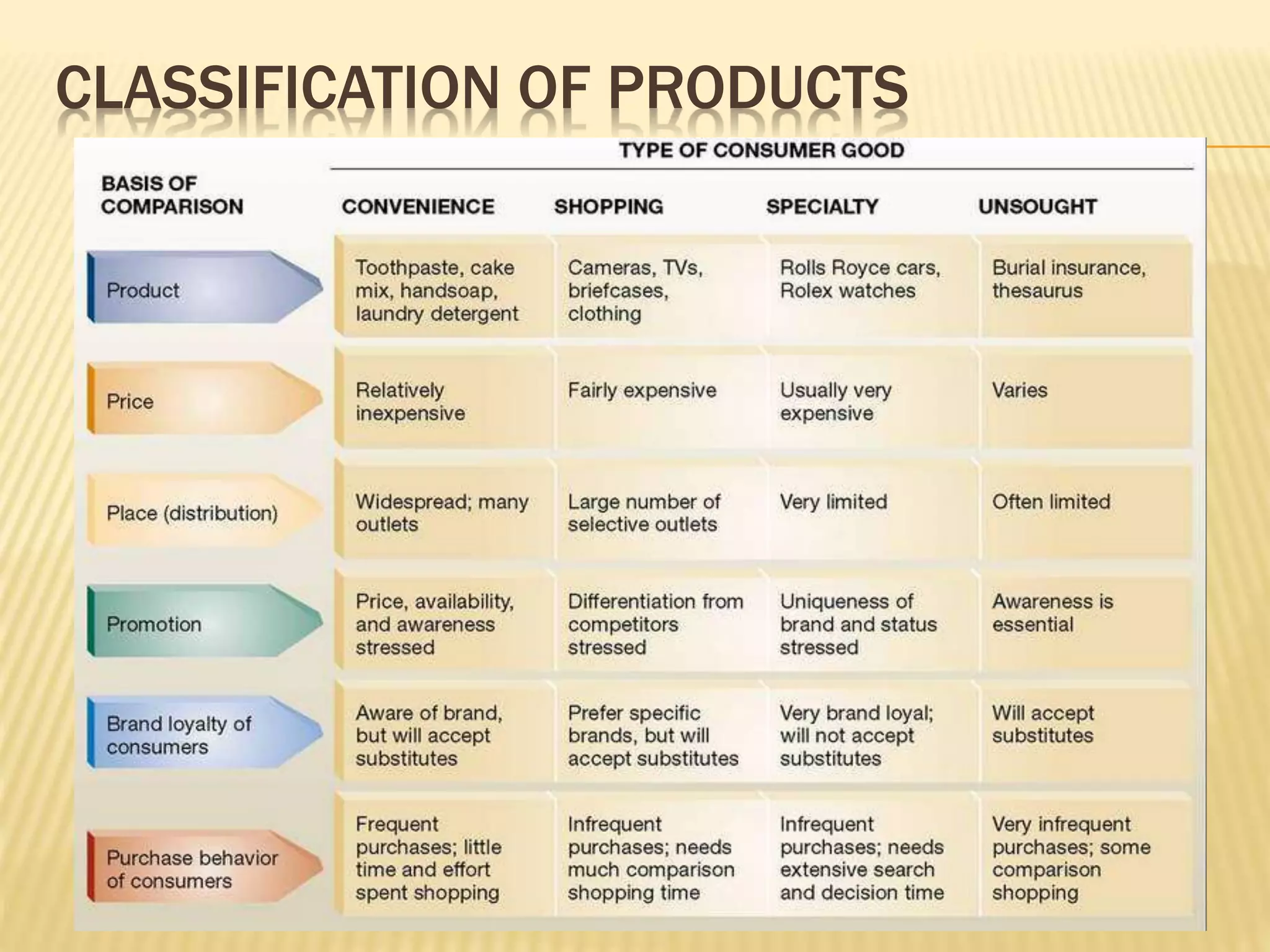
CLASSIFICATION OF PRODUCTS
PRODUCT HIERARCHY
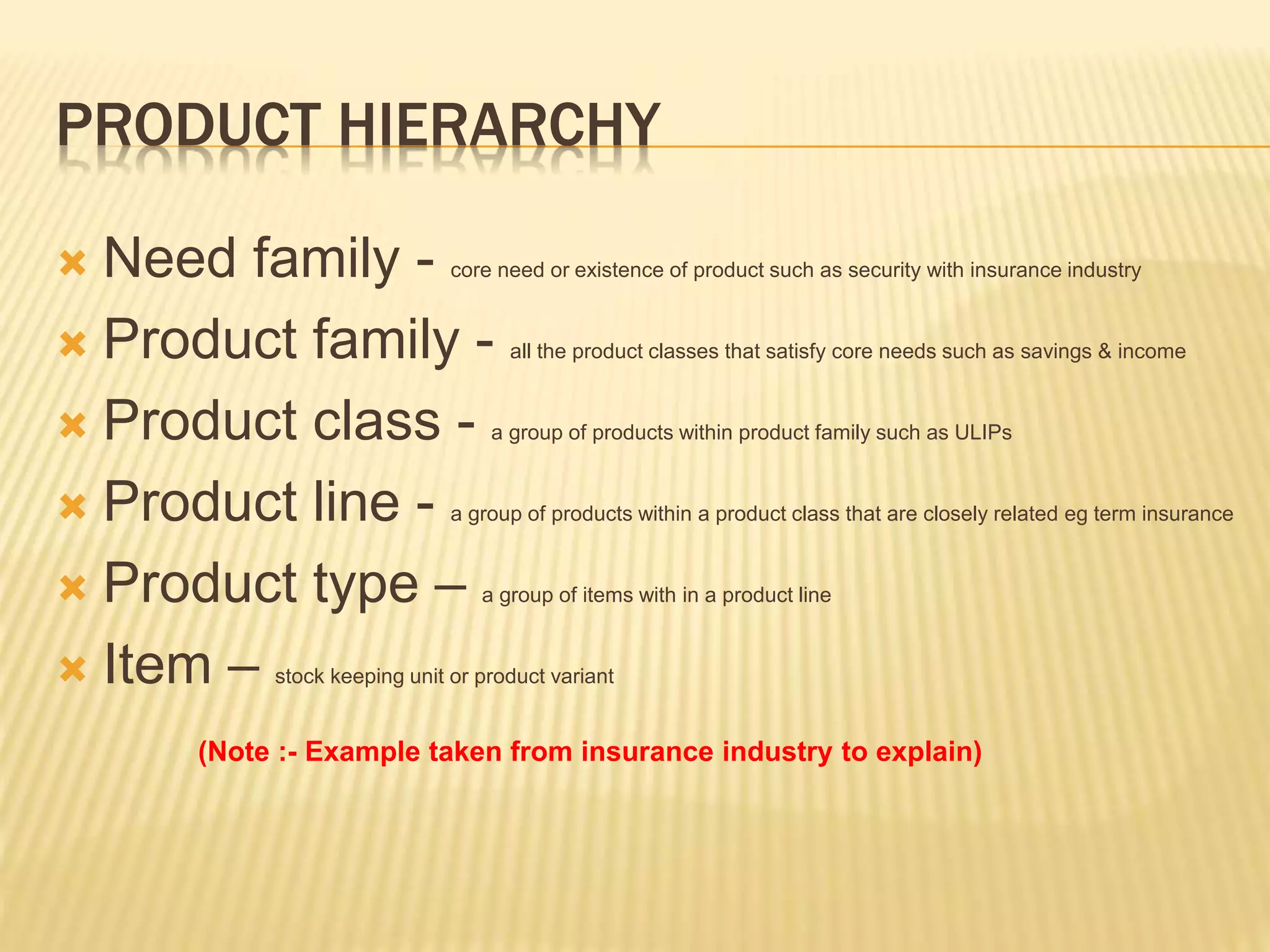
 Need family - core need or existence of product such as security with insurance industry
 Product family - all the product classes that satisfy core needs such as savings & income
 Product class - a group of products within product family such as ULIPs
 Product line - a group of products within a product class that are closely related eg term insurance
 Product type – a group of items with in a product line
 Item – stock keeping unit or product variant
(Note :- Example taken from insurance industry to explain)
PRODUCT LEVELS
 Core product - What the buyer is really buying such as “rest & sleep” with hotel
industry
 Basic product – basic expectation from the customer such as bed, bathroom,
towels ….
 Expected product – a set of attributes and conditions buyers normally expects
such as clean bed, fresh towels, working lamps,…
 Augmented product – products that exceeds customer expectations such
as paintings, refrigerators , high end televisions …
 Potential product- product and services such as FIVE star category
(Note :- Example taken from Hotel industry to explain)
PRODUCT LINE
Meaning :- A product line is a group of products
that are closely related to each other by function,
customer group, market, or price range.
For example, a FMCG company's bath soaps product line.
For HUL, product line includes Pears, Lifebuoy, Hamam,
Santhoor, Jai, Moti, Lux, Dove, Rexona, Liril ….
PRODUCT MIX
PRODUCT MIX
- Set of all products and items that a particular seller
offers for sale
Example:
BPL
 Consumer products
- TVs, Washing Machine
 Cellular Services
- Mobile operations in Mumbai
 Telecom
- Instruments
PRODUCT MIX-CONCEPTS
Width
- How many different product lines are carried by the organization
P & G
 Five lines
- Detergents, Toothpaste, Bar soap, diapers, paper tissue
Length
 Total number of items in the mix
 Total items 25
 Average length of a line is 25/5 = 5
3. Depth
 How many variants are offered of each product in the
line
Proctor and Gamble
 Crest Toothpaste
- Comes in five sizes
- Two formulations
 Mint
 Regular
Total Depth = 5 * 2 = 10
Consistency
How closely related the various product lines are in end
use, production requirements, distribution channels or
some other way.
Proctor and Gamble
- Very consistent
- Why
- Products are available through the same distribution
channels
HUL
- Products
 Fabric wash products
 Beverages
 Bath soaps
NEW PRODUCT DEVELOPMENT
Idea
Generation
Idea
Screening
Concept
Developm
ent
Market
Strategy
Developm
ent
Business
Analysis
Product
Developm
ent
Market
Testing
Commerci
alization
 Idea Generation Sources
 Internal Sources
 Customers
 Competitors
 Distributors and Suppliers
 Other Sources
 Idea Screening
 The purpose of screening is to spot good ideas and drop poor ones
as quickly as possible
 Concept Development and Testing
 A product idea envisions a possible product that company
managers might offer to the market
 A product concept is a detailed version of the idea stated in
meaningful consumer terms
 A product image is the way that consumers picture an actual
or potential product
 The task is to develop an idea into alternative product
concepts, determine how attractive each is to customers, and
choose the best one
 Concept testing occurs within a group of target consumers
 Marketing Strategy
 Includes information such as the target market and
product positioning as well as both short and long term
projections in terms of sales, profits and costs
 Business Analysis
 Business analysis involves a review of the sales, costs,
and profit projections to determine whether they satisfy
the company’s objectives
 Product Development
 The prototype must:
 Have the key features described in the product concept
statement, as perceived by the customer
 Performs safely under normal use
 Be produced for the budgeted costs
 Test Marketing
 The product and marketing program are introduced into realistic
market settings
COMMERCIALIZATION
 In launching a new product, a company must
make four decisions:
 When?
 Where?
 To whom?
 and How?
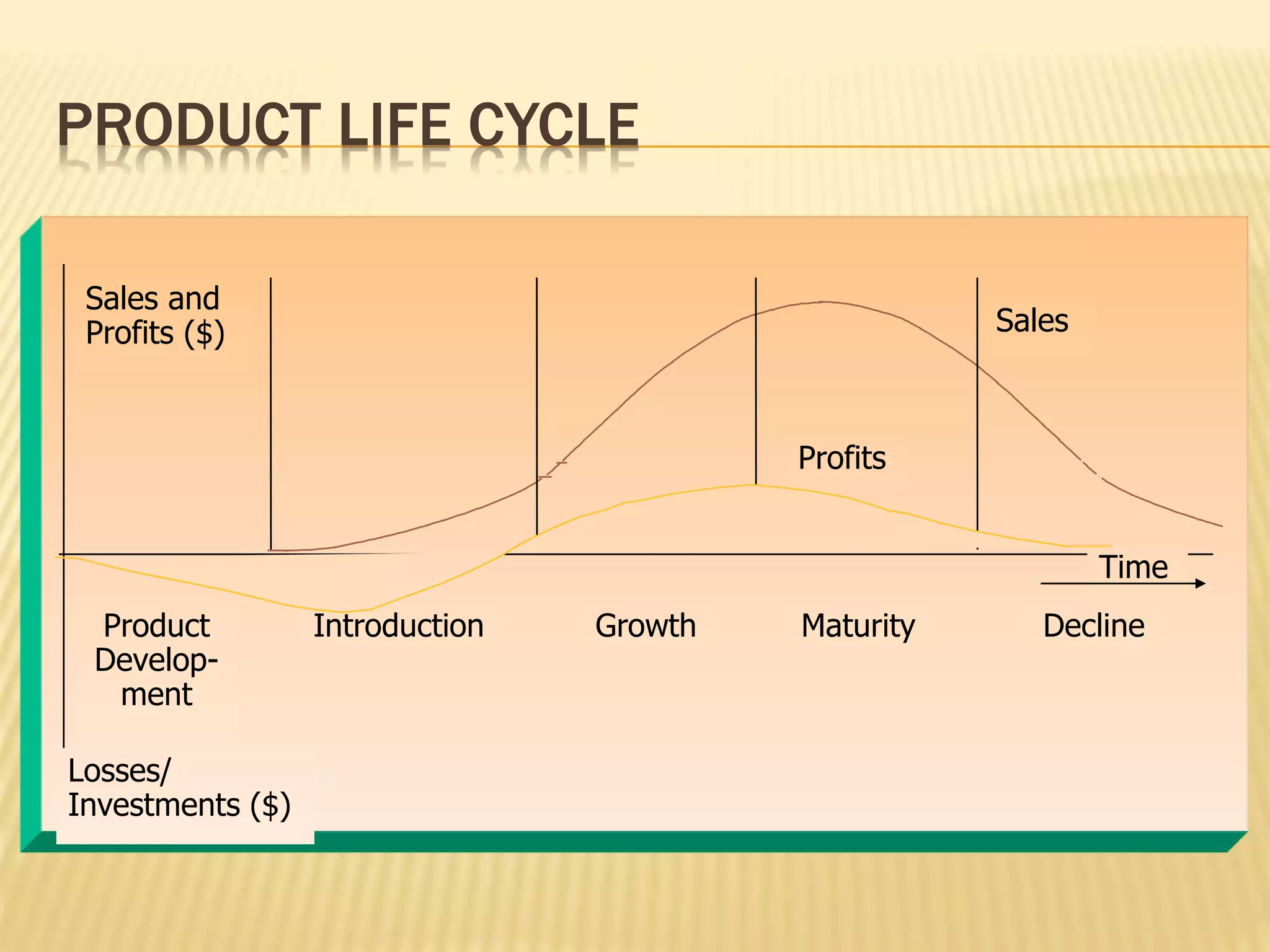
PRODUCT LIFE CYCLE
Time
Product
Develop-
ment
Introduction
Profits
Sales
Growth Maturity Decline
Losses/
Investments ($)
Sales and
Profits ($)
INTRODUCTION STAGE
 Introduction is a period of slow sales growth as the product
is being introduced into the market
 Profits are nonexistent at this stage due to high product
introduction expenses
 High failure rates
 Little competition
 Frequent product modification
 Limited distribution
 High marketing and production costs
 Promotion focuses on awareness and information
 Intensive personal selling to channels
GROWTH STAGE
 Growth is a period of rapid market acceptance and
increasing profits
 Increasing rate of sales
 Entrance of competitors
 Market consolidation
 Initial healthy profits
 Promotion emphasizes brand ads
 Goal is wider distribution
 Prices normally fall
 Development costs are recovered
MATURITY STAGE
 Maturity is a period of slowdown in sales growth
because the product has achieved acceptance by
most of its potential buyers
 Profits level off or decline due to increased marketing
outlays to defend the product against competition
 Declining sales growth
 Saturated markets
 Extending product line
 Stylistic product changes
 Heavy promotions to dealers and consumers
 Marginal competitors drop out
 Prices and profits fall
 Niche marketers emerge
DECLINE STAGE
 Decline is the period when sales fall off quickly and
profits drop
 Long-run drop in sales
 Large inventories of
unsold items
 Elimination of all nonessential
marketing expenses
How stages of the product life cycle relate to firm’s
marketing objectives & marketing mix actions
INTRODUCTION GROWTH MATURITY DECLINE
Product
Strategy
Distribution
Strategy
Promotion
Strategy
Pricing
Strategy
Limited models
Frequent
changes
More models
Frequent
changes.
Large number
of models.
Eliminate
unprofitable
models
Limited
Wholesale/
retail distributors
Expanded
dealers. Long-
term relations
Extensive.
Margins drop.
Shelf space
Phase out
unprofitable
outlets
Awareness.
Stimulate
demand.Sampling
Aggressive ads.
Stimulate
demand
Advertise.
Promote
heavily
Phase out
promotion
Higher/recoup
development
costs
Fall as result of
competition &
efficient produc-
tion.
Prices fall
(usually).
Prices
stabilize at
low level.
Five Profiles of Product Adopters
PACKAGING
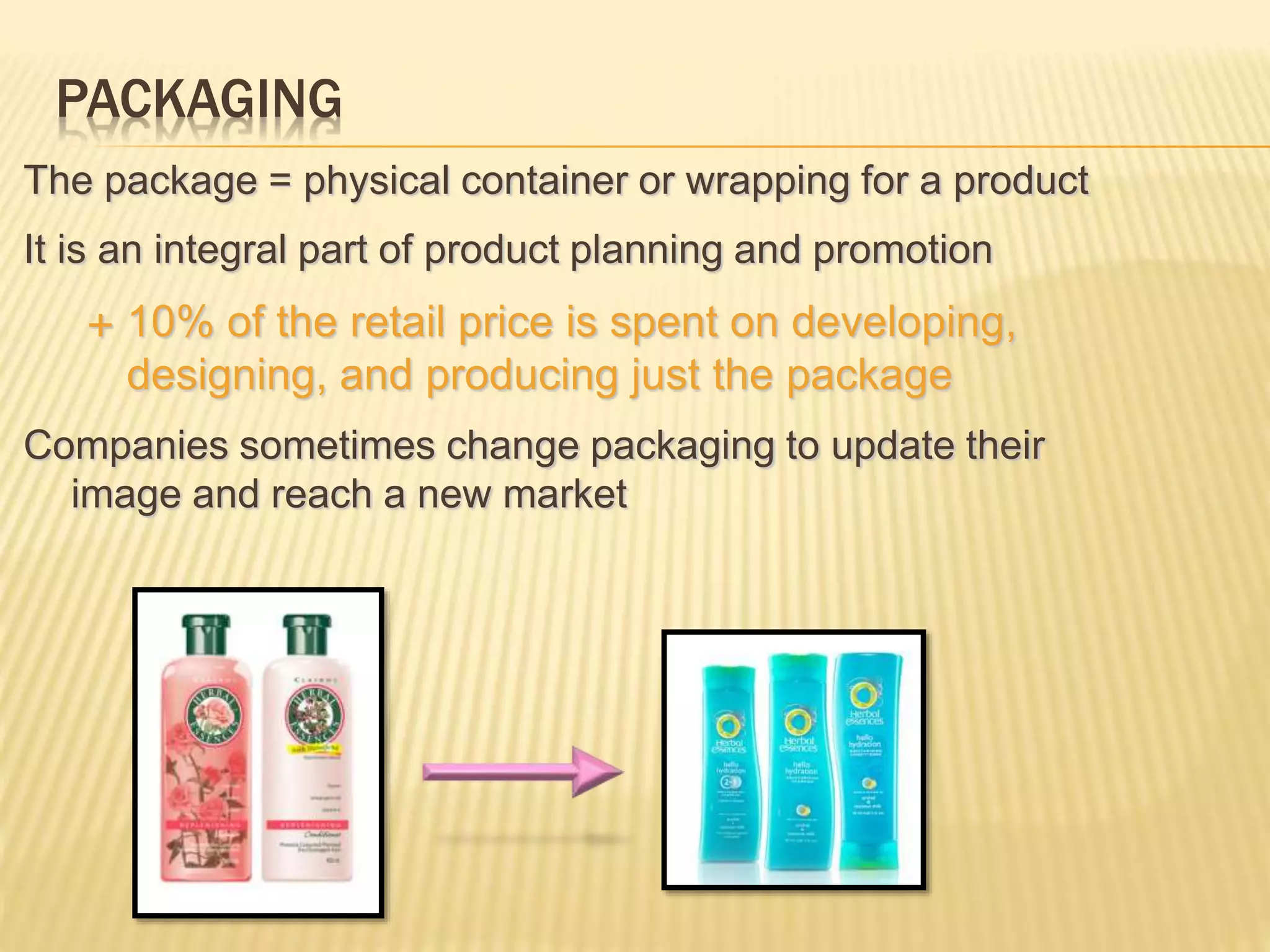
The package = physical container or wrapping for a product
It is an integral part of product planning and promotion
 10% of the retail price is spent on developing,
designing, and producing just the package
Companies sometimes change packaging to update their
image and reach a new market
FUNCTIONS OF PACKAGING
1. Promoting and Selling the Product
2. Defining Product Identity
3. Providing Information
4. Expressing Customer Needs
5. Ensure Safe Use
6. Protecting the Product
The Keys to Product Packaging
1. PROMOTING AND SELLING THE PRODUCT
Attractive, colorful, and
visually appealing
packages have
promotional value
A well designed
package is a powerful
selling device
because it helps the
product stand out
from its competitors
1. PROMOTING AND SELLING THE PRODUCT
Mixed Bundling –
packaging different
products or services
together
 Usually the bundle
price is cheaper than
buying them
individually
Price Bundling – two
or more similar
products are placed
on sale for one
package price
2. DEFINING PRODUCT IDENTITY
Packaging is sometimes
used to promote an image
such as prestige,
convenience, or status
Can be a crucial part of the
marketing strategy,
particularly in advertising
3. PROVIDING INFORMATION
 Gives customer useful
information on:
 directions for using the
product
 its contents
 product guarantees
 nutritional value
 potential hazards
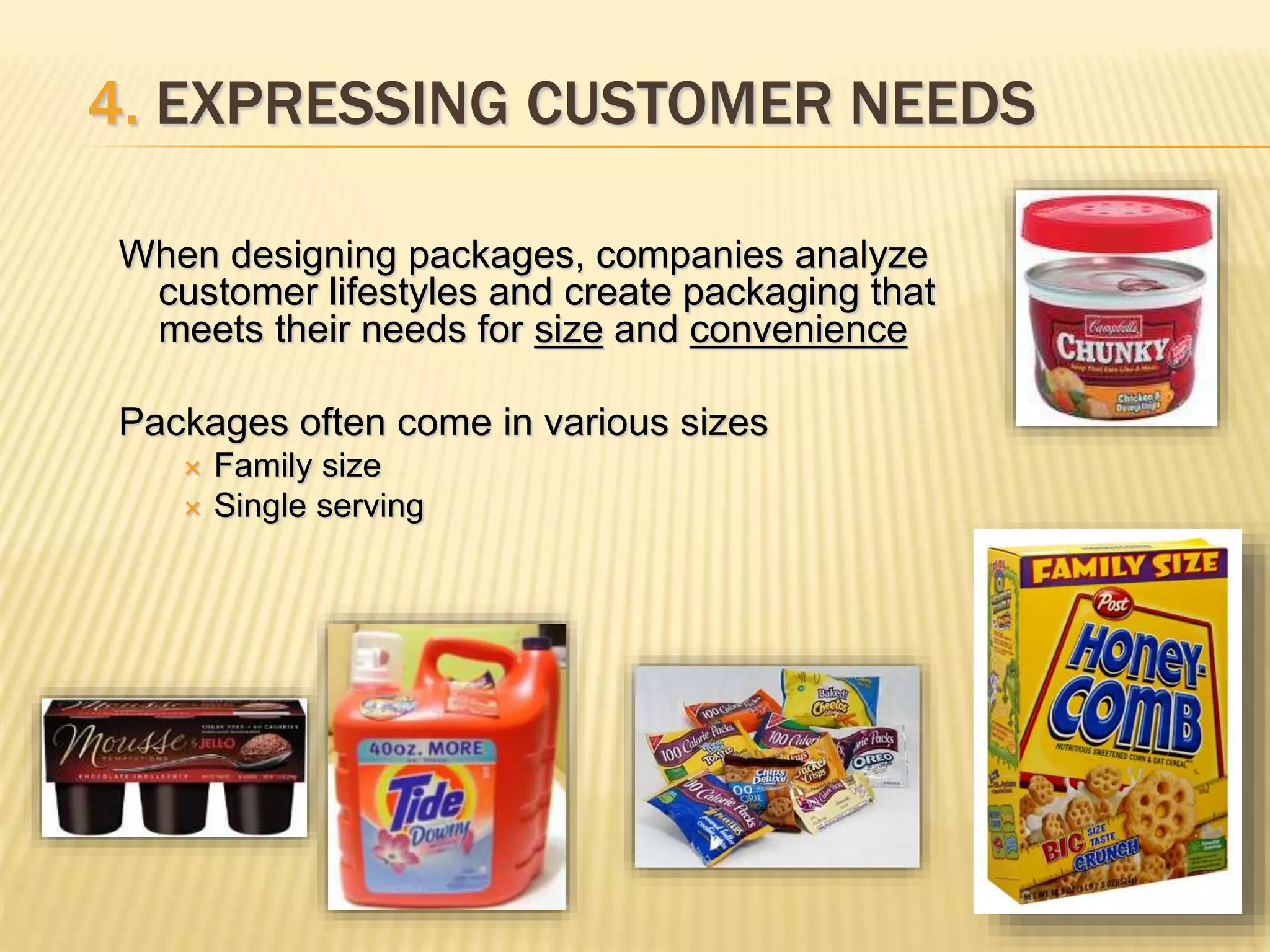
4. EXPRESSING CUSTOMER NEEDS
When designing packages, companies analyze
customer lifestyles and create packaging that
meets their needs for size and convenience
Packages often come in various sizes
 Family size
 Single serving
5. ENSURE SAFE USE
Proper packaging helps to eliminate
potential injuries or misuse of a
product
Formerly glass containers are now
plastic
Childproof caps
Tamper resistant packages
 Blisterpacks – packages with
preformed plastic molds surrounding
individual items arranged on a
backing
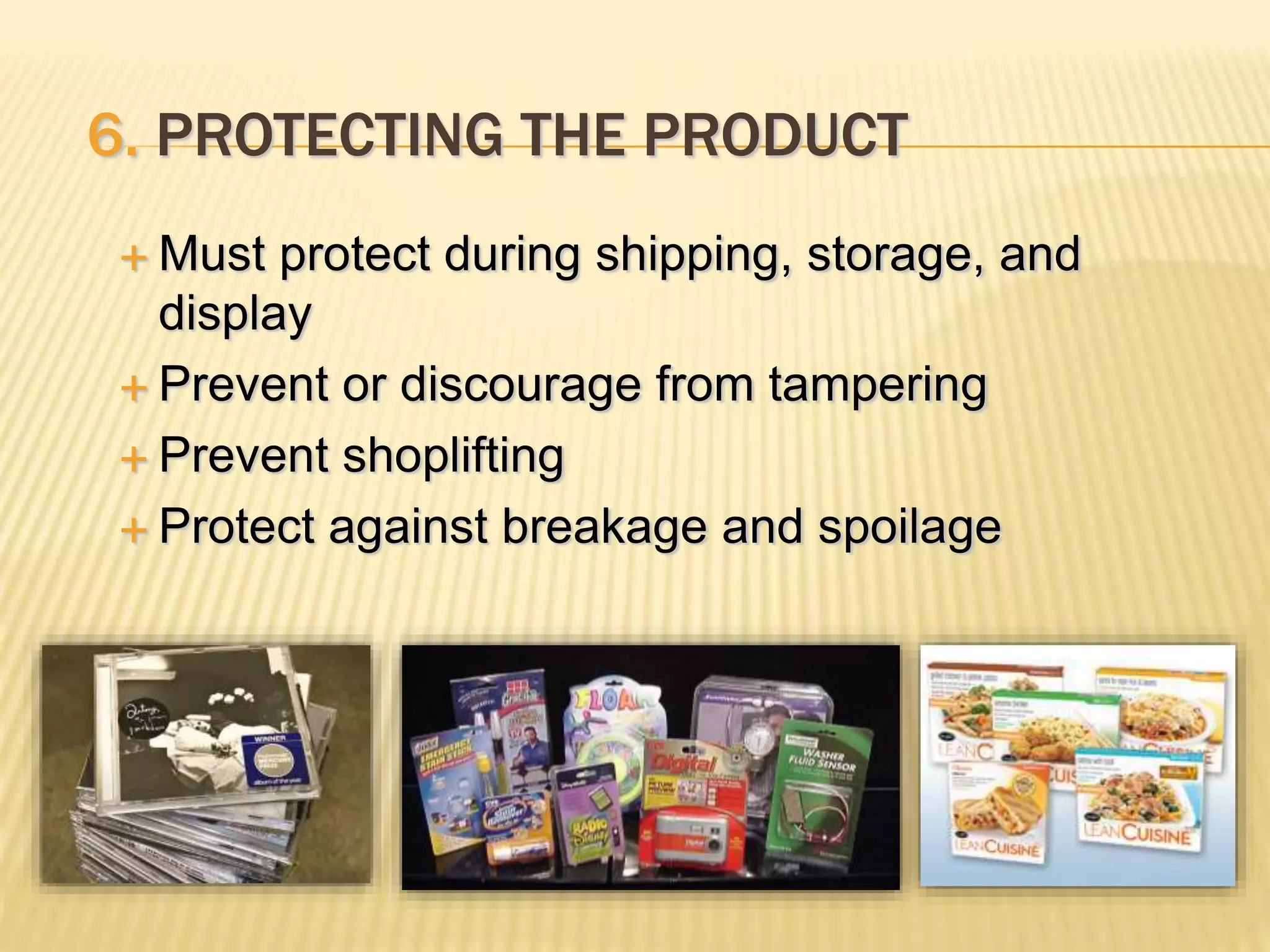
6. PROTECTING THE PRODUCT
 Must protect during shipping, storage, and
display
 Prevent or discourage from tampering
 Prevent shoplifting
 Protect against breakage and spoilage
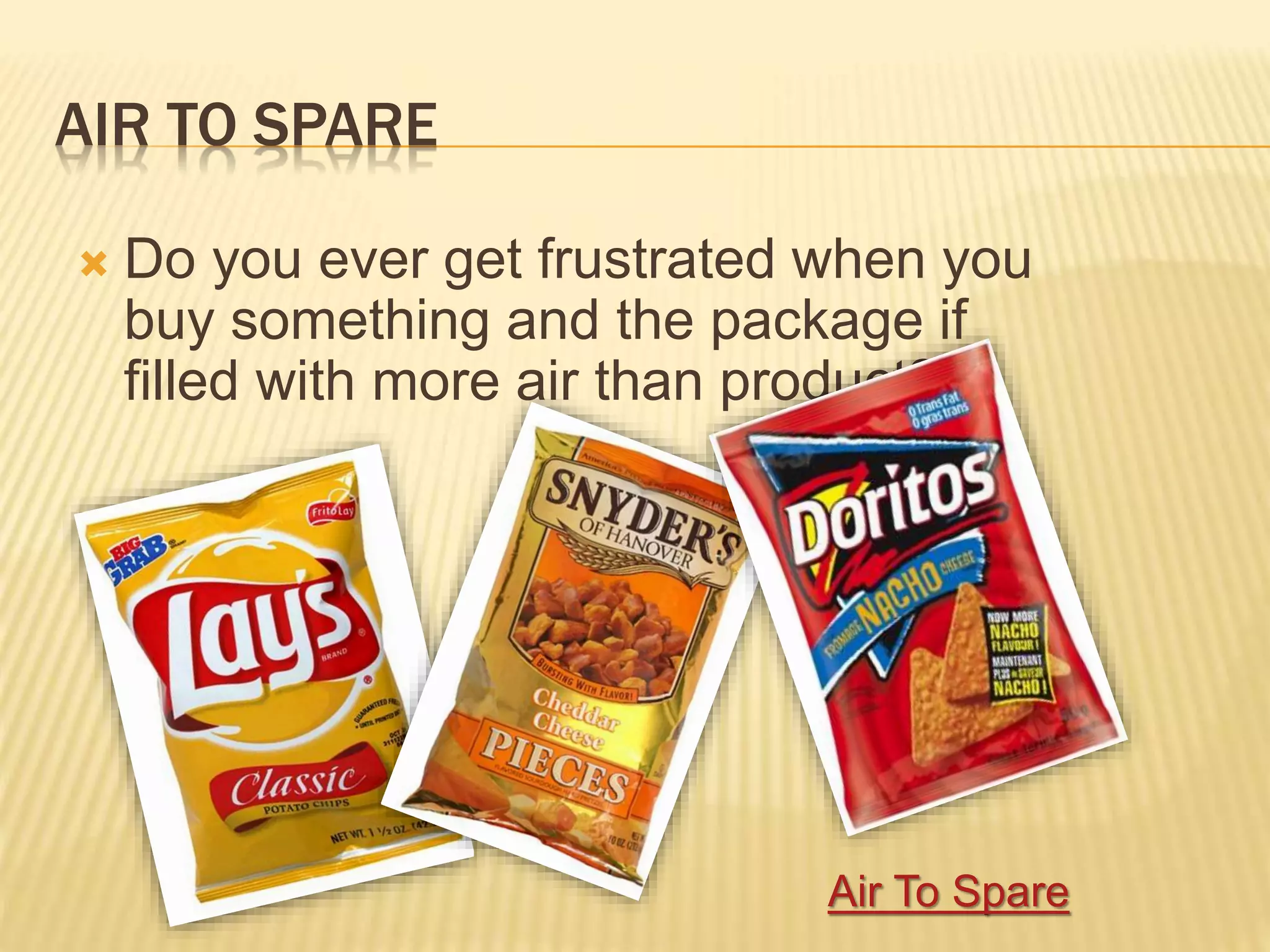
AIR TO SPARE
 Do you ever get frustrated when you
buy something and the package if
filled with more air than product?
Air To Spare
PACKAGING TRENDS
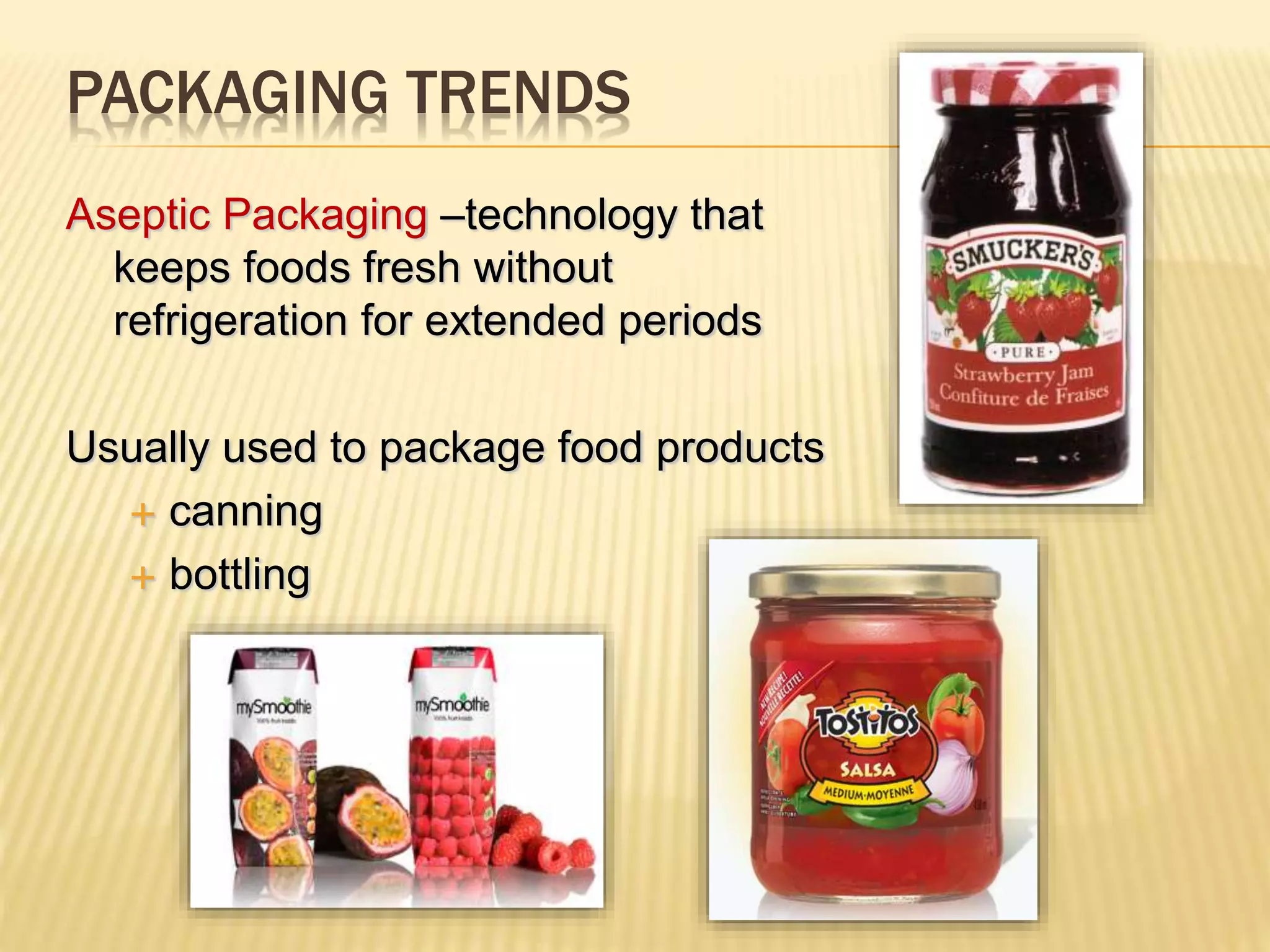
Aseptic Packaging –technology that
keeps foods fresh without
refrigeration for extended periods
Usually used to package food products
 canning
 bottling
PACKAGING TRENDS
Environmental Packaging
– recycled material,
less plastic, and safer
for the environment
Sun Chips Ditching New Bag
PACKAGING TRENDS
Cause Packaging – promote social and
political causes
 May be totally unrelated to the product
LABELING
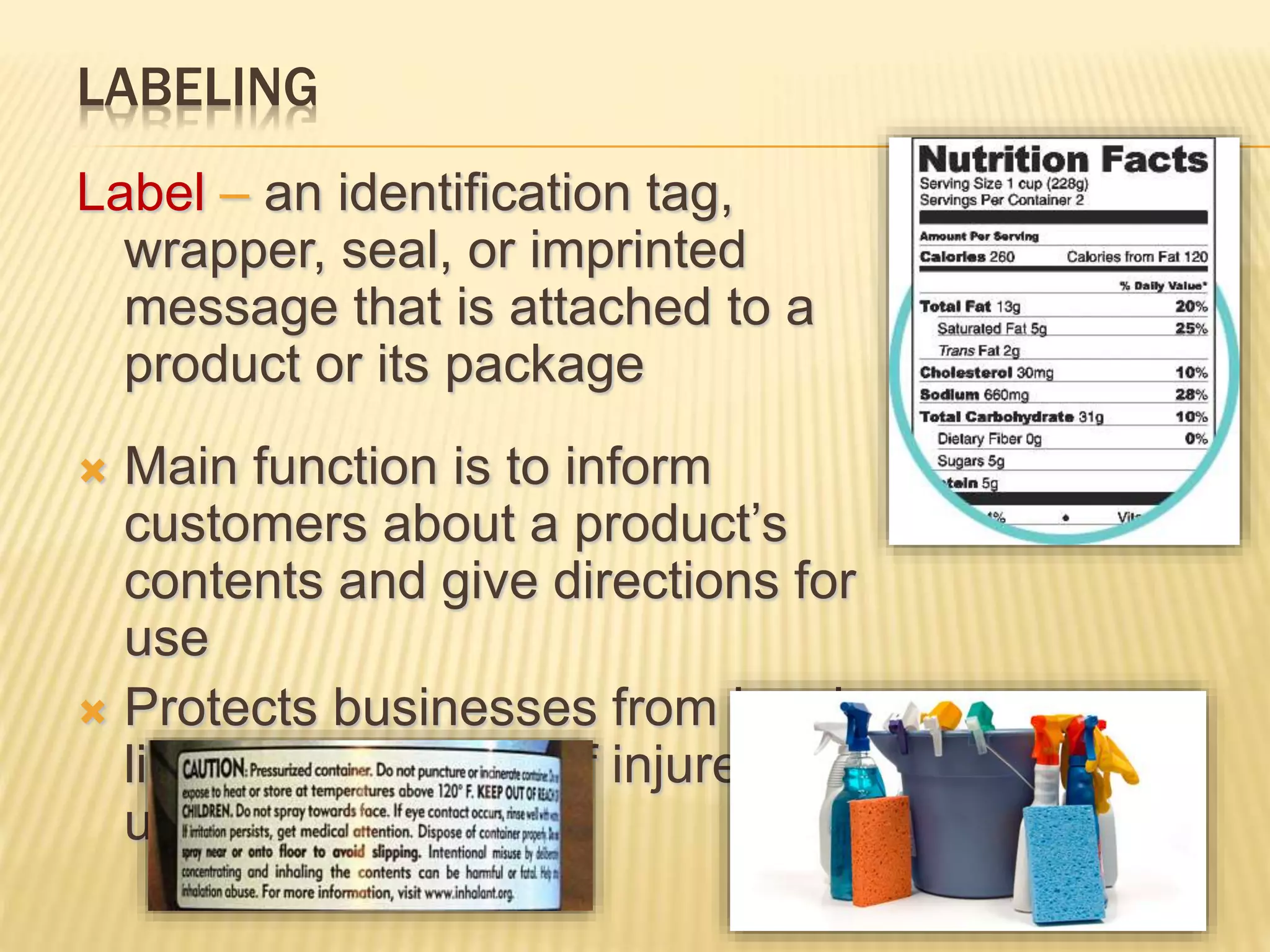
Label – an identification tag,
wrapper, seal, or imprinted
message that is attached to a
product or its package
 Main function is to inform
customers about a product’s
contents and give directions for
use
 Protects businesses from legal
liability if someone if injured while
using the product
THREE KINDS OF LABELS
1. Brand Label – gives brand name and
trademark or logo
2. Descriptive Label – give information
about product use, construction, care,
performance, and other features
3. Grade Label – states the quality of a
product

Managing the Product - Marketing Management

  • 1.
  • 2.
    4TH UNIT SYLLABUS Managing the Product: Concept, product hierarchy, product line, product mix, product mix strategies, Product life cycle and its strategies, New Product Development, packing as a marketing tool, Role of labeling in packing.
  • 3.
    WHAT IS PRODUCT A product is anything that can be offered to a market for attention, acquisition, use or consumption that might satisfy a want or need  A product is a bundle of utilities consisting of various features and accompanying services
  • 4.
  • 5.
    PRODUCT HIERARCHY  Needfamily - core need or existence of product such as security with insurance industry  Product family - all the product classes that satisfy core needs such as savings & income  Product class - a group of products within product family such as ULIPs  Product line - a group of products within a product class that are closely related eg term insurance  Product type – a group of items with in a product line  Item – stock keeping unit or product variant (Note :- Example taken from insurance industry to explain)
  • 6.
    PRODUCT LEVELS  Coreproduct - What the buyer is really buying such as “rest & sleep” with hotel industry  Basic product – basic expectation from the customer such as bed, bathroom, towels ….  Expected product – a set of attributes and conditions buyers normally expects such as clean bed, fresh towels, working lamps,…  Augmented product – products that exceeds customer expectations such as paintings, refrigerators , high end televisions …  Potential product- product and services such as FIVE star category (Note :- Example taken from Hotel industry to explain)
  • 7.
    PRODUCT LINE Meaning :-A product line is a group of products that are closely related to each other by function, customer group, market, or price range. For example, a FMCG company's bath soaps product line. For HUL, product line includes Pears, Lifebuoy, Hamam, Santhoor, Jai, Moti, Lux, Dove, Rexona, Liril ….
  • 8.
    PRODUCT MIX PRODUCT MIX -Set of all products and items that a particular seller offers for sale Example: BPL  Consumer products - TVs, Washing Machine  Cellular Services - Mobile operations in Mumbai  Telecom - Instruments
  • 9.
    PRODUCT MIX-CONCEPTS Width - Howmany different product lines are carried by the organization P & G  Five lines - Detergents, Toothpaste, Bar soap, diapers, paper tissue Length  Total number of items in the mix  Total items 25  Average length of a line is 25/5 = 5
  • 10.
    3. Depth  Howmany variants are offered of each product in the line Proctor and Gamble  Crest Toothpaste - Comes in five sizes - Two formulations  Mint  Regular Total Depth = 5 * 2 = 10
  • 11.
    Consistency How closely relatedthe various product lines are in end use, production requirements, distribution channels or some other way. Proctor and Gamble - Very consistent - Why - Products are available through the same distribution channels HUL - Products  Fabric wash products  Beverages  Bath soaps
  • 12.
  • 13.
     Idea GenerationSources  Internal Sources  Customers  Competitors  Distributors and Suppliers  Other Sources  Idea Screening  The purpose of screening is to spot good ideas and drop poor ones as quickly as possible
  • 14.
     Concept Developmentand Testing  A product idea envisions a possible product that company managers might offer to the market  A product concept is a detailed version of the idea stated in meaningful consumer terms  A product image is the way that consumers picture an actual or potential product  The task is to develop an idea into alternative product concepts, determine how attractive each is to customers, and choose the best one  Concept testing occurs within a group of target consumers
  • 15.
     Marketing Strategy Includes information such as the target market and product positioning as well as both short and long term projections in terms of sales, profits and costs  Business Analysis  Business analysis involves a review of the sales, costs, and profit projections to determine whether they satisfy the company’s objectives
  • 16.
     Product Development The prototype must:  Have the key features described in the product concept statement, as perceived by the customer  Performs safely under normal use  Be produced for the budgeted costs  Test Marketing  The product and marketing program are introduced into realistic market settings
  • 17.
    COMMERCIALIZATION  In launchinga new product, a company must make four decisions:  When?  Where?  To whom?  and How?
  • 18.
    PRODUCT LIFE CYCLE Time Product Develop- ment Introduction Profits Sales GrowthMaturity Decline Losses/ Investments ($) Sales and Profits ($)
  • 19.
    INTRODUCTION STAGE  Introductionis a period of slow sales growth as the product is being introduced into the market  Profits are nonexistent at this stage due to high product introduction expenses  High failure rates  Little competition  Frequent product modification  Limited distribution  High marketing and production costs  Promotion focuses on awareness and information  Intensive personal selling to channels
  • 20.
    GROWTH STAGE  Growthis a period of rapid market acceptance and increasing profits  Increasing rate of sales  Entrance of competitors  Market consolidation  Initial healthy profits  Promotion emphasizes brand ads  Goal is wider distribution  Prices normally fall  Development costs are recovered
  • 21.
    MATURITY STAGE  Maturityis a period of slowdown in sales growth because the product has achieved acceptance by most of its potential buyers  Profits level off or decline due to increased marketing outlays to defend the product against competition  Declining sales growth  Saturated markets  Extending product line  Stylistic product changes  Heavy promotions to dealers and consumers  Marginal competitors drop out  Prices and profits fall  Niche marketers emerge
  • 22.
    DECLINE STAGE  Declineis the period when sales fall off quickly and profits drop  Long-run drop in sales  Large inventories of unsold items  Elimination of all nonessential marketing expenses
  • 23.
    How stages ofthe product life cycle relate to firm’s marketing objectives & marketing mix actions INTRODUCTION GROWTH MATURITY DECLINE Product Strategy Distribution Strategy Promotion Strategy Pricing Strategy Limited models Frequent changes More models Frequent changes. Large number of models. Eliminate unprofitable models Limited Wholesale/ retail distributors Expanded dealers. Long- term relations Extensive. Margins drop. Shelf space Phase out unprofitable outlets Awareness. Stimulate demand.Sampling Aggressive ads. Stimulate demand Advertise. Promote heavily Phase out promotion Higher/recoup development costs Fall as result of competition & efficient produc- tion. Prices fall (usually). Prices stabilize at low level.
  • 24.
    Five Profiles ofProduct Adopters
  • 25.
    PACKAGING The package =physical container or wrapping for a product It is an integral part of product planning and promotion  10% of the retail price is spent on developing, designing, and producing just the package Companies sometimes change packaging to update their image and reach a new market
  • 26.
    FUNCTIONS OF PACKAGING 1.Promoting and Selling the Product 2. Defining Product Identity 3. Providing Information 4. Expressing Customer Needs 5. Ensure Safe Use 6. Protecting the Product The Keys to Product Packaging
  • 27.
    1. PROMOTING ANDSELLING THE PRODUCT Attractive, colorful, and visually appealing packages have promotional value A well designed package is a powerful selling device because it helps the product stand out from its competitors
  • 28.
    1. PROMOTING ANDSELLING THE PRODUCT Mixed Bundling – packaging different products or services together  Usually the bundle price is cheaper than buying them individually Price Bundling – two or more similar products are placed on sale for one package price
  • 29.
    2. DEFINING PRODUCTIDENTITY Packaging is sometimes used to promote an image such as prestige, convenience, or status Can be a crucial part of the marketing strategy, particularly in advertising
  • 30.
    3. PROVIDING INFORMATION Gives customer useful information on:  directions for using the product  its contents  product guarantees  nutritional value  potential hazards
  • 31.
    4. EXPRESSING CUSTOMERNEEDS When designing packages, companies analyze customer lifestyles and create packaging that meets their needs for size and convenience Packages often come in various sizes  Family size  Single serving
  • 32.
    5. ENSURE SAFEUSE Proper packaging helps to eliminate potential injuries or misuse of a product Formerly glass containers are now plastic Childproof caps Tamper resistant packages  Blisterpacks – packages with preformed plastic molds surrounding individual items arranged on a backing
  • 33.
    6. PROTECTING THEPRODUCT  Must protect during shipping, storage, and display  Prevent or discourage from tampering  Prevent shoplifting  Protect against breakage and spoilage
  • 34.
    AIR TO SPARE Do you ever get frustrated when you buy something and the package if filled with more air than product? Air To Spare
  • 35.
    PACKAGING TRENDS Aseptic Packaging–technology that keeps foods fresh without refrigeration for extended periods Usually used to package food products  canning  bottling
  • 36.
    PACKAGING TRENDS Environmental Packaging –recycled material, less plastic, and safer for the environment Sun Chips Ditching New Bag
  • 37.
    PACKAGING TRENDS Cause Packaging– promote social and political causes  May be totally unrelated to the product
  • 38.
    LABELING Label – anidentification tag, wrapper, seal, or imprinted message that is attached to a product or its package  Main function is to inform customers about a product’s contents and give directions for use  Protects businesses from legal liability if someone if injured while using the product
  • 39.
    THREE KINDS OFLABELS 1. Brand Label – gives brand name and trademark or logo 2. Descriptive Label – give information about product use, construction, care, performance, and other features 3. Grade Label – states the quality of a product