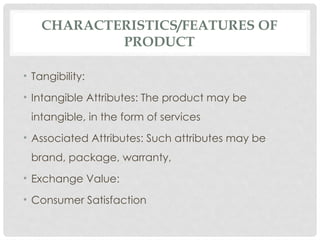
CHARACTERISTICS/FEATURES OF
PRODUCT
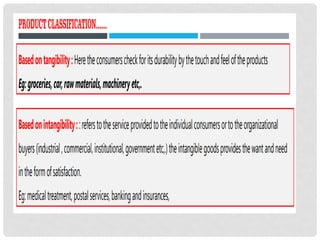
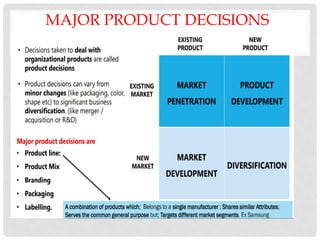
• Tangibility:
•Intangible Attributes: The product may be
intangible, in the form of services
• Associated Attributes: Such attributes may be
brand, package, warranty,
• Exchange Value:
• Consumer Satisfaction
PRODUCT LIFE CYCLE
•“The product life cycle is an attempt to recognize
distinct stages in the sales history of the product”. –
Philip Kotler.
17.
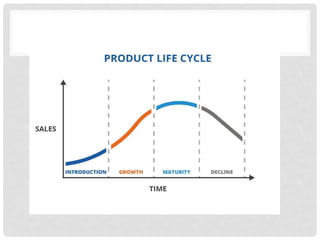
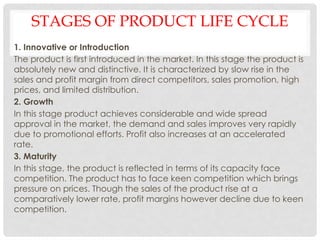
STAGES OF PRODUCTLIFE CYCLE
1. Innovative or Introduction
The product is first introduced in the market. In this stage the product is
absolutely new and distinctive. It is characterized by slow rise in the
sales and profit margin from direct competitors, sales promotion, high
prices, and limited distribution.
2. Growth
In this stage product achieves considerable and wide spread
approval in the market, the demand and sales improves very rapidly
due to promotional efforts. Profit also increases at an accelerated
rate.
3. Maturity
In this stage, the product is reflected in terms of its capacity face
competition. The product has to face keen competition which brings
pressure on prices. Though the sales of the product rise at a
comparatively lower rate, profit margins however decline due to keen
competition.
18.
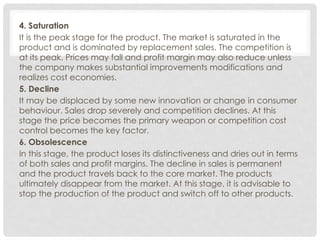
4. Saturation
It isthe peak stage for the product. The market is saturated in the
product and is dominated by replacement sales. The competition is
at its peak. Prices may fall and profit margin may also reduce unless
the company makes substantial improvements modifications and
realizes cost economies.
5. Decline
It may be displaced by some new innovation or change in consumer
behaviour. Sales drop severely and competition declines. At this
stage the price becomes the primary weapon or competition cost
control becomes the key factor.
6. Obsolescence
In this stage, the product loses its distinctiveness and dries out in terms
of both sales and profit margins. The decline in sales is permanent
and the product travels back to the core market. The products
ultimately disappear from the market. At this stage, it is advisable to
stop the production of the product and switch off to other products.
PRODUCT LINE
• Aproduct line is a group of related products under
a single brand sold by the same company. It is a
group of related products produced by one
manufacturer.
21.
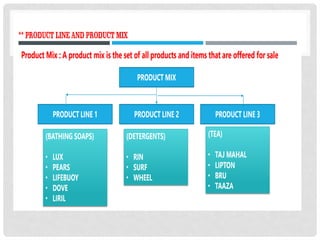
PRODUCT MIX
• Aproduct mix is a list of all products offered for sale
by a company. It is also called as product
assortment or product portfolio, refers to the total
number of product lines a company offers to its
customers.
23.
BRANDING
Meaning of Brand
Itis represented by name, symbol, design, logo,
packaging.
It is the identity of a particular product form that customers
recognize as being different from others.
Meaning of branding
The term ‘branding’ refers to the entire process involved in
creating a unique name and image for a product (good
or service) in the consumers mind. Branding aims to
establish a significant and differentiated presence in the
market that attracts and retains loyal customers.
24.
FEATURES/CHARACTERISTICS/
ESSENTIAL OF GOODBRAND
1.It should be short, simple and easy to recognize,
pronounce spell and remember, such as Colgate,
Onida, Surf, Bata etc.
2.The brand name should be appropriate for the
product such as SOTC tours and travels.
3.Brand name should be helpful in advertising and
identifying.
25.
4.It should beversatile so that it can be applicable to
any product added to the line. Family names such as
Modi, Bajaj, Birla, Tata etc. possess these
characteristics.
5.It should be such which can be easily registered and
thereby legally protectable.
6.It should be clear and attractive.
26.
BRAND EXTENSION
• Itis the use of an established brand name in new
product categories.
• For instance, Nike’s brand core product is shoes. But
it is now extended to sunglasses, soccer balls,
basketballs, and golf equipment's. An existing brand
that gives rise to a brand extension is referred to as
parent brand.
PACKAGING
• Packaging isthe science, art and technology of
enclosing or protecting products for distribution,
storage, sale, and use. Packaging also refers to the
process of designing, evaluating, and producing
packages.
29.
DEFINITION
• According toPride and Farell, “Packaging involves
the development of container and a graphic
design for a product.”
30.
IMPORTANCE OF PACKAGING
•Creation of demand
• Protection of the product
• Transportation
• Guidelines to customers
• Better storage
• Facilitates for carrying
• Identification of product differentiation
• Economy
31.
LABELLING
• Display oflabel in a product.
• It contains information about a product on its
container, packaging or product itself. It also has
warnings in it.
32.
NEW PRODUCT DEVELOPMENT
•New product development is the process of finding
out the possibility of producing a new product. It
includes the decision as to whether it would be
feasible or not to produce the new product.
33.
DEFINITION
• According toW.J. Stanton, M.J. Elzel and B.J.
Walker, “A new product is one which is really
innovative which is significantly different from
existing and imitative products that are new to the
company”.
34.
IMPORTANCE/NEED FOR NEW
PRODUCTDEVELOPMENT
1) Meeting Changes in Consumer Demand
2) Making New Profits
3) Combating Environmental Threats
4) Other Necessities:
• They leverage marketing/brand equity.
• They enhance corporate image.
5) They affect human resources.
6) New products are the source of competitive
advantage.
7) They provide long-term financial return on
investment.
35.
CHALLENGES IN NEWPRODUCT
DEVELOPMENT
• Market research
• Customer Development
• Selling of product
• Developing of product
• Profit making
• New business
36.
PROCESS OF NEWPRODUCT
DEVELOPMENT
1. Exploration of new ideas,
2. Screening of ideas,
3. Business analysis,
4. Product development,
5. Test marketing and
6. Commercialization of the product.
37.
1. EXPLORATION OFNEW IDEAS
The development of a new product starts with the
exploring of new ideas.
There may be a number of sources of exploring these
new ideas are
• Taking consumers opinion and suggestions
• Taking opinion and suggestions of retailers or
salesman or distributors
38.
• Observing thecompetitors products
• Focusing and investing more towards Research and
Development
• Frequently referring the inventory journals published
by universities and government research
laboratories.
• By taking enterprise employees innovative ideas
through brain storming.
39.
2. DEVELOPMENT/SCREENING OFIDEAS
Every idea is evaluated analytically for converting
them into action.
An analysis includes the following:
a. Whether the idea is in accordance with the objects
of the organization such as:
• Object of sales growth
• Object of maximizing profits
• Object of improving the image, etc.
40.
b. Whether theidea can be implemented with the
available resources of the organization such as:
• Technical knowledge
• Financial resources
• Plant capacity
• Managerial ability
If an idea satisfies the above factors favourably, it is
selected, otherwise, it is dropped
41.
3. BUSINESS ANALYSIS
•Efforts are made to establish whether the new
product will be suitable or not.
• Following are the three types of estimates which are
necessary in this regard.
a. Estimating future sales
b. Estimating future profits
c. Estimating future cost
42.
4. PRODUCT DEVELOPMENT
•At this stage management goes ahead to produce
the goods in its physical form. Under this stage all
decisions to bring the idea to final physical form.
43.
5. TESTING THEPRODUCT
• At this stage, the new product is marketed on a trial
basis.
• The product is not introduced in the whole market
at first instance.
• Test marketing provides an opportunity to the
organization to remove the defects of the product
before it is widely marketed.
44.
6. COMMERCIALIZATION OFPRODUCT
• It includes all the activities performed by an
organization by commencing full scale production
of the product, advertising and effective selling in
the wider market and providing after-sale service to
the consumers.
45.
REASONS FOR FAILUREOF NEW
PRODUCT
• Inadequate Market Analysis
• Product Defect
• Higher Costs
• Poor/Bad Timing
• Insufficient Marketing Effort
• Changing in market environment
• Technical or production
46.
PRICE
• Price isthe value that is put to a product or service
and is the result of a complex set of calculations,
research and understanding and risk taking ability.
47.
DEFINITION
• According toW.J.Stanon, “Pricing is the functions of
determining the products value in monetary terms.”
48.
OBJECTIVES OF PRICING
•To maximize the profits
• Price stability
• Competitive situation
• Achieving a target return
• Capturing the market
• Ability to pay
• Long run welfare of the firm
• Cash flow objective
49.
FACTORS INFLUENCING PRICING
DECISION
•The influencing factors for a price decision can be
divided into two groups:
(A) Internal Factors
(B) External Factors.
50.
I) INTERNAL FACTORS
1.Organisational Factors
2. Marketing Mix
3. Product Differentiation:
4. Cost of the Product
5. Objectives of the Firm
51.
(II) EXTERNAL FACTORS
1.Demand
2. Competition
3. Suppliers
4. Economic Conditions
5. Buyers
6. Government
52.
FACTORS AFFECTING PRICE
DETERMINATIONOF PRODUCT
• Product Cost
• The Utility and Demand
• Extent of Competition in the Market
• Government and Legal Regulations
• Pricing Objectives
• Marketing Methods Used
53.
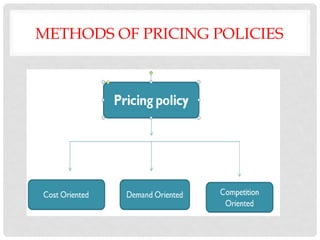
PRICING POLICY
• Apricing policy is a company's approach to
determining the price at which it offers a good or
service to the market.
I) COST ORIENTED
1.Cost plus method:
The price is determined by adding a desired
percentage profit on cost to the total cost of the
product taking into account, the margins for
middlemen.
56.
2. Rate ofreturn or Target pricing:
A business first determines what level of demand
there is for the product and then identifies the desired
profit the business would like to make from the
product.
The price is calculated by dividing the total desired
profit by the expected level of sales.
57.
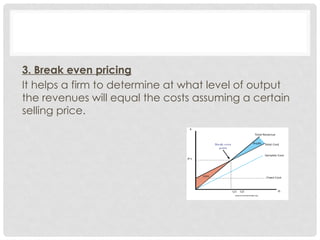
3. Break evenpricing
It helps a firm to determine at what level of output
the revenues will equal the costs assuming a certain
selling price.
58.
4. Marginal costor Incremental cost pricing
The marginal cost is the cost of producing one more
unit of a good. Marginal cost includes all of the costs
that vary with the level of production.
59.
II. DEMAND ORIENTEDPRICING POLICY
1. Purchasing power pricing method
The price is determined on the basis of what the
purchaser can bear or pay.
What purchaser can pay depends upon their
purchasing power.
60.
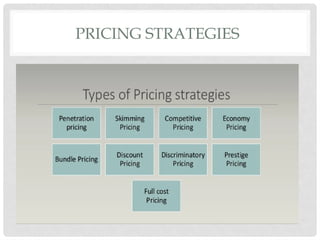
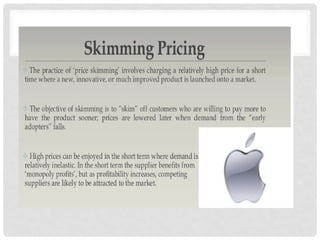
2. Skimmed pricing
highprice is charged for a product till such time as
competitors allow after which prices can be
dropped.
The idea is to recover maximum money before the
product or segment attracts more competitors who
will lower profits for all concerned.
61.
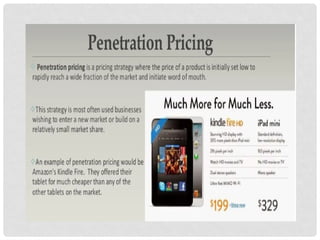
3. Penetration Pricing
priceis set artificially low to gain market share quickly.
This is done when a new product is being launched.
It is understood that prices will be raised once the
promotion period is over
62.
III) COMPETITION ORIENTEDPRICING
POLICY
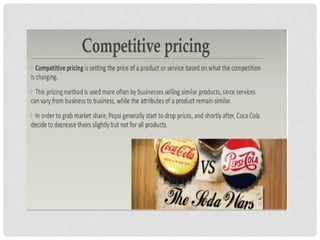
1. Parity/Going rate pricing
The price of the product determined on the basis of
the price of competitors products.
63.
2. Pricing belowcompetitive level or Discount pricing
When the firm determines the price of its products
below the competitive level.
3. Pricing above competitive level or Premium pricing:
When the firm determines the price of its products
above the price of the same products of the
competitors.
SIGNIFICANCE/IMPORTANCE OF
PRICING
• Itmaximize short and long term profit
• It helps in increasing sales volume
• It support to an organization for increasing market
share
• It helps to Obtain target rate of return
75.
DISCOUNT
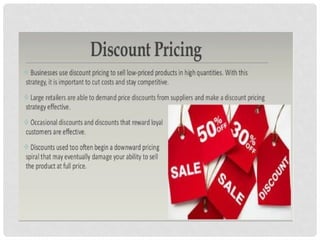
• When areduction in the amount is allowed in order to
encourage more purchase or to have an on time
payment is referred to as discount.
• Trade discount: The discount which is allowed when
purchases are made in large quantity is known as trade
discount. It is allowed as deduction from the sale value
and the sale is recorded at a new amount. This is called
sale less trade discount.
• Cash discount: The discount which is allowed by the
supplier for immediate payment or before the due date
is known as cash discount. It is usually allowed as a
percentage of the amount received.
76.
REBATE
• Rebate isa sales promotion technique in which
certain part of the purchase amount is returned to
the buyer by the seller. It is usually given on the
purchase of a certain quantity or value, product
and for a limited period of time.
• An example of a rebate is a 10% discount on a cell
phone at the time of purchase.
77.
• A Rebateis a form of buying discount and is an
amount paid by way of reduction, return, or refund
that is paid retrospectively. It is a type of sales
promotion that marketers use primarily
as incentives or supplements to product sales.
• It should not be confused with discounts that is
deducted from your purchase amount in advance
of payment whereas rebates are given only after
the payment of full purchase invoice amount.