STRATEGIC CHOICE
How do we get there?
What direction should we
take?
Need for a strategy/strategies
• No single strategy is the best in all
situations and at all times
• Avoid casual bench marking by aligning
your strategic choices to your situation
• We need a consistent set of
choices/decisions and actions/tactics in
order to outwit our rivals
• Without this consistent set of tactics,
synergy is lost
Selecting the best strategy thatSelecting the best strategy that
will enable a firm achieve itswill enable a firm achieve its
goals.goals.
Some strategy options areSome strategy options are
more appropriate than others.more appropriate than others.
Strategists should evaluate theStrategists should evaluate the
existing alternatives beforeexisting alternatives before
choosing the best strategychoosing the best strategy
Criteria for evaluation and selection of
strategy
• Sustainable competitive
advantage
• Corporate goals &
objectives
• Organization policies and
culture
• Ethical issues
• Cost of strategy failure
• Feasibility of the
strategy
The Generic Strategy
Alternatives.
Are the common strategic
approaches that can give a firm
sustainable competitive advantage.
Michael Porter’s approach
Igor Ansoff’s approach
Glueck’s approach
Kotler’s approach
Tailor-made strategies
ichael Porter’s approac
1.Overall cost leadership
2.Differentiation
3.Focus strategy
1.Overall cost
leadership:• Aim at being the lowest
cost producer relative to
competitors
• Increases a firm’s
profitability
• The market can enjoy
affordable prices
 Making oneself differentMaking oneself different
from othersfrom others
 Adding to customersAdding to customers
perceived value of the firmperceived value of the firm
and its productsand its products
 Calls for continuousCalls for continuous
innovations (customer-innovations (customer-
centred)centred)
2. Differentiation2. Differentiation
strategy:strategy:
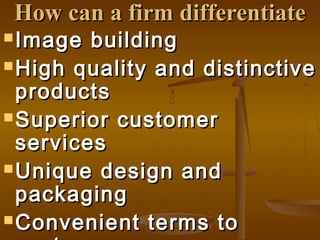
How can a firm differentiateHow can a firm differentiate
 Image buildingImage building
 High quality and distinctiveHigh quality and distinctive
productsproducts
 Superior customerSuperior customer
servicesservices
 Unique design andUnique design and
packagingpackaging
 Convenient terms toConvenient terms to
3. Focus strategy3. Focus strategy
 Involves segmenting theInvolves segmenting the
marketmarket
 Focusing on a given marketFocusing on a given market
segmentsegment
 Calls for specialization in aCalls for specialization in a
specific market segmentspecific market segment
(niche marketing)(niche marketing)
Why focus strategy?Why focus strategy?
Different groups of buyers withDifferent groups of buyers with
different needsdifferent needs
No other rival is attempting toNo other rival is attempting to
specialize in the same segmentspecialize in the same segment
A firm’s resources don’t allow itA firm’s resources don’t allow it
to spread over the entireto spread over the entire
segmentsegment
Where some segments are moreWhere some segments are more
attractive than othersattractive than others
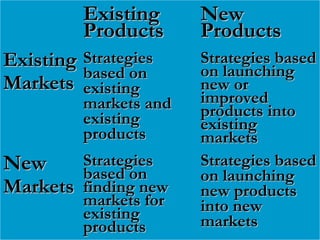
ANSOFF’S
APPROACH
 Provides four strategic
approaches based on
product and market
information
 Came up with the
product/market matrix.
ExistingExisting
ProductsProducts
NewNew
ProductsProducts
ExistingExisting
MarketsMarkets
StrategiesStrategies
based onbased on
existingexisting
markets andmarkets and
existingexisting
productsproducts
Strategies basedStrategies based
on launchingon launching
new ornew or
improvedimproved
products intoproducts into
existingexisting
marketsmarkets
NewNew
MarketsMarkets
StrategiesStrategies
based onbased on
finding newfinding new
markets formarkets for
existingexisting
productsproducts
Strategies basedStrategies based
on launchingon launching
new productsnew products
into newinto new
marketsmarkets
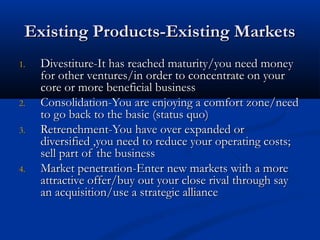
Existing Products-Existing MarketsExisting Products-Existing Markets
1.1. Divestiture-It has reached maturity/you need moneyDivestiture-It has reached maturity/you need money
for other ventures/in order to concentrate on yourfor other ventures/in order to concentrate on your
core or more beneficial businesscore or more beneficial business
2.2. Consolidation-You are enjoying a comfort zone/needConsolidation-You are enjoying a comfort zone/need
to go back to the basic (status quo)to go back to the basic (status quo)
3.3. Retrenchment-You have over expanded orRetrenchment-You have over expanded or
diversified ,you need to reduce your operating costs;diversified ,you need to reduce your operating costs;
sell part of the businesssell part of the business
4.4. Market penetration-Enter new markets with a moreMarket penetration-Enter new markets with a more
attractive offer/buy out your close rival through sayattractive offer/buy out your close rival through say
an acquisition/use a strategic alliancean acquisition/use a strategic alliance
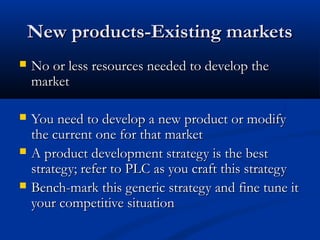
New products-Existing marketsNew products-Existing markets
 No or less resources needed to develop theNo or less resources needed to develop the
marketmarket
 You need to develop a new product or modifyYou need to develop a new product or modify
the current one for that marketthe current one for that market
 A product development strategy is the bestA product development strategy is the best
strategy; refer to PLC as you craft this strategystrategy; refer to PLC as you craft this strategy
 Bench-mark this generic strategy and fine tune itBench-mark this generic strategy and fine tune it
your competitive situationyour competitive situation
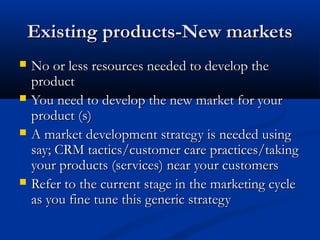
Existing products-New marketsExisting products-New markets
 No or less resources needed to develop theNo or less resources needed to develop the
productproduct
 You need to develop the new market for yourYou need to develop the new market for your
product (s)product (s)
 A market development strategy is needed usingA market development strategy is needed using
say; CRM tactics/customer care practices/takingsay; CRM tactics/customer care practices/taking
your products (services) near your customersyour products (services) near your customers
 Refer to the current stage in the marketing cycleRefer to the current stage in the marketing cycle
as you fine tune this generic strategyas you fine tune this generic strategy
New product-New marketNew product-New market
 A lot of risks and uncertainties involved; youA lot of risks and uncertainties involved; you
need to develop the new product for the newneed to develop the new product for the new
marketmarket
 Minimize such risks through using a competitiveMinimize such risks through using a competitive
stepping stonestepping stone
 Commonly used strategies in such situationsCommonly used strategies in such situations
include; buying franchises, strategic alliances, andinclude; buying franchises, strategic alliances, and
use of pilot projects among othersuse of pilot projects among others
GLUECK’S APPROACH
 Stability strategy
 Expansion strategy
 Retrenchment strategy
 Combination
Stability Strategies:
• Strategies pursued with no
or few changes made in
the firm’s products,
markets or functions.
• Ideal for those firms that
are already consolidated
in the market.
Why stabilize?
The strategy is less risky
When a firm is doing well
Executives aren't creative
and innovative
Fear to disrupt routines
Environment is relatively
stable
Fear of inefficiencies due to
Expansion Strategies
 A firm serves the market with
additional offers, adds to its
markets and functions.
 Firm increases the pace of its
activities
 Ideal where a firm wants to
improve its growth
performance
Why Expand?
To survive in a volatile
environment
To provide variety to the
market
Sign of good performance
Need to re-invest profits
To enjoy economies of scale
Motivates the firm
Retrenchment strategies:
A firm reduces its product lines,
abandons some market territories,
reduces its functions.
Looks like lean management
Firm reduces activities in those
units with negative or little cash
flows.
The pace of operation and scope
of activities greatly reduces.
Why retrench?
• The firm is performing poorly
• The firm has tried all strategies and
still failed to succeed
• The firm needs funds to pursue
better opportunities elsewhere
• Turbulent environment
• External pressure
Combination strategies:
•A firm uses several of
the above strategies
simultaneously to
different portfolios of a
firm.
Kotler’s strategies.
• Looks at market positions (shares) of
competing firms
• The competitors are at war over these
competitive positions
• Different competitive positions require different
competitive strategies
• The positions include; market leader,
challenger, follower, and nicher mainly
Market leader’s strategies
• Those you lead also want to get where you
are and/or even overtake you; you are the
target for the challenger’s strategic attacks
• Use strategies that may help you to expand
or protect your market share
• The best science and art of war/the general
(strategy) depends on your situation at hand
in your internal and external environment
a) Expanding your total market
1. Acquisitions and mergers
2. Franchises and/or international trade
3. Increase usage of your products
4. Finding new users/creating new
demand
Protecting your market share
(strategies involved)
1. Defending your leading position and
competitive business walls
2. Pro-reactive protection of your weak
flanks/Pre-emptive defending
3. Counter offensive defense
4. Enter new markets for future defense
5. Strategic withdrawal
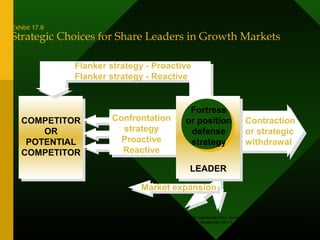
Exhibit 17.9
Strategic Choices for Share Leaders in Growth Markets
COMPETITOR
OR
POTENTIAL
COMPETITOR
Contraction
or strategic
withdrawal
Market expansion
Flanker strategy - Proactive
Flanker strategy - Reactive
LEADER
Fortress
or position
defense
strategy
Confrontation
strategy
Proactive
Reactive
Source: Adapted from P. Kotler and R. Singh Achrol, “Marketing Warfare in the 1980’s” Reprinted with permission from Journal of Business Strategy, Winter 1981,
pp. 30-41. Copyright © 1981 by Warren, Gorham & Lambert, Inc., 210 South Street, Boston MA 02111. All rights reserved.
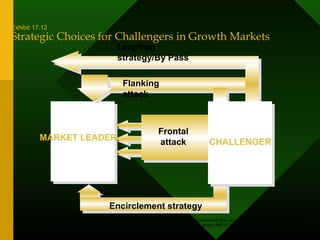
Market Challengers’ strategies
• They want to overtake the share leaders
BUT should also aggressively differentiate
themselves from fellow challengers using
the following alternatives;
1. Frontal/head-on/direct attack (strengths)
2. Flanking/indirect attack ( weak points)
3. By pass/ Leapfrogging
4. Encirclement/Guerrilla attack
Note
• The market leader is usually better than you in
terms of resources/expertise
• They are also watching your attacking activities and
looking for strategies of how to deal with your
challenge
• Some market share leaders’ reactions may shallow
the attacker/challenger
• To improve your market share, you need to build a
distinctive competitive advantage of your own; not
just imitating your market leader
Exhibit 17.12
Strategic Choices for Challengers in Growth Markets
MARKET LEADER
Flanking
attack
Frontal
attack
Encirclement strategy
Leapfrog
strategy/By Pass
Source: Adapted from P. Kotler and R. Singh Achrol, “Marketing Warfare in the 1980’s” Reprinted with permission from Journal of Business Strategy, Winter 1981,
pp. 30-41. Copyright © 1981 by Warren, Gorham & Lambert, Inc., 210 South Street, Boston MA 02111. All rights reserved.
CHALLENGER
Market followers' strategies
• Sometimes overlooked by the market
leader and challenger BUT may become
challenger and/or even overtake the
market share leader
• Their commonly used strategies;
1. Cloner
2. Imitator
3. Adaptor
Market Followers-cont
• Commonly found in oligopolistic
industries
• Try to compete on dimensions other than
price (avoid price competition)
– Product value/quality
– Customer service
– Promotional effectiveness
– Distribution, etc
Market nichers
• Operate on high profit margins vs. high
volume
• Compete in well-defined market segments
(niches)
• They tend to specialize in that niche in
terms of customer category,
products/services, geographical area
• Successful nichers usually have a large
How to select a few from the
many generic/bench-marked
strategies
• The common approaches;
1. The strategic choice matrix
2. SWOT analysis
3. Portfolio analysis
Factors determining the final
acceptance of the proposed
strategy by top management
1. Top management’s attitude towards risk
2. Top executives’ preference for past strategy in
relation to past performance
3. Their values including the shared values,
chief executive's beliefs and personal
intentions
4. CEO’s power relationship with other top
executives and surdodinates

Strategic choice

  • 1.
    STRATEGIC CHOICE How dowe get there? What direction should we take?
  • 2.
    Need for astrategy/strategies • No single strategy is the best in all situations and at all times • Avoid casual bench marking by aligning your strategic choices to your situation • We need a consistent set of choices/decisions and actions/tactics in order to outwit our rivals • Without this consistent set of tactics, synergy is lost
  • 3.
    Selecting the beststrategy thatSelecting the best strategy that will enable a firm achieve itswill enable a firm achieve its goals.goals. Some strategy options areSome strategy options are more appropriate than others.more appropriate than others. Strategists should evaluate theStrategists should evaluate the existing alternatives beforeexisting alternatives before choosing the best strategychoosing the best strategy
  • 4.
    Criteria for evaluationand selection of strategy • Sustainable competitive advantage • Corporate goals & objectives • Organization policies and culture
  • 5.
    • Ethical issues •Cost of strategy failure • Feasibility of the strategy
  • 6.
    The Generic Strategy Alternatives. Arethe common strategic approaches that can give a firm sustainable competitive advantage. Michael Porter’s approach Igor Ansoff’s approach Glueck’s approach Kotler’s approach Tailor-made strategies
  • 7.
    ichael Porter’s approac 1.Overallcost leadership 2.Differentiation 3.Focus strategy
  • 8.
    1.Overall cost leadership:• Aimat being the lowest cost producer relative to competitors • Increases a firm’s profitability • The market can enjoy affordable prices
  • 9.
     Making oneselfdifferentMaking oneself different from othersfrom others  Adding to customersAdding to customers perceived value of the firmperceived value of the firm and its productsand its products  Calls for continuousCalls for continuous innovations (customer-innovations (customer- centred)centred) 2. Differentiation2. Differentiation strategy:strategy:
  • 10.
    How can afirm differentiateHow can a firm differentiate  Image buildingImage building  High quality and distinctiveHigh quality and distinctive productsproducts  Superior customerSuperior customer servicesservices  Unique design andUnique design and packagingpackaging  Convenient terms toConvenient terms to
  • 11.
    3. Focus strategy3.Focus strategy  Involves segmenting theInvolves segmenting the marketmarket  Focusing on a given marketFocusing on a given market segmentsegment  Calls for specialization in aCalls for specialization in a specific market segmentspecific market segment (niche marketing)(niche marketing)
  • 12.
    Why focus strategy?Whyfocus strategy? Different groups of buyers withDifferent groups of buyers with different needsdifferent needs No other rival is attempting toNo other rival is attempting to specialize in the same segmentspecialize in the same segment A firm’s resources don’t allow itA firm’s resources don’t allow it to spread over the entireto spread over the entire segmentsegment Where some segments are moreWhere some segments are more attractive than othersattractive than others
  • 13.
    ANSOFF’S APPROACH  Provides fourstrategic approaches based on product and market information  Came up with the product/market matrix.
  • 14.
    ExistingExisting ProductsProducts NewNew ProductsProducts ExistingExisting MarketsMarkets StrategiesStrategies based onbased on existingexisting marketsandmarkets and existingexisting productsproducts Strategies basedStrategies based on launchingon launching new ornew or improvedimproved products intoproducts into existingexisting marketsmarkets NewNew MarketsMarkets StrategiesStrategies based onbased on finding newfinding new markets formarkets for existingexisting productsproducts Strategies basedStrategies based on launchingon launching new productsnew products into newinto new marketsmarkets
  • 15.
    Existing Products-Existing MarketsExistingProducts-Existing Markets 1.1. Divestiture-It has reached maturity/you need moneyDivestiture-It has reached maturity/you need money for other ventures/in order to concentrate on yourfor other ventures/in order to concentrate on your core or more beneficial businesscore or more beneficial business 2.2. Consolidation-You are enjoying a comfort zone/needConsolidation-You are enjoying a comfort zone/need to go back to the basic (status quo)to go back to the basic (status quo) 3.3. Retrenchment-You have over expanded orRetrenchment-You have over expanded or diversified ,you need to reduce your operating costs;diversified ,you need to reduce your operating costs; sell part of the businesssell part of the business 4.4. Market penetration-Enter new markets with a moreMarket penetration-Enter new markets with a more attractive offer/buy out your close rival through sayattractive offer/buy out your close rival through say an acquisition/use a strategic alliancean acquisition/use a strategic alliance
  • 16.
    New products-Existing marketsNewproducts-Existing markets  No or less resources needed to develop theNo or less resources needed to develop the marketmarket  You need to develop a new product or modifyYou need to develop a new product or modify the current one for that marketthe current one for that market  A product development strategy is the bestA product development strategy is the best strategy; refer to PLC as you craft this strategystrategy; refer to PLC as you craft this strategy  Bench-mark this generic strategy and fine tune itBench-mark this generic strategy and fine tune it your competitive situationyour competitive situation
  • 17.
    Existing products-New marketsExistingproducts-New markets  No or less resources needed to develop theNo or less resources needed to develop the productproduct  You need to develop the new market for yourYou need to develop the new market for your product (s)product (s)  A market development strategy is needed usingA market development strategy is needed using say; CRM tactics/customer care practices/takingsay; CRM tactics/customer care practices/taking your products (services) near your customersyour products (services) near your customers  Refer to the current stage in the marketing cycleRefer to the current stage in the marketing cycle as you fine tune this generic strategyas you fine tune this generic strategy
  • 18.
    New product-New marketNewproduct-New market  A lot of risks and uncertainties involved; youA lot of risks and uncertainties involved; you need to develop the new product for the newneed to develop the new product for the new marketmarket  Minimize such risks through using a competitiveMinimize such risks through using a competitive stepping stonestepping stone  Commonly used strategies in such situationsCommonly used strategies in such situations include; buying franchises, strategic alliances, andinclude; buying franchises, strategic alliances, and use of pilot projects among othersuse of pilot projects among others
  • 19.
    GLUECK’S APPROACH  Stabilitystrategy  Expansion strategy  Retrenchment strategy  Combination
  • 20.
    Stability Strategies: • Strategiespursued with no or few changes made in the firm’s products, markets or functions. • Ideal for those firms that are already consolidated in the market.
  • 21.
    Why stabilize? The strategyis less risky When a firm is doing well Executives aren't creative and innovative Fear to disrupt routines Environment is relatively stable Fear of inefficiencies due to
  • 22.
    Expansion Strategies  Afirm serves the market with additional offers, adds to its markets and functions.  Firm increases the pace of its activities  Ideal where a firm wants to improve its growth performance
  • 23.
    Why Expand? To survivein a volatile environment To provide variety to the market Sign of good performance Need to re-invest profits To enjoy economies of scale Motivates the firm
  • 24.
    Retrenchment strategies: A firmreduces its product lines, abandons some market territories, reduces its functions. Looks like lean management Firm reduces activities in those units with negative or little cash flows. The pace of operation and scope of activities greatly reduces.
  • 25.
    Why retrench? • Thefirm is performing poorly • The firm has tried all strategies and still failed to succeed • The firm needs funds to pursue better opportunities elsewhere • Turbulent environment • External pressure
  • 26.
    Combination strategies: •A firmuses several of the above strategies simultaneously to different portfolios of a firm.
  • 27.
    Kotler’s strategies. • Looksat market positions (shares) of competing firms • The competitors are at war over these competitive positions • Different competitive positions require different competitive strategies • The positions include; market leader, challenger, follower, and nicher mainly
  • 28.
    Market leader’s strategies •Those you lead also want to get where you are and/or even overtake you; you are the target for the challenger’s strategic attacks • Use strategies that may help you to expand or protect your market share • The best science and art of war/the general (strategy) depends on your situation at hand in your internal and external environment
  • 29.
    a) Expanding yourtotal market 1. Acquisitions and mergers 2. Franchises and/or international trade 3. Increase usage of your products 4. Finding new users/creating new demand
  • 30.
    Protecting your marketshare (strategies involved) 1. Defending your leading position and competitive business walls 2. Pro-reactive protection of your weak flanks/Pre-emptive defending 3. Counter offensive defense 4. Enter new markets for future defense 5. Strategic withdrawal
  • 31.
    Exhibit 17.9 Strategic Choicesfor Share Leaders in Growth Markets COMPETITOR OR POTENTIAL COMPETITOR Contraction or strategic withdrawal Market expansion Flanker strategy - Proactive Flanker strategy - Reactive LEADER Fortress or position defense strategy Confrontation strategy Proactive Reactive Source: Adapted from P. Kotler and R. Singh Achrol, “Marketing Warfare in the 1980’s” Reprinted with permission from Journal of Business Strategy, Winter 1981, pp. 30-41. Copyright © 1981 by Warren, Gorham & Lambert, Inc., 210 South Street, Boston MA 02111. All rights reserved.
  • 32.
    Market Challengers’ strategies •They want to overtake the share leaders BUT should also aggressively differentiate themselves from fellow challengers using the following alternatives; 1. Frontal/head-on/direct attack (strengths) 2. Flanking/indirect attack ( weak points) 3. By pass/ Leapfrogging 4. Encirclement/Guerrilla attack
  • 33.
    Note • The marketleader is usually better than you in terms of resources/expertise • They are also watching your attacking activities and looking for strategies of how to deal with your challenge • Some market share leaders’ reactions may shallow the attacker/challenger • To improve your market share, you need to build a distinctive competitive advantage of your own; not just imitating your market leader
  • 34.
    Exhibit 17.12 Strategic Choicesfor Challengers in Growth Markets MARKET LEADER Flanking attack Frontal attack Encirclement strategy Leapfrog strategy/By Pass Source: Adapted from P. Kotler and R. Singh Achrol, “Marketing Warfare in the 1980’s” Reprinted with permission from Journal of Business Strategy, Winter 1981, pp. 30-41. Copyright © 1981 by Warren, Gorham & Lambert, Inc., 210 South Street, Boston MA 02111. All rights reserved. CHALLENGER
  • 35.
    Market followers' strategies •Sometimes overlooked by the market leader and challenger BUT may become challenger and/or even overtake the market share leader • Their commonly used strategies; 1. Cloner 2. Imitator 3. Adaptor
  • 36.
    Market Followers-cont • Commonlyfound in oligopolistic industries • Try to compete on dimensions other than price (avoid price competition) – Product value/quality – Customer service – Promotional effectiveness – Distribution, etc
  • 37.
    Market nichers • Operateon high profit margins vs. high volume • Compete in well-defined market segments (niches) • They tend to specialize in that niche in terms of customer category, products/services, geographical area • Successful nichers usually have a large
  • 38.
    How to selecta few from the many generic/bench-marked strategies • The common approaches; 1. The strategic choice matrix 2. SWOT analysis 3. Portfolio analysis
  • 39.
    Factors determining thefinal acceptance of the proposed strategy by top management 1. Top management’s attitude towards risk 2. Top executives’ preference for past strategy in relation to past performance 3. Their values including the shared values, chief executive's beliefs and personal intentions 4. CEO’s power relationship with other top executives and surdodinates

Editor's Notes