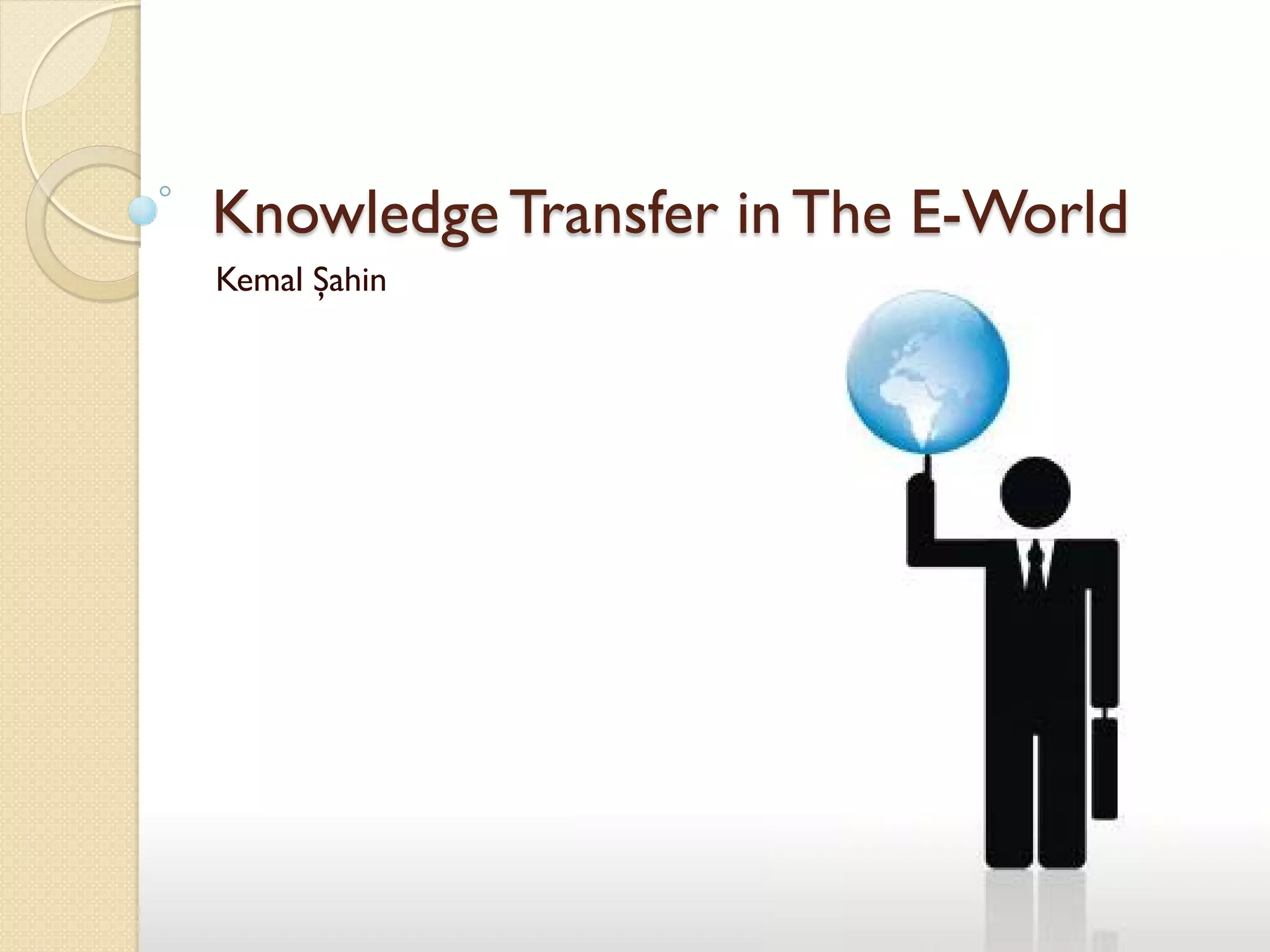
Knowledge Transfer in The E-World
Kemal Şahin
Today, I will talk about;
   E-World

   Intranet

   Extranets
    ◦ Groupware

    ◦ Groupware Applications

   E-Business
    ◦ The Value Chain
          Business to Consumer (B2C)

          Business to Business (B2B)

    ◦ Supply Chain Management (SCM)
          CRM

    ◦ Implications for Knowledge Management
The E-World
   Electronic facilities
    ◦ Accommodate knowledge transfer

    ◦ Knowledge exchange (regardless of place, location)

   The facilities include;
    ◦ Intranet

    ◦ Extranet

    ◦ Groupware

    ◦ E-Commerce (E-Business)
Intranets
   Intranet is a term used when we apply Internet technology to serve the
    internal needs of an organization.
    ◦ Intranets handle all transfers and exchanges with ease.

   6 Major Benefits of Building an Intranet
    ◦ 1. Reduces Cost

    ◦ 2. Saves Time

    ◦ 3. Increases Collaboration

    ◦ 4. Increases Productivity and Effectiveness

    ◦ 5. Integrated and Distributed Computing Environment

    ◦ 6. Rich in Format
Intranets – Intranets Tools
   Detailed e-mail for interoffice communication

   Internal company office circulars

   Bulletin Board Services

   A Daily To-do List

   Assignments from a central desk to all connected desks

   A channel for confidential exchange of strategic decisions
Extranets
   An extranet is a private network that uses Internet protocols, network
    connectivity

   2 or more trading partners = B2B or EXTRANET

   Not a passing trend.They are already the backbone of the e-
    business future.

   Benefits;
    ◦ Faster time to market

    ◦ Customer loyalty
                                      IDENTIFYING A BUSINESS GOAL
    ◦ Increased partner interaction

    ◦ İmporoved processes
Extranets
   Advantages of an extranet (for organizations)
    ◦ Business and exchanges knowledge with partners

    ◦ More effective collabration with business partners

    ◦ A long-term investment in competitive advantage

   Extranet tools
    ◦ Groupware
          Communicate ideas

          Cooperate in problem solving

          Coordinate work flow

          Negotiate solutions
Extranets
   Categories of Groupware
    ◦ Email/messaging

    ◦ Group calendaring and scheduling

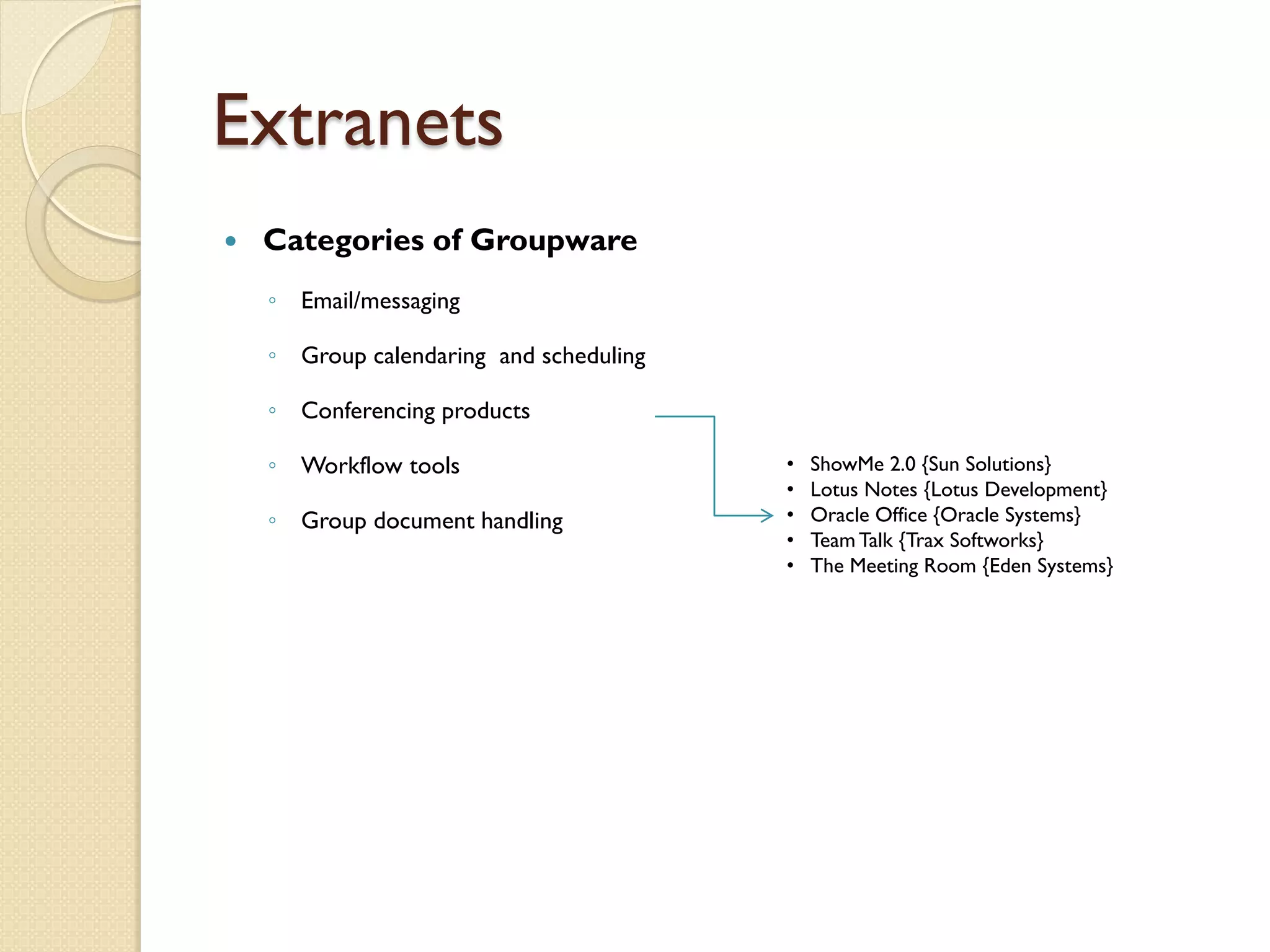
    ◦ Conferencing products

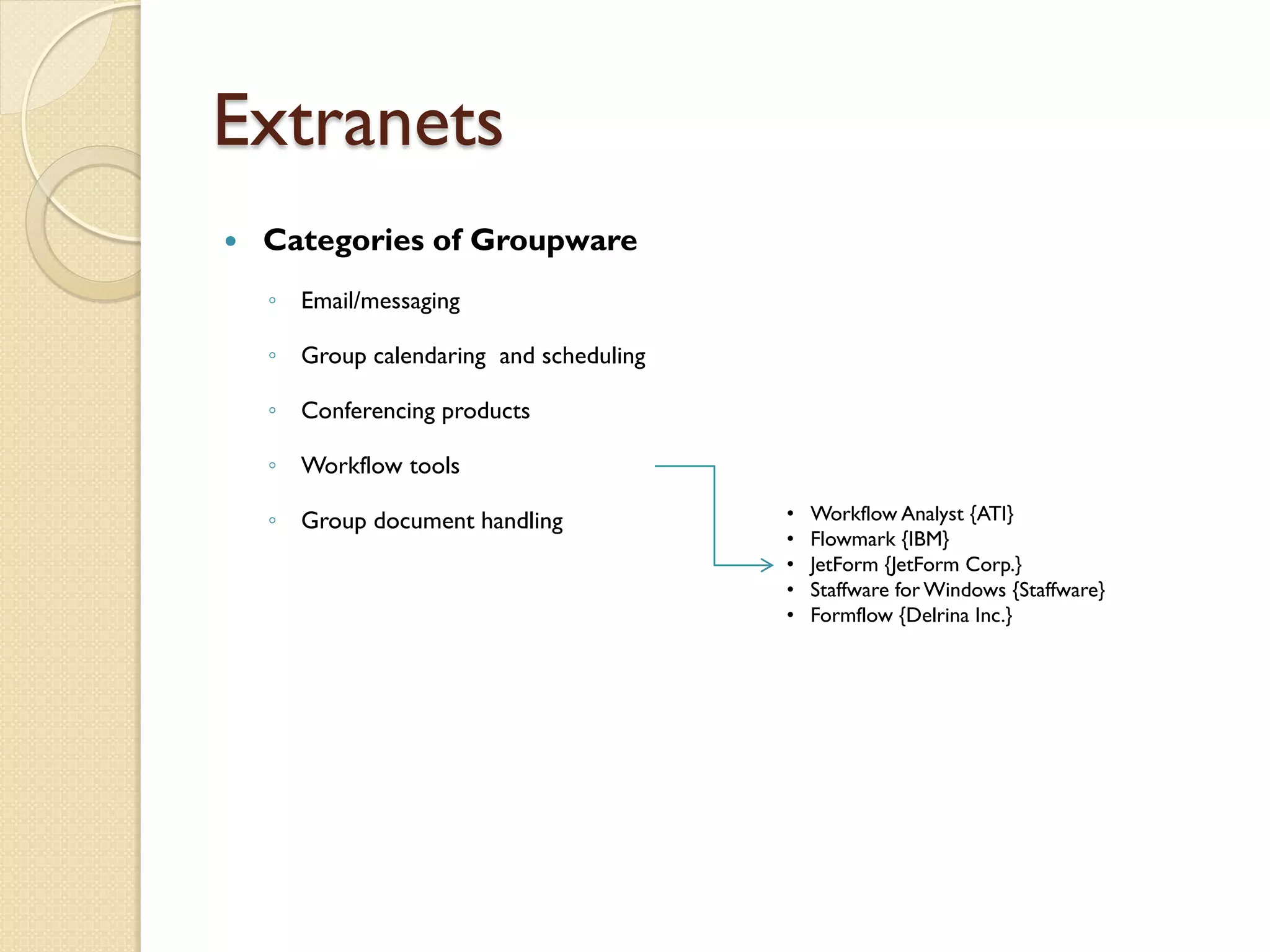
    ◦ Workflow tools

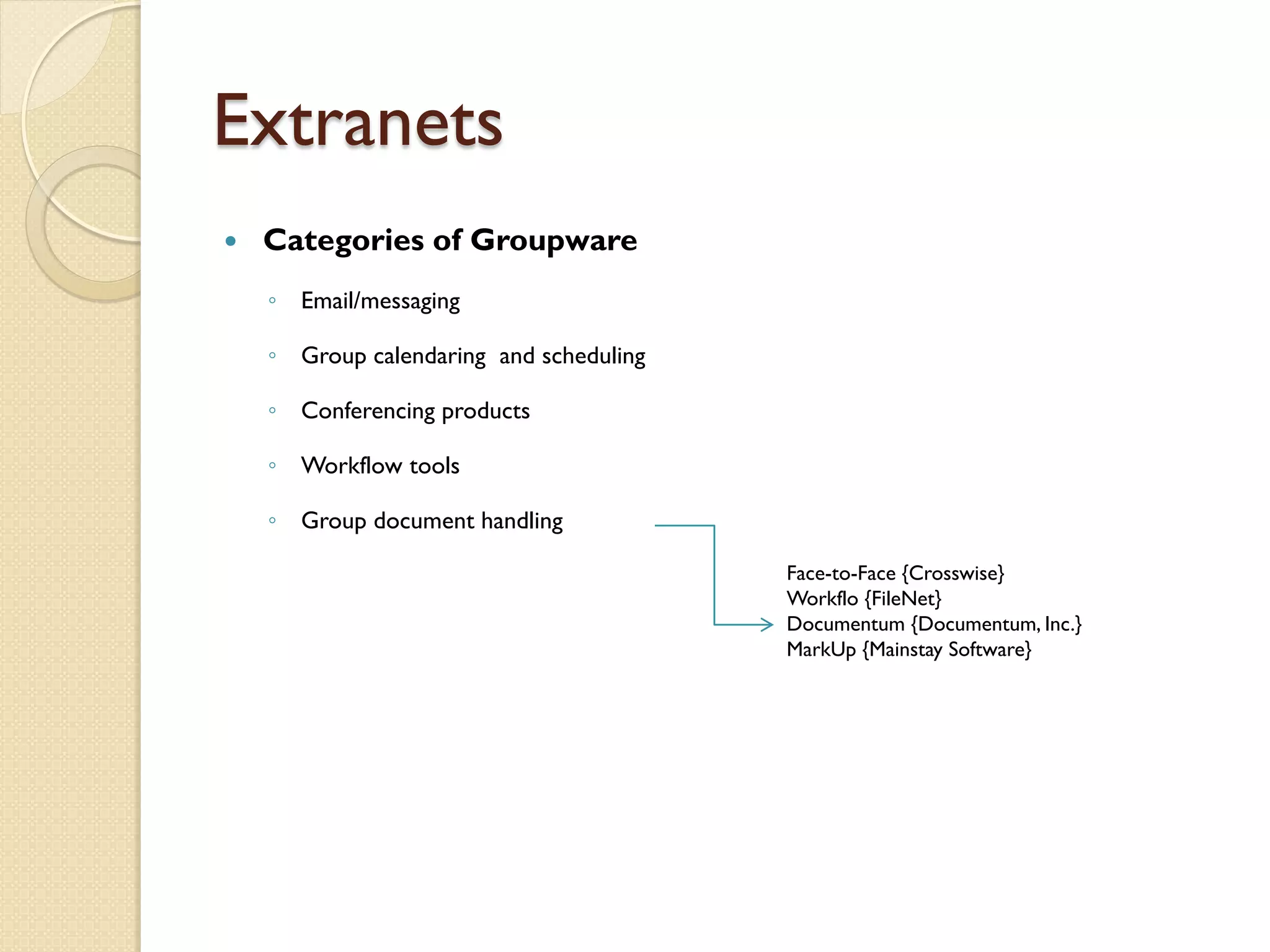
    ◦ Group document handling
Extranets
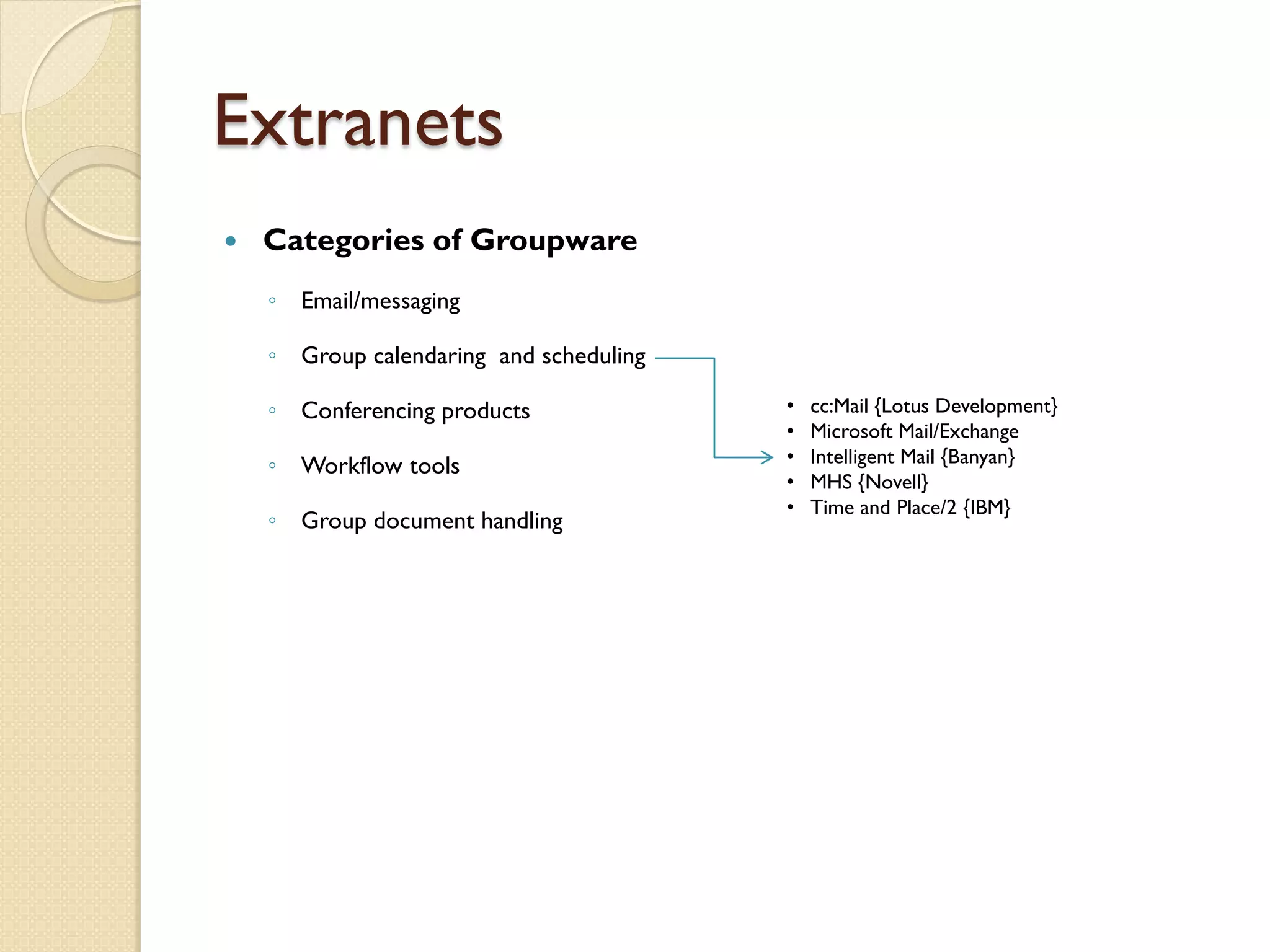
   Categories of Groupware
    ◦ Email/messaging

    ◦ Group calendaring and scheduling

    ◦ Conferencing products              •   cc:Mail {Lotus Development}
                                         •   Microsoft Mail/Exchange
    ◦ Workflow tools                     •   Intelligent Mail {Banyan}
                                         •   MHS {Novell}
                                         •   Time and Place/2 {IBM}
    ◦ Group document handling
Extranets
   Categories of Groupware
    ◦ Email/messaging

    ◦ Group calendaring and scheduling

    ◦ Conferencing products

    ◦ Workflow tools                     •   ShowMe 2.0 {Sun Solutions}
                                         •   Lotus Notes {Lotus Development}
    ◦ Group document handling            •   Oracle Office {Oracle Systems}
                                         •   Team Talk {Trax Softworks}
                                         •   The Meeting Room {Eden Systems}
Extranets
   Categories of Groupware
    ◦ Email/messaging

    ◦ Group calendaring and scheduling

    ◦ Conferencing products

    ◦ Workflow tools

    ◦ Group document handling            •   Workflow Analyst {ATI}
                                         •   Flowmark {IBM}
                                         •   JetForm {JetForm Corp.}
                                         •   Staffware for Windows {Staffware}
                                         •   Formflow {Delrina Inc.}
Extranets
   Categories of Groupware
    ◦ Email/messaging

    ◦ Group calendaring and scheduling

    ◦ Conferencing products

    ◦ Workflow tools

    ◦ Group document handling

                                         Face-to-Face {Crosswise}
                                         Workflo {FileNet}
                                         Documentum {Documentum, Inc.}
                                         MarkUp {Mainstay Software}
Extranets
   One question about groupware


    How can you get Groupware to
    succeed in your organization?
Extranets
   Getting Groupware to work in your organization
    ◦ Find a champion or sponsor to support the implementation of Groupware

    ◦ Plan for changes in the corporate culture

    ◦ Don’t try to implement Groupware to the whole organization all at once
          Pilot project should be

            innovative

            visible and have a financial impact

    ◦ Realize that training, maintenance, and support will be the majority of the cost

    ◦ Use software to solve specific business problems which hasn’t been solved using the
       traditional methods

    ◦ Have adequate planning, support, training, and maintenance for your project
E-Business
   E-Business methods enable companies to link their internal and
    external data processing systems more efficiently and flexibly, to work
    more closely with suppliers and partners, and to better satisfy the needs
    and expectations of their customers.
E-Business
   E-Business Models
    ◦ E-shops

    ◦ E-commerce

    ◦ E-procurement

    ◦ E-malls

    ◦ E-auctions

    ◦ Virtual Communities

    ◦ Collaboration Platforms

    ◦ Third-party Marketplaces

    ◦ Value-chain Integrators

    ◦ Value-chain Service Providers

    ◦ Information Brokerage

    ◦ Telecommunication
E-Business
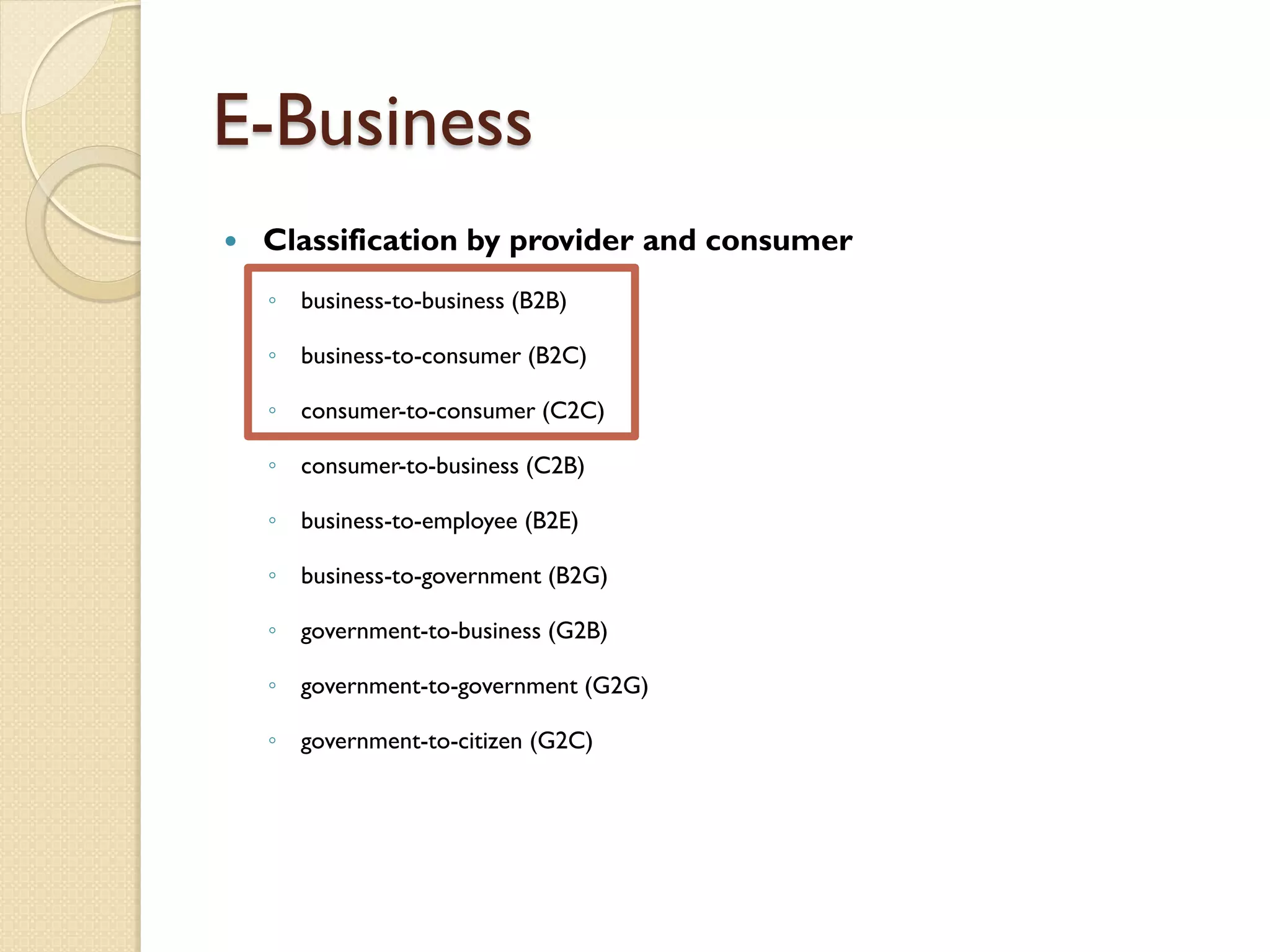
   Classification by provider and consumer
    ◦ business-to-business (B2B)

    ◦ business-to-consumer (B2C)

    ◦ consumer-to-consumer (C2C)

    ◦ consumer-to-business (C2B)

    ◦ business-to-employee (B2E)

    ◦ business-to-government (B2G)

    ◦ government-to-business (G2B)

    ◦ government-to-government (G2G)

    ◦ government-to-citizen (G2C)
E-Business
   Value Chain
    ◦ The value chain is a chain of activities for a firm operating in a specific industry.


    ◦ Six business functions of the Value Chain:

        Research and Development

        Design of Products, Services, or Processes

        Production

        Marketing & Sales

        Distribution

        Customer Service
E-Business
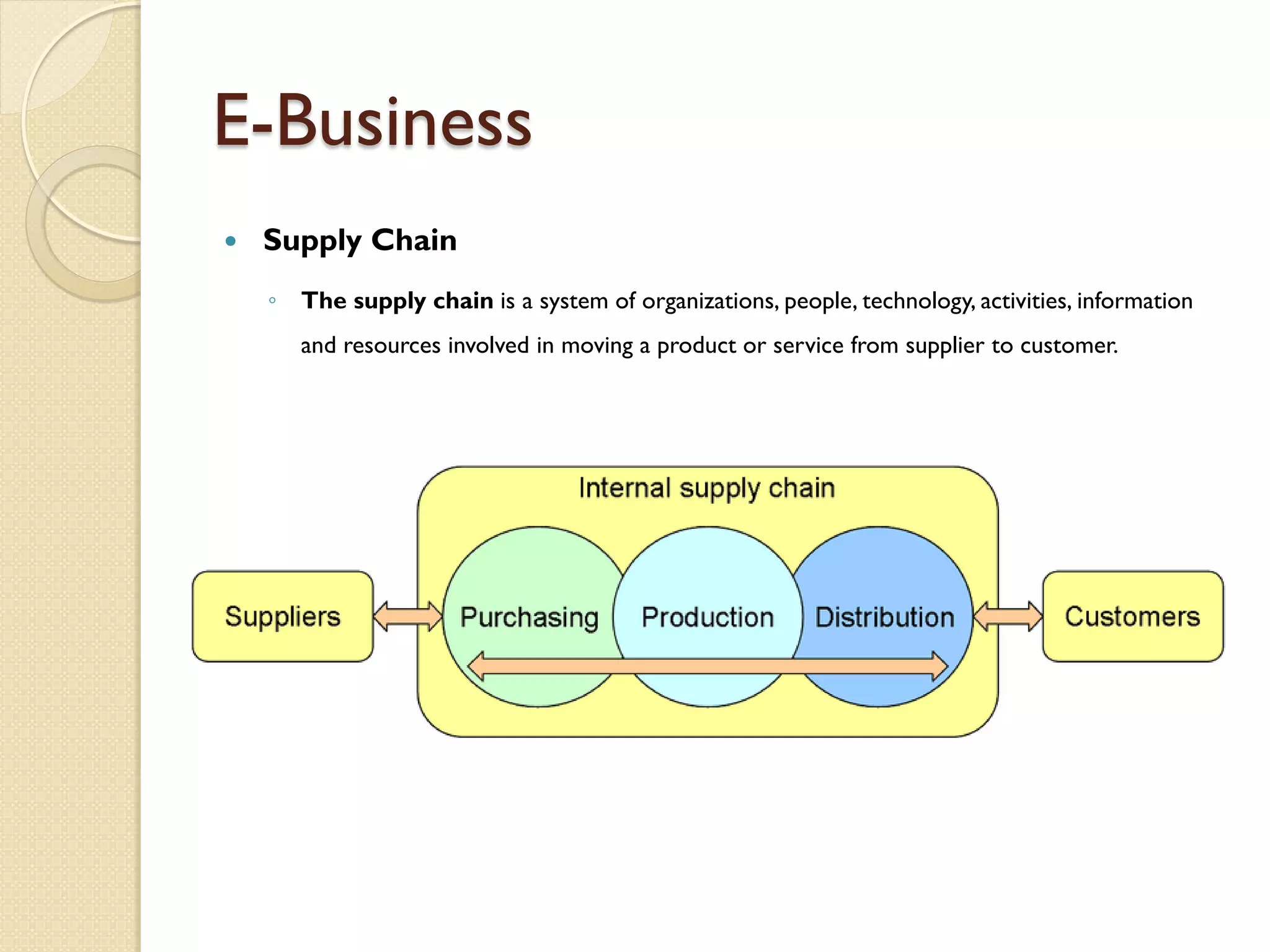
   Supply Chain
    ◦ The supply chain is a system of organizations, people, technology, activities, information
       and resources involved in moving a product or service from supplier to customer.
E-Business
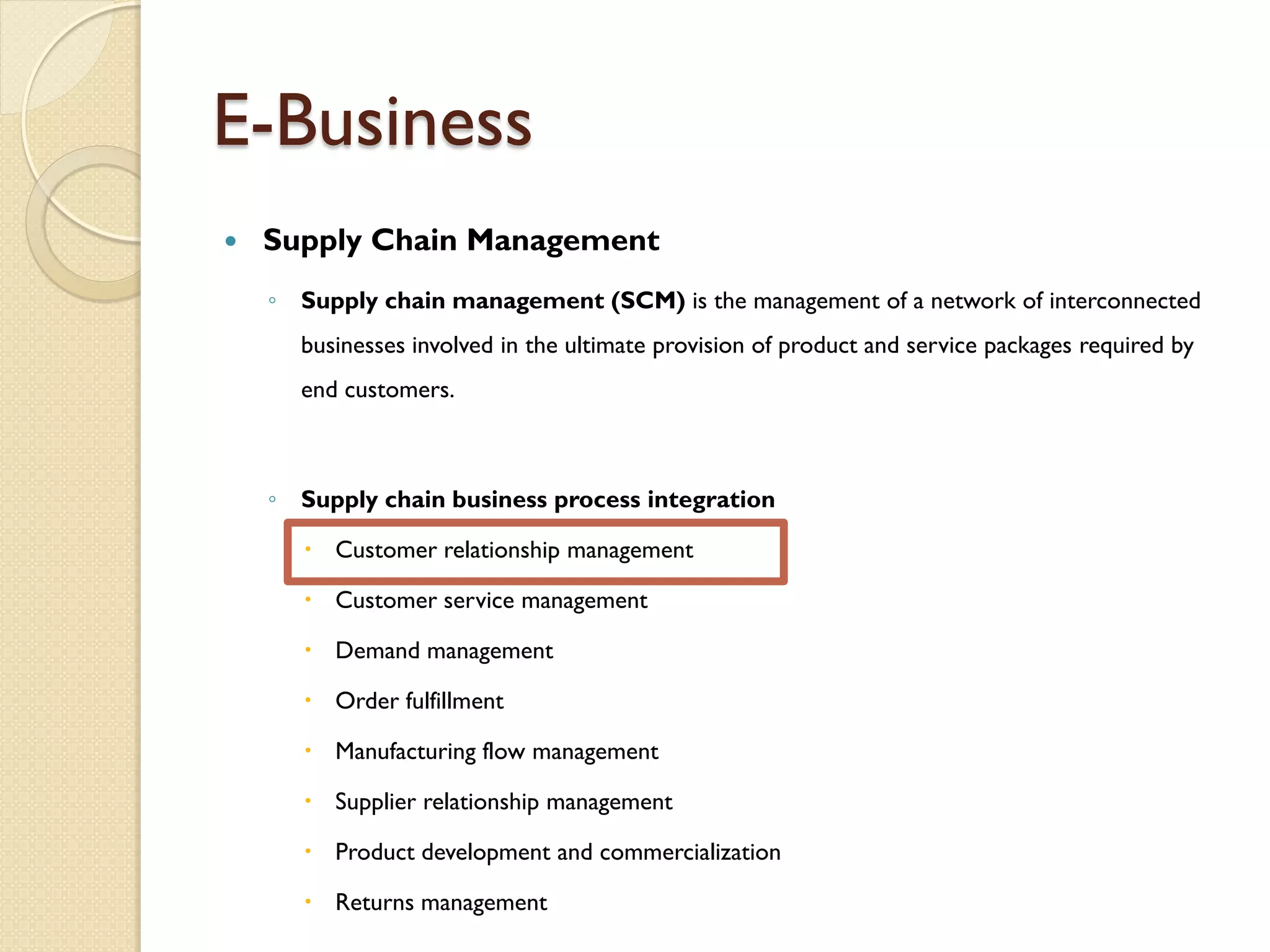
   Supply Chain Management
    ◦ Supply chain management (SCM) is the management of a network of interconnected
      businesses involved in the ultimate provision of product and service packages required by
      end customers.


    ◦ Supply chain business process integration

        Customer relationship management

        Customer service management

        Demand management

        Order fulfillment

        Manufacturing flow management

        Supplier relationship management

        Product development and commercialization

        Returns management
E-Business
   CRM (Customer Relationship Management)
    ◦ Benefits

      Streamlined sales and marketing processes

      Higher sales productivity

      Added cross-selling and up-selling opportunities

      Improved service, loyalty, and retention

      Increased call center efficiency

      Higher close rates

      Better profiling and targeting

      Reduced expenses

      Increased market share

      Higher overall profitability

      Marginal costing
Conclusion
Thank you!
Kemal Şahin


Any Questions?

Knowledge Transfer in The E-World

  • 1.
    Knowledge Transfer inThe E-World Kemal Şahin
  • 2.
    Today, I willtalk about;  E-World  Intranet  Extranets ◦ Groupware ◦ Groupware Applications  E-Business ◦ The Value Chain  Business to Consumer (B2C)  Business to Business (B2B) ◦ Supply Chain Management (SCM)  CRM ◦ Implications for Knowledge Management
  • 3.
    The E-World  Electronic facilities ◦ Accommodate knowledge transfer ◦ Knowledge exchange (regardless of place, location)  The facilities include; ◦ Intranet ◦ Extranet ◦ Groupware ◦ E-Commerce (E-Business)
  • 4.
    Intranets  Intranet is a term used when we apply Internet technology to serve the internal needs of an organization. ◦ Intranets handle all transfers and exchanges with ease.  6 Major Benefits of Building an Intranet ◦ 1. Reduces Cost ◦ 2. Saves Time ◦ 3. Increases Collaboration ◦ 4. Increases Productivity and Effectiveness ◦ 5. Integrated and Distributed Computing Environment ◦ 6. Rich in Format
  • 5.
    Intranets – IntranetsTools  Detailed e-mail for interoffice communication  Internal company office circulars  Bulletin Board Services  A Daily To-do List  Assignments from a central desk to all connected desks  A channel for confidential exchange of strategic decisions
  • 6.
    Extranets  An extranet is a private network that uses Internet protocols, network connectivity  2 or more trading partners = B2B or EXTRANET  Not a passing trend.They are already the backbone of the e- business future.  Benefits; ◦ Faster time to market ◦ Customer loyalty IDENTIFYING A BUSINESS GOAL ◦ Increased partner interaction ◦ İmporoved processes
  • 7.
    Extranets  Advantages of an extranet (for organizations) ◦ Business and exchanges knowledge with partners ◦ More effective collabration with business partners ◦ A long-term investment in competitive advantage  Extranet tools ◦ Groupware  Communicate ideas  Cooperate in problem solving  Coordinate work flow  Negotiate solutions
  • 8.
    Extranets  Categories of Groupware ◦ Email/messaging ◦ Group calendaring and scheduling ◦ Conferencing products ◦ Workflow tools ◦ Group document handling
  • 9.
    Extranets  Categories of Groupware ◦ Email/messaging ◦ Group calendaring and scheduling ◦ Conferencing products • cc:Mail {Lotus Development} • Microsoft Mail/Exchange ◦ Workflow tools • Intelligent Mail {Banyan} • MHS {Novell} • Time and Place/2 {IBM} ◦ Group document handling
  • 10.
    Extranets  Categories of Groupware ◦ Email/messaging ◦ Group calendaring and scheduling ◦ Conferencing products ◦ Workflow tools • ShowMe 2.0 {Sun Solutions} • Lotus Notes {Lotus Development} ◦ Group document handling • Oracle Office {Oracle Systems} • Team Talk {Trax Softworks} • The Meeting Room {Eden Systems}
  • 11.
    Extranets  Categories of Groupware ◦ Email/messaging ◦ Group calendaring and scheduling ◦ Conferencing products ◦ Workflow tools ◦ Group document handling • Workflow Analyst {ATI} • Flowmark {IBM} • JetForm {JetForm Corp.} • Staffware for Windows {Staffware} • Formflow {Delrina Inc.}
  • 12.
    Extranets  Categories of Groupware ◦ Email/messaging ◦ Group calendaring and scheduling ◦ Conferencing products ◦ Workflow tools ◦ Group document handling Face-to-Face {Crosswise} Workflo {FileNet} Documentum {Documentum, Inc.} MarkUp {Mainstay Software}
  • 13.
    Extranets  One question about groupware How can you get Groupware to succeed in your organization?
  • 14.
    Extranets  Getting Groupware to work in your organization ◦ Find a champion or sponsor to support the implementation of Groupware ◦ Plan for changes in the corporate culture ◦ Don’t try to implement Groupware to the whole organization all at once  Pilot project should be  innovative  visible and have a financial impact ◦ Realize that training, maintenance, and support will be the majority of the cost ◦ Use software to solve specific business problems which hasn’t been solved using the traditional methods ◦ Have adequate planning, support, training, and maintenance for your project
  • 15.
    E-Business  E-Business methods enable companies to link their internal and external data processing systems more efficiently and flexibly, to work more closely with suppliers and partners, and to better satisfy the needs and expectations of their customers.
  • 16.
    E-Business  E-Business Models ◦ E-shops ◦ E-commerce ◦ E-procurement ◦ E-malls ◦ E-auctions ◦ Virtual Communities ◦ Collaboration Platforms ◦ Third-party Marketplaces ◦ Value-chain Integrators ◦ Value-chain Service Providers ◦ Information Brokerage ◦ Telecommunication
  • 17.
    E-Business  Classification by provider and consumer ◦ business-to-business (B2B) ◦ business-to-consumer (B2C) ◦ consumer-to-consumer (C2C) ◦ consumer-to-business (C2B) ◦ business-to-employee (B2E) ◦ business-to-government (B2G) ◦ government-to-business (G2B) ◦ government-to-government (G2G) ◦ government-to-citizen (G2C)
  • 18.
    E-Business  Value Chain ◦ The value chain is a chain of activities for a firm operating in a specific industry. ◦ Six business functions of the Value Chain:  Research and Development  Design of Products, Services, or Processes  Production  Marketing & Sales  Distribution  Customer Service
  • 19.
    E-Business  Supply Chain ◦ The supply chain is a system of organizations, people, technology, activities, information and resources involved in moving a product or service from supplier to customer.
  • 20.
    E-Business  Supply Chain Management ◦ Supply chain management (SCM) is the management of a network of interconnected businesses involved in the ultimate provision of product and service packages required by end customers. ◦ Supply chain business process integration  Customer relationship management  Customer service management  Demand management  Order fulfillment  Manufacturing flow management  Supplier relationship management  Product development and commercialization  Returns management
  • 21.
    E-Business  CRM (Customer Relationship Management) ◦ Benefits Streamlined sales and marketing processes Higher sales productivity Added cross-selling and up-selling opportunities Improved service, loyalty, and retention Increased call center efficiency Higher close rates Better profiling and targeting Reduced expenses Increased market share Higher overall profitability Marginal costing
  • 22.
  • 23.