MANAGING PATIENT CARE
INTRODUCTION
The overall goal of nursing is to meet
the patient nursing needs with the
available resources for providing
smooth day and night 24 hrs. quality
care to patients and to honor his
rights.
To ensure that nursing care is provided
to patients, the work must be
organized.
A Nursing Care Delivery Model
organizes the work of caring for
patients.
C O N T …
 The decision of which nursing care delivery model is used is
based on the needs of the patients and the availability of
competent staff in the different skill levels.
 For organizing function to be productive and facilitate meeting the
organization needs, the leader must know the organization and its
members well.
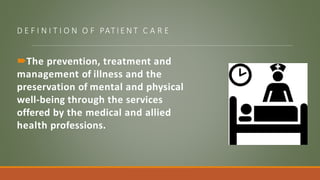
D E F I N I T I O N O F PAT I E N T C A R E
The prevention, treatment and
management of illness and the
preservation of mental and physical
well-being through the services
offered by the medical and allied
health professions.
PATIENT CLASSIFICATION SYSTEMS
 Patient classification system (PCS), which quantifies the quality of
the nursing care, is essential to staffing nursing units of hospitals
and nursing homes.
 In selecting or implementing a patient classification system, a
representative committee of nurse manager can include a
representative of hospital administration.
 The primary aim of patient classification system is to be able to
respond to constant variation in the care needs of patients.
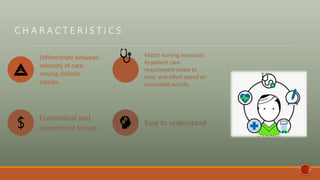
C H A R A C T E R I S T I C S
Differentiate between
intensity of care
among definite
classes.
Match nursing resources
to patient care
requirement relate to
time and effort spend on
associated activity
Economical and
convenient to use.
Easy to understand
P U R P O S E S
The system will establish a unit of measure for nursing that is
time which
will be used to determine numbers and kinds of staff needed.
Program costing and formulation of the nursing budget.
Tracking changes in patients care needs.
It helps the nurse managers the ability to moderate and control
delivery of nursing service
Determining the values of the productivity equations
C O N T …
 Determine the quality: once a standards time element has been
established, staffing is adjusted to meet the aggregate times.
 A nurse manager can elect to staff below the standard time to reduce
costs.
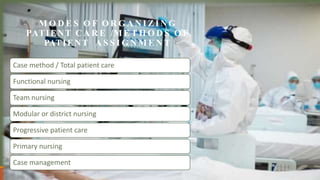
M O D E S O F O R G A N I Z I N G
PATIENT C A R E /M E T H O D S O F
PATIENT A S S I G N M E N T
Case method / Total patient care
Functional nursing
Team nursing
Modular or district nursing
Progressive patient care
Primary nursing
Case management
CASE METHOD
 It was
system.
the first type of
In this method,
nursing care delivery
nurses assume total
responsibility for meeting all the needs of assigned
patients during their time on duty. It involves
assignment of one or more clients to a nurse for a
specific period of time such as shift. The patient has
a different nurse each shift and no guarantee of
having the same nurses the next day.
C O N T …
 Nurse’s responsibility includes complete care including treatments,
medication and administration and planning of nursing care.
 This is the way most nursing students were taught – take one
patient and care for all of their needs.
 This model is used in critical care areas, labor and delivery, or any
area where one nurse cares for one patient’s total needs.
M E R I T S :
The nurse can attend to the total
needs of clients due to the
adequate time and proximity of the interactions.
Good client nurse interaction and rapport can be
developed.
Client may feel more secure.
D E M E R I T S :
Cost-effectiveness.
The greater disadvantage to case nursing
occurs, when the nurse is inadequately
trained or prepared to provide total care to
the patient.
Nurse may feel overworked if most of her
assigned patients are sick.
FUNCTIONAL NURSING
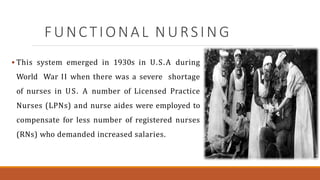
 This system emerged in 1930s in U.S.A during
World War II when there was a severe shortage
of nurses in US. A number of Licensed Practice
Nurses (LPNs) and nurse aides were employed to
compensate for less number of registered nurses
(RNs) who demanded increased salaries.
C O N T …
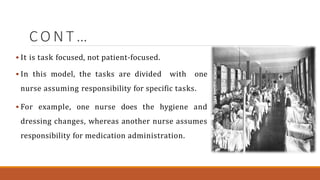
 It is task focused, not patient-focused.
 In this model, the tasks are divided with one
nurse assuming responsibility for specific tasks.
 For example, one nurse does the hygiene and
dressing changes, whereas another nurse assumes
responsibility for medication administration.
M E R I T S :
Each person become very efficient at specific tasks
and a great amount of work can be done in a short
time (time saving).
It is easy to organize the work of the unit and staff.
The organization benefits financially from this
strategy because patient care can be delivered to a
large number of patients by mixing staff with a
large number of unlicensed assistive personnel.
C O N T …
 Nurses become highly competent with tasks that are repeatedly
assigned to them.
 Less equipment is needed and what is available is usually better
cared for when used only by a few personnel.
 The best utilization can be made of a person’s aptitudes, experience
and desires.
DEMERITS:
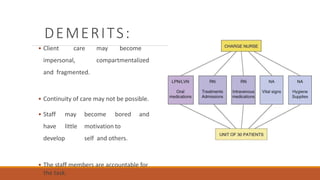
 Client care may become
impersonal, compartmentalized
and fragmented.
 Continuity of care may not be possible.
 Staff may become bored and
have little motivation to
develop self and others.
 The staff members are accountable for
the task.
C O N T …
 Client may feel insecure.
 Only parts of the nursing care plan are
known to personnel.
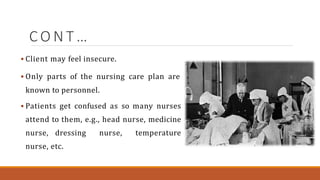
 Patients get confused as so many nurses
attend to them, e.g., head nurse, medicine
nurse, dressing nurse, temperature
nurse, etc.
TEAM NURSING
 Developed in 1950s because the functional method received
criticism, a new system of nursing was devised to improve
patient satisfaction.
 Care through others became the hallmark of team nursing.
 Team nursing is based on philosophy in which groups of
professional and non-professional personnel work together
to identify, plan, implement and evaluate comprehensive
client-centered care.
C O N T …
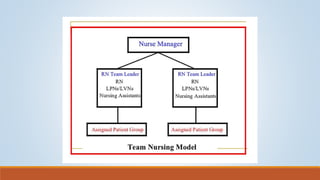
 The team members provide direct patient care to group of patients,
under the direction of the RN team leader in coordinated effort.
 The charge nurse delegates authority to a team leader who must be
a professional nurse.
 This nurse leads the team usually of 4 to 6 members in the care of
between 15 and 25 patients.
MERITS
 High quality comprehensive care can be provided to the patient
 Each member of the team is able to participate in decision making and
problem solving.
 Each team member is able to contribute his or her own special expertise or
skills in caring for the patient.
 Improved patient satisfaction.
 Feeling of participation and belonging are facilitated with team members.
C O N T …
 Work load can be balanced and shared.
 Division of labour allows members the opportunity to develop leadership
skills.
 There is a variety in the daily assignment.
 Nursing care hours are usually cost effective.
 The client is able to identify personnel who are responsible for his care.
 Barriers between professional and non-professional workers can be
minimized, the group efforts prevail.
DEMERITS:
 Unstable staffing pattern make team nursing difficult.
 All personnel must be client centered.
 There is less individual responsibility and independence regarding
nursing functions.
 It is expensive because of the increased number of personnel needed.
MODULAR NURSING
 Modular nursing is a modification of team nursing and
focuses on the patient’s geographic location for staff
assignments.
 The concept of modular nursing calls for a smaller group of
staff providing care for a smaller group of patients.
 The goal is to increase the involvement of the Register nurse
in planning and coordinating care.
C O N T …
 The patient unit is divided into modules or districts and the same team of
caregivers is assigned consistently to the same geographic location.
 Each location, or module, has an register nurse assigned as the team
leader, and the other team members may include Licensed Practical
Nurses(LPN), unlicensed assistive personnel (UAP).
 The team leader is accountable for all patient care and is responsible for
providing leadership for team members and creating a cooperative work
environment
MERITS:
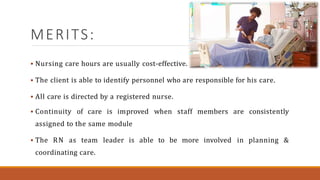
 Nursing care hours are usually cost-effective.
 The client is able to identify personnel who are responsible for his care.
 All care is directed by a registered nurse.
 Continuity of care is improved when staff members are consistently
assigned to the same module
 The RN as team leader is able to be more involved in planning &
coordinating care.
C O N T …
 Geographic closeness and more efficient communication save staff time.
 Feelings of participation and belonging are facilitated with team members.
 Work load can be balanced and shared.
 Division of labor allows members the opportunity to develop leadership
skills
 Continuity care is facilitated especially if teams are constant.
 Everyone has the opportunity to contribute to the care plan.
DEMERITS:
 Costs may be increased to stock each module with the necessary patient care
supplies (medication cart, linens and dressings).
 Establishing the team concepts takes time, effort, and constancy of personnel.
 Unstable staffing pattern make team difficult.
 There is less individual responsibility and autonomy regarding nursing function.
 All personnel must be client centered.
 The team leader must have complex skills and knowledge.
PROGRESSIVE PATIENT
C A R E
 It is a method in which client care areas provide various levels of care. The
central theme is better utilization of facilities, services and personnel for the
better patient care.
 Here the clients are evaluated with respect to all level (intensity) of care
needed.
 As they progress towards increased self-care (as they become less ethically ill or
in need of intensive care or monitoring) they are marred to units/ wards staffed
to best provide the type of care needed. Principal elements of production
planning and control are:
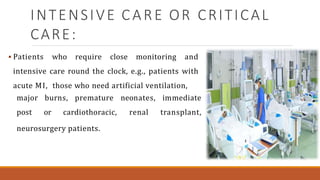
INTENSIVE CARE OR CRITICAL
CARE:
 Patients who require close monitoring and
intensive care round the clock, e.g., patients with
acute MI, those who need artificial ventilation,
major burns, premature neonates,
post or cardiothoracic, renal
immediate
transplant,
neurosurgery patients.
C O N T …
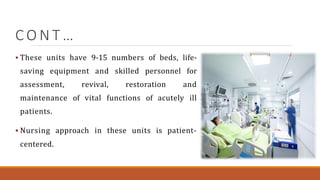
 These units have 9-15 numbers of beds, life-
saving equipment and skilled personnel for
assessment, revival, restoration and
maintenance of vital functions of acutely ill
patients.
 Nursing approach in these units is patient-
centered.
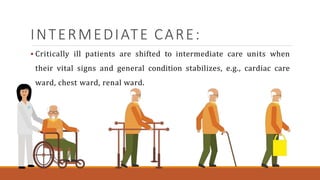
INTERMEDIATE CARE:
 Critically ill patients are shifted to intermediate care units when
their vital signs and general condition stabilizes, e.g., cardiac care
ward, chest ward, renal ward.
S E L F CARE:
 Although rehabilitation programme begins from
acute care setting, yet patients in these areas
participate actively to achieve complete or partial
self-care status.
 Patients are taught administration of drugs, life
style modification, exercises, ambulation, self-
administration of insulin, checking pulse, blood
glucose and dietary management.
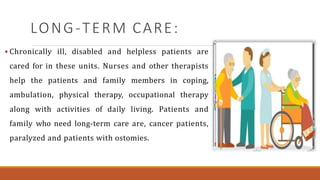
LONG-TERM CARE:
 Chronically ill, disabled and helpless patients are
cared for in these units. Nurses and other therapists
help the patients and family members in coping,
ambulation, physical therapy, occupational therapy
along with activities of daily living. Patients and
family who need long-term care are, cancer patients,
paralyzed and patients with ostomies.
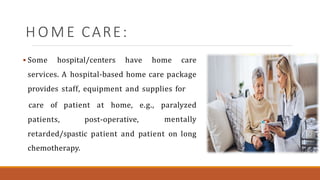
H O M E CARE:
 Some hospital/centers have home care
services. A hospital-based home care package
provides staff, equipment and supplies for
patients, post-operative,
care of patient at home, e.g., paralyzed
mentally
retarded/spastic patient and patient on long
chemotherapy.
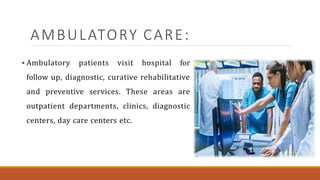
AMBULATORY CARE:
 Ambulatory patients visit hospital for
follow up, diagnostic, curative rehabilitative
and preventive services. These areas are
outpatient departments, clinics, diagnostic
centers, day care centers etc.
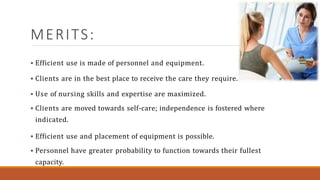
MERITS:
 Efficient use is made of personnel and equipment.
 Clients are in the best place to receive the care they require.
 Use of nursing skills and expertise are maximized.
 Clients are moved towards self-care; independence is fostered where
indicated.
 Efficient use and placement of equipment is possible.
 Personnel have greater probability to function towards their fullest
capacity.
DEMERITS:
 There may be discomfort to clients who are moved often.
 Continuity care is difficult.
 Long term nurse/client relationships are difficult to arrange.
 Great emphasis is placed on comprehensive, written care plan.
 There is often times difficulty in meeting administrative need of the
organization, staffing evaluation and accreditation.
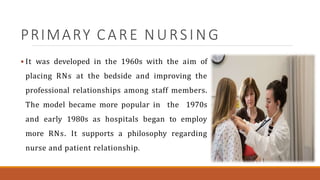
PRIMARY CARE NURSING
 It was developed in the 1960s with the aim of
placing RNs at the bedside and improving the
professional relationships among staff members.
The model became more popular in the 1970s
and early 1980s as hospitals began to employ
more RNs. It supports a philosophy regarding
nurse and patient relationship.
C O N T …
 It is a system in which one nurse is caring for all the needs of a
patient or more within a 24 hour from admission to discharge.
 He or she is responsible for coordinating and implementing all the
necessary nursing care that must be given to the patient during the
shift.
 If the nurse is not available, the associate nurse responsible for
filling in for the nurse’s absence will provide hospital care to the
patient based on the original plan of care made by the nurse.
MERITS:
 Primary Nursing Care System is good for long-term care,
rehabilitation units, nursing clinics, geriatric, psychiatric, burn care
settings where patients and family members can establish good
rapport with the primary nurse.
 Primary nurses are in a position to care for the entire person-
physically, emotionally, socially and spiritually.
C O N T …
 High patient and family satisfaction
 Promotes RN responsibility, authority, autonomy, accountability and courage.
 Patient-centered care that is comprehensive, individualized, and
coordinated; and the professional satisfaction of the nurse.
 Increases coordination and continuity of care.
DEMERITS:
 More nurses are required for this method of care delivery and it is
more expensive than other methods.
 Level of expertise and commitment may vary from nurse to nurse
which may affect quality of patient care.
 Associate nurse may find it difficult to follow the plans made by
another if there is disagreement or when patient’s condition
changes.
C O N T …
 It may be cost-effective especially in specialized units such as the
ICU.
 May create conflict between primary and associate nurses.
 Stress of round the clock responsibility.
 Difficult hiring all RN staff
 Confines nurse’s talent to his/her own patients.
CASE MANAGEMENT
 The case manager (Register nurse or social worker with managerial
qualification) is assigned responsibility of following a patient’s care
and progress from the diagnostic phase through hospitalization,
rehabilitation and back to home care.
 For e.g.; case manager for cardiac surgery patients assists them go
through diagnostic procedures, pre-operative preparations, surgical
interventions, family counseling, post-operative care and
rehabilitation.
C O N T …
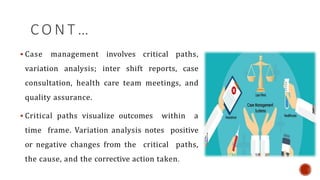
 Case management involves critical paths,
variation analysis; inter shift reports, case
consultation, health care team meetings, and
quality assurance.
 Critical paths visualize outcomes within a
time frame. Variation analysis notes positive
or negative changes from the critical paths,
the cause, and the corrective action taken.
RESPONSIBILITIES OF
CASE MANAGERS
 Assessing clients and their homes and communities.
 Coordinating and planning client care.
 Collaborating with other health professionals
provision of care.
in the
 Monitoring client progress and client outcomes.
 Advocating for clients moving through the services needed.
 Serving as a liaison with third party payers in planning the
client‘s care.
MERITS:
 Case management provides a well-coordinated care experience that
can improve the care outcome, decrease the length of stay, and use
multiple disciplines and services efficiently.
 Provides comprehensive care for those with complex health
problems.
 It seeks the active involvement of the patient, family and diverse
health care professionals
DEMERITS:
 Nurses identify major obstacles in the implementation
service, financial barriers and lack of administrative support.
 Expensive
 Nurse is client focused and outcome oriented
 Facilitates and promotes co-ordination of cost-effective care
of this
 Nursing case management is a professionally autonomous role that
requires expert
FACTORS INFLUENCING THE
QUALITY PATIENT CARE
Many variable factors influence the number of nurses needed on a
ward in order to render a high quality of patient care.
 The total number of patients to be nursed
 The degree of illness of patients (physical dependency)
 Type of service: medical, surgical,
psychiatric
 The total needs of the patients
maternity, Pediatrics and
C O N T …
 Methods of nursing care
 Number of nursing aids and other nonprofessional
available, the amount and quality of supervision
available
 The amount, type and location of equipment and
supplies
C O N T …
 The acuteness of the service and the rate of turnover in patients
according to the degree or period of illness.
 The experience of the nurses who are to give the patient care.
 The number of non-nurses who involve in the patient care, the
quality of their work, their stability in service.
 The physical facilities
C O N T …
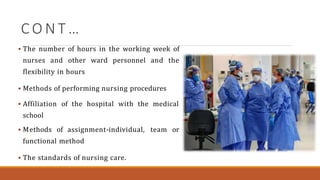
 The number of hours in the working week of
nurses and other ward personnel and the
flexibility in hours
 Methods of performing nursing procedures
 Affiliation of the hospital with the medical
school
 Methods of assignment-individual, team or
functional method
 The standards of nursing care.
MANAGING PATIENT CARE

MANAGING PATIENT CARE

  • 1.
  • 2.
    INTRODUCTION The overall goalof nursing is to meet the patient nursing needs with the available resources for providing smooth day and night 24 hrs. quality care to patients and to honor his rights. To ensure that nursing care is provided to patients, the work must be organized. A Nursing Care Delivery Model organizes the work of caring for patients.
  • 3.
    C O NT …  The decision of which nursing care delivery model is used is based on the needs of the patients and the availability of competent staff in the different skill levels.  For organizing function to be productive and facilitate meeting the organization needs, the leader must know the organization and its members well.
  • 4.
    D E FI N I T I O N O F PAT I E N T C A R E The prevention, treatment and management of illness and the preservation of mental and physical well-being through the services offered by the medical and allied health professions.
  • 5.
    PATIENT CLASSIFICATION SYSTEMS Patient classification system (PCS), which quantifies the quality of the nursing care, is essential to staffing nursing units of hospitals and nursing homes.  In selecting or implementing a patient classification system, a representative committee of nurse manager can include a representative of hospital administration.  The primary aim of patient classification system is to be able to respond to constant variation in the care needs of patients.
  • 6.
    C H AR A C T E R I S T I C S Differentiate between intensity of care among definite classes. Match nursing resources to patient care requirement relate to time and effort spend on associated activity Economical and convenient to use. Easy to understand
  • 7.
    P U RP O S E S The system will establish a unit of measure for nursing that is time which will be used to determine numbers and kinds of staff needed. Program costing and formulation of the nursing budget. Tracking changes in patients care needs. It helps the nurse managers the ability to moderate and control delivery of nursing service Determining the values of the productivity equations
  • 8.
    C O NT …  Determine the quality: once a standards time element has been established, staffing is adjusted to meet the aggregate times.  A nurse manager can elect to staff below the standard time to reduce costs.
  • 9.
    M O DE S O F O R G A N I Z I N G PATIENT C A R E /M E T H O D S O F PATIENT A S S I G N M E N T Case method / Total patient care Functional nursing Team nursing Modular or district nursing Progressive patient care Primary nursing Case management
  • 10.
    CASE METHOD  Itwas system. the first type of In this method, nursing care delivery nurses assume total responsibility for meeting all the needs of assigned patients during their time on duty. It involves assignment of one or more clients to a nurse for a specific period of time such as shift. The patient has a different nurse each shift and no guarantee of having the same nurses the next day.
  • 11.
    C O NT …  Nurse’s responsibility includes complete care including treatments, medication and administration and planning of nursing care.  This is the way most nursing students were taught – take one patient and care for all of their needs.  This model is used in critical care areas, labor and delivery, or any area where one nurse cares for one patient’s total needs.
  • 12.
    M E RI T S : The nurse can attend to the total needs of clients due to the adequate time and proximity of the interactions. Good client nurse interaction and rapport can be developed. Client may feel more secure.
  • 13.
    D E ME R I T S : Cost-effectiveness. The greater disadvantage to case nursing occurs, when the nurse is inadequately trained or prepared to provide total care to the patient. Nurse may feel overworked if most of her assigned patients are sick.
  • 14.
    FUNCTIONAL NURSING  Thissystem emerged in 1930s in U.S.A during World War II when there was a severe shortage of nurses in US. A number of Licensed Practice Nurses (LPNs) and nurse aides were employed to compensate for less number of registered nurses (RNs) who demanded increased salaries.
  • 15.
    C O NT …  It is task focused, not patient-focused.  In this model, the tasks are divided with one nurse assuming responsibility for specific tasks.  For example, one nurse does the hygiene and dressing changes, whereas another nurse assumes responsibility for medication administration.
  • 16.
    M E RI T S : Each person become very efficient at specific tasks and a great amount of work can be done in a short time (time saving). It is easy to organize the work of the unit and staff. The organization benefits financially from this strategy because patient care can be delivered to a large number of patients by mixing staff with a large number of unlicensed assistive personnel.
  • 17.
    C O NT …  Nurses become highly competent with tasks that are repeatedly assigned to them.  Less equipment is needed and what is available is usually better cared for when used only by a few personnel.  The best utilization can be made of a person’s aptitudes, experience and desires.
  • 18.
    DEMERITS:  Client caremay become impersonal, compartmentalized and fragmented.  Continuity of care may not be possible.  Staff may become bored and have little motivation to develop self and others.  The staff members are accountable for the task.
  • 19.
    C O NT …  Client may feel insecure.  Only parts of the nursing care plan are known to personnel.  Patients get confused as so many nurses attend to them, e.g., head nurse, medicine nurse, dressing nurse, temperature nurse, etc.
  • 20.
    TEAM NURSING  Developedin 1950s because the functional method received criticism, a new system of nursing was devised to improve patient satisfaction.  Care through others became the hallmark of team nursing.  Team nursing is based on philosophy in which groups of professional and non-professional personnel work together to identify, plan, implement and evaluate comprehensive client-centered care.
  • 22.
    C O NT …  The team members provide direct patient care to group of patients, under the direction of the RN team leader in coordinated effort.  The charge nurse delegates authority to a team leader who must be a professional nurse.  This nurse leads the team usually of 4 to 6 members in the care of between 15 and 25 patients.
  • 23.
    MERITS  High qualitycomprehensive care can be provided to the patient  Each member of the team is able to participate in decision making and problem solving.  Each team member is able to contribute his or her own special expertise or skills in caring for the patient.  Improved patient satisfaction.  Feeling of participation and belonging are facilitated with team members.
  • 24.
    C O NT …  Work load can be balanced and shared.  Division of labour allows members the opportunity to develop leadership skills.  There is a variety in the daily assignment.  Nursing care hours are usually cost effective.  The client is able to identify personnel who are responsible for his care.  Barriers between professional and non-professional workers can be minimized, the group efforts prevail.
  • 25.
    DEMERITS:  Unstable staffingpattern make team nursing difficult.  All personnel must be client centered.  There is less individual responsibility and independence regarding nursing functions.  It is expensive because of the increased number of personnel needed.
  • 26.
    MODULAR NURSING  Modularnursing is a modification of team nursing and focuses on the patient’s geographic location for staff assignments.  The concept of modular nursing calls for a smaller group of staff providing care for a smaller group of patients.  The goal is to increase the involvement of the Register nurse in planning and coordinating care.
  • 27.
    C O NT …  The patient unit is divided into modules or districts and the same team of caregivers is assigned consistently to the same geographic location.  Each location, or module, has an register nurse assigned as the team leader, and the other team members may include Licensed Practical Nurses(LPN), unlicensed assistive personnel (UAP).  The team leader is accountable for all patient care and is responsible for providing leadership for team members and creating a cooperative work environment
  • 28.
    MERITS:  Nursing carehours are usually cost-effective.  The client is able to identify personnel who are responsible for his care.  All care is directed by a registered nurse.  Continuity of care is improved when staff members are consistently assigned to the same module  The RN as team leader is able to be more involved in planning & coordinating care.
  • 29.
    C O NT …  Geographic closeness and more efficient communication save staff time.  Feelings of participation and belonging are facilitated with team members.  Work load can be balanced and shared.  Division of labor allows members the opportunity to develop leadership skills  Continuity care is facilitated especially if teams are constant.  Everyone has the opportunity to contribute to the care plan.
  • 30.
    DEMERITS:  Costs maybe increased to stock each module with the necessary patient care supplies (medication cart, linens and dressings).  Establishing the team concepts takes time, effort, and constancy of personnel.  Unstable staffing pattern make team difficult.  There is less individual responsibility and autonomy regarding nursing function.  All personnel must be client centered.  The team leader must have complex skills and knowledge.
  • 31.
    PROGRESSIVE PATIENT C AR E  It is a method in which client care areas provide various levels of care. The central theme is better utilization of facilities, services and personnel for the better patient care.  Here the clients are evaluated with respect to all level (intensity) of care needed.  As they progress towards increased self-care (as they become less ethically ill or in need of intensive care or monitoring) they are marred to units/ wards staffed to best provide the type of care needed. Principal elements of production planning and control are:
  • 32.
    INTENSIVE CARE ORCRITICAL CARE:  Patients who require close monitoring and intensive care round the clock, e.g., patients with acute MI, those who need artificial ventilation, major burns, premature neonates, post or cardiothoracic, renal immediate transplant, neurosurgery patients.
  • 33.
    C O NT …  These units have 9-15 numbers of beds, life- saving equipment and skilled personnel for assessment, revival, restoration and maintenance of vital functions of acutely ill patients.  Nursing approach in these units is patient- centered.
  • 34.
    INTERMEDIATE CARE:  Criticallyill patients are shifted to intermediate care units when their vital signs and general condition stabilizes, e.g., cardiac care ward, chest ward, renal ward.
  • 35.
    S E LF CARE:  Although rehabilitation programme begins from acute care setting, yet patients in these areas participate actively to achieve complete or partial self-care status.  Patients are taught administration of drugs, life style modification, exercises, ambulation, self- administration of insulin, checking pulse, blood glucose and dietary management.
  • 36.
    LONG-TERM CARE:  Chronicallyill, disabled and helpless patients are cared for in these units. Nurses and other therapists help the patients and family members in coping, ambulation, physical therapy, occupational therapy along with activities of daily living. Patients and family who need long-term care are, cancer patients, paralyzed and patients with ostomies.
  • 37.
    H O ME CARE:  Some hospital/centers have home care services. A hospital-based home care package provides staff, equipment and supplies for patients, post-operative, care of patient at home, e.g., paralyzed mentally retarded/spastic patient and patient on long chemotherapy.
  • 38.
    AMBULATORY CARE:  Ambulatorypatients visit hospital for follow up, diagnostic, curative rehabilitative and preventive services. These areas are outpatient departments, clinics, diagnostic centers, day care centers etc.
  • 39.
    MERITS:  Efficient useis made of personnel and equipment.  Clients are in the best place to receive the care they require.  Use of nursing skills and expertise are maximized.  Clients are moved towards self-care; independence is fostered where indicated.  Efficient use and placement of equipment is possible.  Personnel have greater probability to function towards their fullest capacity.
  • 40.
    DEMERITS:  There maybe discomfort to clients who are moved often.  Continuity care is difficult.  Long term nurse/client relationships are difficult to arrange.  Great emphasis is placed on comprehensive, written care plan.  There is often times difficulty in meeting administrative need of the organization, staffing evaluation and accreditation.
  • 41.
    PRIMARY CARE NURSING It was developed in the 1960s with the aim of placing RNs at the bedside and improving the professional relationships among staff members. The model became more popular in the 1970s and early 1980s as hospitals began to employ more RNs. It supports a philosophy regarding nurse and patient relationship.
  • 42.
    C O NT …  It is a system in which one nurse is caring for all the needs of a patient or more within a 24 hour from admission to discharge.  He or she is responsible for coordinating and implementing all the necessary nursing care that must be given to the patient during the shift.  If the nurse is not available, the associate nurse responsible for filling in for the nurse’s absence will provide hospital care to the patient based on the original plan of care made by the nurse.
  • 43.
    MERITS:  Primary NursingCare System is good for long-term care, rehabilitation units, nursing clinics, geriatric, psychiatric, burn care settings where patients and family members can establish good rapport with the primary nurse.  Primary nurses are in a position to care for the entire person- physically, emotionally, socially and spiritually.
  • 44.
    C O NT …  High patient and family satisfaction  Promotes RN responsibility, authority, autonomy, accountability and courage.  Patient-centered care that is comprehensive, individualized, and coordinated; and the professional satisfaction of the nurse.  Increases coordination and continuity of care.
  • 45.
    DEMERITS:  More nursesare required for this method of care delivery and it is more expensive than other methods.  Level of expertise and commitment may vary from nurse to nurse which may affect quality of patient care.  Associate nurse may find it difficult to follow the plans made by another if there is disagreement or when patient’s condition changes.
  • 46.
    C O NT …  It may be cost-effective especially in specialized units such as the ICU.  May create conflict between primary and associate nurses.  Stress of round the clock responsibility.  Difficult hiring all RN staff  Confines nurse’s talent to his/her own patients.
  • 47.
    CASE MANAGEMENT  Thecase manager (Register nurse or social worker with managerial qualification) is assigned responsibility of following a patient’s care and progress from the diagnostic phase through hospitalization, rehabilitation and back to home care.  For e.g.; case manager for cardiac surgery patients assists them go through diagnostic procedures, pre-operative preparations, surgical interventions, family counseling, post-operative care and rehabilitation.
  • 48.
    C O NT …  Case management involves critical paths, variation analysis; inter shift reports, case consultation, health care team meetings, and quality assurance.  Critical paths visualize outcomes within a time frame. Variation analysis notes positive or negative changes from the critical paths, the cause, and the corrective action taken.
  • 49.
    RESPONSIBILITIES OF CASE MANAGERS Assessing clients and their homes and communities.  Coordinating and planning client care.  Collaborating with other health professionals provision of care. in the  Monitoring client progress and client outcomes.  Advocating for clients moving through the services needed.  Serving as a liaison with third party payers in planning the client‘s care.
  • 50.
    MERITS:  Case managementprovides a well-coordinated care experience that can improve the care outcome, decrease the length of stay, and use multiple disciplines and services efficiently.  Provides comprehensive care for those with complex health problems.  It seeks the active involvement of the patient, family and diverse health care professionals
  • 51.
    DEMERITS:  Nurses identifymajor obstacles in the implementation service, financial barriers and lack of administrative support.  Expensive  Nurse is client focused and outcome oriented  Facilitates and promotes co-ordination of cost-effective care of this  Nursing case management is a professionally autonomous role that requires expert
  • 52.
    FACTORS INFLUENCING THE QUALITYPATIENT CARE Many variable factors influence the number of nurses needed on a ward in order to render a high quality of patient care.  The total number of patients to be nursed  The degree of illness of patients (physical dependency)  Type of service: medical, surgical, psychiatric  The total needs of the patients maternity, Pediatrics and
  • 53.
    C O NT …  Methods of nursing care  Number of nursing aids and other nonprofessional available, the amount and quality of supervision available  The amount, type and location of equipment and supplies
  • 54.
    C O NT …  The acuteness of the service and the rate of turnover in patients according to the degree or period of illness.  The experience of the nurses who are to give the patient care.  The number of non-nurses who involve in the patient care, the quality of their work, their stability in service.  The physical facilities
  • 55.
    C O NT …  The number of hours in the working week of nurses and other ward personnel and the flexibility in hours  Methods of performing nursing procedures  Affiliation of the hospital with the medical school  Methods of assignment-individual, team or functional method  The standards of nursing care.