Drugs used on Respiratory
System
Anti-Asthmatic Drugs
•Classified as:
1. Bronchodilators:
2. Anticholinergic.
3. Mast cell stabilizers
4. Corticosteroids.
5. Anti-histamines.
• Adrenergic Agonist
or
sympathomimetics.
• Methylxanthines.
Bronchodilators: Adrenergic agonist or
sympathomimetics
•Mechanism of action: They
causes widening of the
airway by relaxing bronchial
smooth muscles by stimulate
beta receptors.
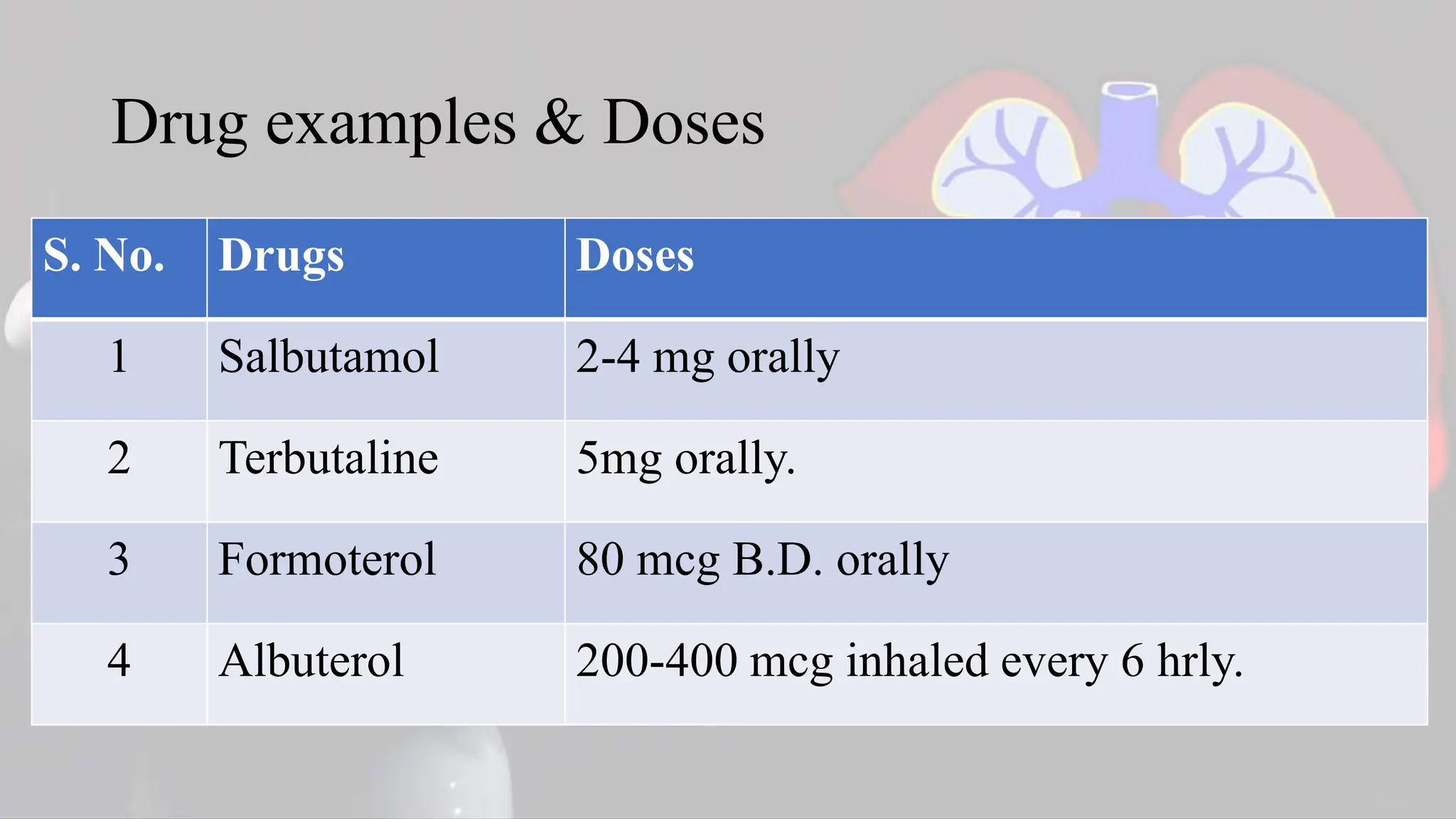
Drug examples & Doses
S. No. Drugs Doses
1 Salbutamol 2-4 mg orally
2 Terbutaline 5mg orally.
3 Formoterol 80 mcg B.D. orally
4 Albuterol 200-400 mcg inhaled every 6 hrly.
Indications/uses
•Relieving the distress of asthma.
•Bronchospasm or broncho-
constriction.
Contraindications/ Precautions.
•Patient with uncontrolled
arrythmias.
•Prolonged use of albuterol may
cause hypokalemia.
Adverse Effects
•Nervousness.
•Anxiety.
•Tremor.
•Headache.
•Palpitations.
•Tachycardia.
•Arrhythmias.
Drug interactions
•ꞵ (beta) blocker antagonize the
effects of adrenergic agonists.
•Prolonged use of theophylline
cause additive effects.
Nursing Responsibilities
•Nurse should monitor the patient’s blood
pressure, pulse, respiratory rate, and
breathing sounds.
•Teach the patients that how to use
inhalers.
•Instruct the patient to avoid respiratory
irritants, such as smoke, dust, and strong
smell.
Bronchodilators: Methylxanthine
•Mechanism of action: These drugs
are weak CNS stimulants that are
powerful smooth muscle relaxants
thus they relax the smooth muscle of
bronchi. They also have diuretic
effect.
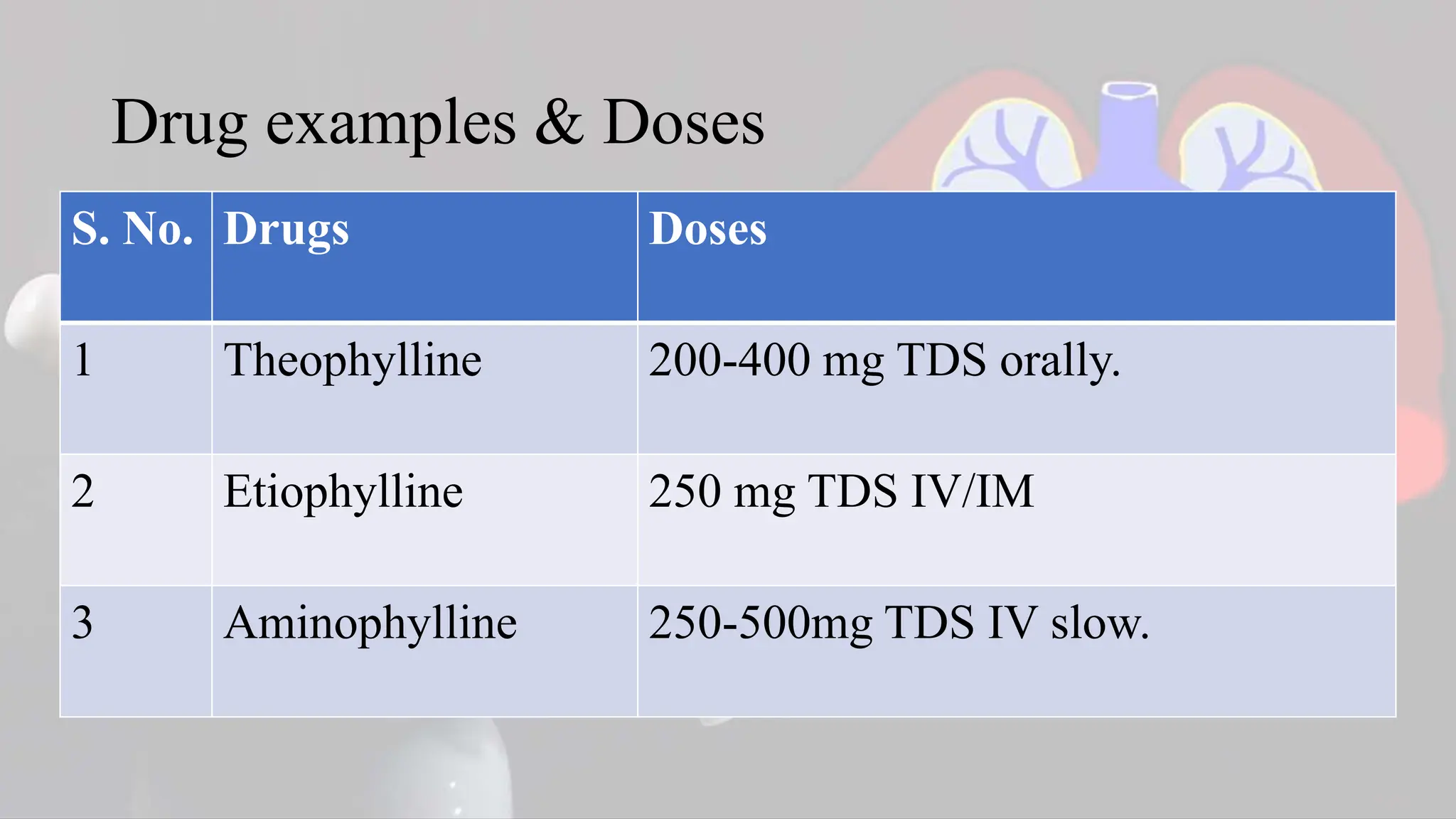
Drug examples & Doses
S. No. Drugs Doses
1 Theophylline 200-400 mg TDS orally.
2 Etiophylline 250 mg TDS IV/IM
3 Aminophylline 250-500mg TDS IV slow.
Indication/Uses
•To treat and prevent bronchospasm.
•To treat asthma, bronchitis,
emphysema.
Contraindications/ Precautions
•Hypersensitivity to any xanthine.
•Infection or irritation of rectum or lower
portion.
•Give cautiously in neonates, in elderly
patients, heart disorders hepatic disorders.
Adverse effects
•Headache.
•Anxiety.
•Nausea.
•Seizures.
•Abdominal Cramping.
•Diarrhea.
•Respiratory arrest.
•Irritability.
•Insomnia.
•Vomiting.
•Peptic ulcer.
•Epigastric pain.
•Tachycardia.
Drug interactions
•ꞵ (beta) Blocker may antagonize the effects of
methylxanthines.
•Erythromycin may increase the half life of
methylxanthines, and increasing the risk of
methylxanthines toxicity.
•Rifampicin, phenobarbital phenytoin, cigarette
smoking and charcoal – broiled food may shorten
the half-life of drugs and reducing their
effectiveness.
Nursing Responsibilities
•Nurse should assess for signs and symptoms of
toxicity.
•Nurse also should know that therapeutic sr. level
of theophylline ranges from 10 to 20 mcg/ml.
•Advise patients to decrease consumption of
xanthine – containing food and beverages.
•To detect toxicity, nurse should monitor sr drugs
levels.
Anticholinergic – Already Explained
Mast cell Stabilizers – Introduction
•Mast cell stabilizers works to prevent allergy
cells called mast cell from breaking open
and releasing chemicals that help to cause
inflammation.
•They are not effective once the allergic
reaction has occurred and mediators are
released from mast cells. So they are useless
during asthmatic attack. They are used in the
prophylaxis of asthma.
Mechanism of action
•They inhibit mast cell activity, thus
prevent the release of allergic
mediators like histamine, serotonin,
prostaglandins, cytokines. These
chemical are essential for an
inflammation and allergic reactions.
Drug examples and Doses
S. No. Drug Doses
1 Cromolyn
sodium
20mg 4times a day
(Nebulization solution)
2 Sodium
cromoglicate
20mg 6hrly
3 Ketotifen 1-2mg OD or BD
Indication / uses
•Prevent asthma symptoms from occurring or
prophylaxis to asthmatic attack.
•To decrease inflammation or bronchospasm.
•To decrease allergic reactions.
•Rhinitis/conjunctivitis.
Contraindications/ precautions
•Hypersensitivity.
•Precautiously with renal
dysfunction, hepatic dysfunction.
•Lactation, Cardiac arrhythmias.
Adverse effects •Throat irritations.
•Nasal irritations.
•Wt. Gain.
•Headache.
•Drowsiness.
•Dry mouth.
•Dizziness.
Drug interactions
• Not reported
Nursing Responsibilities
•Nurse should monitor drugs adverse reactions.
•Instruct patients that this drug is not effective in an acute
attack.
•Nurse should instruct the patient how to use metered – dose
inhaler or nebulizer.
•If more than one inhalation is ordered, advise patient to wait
1-2 minutes before taking second puff.
•If the parents is also receiving an inhaled bronchodilator,
advise the patient to use bronchodilators first to open the
airways and then wait approximately 5min before using
cromolyn sodium to maximize its effectiveness.
Anti-Inflammatory Drugs (Cortico-steroids)
•These drugs have anti-
inflammatory as well as anti-
allergic actions thus they are
effective in bronchial asthma.
Mechanism of action
•They prevent the release of or
counteract the bronchial mediators
(Kinins, serotonin, Histamine) that
cause tissue inflammation
responsible for edema and airway
narrowing.
Drug example and dose
S. No Drugs Doses
1 Prednisolone 5-60mg per day in divided dose.
2 Beclomethasone
Dipropionate
100μgm (microgram) 6hrly by aerosol
inhalation.
3 Budesonide 400 μgm (microgram) daily in divided dose.
4 Fluticasone 100-250μgm (microgram) BID by aerosol
5 Betamethasone
Valerate
200μgm (microgram) 6hrly by aerosol.
Indication/uses
•Chronic bronchitis.
•Allergic Rhinitis.
•Respiratory inflammatory disorders.
•Bronchial asthma.
•Prophylaxis in exercise induced asthma.
•Allergic reaction.
Contraindications/precautions
•Acute bronchospasm.
•Use cautiously in patients who are
immunosuppressed and in those taking
prednisone or other corticosteroids.
•Use very cautiously in patients with viral
respiratory infections.
Adverse effects
•Hoarseness.
•Candida infections.
•Oropharyngeal irritation.
•Bronchospasm after inhalation of
dry powder.
Drug interaction
• Generally Not reported but can be find drug specific.
Nursing Responsibilities
• Nurse should instruct the patient to rinse his mouth, after using inhaled
steroids.
• Nurse should teach the patient to:
 Use bronchodilators several minutes before glucocorticoid inhaler.
Rinse mouth after using inhaled steroids.
Use and care for inhaler properly.
Antihistamines
•Antihistamines are the drugs
used in the treatment od
allergic disorders and some
other conditions.
Mechanism of action
• These drugs block the effect of histamine and its
receptors. They also provide some sort of sedation.
There are four types of antihistamines drugs.
1. Highly sedatives.
2. Moderate sedatives.
3. Mild sedatives.
4. Non sedatives.
Drug Example & Doses
S. No Drugs Doses
Highly Sedative
1 Diphenhydramine 25-50mg
2 Promethazine 25-50mg
3 Hydroxyzine 25-50mg
Moderate Sedatives
4 Medizine 25-50mg
5 Buclizine 25-50mg
6 Phenivamine 25-50mg
7 Cyproheptadine 4mg
contd
S. No. Drugs Doses
Mild Sedatives
8 Chlorpheniramine 2-4mg
9 Cyclizine 50mg
10 Triprolidine 2.5-5mg
Non Sedatives
11 Astemizole 10mg
12 Cetrizine 10mg
13 Lovatadine 10mg
14 Fexofenadine 120-180mg
Indications/Uses
•Allergic reactions (Hay fever, Vasomotor rhinitis
urticaria, asthma, Anaphylaxis).
•Because of their anticholinergic actions they are
used as antiemetics and useful in motion
sickness.
•As hypnotics, Mild sedative/anxiolytics.
•Parkinsonism.
Contraindications/precautions
• Hypersensitivity.
• Lactation.
• Hypokalemia.
• Neonate.
• Coma.
• Special precautions in acute asthma and pregnancy,
elderly, epilepsy.
Adverse effects
• Drowsiness in common.
• Dryness of mouth.
• Blurring of vision. Due to anticholinergic effect
• Urinary retention.
• Constipation.
• Delirium.
• Convulsions.
• Severe toxicity may causes death to cardiac and respiratory failure.
Nursing Responsibilities
•Antihistamines are best given in the evening
since all antihistamines cause drowsiness.
•Advise to patient not to drive vehicle or do not
operate machinery.
•Advise to patient to avoid sedative such as
alcohol or sedative hypnotics.
Mucolytics
•These drugs reduced the
viscosity of sputum that leads
to easily expel the sputum.
Mechanism of action
•Decrease mucous viscosity
by breaking or altering
mucoproteins present in
sputum.
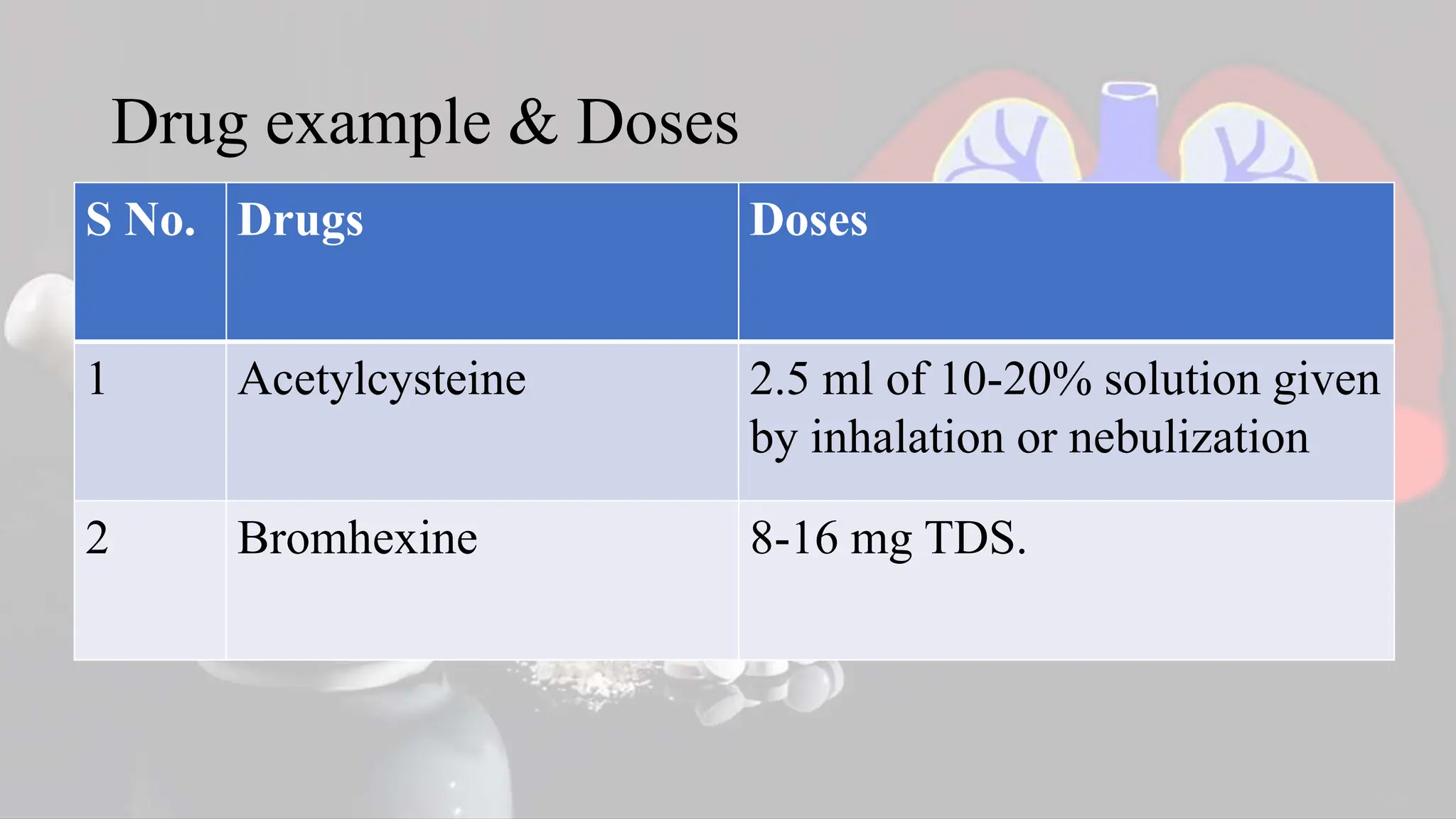
Drug example & Doses
S No. Drugs Doses
1 Acetylcysteine 2.5 ml of 10-20% solution given
by inhalation or nebulization
2 Bromhexine 8-16 mg TDS.
Indications/uses
•To treat abnormal viscid, or thick
and hard mucus.
•As an antidote for acetaminophen
overdose (acetylcysteine).
Contraindications/precautions
•Hypersensitivity to these
drugs.
•Cautiously in elderly,
pregnant or breast feeding
mothers.
Adverse effects
•Stomatitis.
•Drowsiness.
•Bronchospasm.
•Nausea/vomiting.
•Severe rhinorrhea.
Drug interactions
•Activated charcoal decreases
acetylcysteine effectiveness.
•Incompatible with
chlortetracycline, erythromycin,
amphotericin B, Hydrogen
peroxide.
Nursing Responsibilities
•To assess the airway and maintain it patent.
•Provide suction if needed.
•Assess the pattern breath sounds, cough, and
bronchial secretions.
•Advise patient to maintain a fluid intake of 2-
3litres/day.
•Warn the patient about the rotten egg smell of
acetylcysteine.
Decongestants
•A Decongestant drugs used
to relieve nasal congestion
in upper respiratory tracts.
Mechanism of action
•Decongestants are sympathomimetic drugs
that act by stimulating the α (alpha) –
adrenergic receptors. The decongestant
effect due to vasoconstriction of the blood
vessel in the nose sinuses etc. the
vasoconstriction effect reduces swelling or
inflammation and mucous formation in the
nasal passage and make it easier to breath.
Drug examples and doses
S. No. Drugs Doses
1 Oxymetazoline
hydrochloride
0.05% solution or nasal spray.
2 Phenylephrine
hydrochloride
10 mg
3 Pseudoephedrine
hydrochloride
60 mg.
Indications /uses
•For temporary relief of nasal congestion due
to common cold.
•Hay fever.
•Sinusitis.
•Upper respiratory tract allergens.
•To promote nasal and sinus drainage.
Contraindications/precautions
•Hypersensitivity to these drugs.
•MAO (Monoamine oxidase) inhibiters drugs therapy.
•Use cautiously in older age patient they are more likely to
experience adverse reaction.
•Nasal contestant should not be used for more than three
days, and oral decongestant should not used more than
7days because prolonged use will result in rebound
congestion.
Adverse Effects
•Arrhythmias.
•Tachycardia.
•Insomnia.
•Palpitation.
•Hypertension.
•Drowsiness.
•Hypersensitivity reactions including rash, urticaria.
Drug interactions
•If given with other
sympathomimetic amines may
increase central nervous system
stimulation.
•If given with MAO inhibiters may
cause severe hypertension.
Nursing Responsibilities
•Nurse should assess adverse effect of drugs.
•Monitor pulse rate, BP, and ECG.
•Advise patient not to share the container
with other people and not allow the tip of the
container to touch the nasal passage to avoid
contamination.
Drugs for cough
•The drug which used in cough are:
1.Antitussive.
2.Expectorants.
3.Bronchodilators.
Antitussives (Cough center suppressant)
a)Opioids – Codeine, pholcodine.
b)Non opioids – Noscapine,
dextromethorphan.
c)Antihistamine – Chlorpheniramine
diphenhydramine.
Expectorants
a)Bronchial secretion enhances – sodium
or potassium citrate, potassium iodide,
ammonium chloride.
b)Mucolytes – bromhexine ambroxol,
acetylcysteine.
Bronchodilators – already explained
•Salbutamol, Terbutaline.
Antitussives – Introduction
•They are used to suppress dry cough
mostly because their aim to control
rather than eliminate cough. These
are also called cough center
suppressants.
Mechanism of action
•These are the drugs that act in
the CNS to increase threshold of
cough center.
Drug example & Doses
S.
No
Drugs Doses
1 Codeine (Opioids) 15-60mg up to every 4 hrs
2 Noscapine (Non opioids) PO 15-30 mg itramin maleate
3 Dextromethorphan (Non
opioids)
10-30mg PO 4-8hrs max.
120/day
4 Chlorpheniramine
(Antihistamine)
4 mg PO 4-6 hrly
5 Diphenhydramine
(Antihistamine)
25 mg PO 4hrly not to exceed
150 mg / day.
Indications/uses
•Dry & unproductive cough.
•Allergic cough.
•Spasmodic cough.
Adverse
Effects
•Constipation.
•Drowsiness.
•Dryness of mouth.
•Irritability.
•Ataxia.
•Respiratory depression in higher doses.
•Addiction.
•Vertigo.
•Nausea, Headache.
Contraindication/precautions
•Respiratory Depression.
•Asthmatics.
•Convulsion disorder.
•Contraindicate while driving.
•Obstructive airway disease.
Nursing Responsibilities
•Assess the side effects or adverse
reaction during the therapy.
•Special precaution should be keep in
mind before drug administration.
•Advise to patient not to driving after
taken opioids drugs such as codeine
pholecodiene.
Expectorants – Introduction
•These drugs help in removal of
secretions of respiratory tract and
mucolytic agents produce liquification of
mucous making expectoration easier.
Mechanism of action
•They increase bronchial secretions or
reduce its viscosity, sodium and
potassium citrate increase bronchial
secretion by salt action also these drugs
stimulate gastric mucosa or directly
acting on mucous membrane of lungs to
increase the secretion of mucous.
Indications/uses
•Chronic productive cough.
•Thick mucous production.
•Combinations with antitussives drugs for
relieving cough.
Adverse effect
•Allergic reactions / hypersensitivity.
•Rhinorrhea.
•Lacrimation.
•Gastric irritation.
Contraindication/precautions
•History of peptic ulceration.
•Asthmatic patients.
•Severe hepatic or renal function.
Drug interactions
•They may increase the risk of bleeding
when use with anticoagulants.
Nursing Responsibilities
•Advise to take plenty of fluid during this
therapy to easier removal of thick
mucous.
•Assess the adverse effects.
References
1. Dr. P.K. Panwar, Essentials of pharmacology for nurses, AITBS pub. 2017,
India, Pg no. 49 – 62.
2. Dr. Suresh k sharma, Textbook of pharmacology, pathology & genetics for
nurses, Jaypee pub. 2016 India Pg no 161 – 205.
3. Tara v. Shanbhag, Smita shenoy, Pharmacology preparation manual for
undergraduate, Elsevier pub. 2014. Pg no. 226 – 257.
4. Marilyn Herbert – Ashton, Nancy Clarkson, Pharmacology, Jones & Barlet
pub 2010 India, Pg no 225-258.
5. Govind s. Mittal, Pharmacology at a glance, Paras medical book pub. 2009
India 18 – 19.
6. Madhuri Inamdar, Pharmacology in nursing, Vora medical pub. 2006 India
1st edition, Pg no 92 – 98.
RESPIRATORY SYSTEM PHARMACOLOGY FOR STUDENTS

RESPIRATORY SYSTEM PHARMACOLOGY FOR STUDENTS