Occupational hearing loss and
prevention
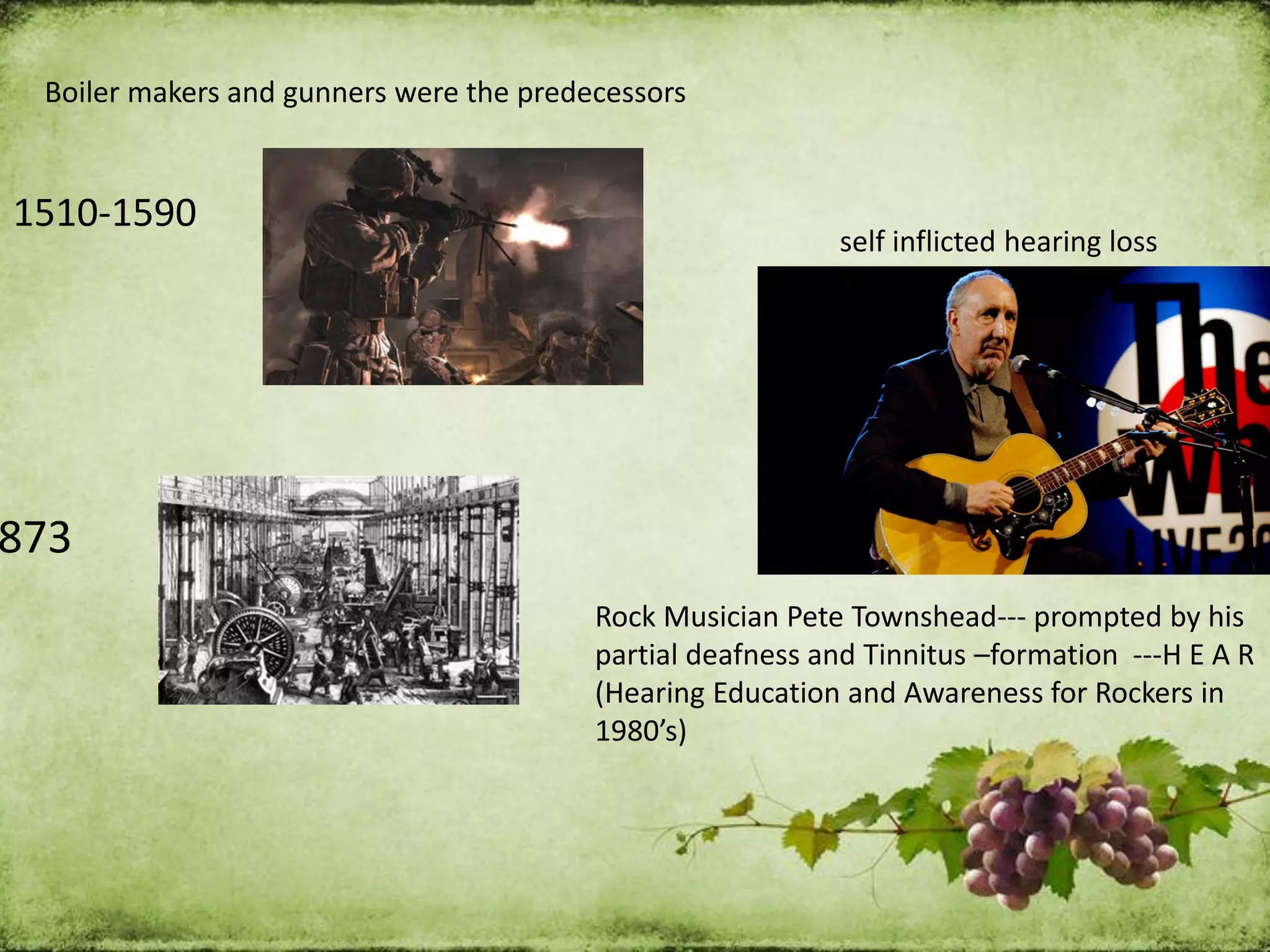
Boiler makers and gunners were the predecessors
1510-1590
873
self inflicted hearing loss
Rock Musician Pete Townshead--- prompted by his
partial deafness and Tinnitus –formation ---H E A R
(Hearing Education and Awareness for Rockers in
1980’s)
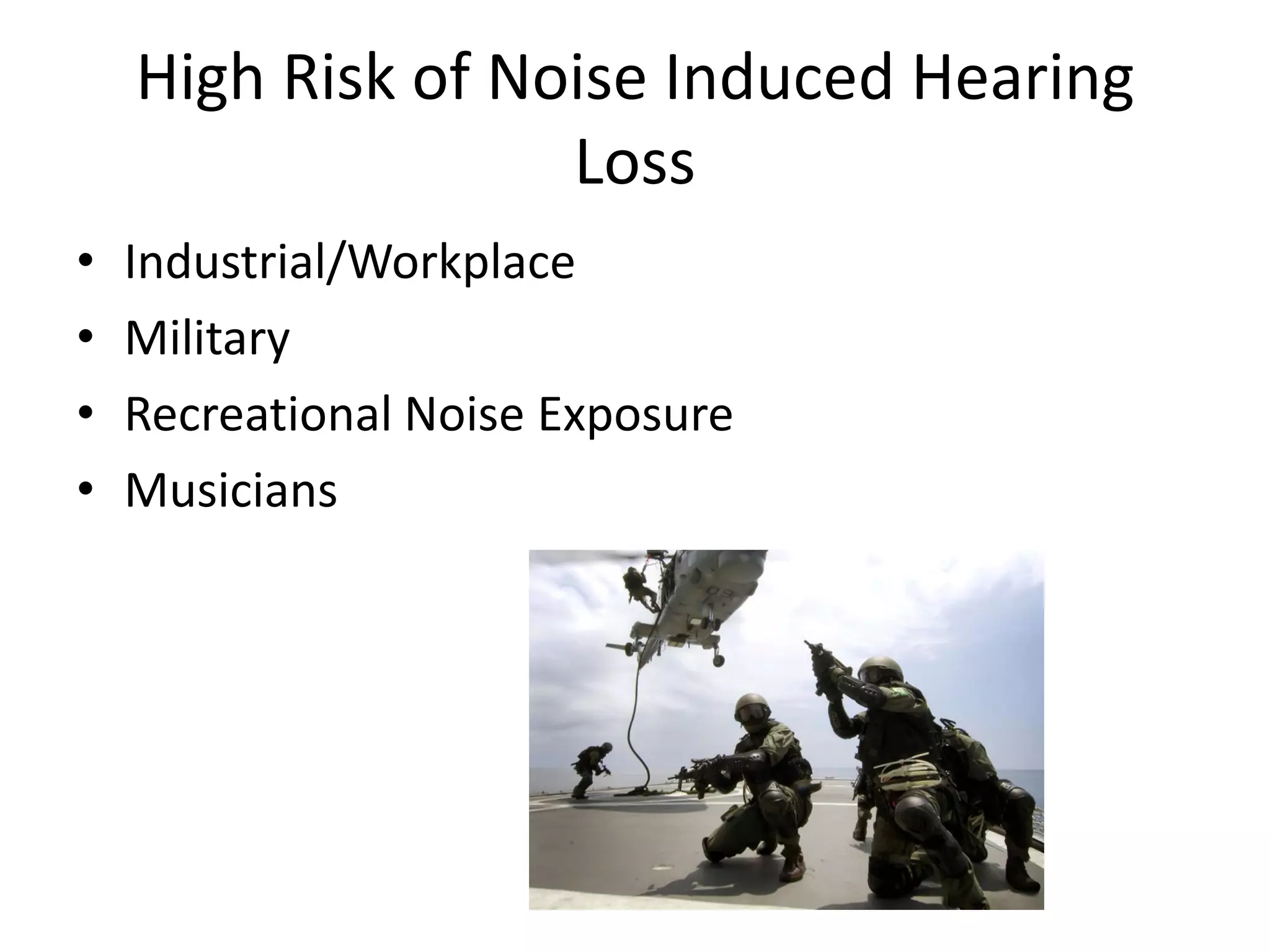
High Risk of Noise Induced Hearing
Loss
• Industrial/Workplace
• Military
• Recreational Noise Exposure
• Musicians
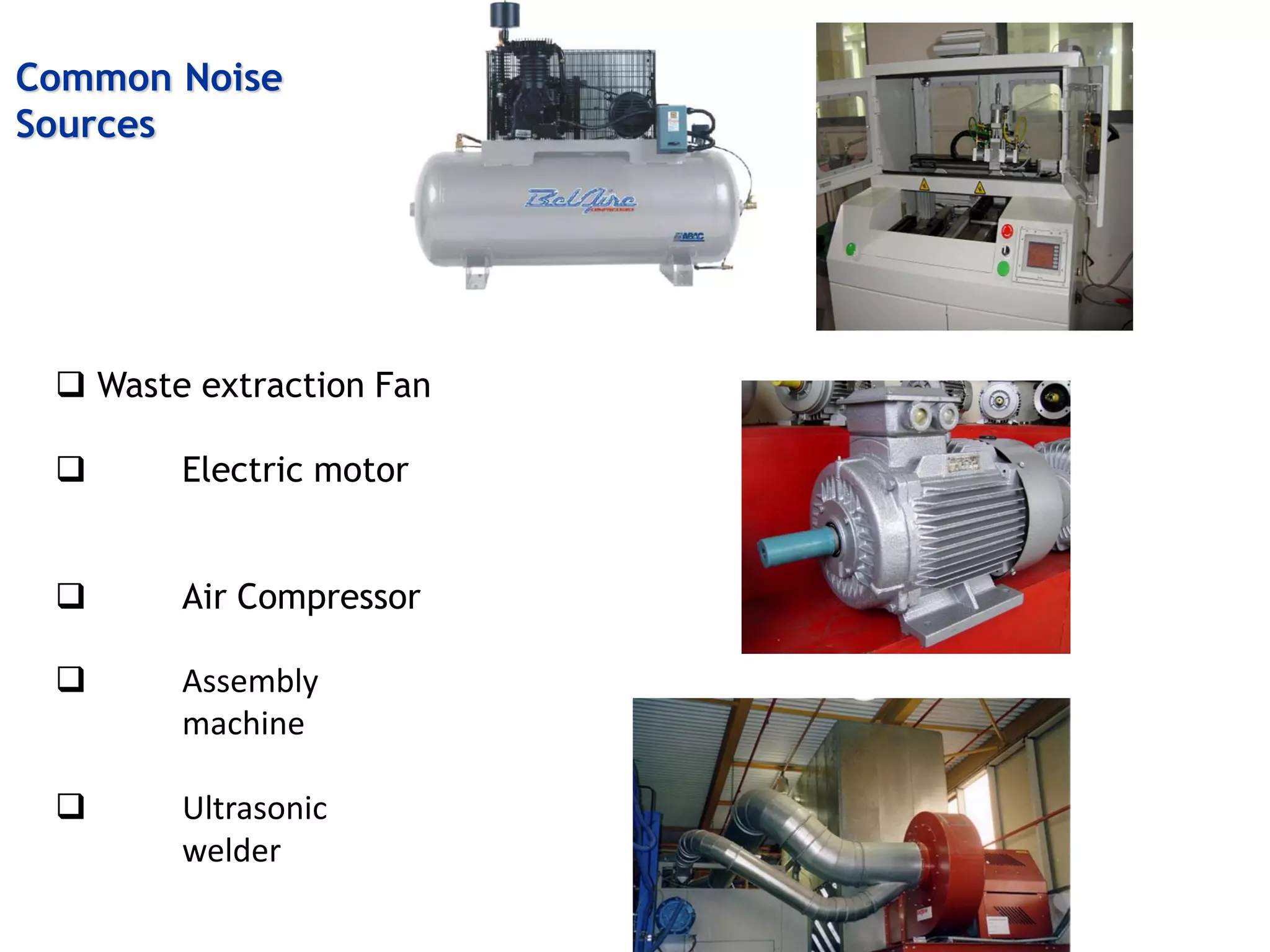
Common Noise
Sources
 Waste extraction Fan
 Electric motor
 Air Compressor
 Assembly
machine
 Ultrasonic
welder
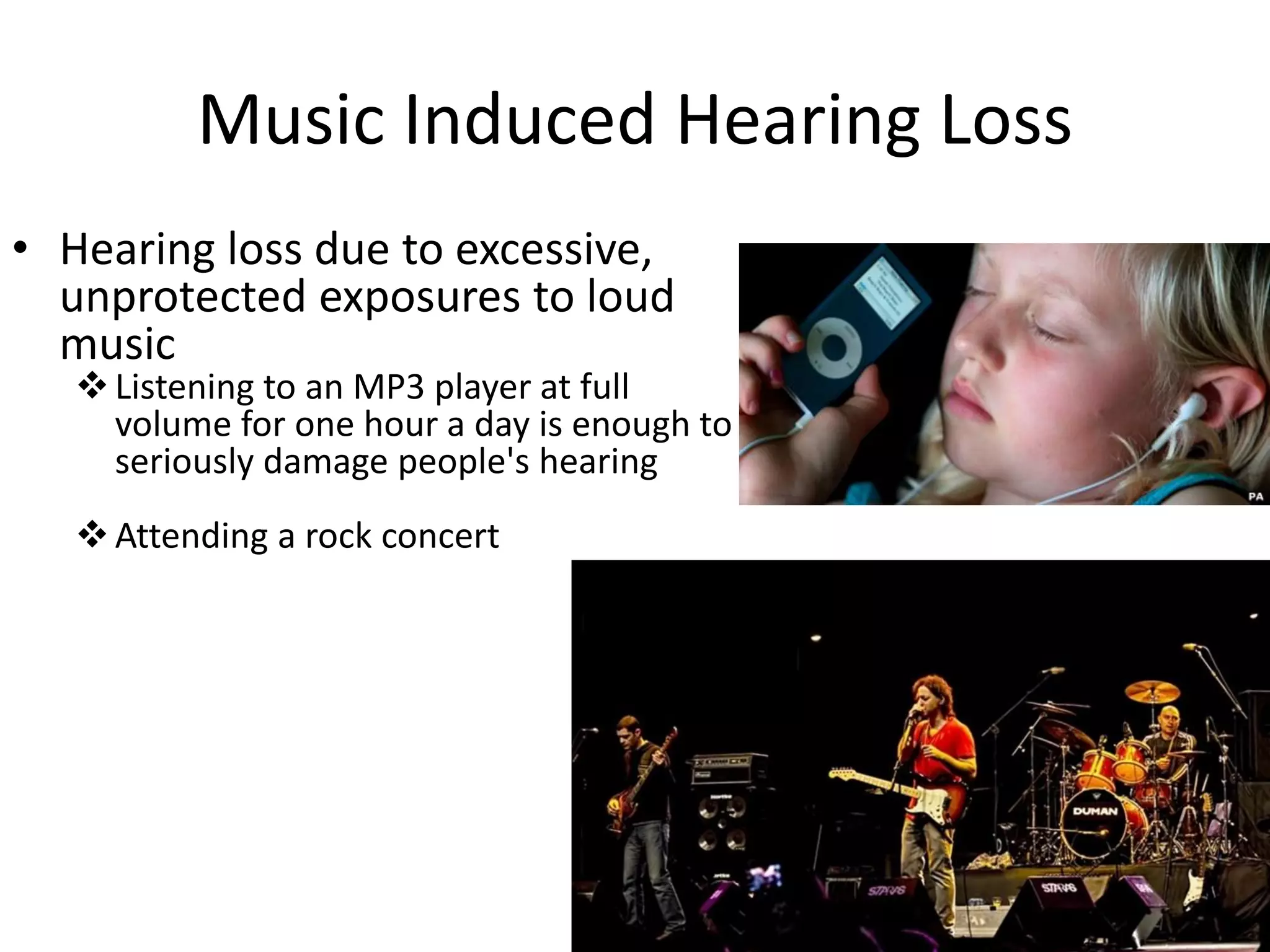
Music Induced Hearing Loss
• Hearing loss due to excessive,
unprotected exposures to loud
music
Listening to an MP3 player at full
volume for one hour a day is enough to
seriously damage people's hearing
Attending a rock concert
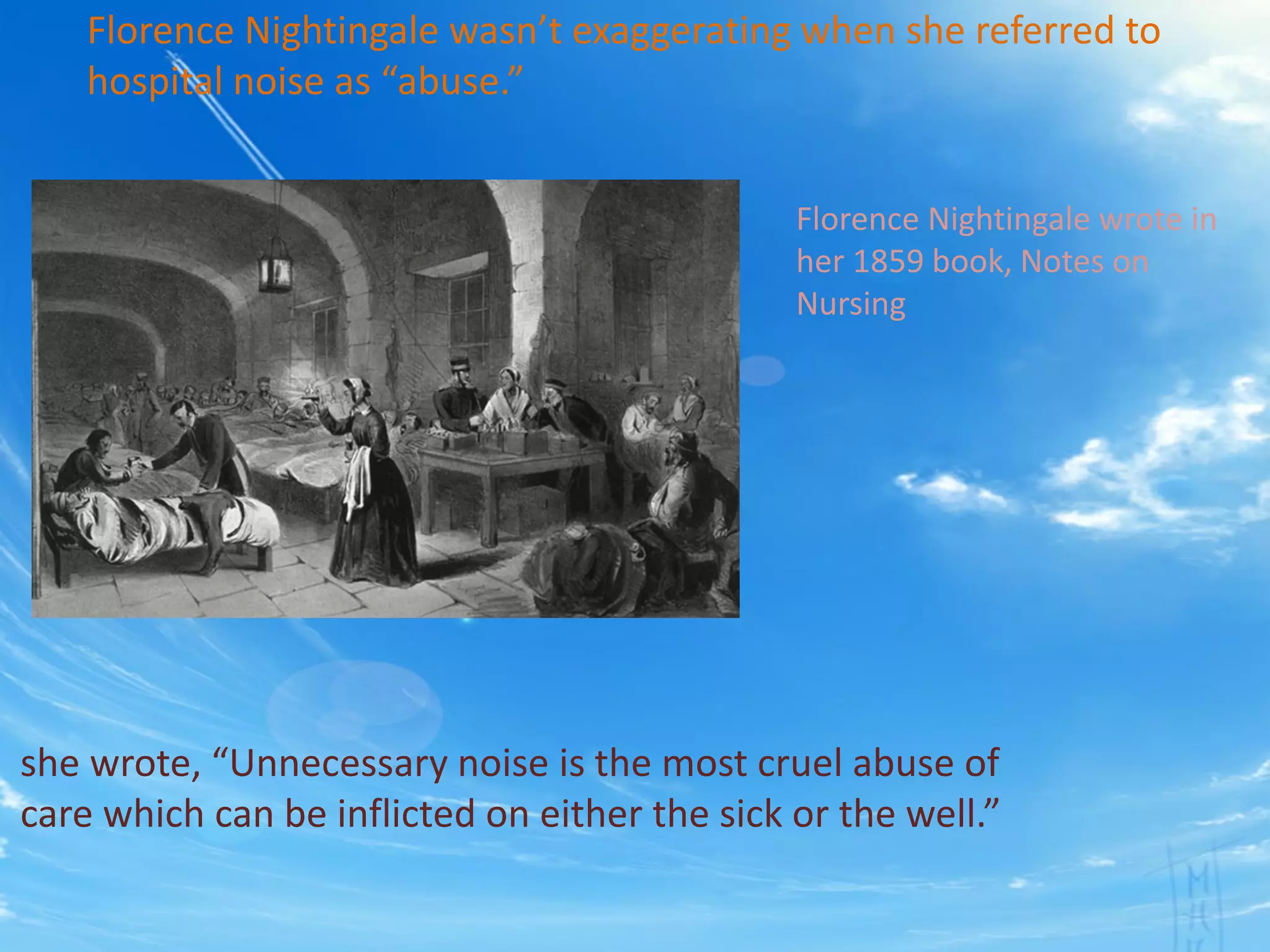
Florence Nightingale wasn’t exaggerating when she referred to
hospital noise as “abuse.”
Florence Nightingale wrote in
her 1859 book, Notes on
Nursing
she wrote, “Unnecessary noise is the most cruel abuse of
care which can be inflicted on either the sick or the well.”
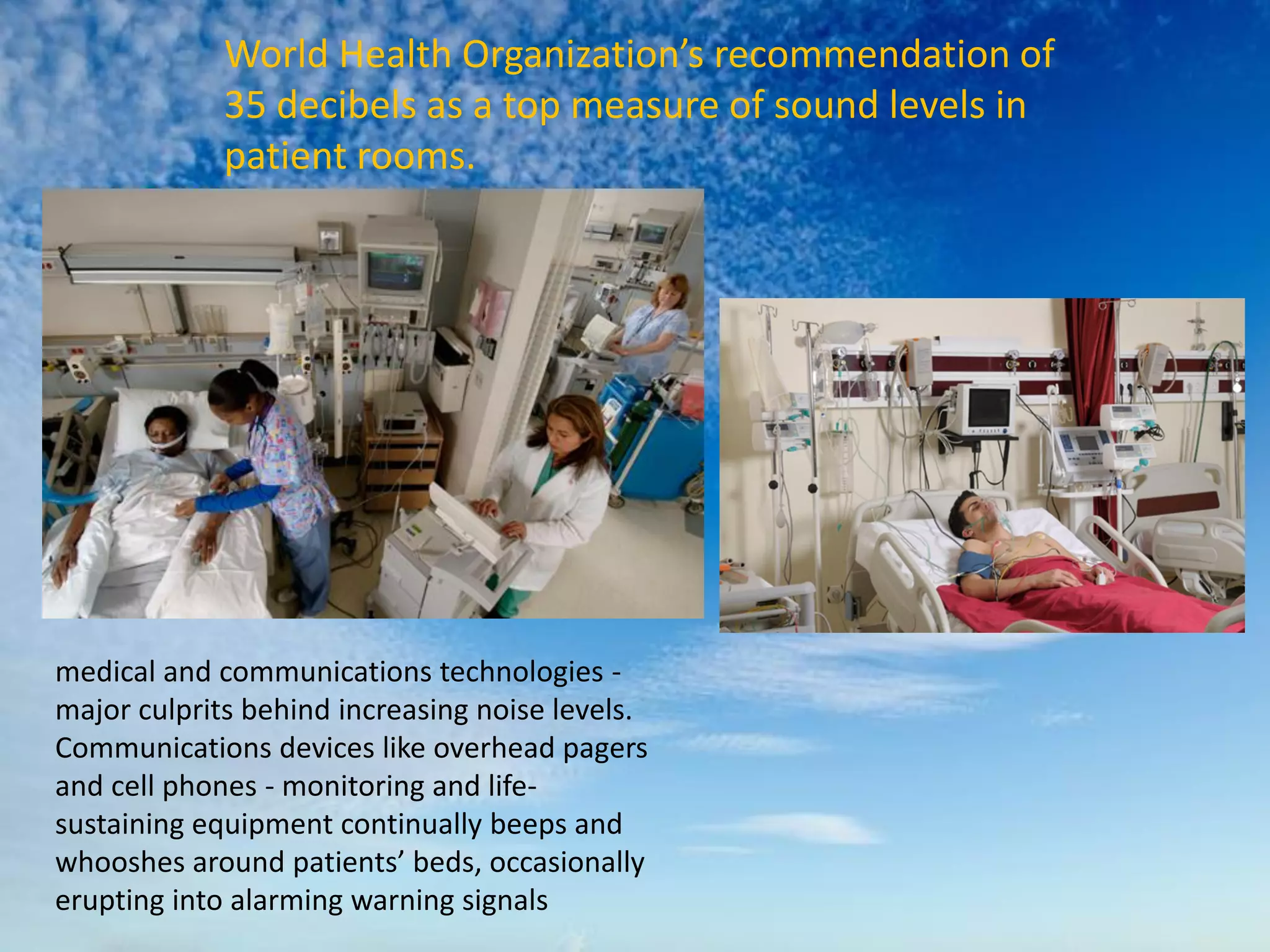
World Health Organization’s recommendation of
35 decibels as a top measure of sound levels in
patient rooms.
medical and communications technologies -
major culprits behind increasing noise levels.
Communications devices like overhead pagers
and cell phones - monitoring and life-
sustaining equipment continually beeps and
whooshes around patients’ beds, occasionally
erupting into alarming warning signals
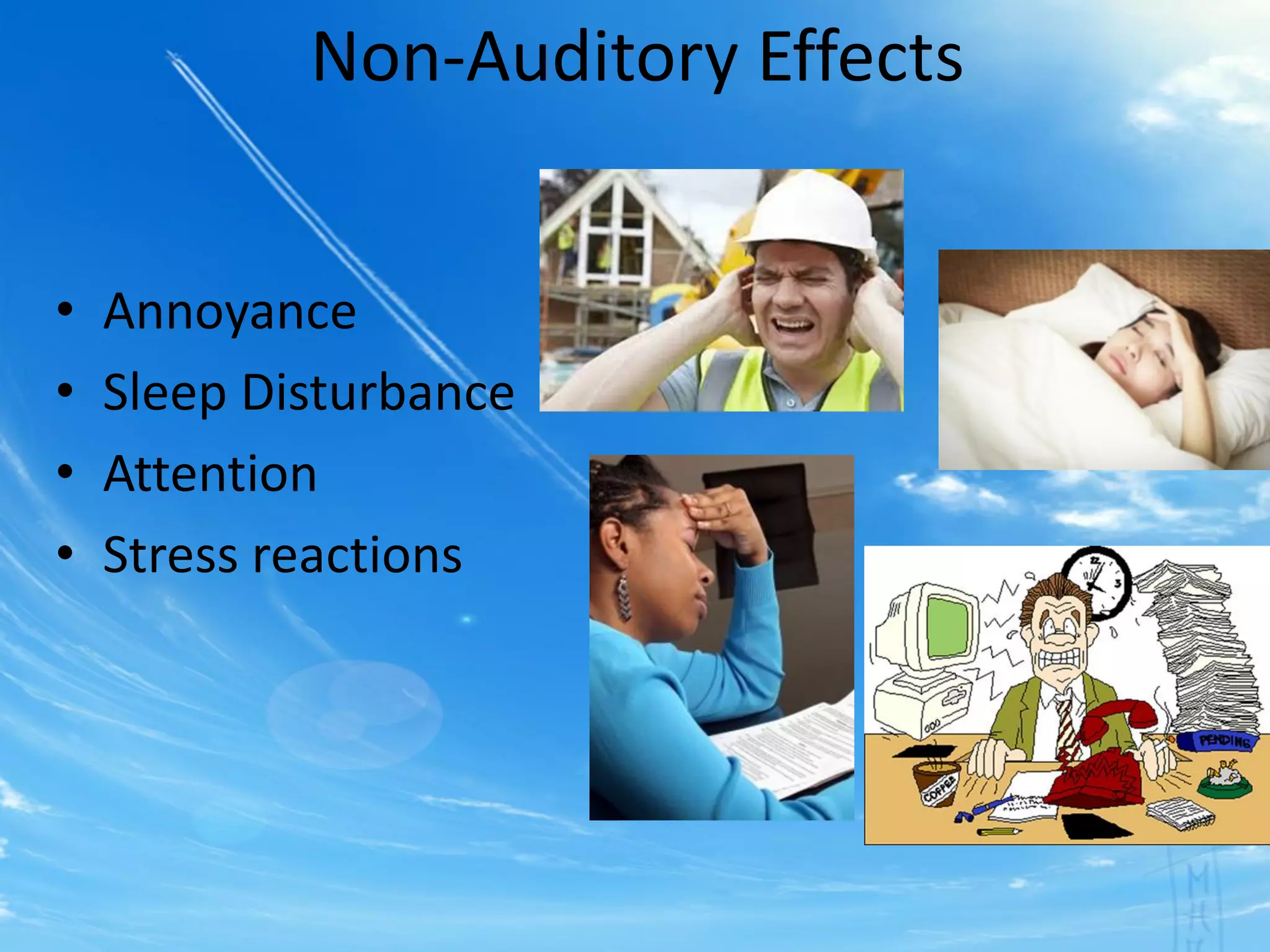
Non-Auditory Effects
• Annoyance
• Sleep Disturbance
• Attention
• Stress reactions
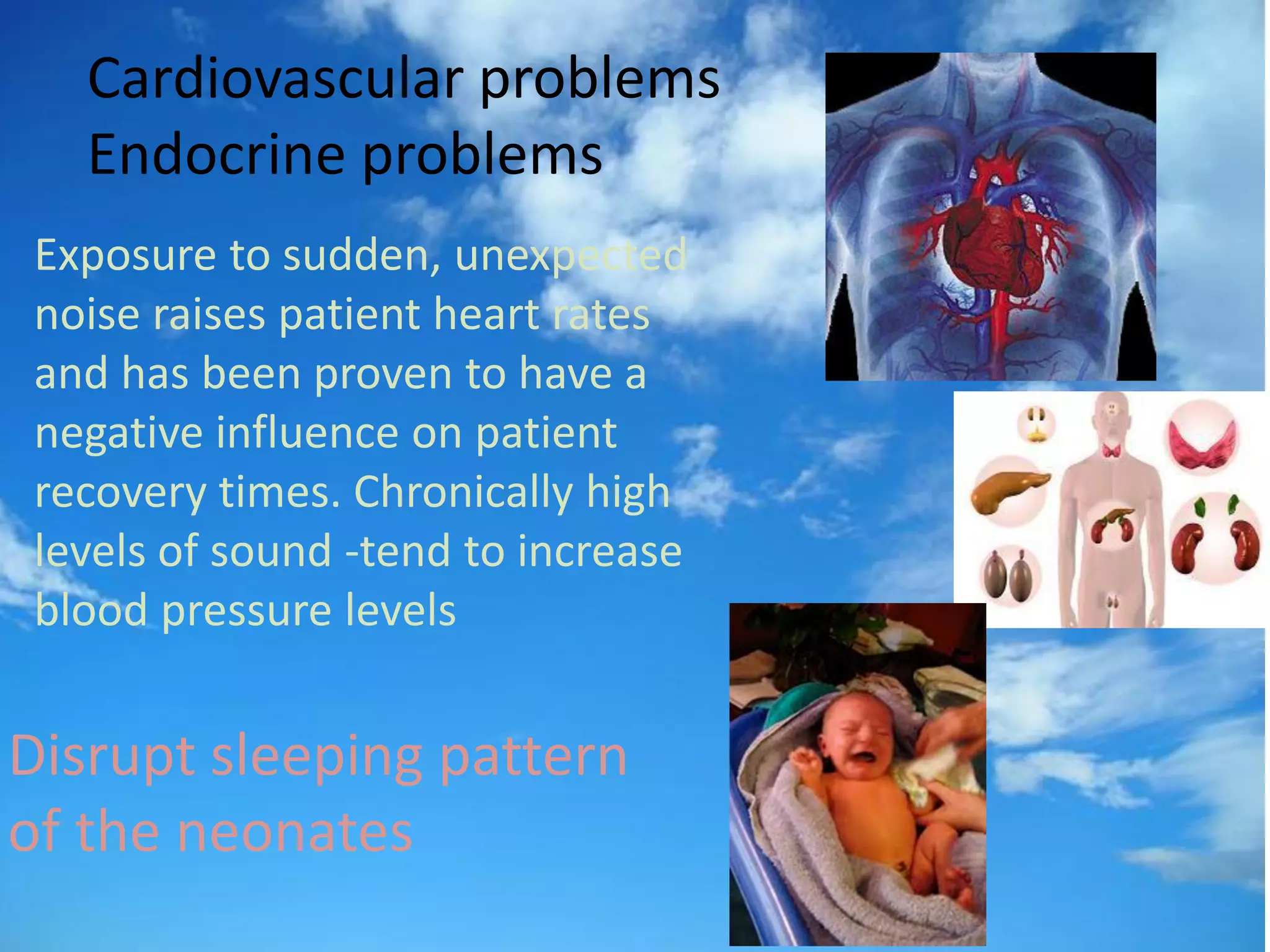
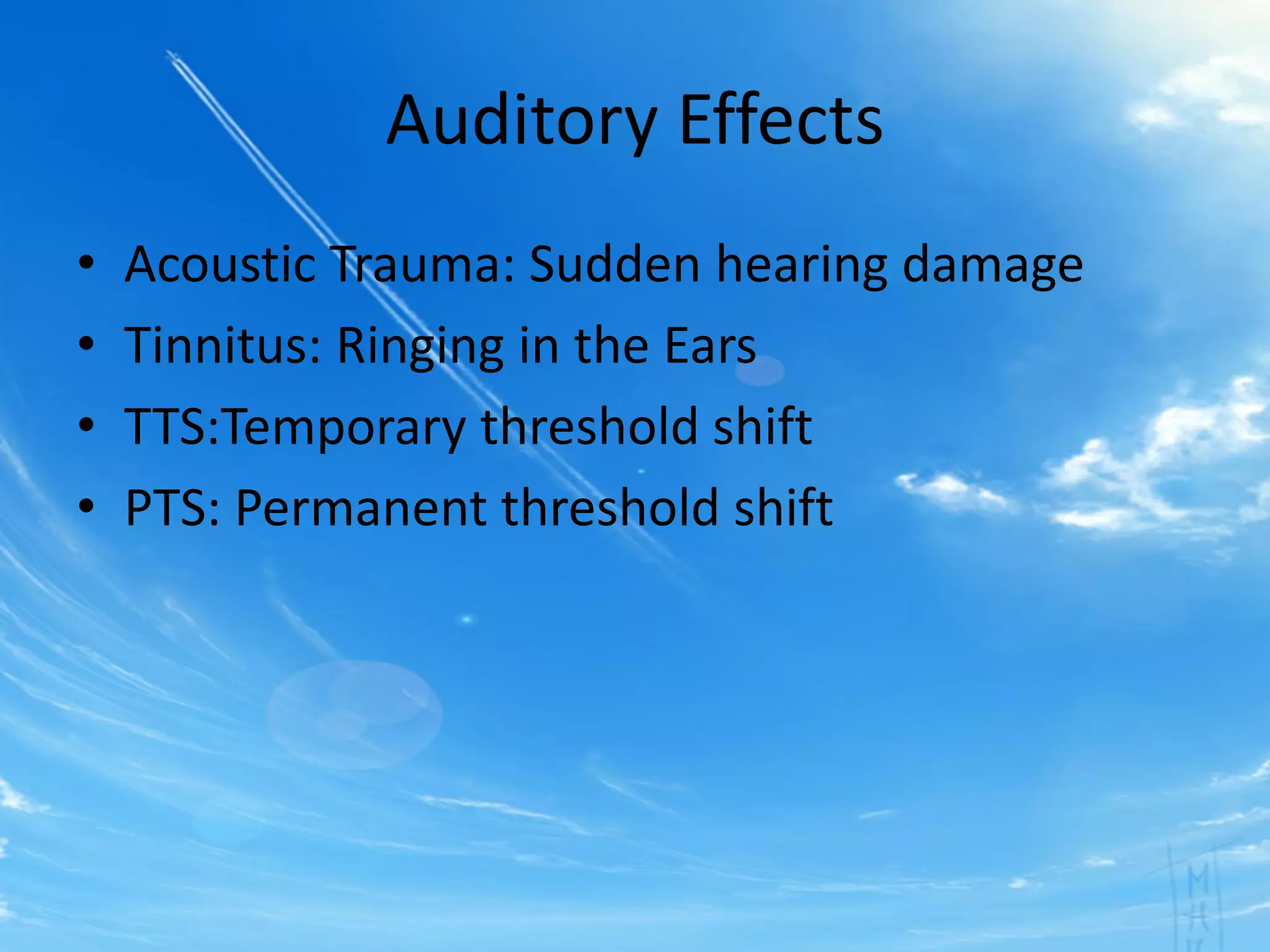
Cardiovascular problems
Endocrine problems
Exposure to sudden, unexpected
noise raises patient heart rates
and has been proven to have a
negative influence on patient
recovery times. Chronically high
levels of sound -tend to increase
blood pressure levels
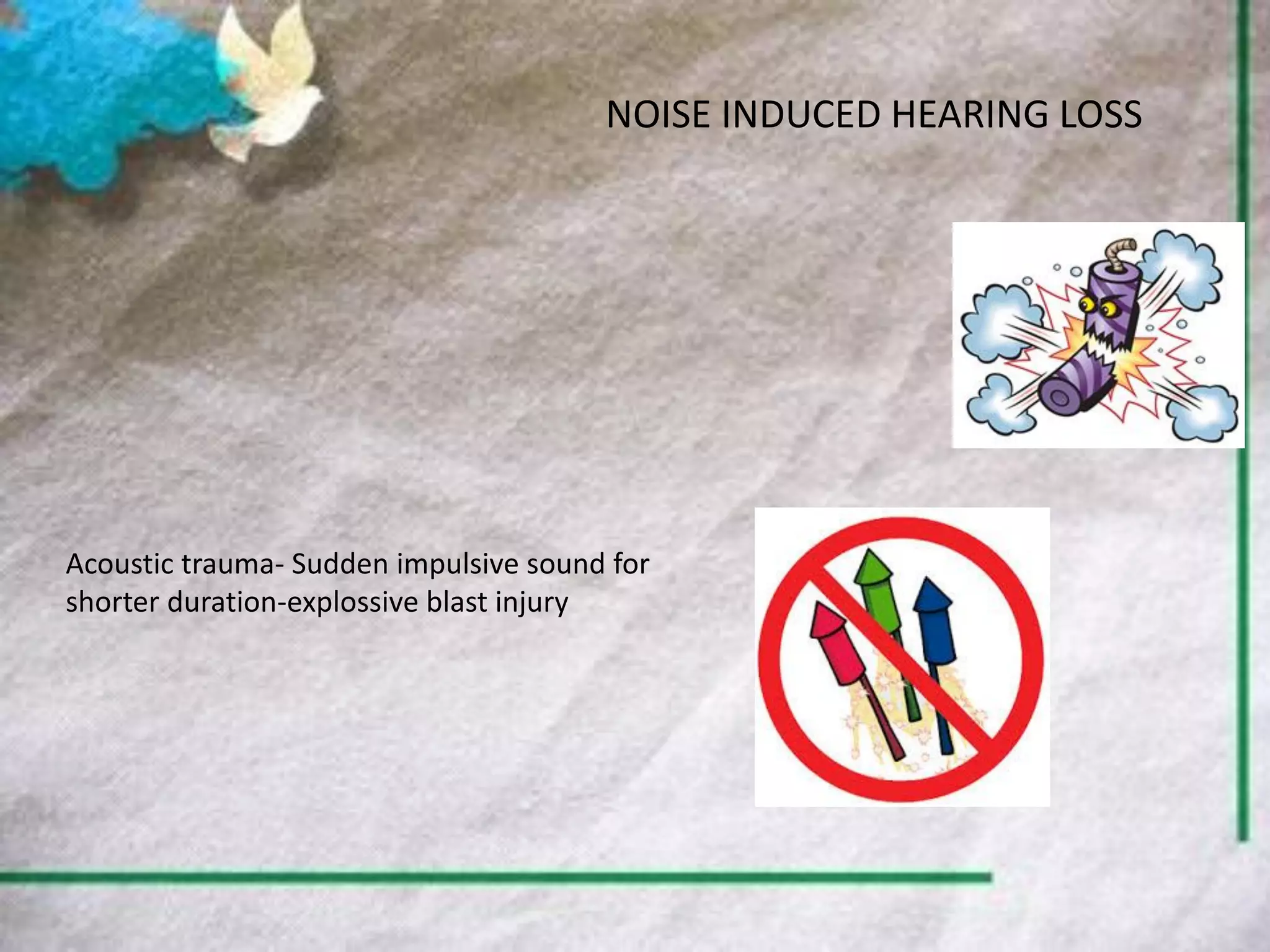
Disrupt sleeping pattern
of the neonates
Auditory Effects
• Acoustic Trauma: Sudden hearing damage
• Tinnitus: Ringing in the Ears
• TTS:Temporary threshold shift
• PTS: Permanent threshold shift
NOISE INDUCED HEARING LOSS
Acoustic trauma- Sudden impulsive sound for
shorter duration-explossive blast injury
Progressive
Can be temporary or permanent
– Temporary Loss: Change in hearing after noise exposure but returns in time
– a temporary loss of hearing after exposure to sound---results in a temporary
shift of the auditory threshold known as a temporary threshold shift (TTS).
– Permanent Loss: Change in hearing after noise exposure but will NOT return
– The damage can become permanent (permanent threshold shift, PTS) if
sufficient recovery time is not allowed for before continued sound exposure
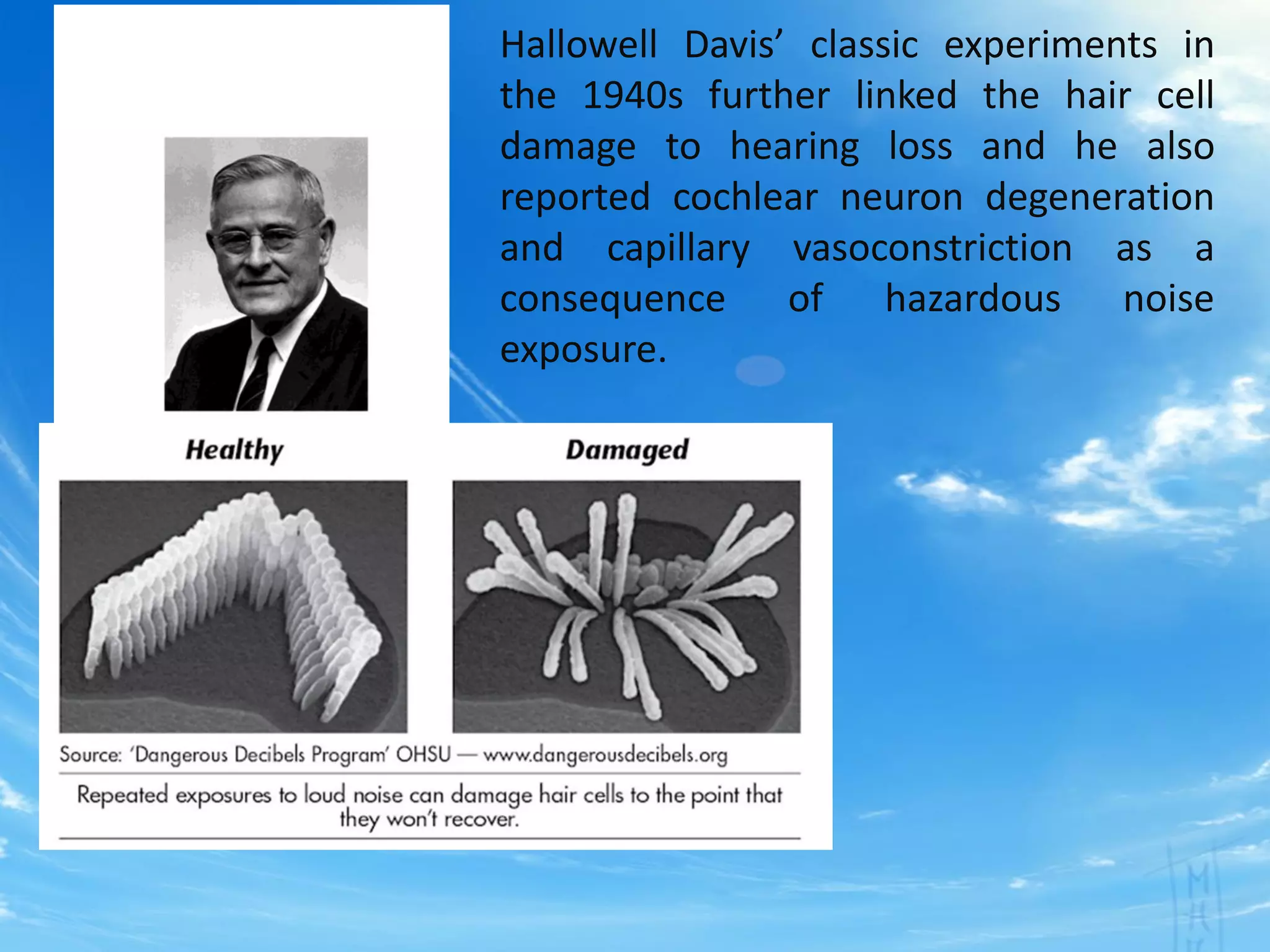
Hallowell Davis’ classic experiments in
the 1940s further linked the hair cell
damage to hearing loss and he also
reported cochlear neuron degeneration
and capillary vasoconstriction as a
consequence of hazardous noise
exposure.
minor bending of the stereocilia (inner ear) is
associated with temporary hearing loss and is
involved in auditory fatigue. Complete loss of
the stereocilia causes permanent hearing
damage
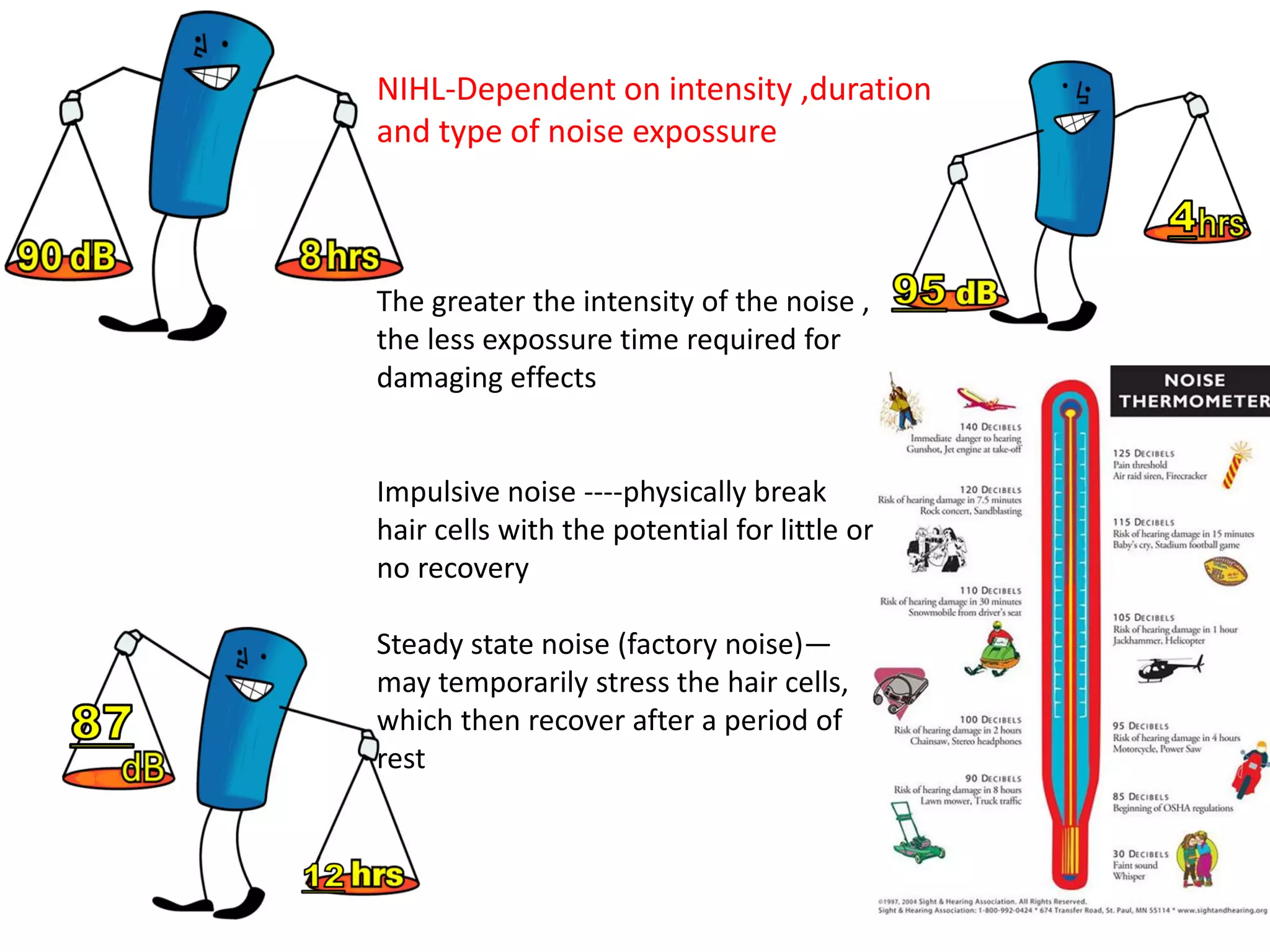
NIHL-Dependent on intensity ,duration
and type of noise expossure
The greater the intensity of the noise ,
the less expossure time required for
damaging effects
Impulsive noise ----physically break
hair cells with the potential for little or
no recovery
Steady state noise (factory noise)—
may temporarily stress the hair cells,
which then recover after a period of
rest
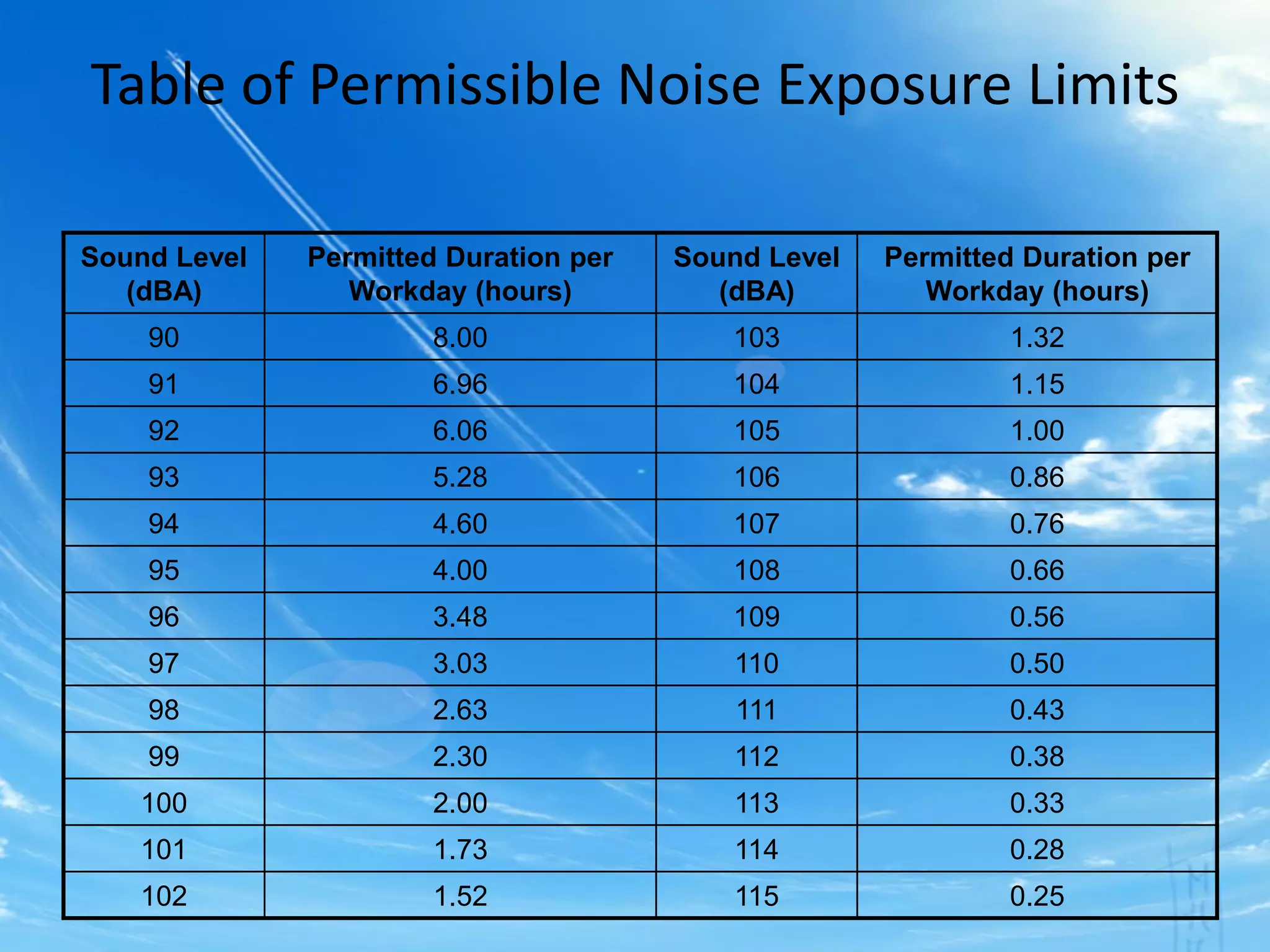
Sound Level
(dBA)
Permitted Duration per
Workday (hours)
Sound Level
(dBA)
Permitted Duration per
Workday (hours)
90 8.00 103 1.32
91 6.96 104 1.15
92 6.06 105 1.00
93 5.28 106 0.86
94 4.60 107 0.76
95 4.00 108 0.66
96 3.48 109 0.56
97 3.03 110 0.50
98 2.63 111 0.43
99 2.30 112 0.38
100 2.00 113 0.33
101 1.73 114 0.28
102 1.52 115 0.25
Table of Permissible Noise Exposure Limits
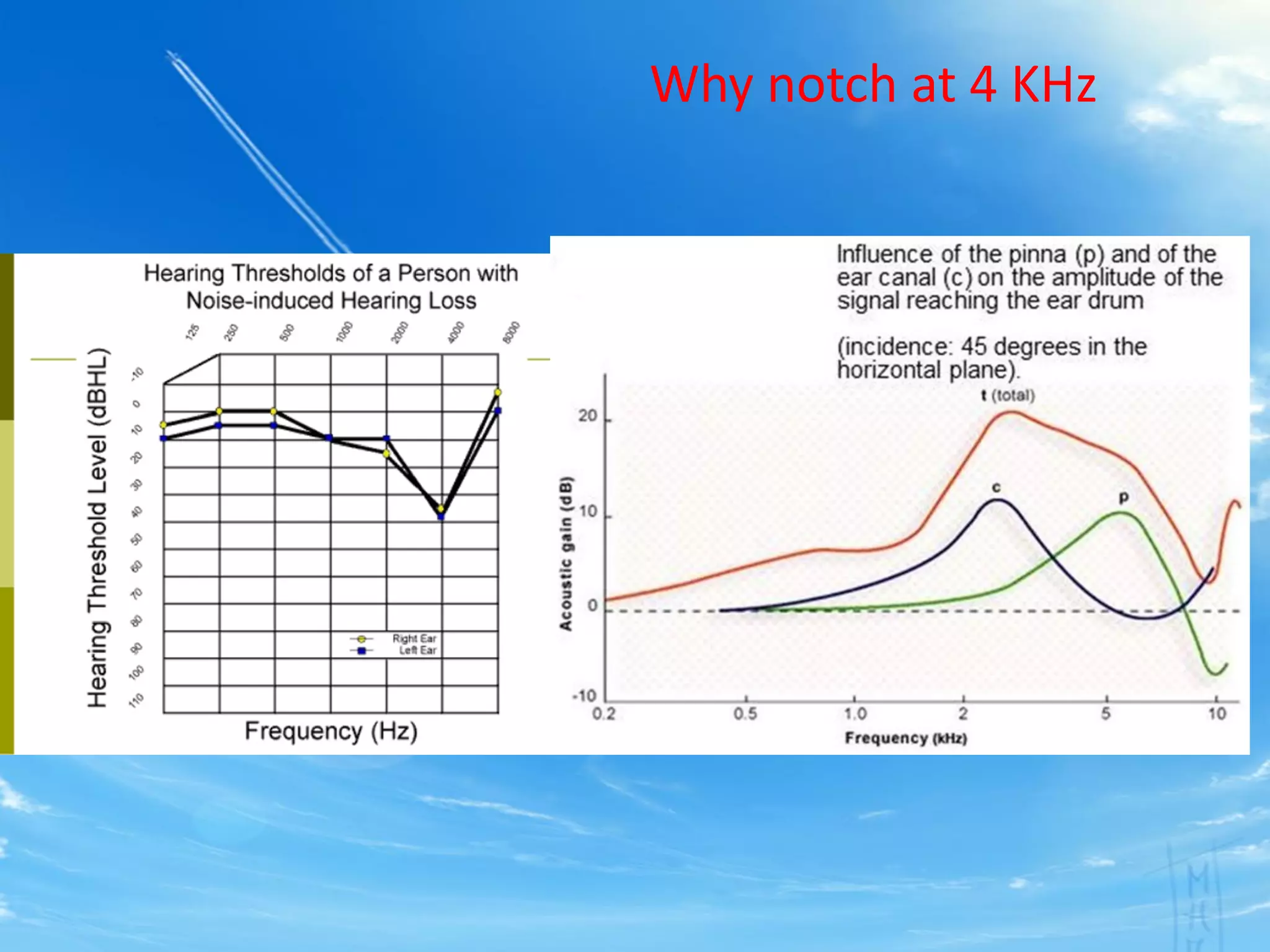
Why notch at 4 KHz
PREVENTION
Pre-employment & annual examinations
Audiometry
Designated Factory Doctor
Audiometric screening
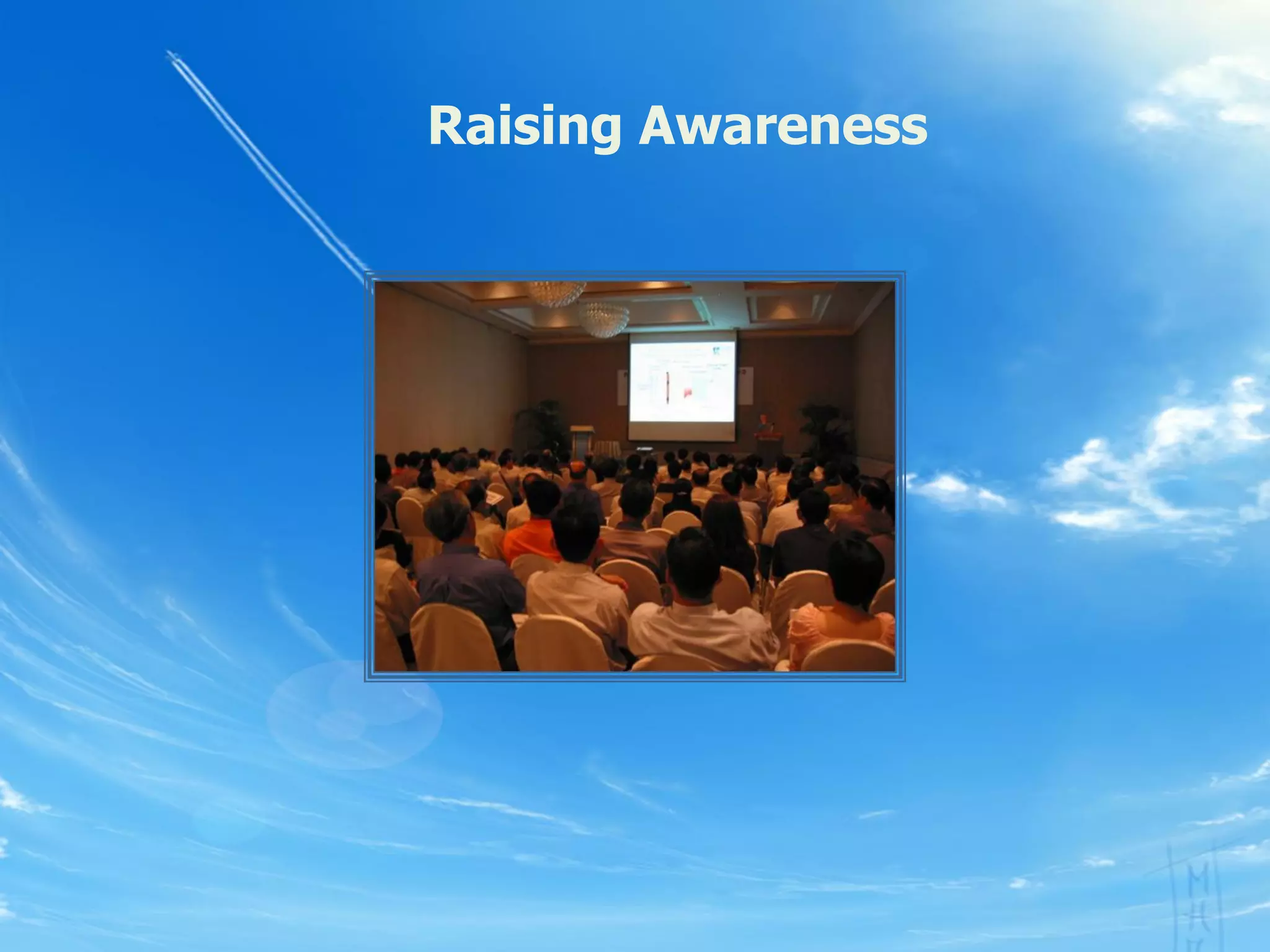
Raising Awareness
Sound Level Meter and Noise Dosimeter
Noise monitoring
• noise dosimeters - document
the average noise exposure over
your working day
A personal noise indicator is a
warning device.It indicates if
your immediate exposure is
less than or greater than 85
dBA. It flashes green if the
sound level is under 85 dBA
and red when above 85 dBA.
Hearing
Protection Devices
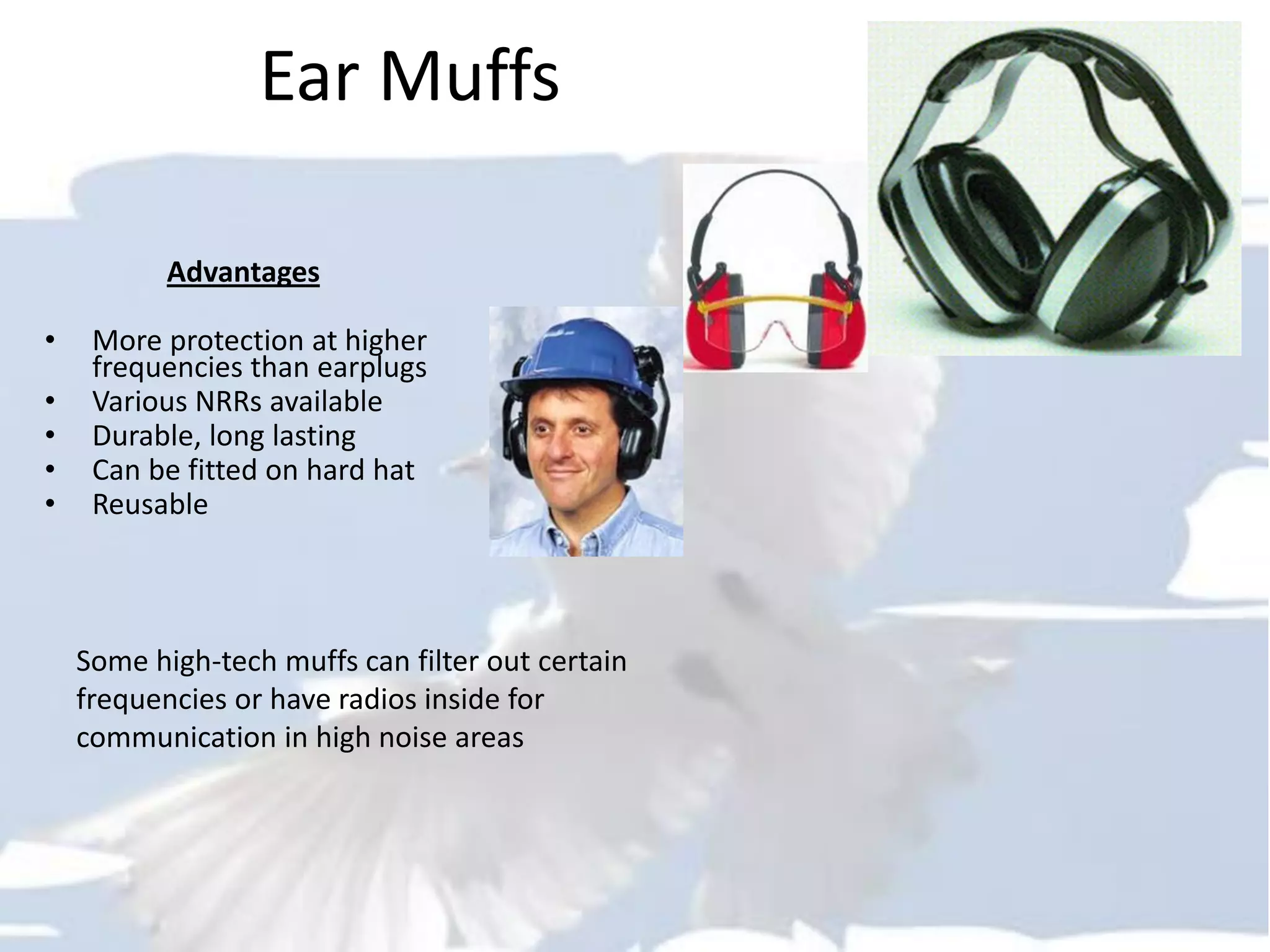
Ear Muffs
Advantages
• More protection at higher
frequencies than earplugs
• Various NRRs available
• Durable, long lasting
• Can be fitted on hard hat
• Reusable
Some high-tech muffs can filter out certain
frequencies or have radios inside for
communication in high noise areas
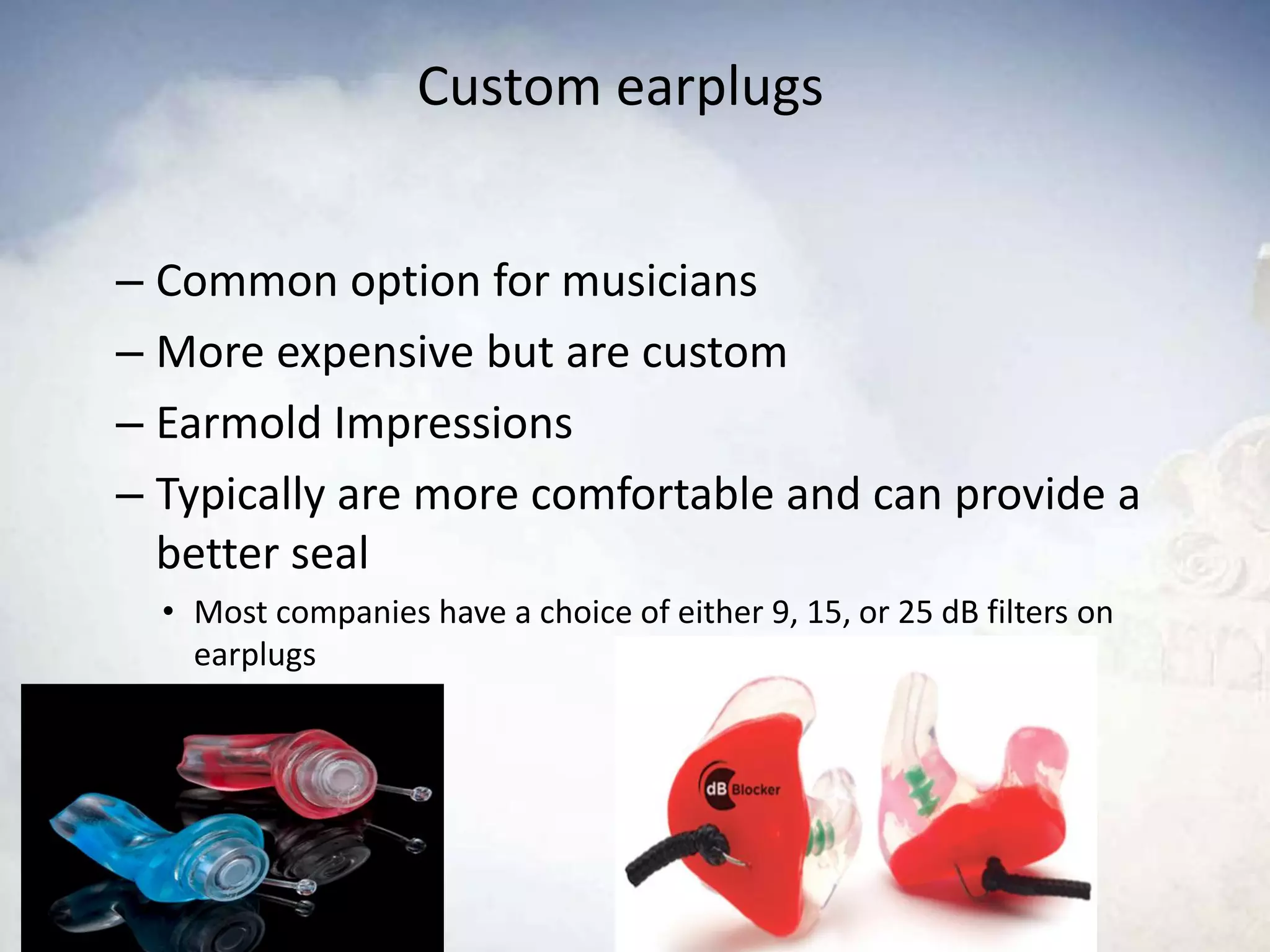
Custom earplugs
– Common option for musicians
– More expensive but are custom
– Earmold Impressions
– Typically are more comfortable and can provide a
better seal
• Most companies have a choice of either 9, 15, or 25 dB filters on
earplugs
Foam Insert Earplugs
Advantages
• Inexpensive; disposable
• Can be custom molded for
individual worker
• Reusable plugs are available
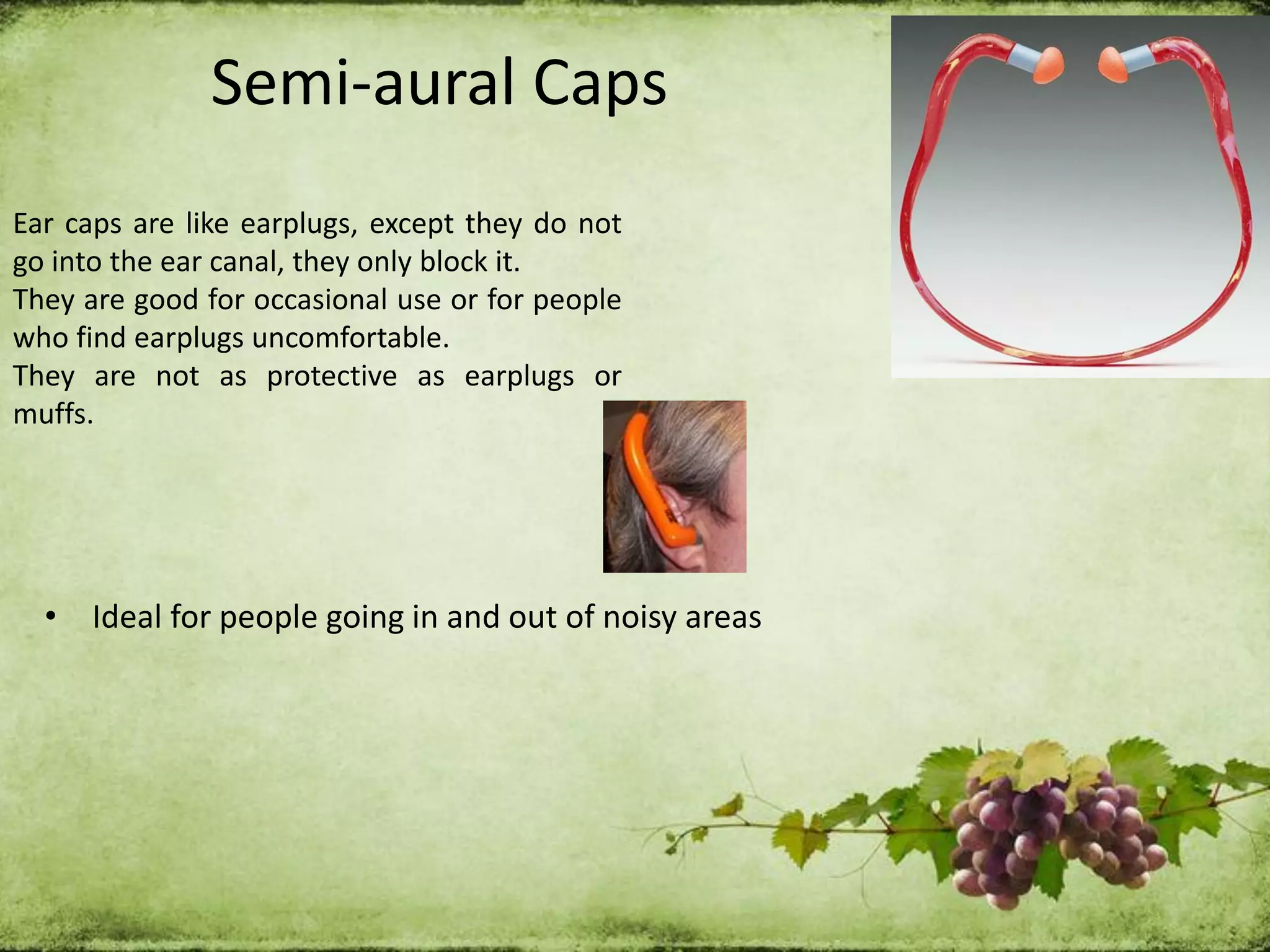
Semi-aural Caps
Ear caps are like earplugs, except they do not
go into the ear canal, they only block it.
They are good for occasional use or for people
who find earplugs uncomfortable.
They are not as protective as earplugs or
muffs.
• Ideal for people going in and out of noisy areas
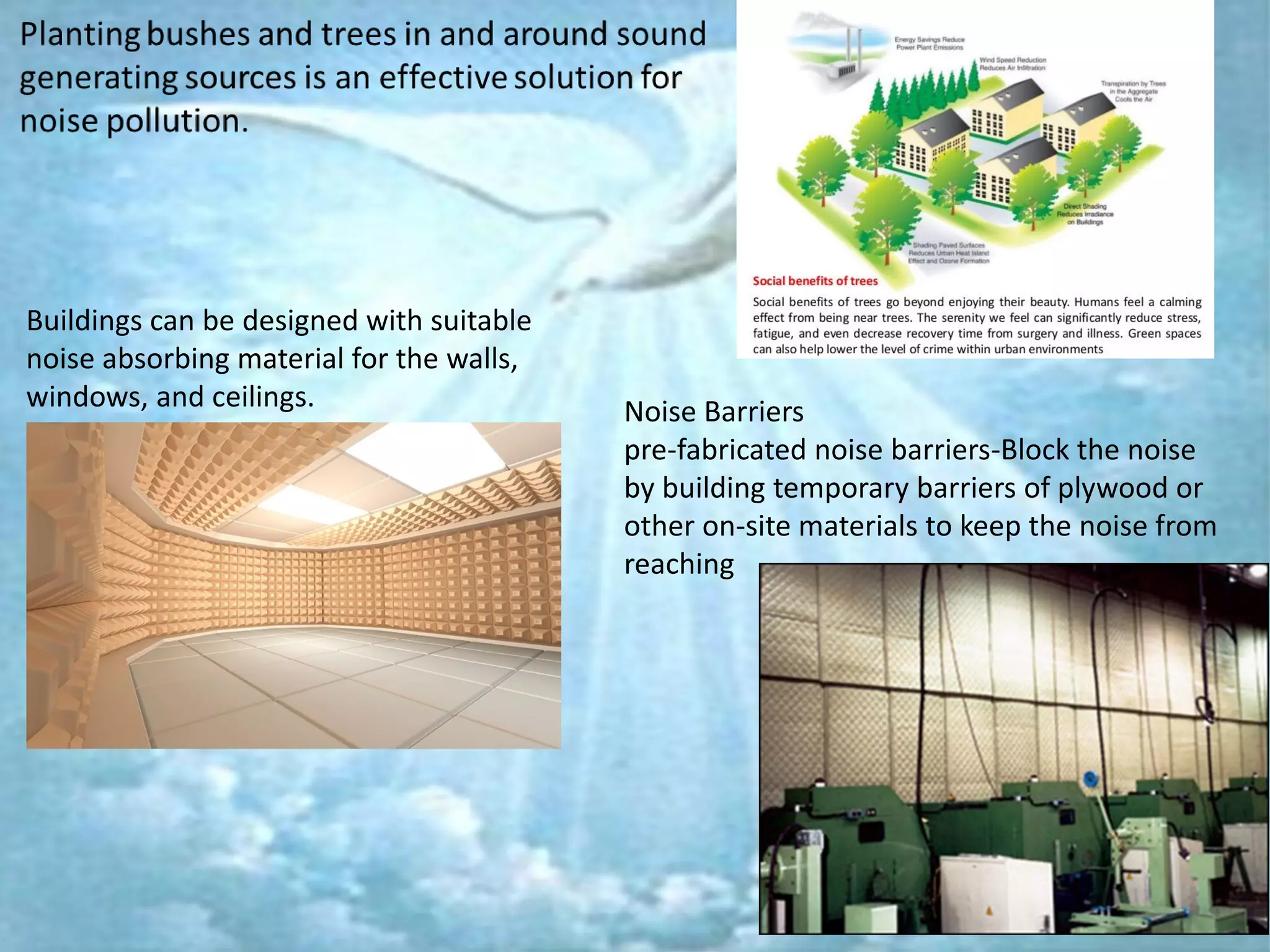
Buildings can be designed with suitable
noise absorbing material for the walls,
windows, and ceilings. Noise Barriers
pre-fabricated noise barriers-Block the noise
by building temporary barriers of plywood or
other on-site materials to keep the noise from
reaching
Soundproof doors and windows can be
installed to block unwanted noise from
outside.
Regulations should be imposed to restrict the
usage of play loudspeakers
acoustical insulation-Place wooden box
over the generator. Add fire-resistant
acoustical absorbing material (foam) inside
the box. If the generator sits on soil or
sand,that will help absorb some of the
noise.
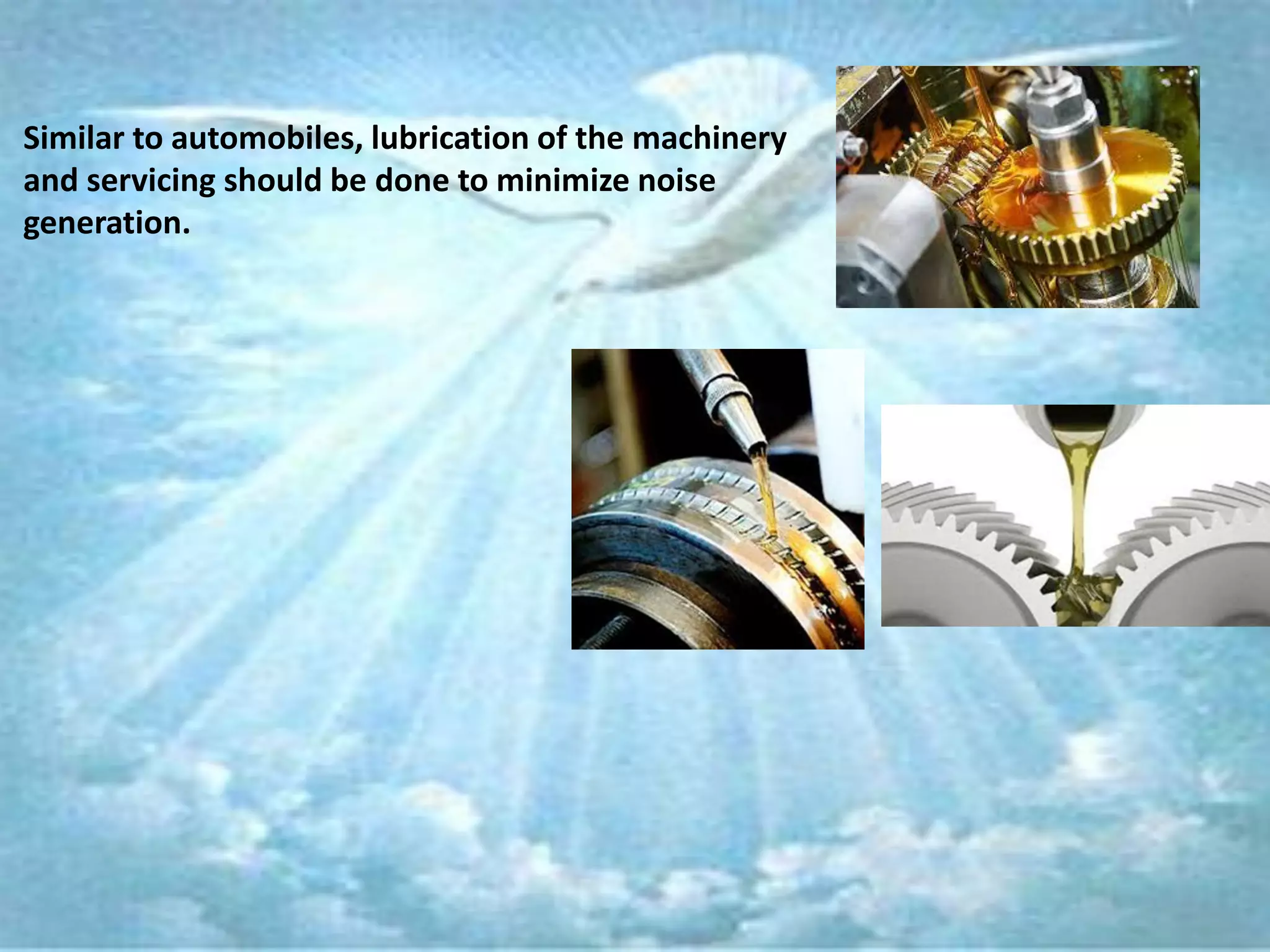
Similar to automobiles, lubrication of the machinery
and servicing should be done to minimize noise
generation.
• It is cumulative like tobacco.
• One cigarette will not kill you and one day at work will not
make you deaf.
• Neither will two or three – but where is the line? It is easy
to say “one more exposure is not going to make any
difference.”
Managing  noise and preventing hearing loss,

Managing noise and preventing hearing loss,

  • 1.
  • 2.
    Boiler makers andgunners were the predecessors 1510-1590 873 self inflicted hearing loss Rock Musician Pete Townshead--- prompted by his partial deafness and Tinnitus –formation ---H E A R (Hearing Education and Awareness for Rockers in 1980’s)
  • 3.
    High Risk ofNoise Induced Hearing Loss • Industrial/Workplace • Military • Recreational Noise Exposure • Musicians
  • 4.
    Common Noise Sources  Wasteextraction Fan  Electric motor  Air Compressor  Assembly machine  Ultrasonic welder
  • 5.
    Music Induced HearingLoss • Hearing loss due to excessive, unprotected exposures to loud music Listening to an MP3 player at full volume for one hour a day is enough to seriously damage people's hearing Attending a rock concert
  • 6.
    Florence Nightingale wasn’texaggerating when she referred to hospital noise as “abuse.” Florence Nightingale wrote in her 1859 book, Notes on Nursing she wrote, “Unnecessary noise is the most cruel abuse of care which can be inflicted on either the sick or the well.”
  • 7.
    World Health Organization’srecommendation of 35 decibels as a top measure of sound levels in patient rooms. medical and communications technologies - major culprits behind increasing noise levels. Communications devices like overhead pagers and cell phones - monitoring and life- sustaining equipment continually beeps and whooshes around patients’ beds, occasionally erupting into alarming warning signals
  • 8.
    Non-Auditory Effects • Annoyance •Sleep Disturbance • Attention • Stress reactions
  • 9.
    Cardiovascular problems Endocrine problems Exposureto sudden, unexpected noise raises patient heart rates and has been proven to have a negative influence on patient recovery times. Chronically high levels of sound -tend to increase blood pressure levels Disrupt sleeping pattern of the neonates
  • 10.
    Auditory Effects • AcousticTrauma: Sudden hearing damage • Tinnitus: Ringing in the Ears • TTS:Temporary threshold shift • PTS: Permanent threshold shift
  • 11.
    NOISE INDUCED HEARINGLOSS Acoustic trauma- Sudden impulsive sound for shorter duration-explossive blast injury
  • 12.
    Progressive Can be temporaryor permanent – Temporary Loss: Change in hearing after noise exposure but returns in time – a temporary loss of hearing after exposure to sound---results in a temporary shift of the auditory threshold known as a temporary threshold shift (TTS). – Permanent Loss: Change in hearing after noise exposure but will NOT return – The damage can become permanent (permanent threshold shift, PTS) if sufficient recovery time is not allowed for before continued sound exposure
  • 13.
    Hallowell Davis’ classicexperiments in the 1940s further linked the hair cell damage to hearing loss and he also reported cochlear neuron degeneration and capillary vasoconstriction as a consequence of hazardous noise exposure.
  • 14.
    minor bending ofthe stereocilia (inner ear) is associated with temporary hearing loss and is involved in auditory fatigue. Complete loss of the stereocilia causes permanent hearing damage
  • 15.
    NIHL-Dependent on intensity,duration and type of noise expossure The greater the intensity of the noise , the less expossure time required for damaging effects Impulsive noise ----physically break hair cells with the potential for little or no recovery Steady state noise (factory noise)— may temporarily stress the hair cells, which then recover after a period of rest
  • 16.
    Sound Level (dBA) Permitted Durationper Workday (hours) Sound Level (dBA) Permitted Duration per Workday (hours) 90 8.00 103 1.32 91 6.96 104 1.15 92 6.06 105 1.00 93 5.28 106 0.86 94 4.60 107 0.76 95 4.00 108 0.66 96 3.48 109 0.56 97 3.03 110 0.50 98 2.63 111 0.43 99 2.30 112 0.38 100 2.00 113 0.33 101 1.73 114 0.28 102 1.52 115 0.25 Table of Permissible Noise Exposure Limits
  • 17.
  • 18.
  • 19.
    Pre-employment & annualexaminations Audiometry Designated Factory Doctor Audiometric screening
  • 20.
  • 21.
    Sound Level Meterand Noise Dosimeter Noise monitoring • noise dosimeters - document the average noise exposure over your working day A personal noise indicator is a warning device.It indicates if your immediate exposure is less than or greater than 85 dBA. It flashes green if the sound level is under 85 dBA and red when above 85 dBA.
  • 22.
  • 23.
    Ear Muffs Advantages • Moreprotection at higher frequencies than earplugs • Various NRRs available • Durable, long lasting • Can be fitted on hard hat • Reusable Some high-tech muffs can filter out certain frequencies or have radios inside for communication in high noise areas
  • 24.
    Custom earplugs – Commonoption for musicians – More expensive but are custom – Earmold Impressions – Typically are more comfortable and can provide a better seal • Most companies have a choice of either 9, 15, or 25 dB filters on earplugs
  • 25.
    Foam Insert Earplugs Advantages •Inexpensive; disposable • Can be custom molded for individual worker • Reusable plugs are available
  • 26.
    Semi-aural Caps Ear capsare like earplugs, except they do not go into the ear canal, they only block it. They are good for occasional use or for people who find earplugs uncomfortable. They are not as protective as earplugs or muffs. • Ideal for people going in and out of noisy areas
  • 27.
    Buildings can bedesigned with suitable noise absorbing material for the walls, windows, and ceilings. Noise Barriers pre-fabricated noise barriers-Block the noise by building temporary barriers of plywood or other on-site materials to keep the noise from reaching
  • 28.
    Soundproof doors andwindows can be installed to block unwanted noise from outside. Regulations should be imposed to restrict the usage of play loudspeakers acoustical insulation-Place wooden box over the generator. Add fire-resistant acoustical absorbing material (foam) inside the box. If the generator sits on soil or sand,that will help absorb some of the noise.
  • 29.
    Similar to automobiles,lubrication of the machinery and servicing should be done to minimize noise generation.
  • 30.
    • It iscumulative like tobacco. • One cigarette will not kill you and one day at work will not make you deaf. • Neither will two or three – but where is the line? It is easy to say “one more exposure is not going to make any difference.”