EAR SAFETY
THE EAR
OUTER EAR MIDDLE EAR INNER EAROUTER EAR - MIDDLE EAR - INNER EAR
AUDITORY
NERVE
HAMMER
ANVIL
NERVE
ANVIL
STIRRUP
COCHLEA
EAR
CANAL
EAR
DRUM
EUSTACHIAN
TUBE
Noise Basics
Th t f t th t d t i h h d• The two factors that determine how hazardous
noise is are:
– Intensity (Loudness) measured in dBA
– Time of Exposure measured in Hours and Minutes
• The louder the noise, the more hazardous it is.
Also, the longer the exposure time, the more, g p ,
hazardous the noise is.
• A “Noise Dose” combines both loudness andA Noise Dose combines both loudness and
time and is a convenient way of describing the
relative hazard of the noiserelative hazard of the noise.
Noise Basics
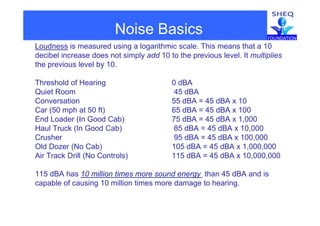
Loudness is measured using a logarithmic scale. This means that a 10
decibel increase does not simply add 10 to the previous level. It multiplies
th i l l b 10the previous level by 10.
Threshold of Hearing 0 dBA
Quiet Room 45 dBA
Conversation 55 dBA = 45 dBA x 10
Car (50 mph at 50 ft) 65 dBA = 45 dBA x 100( p )
End Loader (In Good Cab) 75 dBA = 45 dBA x 1,000
Haul Truck (In Good Cab) 85 dBA = 45 dBA x 10,000
Crusher 95 dBA = 45 dBA x 100 000Crusher 95 dBA 45 dBA x 100,000
Old Dozer (No Cab) 105 dBA = 45 dBA x 1,000,000
Air Track Drill (No Controls) 115 dBA = 45 dBA x 10,000,000
115 dBA has 10 million times more sound energy10 million times more sound energy than 45 dBA and is
capable of causing 10 million times more damage to hearing.
Human Hearing Ranges
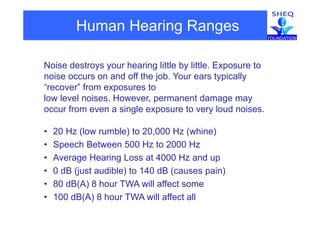
Noise destroys your hearing little by little. Exposure to
noise occurs on and off the job. Your ears typically
“recover” from exposures torecover from exposures to
low level noises. However, permanent damage may
occur from even a single exposure to very loud noises.g p y
• 20 Hz (low rumble) to 20,000 Hz (whine)
• Speech Between 500 Hz to 2000 Hz
• Average Hearing Loss at 4000 Hz and up
• 0 dB (just audible) to 140 dB (causes pain)
• 80 dB(A) 8 hour TWA will affect some
• 100 dB(A) 8 hour TWA will affect all
Sources of Noise
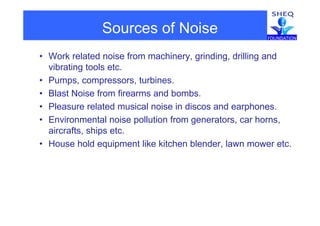
• Work related noise from machinery, grinding, drilling and
vibrating tools etc.
• Pumps, compressors, turbines.
• Blast Noise from firearms and bombs.
• Pleasure related musical noise in discos and earphones.
• Environmental noise pollution from generators, car horns,
aircrafts, ships etc.
• House hold equipment like kitchen blender, lawn mower etc.
FACTORS AFFECTING HEARING
WORK SOURCES & FACTORS AFFECTING HEARING:WORK SOURCES & FACTORS AFFECTING HEARING:
• Age
• PitchPitch
• Loudness
• Surroundings
• Type of machinesyp
• Position of source
• Length of exposure
• Previous ear trouble
• Distance from source
• Think about your personal work habits!
Hearing Lossg
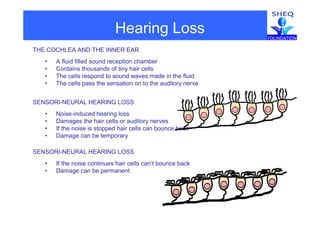
THE COCHLEA AND THE INNER EAR
• A fluid filled sound reception chamber• A fluid filled sound reception chamber
• Contains thousands of tiny hair cells
• The cells respond to sound waves made in the fluid
• The cells pass the sensation on to the auditory nerve
SENSORI-NEURAL HEARING LOSS
• Noise induced hearing loss• Noise-induced hearing loss
• Damages the hair cells or auditory nerves
• If the noise is stopped hair cells can bounce back
• Damage can be temporaryg p y
SENSORI-NEURAL HEARING LOSS
• If the noise continues hair cells can’t bounce backIf the noise continues hair cells can t bounce back
• Damage can be permanent
SYMPTOMS OF HEARING LOSS
• Constant ringing in the ear (tinnitus)
• Difficulty hearing soft sounds, such as a
child’s voicechild s voice
• Complaints from others that you are talking
too loudly or shouting unnecessarilytoo loudly or shouting unnecessarily
• Difficulty in separating speech from
b k d ibackground noise
• Having to turn up the volume on TVs or
radios
Engineering controlsg g
• Isolate noisy machinery in a separate area
• Place machinery on rubber mountings
• Use sound-absorbing acoustical tilesg
• Arrange work schedules to reduce employee
exposure to noise
• Inform supervisors of unpleasant/unacceptable noise
levels
3a
HEARING PROTECTION
As with all personal protection – Ear protectionAs with all personal protection Ear protection
is the last line in the hierarchy of control
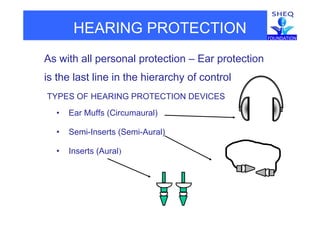
TYPES OF HEARING PROTECTION DEVICES
• Ear Muffs (Circumaural)• Ear Muffs (Circumaural)
• Semi-Inserts (Semi-Aural)
• Inserts (Aural)
CONCLUSION
HEARING LOSS HAPPENS!
Noise induced hearing loss is 100% preventable
Your hearing health starts with YOU while at work or home
If YOU don’t protect it YOU will lose it

Ear safety

  • 1.
  • 2.
    THE EAR OUTER EARMIDDLE EAR INNER EAROUTER EAR - MIDDLE EAR - INNER EAR AUDITORY NERVE HAMMER ANVIL NERVE ANVIL STIRRUP COCHLEA EAR CANAL EAR DRUM EUSTACHIAN TUBE
  • 3.
    Noise Basics Th tf t th t d t i h h d• The two factors that determine how hazardous noise is are: – Intensity (Loudness) measured in dBA – Time of Exposure measured in Hours and Minutes • The louder the noise, the more hazardous it is. Also, the longer the exposure time, the more, g p , hazardous the noise is. • A “Noise Dose” combines both loudness andA Noise Dose combines both loudness and time and is a convenient way of describing the relative hazard of the noiserelative hazard of the noise.
  • 4.
    Noise Basics Loudness ismeasured using a logarithmic scale. This means that a 10 decibel increase does not simply add 10 to the previous level. It multiplies th i l l b 10the previous level by 10. Threshold of Hearing 0 dBA Quiet Room 45 dBA Conversation 55 dBA = 45 dBA x 10 Car (50 mph at 50 ft) 65 dBA = 45 dBA x 100( p ) End Loader (In Good Cab) 75 dBA = 45 dBA x 1,000 Haul Truck (In Good Cab) 85 dBA = 45 dBA x 10,000 Crusher 95 dBA = 45 dBA x 100 000Crusher 95 dBA 45 dBA x 100,000 Old Dozer (No Cab) 105 dBA = 45 dBA x 1,000,000 Air Track Drill (No Controls) 115 dBA = 45 dBA x 10,000,000 115 dBA has 10 million times more sound energy10 million times more sound energy than 45 dBA and is capable of causing 10 million times more damage to hearing.
  • 5.
    Human Hearing Ranges Noisedestroys your hearing little by little. Exposure to noise occurs on and off the job. Your ears typically “recover” from exposures torecover from exposures to low level noises. However, permanent damage may occur from even a single exposure to very loud noises.g p y • 20 Hz (low rumble) to 20,000 Hz (whine) • Speech Between 500 Hz to 2000 Hz • Average Hearing Loss at 4000 Hz and up • 0 dB (just audible) to 140 dB (causes pain) • 80 dB(A) 8 hour TWA will affect some • 100 dB(A) 8 hour TWA will affect all
  • 6.
    Sources of Noise •Work related noise from machinery, grinding, drilling and vibrating tools etc. • Pumps, compressors, turbines. • Blast Noise from firearms and bombs. • Pleasure related musical noise in discos and earphones. • Environmental noise pollution from generators, car horns, aircrafts, ships etc. • House hold equipment like kitchen blender, lawn mower etc.
  • 7.
    FACTORS AFFECTING HEARING WORKSOURCES & FACTORS AFFECTING HEARING:WORK SOURCES & FACTORS AFFECTING HEARING: • Age • PitchPitch • Loudness • Surroundings • Type of machinesyp • Position of source • Length of exposure • Previous ear trouble • Distance from source • Think about your personal work habits!
  • 8.
    Hearing Lossg THE COCHLEAAND THE INNER EAR • A fluid filled sound reception chamber• A fluid filled sound reception chamber • Contains thousands of tiny hair cells • The cells respond to sound waves made in the fluid • The cells pass the sensation on to the auditory nerve SENSORI-NEURAL HEARING LOSS • Noise induced hearing loss• Noise-induced hearing loss • Damages the hair cells or auditory nerves • If the noise is stopped hair cells can bounce back • Damage can be temporaryg p y SENSORI-NEURAL HEARING LOSS • If the noise continues hair cells can’t bounce backIf the noise continues hair cells can t bounce back • Damage can be permanent
  • 9.
    SYMPTOMS OF HEARINGLOSS • Constant ringing in the ear (tinnitus) • Difficulty hearing soft sounds, such as a child’s voicechild s voice • Complaints from others that you are talking too loudly or shouting unnecessarilytoo loudly or shouting unnecessarily • Difficulty in separating speech from b k d ibackground noise • Having to turn up the volume on TVs or radios
  • 10.
    Engineering controlsg g •Isolate noisy machinery in a separate area • Place machinery on rubber mountings • Use sound-absorbing acoustical tilesg • Arrange work schedules to reduce employee exposure to noise • Inform supervisors of unpleasant/unacceptable noise levels 3a
  • 11.
    HEARING PROTECTION As withall personal protection – Ear protectionAs with all personal protection Ear protection is the last line in the hierarchy of control TYPES OF HEARING PROTECTION DEVICES • Ear Muffs (Circumaural)• Ear Muffs (Circumaural) • Semi-Inserts (Semi-Aural) • Inserts (Aural)
  • 12.
    CONCLUSION HEARING LOSS HAPPENS! Noiseinduced hearing loss is 100% preventable Your hearing health starts with YOU while at work or home If YOU don’t protect it YOU will lose it