Occupational Noise
Exposure
Hearing
Conservation
Training
Program
Presented by
ECU Office of Environmental Health and Safety
Did You Know?
 About 30 million workers are exposed to hazardous
noise on the job
 Noise-induced hearing loss is the most common
occupational hazard for American workers
 Hearing loss from noise is slow and painless; you can
have a disability before you notice it
 If you must raise your voice to speak with someone only 3
feet away, you are in high (hazardous) noise.
 It is 100% preventable
Noise and Hearing Loss Prevention | NIOSH | CDC.
Source
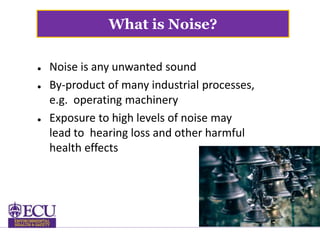
What is Noise?
 Noise is any unwanted sound
 By-product of many industrial processes,
e.g. operating machinery
 Exposure to high levels of noise may
lead to hearing loss and other harmful
health effects
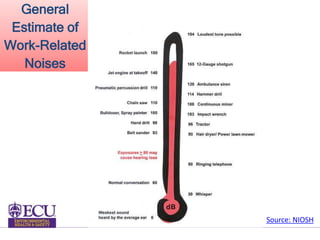
General
Estimate of
Work-Related
Noises
Source: NIOSH
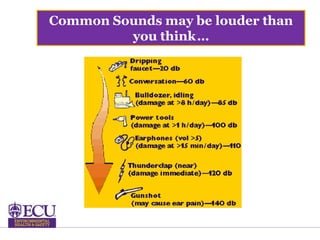
Common Sounds may be louder than
you think…
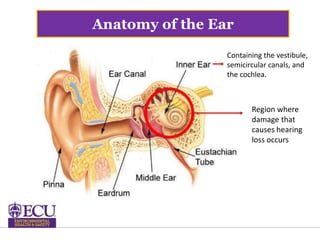
Anatomy of the Ear
Region where
damage that
causes hearing
loss occurs
Containing the vestibule,
semicircular canals, and
the cochlea.
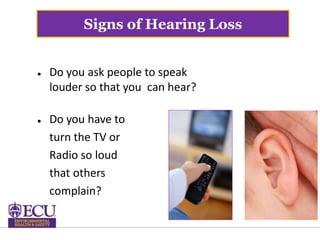
Signs of Hearing Loss
 Do you ask people to speak
louder so that you can hear?
 Do you have to
turn the TV or
Radio so loud
that others
complain?
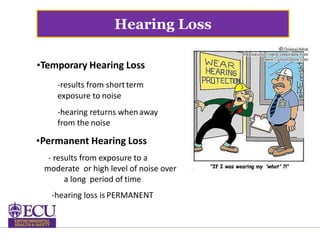
Hearing Loss
•Temporary Hearing Loss
-results from shortterm
exposure to noise
-hearing returns whenaway
from the noise
•Permanent Hearing Loss
- results from exposure to a
moderate or high level of noise over
a long period of time
-hearing loss is PERMANENT
Selection of Hearing Protection
Devices
• Hearing protection devices are selected according to:
– Employee comfort
– Level of noise exposure
– NRR of device
– Type of work being performed
– Environmental conditions
• Employee may select hearing protection from a variety ofsuitable
hearing protectors provided by employer.
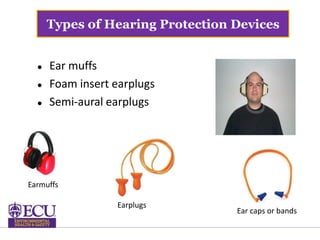
Types of Hearing Protection Devices
 Ear muffs
 Foam insert earplugs
 Semi-aural earplugs
Earmuffs
Earplugs
Ear caps or bands
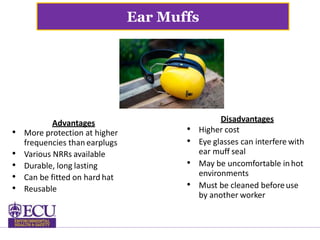
Ear Muffs
Advantages
• More protection at higher
frequencies than earplugs
• Various NRRs available
• Durable, long lasting
• Can be fitted on hard hat
• Reusable
Disadvantages
• Higher cost
• Eye glasses can interfere with
ear muff seal
• May be uncomfortable inhot
environments
• Must be cleaned beforeuse
by another worker
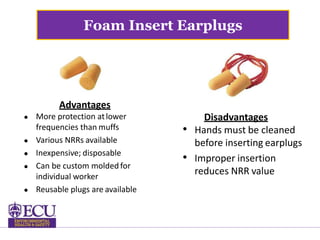
Foam Insert Earplugs
Advantages
 More protection atlower
frequencies than muffs
 Various NRRs available
 Inexpensive; disposable
 Can be custom molded for
individual worker
 Reusable plugs are available
Disadvantages
• Hands must be cleaned
before inserting earplugs
• Improper insertion
reduces NRR value
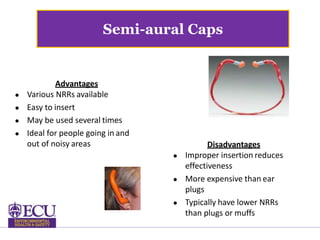
Semi-aural Caps
Advantages
 Various NRRs available
 Easy to insert
 May be used several times
 Ideal for people going in and
out of noisy areas Disadvantages
 Improper insertion reduces
effectiveness
 More expensive than ear
plugs
 Typically have lower NRRs
than plugs or muffs
Fit, Use and Care of Hearing
Protection Devices
 Employer must ensure proper initial fitting
 Employer must supervise the correct use of hearing
protectors
 Hearing protectors must be replaced as necessary at no
cost to employee, contact your supervisor
 Hearing protection devices must be cleaned and stored
according to the manufacturer’s specification
 For questions concerning selection of hearing protection
based on NRR and proper fit contact EH&S @ 328-6166
Audiometric Testing
 Monitors employee’s hearing over time
 Baseline audiogram must be performed within first 6
months of work exposure ( 8 hour TWA ≥ 85 dBA)
 Annual audiograms are required each year after
baseline audiogram
 Employer must pay for the cost of each required
audiogram
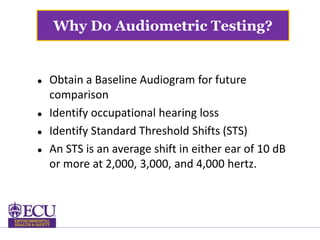
Why Do Audiometric Testing?
 Obtain a Baseline Audiogram for future
comparison
 Identify occupational hearing loss
 Identify Standard Threshold Shifts (STS)
 An STS is an average shift in either ear of 10 dB
or more at 2,000, 3,000, and 4,000 hertz.
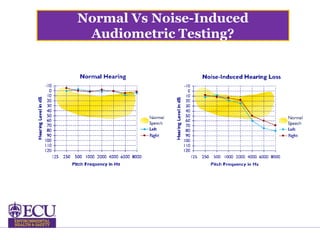
Normal Vs Noise-Induced
Audiometric Testing?
Access to Information and Training
Materials
 A copy of the OSHA 29 CFR1910.95 standard
available to affected employees online @
www.osha.gov
 OSHA Occupational noise exposure standard must be
posted in the workplace
 Employer is responsible for record keeping regarding
employee noise exposure measurements for 2 years.
However, the audiometric test records are kept for the
duration of employment of the employees who are in the
hearing conservation program.
211 South Jarvis Street, Suite 102, Greenville NC 27858
Online: www.ecu.edu/oehs
Email: safety@ecu.edu
Phone: (252) 328-6166
Questions
QUIZ
To receive credit for this training please complete the linked

Occupational Hearing-Conservation-Training

  • 1.
  • 2.
    Did You Know? About 30 million workers are exposed to hazardous noise on the job  Noise-induced hearing loss is the most common occupational hazard for American workers  Hearing loss from noise is slow and painless; you can have a disability before you notice it  If you must raise your voice to speak with someone only 3 feet away, you are in high (hazardous) noise.  It is 100% preventable Noise and Hearing Loss Prevention | NIOSH | CDC. Source
  • 3.
    What is Noise? Noise is any unwanted sound  By-product of many industrial processes, e.g. operating machinery  Exposure to high levels of noise may lead to hearing loss and other harmful health effects
  • 4.
  • 5.
    Common Sounds maybe louder than you think…
  • 6.
    Anatomy of theEar Region where damage that causes hearing loss occurs Containing the vestibule, semicircular canals, and the cochlea.
  • 7.
    Signs of HearingLoss  Do you ask people to speak louder so that you can hear?  Do you have to turn the TV or Radio so loud that others complain?
  • 8.
    Hearing Loss •Temporary HearingLoss -results from shortterm exposure to noise -hearing returns whenaway from the noise •Permanent Hearing Loss - results from exposure to a moderate or high level of noise over a long period of time -hearing loss is PERMANENT
  • 9.
    Selection of HearingProtection Devices • Hearing protection devices are selected according to: – Employee comfort – Level of noise exposure – NRR of device – Type of work being performed – Environmental conditions • Employee may select hearing protection from a variety ofsuitable hearing protectors provided by employer.
  • 10.
    Types of HearingProtection Devices  Ear muffs  Foam insert earplugs  Semi-aural earplugs Earmuffs Earplugs Ear caps or bands
  • 11.
    Ear Muffs Advantages • Moreprotection at higher frequencies than earplugs • Various NRRs available • Durable, long lasting • Can be fitted on hard hat • Reusable Disadvantages • Higher cost • Eye glasses can interfere with ear muff seal • May be uncomfortable inhot environments • Must be cleaned beforeuse by another worker
  • 12.
    Foam Insert Earplugs Advantages More protection atlower frequencies than muffs  Various NRRs available  Inexpensive; disposable  Can be custom molded for individual worker  Reusable plugs are available Disadvantages • Hands must be cleaned before inserting earplugs • Improper insertion reduces NRR value
  • 13.
    Semi-aural Caps Advantages  VariousNRRs available  Easy to insert  May be used several times  Ideal for people going in and out of noisy areas Disadvantages  Improper insertion reduces effectiveness  More expensive than ear plugs  Typically have lower NRRs than plugs or muffs
  • 14.
    Fit, Use andCare of Hearing Protection Devices  Employer must ensure proper initial fitting  Employer must supervise the correct use of hearing protectors  Hearing protectors must be replaced as necessary at no cost to employee, contact your supervisor  Hearing protection devices must be cleaned and stored according to the manufacturer’s specification  For questions concerning selection of hearing protection based on NRR and proper fit contact EH&S @ 328-6166
  • 15.
    Audiometric Testing  Monitorsemployee’s hearing over time  Baseline audiogram must be performed within first 6 months of work exposure ( 8 hour TWA ≥ 85 dBA)  Annual audiograms are required each year after baseline audiogram  Employer must pay for the cost of each required audiogram
  • 16.
    Why Do AudiometricTesting?  Obtain a Baseline Audiogram for future comparison  Identify occupational hearing loss  Identify Standard Threshold Shifts (STS)  An STS is an average shift in either ear of 10 dB or more at 2,000, 3,000, and 4,000 hertz.
  • 17.
  • 18.
    Access to Informationand Training Materials  A copy of the OSHA 29 CFR1910.95 standard available to affected employees online @ www.osha.gov  OSHA Occupational noise exposure standard must be posted in the workplace  Employer is responsible for record keeping regarding employee noise exposure measurements for 2 years. However, the audiometric test records are kept for the duration of employment of the employees who are in the hearing conservation program.
  • 20.
    211 South JarvisStreet, Suite 102, Greenville NC 27858 Online: www.ecu.edu/oehs Email: safety@ecu.edu Phone: (252) 328-6166 Questions QUIZ To receive credit for this training please complete the linked

Editor's Notes

  • #9 Employers must provide hearing protectors to all workers exposed to 8-hour TWA noise levels of 85 dB or above. This requirement ensures that employees have access to protectors before they experience any hearing loss. Employees must wear hearing protectors:For any period exceeding 6 months from the time they are first exposed to 8-hour TWA noise levels of 85 dB or above, until they receive their baseline audiograms if these tests are delayed due to mobile test van scheduling; If they have incurred standard threshold shifts that demonstrate they are susceptible to noise; and If they are exposed to noise over the permissible exposure limit of 90 dB over an 8-hour TWA.
  • #16 Employers must provide baseline audiograms within 6 months of an employee's first exposure at or above an 8-hour TWA of 85 dB.  It is important to test workers' hearing annually to identify deterioration in their hearing ability as early as possible. This is to ensure a quick followup measures before hearing loss progresses. Employers must compare annual audiograms to baseline audiograms to determine whether the audiogram is valid and whether the employee has lost hearing ability or experienced a standard threshold shift (STS). An STS is an average shift in either ear of 10 dB or more at 2,000, 3,000, and 4,000 hertz.