Dr. Sanjib Kumar Das, PhD
Noise
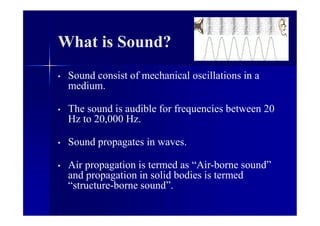
What is Sound?
• Sound consist of mechanical oscillations in a
medium.
• The sound is audible for frequencies between 20
Hz to 20,000 Hz.
• Sound propagates in waves.
• Air propagation is termed as “Air-borne sound”
and propagation in solid bodies is termed
“structure-borne sound”.
Sound Depends On:
 A vibrating source
to set up the sound
waves
 A medium to carry
the waves
 A receiver to
detect them
Which Would Be the Best
Conductor?
 Solid?
 Liquid?
 Gas?
 Solid – The
Bricks!
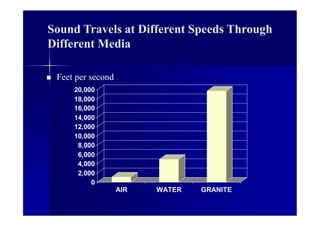
Sound Travels at Different Speeds Through
Different Media
0
2,000
4,000
6,000
8,000
10,000
12,000
14,000
16,000
18,000
20,000
AIR WATER GRANITE
 Feet per second
What is noise?
 Unwanted sound.
 When unwanted noise gets loud enough
– It is unpleasant
– It is distracting
– It is tiring & stressful
– Higher levels may cause permanent hearing
damage
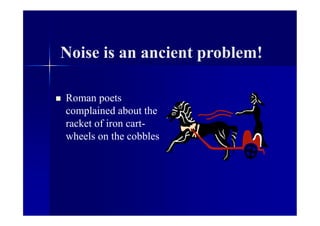
Noise is an ancient problem!
 Roman poets
complained about the
racket of iron cart-
wheels on the cobbles
Prologue…..
 In the UK there are
over 170,000 people
with significant
work-related hearing
damage
 14,200 are serious
enough affected to
receive disablement
benefit
NOISE STATISTICS
High Risk workers and Industries
- Highest Risk workers are (88% of all claims):
- Laborers
- Machine operators
- Transport workers
- High risk Industries:
- Manufacturing
- Construction
- Electricity, water supply
- Mining
- Transport
Effect of noise on Human
Damage can include:
 Temporary hearing loss
– hearing returns after a
short period away from
noise
 Permanent hearing loss
– Permanent damage or
destruction of hair cells in
the ears.
– Hearing cannot be
restored
Signs of developing hearing loss
 Inability to hear soft or high pitched
sounds
 Trouble understanding conversation at
a distance or in a crowd
 Ringing in the ears
 Others can hear something you can’t
DO YOU HAVE A NOISE PROBLEM?YOU DO IF:
1. You have to raise your voice when talking to someone about
one meter away
2.Workers say their hearing sounds are dull at the end of the
shift.
3. Workers experience ringing in their ears during or after work.
4. If any of these symptoms are present the noise will be around
85dB(A) or greater!! And risk assessment should be conducted.
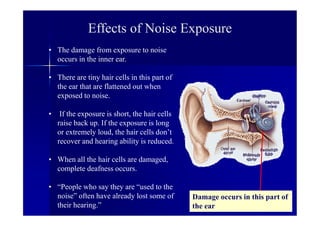
Effects of Noise Exposure
• The damage from exposure to noise
occurs in the inner ear.
• There are tiny hair cells in this part of
the ear that are flattened out when
exposed to noise.
• If the exposure is short, the hair cells
raise back up. If the exposure is long
or extremely loud, the hair cells don’t
recover and hearing ability is reduced.
• When all the hair cells are damaged,
complete deafness occurs.
• “People who say they are “used to the
noise” often have already lost some of
their hearing.”
Damage occurs in this part of
the ear
EFFECT OF LOUD NOISE ON HEARING
hair cells in the Cochlea
Healthy hair cells Serious Hearing loss
The cilia (
sensory hairs)
appear normal
Loss of cilia as
a result of
Noise
There is no cure for hearing damage!
 Normal hearing can
never be restored
 Hearing aids do not
restore noise-damaged
hearing
 At best, they help the
person a little
Exposure to noise may pose a variety of
health and safety risks to workers
Hearing loss:
Excessive noise damages the hair cells in the cochlea, part of the inner
ear, leading to loss of hearing. ‘In many countries, noise-induced hearing
loss is the most prevalent irreversible industrial disease.’ It is estimated
that the number of people in Europe with hearing difficulties is more
than the population of France.
Loud noise can cause:
Acoustic Trauma
-immediate damage from unprotected exposure to very intense or explosive
sounds (e.g. gunshot, explosion, nail guns)
Temporary Threshold Shift
may last hours or longer depending on the degree of noise exposure.
Permanent Threshold Shift
• Severe noise exposure is repeated over many years.
• Problems communicating.
• Reduced ability to hear high pitched sounds, eg. S, T, H,
K, F, C, consonants.
• Accused of ‘selective deafness’
Tinnitus
• Ringing in the ears
 Physiological effects:
There is evidence that exposure to noise has an effect on the
cardiovascular system resulting in the release of catecholamines and
an increase in blood pressure. Levels of catecholamines in blood
(including epinephrine (adrenaline)) are associated with stress.
 Work-related stress:
Work-related stress rarely has a single cause, and usually arises from
an interaction of several risk factors. Noise in the work environment
can be a stressor, even at quite low levels.
 Increased risk of accidents:
High noise levels make it difficult for staff to hear and
communicate, increasing the probability of accidents. Work-related
stress (in which noise may be a factor) can compound this problem.
Noise exposure and pregnancy
Recent review of the literature (American
Academy of Pediatrics, 1997) concludes that:
Exposure to noise during pregnancy may result in
high-frequency hearing loss and may be associated
with premature birth and foetal growth retardation.
OTHER HEALTH EFFECTS
These health effects may occur at exposures LESS than Standard -
includes:
Annoyance
-interferes with conversation, concentration,
-disturbs judgment
-increases anxiety
Task distraction
Clinical health effects
-raised blood pressure, increased heart rate, heart disease and stress
-reduced white blood cell counts
-reduced immune response
Non-Auditory Effects of Noise
 Job dissatisfaction
 Somatic complaints (e.g. headaches)
 Anxiety
 Post work irritability
– Impatience
– Nervousness
– Generally inability to unwind
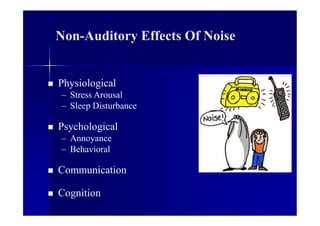
Non-Auditory Effects Of Noise
 Physiological
– Stress Arousal
– Sleep Disturbance
 Psychological
– Annoyance
– Behavioral
 Communication
 Cognition
Physiological Stress
 Noise is biological stressor
Activated at 65-70dBA
 What is it?
– Body’s reaction to any stressor requires an adjustment or
response
 The reaction to stress can be physical, mental or emotional
 Causes of stress can come from your body, your thoughts,
or the environment
 Whatever the cause of stress, real or imagined, the body’s
response is real
Physiological: Sleep Disturbance
 60dB(A) Awakening
 Sleep disturbance is influenced by
– Characteristics of the noise
– Individual differences
– Age
Psychological Annoyance
 Annoyance
– A response to noise rather than an auditory perception of
it
 Closing a window when noise outside is too loud
 Noise is more likely to be annoying if
– Random
– Higher pitched
– Combined with warmer climate
– Occurs at night
 Threshold of annoyance
– 50-55dB(A)
Psychological Annoyance
 Annoyance is subjective
– Noise is likely to be an annoyance if one
perceives:
 Not necessary
 People causing the noise do not care about its
effects on those exposed to it
 The noise is not important to the economic and
social success of the community
Cognition
 Functions most affected
– Reading comprehension
– Attention span
– Problem solving
– Memorization
– Job performance
Communication
 Above 55-60dB(A) background noise interferes
with communication
 Armor Crew Performance (Garinther & Peters,
1990)
– Mission time completion increased from 40-90 seconds
– Crew killed by enemy increased from 7% to 28%
– Targets correctly identified decreased from 98% to
68%
 The blast is the pressure above the ambient air
pressure.
 The biological effect of the blast wave depends
on the peak overpressure and the positive phase
duration.
 Peak levels above 190 dBP is the point where
there are concerns about blast injuries.
Blast Injuries
Noise
– The “auditory” component
– Target Organ(s): inner ear
– Outcome: temporary to permanent hearing loss
Blast Injuries
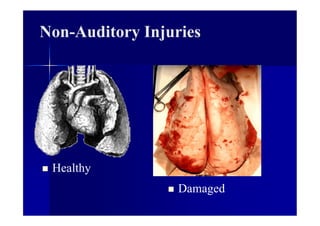
Blast Overpressure
– The “non-auditory” component
– Target Organ(s): gas-containing organs (lungs*,
trachea, GI tract)
– Outcome: performance problems, mild to severe
hemorrhage
Non-Auditory Injuries
 Healthy
 Damaged
Noise Effects
 Steady State Noise
– 120 dBA Discomfort
– 140 dBA Pain
– 160 dBA Ear drum rupture
 Impulse
– 185 dBP Ear drum rupture
– 200 dBP Lung rupture & embolism
Measurement of Noise
Sound Level Meter
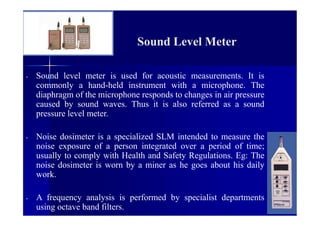
- Sound level meter is used for acoustic measurements. It is
commonly a hand-held instrument with a microphone. The
diaphragm of the microphone responds to changes in air pressure
caused by sound waves. Thus it is also referred as a sound
pressure level meter.
- Noise dosimeter is a specialized SLM intended to measure the
noise exposure of a person integrated over a period of time;
usually to comply with Health and Safety Regulations. Eg: The
noise dosimeter is worn by a miner as he goes about his daily
work.
- A frequency analysis is performed by specialist departments
using octave band filters.
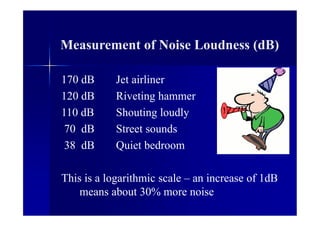
Measurement of Noise Loudness (dB)
170 dB Jet airliner
120 dB Riveting hammer
110 dB Shouting loudly
70 dB Street sounds
38 dB Quiet bedroom
This is a logarithmic scale – an increase of 1dB
means about 30% more noise
Speed of Propagation
This standard gives three differing response speeds of the
sound level meter depending on the characteristic of
noise:
“Slow”-
For steady state noises that change only slowly and for
sound power measurements. The test values are indicated
by dB (AS).
“Fast”-
For noises which change rapidly and which last for longer
than 200 ms. The test values are indicated by dB (AF).
“Impulse”-
For impulse-type and short-period noises (from 1 ms to 200
ms). The test values are indicated by db (AI)
US Standards:
OSHA (Occupational Safety and Health
Administration, US Department of Labor)
OCCUPATIONAL NOISE EXPOSURE STANDARD:
- Effective from 7 October 2004
- Exposure standard must not be interpreted as a “NO
EFFECT” level
the standard of 85 dB (A) is considered to be an
“acceptable risk" for the working population.
e.g.. Exposure of 85 dB (A) for 8-hours a day over a
40-year period, 85% of male population can expect to
have an average of 10% hearing loss.
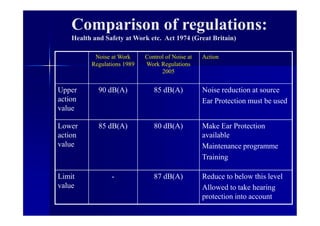
Comparison of regulations:
Health and Safety at Work etc. Act 1974 (Great Britain)
Noise at Work
Regulations 1989
Control of Noise at
Work Regulations
2005
Action
Upper
action
value
90 dB(A) 85 dB(A) Noise reduction at source
Ear Protection must be used
Lower
action
value
85 dB(A) 80 dB(A) Make Ear Protection
available
Maintenance programme
Training
Limit
value
- 87 dB(A) Reduce to below this level
Allowed to take hearing
protection into account
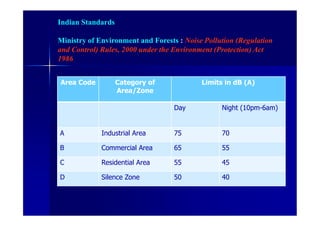
Indian Standards
Ministry of Environment and Forests : Noise Pollution (Regulation
and Control) Rules, 2000 under the Environment (Protection) Act
1986
Area Code Category of
Area/Zone
Limits in dB (A)
Day Night (10pm-6am)
A Industrial Area 75 70
B Commercial Area 65 55
C Residential Area 55 45
D Silence Zone 50 40
Daily Allowable Exposure Times to Noise
 The table below shows noise levels and how long a
person can be exposed without hearing protection before
there is damage to the ear.
 Noise Level Allowable Exposure Time
 85 decibels 8 hours
 90 decibels 4 hours
 100 decibels 1 hour
 105 decibels 30 minutes
 110 decibels 15 minutes
 115 decibels 0 minutes
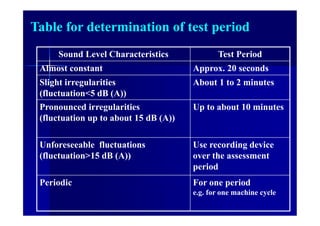
Table for determination of test period
Sound Level Characteristics Test Period
Almost constant Approx. 20 seconds
Slight irregularities
(fluctuation<5 dB (A))
About 1 to 2 minutes
Pronounced irregularities
(fluctuation up to about 15 dB (A))
Up to about 10 minutes
Unforeseeable fluctuations
(fluctuation>15 dB (A))
Use recording device
over the assessment
period
Periodic For one period
e.g. for one machine cycle
Measuring and averaging the
noise levels at the workplace
• Assessment of workplace noise and for comparisons with
established standards are required.
• Sound sources to be recorded with mentioning details of
location, time, test period, instruments and their settings.
• When taking measurements, the microphone shall be
setup in such a way that noise typical of the work place
in the vicinity of the employee's ear is picked up.
principles of noise
reduction
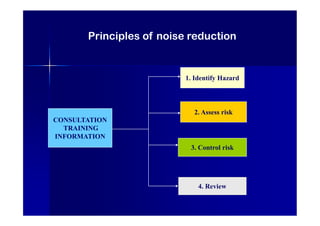
Principles of noise reduction
CONSULTATION
TRAINING
INFORMATION
1. Identify Hazard
2. Assess risk
3. Control risk
4. Review
ASSESS THE RISK
May involve noise measurements:
 Sound level meter
Noise dosimeters
• Worn by worker –records personal noise
exposure
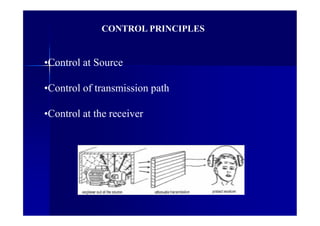
CONTROL PRINCIPLES
•Control at Source
•Control of transmission path
•Control at the receiver
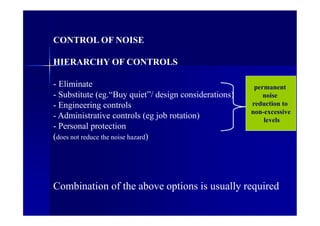
CONTROL OF NOISE
HIERARCHY OF CONTROLS
- Eliminate
- Substitute (eg.“Buy quiet”/ design considerations)
- Engineering controls
- Administrative controls (eg job rotation)
- Personal protection
(does not reduce the noise hazard)
Combination of the above options is usually required
permanent
noise
reduction to
non-excessive
levels
CONTROLAT SOURCE
Eliminate activity/process creating noise
Eliminate hard surface to hard surface contact
in processes (eg metal to concrete)
Substitute activity creating noise
Purchase quieter equipment
•Electric forklifts instead of diesel/gas
Change to quieter processes
•Screws instead of nailing
Change operating conditions
•Reduce air velocity on fans
 Maintenance
Maintenance
•Worn
•Loose
•Lubricate
Purchasing policy
•Quieter process
•Buy low noise machines
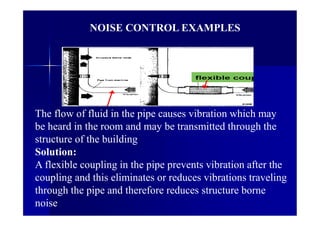
The flow of fluid in the pipe causes vibration which may
be heard in the room and may be transmitted through the
structure of the building
Solution:
A flexible coupling in the pipe prevents vibration after the
coupling and this eliminates or reduces vibrations traveling
through the pipe and therefore reduces structure borne
noise
NOISE CONTROL EXAMPLES
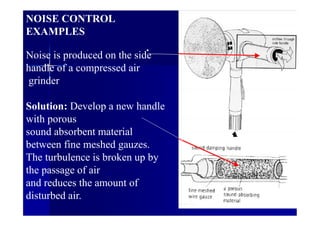
Noise is produced on the side
handle of a compressed air
grinder
Solution: Develop a new handle
with porous
sound absorbent material
between fine meshed gauzes.
The turbulence is broken up by
the passage of air
and reduces the amount of
disturbed air.
NOISE CONTROL
EXAMPLES
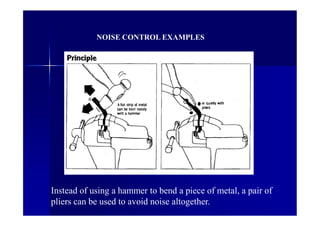
NOISE CONTROL EXAMPLES
Instead of using a hammer to bend a piece of metal, a pair of
pliers can be used to avoid noise altogether.
In terms of sound intensity the 4” angle grinder is 4 times
quieter than the 9” angle grinder!!
The 9” angle grinder 108dB(A) The 4” angle grinder,102dB(A)
NOISE CONTROL EXAMPLES
CONTROL TRANSMISSION OF NOISE
Isolate sound using anti-vibration mountings
Increase distance from source to receiver
(Note: if distance from source is doubled, SPL
decreases by 6 dB)
Use sound absorbing surfaces
Enclose sound sources
Enclose person in soundproof cabin
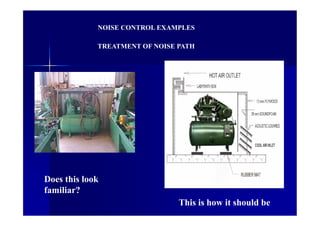
Does this look
familiar?
This is how it should be
NOISE CONTROL EXAMPLES
TREATMENT OF NOISE PATH
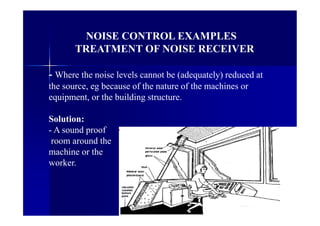
NOISE CONTROL EXAMPLES
TREATMENT OF NOISE RECEIVER
- Where the noise levels cannot be (adequately) reduced at
the source, eg because of the nature of the machines or
equipment, or the building structure.
Solution:
- A sound proof
room around the
machine or the
worker.
High frequency sound is transported
directly to the worker’s ears from a
high speed riveting machine hood
Solution:
A sound insulating hood is placed around
the machine with a small opening for work
pieces towards the bottom. Safety glass is
placed in the upper part of the hood side
facing the worker. The safety glass reflects
the sound back onto the sound absorbent
material of the hood.
NOISE CONTROL EXAMPLES
Engineering control
Methods
•Reduce impact and vibration
•Transmission and belt noise
•Silencing
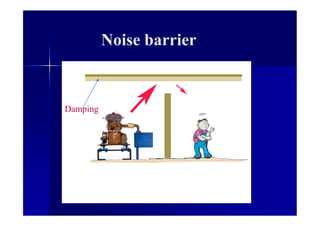
•Damping
•Partial enclosure
Anti-vibration mounts
Noise barrier
Noise barrier
Damping
Noise enclosure
Enclosure
•Mass
•Damping/absorption
ADMINITRATIVE CONTROL
- Areas or equipment where excessive noise
occurs must be signposted or marked at
Workplace
Hearing Protection-
The employer must provide hearing protection for all
employees that have an eight hour time weighted
exposure of 85 dBA or above, who have any
continuous exposure at or above 115 dBA, or who
have an exposure to any impulse noise levels above
140 dB.
ADMINISTRATIVE CONTROL
Employer’s Responsibility
What the WISHA Rules Require
Washington Industrial Safety and Health Act
 The WISHA* noise regulations require that we
have at least 2 types of hearing protection to
choose from.
 There are three types of hearing protection – ear
muffs, earplugs and ear caps.
 Ear muffs and earplugs provide about equal
protection, ear caps somewhat less.
CONTROL AT THE RECEIVER
Types of Hearing Protection
earmuffs
earplugs ear capsReference: Washington Industrial Safety and Health Act
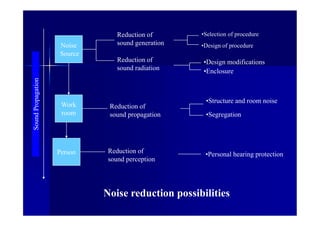
Noise
Source
Reduction of
sound generation
Reduction of
sound radiation
Work
room
Reduction of
sound propagation
Person Reduction of
sound perception
•Selection of procedure
•Design of procedure
•Design modifications
•Enclosure
•Structure and room noise
•Segregation
•Personal hearing protection
Noise reduction possibilities
SoundPropagation
Don’t take noise for granted!
Noise

Noise

  • 1.
    Dr. Sanjib KumarDas, PhD Noise
  • 2.
    What is Sound? •Sound consist of mechanical oscillations in a medium. • The sound is audible for frequencies between 20 Hz to 20,000 Hz. • Sound propagates in waves. • Air propagation is termed as “Air-borne sound” and propagation in solid bodies is termed “structure-borne sound”.
  • 3.
    Sound Depends On: A vibrating source to set up the sound waves  A medium to carry the waves  A receiver to detect them
  • 4.
    Which Would Bethe Best Conductor?  Solid?  Liquid?  Gas?  Solid – The Bricks!
  • 5.
    Sound Travels atDifferent Speeds Through Different Media 0 2,000 4,000 6,000 8,000 10,000 12,000 14,000 16,000 18,000 20,000 AIR WATER GRANITE  Feet per second
  • 6.
    What is noise? Unwanted sound.  When unwanted noise gets loud enough – It is unpleasant – It is distracting – It is tiring & stressful – Higher levels may cause permanent hearing damage
  • 7.
    Noise is anancient problem!  Roman poets complained about the racket of iron cart- wheels on the cobbles
  • 9.
    Prologue…..  In theUK there are over 170,000 people with significant work-related hearing damage  14,200 are serious enough affected to receive disablement benefit
  • 10.
    NOISE STATISTICS High Riskworkers and Industries - Highest Risk workers are (88% of all claims): - Laborers - Machine operators - Transport workers - High risk Industries: - Manufacturing - Construction - Electricity, water supply - Mining - Transport
  • 11.
  • 12.
    Damage can include: Temporary hearing loss – hearing returns after a short period away from noise  Permanent hearing loss – Permanent damage or destruction of hair cells in the ears. – Hearing cannot be restored
  • 13.
    Signs of developinghearing loss  Inability to hear soft or high pitched sounds  Trouble understanding conversation at a distance or in a crowd  Ringing in the ears  Others can hear something you can’t
  • 14.
    DO YOU HAVEA NOISE PROBLEM?YOU DO IF: 1. You have to raise your voice when talking to someone about one meter away 2.Workers say their hearing sounds are dull at the end of the shift. 3. Workers experience ringing in their ears during or after work. 4. If any of these symptoms are present the noise will be around 85dB(A) or greater!! And risk assessment should be conducted.
  • 15.
    Effects of NoiseExposure • The damage from exposure to noise occurs in the inner ear. • There are tiny hair cells in this part of the ear that are flattened out when exposed to noise. • If the exposure is short, the hair cells raise back up. If the exposure is long or extremely loud, the hair cells don’t recover and hearing ability is reduced. • When all the hair cells are damaged, complete deafness occurs. • “People who say they are “used to the noise” often have already lost some of their hearing.” Damage occurs in this part of the ear
  • 16.
    EFFECT OF LOUDNOISE ON HEARING hair cells in the Cochlea Healthy hair cells Serious Hearing loss The cilia ( sensory hairs) appear normal Loss of cilia as a result of Noise
  • 17.
    There is nocure for hearing damage!  Normal hearing can never be restored  Hearing aids do not restore noise-damaged hearing  At best, they help the person a little
  • 18.
    Exposure to noisemay pose a variety of health and safety risks to workers
  • 19.
    Hearing loss: Excessive noisedamages the hair cells in the cochlea, part of the inner ear, leading to loss of hearing. ‘In many countries, noise-induced hearing loss is the most prevalent irreversible industrial disease.’ It is estimated that the number of people in Europe with hearing difficulties is more than the population of France. Loud noise can cause: Acoustic Trauma -immediate damage from unprotected exposure to very intense or explosive sounds (e.g. gunshot, explosion, nail guns) Temporary Threshold Shift may last hours or longer depending on the degree of noise exposure.
  • 20.
    Permanent Threshold Shift •Severe noise exposure is repeated over many years. • Problems communicating. • Reduced ability to hear high pitched sounds, eg. S, T, H, K, F, C, consonants. • Accused of ‘selective deafness’ Tinnitus • Ringing in the ears
  • 21.
     Physiological effects: Thereis evidence that exposure to noise has an effect on the cardiovascular system resulting in the release of catecholamines and an increase in blood pressure. Levels of catecholamines in blood (including epinephrine (adrenaline)) are associated with stress.  Work-related stress: Work-related stress rarely has a single cause, and usually arises from an interaction of several risk factors. Noise in the work environment can be a stressor, even at quite low levels.  Increased risk of accidents: High noise levels make it difficult for staff to hear and communicate, increasing the probability of accidents. Work-related stress (in which noise may be a factor) can compound this problem.
  • 22.
    Noise exposure andpregnancy Recent review of the literature (American Academy of Pediatrics, 1997) concludes that: Exposure to noise during pregnancy may result in high-frequency hearing loss and may be associated with premature birth and foetal growth retardation.
  • 23.
    OTHER HEALTH EFFECTS Thesehealth effects may occur at exposures LESS than Standard - includes: Annoyance -interferes with conversation, concentration, -disturbs judgment -increases anxiety Task distraction Clinical health effects -raised blood pressure, increased heart rate, heart disease and stress -reduced white blood cell counts -reduced immune response
  • 24.
    Non-Auditory Effects ofNoise  Job dissatisfaction  Somatic complaints (e.g. headaches)  Anxiety  Post work irritability – Impatience – Nervousness – Generally inability to unwind
  • 25.
    Non-Auditory Effects OfNoise  Physiological – Stress Arousal – Sleep Disturbance  Psychological – Annoyance – Behavioral  Communication  Cognition
  • 26.
    Physiological Stress  Noiseis biological stressor Activated at 65-70dBA  What is it? – Body’s reaction to any stressor requires an adjustment or response  The reaction to stress can be physical, mental or emotional  Causes of stress can come from your body, your thoughts, or the environment  Whatever the cause of stress, real or imagined, the body’s response is real
  • 27.
    Physiological: Sleep Disturbance 60dB(A) Awakening  Sleep disturbance is influenced by – Characteristics of the noise – Individual differences – Age
  • 28.
    Psychological Annoyance  Annoyance –A response to noise rather than an auditory perception of it  Closing a window when noise outside is too loud  Noise is more likely to be annoying if – Random – Higher pitched – Combined with warmer climate – Occurs at night  Threshold of annoyance – 50-55dB(A)
  • 29.
    Psychological Annoyance  Annoyanceis subjective – Noise is likely to be an annoyance if one perceives:  Not necessary  People causing the noise do not care about its effects on those exposed to it  The noise is not important to the economic and social success of the community
  • 30.
    Cognition  Functions mostaffected – Reading comprehension – Attention span – Problem solving – Memorization – Job performance
  • 31.
    Communication  Above 55-60dB(A)background noise interferes with communication  Armor Crew Performance (Garinther & Peters, 1990) – Mission time completion increased from 40-90 seconds – Crew killed by enemy increased from 7% to 28% – Targets correctly identified decreased from 98% to 68%
  • 32.
     The blastis the pressure above the ambient air pressure.  The biological effect of the blast wave depends on the peak overpressure and the positive phase duration.  Peak levels above 190 dBP is the point where there are concerns about blast injuries. Blast Injuries
  • 33.
    Noise – The “auditory”component – Target Organ(s): inner ear – Outcome: temporary to permanent hearing loss Blast Injuries Blast Overpressure – The “non-auditory” component – Target Organ(s): gas-containing organs (lungs*, trachea, GI tract) – Outcome: performance problems, mild to severe hemorrhage
  • 34.
  • 35.
    Noise Effects  SteadyState Noise – 120 dBA Discomfort – 140 dBA Pain – 160 dBA Ear drum rupture  Impulse – 185 dBP Ear drum rupture – 200 dBP Lung rupture & embolism
  • 36.
  • 37.
    Sound Level Meter -Sound level meter is used for acoustic measurements. It is commonly a hand-held instrument with a microphone. The diaphragm of the microphone responds to changes in air pressure caused by sound waves. Thus it is also referred as a sound pressure level meter. - Noise dosimeter is a specialized SLM intended to measure the noise exposure of a person integrated over a period of time; usually to comply with Health and Safety Regulations. Eg: The noise dosimeter is worn by a miner as he goes about his daily work. - A frequency analysis is performed by specialist departments using octave band filters.
  • 38.
    Measurement of NoiseLoudness (dB) 170 dB Jet airliner 120 dB Riveting hammer 110 dB Shouting loudly 70 dB Street sounds 38 dB Quiet bedroom This is a logarithmic scale – an increase of 1dB means about 30% more noise
  • 39.
    Speed of Propagation Thisstandard gives three differing response speeds of the sound level meter depending on the characteristic of noise: “Slow”- For steady state noises that change only slowly and for sound power measurements. The test values are indicated by dB (AS). “Fast”- For noises which change rapidly and which last for longer than 200 ms. The test values are indicated by dB (AF). “Impulse”- For impulse-type and short-period noises (from 1 ms to 200 ms). The test values are indicated by db (AI)
  • 40.
    US Standards: OSHA (OccupationalSafety and Health Administration, US Department of Labor) OCCUPATIONAL NOISE EXPOSURE STANDARD: - Effective from 7 October 2004 - Exposure standard must not be interpreted as a “NO EFFECT” level the standard of 85 dB (A) is considered to be an “acceptable risk" for the working population. e.g.. Exposure of 85 dB (A) for 8-hours a day over a 40-year period, 85% of male population can expect to have an average of 10% hearing loss.
  • 41.
    Comparison of regulations: Healthand Safety at Work etc. Act 1974 (Great Britain) Noise at Work Regulations 1989 Control of Noise at Work Regulations 2005 Action Upper action value 90 dB(A) 85 dB(A) Noise reduction at source Ear Protection must be used Lower action value 85 dB(A) 80 dB(A) Make Ear Protection available Maintenance programme Training Limit value - 87 dB(A) Reduce to below this level Allowed to take hearing protection into account
  • 42.
    Indian Standards Ministry ofEnvironment and Forests : Noise Pollution (Regulation and Control) Rules, 2000 under the Environment (Protection) Act 1986 Area Code Category of Area/Zone Limits in dB (A) Day Night (10pm-6am) A Industrial Area 75 70 B Commercial Area 65 55 C Residential Area 55 45 D Silence Zone 50 40
  • 43.
    Daily Allowable ExposureTimes to Noise  The table below shows noise levels and how long a person can be exposed without hearing protection before there is damage to the ear.  Noise Level Allowable Exposure Time  85 decibels 8 hours  90 decibels 4 hours  100 decibels 1 hour  105 decibels 30 minutes  110 decibels 15 minutes  115 decibels 0 minutes
  • 44.
    Table for determinationof test period Sound Level Characteristics Test Period Almost constant Approx. 20 seconds Slight irregularities (fluctuation<5 dB (A)) About 1 to 2 minutes Pronounced irregularities (fluctuation up to about 15 dB (A)) Up to about 10 minutes Unforeseeable fluctuations (fluctuation>15 dB (A)) Use recording device over the assessment period Periodic For one period e.g. for one machine cycle
  • 45.
    Measuring and averagingthe noise levels at the workplace • Assessment of workplace noise and for comparisons with established standards are required. • Sound sources to be recorded with mentioning details of location, time, test period, instruments and their settings. • When taking measurements, the microphone shall be setup in such a way that noise typical of the work place in the vicinity of the employee's ear is picked up.
  • 46.
  • 47.
    Principles of noisereduction CONSULTATION TRAINING INFORMATION 1. Identify Hazard 2. Assess risk 3. Control risk 4. Review
  • 48.
    ASSESS THE RISK Mayinvolve noise measurements:  Sound level meter Noise dosimeters • Worn by worker –records personal noise exposure
  • 49.
    CONTROL PRINCIPLES •Control atSource •Control of transmission path •Control at the receiver
  • 50.
    CONTROL OF NOISE HIERARCHYOF CONTROLS - Eliminate - Substitute (eg.“Buy quiet”/ design considerations) - Engineering controls - Administrative controls (eg job rotation) - Personal protection (does not reduce the noise hazard) Combination of the above options is usually required permanent noise reduction to non-excessive levels
  • 51.
    CONTROLAT SOURCE Eliminate activity/processcreating noise Eliminate hard surface to hard surface contact in processes (eg metal to concrete) Substitute activity creating noise Purchase quieter equipment •Electric forklifts instead of diesel/gas Change to quieter processes •Screws instead of nailing Change operating conditions •Reduce air velocity on fans  Maintenance
  • 52.
  • 53.
    The flow offluid in the pipe causes vibration which may be heard in the room and may be transmitted through the structure of the building Solution: A flexible coupling in the pipe prevents vibration after the coupling and this eliminates or reduces vibrations traveling through the pipe and therefore reduces structure borne noise NOISE CONTROL EXAMPLES
  • 54.
    Noise is producedon the side handle of a compressed air grinder Solution: Develop a new handle with porous sound absorbent material between fine meshed gauzes. The turbulence is broken up by the passage of air and reduces the amount of disturbed air. NOISE CONTROL EXAMPLES
  • 55.
    NOISE CONTROL EXAMPLES Insteadof using a hammer to bend a piece of metal, a pair of pliers can be used to avoid noise altogether.
  • 56.
    In terms ofsound intensity the 4” angle grinder is 4 times quieter than the 9” angle grinder!! The 9” angle grinder 108dB(A) The 4” angle grinder,102dB(A) NOISE CONTROL EXAMPLES
  • 57.
    CONTROL TRANSMISSION OFNOISE Isolate sound using anti-vibration mountings Increase distance from source to receiver (Note: if distance from source is doubled, SPL decreases by 6 dB) Use sound absorbing surfaces Enclose sound sources Enclose person in soundproof cabin
  • 58.
    Does this look familiar? Thisis how it should be NOISE CONTROL EXAMPLES TREATMENT OF NOISE PATH
  • 59.
    NOISE CONTROL EXAMPLES TREATMENTOF NOISE RECEIVER - Where the noise levels cannot be (adequately) reduced at the source, eg because of the nature of the machines or equipment, or the building structure. Solution: - A sound proof room around the machine or the worker.
  • 60.
    High frequency soundis transported directly to the worker’s ears from a high speed riveting machine hood Solution: A sound insulating hood is placed around the machine with a small opening for work pieces towards the bottom. Safety glass is placed in the upper part of the hood side facing the worker. The safety glass reflects the sound back onto the sound absorbent material of the hood. NOISE CONTROL EXAMPLES
  • 61.
    Engineering control Methods •Reduce impactand vibration •Transmission and belt noise •Silencing •Damping •Partial enclosure Anti-vibration mounts
  • 62.
  • 63.
  • 64.
  • 65.
    ADMINITRATIVE CONTROL - Areasor equipment where excessive noise occurs must be signposted or marked at Workplace
  • 66.
    Hearing Protection- The employermust provide hearing protection for all employees that have an eight hour time weighted exposure of 85 dBA or above, who have any continuous exposure at or above 115 dBA, or who have an exposure to any impulse noise levels above 140 dB. ADMINISTRATIVE CONTROL Employer’s Responsibility What the WISHA Rules Require Washington Industrial Safety and Health Act
  • 67.
     The WISHA*noise regulations require that we have at least 2 types of hearing protection to choose from.  There are three types of hearing protection – ear muffs, earplugs and ear caps.  Ear muffs and earplugs provide about equal protection, ear caps somewhat less. CONTROL AT THE RECEIVER Types of Hearing Protection earmuffs earplugs ear capsReference: Washington Industrial Safety and Health Act
  • 68.
    Noise Source Reduction of sound generation Reductionof sound radiation Work room Reduction of sound propagation Person Reduction of sound perception •Selection of procedure •Design of procedure •Design modifications •Enclosure •Structure and room noise •Segregation •Personal hearing protection Noise reduction possibilities SoundPropagation
  • 69.
    Don’t take noisefor granted!