Nursing Management
 Every organization has predetermined goal of objectives which are
attained by with help of proper planning and execution of plans
economically. The plan are in the form of statements are called
budget.
 Budget expresses the plan of hospital in the health organization to
improve the optimum care at a reasonable cost in the financial
terms.
 The process of budgeting has been gained importance in recent
years because of rising health cost and emphasis on cost
containment.
 Health economy has gained a lot to do in the management of health
care agencies and in provision of effective and economical health
care to individual, families and community and court as a whole.
 It is responsibility of every country to look in to the source of
income over expenditure on various aspects of health which include
education, infrastructure and organization of health care services.
 Budget word first coined by the British Kings in early days
from the word ‘BOUGETTE’ which means lather bag or
pouch that held the seal of medieval court Exchequer
(Former Government Department Incharge of National
Revenue.)
 Centuries later the statements come to be popularly known
as ‘BUDGET’.
 Now the term “budget” refers to financial papers. Budget
is numerical description of expected income and planned
expenditure for an organization for special period of time.
 It is concrete, precise, picture of the total operation of an
enterprise/ organization/ institution in monetary term.
 Budgeting is the heart of administrative
management, serves positively as a powerful tool
of coordination and negatively, an effective
device to eliminating duplication and wastage.
 DEFINITION: Budgeting is an operational plan,
for a definite period usually a year. Expressed in
financial terms and based on the expected income
and expenditure.
 Budgeting is a concrete precise picture of the
total operation of an enterprise in monetary
terms. By: H.M. Donovan
 MAIN PURPOSE:
To ensure the most effective use of scarce financial and non-
financial resources.
 SPECIFIC PURPOSES:
It provides detailed plan to reduce uncertainty.
It controls expenses by efficient and economical manner.
It provides mechanism for measurement of work effort on
timely basis.
Enhance budget planning.
Coordinates effort among organizational department.
Establish the frame of reference for management decision.
Provides criterion for evaluating managerial performance.
Offers useful format for communication.
It aids in planning and controlling.
It guides for action and future needs.
It serves as instrument for economic and social policies.
It conserves the resources by regulation.
 ORGANIZATIONAL STRUCTURE: Need a sound organizational
structure with clear line of authority and responsibility.
 NON-MONETARY STATISTICAL DATA: Such as number of
admissions, average length of stay, percentage of occupancy and number
of patient’s days. Used for planning and budgetary process.
 CHARTS OF ACCOUNTS: Designed to be consistent with the
organizational plans. Revenues and expenses are reported by
responsibilities areas, thus providing historical data that are valuable for
planning and providing budgetary control for evaluation as performance
can be compared to plans.
 MANAGERIAL SUPPORT: Essential for the budgetary programme.
Budgeting is done at the departmental level, it must be valued by top
administration. Managers must be willing to devote their time and energy
to the budgeting process.
 FORMAL BUDGETING PROCESS AND PROCEDURES: Should
be available in budget manual, in which objectives are clarified and
instructions for budget development are discussed. Calendar of budgeting
activities with the schedule for each stage of programme is presented.
 Should be flexible.
 Should be synthesis of past, present and future.
 Should be product of joint venture and cooperation of
executive/department head at different level of management.
 Should be in the form of statistical standard laid down in the
specific numerical terms.
 Should have support of top management throughout the period of
its planning and implementation.
IMPORTANCE OF BUDGETING:
Needed for planning future course of action and control over all
activities in the organization.
Facilitates coordinating operation of various departments and
sectors.
Helps to weigh values and make decision when necessary.
 Should provide sound financial management by focusing on requirement of the
organization.
 Should focus on the objectives and policies of the organization.
 Should ensure the most effective use of financial and non financial resources.
 Programme activities should be planned in advance.
 Requires consistent delegation for framing and executive budget.
 Should include coordinating efforts of various departments establishing a frame of
reference for managerial decision and evaluate managerial performance.
 Requires an adequate checks and balance against adoption of too high and too low
estimates.
 Must be appropriate to nature of business, services and to the type of budget.
 Prepared under the direction and supervision of administrator or financial officer.
 To be prepared and interpreted throughout the organization.
 Requires review of performance of previous year and adequacy both quantitatively
and qualitatively.
 Provision should be made for flexibility.
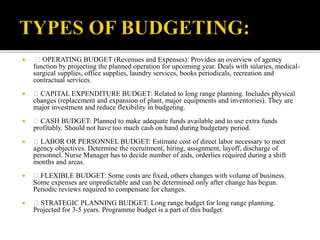
 OPERATING BUDGET (Revenues and Expenses): Provides an overview of agency
function by projecting the planned operation for upcoming year. Deals with salaries, medical-
surgical supplies, office supplies, laundry services, books periodicals, recreation and
contractual services.
 CAPITAL EXPENDITURE BUDGET: Related to long range planning. Includes physical
changes (replacement and expansion of plant, major equipments and inventories). They are
major investment and reduce flexibility in budgeting.
 CASH BUDGET: Planned to make adequate funds available and to use extra funds
profitably. Should not have too much cash on hand during budgetary period.
 LABOR OR PERSONNEL BUDGET: Estimate cost of direct labor necessary to meet
agency objectives. Determine the recruitment, hiring, assignment, layoff, discharge of
personnel. Nurse Manager has to decide number of aids, orderlies required during a shift
months and areas.
 FLEXIBLE BUDGET: Some costs are fixed, others changes with volume of business.
Some expenses are unpredictable and can be determined only after change has begun.
Periodic reviews required to compensate for changes.
 STRATEGIC PLANNING BUDGET: Long range budget for long range planning.
Projected for 3-5 years. Programme budget is a part of this budget.
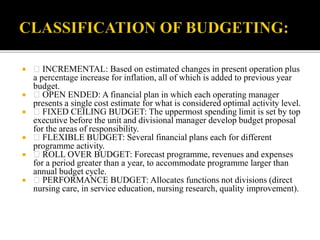
 INCREMENTAL: Based on estimated changes in present operation plus
a percentage increase for inflation, all of which is added to previous year
budget.
 OPEN ENDED: A financial plan in which each operating manager
presents a single cost estimate for what is considered optimal activity level.
 FIXED CEILING BUDGET: The uppermost spending limit is set by top
executive before the unit and divisional manager develop budget proposal
for the areas of responsibility.
 FLEXIBLE BUDGET: Several financial plans each for different
programme activity.
 ROLL OVER BUDGET: Forecast programme, revenues and expenses
for a period greater than a year, to accommodate programme larger than
annual budget cycle.
 PERFORMANCE BUDGET: Allocates functions not divisions (direct
nursing care, in service education, nursing research, quality improvement).
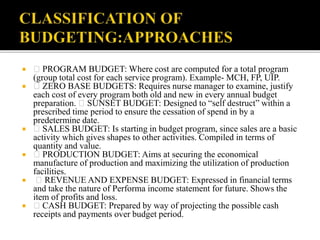
 PROGRAM BUDGET: Where cost are computed for a total program
(group total cost for each service program). Example- MCH, FP, UIP.
 ZERO BASE BUDGETS: Requires nurse manager to examine, justify
each cost of every program both old and new in every annual budget
preparation. SUNSET BUDGET: Designed to “self destruct” within a
prescribed time period to ensure the cessation of spend in by a
predetermine date.
 SALES BUDGET: Is starting in budget program, since sales are a basic
activity which gives shapes to other activities. Compiled in terms of
quantity and value.
 PRODUCTION BUDGET: Aims at securing the economical
manufacture of production and maximizing the utilization of production
facilities.
 REVENUE AND EXPENSE BUDGET: Expressed in financial terms
and take the nature of Performa income statement for future. Shows the
item of profits and loss.
 CASH BUDGET: Prepared by way of projecting the possible cash
receipts and payments over budget period.
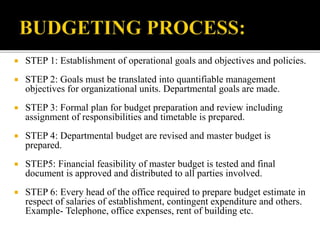
 STEP 1: Establishment of operational goals and objectives and policies.
 STEP 2: Goals must be translated into quantifiable management
objectives for organizational units. Departmental goals are made.
 STEP 3: Formal plan for budget preparation and review including
assignment of responsibilities and timetable is prepared.
 STEP 4: Departmental budget are revised and master budget is
prepared.
 STEP5: Financial feasibility of master budget is tested and final
document is approved and distributed to all parties involved.
 STEP 6: Every head of the office required to prepare budget estimate in
respect of salaries of establishment, contingent expenditure and others.
Example- Telephone, office expenses, rent of building etc.
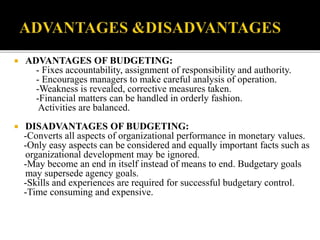
 ADVANTAGES OF BUDGETING:
- Fixes accountability, assignment of responsibility and authority.
- Encourages managers to make careful analysis of operation.
-Weakness is revealed, corrective measures taken.
-Financial matters can be handled in orderly fashion.
Activities are balanced.
 DISADVANTAGES OF BUDGETING:
-Converts all aspects of organizational performance in monetary values.
-Only easy aspects can be considered and equally important facts such as
organizational development may be ignored.
-May become an end in itself instead of means to end. Budgetary goals
may supersede agency goals.
-Skills and experiences are required for successful budgetary control.
-Time consuming and expensive.
COST BENEFIT ANALYSIS
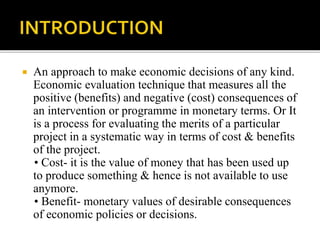
 An approach to make economic decisions of any kind.
Economic evaluation technique that measures all the
positive (benefits) and negative (cost) consequences of
an intervention or programme in monetary terms. Or It
is a process for evaluating the merits of a particular
project in a systematic way in terms of cost & benefits
of the project.
• Cost- it is the value of money that has been used up
to produce something & hence is not available to use
anymore.
• Benefit- monetary values of desirable consequences
of economic policies or decisions.
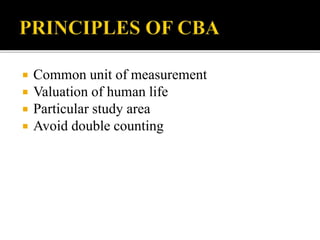
 Common unit of measurement
 Valuation of human life
 Particular study area
 Avoid double counting
COST
Cost of healthcare services is estimated. e.g
supplies, expenditure, materials & their
maintenance
BENEFIT
Can not be expressed in monetary terms. eg
morbidity, mortality
AUDIT
 Systematic & critical examination to examine
& verify.
 PURPOSES
 Critical review
Determine effectiveness
Accuracy & adequacy
Extent of compliance
Identification of unauthorized & unsound
transactions
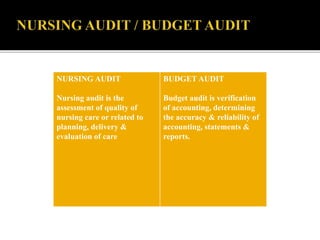
NURSING AUDIT
Nursing audit is the
assessment of quality of
nursing care or related to
planning, delivery &
evaluation of care
BUDGET AUDIT
Budget audit is verification
of accounting, determining
the accuracy & reliability of
accounting, statements &
reports.
 COST AUDIT- To verify the accuracy of accounts in
accordance with established norms.
 TAX AUDIT- Compulsory audit of accounts under income tax
act, 1961.
 BALANCE SHEET AUDIT- Verification of details in balance
sheet for ascertaining profit.
 SPECIAL AUDIT-Can be done by central govt. at any time
under company's act , 1956
 FINANCIAL AUDIT- Independent examination of vouchers
& account book.
STATUTORY AUDIT COST AUDIT- To verify the accuracy of counts in accordance with established norms. TAX AUDIT- Compulsory audit of accounts under income tax act, 1961.
BALANCE SHEET AUDIT- Verification of details in balance sheet for ascertaining profit. SPECIAL AUDIT-Can be done by central govt. at any time under company's act , 1956
FINANCIAL AUDIT- Independent examination of vouchers & account book.
the accuracy of accounts in accordance with established norms. TAX AUDIT- Compulsory audit of accounts under income tax act, 1961. BALANCE SHEET AUDIT- Verification of details in
balance sheet for ascertaining profit. SPECIAL AUDIT-Can be done by central govt. at any time under company's act , 1956 FINANCIAL AUDIT- Independent examination of vouchers
& account book.
 Planning
 Communicate results
 Conduct the audit
 Audit follow up
 VOUCHING- inspection for authorization,
recording & entry book. CHECKING &
TICKING- with colored pencils, pens or
rubber stamps.
 TEST CHECKING- random sample checking
 AUDIT NOTES- careful & precise note of
discoveries in audit
 QUESTIONNAIRES- about important
elements of cost, asked to managers.,
 Basavanthapa BT, Nursing Administration,
Jaypee Brothers Publications; 2nd edition;
2009; page number- 306-317.
 www.unsouthal.edu/osp/documents/sample
research budg.doc.
 www.doculink.org/downloads/doc sample.

Budgeting.pptx

  • 1.
  • 2.
     Every organizationhas predetermined goal of objectives which are attained by with help of proper planning and execution of plans economically. The plan are in the form of statements are called budget.  Budget expresses the plan of hospital in the health organization to improve the optimum care at a reasonable cost in the financial terms.  The process of budgeting has been gained importance in recent years because of rising health cost and emphasis on cost containment.  Health economy has gained a lot to do in the management of health care agencies and in provision of effective and economical health care to individual, families and community and court as a whole.  It is responsibility of every country to look in to the source of income over expenditure on various aspects of health which include education, infrastructure and organization of health care services.
  • 3.
     Budget wordfirst coined by the British Kings in early days from the word ‘BOUGETTE’ which means lather bag or pouch that held the seal of medieval court Exchequer (Former Government Department Incharge of National Revenue.)  Centuries later the statements come to be popularly known as ‘BUDGET’.  Now the term “budget” refers to financial papers. Budget is numerical description of expected income and planned expenditure for an organization for special period of time.  It is concrete, precise, picture of the total operation of an enterprise/ organization/ institution in monetary term.
  • 4.
     Budgeting isthe heart of administrative management, serves positively as a powerful tool of coordination and negatively, an effective device to eliminating duplication and wastage.  DEFINITION: Budgeting is an operational plan, for a definite period usually a year. Expressed in financial terms and based on the expected income and expenditure.  Budgeting is a concrete precise picture of the total operation of an enterprise in monetary terms. By: H.M. Donovan
  • 5.
     MAIN PURPOSE: Toensure the most effective use of scarce financial and non- financial resources.  SPECIFIC PURPOSES: It provides detailed plan to reduce uncertainty. It controls expenses by efficient and economical manner. It provides mechanism for measurement of work effort on timely basis. Enhance budget planning. Coordinates effort among organizational department. Establish the frame of reference for management decision. Provides criterion for evaluating managerial performance. Offers useful format for communication. It aids in planning and controlling. It guides for action and future needs. It serves as instrument for economic and social policies. It conserves the resources by regulation.
  • 6.
     ORGANIZATIONAL STRUCTURE:Need a sound organizational structure with clear line of authority and responsibility.  NON-MONETARY STATISTICAL DATA: Such as number of admissions, average length of stay, percentage of occupancy and number of patient’s days. Used for planning and budgetary process.  CHARTS OF ACCOUNTS: Designed to be consistent with the organizational plans. Revenues and expenses are reported by responsibilities areas, thus providing historical data that are valuable for planning and providing budgetary control for evaluation as performance can be compared to plans.  MANAGERIAL SUPPORT: Essential for the budgetary programme. Budgeting is done at the departmental level, it must be valued by top administration. Managers must be willing to devote their time and energy to the budgeting process.  FORMAL BUDGETING PROCESS AND PROCEDURES: Should be available in budget manual, in which objectives are clarified and instructions for budget development are discussed. Calendar of budgeting activities with the schedule for each stage of programme is presented.
  • 7.
     Should beflexible.  Should be synthesis of past, present and future.  Should be product of joint venture and cooperation of executive/department head at different level of management.  Should be in the form of statistical standard laid down in the specific numerical terms.  Should have support of top management throughout the period of its planning and implementation. IMPORTANCE OF BUDGETING: Needed for planning future course of action and control over all activities in the organization. Facilitates coordinating operation of various departments and sectors. Helps to weigh values and make decision when necessary.
  • 8.
     Should providesound financial management by focusing on requirement of the organization.  Should focus on the objectives and policies of the organization.  Should ensure the most effective use of financial and non financial resources.  Programme activities should be planned in advance.  Requires consistent delegation for framing and executive budget.  Should include coordinating efforts of various departments establishing a frame of reference for managerial decision and evaluate managerial performance.  Requires an adequate checks and balance against adoption of too high and too low estimates.  Must be appropriate to nature of business, services and to the type of budget.  Prepared under the direction and supervision of administrator or financial officer.  To be prepared and interpreted throughout the organization.  Requires review of performance of previous year and adequacy both quantitatively and qualitatively.  Provision should be made for flexibility.
  • 9.
     OPERATING BUDGET(Revenues and Expenses): Provides an overview of agency function by projecting the planned operation for upcoming year. Deals with salaries, medical- surgical supplies, office supplies, laundry services, books periodicals, recreation and contractual services.  CAPITAL EXPENDITURE BUDGET: Related to long range planning. Includes physical changes (replacement and expansion of plant, major equipments and inventories). They are major investment and reduce flexibility in budgeting.  CASH BUDGET: Planned to make adequate funds available and to use extra funds profitably. Should not have too much cash on hand during budgetary period.  LABOR OR PERSONNEL BUDGET: Estimate cost of direct labor necessary to meet agency objectives. Determine the recruitment, hiring, assignment, layoff, discharge of personnel. Nurse Manager has to decide number of aids, orderlies required during a shift months and areas.  FLEXIBLE BUDGET: Some costs are fixed, others changes with volume of business. Some expenses are unpredictable and can be determined only after change has begun. Periodic reviews required to compensate for changes.  STRATEGIC PLANNING BUDGET: Long range budget for long range planning. Projected for 3-5 years. Programme budget is a part of this budget.
  • 10.
     INCREMENTAL: Basedon estimated changes in present operation plus a percentage increase for inflation, all of which is added to previous year budget.  OPEN ENDED: A financial plan in which each operating manager presents a single cost estimate for what is considered optimal activity level.  FIXED CEILING BUDGET: The uppermost spending limit is set by top executive before the unit and divisional manager develop budget proposal for the areas of responsibility.  FLEXIBLE BUDGET: Several financial plans each for different programme activity.  ROLL OVER BUDGET: Forecast programme, revenues and expenses for a period greater than a year, to accommodate programme larger than annual budget cycle.  PERFORMANCE BUDGET: Allocates functions not divisions (direct nursing care, in service education, nursing research, quality improvement).
  • 11.
     PROGRAM BUDGET:Where cost are computed for a total program (group total cost for each service program). Example- MCH, FP, UIP.  ZERO BASE BUDGETS: Requires nurse manager to examine, justify each cost of every program both old and new in every annual budget preparation. SUNSET BUDGET: Designed to “self destruct” within a prescribed time period to ensure the cessation of spend in by a predetermine date.  SALES BUDGET: Is starting in budget program, since sales are a basic activity which gives shapes to other activities. Compiled in terms of quantity and value.  PRODUCTION BUDGET: Aims at securing the economical manufacture of production and maximizing the utilization of production facilities.  REVENUE AND EXPENSE BUDGET: Expressed in financial terms and take the nature of Performa income statement for future. Shows the item of profits and loss.  CASH BUDGET: Prepared by way of projecting the possible cash receipts and payments over budget period.
  • 12.
     STEP 1:Establishment of operational goals and objectives and policies.  STEP 2: Goals must be translated into quantifiable management objectives for organizational units. Departmental goals are made.  STEP 3: Formal plan for budget preparation and review including assignment of responsibilities and timetable is prepared.  STEP 4: Departmental budget are revised and master budget is prepared.  STEP5: Financial feasibility of master budget is tested and final document is approved and distributed to all parties involved.  STEP 6: Every head of the office required to prepare budget estimate in respect of salaries of establishment, contingent expenditure and others. Example- Telephone, office expenses, rent of building etc.
  • 13.
     ADVANTAGES OFBUDGETING: - Fixes accountability, assignment of responsibility and authority. - Encourages managers to make careful analysis of operation. -Weakness is revealed, corrective measures taken. -Financial matters can be handled in orderly fashion. Activities are balanced.  DISADVANTAGES OF BUDGETING: -Converts all aspects of organizational performance in monetary values. -Only easy aspects can be considered and equally important facts such as organizational development may be ignored. -May become an end in itself instead of means to end. Budgetary goals may supersede agency goals. -Skills and experiences are required for successful budgetary control. -Time consuming and expensive.
  • 14.
  • 15.
     An approachto make economic decisions of any kind. Economic evaluation technique that measures all the positive (benefits) and negative (cost) consequences of an intervention or programme in monetary terms. Or It is a process for evaluating the merits of a particular project in a systematic way in terms of cost & benefits of the project. • Cost- it is the value of money that has been used up to produce something & hence is not available to use anymore. • Benefit- monetary values of desirable consequences of economic policies or decisions.
  • 16.
     Common unitof measurement  Valuation of human life  Particular study area  Avoid double counting
  • 17.
    COST Cost of healthcareservices is estimated. e.g supplies, expenditure, materials & their maintenance BENEFIT Can not be expressed in monetary terms. eg morbidity, mortality
  • 18.
  • 19.
     Systematic &critical examination to examine & verify.  PURPOSES  Critical review Determine effectiveness Accuracy & adequacy Extent of compliance Identification of unauthorized & unsound transactions
  • 20.
    NURSING AUDIT Nursing auditis the assessment of quality of nursing care or related to planning, delivery & evaluation of care BUDGET AUDIT Budget audit is verification of accounting, determining the accuracy & reliability of accounting, statements & reports.
  • 21.
     COST AUDIT-To verify the accuracy of accounts in accordance with established norms.  TAX AUDIT- Compulsory audit of accounts under income tax act, 1961.  BALANCE SHEET AUDIT- Verification of details in balance sheet for ascertaining profit.  SPECIAL AUDIT-Can be done by central govt. at any time under company's act , 1956  FINANCIAL AUDIT- Independent examination of vouchers & account book. STATUTORY AUDIT COST AUDIT- To verify the accuracy of counts in accordance with established norms. TAX AUDIT- Compulsory audit of accounts under income tax act, 1961. BALANCE SHEET AUDIT- Verification of details in balance sheet for ascertaining profit. SPECIAL AUDIT-Can be done by central govt. at any time under company's act , 1956 FINANCIAL AUDIT- Independent examination of vouchers & account book. the accuracy of accounts in accordance with established norms. TAX AUDIT- Compulsory audit of accounts under income tax act, 1961. BALANCE SHEET AUDIT- Verification of details in balance sheet for ascertaining profit. SPECIAL AUDIT-Can be done by central govt. at any time under company's act , 1956 FINANCIAL AUDIT- Independent examination of vouchers & account book.
  • 22.
     Planning  Communicateresults  Conduct the audit  Audit follow up
  • 23.
     VOUCHING- inspectionfor authorization, recording & entry book. CHECKING & TICKING- with colored pencils, pens or rubber stamps.  TEST CHECKING- random sample checking  AUDIT NOTES- careful & precise note of discoveries in audit  QUESTIONNAIRES- about important elements of cost, asked to managers.,
  • 24.
     Basavanthapa BT,Nursing Administration, Jaypee Brothers Publications; 2nd edition; 2009; page number- 306-317.  www.unsouthal.edu/osp/documents/sample research budg.doc.  www.doculink.org/downloads/doc sample.