FISCAL
PLANNING
PRESENTED BY :
VRUTI PATEL,
FINAL YEAR M.Sc.,
SNC.
FINANCIAL, FISCAL AND
MONETARY
• Financial : relating to finance, which is the
commercial activity of providing funds and capital,
or to put it the other way, the ways in which
individuals and organizations raise money.
• Fiscal : relating to financial matters, especially
government tax revenues and government
expenditure and debt.
• Monetary : relating to the money supply: the
amount of money in circulation, its rate of growth
and interest rates.
FINANCIAL
MANAGEMENT/ADMNISTRATIO
N
Financial Management means planning,
organizing, directing and controlling the financial
activities such as procurement and utilization of
funds of the enterprise. It means applying general
management principles to financial resources of
the enterprise.
Financial administration consists of all
those operations, the object of which is to
make funds/money available for the
organizational activities and to ensure the
lawful and efficient use of these funds in
order to achieve the organizational goals
and objectives.
DEFINITION
Financial management is chiefly
concerned with maximizing the wealth of
owners through wise and rational investment
of funds. It involves the application of general
management principles to a particular
financial operation.
- Harward and Upton
Financial management is concerned with
raising the financial resources and their
utilization towards achieving the organizational
goals.
- SN Maheshwary
It is the process of putting the available funds
to the best advantage from the long term point
of view of business objectives.
- Richard A Brealey
OBJECTIVES OF FISCAL
PLANNING
To determine capital requirements
 depend upon factors like cost of current and fixed
assets, promotional expenses and long range
planning.
 looked with both aspects: short-term and long-term
requirements.
To determine capital structure
 composition of capital, i.e. the relative kind and
proportion of capital required in the business. This
includes decisions of debt-equity ratio both short-
term and long-term..
To frame financial policies
• In fiscal planning the policies are framed with
regards to cash control, lending, borrowings, etc.
To utilize financial resources adequately
• This is to ensure that the scarce financial
resources are maximally utilized in the best
possible manner at least cost in order to get
maximum returns on investment.
IMPORTANCE OF FISCAL
PLANNING
 Ensures provision of adequate funds to meet day to
day requirements of the organization as well as its
future expansion.
 Ensures timely availability of funds.
 Provides policies, procedures and plans.
 Helps in ensuring a reasonable balance between
outflow and inflow of funds so that stability is
maintained.
 Ensures that the suppliers of funds are easily
investing in organization which exercise financial
planning
 Helps in making growth and expansion
programmes.
 Reduces uncertainties with regards to changing
trends which can be faced easily through enough
funds.
 Helps in ensuring stability and profitability in
concern.
 Provides sound financial control and thus seeks to
eliminate waste of funds.
 Guides for proper and fuller utilization of available
resources.
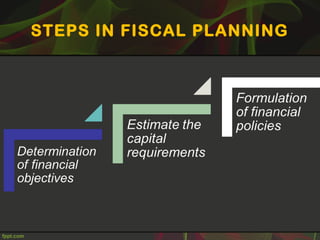
STEPS IN FISCAL PLANNING
FACTORS AFFECTING
FINANCIAL PLANNING
• Objectives:
Should be made in light of organizational
objectives
• Requirements of organization:
The financial plan should be based on the
present and future requirements of the
organization.
•
• Economy:
The capital structure should be such that there
should be a balance between the cost of the funds
and services to be determined.
• Flexibility:
Financial planning should be such that it ensures
flexibility to utilize the funds into more profitable
manner.
BUDGET
DEFINITIONS
A budget is a tool for planning, quantifying the plans
and controlling costs.
- Flinker, 1984
A budget is a plan that uses numerical data to
predict the activities of an organization over a
period of time and it provides a mechanism for
planning each unit’s needs and contributions.
- carruth, carruth & Noto, 2000
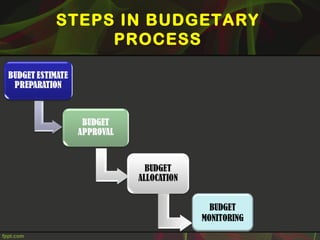
STEPS IN BUDGETARY
PROCESS
BUDGET
MONITORING
BUDGET ESTIMATE
• Financial planning responsibilities need to be
identified before budget preparation begins.
• The governing board, administrator, budget
director, steering committee, and department
heads are often involved in the budgetary
process.
 The governing body is responsible for the
general planning function. It selects the budget
steering committee, determines the budgetary
objectives, and reviews and approves the
master budget.
 The administrator is responsible for the formulation
and execution of the budget, by correlating the
governing board’s goals with the guidelines for
budget preparation and supervising the budget
preparation.
 The budget director is responsible for the budgeting
procedures and reporting. He or she establishes a
completion timetable, has forms prepared, and
supervises data collection and budget preparation.
The budget director serves as the chairperson of the
steering committee, which approves the budget
before it is submitted to the governing board.
 Department heads prepare and review goals
and objectives and prepare the budgets for their
departments. Departmental budgets need to be
prepared and coordinated. During this phase,
units of service, staffing patterns, salary and
non-salary expenses and revenues are
forecasted so that preliminary rate setting can
be done.

fiscal & Financial planning

  • 1.
    FISCAL PLANNING PRESENTED BY : VRUTIPATEL, FINAL YEAR M.Sc., SNC.
  • 2.
    FINANCIAL, FISCAL AND MONETARY •Financial : relating to finance, which is the commercial activity of providing funds and capital, or to put it the other way, the ways in which individuals and organizations raise money. • Fiscal : relating to financial matters, especially government tax revenues and government expenditure and debt. • Monetary : relating to the money supply: the amount of money in circulation, its rate of growth and interest rates.
  • 3.
    FINANCIAL MANAGEMENT/ADMNISTRATIO N Financial Management meansplanning, organizing, directing and controlling the financial activities such as procurement and utilization of funds of the enterprise. It means applying general management principles to financial resources of the enterprise.
  • 4.
    Financial administration consistsof all those operations, the object of which is to make funds/money available for the organizational activities and to ensure the lawful and efficient use of these funds in order to achieve the organizational goals and objectives.
  • 5.
    DEFINITION Financial management ischiefly concerned with maximizing the wealth of owners through wise and rational investment of funds. It involves the application of general management principles to a particular financial operation. - Harward and Upton
  • 6.
    Financial management isconcerned with raising the financial resources and their utilization towards achieving the organizational goals. - SN Maheshwary It is the process of putting the available funds to the best advantage from the long term point of view of business objectives. - Richard A Brealey
  • 9.
    OBJECTIVES OF FISCAL PLANNING Todetermine capital requirements  depend upon factors like cost of current and fixed assets, promotional expenses and long range planning.  looked with both aspects: short-term and long-term requirements. To determine capital structure  composition of capital, i.e. the relative kind and proportion of capital required in the business. This includes decisions of debt-equity ratio both short- term and long-term..
  • 10.
    To frame financialpolicies • In fiscal planning the policies are framed with regards to cash control, lending, borrowings, etc. To utilize financial resources adequately • This is to ensure that the scarce financial resources are maximally utilized in the best possible manner at least cost in order to get maximum returns on investment.
  • 11.
    IMPORTANCE OF FISCAL PLANNING Ensures provision of adequate funds to meet day to day requirements of the organization as well as its future expansion.  Ensures timely availability of funds.  Provides policies, procedures and plans.  Helps in ensuring a reasonable balance between outflow and inflow of funds so that stability is maintained.  Ensures that the suppliers of funds are easily investing in organization which exercise financial planning
  • 12.
     Helps inmaking growth and expansion programmes.  Reduces uncertainties with regards to changing trends which can be faced easily through enough funds.  Helps in ensuring stability and profitability in concern.  Provides sound financial control and thus seeks to eliminate waste of funds.  Guides for proper and fuller utilization of available resources.
  • 13.
  • 14.
    FACTORS AFFECTING FINANCIAL PLANNING •Objectives: Should be made in light of organizational objectives • Requirements of organization: The financial plan should be based on the present and future requirements of the organization. •
  • 15.
    • Economy: The capitalstructure should be such that there should be a balance between the cost of the funds and services to be determined. • Flexibility: Financial planning should be such that it ensures flexibility to utilize the funds into more profitable manner.
  • 16.
  • 17.
    DEFINITIONS A budget isa tool for planning, quantifying the plans and controlling costs. - Flinker, 1984 A budget is a plan that uses numerical data to predict the activities of an organization over a period of time and it provides a mechanism for planning each unit’s needs and contributions. - carruth, carruth & Noto, 2000
  • 18.
  • 19.
    BUDGET ESTIMATE • Financialplanning responsibilities need to be identified before budget preparation begins. • The governing board, administrator, budget director, steering committee, and department heads are often involved in the budgetary process.  The governing body is responsible for the general planning function. It selects the budget steering committee, determines the budgetary objectives, and reviews and approves the master budget.
  • 20.
     The administratoris responsible for the formulation and execution of the budget, by correlating the governing board’s goals with the guidelines for budget preparation and supervising the budget preparation.  The budget director is responsible for the budgeting procedures and reporting. He or she establishes a completion timetable, has forms prepared, and supervises data collection and budget preparation. The budget director serves as the chairperson of the steering committee, which approves the budget before it is submitted to the governing board.
  • 21.
     Department headsprepare and review goals and objectives and prepare the budgets for their departments. Departmental budgets need to be prepared and coordinated. During this phase, units of service, staffing patterns, salary and non-salary expenses and revenues are forecasted so that preliminary rate setting can be done.