Managing ataxia
in MS
MS Trust Conference 2019
Wendy Hendrie
Clinical specialist physiotherapist in MS
Norwich
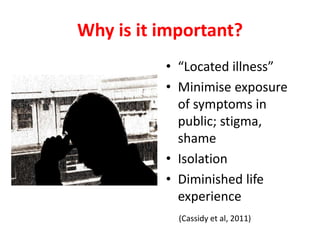
Why is it important?
• “Located illness”
• Minimise exposure
of symptoms in
public; stigma,
shame
• Isolation
• Diminished life
experience
(Cassidy et al, 2011)
Self-management
000000000000000000000000000000000000000000000
000000000000000000000000000000000000000000000
000000000000000000000000000000000000000000000
000000000000000000000000000000000000000000000
000000000000000000000000000000000000000000000
000000000000000000000000000000000000000000000
000000000000000000000000000000000000000000000
000000000000000000000000000000000000000000000
00000
3
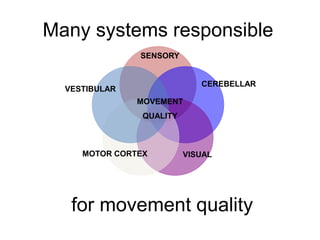
Many systems responsible
MOVEMENT
QUALITY
SENSORY
VESTIBULAR
CEREBELLAR
VISUALMOTOR CORTEX
for movement quality
Ataxia in MS
• Sensory
• Vestibular
• Cerebellar
• MIXED
Just to complicate matters…
• Spasticity/spasms
• Weakness
• Pain
• Fatigue/fatigueability
• Cognitive change
Huge impact on function and quality of life
Multidisciplinary approach
• Mobility/transfers
• Posture/wheelchairs
• ADL
• Speech and swallowing
• Nutrition
• Psychological interventions
• Management of other symptoms of MS
• Social services
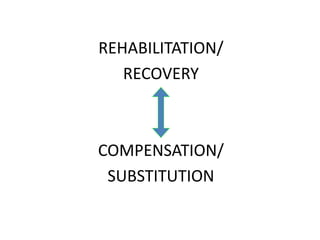
REHABILITATION/
RECOVERY
COMPENSATION/
SUBSTITUTION
Managing ataxia
Treatment of ataxic patients requires balance
between facilitation of improved control and
the recognition and acceptance of necessary
compensation which is essential for function.
(Marsden and Harris, 2011)
Assessment - don’t forget…
• Disorders of vision
• Cataracts
• Vertigo
• Nausea
Assessment – ask about….
• Medication – especially anti-spasticity tabs
• Percentage of day sitting
• Use of walking aids
• Things they have found useful
• Their expectation of what you can do
• Beliefs about the future
• Family / carer concerns
• Attitude to exercise / activity
Motivation
12
Long-term activity
Not just a few weeks… …but long-term
13
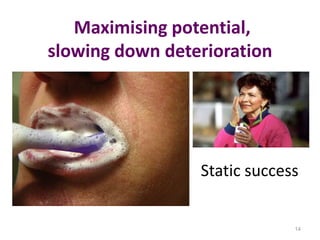
Maximising potential,
slowing down deterioration
14
Static success
Outcome measures for ataxia
• SARA (Scale for Assessment and Rating of
Ataxia)
• ICARS – International Cooperative Ataxia
Rating Scale
• Kurtze Functional Systems Score
• SF 36 (v2) for quality of life
• VAS - 0 - 10cm scale “How difficult is it to…”
• Canadian Occupational Performance Measure
Balance and gait outcomes
• Functional Reach (modified)
• TUG
• Single leg stance
• Berg balance
• ABC (Activities-specific Balance Confidence
scale)
• Balance – SARA
• Timed 10m walk; 6 minute walk
Tests of coordination
• 9 hole peg test – can dishearten if repeatedly
fails
• Figure of 8 drawing or spiral (A4 page)
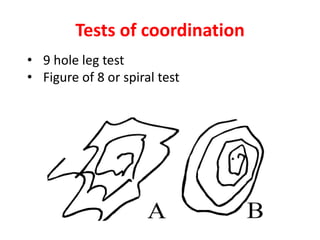
Tests of coordination
• 9 hole leg test
• Figure of 8 or spiral test
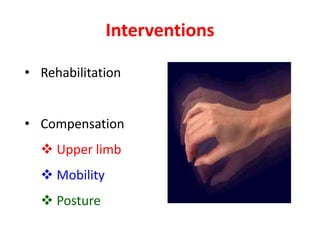
Interventions
• Rehabilitation
• Compensation
 Upper limb
 Mobility
 Posture
RCT evidence for rehab in MS?
• Cochrane review – 2007 (Mills et al)
• NICE Guidelines for MS 2014
– Armutlu et al 2001
– Keser et al 2013
Evidence for rehab in ataxias
Physiotherapy can improve:
• Mobility
• Balance
• Trunk control
(Gill-Body et al 1997; Marsden and Harris, 2011; Miyai et al 2012, Ataxia
UK Guidelines 2016)
Approaches to rehabilitation
• Dynamic task practice – challenge stability,
reduce UL weight bearing (Armutlu et al 2001)
• Balance retraining (challenging) (Keller & Bastian 2014)
• Priming/rehearsing task visually (Crowdy et al, 2002)
Approaches to rehabilitation
• Strengthening and treadmill training (Vaz et al 2006)
• Biofeedback + computer game (Betker et al, 2006; Bunn
et al 2015)
• Frenkel’s exercises – visual feedback to control
movement(Armultlu et al 2001)
Rehabilitation
• More training, better outcomes – prolonged
intervention 3-12 months
• Better outcomes in mild ataxia
• Carry-over not usually assessed
Deconditioning
• People with ataxia tend to sit for long periods
– change patterns of movement e.g. push up
with arms
• Deconditioning reversible
Standing frames
Standing
• Improves motor function
• Feasible to use at home
• People enjoy standing safely upright
(Freeman et al 2019)
Standing frame website (results and resources):
www.plymouth.ac.uk/research/sums
Tailoring activity to the person
• Yoga
• T’ai Chi
• Pilates
• Horse riding
• Climbing wall
The importance of challenge!
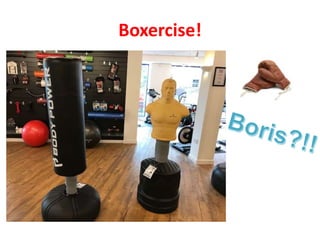
Boxercise!
Compensation
• Mobility aids
– Case-by-case basis
– Tendency to fix postures
– Over use of upper limb weight bearing
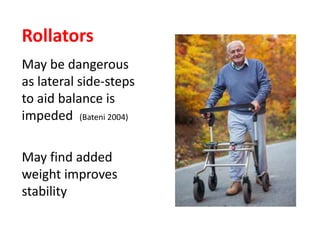
Rollators
May be dangerous
as lateral side-steps
to aid balance is
impeded (Bateni 2004)
May find added
weight improves
stability
Mobility Aids
• Trekking / Nordic poles – light tough contact,
reduce UL weight bearing (Jekka 1997; Balliet 1987)
• Difficult placing sticks / poles if person has
dysmetria or tremor
• Can weight hollow mobility aids with sand /
ball-bearings or use weights (graded to
person)
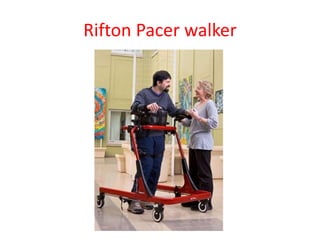
Rifton Pacer walker
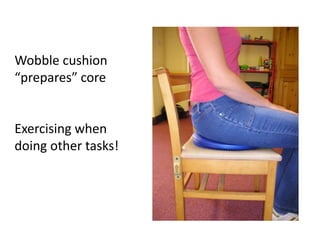
Wobble cushion
“prepares” core
Exercising when
doing other tasks!
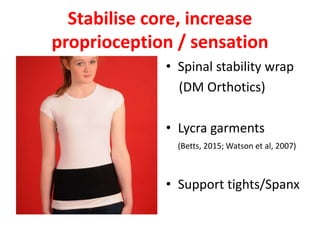
Stabilise core, increase
proprioception / sensation
• Spinal stability wrap
(DM Orthotics)
• Lycra garments
(Betts, 2015; Watson et al, 2007)
• Support tights/Spanx
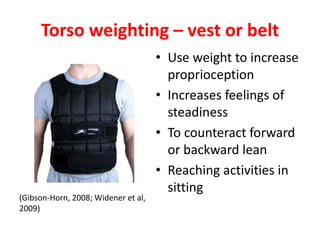
Torso weighting – vest or belt
• Use weight to increase
proprioception
• Increases feelings of
steadiness
• To counteract forward
or backward lean
• Reaching activities in
sitting
(Gibson-Horn, 2008; Widener et al,
2009)
Visual and verbal cues
• Visual cues using virtual reality (walking along
virtual tiles) (Baram and Miller, 2006)
• Verbal cues delivered through ear piece (tick
on stepping) increased speed and stride
length (Baram and Miller 2007)
Strategies for the upper limb
• Manipulation of visual information (Haggard et al
1994, Pope 2007)
• Tremor and dysmetria may improve if
movement not visually guided (Pope, 2007)
• Can work well in people with intention tremor
• Find the ‘quiet arc’ of movement
Central vs. Peripheral vision
• Central pick-up may increase tremor
• Locate object then use peripheral vision
• Place object to one side
Lycra garments
• Increases sensation/proprioception
• Some success with UL (Watson et al, 2007; Betts 2015)
Lycra garments
• May help with functional tasks
• Can be hot
• Can be difficult to put on
• Assess with two layers of Size B tubigrip
Using tubigrip
• Size B Tubigrip on upper limb (double layer)
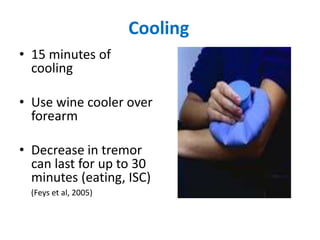
• 15 minutes of
cooling
• Use wine cooler over
forearm
• Decrease in tremor
can last for up to 30
minutes (eating, ISC)
(Feys et al, 2005)
Cooling
Keeping cool
• Very important during exercise / activity
• Damp T-shirt
• Cold drinks, meals, puddings
• Cold gel neck-tie/scarf
Cooling neck packs/scarves
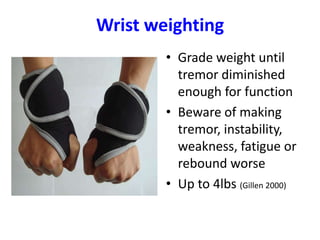
Wrist weighting
• Grade weight until
tremor diminished
enough for function
• Beware of making
tremor, instability,
weakness, fatigue or
rebound worse
• Up to 4lbs (Gillen 2000)
Equipment for eating
• Weighted cutlery / mugs
• Plate guard
• Non-slip mats
• Valved straws (Pat Saunders)
• Nosey cups
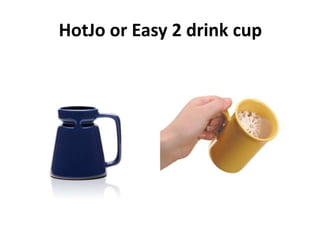
• Easy 2 drink cup
• HotJo cup
HotJo or Easy 2 drink cup
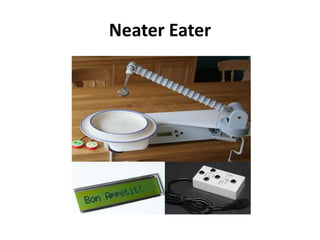
Neater Eater
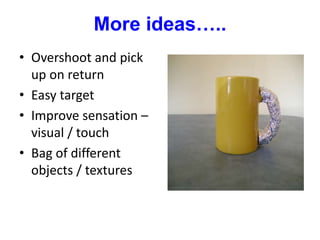
More ideas…..
• Overshoot and pick
up on return
• Easy target
• Improve sensation –
visual / touch
• Bag of different
objects / textures
Single joint move
• Simplify movement
• Avoid rapid, multi-joint movements
• Reduce number of moving joints
• Stabilise
• Slow movement down
(Bastian 1997)
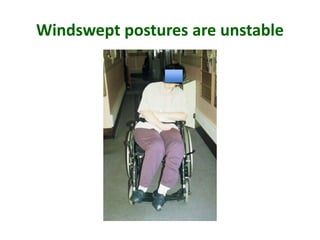
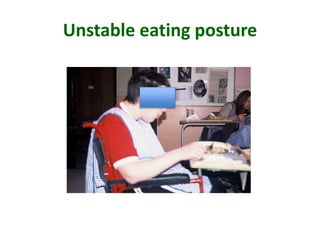
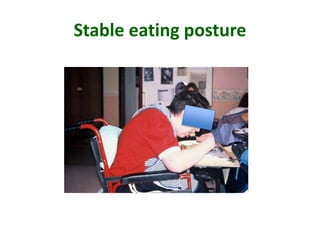
Windswept postures are unstable
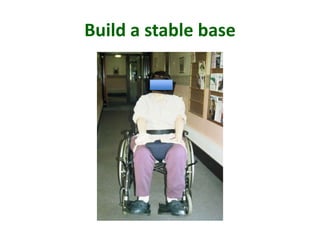
Build a stable base
Unstable eating posture
Stable eating posture
Medical interventions
• Medication may not be helpful
• Botulinum toxin Type A – two randomised
placebo controlled trials reporting benefit in
tremor reduction and improved writing ability.
However – no improvement in QoL and
increased weakness
(Alusi et al 2000; Brin et al 2001)
Medical interventions
• Review drugs which may effect ataxia e.g.
anti-spasticity medication
• Essential to monitor effects of these drugs
• Gabapentin – possibly effective but
insufficient evidence to confirm or refute
Medical interventions
• Stereotactic thalamotomy and Deep Brain
Stimulation (DBS)
– Initial tremor suppression in 94% (thalamotomy)
and 96% (DBS)
– 63% had tremor suppression at 12 months
– Adverse effects: hemiparesis, dysarthria,
dysphagia
(Yap et al 2007)
In summary
• Balance exercises should challenge base of
support!
• May need to use a variety of compensatory
interventions
• Check medication (especially anti-spasticity)
as muscle weakness may be contributing to
ataxia
In summary
• Deconditioning makes everything worse
• Support long-term activity
• Talk about expectations and the importance of
doing a bit to keep as good as possible
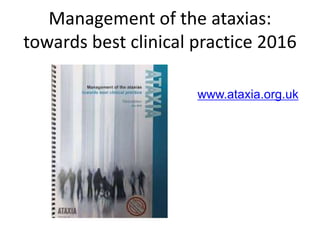
Management of the ataxias:
towards best clinical practice 2016
www.ataxia.org.uk
Thank you for listening!
References
1. Marsden J. Harris CM. (2011) Cerebellar ataxia: Pathophysiology and rehabilitation
Clinical Rehabilitation 25:195-216
2. Management of the ataxias: towards best clinical practice 3rd Ed July 2016 Ataxia
UK – www.ataxia.org.uk
3. Mills, RJ et al (2007) Treatment for ataxia in multiple sclerosis. Cochrane database of
systematic reviews. Issue 1 Art.No.:CD005029.DOI:10.1002/14651858.CD005029.pub2
4. Keller JL and Bastian AJ (2014) A home balance exercise program improves walking
in people with cerebellar ataxia Neurorehabilitation and Neural Repair 28(8):770-778
5. Davis, AE. Lee RG (1980) EMG feedback in patients with motor disorders: an aid for
co-ordinating activity in antagonistic muscles groups. Can J Neurosci 7:199-206
6. Guercio JM et al (2001) Increasing functional communication through relaxation
training and neuromuscular feedback Brain Inj 15:1073-82
References
7. Betker et al (2006) Video game-based exercises for balance rehabilitation: a single-
subject design Arch Phys Med Rehabil 87:1141-49
8. Bastian, AJ (1997) Mechanisms of ataxia. Phys Ther 77:672-675
9. Armutlu K et al (2001) Physiotherapy approached in the treatment of ataxic multiple
sclerosis: a pilot study. Neurorehabil and Neural Repair 15: 203-211
10. Balliet R et al (1987) Retraining of functional gait through the reduction of upper
extremity weight-bearing in chronic cerebellar ataxia. Int Rehabil Med 8:148-153
11. Vaz, DV et al (2008) Treadmill training for ataxic patients: a single subject
experimental design. Clin Rehab 22:234-241
12. Gill-Body, KM et al (1997) Rehabilitation of balance in two patients with cerebellar
dysfunction. Phys Ther 77:534-552
13. Miyai, I et al (2012) Cerebellar ataxia rehabilitation trial in degenerative cerebellar
disease. Neurorehabil Neural Repair 26:515-522
14. Yap, L et al (2007) Stereotactic neurosurgery for disabling tremor in multiple
sclerosis: thalamotomy or deep brain stimulation? British Journal of Neurosurgery
21(4):349-354
References
15. Crowdy, KA et al (2002) Rehearsal by eye movement improves visuomotor
performance in cerebellar patients. Exp. Brain Res. Exp Hirnforsch Experimentation
Cerebrale 146:244-247
16. Jekka, JJ (1997) Light touch contact as a balance aid. Phys Ther 77:476-487
17. Bateni, H. et al (2004) Can use of walkers or canes impede lateral compensatory
stepping movements? Gait Posture 20: 74-83
18. Cassidy, E et al (2011) Using interpretive phenomenological analysis to inform
physiotherapy practice: An introduction with reference to the lived experience of
cerebellar ataxia. Physiother Theory Pract. 27:263-277
19. Bunn, L et al (2015) Training balance with opto-kinetic stimuli in the home: a
randomised controlled feasibility study in people with pure cerebellar disease. Clinical
Rehabilitation 29(2):143-153
20. Freeman, J. et al (2019) Assessment of a home-based standing frame programme
in people with progressive multiple sclerosis (SUMS): a pragmatic, multi-centre,
randomised, controlled trial and cost-effectiveness analysis. Lancet Neurology 18 736-
747
References
21. Gibson-Horn, C. (2008) Balance-based torso-weighting in a patient with ataxia and
multiple sclerosis: a case report. Journal of Neurologic Physical Therapy 32(3):139-146
22. Widener, GL et al (2009) Randomised clinical trial of balance-based torso weighting
for improving upright mobility in people with multiple sclerosis. Neurorehab and
Neural Repair 23(8):784-791

Managing ataxia in MS

  • 1.
    Managing ataxia in MS MSTrust Conference 2019 Wendy Hendrie Clinical specialist physiotherapist in MS Norwich
  • 2.
    Why is itimportant? • “Located illness” • Minimise exposure of symptoms in public; stigma, shame • Isolation • Diminished life experience (Cassidy et al, 2011)
  • 3.
  • 4.
  • 5.
    Ataxia in MS •Sensory • Vestibular • Cerebellar • MIXED
  • 6.
    Just to complicatematters… • Spasticity/spasms • Weakness • Pain • Fatigue/fatigueability • Cognitive change Huge impact on function and quality of life
  • 7.
    Multidisciplinary approach • Mobility/transfers •Posture/wheelchairs • ADL • Speech and swallowing • Nutrition • Psychological interventions • Management of other symptoms of MS • Social services
  • 8.
  • 9.
    Managing ataxia Treatment ofataxic patients requires balance between facilitation of improved control and the recognition and acceptance of necessary compensation which is essential for function. (Marsden and Harris, 2011)
  • 10.
    Assessment - don’tforget… • Disorders of vision • Cataracts • Vertigo • Nausea
  • 11.
    Assessment – askabout…. • Medication – especially anti-spasticity tabs • Percentage of day sitting • Use of walking aids • Things they have found useful • Their expectation of what you can do • Beliefs about the future • Family / carer concerns • Attitude to exercise / activity
  • 12.
  • 13.
    Long-term activity Not justa few weeks… …but long-term 13
  • 14.
    Maximising potential, slowing downdeterioration 14 Static success
  • 15.
    Outcome measures forataxia • SARA (Scale for Assessment and Rating of Ataxia) • ICARS – International Cooperative Ataxia Rating Scale • Kurtze Functional Systems Score • SF 36 (v2) for quality of life • VAS - 0 - 10cm scale “How difficult is it to…” • Canadian Occupational Performance Measure
  • 16.
    Balance and gaitoutcomes • Functional Reach (modified) • TUG • Single leg stance • Berg balance • ABC (Activities-specific Balance Confidence scale) • Balance – SARA • Timed 10m walk; 6 minute walk
  • 17.
    Tests of coordination •9 hole peg test – can dishearten if repeatedly fails • Figure of 8 drawing or spiral (A4 page)
  • 18.
    Tests of coordination •9 hole leg test • Figure of 8 or spiral test
  • 19.
    Interventions • Rehabilitation • Compensation Upper limb  Mobility  Posture
  • 20.
    RCT evidence forrehab in MS? • Cochrane review – 2007 (Mills et al) • NICE Guidelines for MS 2014 – Armutlu et al 2001 – Keser et al 2013
  • 21.
    Evidence for rehabin ataxias Physiotherapy can improve: • Mobility • Balance • Trunk control (Gill-Body et al 1997; Marsden and Harris, 2011; Miyai et al 2012, Ataxia UK Guidelines 2016)
  • 22.
    Approaches to rehabilitation •Dynamic task practice – challenge stability, reduce UL weight bearing (Armutlu et al 2001) • Balance retraining (challenging) (Keller & Bastian 2014) • Priming/rehearsing task visually (Crowdy et al, 2002)
  • 23.
    Approaches to rehabilitation •Strengthening and treadmill training (Vaz et al 2006) • Biofeedback + computer game (Betker et al, 2006; Bunn et al 2015) • Frenkel’s exercises – visual feedback to control movement(Armultlu et al 2001)
  • 24.
    Rehabilitation • More training,better outcomes – prolonged intervention 3-12 months • Better outcomes in mild ataxia • Carry-over not usually assessed
  • 25.
    Deconditioning • People withataxia tend to sit for long periods – change patterns of movement e.g. push up with arms • Deconditioning reversible
  • 26.
  • 27.
    Standing • Improves motorfunction • Feasible to use at home • People enjoy standing safely upright (Freeman et al 2019) Standing frame website (results and resources): www.plymouth.ac.uk/research/sums
  • 28.
    Tailoring activity tothe person • Yoga • T’ai Chi • Pilates • Horse riding • Climbing wall The importance of challenge!
  • 29.
  • 30.
    Compensation • Mobility aids –Case-by-case basis – Tendency to fix postures – Over use of upper limb weight bearing
  • 31.
    Rollators May be dangerous aslateral side-steps to aid balance is impeded (Bateni 2004) May find added weight improves stability
  • 32.
    Mobility Aids • Trekking/ Nordic poles – light tough contact, reduce UL weight bearing (Jekka 1997; Balliet 1987) • Difficult placing sticks / poles if person has dysmetria or tremor • Can weight hollow mobility aids with sand / ball-bearings or use weights (graded to person)
  • 33.
  • 34.
  • 35.
    Stabilise core, increase proprioception/ sensation • Spinal stability wrap (DM Orthotics) • Lycra garments (Betts, 2015; Watson et al, 2007) • Support tights/Spanx
  • 36.
    Torso weighting –vest or belt • Use weight to increase proprioception • Increases feelings of steadiness • To counteract forward or backward lean • Reaching activities in sitting (Gibson-Horn, 2008; Widener et al, 2009)
  • 37.
    Visual and verbalcues • Visual cues using virtual reality (walking along virtual tiles) (Baram and Miller, 2006) • Verbal cues delivered through ear piece (tick on stepping) increased speed and stride length (Baram and Miller 2007)
  • 38.
    Strategies for theupper limb • Manipulation of visual information (Haggard et al 1994, Pope 2007) • Tremor and dysmetria may improve if movement not visually guided (Pope, 2007) • Can work well in people with intention tremor • Find the ‘quiet arc’ of movement
  • 39.
    Central vs. Peripheralvision • Central pick-up may increase tremor • Locate object then use peripheral vision • Place object to one side
  • 40.
    Lycra garments • Increasessensation/proprioception • Some success with UL (Watson et al, 2007; Betts 2015)
  • 41.
    Lycra garments • Mayhelp with functional tasks • Can be hot • Can be difficult to put on • Assess with two layers of Size B tubigrip
  • 42.
    Using tubigrip • SizeB Tubigrip on upper limb (double layer)
  • 43.
    • 15 minutesof cooling • Use wine cooler over forearm • Decrease in tremor can last for up to 30 minutes (eating, ISC) (Feys et al, 2005) Cooling
  • 44.
    Keeping cool • Veryimportant during exercise / activity • Damp T-shirt • Cold drinks, meals, puddings • Cold gel neck-tie/scarf
  • 45.
  • 46.
    Wrist weighting • Gradeweight until tremor diminished enough for function • Beware of making tremor, instability, weakness, fatigue or rebound worse • Up to 4lbs (Gillen 2000)
  • 47.
    Equipment for eating •Weighted cutlery / mugs • Plate guard • Non-slip mats • Valved straws (Pat Saunders) • Nosey cups • Easy 2 drink cup • HotJo cup
  • 48.
    HotJo or Easy2 drink cup
  • 49.
  • 50.
    More ideas….. • Overshootand pick up on return • Easy target • Improve sensation – visual / touch • Bag of different objects / textures
  • 51.
    Single joint move •Simplify movement • Avoid rapid, multi-joint movements • Reduce number of moving joints • Stabilise • Slow movement down (Bastian 1997)
  • 52.
  • 53.
  • 54.
  • 55.
  • 56.
    Medical interventions • Medicationmay not be helpful • Botulinum toxin Type A – two randomised placebo controlled trials reporting benefit in tremor reduction and improved writing ability. However – no improvement in QoL and increased weakness (Alusi et al 2000; Brin et al 2001)
  • 57.
    Medical interventions • Reviewdrugs which may effect ataxia e.g. anti-spasticity medication • Essential to monitor effects of these drugs • Gabapentin – possibly effective but insufficient evidence to confirm or refute
  • 58.
    Medical interventions • Stereotacticthalamotomy and Deep Brain Stimulation (DBS) – Initial tremor suppression in 94% (thalamotomy) and 96% (DBS) – 63% had tremor suppression at 12 months – Adverse effects: hemiparesis, dysarthria, dysphagia (Yap et al 2007)
  • 59.
    In summary • Balanceexercises should challenge base of support! • May need to use a variety of compensatory interventions • Check medication (especially anti-spasticity) as muscle weakness may be contributing to ataxia
  • 60.
    In summary • Deconditioningmakes everything worse • Support long-term activity • Talk about expectations and the importance of doing a bit to keep as good as possible
  • 61.
    Management of theataxias: towards best clinical practice 2016 www.ataxia.org.uk
  • 62.
    Thank you forlistening!
  • 63.
    References 1. Marsden J.Harris CM. (2011) Cerebellar ataxia: Pathophysiology and rehabilitation Clinical Rehabilitation 25:195-216 2. Management of the ataxias: towards best clinical practice 3rd Ed July 2016 Ataxia UK – www.ataxia.org.uk 3. Mills, RJ et al (2007) Treatment for ataxia in multiple sclerosis. Cochrane database of systematic reviews. Issue 1 Art.No.:CD005029.DOI:10.1002/14651858.CD005029.pub2 4. Keller JL and Bastian AJ (2014) A home balance exercise program improves walking in people with cerebellar ataxia Neurorehabilitation and Neural Repair 28(8):770-778 5. Davis, AE. Lee RG (1980) EMG feedback in patients with motor disorders: an aid for co-ordinating activity in antagonistic muscles groups. Can J Neurosci 7:199-206 6. Guercio JM et al (2001) Increasing functional communication through relaxation training and neuromuscular feedback Brain Inj 15:1073-82
  • 64.
    References 7. Betker etal (2006) Video game-based exercises for balance rehabilitation: a single- subject design Arch Phys Med Rehabil 87:1141-49 8. Bastian, AJ (1997) Mechanisms of ataxia. Phys Ther 77:672-675 9. Armutlu K et al (2001) Physiotherapy approached in the treatment of ataxic multiple sclerosis: a pilot study. Neurorehabil and Neural Repair 15: 203-211 10. Balliet R et al (1987) Retraining of functional gait through the reduction of upper extremity weight-bearing in chronic cerebellar ataxia. Int Rehabil Med 8:148-153 11. Vaz, DV et al (2008) Treadmill training for ataxic patients: a single subject experimental design. Clin Rehab 22:234-241 12. Gill-Body, KM et al (1997) Rehabilitation of balance in two patients with cerebellar dysfunction. Phys Ther 77:534-552 13. Miyai, I et al (2012) Cerebellar ataxia rehabilitation trial in degenerative cerebellar disease. Neurorehabil Neural Repair 26:515-522 14. Yap, L et al (2007) Stereotactic neurosurgery for disabling tremor in multiple sclerosis: thalamotomy or deep brain stimulation? British Journal of Neurosurgery 21(4):349-354
  • 65.
    References 15. Crowdy, KAet al (2002) Rehearsal by eye movement improves visuomotor performance in cerebellar patients. Exp. Brain Res. Exp Hirnforsch Experimentation Cerebrale 146:244-247 16. Jekka, JJ (1997) Light touch contact as a balance aid. Phys Ther 77:476-487 17. Bateni, H. et al (2004) Can use of walkers or canes impede lateral compensatory stepping movements? Gait Posture 20: 74-83 18. Cassidy, E et al (2011) Using interpretive phenomenological analysis to inform physiotherapy practice: An introduction with reference to the lived experience of cerebellar ataxia. Physiother Theory Pract. 27:263-277 19. Bunn, L et al (2015) Training balance with opto-kinetic stimuli in the home: a randomised controlled feasibility study in people with pure cerebellar disease. Clinical Rehabilitation 29(2):143-153 20. Freeman, J. et al (2019) Assessment of a home-based standing frame programme in people with progressive multiple sclerosis (SUMS): a pragmatic, multi-centre, randomised, controlled trial and cost-effectiveness analysis. Lancet Neurology 18 736- 747
  • 66.
    References 21. Gibson-Horn, C.(2008) Balance-based torso-weighting in a patient with ataxia and multiple sclerosis: a case report. Journal of Neurologic Physical Therapy 32(3):139-146 22. Widener, GL et al (2009) Randomised clinical trial of balance-based torso weighting for improving upright mobility in people with multiple sclerosis. Neurorehab and Neural Repair 23(8):784-791

Editor's Notes

  • #3 Experienced in the social world