
VITAMIN D AND
MULTIPLE
SCLEROSIS
UK MS Trust – 3 Nov 2019
Joost Smolders
Neurologist
ErasMS
Clonflicts of interest
• I received consultancy/ speakers free from Biogen, Merck, Novartis, Sanofi Genzyme
• I was indoctrinated by my parents that vitamins are healthy
• I indoctrinate my children that vitamins are healthy
“Vitamins are good for you”
• WHY is vitamin D relevant for people with MS?
• Do vitamin D supplements improve the lives of people with MS?
• What should we advise people with MS?
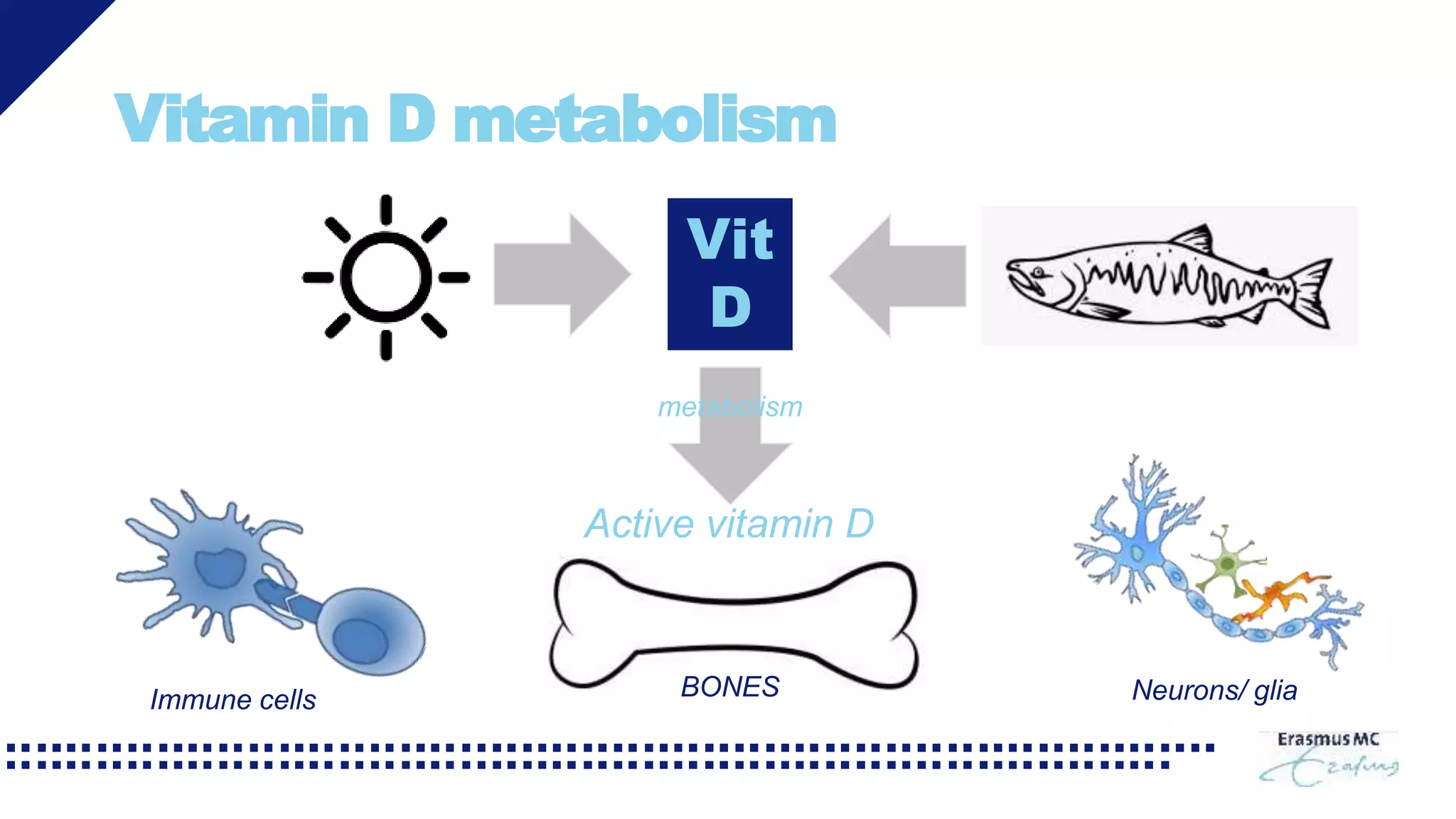
Vitamin D metabolism
metabolism
Active vitamin D
BONESImmune cells Neurons/ glia
Vit
D
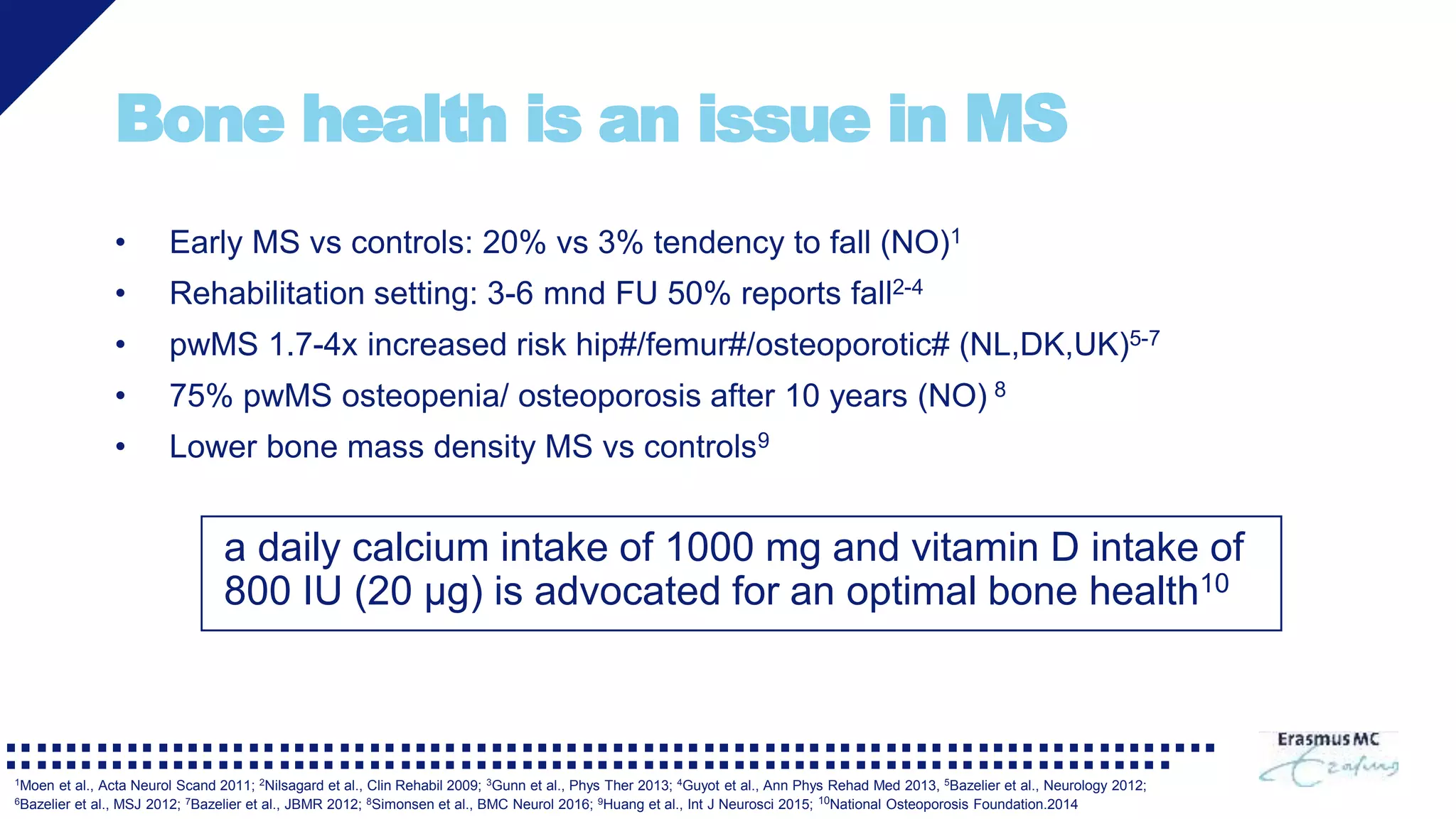
Bone health is an issue in MS
• Early MS vs controls: 20% vs 3% tendency to fall (NO)1
• Rehabilitation setting: 3-6 mnd FU 50% reports fall2-4
• pwMS 1.7-4x increased risk hip#/femur#/osteoporotic# (NL,DK,UK)5-7
• 75% pwMS osteopenia/ osteoporosis after 10 years (NO) 8
• Lower bone mass density MS vs controls9
a daily calcium intake of 1000 mg and vitamin D intake of
800 IU (20 μg) is advocated for an optimal bone health10
1Moen et al., Acta Neurol Scand 2011; 2Nilsagard et al., Clin Rehabil 2009; 3Gunn et al., Phys Ther 2013; 4Guyot et al., Ann Phys Rehad Med 2013, 5Bazelier et al., Neurology 2012;
6Bazelier et al., MSJ 2012; 7Bazelier et al., JBMR 2012; 8Simonsen et al., BMC Neurol 2016; 9Huang et al., Int J Neurosci 2015; 10National Osteoporosis Foundation.2014
R
R
M
S
S
P
M
S
P
P
M
S
0
5 0
1 0 0
1 5 0
2 0 0
2 5 0
serum25(OH)D(nmol/L)
Vitamin D may promote bone health
Bone health
• (especially progressive) pwMS have
low 25(OH)D levels1
• Low 25(OH)D levels associate with low
bone mineral density, increased risk of
falls and fractures2
• Supplementation of vitamin D3
promotes bone mineral density in
people with low 25(OH)D levels3-5
1Smolders, MSJ 2008,2Bischoff-Ferrari, AM J Med,2004; 3Tang, Lancet 2007; 4Bischoff-Ferrari, JAMA 2005; 5Bischoff-Ferrari, BMJ 2009
Vitamin D predicts MS outcomes
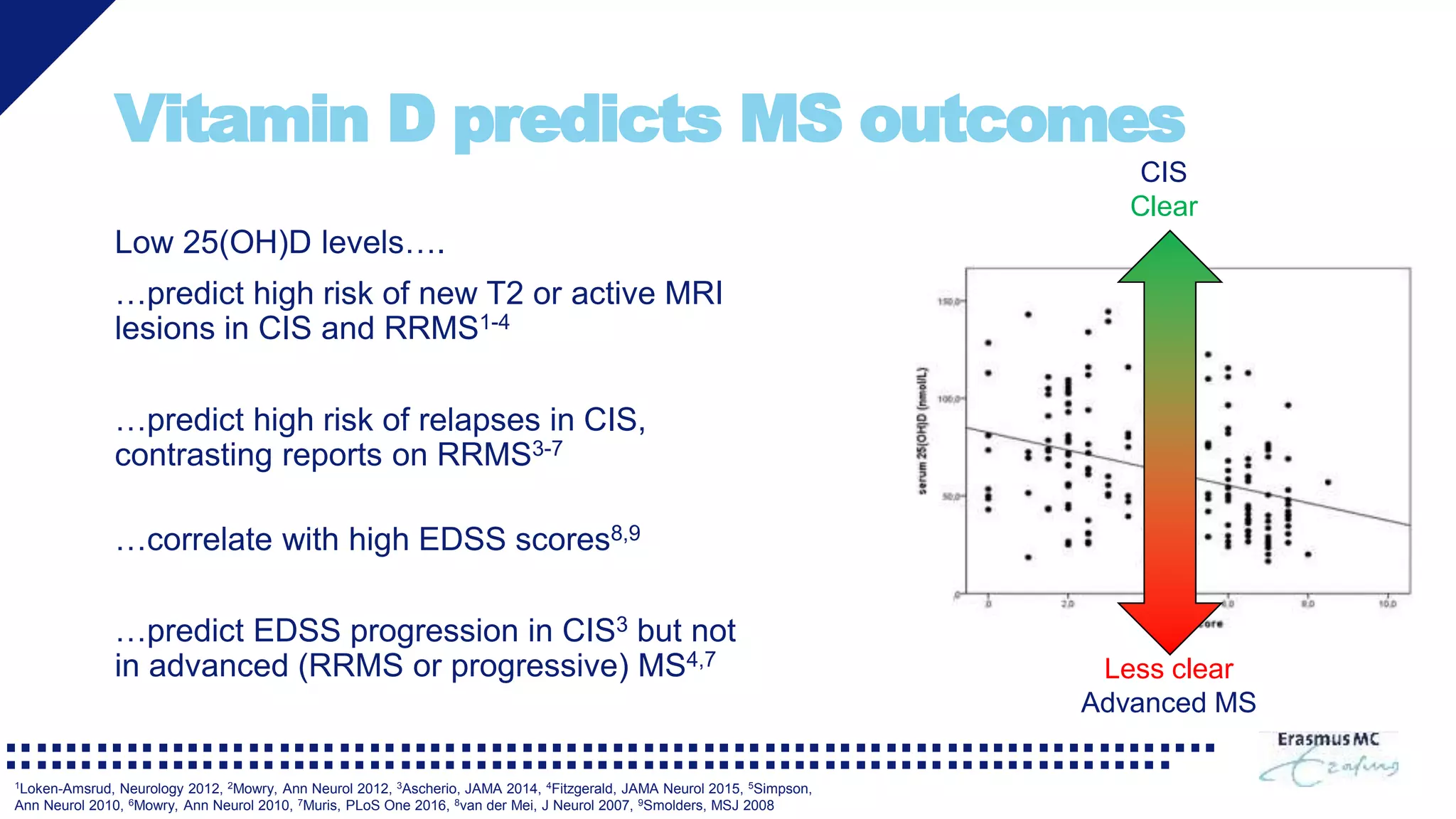
Low 25(OH)D levels….
…predict high risk of new T2 or active MRI
lesions in CIS and RRMS1-4
…predict high risk of relapses in CIS,
contrasting reports on RRMS3-7
…correlate with high EDSS scores8,9
…predict EDSS progression in CIS3 but not
in advanced (RRMS or progressive) MS4,7
CIS
Clear
Less clear
Advanced MS
1Loken-Amsrud, Neurology 2012, 2Mowry, Ann Neurol 2012, 3Ascherio, JAMA 2014, 4Fitzgerald, JAMA Neurol 2015, 5Simpson,
Ann Neurol 2010, 6Mowry, Ann Neurol 2010, 7Muris, PLoS One 2016, 8van der Mei, J Neurol 2007, 9Smolders, MSJ 2008
WHY does vitamin D predict MS
outcomes?
Adapted from Smolders et al., in Minagar (Ed), neuroinflammation 2018
Simpson et al., Front Neurol 2018
0 1 2 3 5 9 2 4
0
2 0
4 0
6 0
t i m e ( h o u r s )
25(OH)D3(nM)
P = 0 . 0 0 4 *
P = 0 . 0 0 4 *
L P S i. v .
Geven et al., in preparation
Van der Mei et al., J Neurol 2007
Vitamin D is the precursor of an anti-
inflammatory molecule
L: Smolders & Damoiseaux, Vit Horm 2011; R: Cantorna et al., PNAS 1996
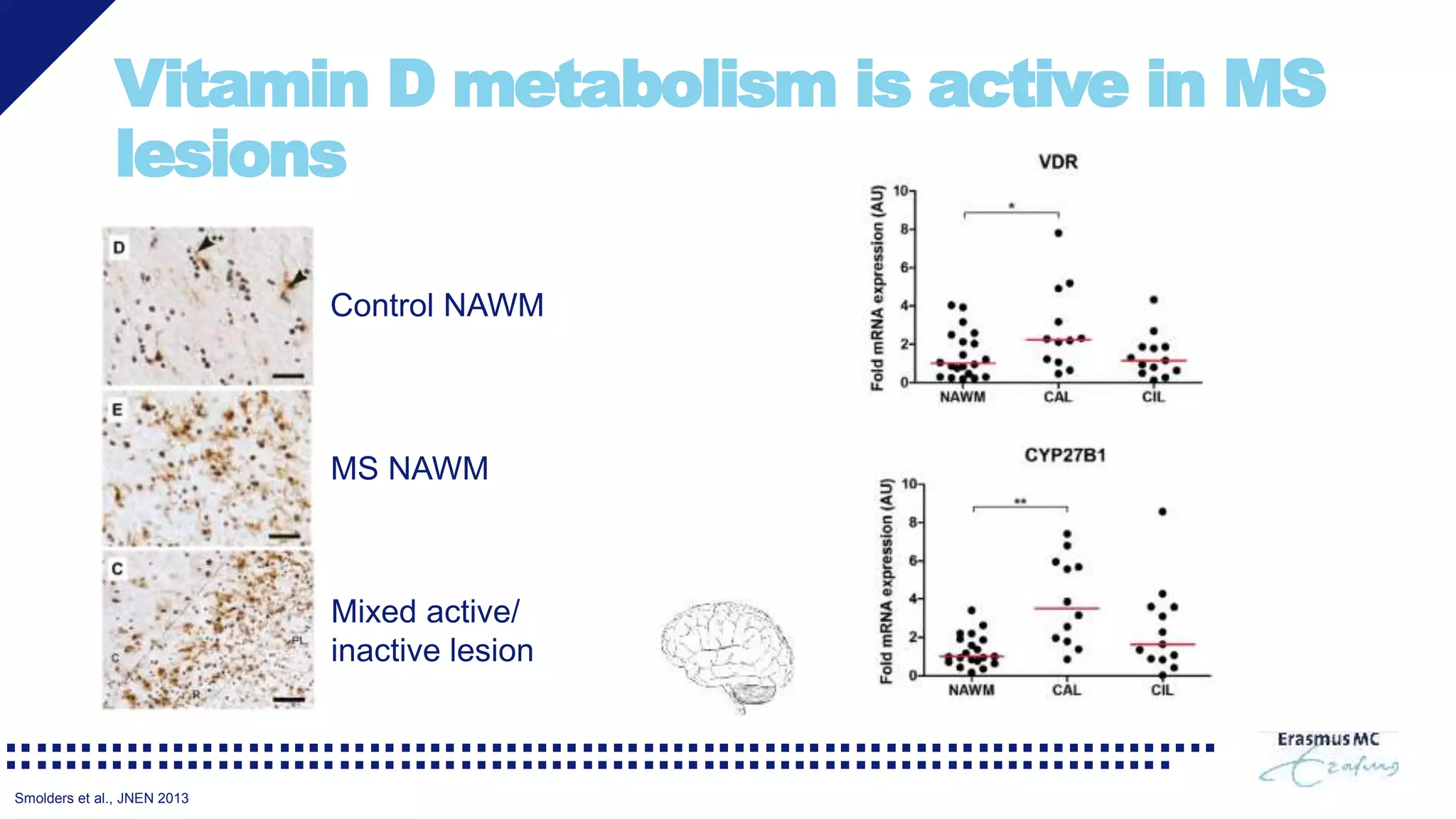
Vitamin D metabolism is active in MS
lesions
MS NAWM
Control NAWM
Mixed active/
inactive lesion
Smolders et al., JNEN 2013
Genes associated with low vitamin D
levels associate with MS risk
Rhead, Neurol Genet 2016
Graves et al., MSJ 2019
Controlled Vitamin D
supplementation studies in MS
4 0 5 0 6 0 7 0
0
5 0
1 0 0
1 5 0
2 0 0
B a s e l i n e 2 5 ( O H ) D l e v e l s ( n M )
Reportedincrease25(OH)D
interventiongroup(nM)
S o i l u - H ä n n i n e n
S t e i n
K a m p m a n
G o l a n
S o t i r c h o s
C a m u
O 'C o n n e l
H u p p e r t s
Stein et al., Neurology 2011; Kampman et al., MSJ 2012; Soilu-Hänninen et al., JNNP 2012; Golan et al., BMC Neurol 2013;
Sotirchos et al., Neurology 2016; O’Connel et al., MSJ ECT 2017; Camu et al., N2 2019; Hupperts et al., Neurology 2019.
Clinical trials – signals in secondary
endpoints
• Soilu-Hänninen (Fi)1
 ITT Primary T2 lesion volume increase -204mm3 (p=0.105)
 ITT T1 Gd+ MRI lesions 0.1 (0.2) vs 0.7 (3.5) (p=0.0004)
 ITT N new/enlarging T2 0.5 (1.0) vs 1.1 (2.2) (p=0.286)
• Camu (FR)2
• Completers ARR reduction (rR 0.395; p=0.01)
• Completers less new T1 MRI lesions (rR 0.494; P=0.03)
• Completers lower T1 volume increase (-312 mm3; P=0.03)
• Hupperts (NL)3
• ITT N CUA levels MRI reduction 31% (p=0.005)
• ITT lower % increase T2 lesion volume (-2.5%, p=0.035)
• ITT point estimate ARR reduction 30% (p=0.17)
1Soilu-Hänninen et al., JNNP 2012; 2Camu et al., N2 2019; 3Hupperts et al., Neurology 2019.
4 0 5 0 6 0 7 0
0
5 0
1 0 0
1 5 0
2 0 0
B a s e l i n e 2 5 ( O H ) D l e v e l s ( n M )
Reportedincrease25(OH)D
interventiongroup(nM)
S o i l u - H ä n n i n e n
S t e i n
K a m p m a n
G o l a n
S o t i r c h o s
C a m u
O 'C o n n e l
H u p p e r t s
Controlled studies - Biomarkers
Disclaimer: small, heterogeneous
cohorts
• No effect of vitamin D3 supplements
on circulating neurofilament light chain
levels1,2
• Conflicting results on cytokine profiles/
cellular phenotypes3-11
• Reproducible (temporary) drop in Anti
Epstein Bar Virus Nuclear Antigen 1
(Ebna1) IgG levels12-14
1Holmøy, Acta Neurol Scand 2019; 2Smolders, Acta Neurol Scand 2019; 3Mahon, JNI 2003; 4Åivo, JNI 2016; 5Røsjø, J Neurol 2015; 6Muris, JNI 2016; 7Sotirchos, Neurology 2016;
8Mrad, Clin Immunol 2017; 9Røsjø, JNI 2015; 10O’Connell, MSJ-ETC 2017; 11Rolf, MIM 2019 12Dissanto, MSJ 2014; 13Røsjø, MSJ 2016; 14Rolf, MSJ 2017
Dangers associated with high doses
• Toxic doses of vitamin D3 in mice
exacerbated EAE1
• Three years high (10.000 IU/d) vs
low (400 IU/d) dose vitamin D3 was
associated with reduced bone
mineral density in ambulatory
healthy controls2
• Supplementation studies of high
doses vitamin D3 in MS did not show
safety concerns in 48-96w FU3
1Häusler et al., Brain 2019; 2Burt et al., JAMA 2019; 3Stein et al., Neurology 2011; Kampman et al., MSJ 2012; Soilu-Hänninen et al., JNNP 2012; Golan
et al., BMC Neurol 2013; Sotirchos et al., Neurology 2016; O’Connel et al., MSJ ECT 2017; Camu et al., N2 2019; Hupperts et al., Neurology 2019.
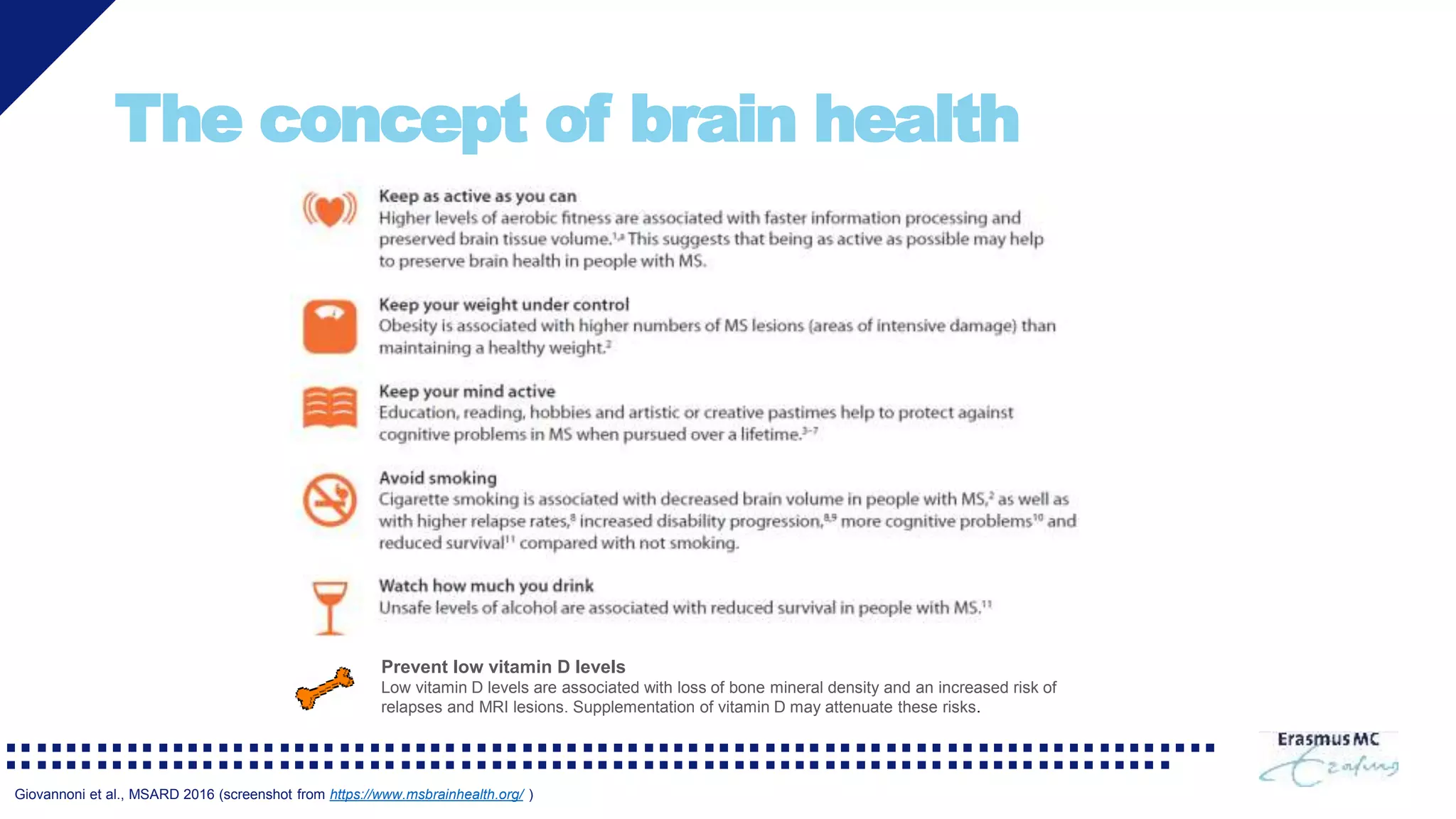
The concept of brain health
Giovannoni et al., MSARD 2016 (screenshot from https://www.msbrainhealth.org/ )
Prevent low vitamin D levels
Low vitamin D levels are associated with loss of bone mineral density and an increased risk of
relapses and MRI lesions. Supplementation of vitamin D may attenuate these risks.
What to advise pwMS?
Prevent having the lowest 25(OH)D levels
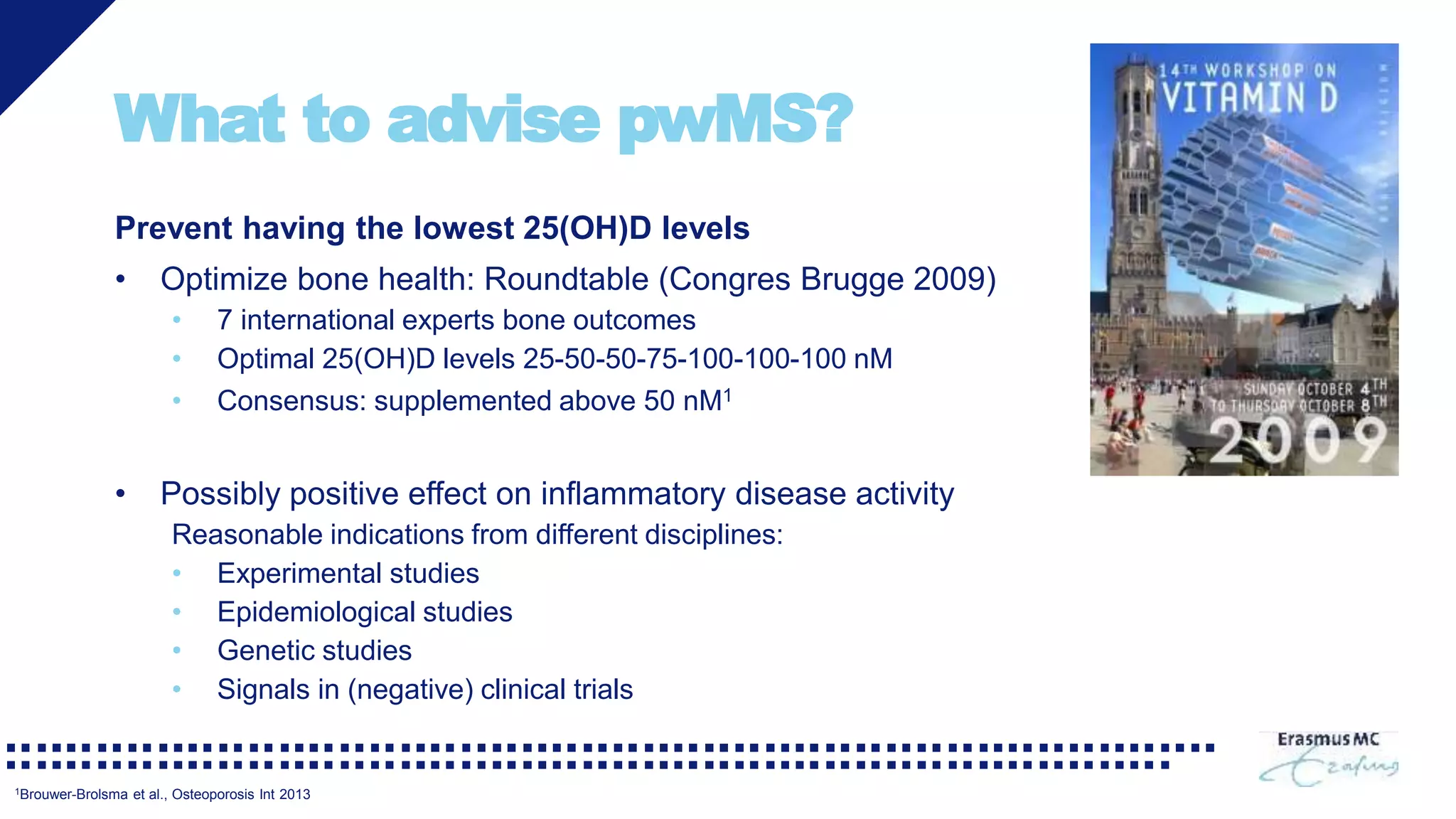
• Optimize bone health: Roundtable (Congres Brugge 2009)
• 7 international experts bone outcomes
• Optimal 25(OH)D levels 25-50-50-75-100-100-100 nM
• Consensus: supplemented above 50 nM1
• Possibly positive effect on inflammatory disease activity
Reasonable indications from different disciplines:
• Experimental studies
• Epidemiological studies
• Genetic studies
• Signals in (negative) clinical trials
1Brouwer-Brolsma et al., Osteoporosis Int 2013
What to advise pwMS?
Determine 25-hydroxyvitamin D levels
No clear benefit supra-physiological doses compared to moderate doses
25-hydroxyvitamin D levels <50nM do worse compared to >100 nM
• Vitamin D3 800 IU/d (20 µg) is advocated to prevent levels <50 nM in ambulatory
elderly1
• Vitamin D3 4000 IU/d (100 µg) induced levels >100 nM in 82% of pwRRMS2
Even moderate dose available over the counter against competitive prices
(€15.80/year or £13.64/year)
1Brouwer-Brolsma et al., Osteoporosis Int 2013; 2Rolf et al., Frontiers Neurol 2019.
Conclusion
• Low vitamin D levels are frequently encountered in people with MS
• Supplementation of low vitamin D levels is beneficial for bone metabolism in MS
• Supplementation of low vitamin D levels may be beneficial for preventing disease
activity in MS
• Supplementation to 100nM may provide additional benefit compared to 50nM (but
we really do not know)
• No clear benefit of supplementation of very high doses
Thank you for your attention!
j.j.f.m.smolders@erasmusmc.nl

Vitamin D and Multiple Sclerosis

  • 1.
    VITAMIN D AND MULTIPLE SCLEROSIS UKMS Trust – 3 Nov 2019 Joost Smolders Neurologist ErasMS
  • 2.
    Clonflicts of interest •I received consultancy/ speakers free from Biogen, Merck, Novartis, Sanofi Genzyme • I was indoctrinated by my parents that vitamins are healthy • I indoctrinate my children that vitamins are healthy
  • 3.
    “Vitamins are goodfor you” • WHY is vitamin D relevant for people with MS? • Do vitamin D supplements improve the lives of people with MS? • What should we advise people with MS?
  • 4.
    Vitamin D metabolism metabolism Activevitamin D BONESImmune cells Neurons/ glia Vit D
  • 5.
    Bone health isan issue in MS • Early MS vs controls: 20% vs 3% tendency to fall (NO)1 • Rehabilitation setting: 3-6 mnd FU 50% reports fall2-4 • pwMS 1.7-4x increased risk hip#/femur#/osteoporotic# (NL,DK,UK)5-7 • 75% pwMS osteopenia/ osteoporosis after 10 years (NO) 8 • Lower bone mass density MS vs controls9 a daily calcium intake of 1000 mg and vitamin D intake of 800 IU (20 μg) is advocated for an optimal bone health10 1Moen et al., Acta Neurol Scand 2011; 2Nilsagard et al., Clin Rehabil 2009; 3Gunn et al., Phys Ther 2013; 4Guyot et al., Ann Phys Rehad Med 2013, 5Bazelier et al., Neurology 2012; 6Bazelier et al., MSJ 2012; 7Bazelier et al., JBMR 2012; 8Simonsen et al., BMC Neurol 2016; 9Huang et al., Int J Neurosci 2015; 10National Osteoporosis Foundation.2014
  • 6.
    R R M S S P M S P P M S 0 5 0 1 00 1 5 0 2 0 0 2 5 0 serum25(OH)D(nmol/L) Vitamin D may promote bone health Bone health • (especially progressive) pwMS have low 25(OH)D levels1 • Low 25(OH)D levels associate with low bone mineral density, increased risk of falls and fractures2 • Supplementation of vitamin D3 promotes bone mineral density in people with low 25(OH)D levels3-5 1Smolders, MSJ 2008,2Bischoff-Ferrari, AM J Med,2004; 3Tang, Lancet 2007; 4Bischoff-Ferrari, JAMA 2005; 5Bischoff-Ferrari, BMJ 2009
  • 7.
    Vitamin D predictsMS outcomes Low 25(OH)D levels…. …predict high risk of new T2 or active MRI lesions in CIS and RRMS1-4 …predict high risk of relapses in CIS, contrasting reports on RRMS3-7 …correlate with high EDSS scores8,9 …predict EDSS progression in CIS3 but not in advanced (RRMS or progressive) MS4,7 CIS Clear Less clear Advanced MS 1Loken-Amsrud, Neurology 2012, 2Mowry, Ann Neurol 2012, 3Ascherio, JAMA 2014, 4Fitzgerald, JAMA Neurol 2015, 5Simpson, Ann Neurol 2010, 6Mowry, Ann Neurol 2010, 7Muris, PLoS One 2016, 8van der Mei, J Neurol 2007, 9Smolders, MSJ 2008
  • 8.
    WHY does vitaminD predict MS outcomes? Adapted from Smolders et al., in Minagar (Ed), neuroinflammation 2018 Simpson et al., Front Neurol 2018 0 1 2 3 5 9 2 4 0 2 0 4 0 6 0 t i m e ( h o u r s ) 25(OH)D3(nM) P = 0 . 0 0 4 * P = 0 . 0 0 4 * L P S i. v . Geven et al., in preparation Van der Mei et al., J Neurol 2007
  • 9.
    Vitamin D isthe precursor of an anti- inflammatory molecule L: Smolders & Damoiseaux, Vit Horm 2011; R: Cantorna et al., PNAS 1996
  • 10.
    Vitamin D metabolismis active in MS lesions MS NAWM Control NAWM Mixed active/ inactive lesion Smolders et al., JNEN 2013
  • 11.
    Genes associated withlow vitamin D levels associate with MS risk Rhead, Neurol Genet 2016 Graves et al., MSJ 2019
  • 12.
    Controlled Vitamin D supplementationstudies in MS 4 0 5 0 6 0 7 0 0 5 0 1 0 0 1 5 0 2 0 0 B a s e l i n e 2 5 ( O H ) D l e v e l s ( n M ) Reportedincrease25(OH)D interventiongroup(nM) S o i l u - H ä n n i n e n S t e i n K a m p m a n G o l a n S o t i r c h o s C a m u O 'C o n n e l H u p p e r t s Stein et al., Neurology 2011; Kampman et al., MSJ 2012; Soilu-Hänninen et al., JNNP 2012; Golan et al., BMC Neurol 2013; Sotirchos et al., Neurology 2016; O’Connel et al., MSJ ECT 2017; Camu et al., N2 2019; Hupperts et al., Neurology 2019.
  • 13.
    Clinical trials –signals in secondary endpoints • Soilu-Hänninen (Fi)1  ITT Primary T2 lesion volume increase -204mm3 (p=0.105)  ITT T1 Gd+ MRI lesions 0.1 (0.2) vs 0.7 (3.5) (p=0.0004)  ITT N new/enlarging T2 0.5 (1.0) vs 1.1 (2.2) (p=0.286) • Camu (FR)2 • Completers ARR reduction (rR 0.395; p=0.01) • Completers less new T1 MRI lesions (rR 0.494; P=0.03) • Completers lower T1 volume increase (-312 mm3; P=0.03) • Hupperts (NL)3 • ITT N CUA levels MRI reduction 31% (p=0.005) • ITT lower % increase T2 lesion volume (-2.5%, p=0.035) • ITT point estimate ARR reduction 30% (p=0.17) 1Soilu-Hänninen et al., JNNP 2012; 2Camu et al., N2 2019; 3Hupperts et al., Neurology 2019. 4 0 5 0 6 0 7 0 0 5 0 1 0 0 1 5 0 2 0 0 B a s e l i n e 2 5 ( O H ) D l e v e l s ( n M ) Reportedincrease25(OH)D interventiongroup(nM) S o i l u - H ä n n i n e n S t e i n K a m p m a n G o l a n S o t i r c h o s C a m u O 'C o n n e l H u p p e r t s
  • 14.
    Controlled studies -Biomarkers Disclaimer: small, heterogeneous cohorts • No effect of vitamin D3 supplements on circulating neurofilament light chain levels1,2 • Conflicting results on cytokine profiles/ cellular phenotypes3-11 • Reproducible (temporary) drop in Anti Epstein Bar Virus Nuclear Antigen 1 (Ebna1) IgG levels12-14 1Holmøy, Acta Neurol Scand 2019; 2Smolders, Acta Neurol Scand 2019; 3Mahon, JNI 2003; 4Åivo, JNI 2016; 5Røsjø, J Neurol 2015; 6Muris, JNI 2016; 7Sotirchos, Neurology 2016; 8Mrad, Clin Immunol 2017; 9Røsjø, JNI 2015; 10O’Connell, MSJ-ETC 2017; 11Rolf, MIM 2019 12Dissanto, MSJ 2014; 13Røsjø, MSJ 2016; 14Rolf, MSJ 2017
  • 15.
    Dangers associated withhigh doses • Toxic doses of vitamin D3 in mice exacerbated EAE1 • Three years high (10.000 IU/d) vs low (400 IU/d) dose vitamin D3 was associated with reduced bone mineral density in ambulatory healthy controls2 • Supplementation studies of high doses vitamin D3 in MS did not show safety concerns in 48-96w FU3 1Häusler et al., Brain 2019; 2Burt et al., JAMA 2019; 3Stein et al., Neurology 2011; Kampman et al., MSJ 2012; Soilu-Hänninen et al., JNNP 2012; Golan et al., BMC Neurol 2013; Sotirchos et al., Neurology 2016; O’Connel et al., MSJ ECT 2017; Camu et al., N2 2019; Hupperts et al., Neurology 2019.
  • 16.
    The concept ofbrain health Giovannoni et al., MSARD 2016 (screenshot from https://www.msbrainhealth.org/ ) Prevent low vitamin D levels Low vitamin D levels are associated with loss of bone mineral density and an increased risk of relapses and MRI lesions. Supplementation of vitamin D may attenuate these risks.
  • 17.
    What to advisepwMS? Prevent having the lowest 25(OH)D levels • Optimize bone health: Roundtable (Congres Brugge 2009) • 7 international experts bone outcomes • Optimal 25(OH)D levels 25-50-50-75-100-100-100 nM • Consensus: supplemented above 50 nM1 • Possibly positive effect on inflammatory disease activity Reasonable indications from different disciplines: • Experimental studies • Epidemiological studies • Genetic studies • Signals in (negative) clinical trials 1Brouwer-Brolsma et al., Osteoporosis Int 2013
  • 18.
    What to advisepwMS? Determine 25-hydroxyvitamin D levels No clear benefit supra-physiological doses compared to moderate doses 25-hydroxyvitamin D levels <50nM do worse compared to >100 nM • Vitamin D3 800 IU/d (20 µg) is advocated to prevent levels <50 nM in ambulatory elderly1 • Vitamin D3 4000 IU/d (100 µg) induced levels >100 nM in 82% of pwRRMS2 Even moderate dose available over the counter against competitive prices (€15.80/year or £13.64/year) 1Brouwer-Brolsma et al., Osteoporosis Int 2013; 2Rolf et al., Frontiers Neurol 2019.
  • 19.
    Conclusion • Low vitaminD levels are frequently encountered in people with MS • Supplementation of low vitamin D levels is beneficial for bone metabolism in MS • Supplementation of low vitamin D levels may be beneficial for preventing disease activity in MS • Supplementation to 100nM may provide additional benefit compared to 50nM (but we really do not know) • No clear benefit of supplementation of very high doses
  • 20.
    Thank you foryour attention! j.j.f.m.smolders@erasmusmc.nl

Editor's Notes

  • #19 Smoking 15%, obese 29%