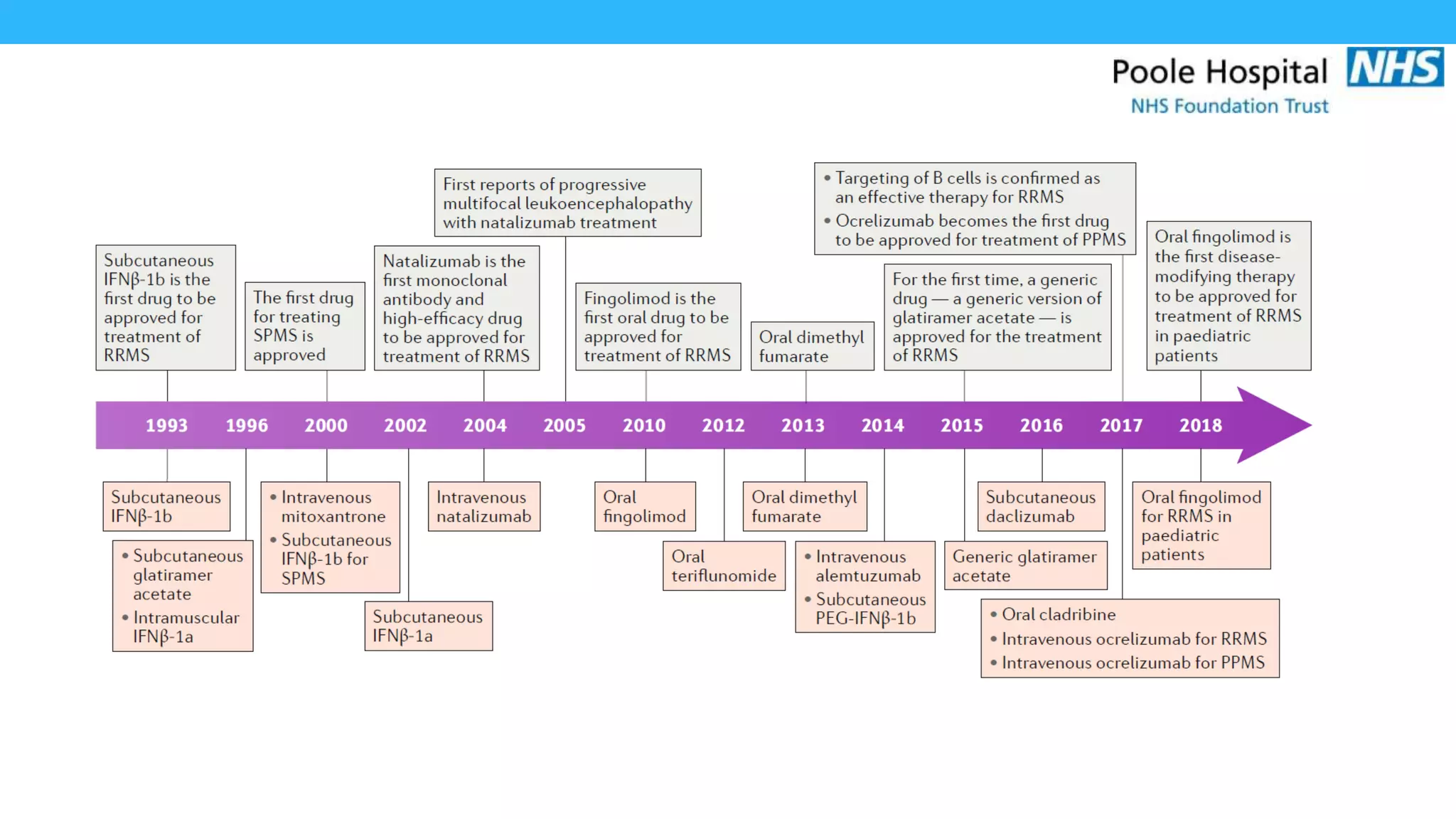
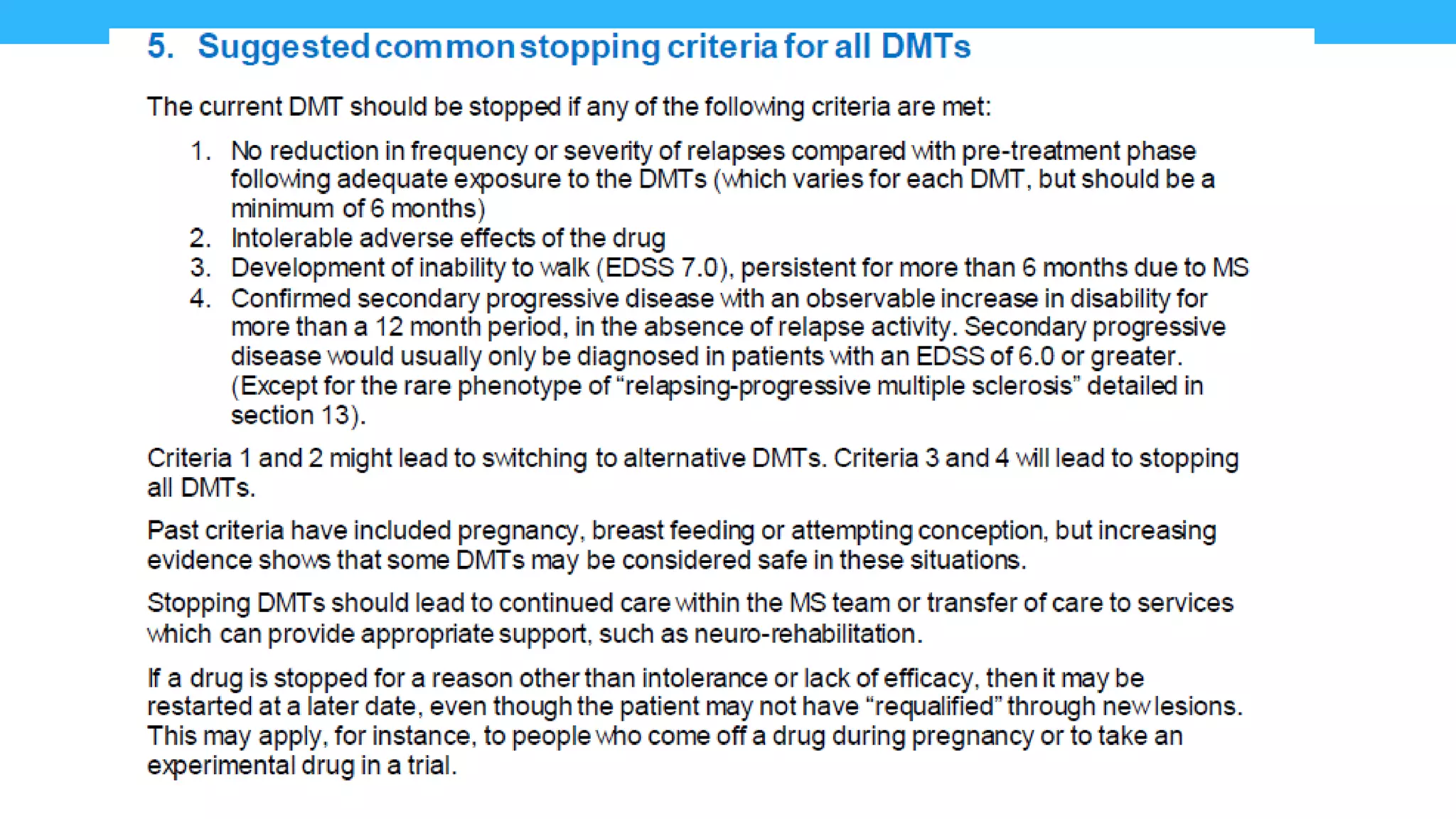
A PRACTICAL GUIDE TO STOPPING
DISEASE MODIFYING THERAPY
Charles Hillier
Michelle Davies
Cheryl King
On behalf of the Dorset MS service
November 2019
Disclosure of interest
The Dorset MS service has received lovely sandwiches’ (mainly from M&S)
from all good pharmaceutical companies involved in MS and loves twinkly
things, nice pens and misses post-it notes. We have been taken on nights out
for dinner and some of us funded to go to conferences all expenses paid (more
please). We will never knowingly obstruct a DMT prescription if the
pharmaceutical sales person is nice to us and it helps if they are good looking.
We miss the old days of unrestricted budgets to entertain us and we are sure
that we have been unbiased in our prescribing habits, but recognise that if
pharmaceutical companies do not make vast profits there will be no new drugs
for MS.
‘I want to break free from DMTs’
• Any evidence to guide us on who and when to stop?
• When to have the conversation
• The practical bit
• Group discussion Q and As
• Summary
Questions:
• When should we stopping DMTs?
• no longer effective
• causing harm – side effects
• both
• What factors influence your decision?
• type of MS
• level of disability
• length of time with MS and relapse freedom
• age
• What monitoring should take place after the decision to stop?
What image do you have of the person with
MS who should consider stopping DMTs ?
Long term side effects: IFNs Reder MSARD 2014
Long term side effects: IFN and others
• Infection
• PML
• Cancer
• Hypertension
• Long term SE of newer DMTs just not known
Outcomes in stable MS after stopping DMT
• Comparison of DMT “stoppers” (485) vs DMT “stayers (854)” MS base
• treated > 3 years with injection DMTs, mean age 45
• no relapses > 5 years
• FU > 3 years
• Key findings:
• Relapse rate the same in the two groups (25%)
• As you get older relapse rate reduced
• Disability progression did occur sooner in the ‘stoppers’
Krister JNNP 2016
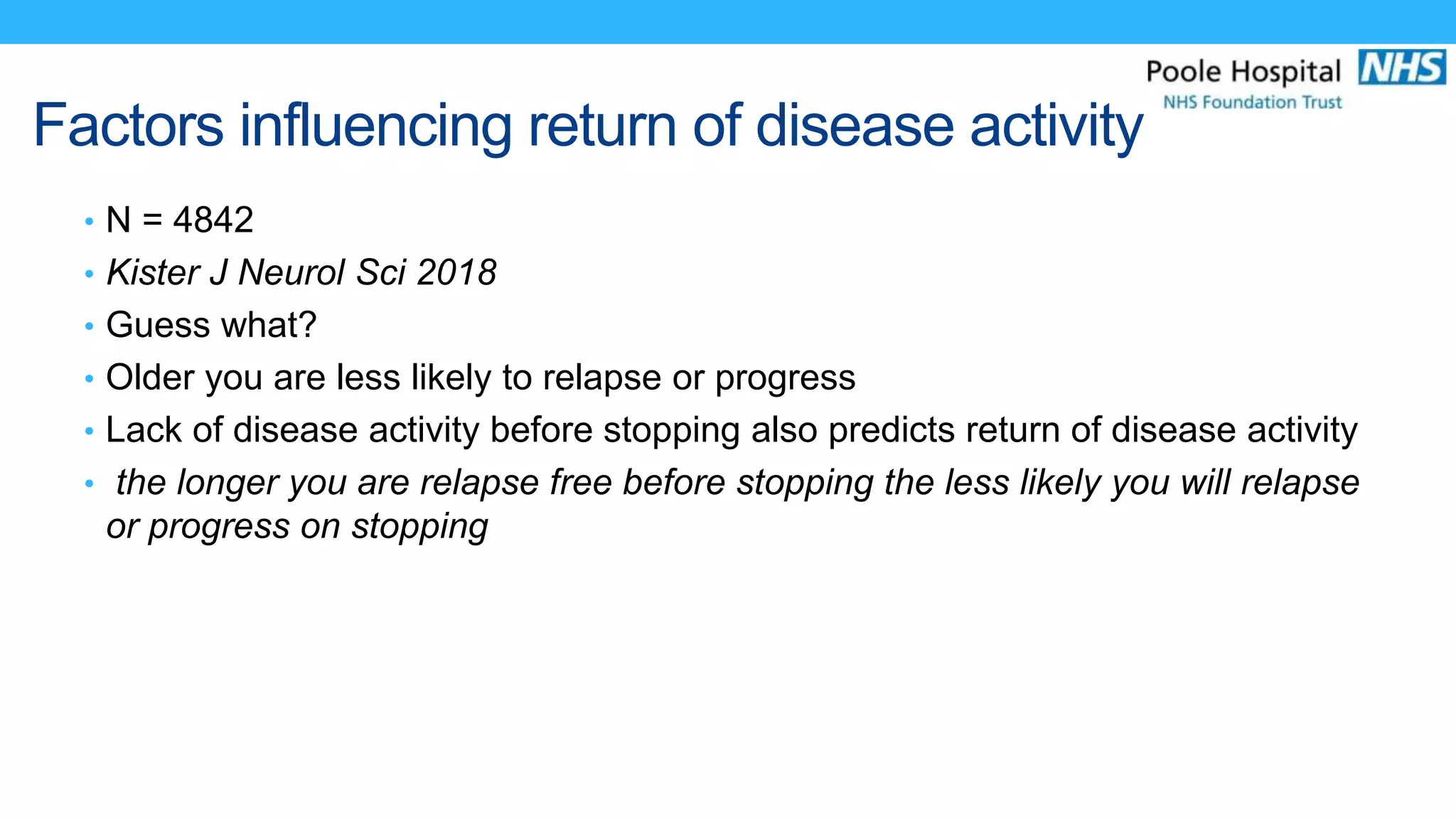
Factors influencing return of disease activity
• N = 4842
• Kister J Neurol Sci 2018
• Guess what?
• Older you are less likely to relapse or progress
• Lack of disease activity before stopping also predicts return of disease activity
• the longer you are relapse free before stopping the less likely you will relapse
or progress on stopping
Treatment effect in part age related
Inhibitionofdisabilityprogression(%)
Stopping DMTs in non relapsing MS
• Increasing age
• Stability
• Birnbaum Int J MS Care 2017
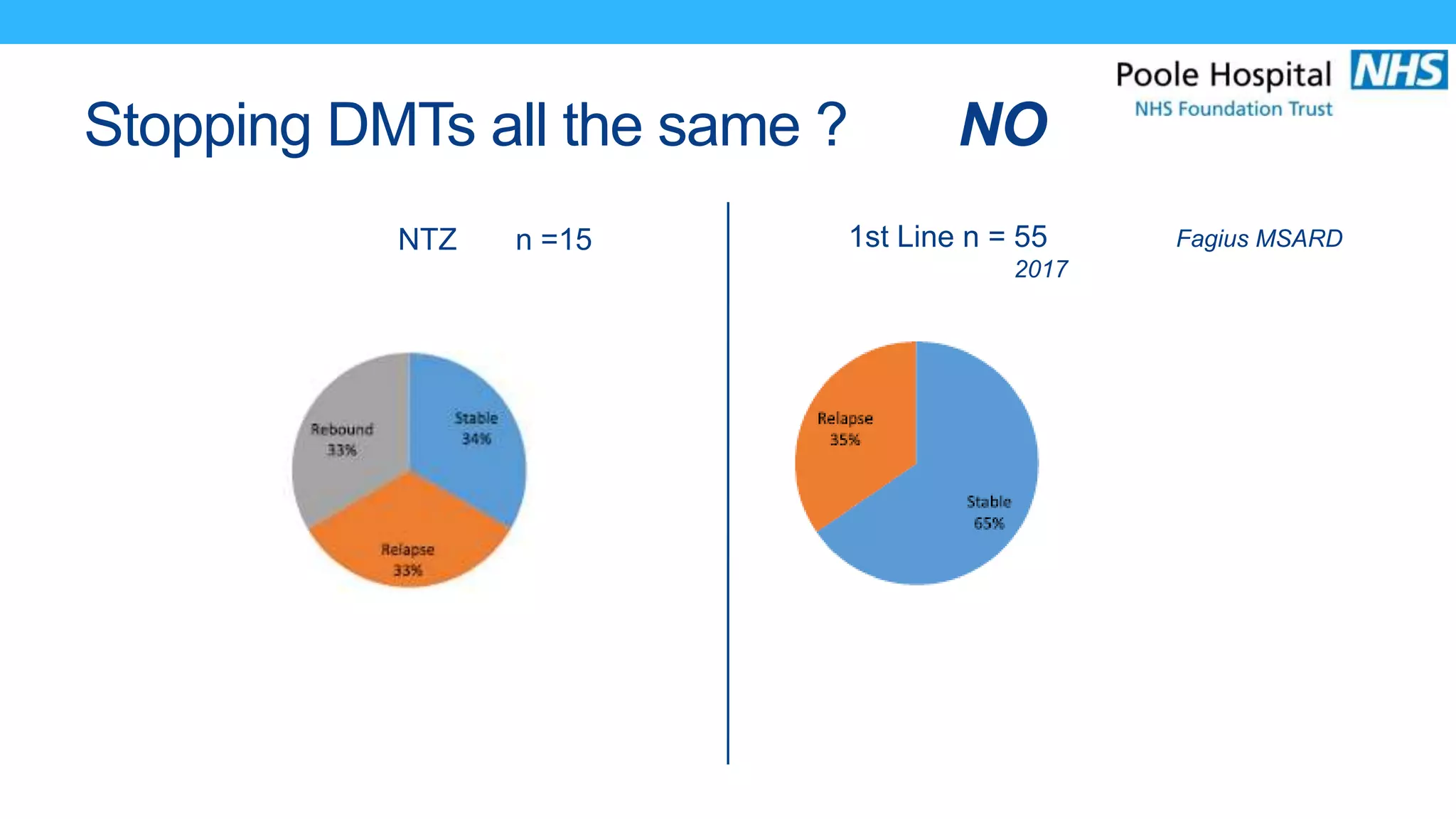
Stopping DMTs all the same ? NO
NTZ n =15 1st Line n = 55 Fagius MSARD
2017
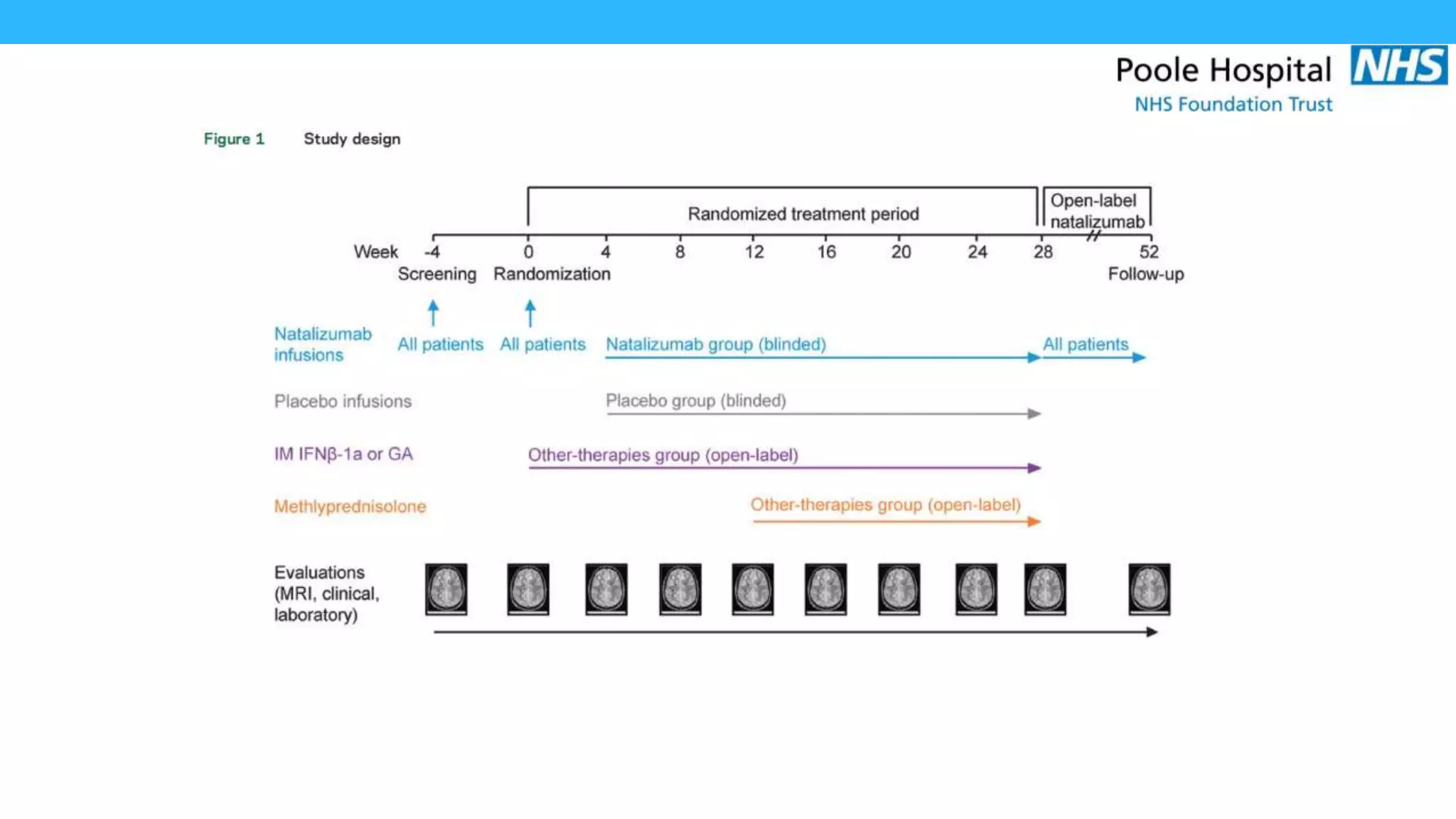
Rebound with Natalizumab (NTZ)
N=142 switch
NTZ to fingolimod
(TOFINGO)
Different washout periods
return of activity from 12
weeks.
Kappos Neurology 2015
Stopping NTZ and return of disease activity
• RESTORE (1:1:2)
• N=175
• Stable disease
• Either:
• Continue (n = 45)
• Stop (n = 42)
• GA , interferon, MP (n = 88)
• Activity return from 4 weeks
Fox Neurology 2014
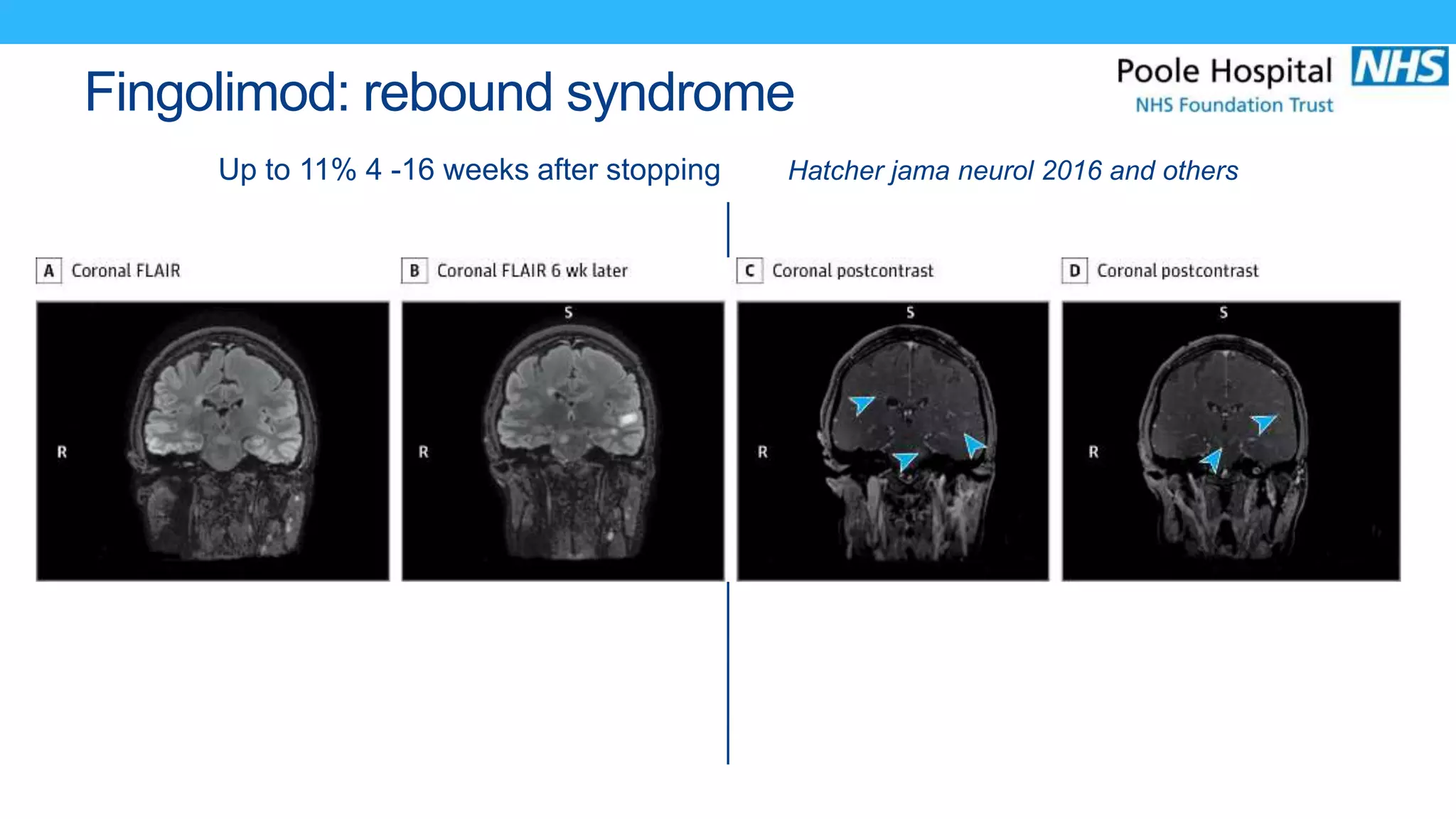
Fingolimod: rebound syndrome
Up to 11% 4 -16 weeks after stopping Hatcher jama neurol 2016 and others
Infographic summarising advice about the use of disease-modifying drugs during pregnancy
and in breastfeeding.
Ruth Dobson et al. Pract Neurol 2019;19:106-114
©2019 by BMJ Publishing Group Ltd
ARCHIE 2 years 8 months taken 21/10/19 in his new coat 😄
KENZIE 4 years 5 months. I have just started
school and I am going to be a Big Brother in 6
months.
ALEXANDER 6 months. My Mummy stopped Fingolimod Smarties to have my Big Sister Poppy.
Mummy got poorly after Poppy was born so Dr Hillier gave her Tysabri juice and she made me.
What do we do?
• Talk about stopping DMTs before starting DMTs
• Encourage women of child bearing age to think carefully before starting
fingolimod, DMF and Teriflunomide
• SPMS Interferons age > 55 Offer baseline scan before stopping
• Offer a ‘drug holiday’
• Those on NTZ switch to Fingo and continue for at least 2 years
• Promise continued follow up with same team and same members of the team
Principles to guide practice (Hua)
• Current DMTs benefits appear to reduce as inflammation naturally wanes
• Around age 60
• DMT is not without risk
• Other factors
• Stable with mild disability for several years
• Severe progressive disability despite DMT
• Cost
What have we learnt?
• Stable disease and age > 55: consider having the conversation
• Progression, Infection, EDSS 7 : consider having the conversation
• Watch out, watch out : rebound about
• Pregnancy: safe to continue GA and IFN
Consider continuing NTZ
Future Evidence: DISCO-MS trial
• US based
• RCCT
• Stable MS 5 years (RRMS or PMS)
• Age >55
• 2 years
• % new relapse / MRI activity
• % with EDSS change
• Patient reported outcome
• 250 recruited as July 19
Dorset MS Service – Continuing the legacy
The process that Dorset MS Service follows in terms of DMD is still based on
what the service did when it was set up in 2003
This is due to the benefits the service has found in terms of compliance and the
relationship with the pwMS
Juggling within existing resources
• Choices of Dorset MS Service:
• To invest in DMD counselling & education
• Improved compliance
• Reduced Rx switches
• Dorset MS Service does all counselling and follow-up
• Named practitioner for all patients
• Practitioner knows pwMS well
• Improved patient knowledge leads to improved response to changes (DMD or other)
• Reduction in time for DMD clinics
• Unable to do holistic MS review annually for all DMD patients
• Increase in DMD work has knock on effect on non-DMD caseload
• Business Cases
• To highlight capacity issues & provide data to support increase in staff
DMD Counselling
• Broad education
• 60-90 minutes
• Group/1:1
• Includes expectations for pwMS continuing on treatment with knowledge of expected side
effects
• Includes stopping criteria
• DMD specific Education
• Group/1:1
• 60 minutes
• Injectables - First injection at Poole Hospital
• Follow-up phone call day after starting treatment

A practical guide to stopping disease modifying therapy

  • 1.
    A PRACTICAL GUIDETO STOPPING DISEASE MODIFYING THERAPY Charles Hillier Michelle Davies Cheryl King On behalf of the Dorset MS service November 2019
  • 2.
    Disclosure of interest TheDorset MS service has received lovely sandwiches’ (mainly from M&S) from all good pharmaceutical companies involved in MS and loves twinkly things, nice pens and misses post-it notes. We have been taken on nights out for dinner and some of us funded to go to conferences all expenses paid (more please). We will never knowingly obstruct a DMT prescription if the pharmaceutical sales person is nice to us and it helps if they are good looking. We miss the old days of unrestricted budgets to entertain us and we are sure that we have been unbiased in our prescribing habits, but recognise that if pharmaceutical companies do not make vast profits there will be no new drugs for MS.
  • 4.
    ‘I want tobreak free from DMTs’ • Any evidence to guide us on who and when to stop? • When to have the conversation • The practical bit • Group discussion Q and As • Summary
  • 5.
    Questions: • When shouldwe stopping DMTs? • no longer effective • causing harm – side effects • both • What factors influence your decision? • type of MS • level of disability • length of time with MS and relapse freedom • age • What monitoring should take place after the decision to stop?
  • 6.
    What image doyou have of the person with MS who should consider stopping DMTs ?
  • 9.
    Long term sideeffects: IFNs Reder MSARD 2014
  • 10.
    Long term sideeffects: IFN and others • Infection • PML • Cancer • Hypertension • Long term SE of newer DMTs just not known
  • 11.
    Outcomes in stableMS after stopping DMT • Comparison of DMT “stoppers” (485) vs DMT “stayers (854)” MS base • treated > 3 years with injection DMTs, mean age 45 • no relapses > 5 years • FU > 3 years • Key findings: • Relapse rate the same in the two groups (25%) • As you get older relapse rate reduced • Disability progression did occur sooner in the ‘stoppers’ Krister JNNP 2016
  • 12.
    Factors influencing returnof disease activity • N = 4842 • Kister J Neurol Sci 2018 • Guess what? • Older you are less likely to relapse or progress • Lack of disease activity before stopping also predicts return of disease activity • the longer you are relapse free before stopping the less likely you will relapse or progress on stopping
  • 13.
    Treatment effect inpart age related Inhibitionofdisabilityprogression(%)
  • 14.
    Stopping DMTs innon relapsing MS • Increasing age • Stability • Birnbaum Int J MS Care 2017
  • 15.
    Stopping DMTs allthe same ? NO NTZ n =15 1st Line n = 55 Fagius MSARD 2017
  • 16.
    Rebound with Natalizumab(NTZ) N=142 switch NTZ to fingolimod (TOFINGO) Different washout periods return of activity from 12 weeks. Kappos Neurology 2015
  • 17.
    Stopping NTZ andreturn of disease activity • RESTORE (1:1:2) • N=175 • Stable disease • Either: • Continue (n = 45) • Stop (n = 42) • GA , interferon, MP (n = 88) • Activity return from 4 weeks Fox Neurology 2014
  • 20.
    Fingolimod: rebound syndrome Upto 11% 4 -16 weeks after stopping Hatcher jama neurol 2016 and others
  • 21.
    Infographic summarising adviceabout the use of disease-modifying drugs during pregnancy and in breastfeeding. Ruth Dobson et al. Pract Neurol 2019;19:106-114 ©2019 by BMJ Publishing Group Ltd
  • 22.
    ARCHIE 2 years8 months taken 21/10/19 in his new coat 😄 KENZIE 4 years 5 months. I have just started school and I am going to be a Big Brother in 6 months. ALEXANDER 6 months. My Mummy stopped Fingolimod Smarties to have my Big Sister Poppy. Mummy got poorly after Poppy was born so Dr Hillier gave her Tysabri juice and she made me.
  • 23.
    What do wedo? • Talk about stopping DMTs before starting DMTs • Encourage women of child bearing age to think carefully before starting fingolimod, DMF and Teriflunomide • SPMS Interferons age > 55 Offer baseline scan before stopping • Offer a ‘drug holiday’ • Those on NTZ switch to Fingo and continue for at least 2 years • Promise continued follow up with same team and same members of the team
  • 24.
    Principles to guidepractice (Hua) • Current DMTs benefits appear to reduce as inflammation naturally wanes • Around age 60 • DMT is not without risk • Other factors • Stable with mild disability for several years • Severe progressive disability despite DMT • Cost
  • 25.
    What have welearnt? • Stable disease and age > 55: consider having the conversation • Progression, Infection, EDSS 7 : consider having the conversation • Watch out, watch out : rebound about • Pregnancy: safe to continue GA and IFN Consider continuing NTZ
  • 27.
    Future Evidence: DISCO-MStrial • US based • RCCT • Stable MS 5 years (RRMS or PMS) • Age >55 • 2 years • % new relapse / MRI activity • % with EDSS change • Patient reported outcome • 250 recruited as July 19
  • 28.
    Dorset MS Service– Continuing the legacy The process that Dorset MS Service follows in terms of DMD is still based on what the service did when it was set up in 2003 This is due to the benefits the service has found in terms of compliance and the relationship with the pwMS
  • 29.
    Juggling within existingresources • Choices of Dorset MS Service: • To invest in DMD counselling & education • Improved compliance • Reduced Rx switches • Dorset MS Service does all counselling and follow-up • Named practitioner for all patients • Practitioner knows pwMS well • Improved patient knowledge leads to improved response to changes (DMD or other) • Reduction in time for DMD clinics • Unable to do holistic MS review annually for all DMD patients • Increase in DMD work has knock on effect on non-DMD caseload • Business Cases • To highlight capacity issues & provide data to support increase in staff
  • 30.
    DMD Counselling • Broadeducation • 60-90 minutes • Group/1:1 • Includes expectations for pwMS continuing on treatment with knowledge of expected side effects • Includes stopping criteria • DMD specific Education • Group/1:1 • 60 minutes • Injectables - First injection at Poole Hospital • Follow-up phone call day after starting treatment

Editor's Notes

  • #22 Infographic summarising advice about the use of disease-modifying drugs during pregnancy and in breastfeeding. IFN-B, interferon beta.