An update on the SNP and AMSC
programmes
Paru Naik
Interim Health Professionals Programmes Director
2
What will I cover?
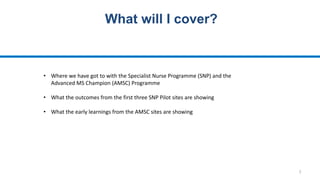
• Where we have got to with the Specialist Nurse Programme (SNP) and the
Advanced MS Champion (AMSC) Programme
• What the outcomes from the first three SNP Pilot sites are showing
• What the early learnings from the AMSC sites are showing
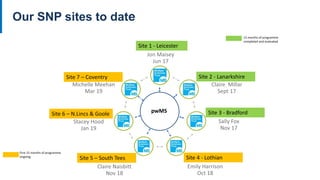
Our SNP sites to date
pwMS
Site 1 - Leicester
Site 2 - Lanarkshire
Site 3 - Bradford
Site 4 - LothianSite 5 – South Tees
Site 6 – N.Lincs & Goole
Site 7 – Coventry
15 months of programme
completed and evaluated
First 15 months of programme
ongoing
4
Meet our first SNP site team - Leicester
• Video
• https://youtu.be/oL20SejSZrc
5
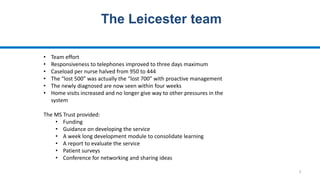
The Leicester team
• Team effort
• Responsiveness to telephones improved to three days maximum
• Caseload per nurse halved from 950 to 444
• The “lost 500” was actually the “lost 700” with proactive management
• The newly diagnosed are now seen within four weeks
• Home visits increased and no longer give way to other pressures in the
system
The MS Trust provided:
• Funding
• Guidance on developing the service
• A week long development module to consolidate learning
• A report to evaluate the service
• Patient surveys
• Conference for networking and sharing ideas
6
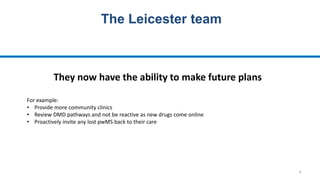
The Leicester team
They now have the ability to make future plans
For example:
• Provide more community clinics
• Review DMD pathways and not be reactive as new drugs come online
• Proactively invite any lost pwMS back to their care
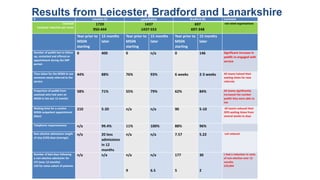
Results from Leicester, Bradford and Lanarkshirell Leicester (L) Lanarkshire Bradford (B) Comment
Caseload
Caesload reduction per nurse
1720
950-444
1437
1437-553
697
697-348
red rated organisations
Year prior to
MSSN
starting
15 months
later
Year prior to
MSSN
starting
15 months
later
Year prior to
MSSN
starting
15 months
later
Number of pwMS lost to follow
up, contacted and offered an
appointment during the SNP
period.
0 400 0 n/a 0 146 Significant increase in
pwMS re-engaged with
service
Time taken for the MSSN to see
someone newly referred to the
service
44% 88% 76% 93% 6 weeks 2-3 weeks All teams halved their
waiting times for new
referrals
Proportion of pwMS from
caseload who had seen an
MSSN in the last 12 months
58% 71% 55% 79% 62% 84% All teams significantly
increased the number
pwMS they were able to
see
Waiting time for a routine
MSSN outpatient appointment
(days)
210 5-20 n/a n/a 90 5-10 All teams reduced their
OPD waiting times from
several weeks to days
Telephone responsiveness n/a 99.4% 11% 100% 88% 96%
Non-elective admissions length
of stay (LOS) days (average)
n/a 20 less
admissions
in 12
months
n/a n/a 7.57 5.22 LoS reduced
Number of bed days following
a non-elective admission for
UTI (over 12 months)
LOS for same cohort of patients
n/a n/a n/a
9
n/a
6.5
177
5
30
2
L had a reduction in costs
of non-elective over 12
months
£29,964
8
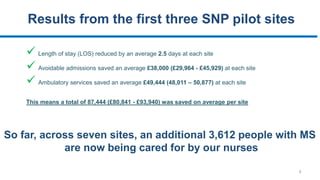
Results from the first three SNP pilot sites
 Length of stay (LOS) reduced by an average 2.5 days at each site
 Avoidable admissions saved an average £38,000 (£29,964 - £45,929) at each site
 Ambulatory services saved an average £49,444 (48,011 – 50,877) at each site
This means a total of 87,444 (£80,841 - £93,940) was saved on average per site
So far, across seven sites, an additional 3,612 people with MS
are now being cared for by our nurses
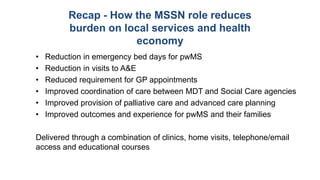
Recap - How the MSSN role reduces
burden on local services and health
economy
• Reduction in emergency bed days for pwMS
• Reduction in visits to A&E
• Reduced requirement for GP appointments
• Improved coordination of care between MDT and Social Care agencies
• Improved provision of palliative care and advanced care planning
• Improved outcomes and experience for pwMS and their families
Delivered through a combination of clinics, home visits, telephone/email
access and educational courses
10
Every MS team should have a
named professional lead for
advanced MS.
People with advanced MS and
those who care for them have a
particular need for coordinated
care from a wide range of
services.
Why don’t we
make
consensus 5
of the
forward view
(Jan 16) a
reality?
May 2017 – October club award
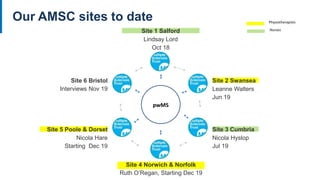
Our AMSC sites to date
Site 1 Salford
Lindsay Lord
Oct 18
Site 2 Swansea
Leanne Walters
Jun 19
Site 3 Cumbria
Nicola Hyslop
Jul 19
Site 4 Norwich & Norfolk
Ruth O’Regan, Starting Dec 19
Site 5 Poole & Dorset
Nicola Hare
Starting Dec 19
Site 6 Bristol
Interviews Nov 19
Physiotherapists
Nurses
pwMS
Number of avoidable admissions and costs
[CELLRANGE]
UTIs
23%
[CELLRANGE]
Pressure sores
22%
[CELLRANGE]
Respiratory
infections
22%
[CELLRANGE]
Aspiration/pneu
monia/resp
infections
17%
[CELLRANGE]
Falls
11%
[CELLRANGE]
Pain
5%
12
Salford – potential
£245,902 savings, 79
avoided admissions
Another comparable service independent of the MS
Trust programme demonstrated savings of £227,976,
69 avoidable admissions over a 12 month period
• Leary et al (2015)
Reduction in utilization was from a mean of
2700 bed-days per year (2002–2006) to a mean
of 198 bed-days per year (2007–2013).
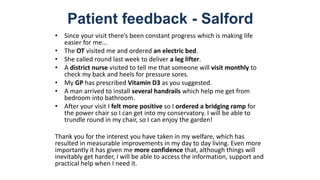
Patient feedback - Salford
• Since your visit there’s been constant progress which is making life
easier for me...
• The OT visited me and ordered an electric bed.
• She called round last week to deliver a leg lifter.
• A district nurse visited to tell me that someone will visit monthly to
check my back and heels for pressure sores.
• My GP has prescribed Vitamin D3 as you suggested.
• A man arrived to install several handrails which help me get from
bedroom into bathroom.
• After your visit I felt more positive so I ordered a bridging ramp for
the power chair so I can get into my conservatory. I will be able to
trundle round in my chair, so I can enjoy the garden!
Thank you for the interest you have taken in my welfare, which has
resulted in measurable improvements in my day to day living. Even more
importantly it has given me more confidence that, although things will
inevitably get harder, I will be able to access the information, support and
practical help when I need it.
Breaking News
14
15
Take home messages
• We can demonstrate value. You just need to know how and do it.
• Each and Every contact with a nurse/therapist should count.
• Choose what data you are going to collect appropriately. Overload
does not make prizes, it just makes for exhausted staff away from the
frontline.
• If you know you need additional resources to run your services safely
and fairly or you just need to demonstrate your current value contact
us.
We are here to help
16
A big Thankyou
• To those of you who were here from the start
• To those of you who joined us along the
journey and not least,
• To those of you who have just joined us to
continue this great and successful journey

An update on the SNP and AMSC programmes

  • 1.
    An update onthe SNP and AMSC programmes Paru Naik Interim Health Professionals Programmes Director
  • 2.
    2 What will Icover? • Where we have got to with the Specialist Nurse Programme (SNP) and the Advanced MS Champion (AMSC) Programme • What the outcomes from the first three SNP Pilot sites are showing • What the early learnings from the AMSC sites are showing
  • 3.
    Our SNP sitesto date pwMS Site 1 - Leicester Site 2 - Lanarkshire Site 3 - Bradford Site 4 - LothianSite 5 – South Tees Site 6 – N.Lincs & Goole Site 7 – Coventry 15 months of programme completed and evaluated First 15 months of programme ongoing
  • 4.
    4 Meet our firstSNP site team - Leicester • Video • https://youtu.be/oL20SejSZrc
  • 5.
    5 The Leicester team •Team effort • Responsiveness to telephones improved to three days maximum • Caseload per nurse halved from 950 to 444 • The “lost 500” was actually the “lost 700” with proactive management • The newly diagnosed are now seen within four weeks • Home visits increased and no longer give way to other pressures in the system The MS Trust provided: • Funding • Guidance on developing the service • A week long development module to consolidate learning • A report to evaluate the service • Patient surveys • Conference for networking and sharing ideas
  • 6.
    6 The Leicester team Theynow have the ability to make future plans For example: • Provide more community clinics • Review DMD pathways and not be reactive as new drugs come online • Proactively invite any lost pwMS back to their care
  • 7.
    Results from Leicester,Bradford and Lanarkshirell Leicester (L) Lanarkshire Bradford (B) Comment Caseload Caesload reduction per nurse 1720 950-444 1437 1437-553 697 697-348 red rated organisations Year prior to MSSN starting 15 months later Year prior to MSSN starting 15 months later Year prior to MSSN starting 15 months later Number of pwMS lost to follow up, contacted and offered an appointment during the SNP period. 0 400 0 n/a 0 146 Significant increase in pwMS re-engaged with service Time taken for the MSSN to see someone newly referred to the service 44% 88% 76% 93% 6 weeks 2-3 weeks All teams halved their waiting times for new referrals Proportion of pwMS from caseload who had seen an MSSN in the last 12 months 58% 71% 55% 79% 62% 84% All teams significantly increased the number pwMS they were able to see Waiting time for a routine MSSN outpatient appointment (days) 210 5-20 n/a n/a 90 5-10 All teams reduced their OPD waiting times from several weeks to days Telephone responsiveness n/a 99.4% 11% 100% 88% 96% Non-elective admissions length of stay (LOS) days (average) n/a 20 less admissions in 12 months n/a n/a 7.57 5.22 LoS reduced Number of bed days following a non-elective admission for UTI (over 12 months) LOS for same cohort of patients n/a n/a n/a 9 n/a 6.5 177 5 30 2 L had a reduction in costs of non-elective over 12 months £29,964
  • 8.
    8 Results from thefirst three SNP pilot sites  Length of stay (LOS) reduced by an average 2.5 days at each site  Avoidable admissions saved an average £38,000 (£29,964 - £45,929) at each site  Ambulatory services saved an average £49,444 (48,011 – 50,877) at each site This means a total of 87,444 (£80,841 - £93,940) was saved on average per site So far, across seven sites, an additional 3,612 people with MS are now being cared for by our nurses
  • 9.
    Recap - Howthe MSSN role reduces burden on local services and health economy • Reduction in emergency bed days for pwMS • Reduction in visits to A&E • Reduced requirement for GP appointments • Improved coordination of care between MDT and Social Care agencies • Improved provision of palliative care and advanced care planning • Improved outcomes and experience for pwMS and their families Delivered through a combination of clinics, home visits, telephone/email access and educational courses
  • 10.
    10 Every MS teamshould have a named professional lead for advanced MS. People with advanced MS and those who care for them have a particular need for coordinated care from a wide range of services. Why don’t we make consensus 5 of the forward view (Jan 16) a reality? May 2017 – October club award
  • 11.
    Our AMSC sitesto date Site 1 Salford Lindsay Lord Oct 18 Site 2 Swansea Leanne Walters Jun 19 Site 3 Cumbria Nicola Hyslop Jul 19 Site 4 Norwich & Norfolk Ruth O’Regan, Starting Dec 19 Site 5 Poole & Dorset Nicola Hare Starting Dec 19 Site 6 Bristol Interviews Nov 19 Physiotherapists Nurses pwMS
  • 12.
    Number of avoidableadmissions and costs [CELLRANGE] UTIs 23% [CELLRANGE] Pressure sores 22% [CELLRANGE] Respiratory infections 22% [CELLRANGE] Aspiration/pneu monia/resp infections 17% [CELLRANGE] Falls 11% [CELLRANGE] Pain 5% 12 Salford – potential £245,902 savings, 79 avoided admissions Another comparable service independent of the MS Trust programme demonstrated savings of £227,976, 69 avoidable admissions over a 12 month period • Leary et al (2015) Reduction in utilization was from a mean of 2700 bed-days per year (2002–2006) to a mean of 198 bed-days per year (2007–2013).
  • 13.
    Patient feedback -Salford • Since your visit there’s been constant progress which is making life easier for me... • The OT visited me and ordered an electric bed. • She called round last week to deliver a leg lifter. • A district nurse visited to tell me that someone will visit monthly to check my back and heels for pressure sores. • My GP has prescribed Vitamin D3 as you suggested. • A man arrived to install several handrails which help me get from bedroom into bathroom. • After your visit I felt more positive so I ordered a bridging ramp for the power chair so I can get into my conservatory. I will be able to trundle round in my chair, so I can enjoy the garden! Thank you for the interest you have taken in my welfare, which has resulted in measurable improvements in my day to day living. Even more importantly it has given me more confidence that, although things will inevitably get harder, I will be able to access the information, support and practical help when I need it.
  • 14.
  • 15.
    15 Take home messages •We can demonstrate value. You just need to know how and do it. • Each and Every contact with a nurse/therapist should count. • Choose what data you are going to collect appropriately. Overload does not make prizes, it just makes for exhausted staff away from the frontline. • If you know you need additional resources to run your services safely and fairly or you just need to demonstrate your current value contact us.
  • 16.
    We are hereto help 16
  • 17.
    A big Thankyou •To those of you who were here from the start • To those of you who joined us along the journey and not least, • To those of you who have just joined us to continue this great and successful journey

Editor's Notes

  • #10 Also improves patient flow within hospitals , reduces burden on GPs etc. in primary care and provides better outcomes for pwMS and their families