MS NURSES
SKILLS DEVELOPMENT WORKSHOP
Katrina Potter
Lesley Catterall
UKMSSNA Committee members
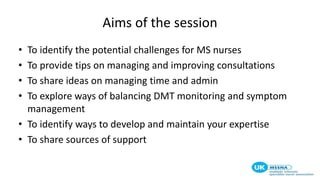
Aims of the session
• To identify the potential challenges for MS nurses
• To provide tips on managing and improving consultations
• To share ideas on managing time and admin
• To explore ways of balancing DMT monitoring and symptom
management
• To identify ways to develop and maintain your expertise
• To share sources of support
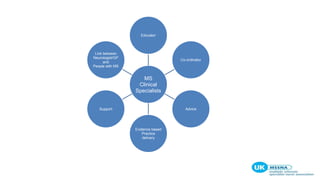
MS
Clinical
Specialists
Educator
Co-ordinator
Advice
Evidence based
Practice
delivery
Support
Link between
Neurologist/GP
and
People with MS
What are the challenges for MS
nurses?
Group exercise
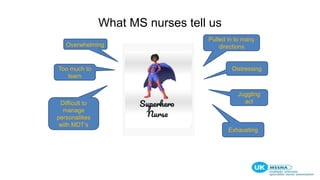
What MS nurses tell us
Overwhelming
Pulled in to many
directions
Exhausting
DistressingToo much to
learn
Juggling
actDifficult to
manage
personalities
with MDT’s
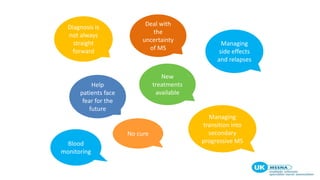
Diagnosis is
not always
straight
forward
Help
patients face
fear for the
future
Deal with
the
uncertainty
of MS
New
treatments
available
No cure
Managing
side effects
and relapses
Managing
transition into
secondary
progressive MSBlood
monitoring
How can we manage these problems?
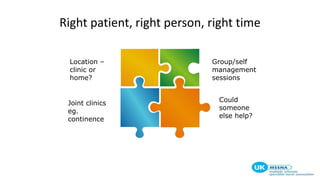
Right patient, right person, right time
Location –
clinic or
home?
Joint clinics
eg.
continence
Group/self
management
sessions
Could
someone
else help?
Managing consultations: the
challenges
Group exercise
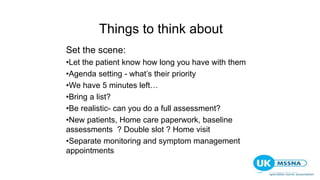
Things to think about
Set the scene:
•Let the patient know how long you have with them
•Agenda setting - what’s their priority
•We have 5 minutes left…
•Bring a list?
•Be realistic- can you do a full assessment?
•New patients, Home care paperwork, baseline
assessments ? Double slot ? Home visit
•Separate monitoring and symptom management
appointments
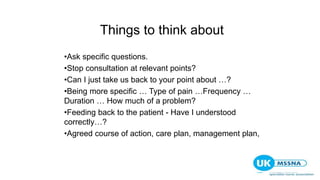
Things to think about
•Ask specific questions.
•Stop consultation at relevant points?
•Can I just take us back to your point about …?
•Being more specific … Type of pain …Frequency …
Duration … How much of a problem?
•Feeding back to the patient - Have I understood
correctly…?
•Agreed course of action, care plan, management plan,
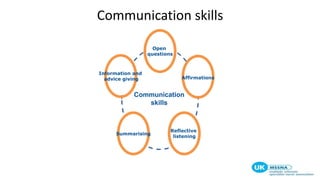
Communication skills
Communication
skills
Open
questions
Information and
advice giving
Summarising
Reflective
listening
Affirmations
Managing patient
Dependence
How do pts contact you?
Can we become “too” available?
Do we create dependence?
How can we reduce dependency?
How can we reduce
dependence?
Promoting Self Management at onset
Realistic expectations
Consider putting on phone message ‘may
not be able to return your call on the
same day’
Managing Expectations
Building the Relationship
Gaining Trust
Honesty
Education
Dispelling Myths
Appropriate Support
Shared Decision Making
Sometimes saying “No”
Consistency
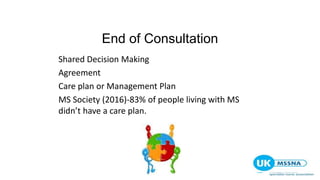
End of Consultation
Shared Decision Making
Agreement
Care plan or Management Plan
MS Society (2016)-83% of people living with MS
didn’t have a care plan.
KEYPOINTS
• Can we be too available?
• Can we promote self
management?
• Shared Decision Making
• Prioritize appropriately
• Manage our time effectively
• Plan treatment in agreement
with patient
• Get pts to be specific
• Get them back on track
• Work within our own roles and
know when to refer on and to
whom
• End the consultation on a
positive note
• Build the relationship
• Be reflective practitioners
• Know when to ask for
help/advice
• Say “NO”
• Know which consultation slot is
most appropriate
• Balance between building trust
and not creating dependence
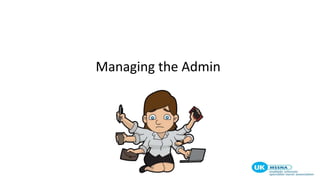
Managing the Admin
“Organisation is like exercise, its
not very effective if you do it only
once. You have to keep at it”
(Jill Pollack 2011)
Tips to becoming an organised Specialist
• Remember you cannot add hours to the day
• Set your goals
• Prioritise
• ? Benefits of multi-tasking
• Delegate where possible
• Don’t suffer from inbox congestion
• Treat phone calls like meetings
• Know yourself
• Review of your day
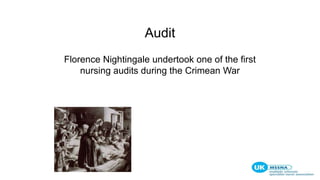
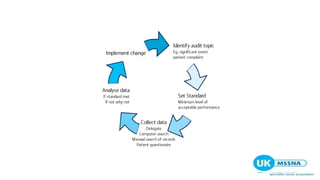
Audit
Florence Nightingale undertook one of the first
nursing audits during the Crimean War
Audit
NHS England states that:
• Clinical audit is a way to find out if healthcare is being provided in line with
standards and lets care providers and patients know where their service is
doing well, and where there could be improvements.
Different types of audit: - standards-based
audit - patient surveys
Liaise with audit department for support and help
Utilise existing tools, don’t reinvent the wheel
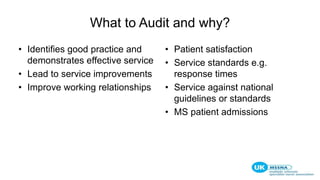
What to Audit and why?
• Identifies good practice and
demonstrates effective service
• Lead to service improvements
• Improve working relationships
• Patient satisfaction
• Service standards e.g.
response times
• Service against national
guidelines or standards
• MS patient admissions
Changing Landscape
• Increase in demand for our time
• Treatment monitoring v holistic MS care
• Reducing cost but improving quality
• Need to work smarter
• Need for expertise in other disease areas:
haematology, endocrinology, dermatology
• Increase need for knowledge of current and
emerging therapies
How do we achieve this?
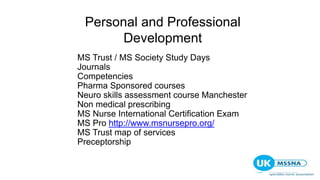
Personal and Professional
Development
MS Trust / MS Society Study Days
Journals
Competencies
Pharma Sponsored courses
Neuro skills assessment course Manchester
Non medical prescribing
MS Nurse International Certification Exam
MS Pro http://www.msnursepro.org/
MS Trust map of services
Preceptorship
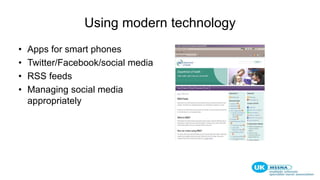
Using modern technology
• Apps for smart phones
• Twitter/Facebook/social media
• RSS feeds
• Managing social media
appropriately
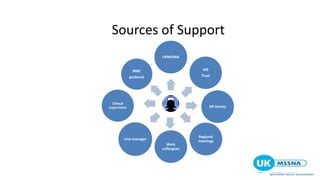
Sources of Support
UKMSSNA
MS
Trust
MS Society
Regional
meetings
Work
colleagues
Line manager
Clinical
supervision
NMC
guidance
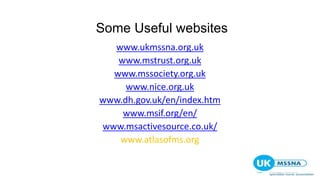
Some Useful websites
www.ukmssna.org.uk
www.mstrust.org.uk
www.mssociety.org.uk
www.nice.org.uk
www.dh.gov.uk/en/index.htm
www.msif.org/en/
www.msactivesource.co.uk/
www.atlasofms.org
Networking!
Leave contact details at UKMSSNA stand and
we will try and match you with someone with
expertise in the area you need support in
Any questions?

MS Nurses Skills Development Workshop

  • 1.
    MS NURSES SKILLS DEVELOPMENTWORKSHOP Katrina Potter Lesley Catterall UKMSSNA Committee members
  • 2.
    Aims of thesession • To identify the potential challenges for MS nurses • To provide tips on managing and improving consultations • To share ideas on managing time and admin • To explore ways of balancing DMT monitoring and symptom management • To identify ways to develop and maintain your expertise • To share sources of support
  • 3.
  • 4.
    What are thechallenges for MS nurses? Group exercise
  • 5.
    What MS nursestell us Overwhelming Pulled in to many directions Exhausting DistressingToo much to learn Juggling actDifficult to manage personalities with MDT’s
  • 6.
    Diagnosis is not always straight forward Help patientsface fear for the future Deal with the uncertainty of MS New treatments available No cure Managing side effects and relapses Managing transition into secondary progressive MSBlood monitoring
  • 7.
    How can wemanage these problems?
  • 8.
    Right patient, rightperson, right time Location – clinic or home? Joint clinics eg. continence Group/self management sessions Could someone else help?
  • 9.
  • 10.
    Things to thinkabout Set the scene: •Let the patient know how long you have with them •Agenda setting - what’s their priority •We have 5 minutes left… •Bring a list? •Be realistic- can you do a full assessment? •New patients, Home care paperwork, baseline assessments ? Double slot ? Home visit •Separate monitoring and symptom management appointments
  • 11.
    Things to thinkabout •Ask specific questions. •Stop consultation at relevant points? •Can I just take us back to your point about …? •Being more specific … Type of pain …Frequency … Duration … How much of a problem? •Feeding back to the patient - Have I understood correctly…? •Agreed course of action, care plan, management plan,
  • 12.
    Communication skills Communication skills Open questions Information and advicegiving Summarising Reflective listening Affirmations
  • 13.
    Managing patient Dependence How dopts contact you? Can we become “too” available? Do we create dependence? How can we reduce dependency?
  • 14.
    How can wereduce dependence? Promoting Self Management at onset Realistic expectations Consider putting on phone message ‘may not be able to return your call on the same day’
  • 15.
    Managing Expectations Building theRelationship Gaining Trust Honesty Education Dispelling Myths Appropriate Support Shared Decision Making Sometimes saying “No” Consistency
  • 16.
    End of Consultation SharedDecision Making Agreement Care plan or Management Plan MS Society (2016)-83% of people living with MS didn’t have a care plan.
  • 17.
    KEYPOINTS • Can webe too available? • Can we promote self management? • Shared Decision Making • Prioritize appropriately • Manage our time effectively • Plan treatment in agreement with patient • Get pts to be specific • Get them back on track • Work within our own roles and know when to refer on and to whom • End the consultation on a positive note • Build the relationship • Be reflective practitioners • Know when to ask for help/advice • Say “NO” • Know which consultation slot is most appropriate • Balance between building trust and not creating dependence
  • 18.
  • 20.
    “Organisation is likeexercise, its not very effective if you do it only once. You have to keep at it” (Jill Pollack 2011)
  • 21.
    Tips to becomingan organised Specialist • Remember you cannot add hours to the day • Set your goals • Prioritise • ? Benefits of multi-tasking • Delegate where possible • Don’t suffer from inbox congestion • Treat phone calls like meetings • Know yourself • Review of your day
  • 22.
    Audit Florence Nightingale undertookone of the first nursing audits during the Crimean War
  • 23.
    Audit NHS England statesthat: • Clinical audit is a way to find out if healthcare is being provided in line with standards and lets care providers and patients know where their service is doing well, and where there could be improvements. Different types of audit: - standards-based audit - patient surveys Liaise with audit department for support and help Utilise existing tools, don’t reinvent the wheel
  • 25.
    What to Auditand why? • Identifies good practice and demonstrates effective service • Lead to service improvements • Improve working relationships • Patient satisfaction • Service standards e.g. response times • Service against national guidelines or standards • MS patient admissions
  • 27.
    Changing Landscape • Increasein demand for our time • Treatment monitoring v holistic MS care • Reducing cost but improving quality • Need to work smarter • Need for expertise in other disease areas: haematology, endocrinology, dermatology • Increase need for knowledge of current and emerging therapies
  • 28.
    How do weachieve this?
  • 29.
    Personal and Professional Development MSTrust / MS Society Study Days Journals Competencies Pharma Sponsored courses Neuro skills assessment course Manchester Non medical prescribing MS Nurse International Certification Exam MS Pro http://www.msnursepro.org/ MS Trust map of services Preceptorship
  • 30.
    Using modern technology •Apps for smart phones • Twitter/Facebook/social media • RSS feeds • Managing social media appropriately
  • 31.
    Sources of Support UKMSSNA MS Trust MSSociety Regional meetings Work colleagues Line manager Clinical supervision NMC guidance
  • 32.
  • 33.
    Networking! Leave contact detailsat UKMSSNA stand and we will try and match you with someone with expertise in the area you need support in
  • 34.

Editor's Notes

  • #2 Introduce self and Emma Other members of UKMSSNA make yourselves known Introduce themselves name where they work community/acute, specialist centre length of time in post
  • #3 Liz tips and admin Emma audit, being a specialist and support Please be interactive, we may not have the answers you may
  • #8 Each service will be unique, not one answer will fit all
  • #11 Length of time slot in letter Some patients you know will take longer book double slots or I put them at the end of clinic New patients have double slots Some services run sessions to discuss DMDs to a group of patients rather than seeing people on a one to one basis Be clever with your limited time HV for those unable to get to clinic, although have transport issues
  • #12 Think of ways you can end your consultation in a professional and thoughtful way ‘I realise we have not addressed everything today shall we book another appointment to cover your other concerns?’ Summing up can be a useful tool Sometimes you just have to get up and open the door, standing up is helpful, closing the file, putting pen down Sometimes closed questions are good, yes/no answers
  • #14 Use motivational interviewing techniques shared decision making, advise attending local course, good for goal orientated client centred care We all have patients that contact us all the time but in my experience most patients don’t contact you unless it is really important to them or you have asked them. Getting to know your case load really helps Usually patients have a unique selling point to help you remember you they are Flexible Email, phone, drop in clinics
  • #15 Plus care plan so patients know when to contact you and when to contact others
  • #22 I now have 1 day a month where I work form home and do all the tedious admin/paperwork projects e.g. teaching sessions, online training, write policy etc. this way when projects come in I know I have set time to complete them I work best one by completing one task at a time
  • #25 Can be auditing a standard or about a problem you are facing and planning a change Great idea to audit your service before setting up the service as then will have comparison of effectiveness of the service Keep audit small and doable Ensure you complete the circle and implement change then audit the change Liaise with audit departments for support and help Utilise existing tolls, don’t reinvent the wheel
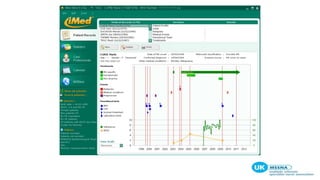
  • #26 Use of GEMMS survey tool, compares your service against national MS services NICE guidelines 2014 have audit on line for you to complete to see how your service is doing against this guideline, what improvements need to be made
  • #27 ?remove
  • #30 UKMSSNA care manual working on competencies with MS trust Identify own gaps in knowledge may be IT skills, presentation skills, motivational interviewingetc