Demonstrating your value
GuyHannan–EvaluationsManager,MSTrust
ParuNaik-InterimHealthProfessionalsProgrammesDirector,MSTrust
2
What will we cover?
• What data you might need
• Case study analysis
3
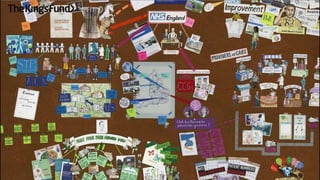
The NHS
4
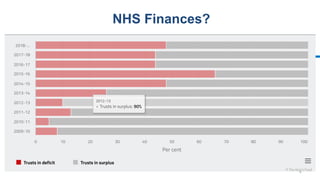
NHS Finances?
5
Important people you need to be friends with
• Your manager
• Your information manager
• Your finance manager
• Your Divisional/director nurse/therapist/other
• Your HR manager
• Who are your commissioners
6
Tools you need access to
• Local databases
• Information from any centralised system
• Excel
7
What is block funding vs PbR
• Under the payment by results tariff, a provider is paid according to the
number of treatments or operations it performs.
• Whereas a block or risk share contract means the contract value is
fixed, or partially fixed, usually over the course of a year.
• Payment by results PbR was introduced by the Department of Health
in the early 2000s, with the aim of improving efficiency, volume of
activity and quality of care.
One in four acute providers now mostly contracted through some
form of block payment or risk share, research suggests
28% increase in the cash value of block contracts in 2017-18,
compared to 2016-17
8
9
Individual work
How do you currently add value as an
Individual?
10
Group work
What is it you do that makes a difference?
11
Group work
What is it you do that makes a difference?
Feedback
12
Group work
How do you currently demonstrate this
and where?
13
Case Studies
The most influential data you
will ever collect
14
Case Studies
Feed back
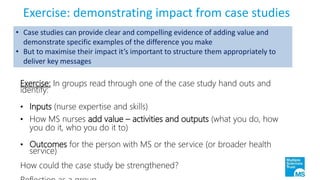
Exercise: demonstrating impact from case studies
Exercise: In groups read through one of the case study hand outs and
identify:
• Inputs (nurse expertise and skills)
• How MS nurses add value – activities and outputs (what you do, how
you do it, who you do it to)
• Outcomes for the person with MS or the service (or broader health
service)
How could the case study be strengthened?
• Case studies can provide clear and compelling evidence of adding value and
demonstrate specific examples of the difference you make
• But to maximise their impact it’s important to structure them appropriately to
deliver key messages
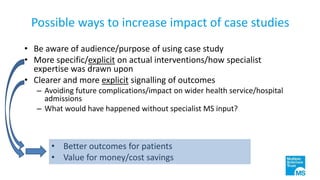
Possible ways to increase impact of case studies
• Be aware of audience/purpose of using case study
• More specific/explicit on actual interventions/how specialist
expertise was drawn upon
• Clearer and more explicit signalling of outcomes
– Avoiding future complications/impact on wider health service/hospital
admissions
– What would have happened without specialist MS input?
• Better outcomes for patients
• Value for money/cost savings
17
Take home message
• Many managers do not understand your service – its up to you
• Create a story/journey for your service you can share
• What’s happened
• What have you done
• What would you like to do
• Take your decision makers on your journey not just when you want something but to inform
• Get the people you have got to know e.g information manager to help and send regular reports
• If you are struggling get in touch with us – we will help
18
19
Thank you

Demonstrating your value

  • 1.
  • 2.
    2 What will wecover? • What data you might need • Case study analysis
  • 3.
  • 4.
  • 5.
    5 Important people youneed to be friends with • Your manager • Your information manager • Your finance manager • Your Divisional/director nurse/therapist/other • Your HR manager • Who are your commissioners
  • 6.
    6 Tools you needaccess to • Local databases • Information from any centralised system • Excel
  • 7.
    7 What is blockfunding vs PbR • Under the payment by results tariff, a provider is paid according to the number of treatments or operations it performs. • Whereas a block or risk share contract means the contract value is fixed, or partially fixed, usually over the course of a year. • Payment by results PbR was introduced by the Department of Health in the early 2000s, with the aim of improving efficiency, volume of activity and quality of care. One in four acute providers now mostly contracted through some form of block payment or risk share, research suggests 28% increase in the cash value of block contracts in 2017-18, compared to 2016-17
  • 8.
  • 9.
    9 Individual work How doyou currently add value as an Individual?
  • 10.
    10 Group work What isit you do that makes a difference?
  • 11.
    11 Group work What isit you do that makes a difference? Feedback
  • 12.
    12 Group work How doyou currently demonstrate this and where?
  • 13.
    13 Case Studies The mostinfluential data you will ever collect
  • 14.
  • 15.
    Exercise: demonstrating impactfrom case studies Exercise: In groups read through one of the case study hand outs and identify: • Inputs (nurse expertise and skills) • How MS nurses add value – activities and outputs (what you do, how you do it, who you do it to) • Outcomes for the person with MS or the service (or broader health service) How could the case study be strengthened? • Case studies can provide clear and compelling evidence of adding value and demonstrate specific examples of the difference you make • But to maximise their impact it’s important to structure them appropriately to deliver key messages
  • 16.
    Possible ways toincrease impact of case studies • Be aware of audience/purpose of using case study • More specific/explicit on actual interventions/how specialist expertise was drawn upon • Clearer and more explicit signalling of outcomes – Avoiding future complications/impact on wider health service/hospital admissions – What would have happened without specialist MS input? • Better outcomes for patients • Value for money/cost savings
  • 17.
    17 Take home message •Many managers do not understand your service – its up to you • Create a story/journey for your service you can share • What’s happened • What have you done • What would you like to do • Take your decision makers on your journey not just when you want something but to inform • Get the people you have got to know e.g information manager to help and send regular reports • If you are struggling get in touch with us – we will help
  • 18.
  • 19.

Editor's Notes

  • #17 Be aware of audience/purpose: This shapes what you need to say, and important in this is understanding what different audiences will want to hear. For example, if it’s for a business case to get extra resource (being read by a commissioner) strongly emphasising potential cost savings could be appropriate, but if for a support group more of a focus on patient clinical and emotional outcomes could be more impactful. This is not to say commissioners are not interested in these, but a targeted emphasis depending on audience will increase impact. More explicit on actual interventions. It may be obvious to you and you might feel explaining some things is too simplistic, but the reader of the case study may not fully appreciate what you actually did. Eg, in the spasticity case study it mentions the MSSN knew the approach would have to be a team one, but doesn’t explicitly state the lead role she took in ensure this team was engaged. More explicit on specialist expertise: Again, the reader of the case study may not fully appreciate how your experience and expertise has allowed you to inform your judgement and intervention. So rather than saying ”it was decided”, something like “using my specialist judgement I decided”, or “my specialist into MDT discussions contributed towards a decision”. More explicit on outcomes: The example case studies talk about getting a more speedy recovery from a relapse, Marie returning to work more quickly and reconsidering the decision to not use a disease modifying therapy. And in the second reducing the impact of spasticity and emotional impact of MS. These are great, but were there other likely outcomes not stated? In either of these cases, or more in general, could there have been any further complications that may have led to the patient having to make more use of the health service/possibly hospital admission. If so, be explicit. ASCM evaluation. What would have happened without specialist MS input? Not just what did, but but might have happened. AMSC evaluation – many not seen by MS specialist in years, and when have been much better outcomes. Ultimately this is all about demonstrating how MS specialist input achieves better outcomes for patients, and importantly value for money. You know what value you add, but it’s all about demonstrating this in the clearest and most explicit way possible.