By: Swaraj Mane
Initial Phase
Successful
CompanyEffectiveManagerialFunctions
ImplicationsofFunctions
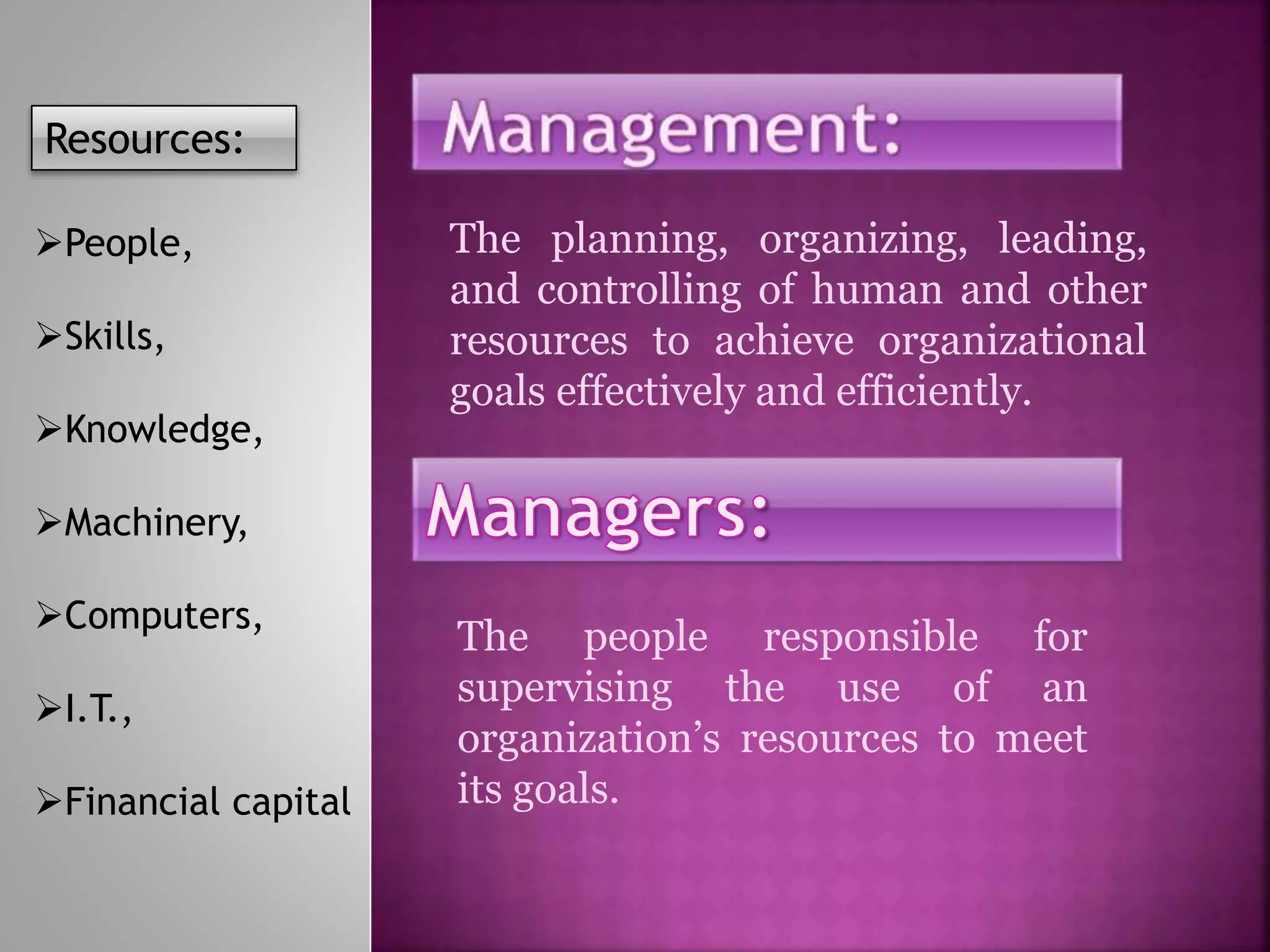
The planning, organizing, leading,
and controlling of human and other
resources to achieve organizational
goals effectively and efficiently.
The people responsible for
supervising the use of an
organization’s resources to meet
its goals.
Resources:
People,
Skills,
Knowledge,
Machinery,
Computers,
I.T.,
Financial capital
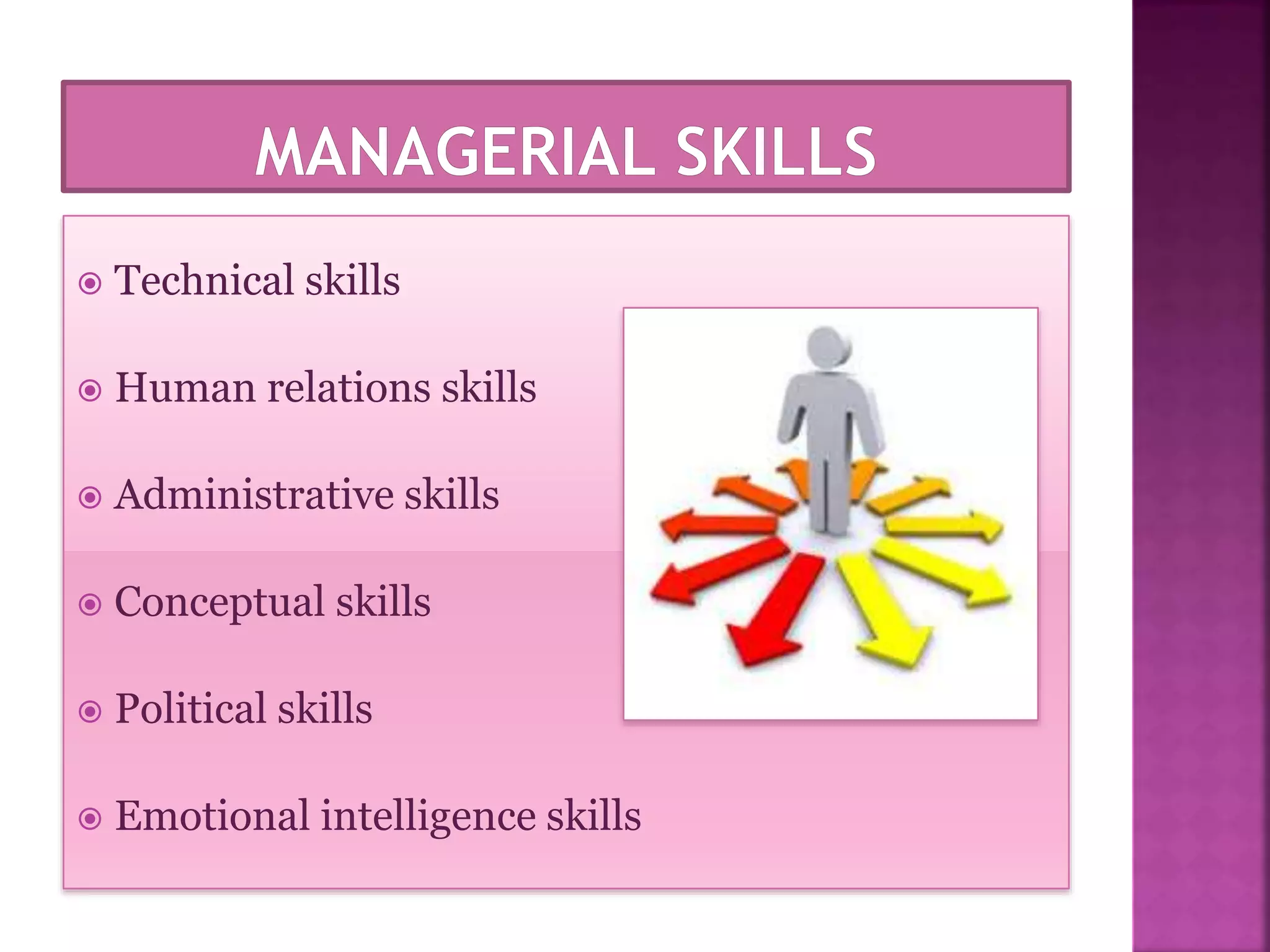
 Technical skills
 Human relations skills
 Administrative skills
 Conceptual skills
 Political skills
 Emotional intelligence skills
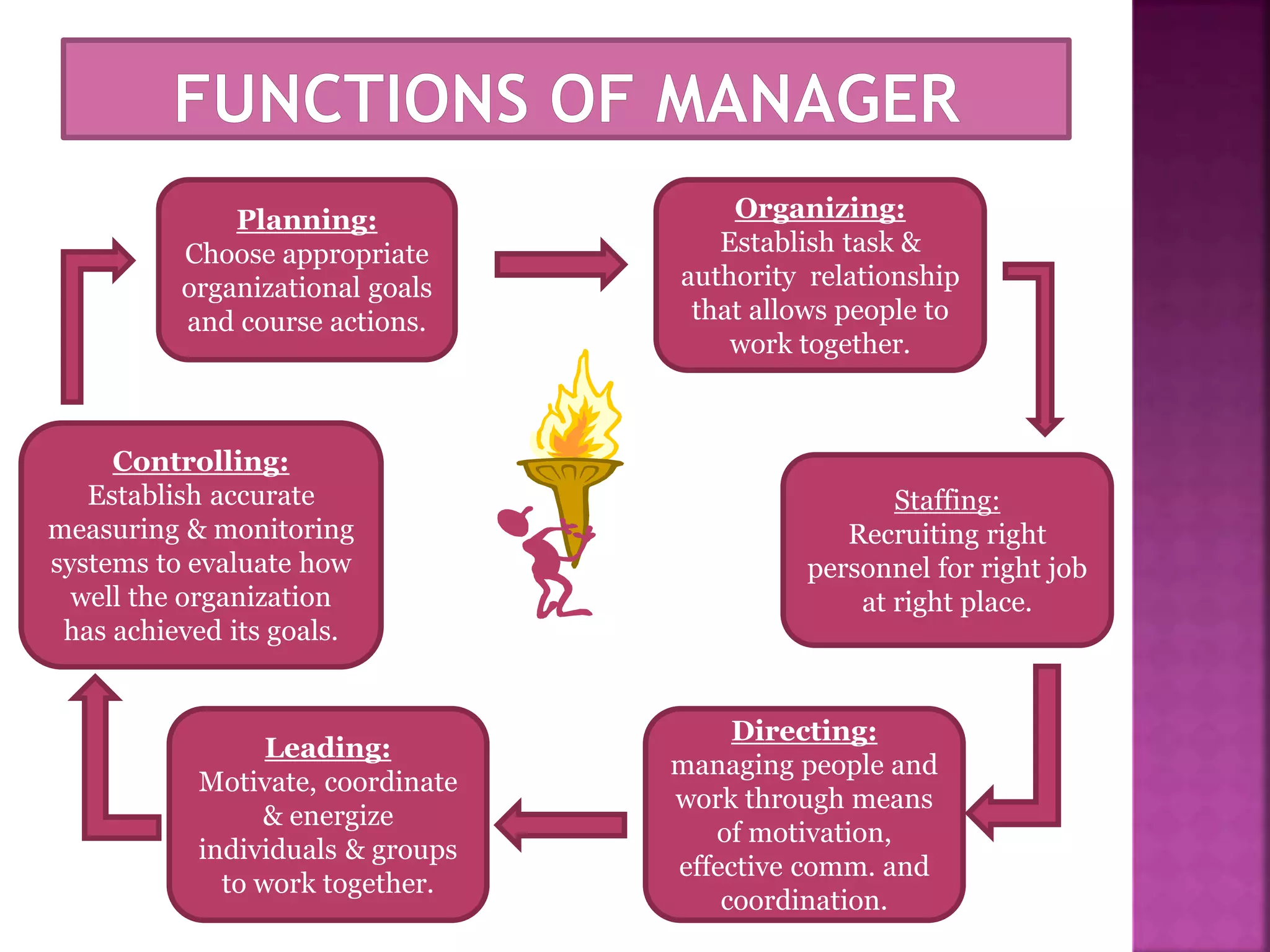
Planning:
Choose appropriate
organizational goals
and course actions.
Leading:
Motivate, coordinate
& energize
individuals & groups
to work together.
Controlling:
Establish accurate
measuring & monitoring
systems to evaluate how
well the organization
has achieved its goals.
Staffing:
Recruiting right
personnel for right job
at right place.
Organizing:
Establish task &
authority relationship
that allows people to
work together.
Directing:
managing people and
work through means
of motivation,
effective comm. and
coordination.
 “Deciding in advance What to do , how to do it, when to do it, and
who is to do it.”
 Deciding about all the aspects.
Characteristics:
1) Focuses on achieving the objectives.
2) The primary function of
Management.
3) It is continuous.
4) It is Futuristic.
5) It is mental exercise
 What to do?
 how to do it?
 When to do it?
 Who is to do it?
Importance Process
 Facilitates decision
making.
 Reduces risk of
uncertainty.
 Reduces overlapping &
wasteful activities.
 Provides directions.
 Establishes standards for
controlling.
 Forecasting.
 Establishing Objectives.
 Programming.
 Scheduling.
 Budgeting.
 Establishing Procedures.
 Developing Policies.
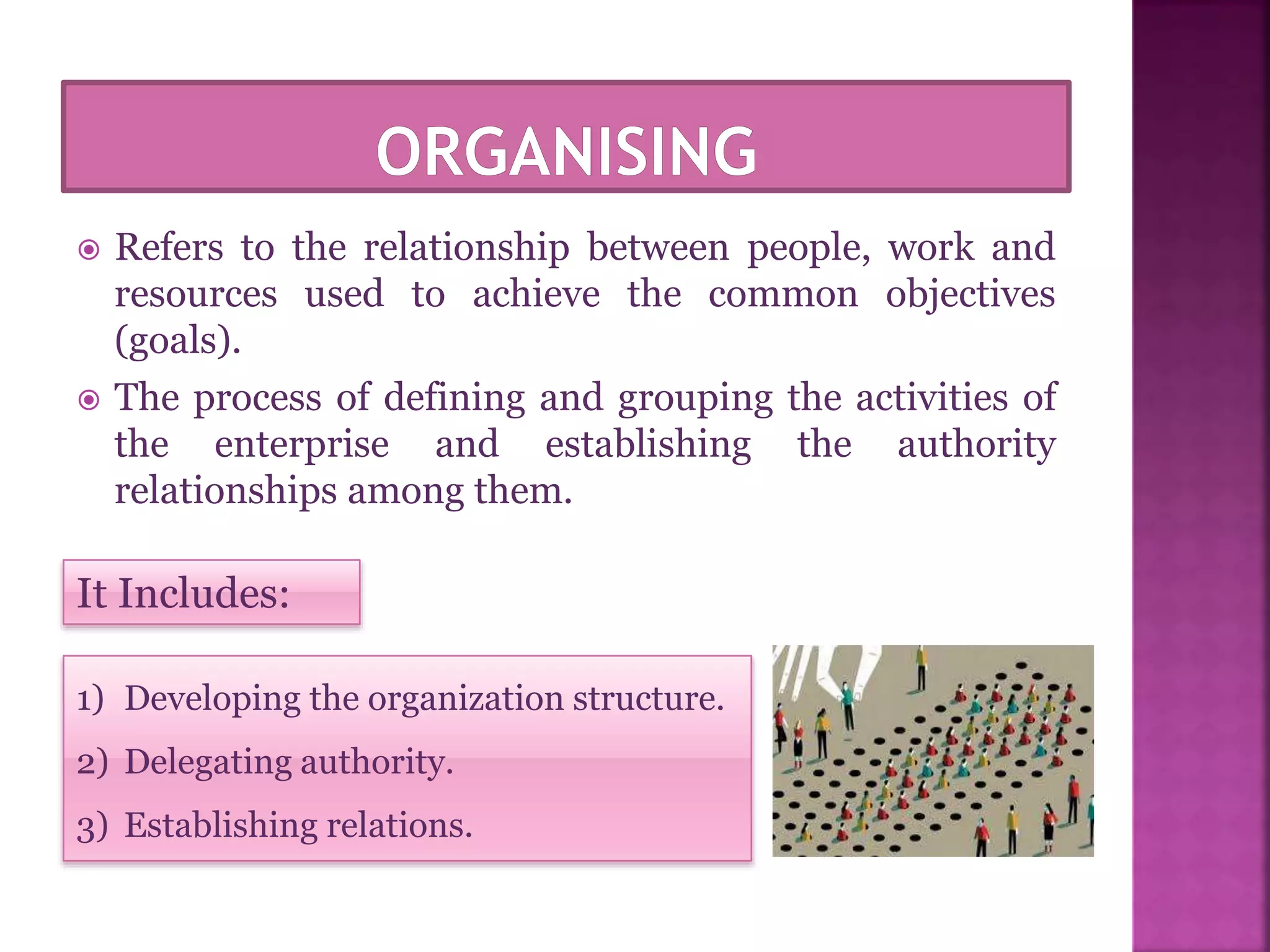
 Refers to the relationship between people, work and
resources used to achieve the common objectives
(goals).
 The process of defining and grouping the activities of
the enterprise and establishing the authority
relationships among them.
It Includes:
1) Developing the organization structure.
2) Delegating authority.
3) Establishing relations.
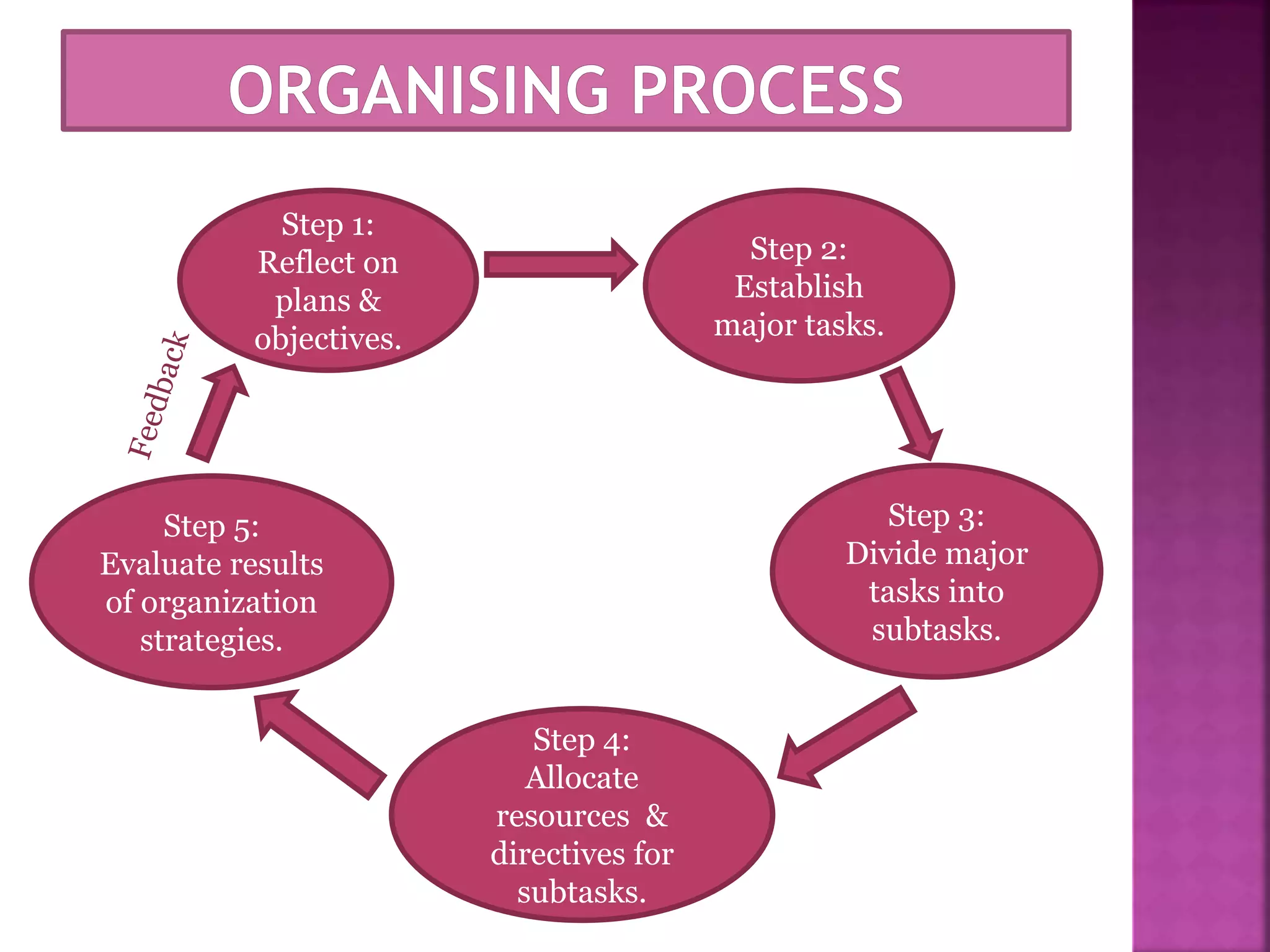
Step 5:
Evaluate results
of organization
strategies.
Step 4:
Allocate
resources &
directives for
subtasks.
Step 2:
Establish
major tasks.
Step 3:
Divide major
tasks into
subtasks.
Step 1:
Reflect on
plans &
objectives.
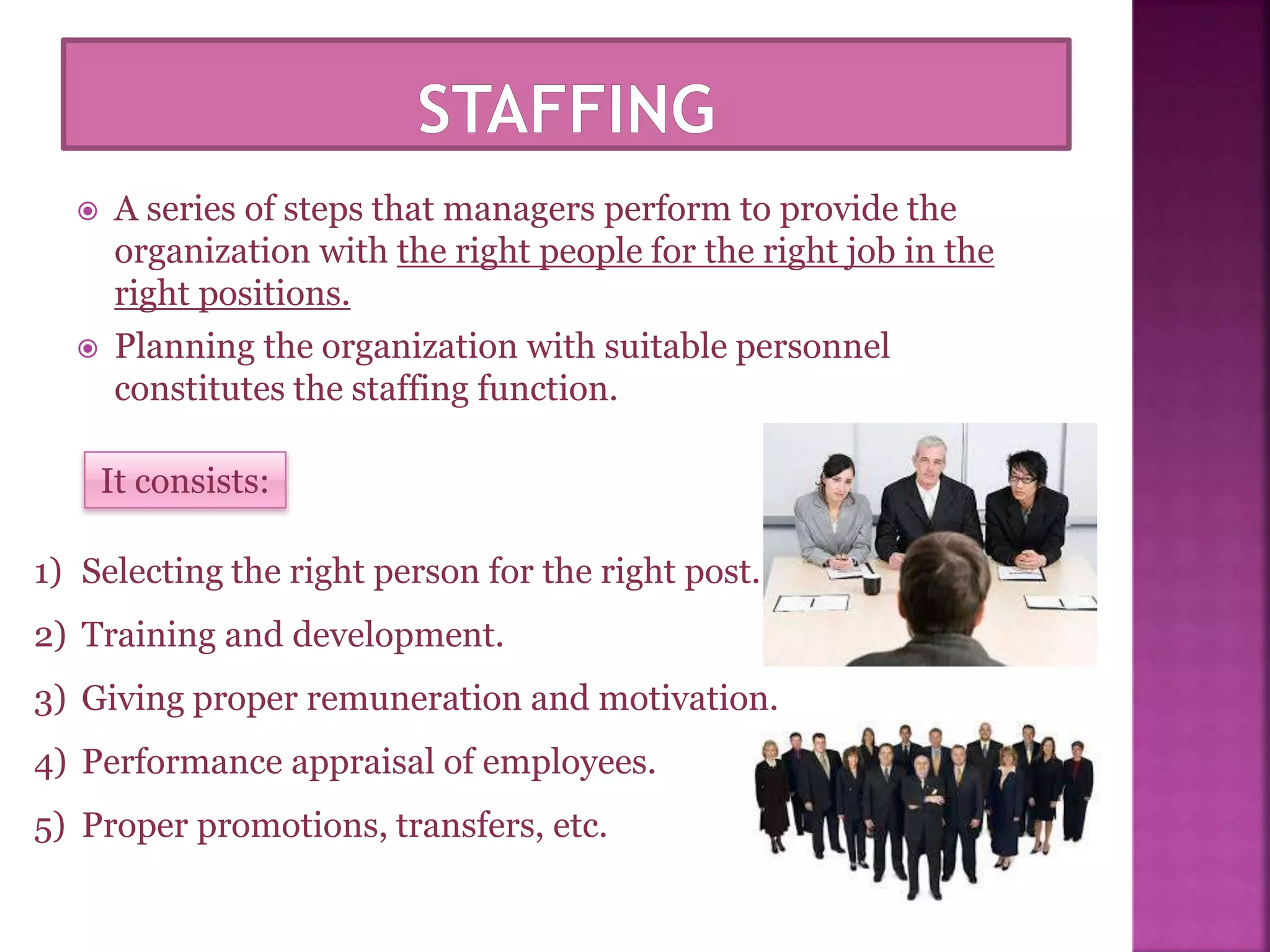
 A series of steps that managers perform to provide the
organization with the right people for the right job in the
right positions.
 Planning the organization with suitable personnel
constitutes the staffing function.
It consists:
1) Selecting the right person for the right post.
2) Training and development.
3) Giving proper remuneration and motivation.
4) Performance appraisal of employees.
5) Proper promotions, transfers, etc.
Internal factor External factor
1) Promotion policy
2) Future growth plans
3) Technology used
4) Support from top
management
5) Image of organization.
1) Labor laws
2) Pressure from socio-
political groups
3) Competition
4) Educational standards
5) Other external factors
Sources of Applicants:
1) Internal Source
2) External Sources
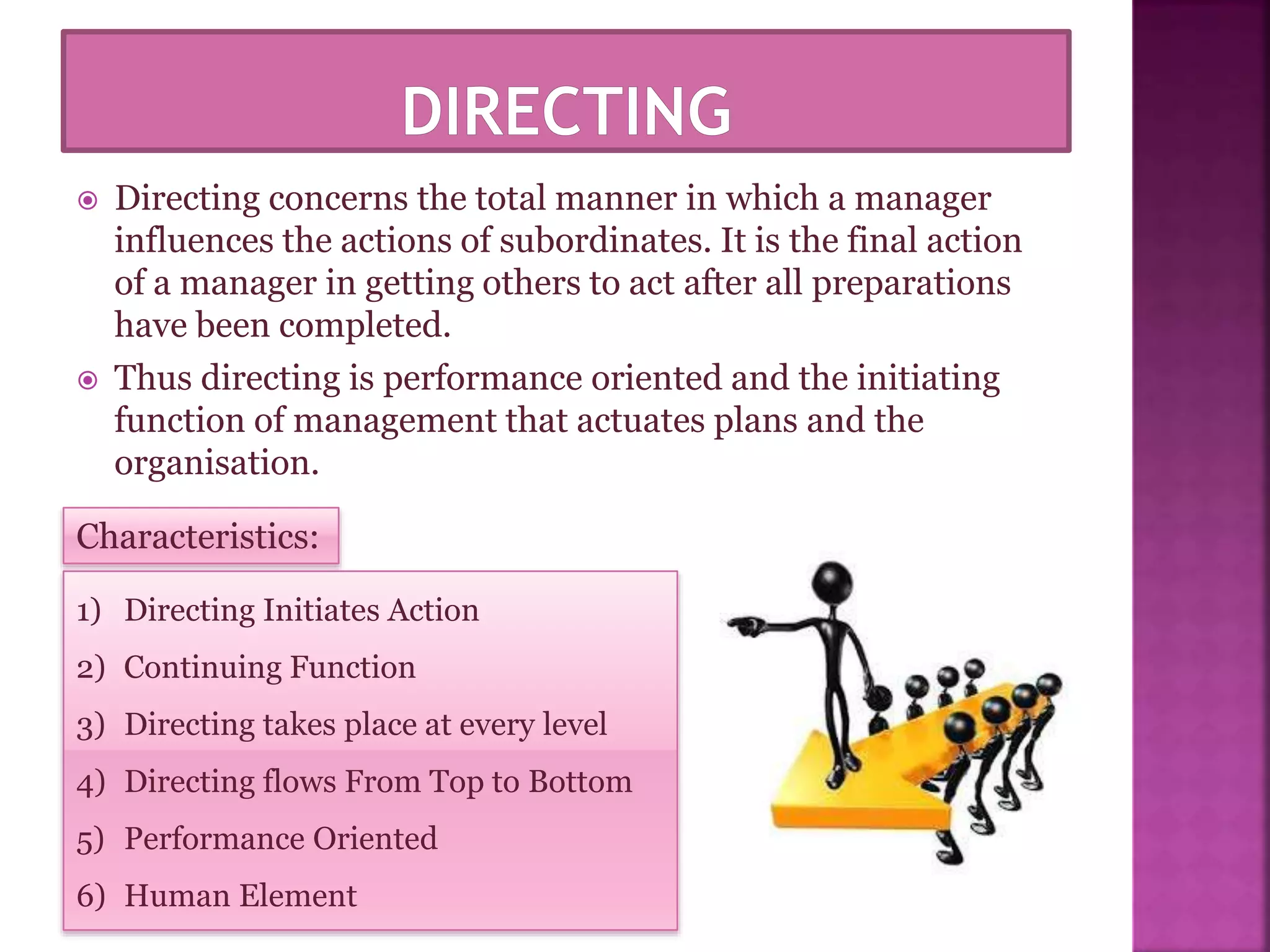
 Directing concerns the total manner in which a manager
influences the actions of subordinates. It is the final action
of a manager in getting others to act after all preparations
have been completed.
 Thus directing is performance oriented and the initiating
function of management that actuates plans and the
organisation.
Characteristics:
1) Directing Initiates Action
2) Continuing Function
3) Directing takes place at every level
4) Directing flows From Top to Bottom
5) Performance Oriented
6) Human Element
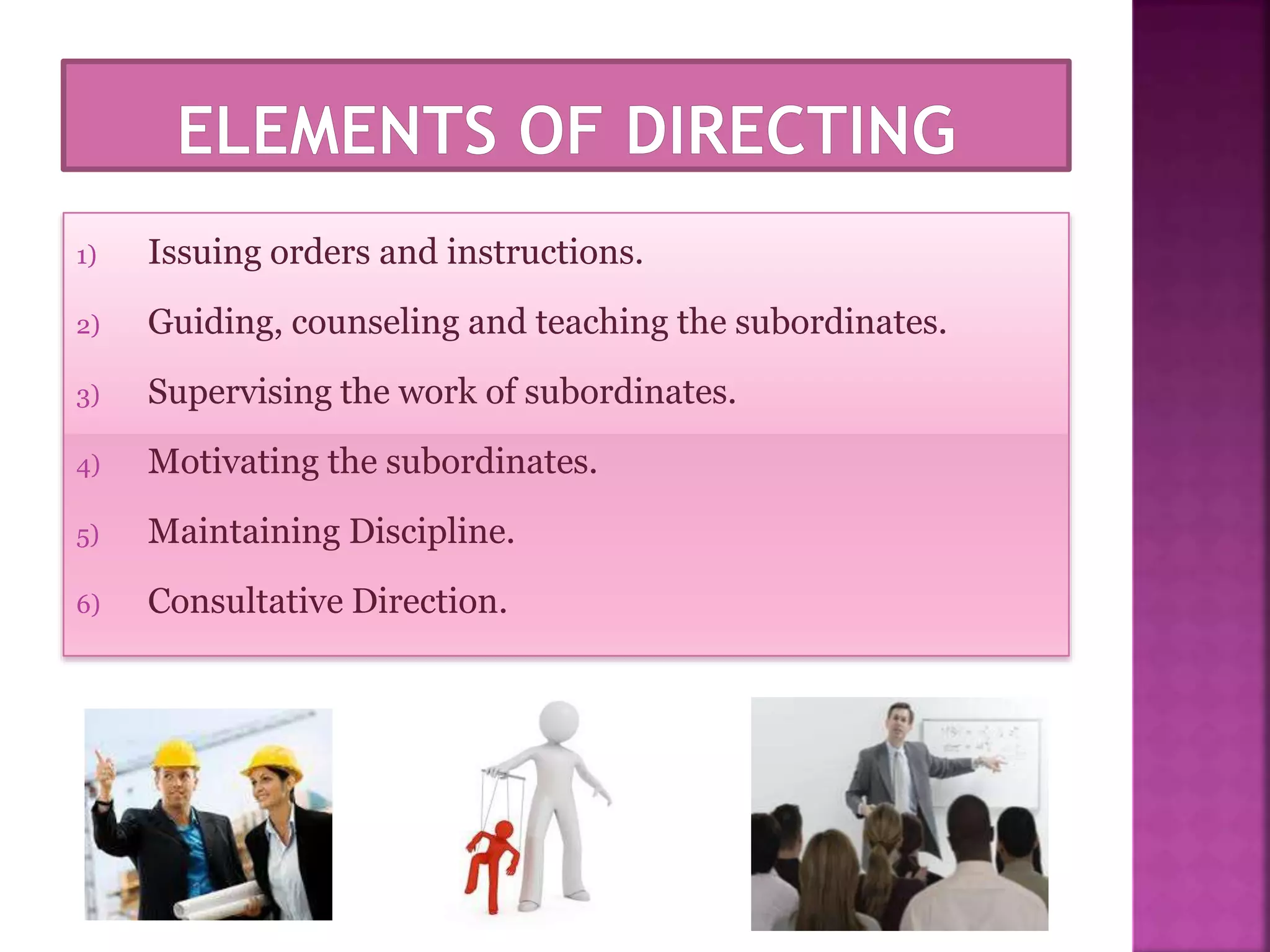
1) Issuing orders and instructions.
2) Guiding, counseling and teaching the subordinates.
3) Supervising the work of subordinates.
4) Motivating the subordinates.
5) Maintaining Discipline.
6) Consultative Direction.
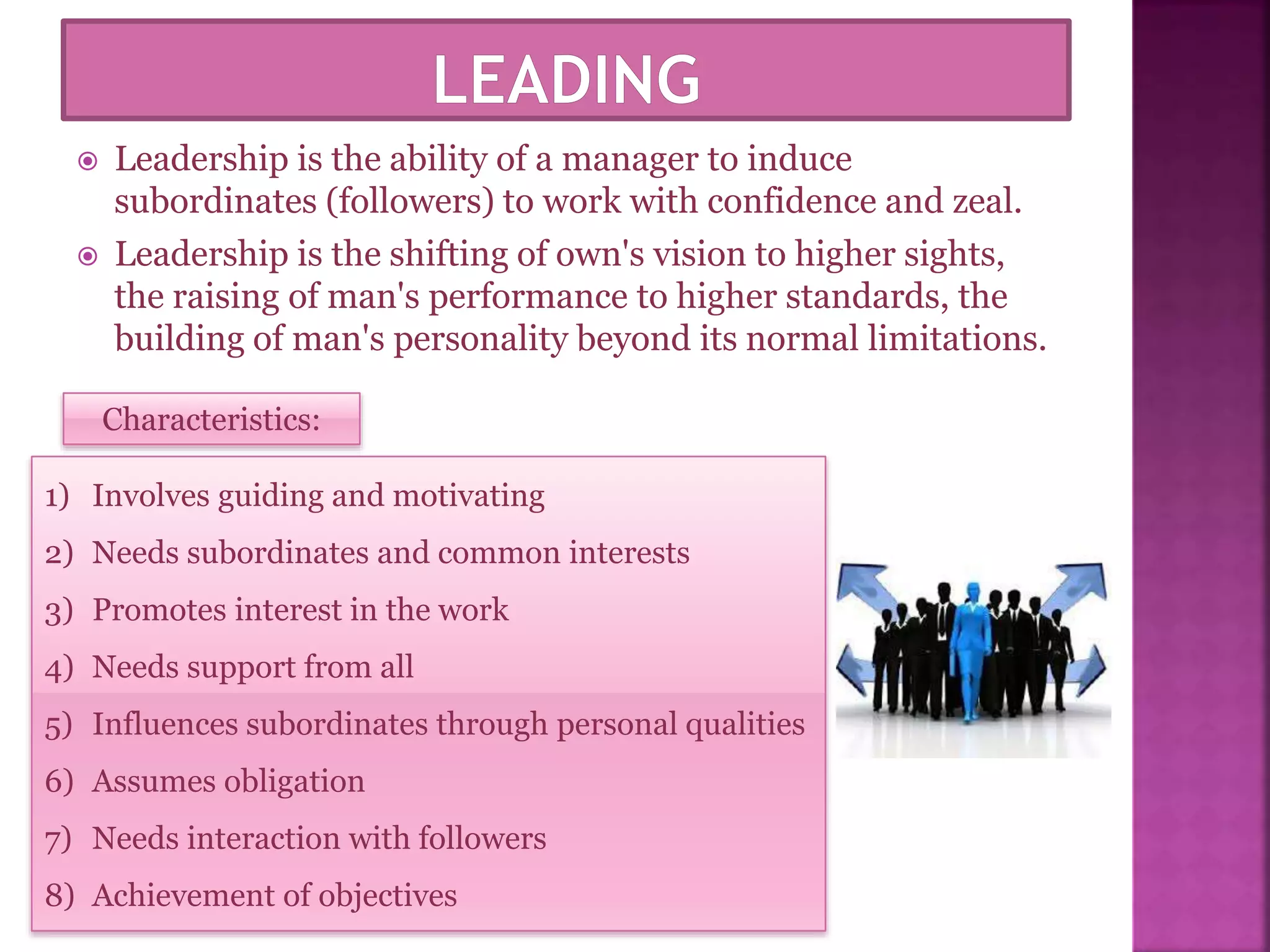
 Leadership is the ability of a manager to induce
subordinates (followers) to work with confidence and zeal.
 Leadership is the shifting of own's vision to higher sights,
the raising of man's performance to higher standards, the
building of man's personality beyond its normal limitations.
Characteristics:
1) Involves guiding and motivating
2) Needs subordinates and common interests
3) Promotes interest in the work
4) Needs support from all
5) Influences subordinates through personal qualities
6) Assumes obligation
7) Needs interaction with followers
8) Achievement of objectives
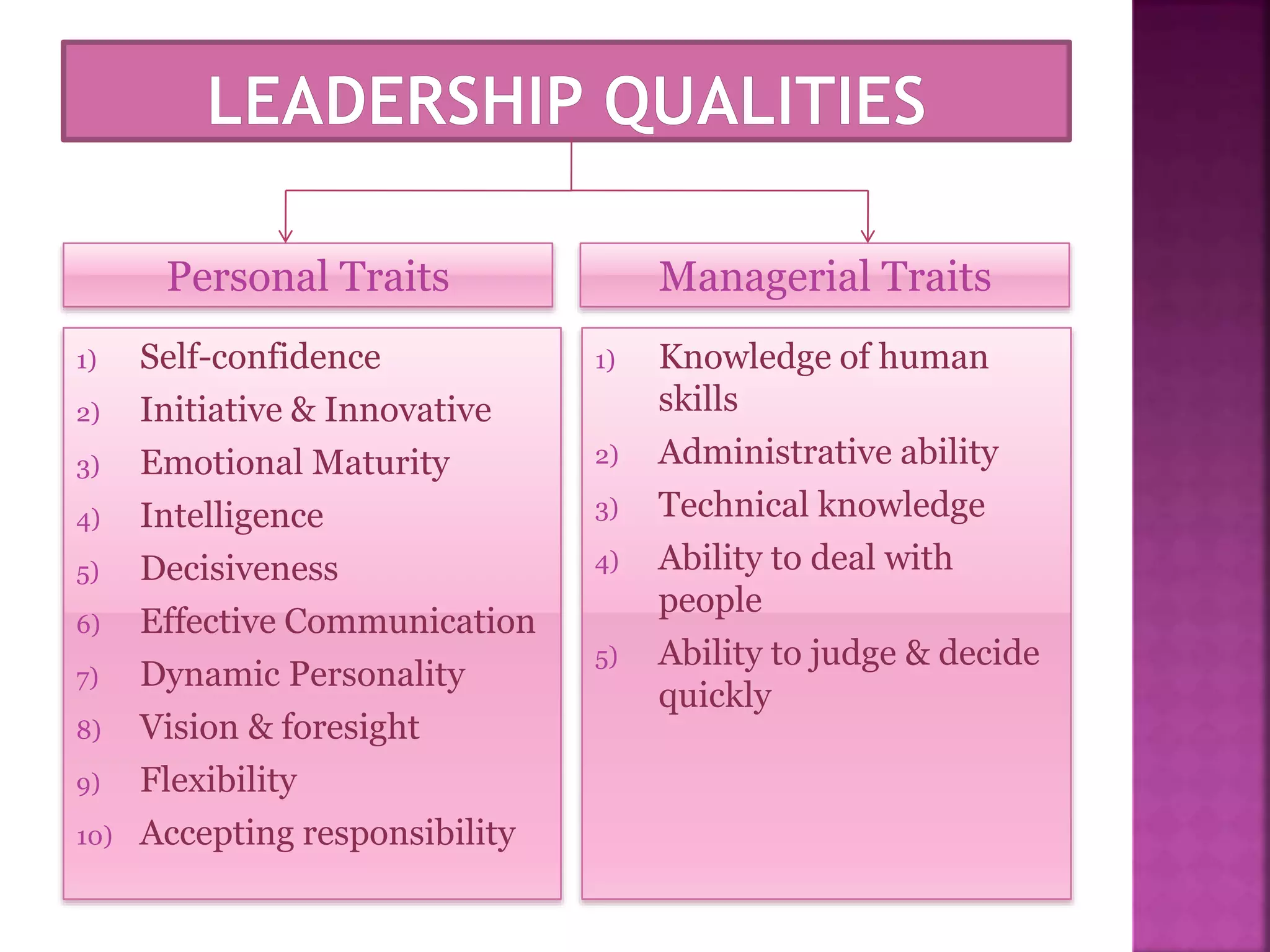
Personal Traits Managerial Traits
1) Self-confidence
2) Initiative & Innovative
3) Emotional Maturity
4) Intelligence
5) Decisiveness
6) Effective Communication
7) Dynamic Personality
8) Vision & foresight
9) Flexibility
10) Accepting responsibility
1) Knowledge of human
skills
2) Administrative ability
3) Technical knowledge
4) Ability to deal with
people
5) Ability to judge & decide
quickly
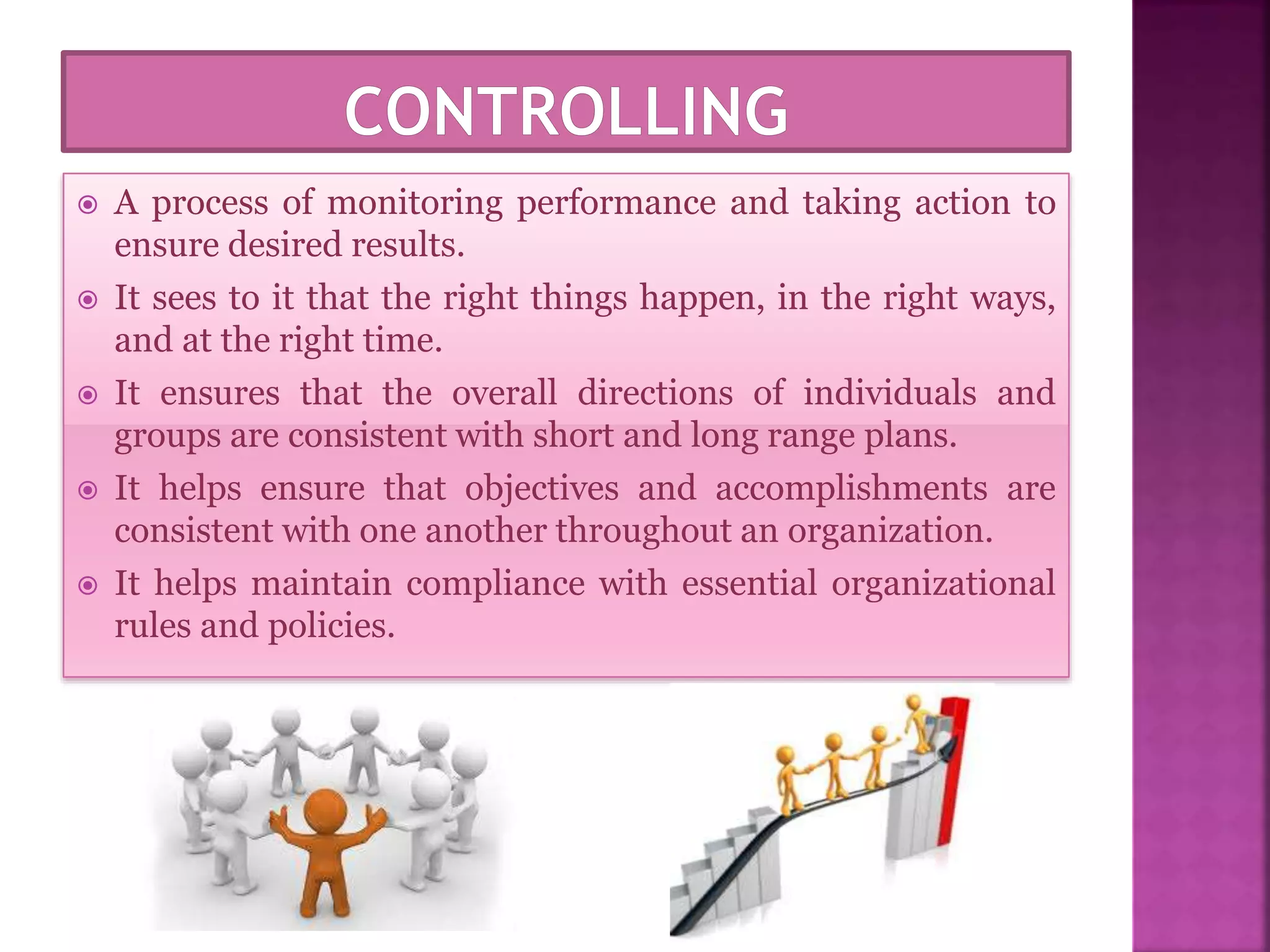
 A process of monitoring performance and taking action to
ensure desired results.
 It sees to it that the right things happen, in the right ways,
and at the right time.
 It ensures that the overall directions of individuals and
groups are consistent with short and long range plans.
 It helps ensure that objectives and accomplishments are
consistent with one another throughout an organization.
 It helps maintain compliance with essential organizational
rules and policies.
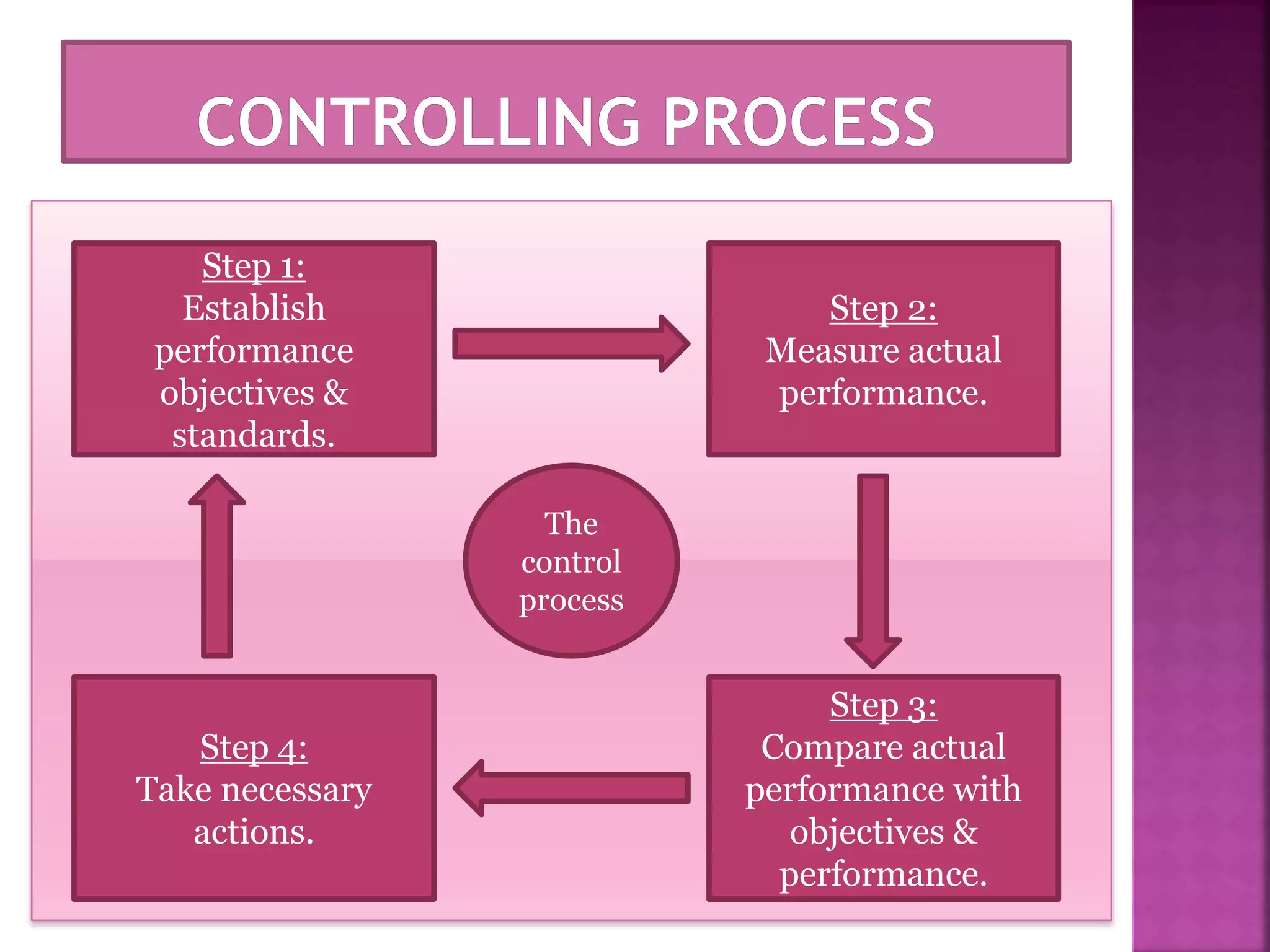
Step 1:
Establish
performance
objectives &
standards.
Step 2:
Measure actual
performance.
Step 3:
Compare actual
performance with
objectives &
performance.
Step 4:
Take necessary
actions.
The
control
process
Managerial functions

Managerial functions

  • 1.
    By: Swaraj Mane InitialPhase Successful CompanyEffectiveManagerialFunctions ImplicationsofFunctions
  • 2.
    The planning, organizing,leading, and controlling of human and other resources to achieve organizational goals effectively and efficiently. The people responsible for supervising the use of an organization’s resources to meet its goals. Resources: People, Skills, Knowledge, Machinery, Computers, I.T., Financial capital
  • 3.
     Technical skills Human relations skills  Administrative skills  Conceptual skills  Political skills  Emotional intelligence skills
  • 4.
    Planning: Choose appropriate organizational goals andcourse actions. Leading: Motivate, coordinate & energize individuals & groups to work together. Controlling: Establish accurate measuring & monitoring systems to evaluate how well the organization has achieved its goals. Staffing: Recruiting right personnel for right job at right place. Organizing: Establish task & authority relationship that allows people to work together. Directing: managing people and work through means of motivation, effective comm. and coordination.
  • 5.
     “Deciding inadvance What to do , how to do it, when to do it, and who is to do it.”  Deciding about all the aspects. Characteristics: 1) Focuses on achieving the objectives. 2) The primary function of Management. 3) It is continuous. 4) It is Futuristic. 5) It is mental exercise  What to do?  how to do it?  When to do it?  Who is to do it?
  • 6.
    Importance Process  Facilitatesdecision making.  Reduces risk of uncertainty.  Reduces overlapping & wasteful activities.  Provides directions.  Establishes standards for controlling.  Forecasting.  Establishing Objectives.  Programming.  Scheduling.  Budgeting.  Establishing Procedures.  Developing Policies.
  • 7.
     Refers tothe relationship between people, work and resources used to achieve the common objectives (goals).  The process of defining and grouping the activities of the enterprise and establishing the authority relationships among them. It Includes: 1) Developing the organization structure. 2) Delegating authority. 3) Establishing relations.
  • 8.
    Step 5: Evaluate results oforganization strategies. Step 4: Allocate resources & directives for subtasks. Step 2: Establish major tasks. Step 3: Divide major tasks into subtasks. Step 1: Reflect on plans & objectives.
  • 9.
     A seriesof steps that managers perform to provide the organization with the right people for the right job in the right positions.  Planning the organization with suitable personnel constitutes the staffing function. It consists: 1) Selecting the right person for the right post. 2) Training and development. 3) Giving proper remuneration and motivation. 4) Performance appraisal of employees. 5) Proper promotions, transfers, etc.
  • 10.
    Internal factor Externalfactor 1) Promotion policy 2) Future growth plans 3) Technology used 4) Support from top management 5) Image of organization. 1) Labor laws 2) Pressure from socio- political groups 3) Competition 4) Educational standards 5) Other external factors Sources of Applicants: 1) Internal Source 2) External Sources
  • 11.
     Directing concernsthe total manner in which a manager influences the actions of subordinates. It is the final action of a manager in getting others to act after all preparations have been completed.  Thus directing is performance oriented and the initiating function of management that actuates plans and the organisation. Characteristics: 1) Directing Initiates Action 2) Continuing Function 3) Directing takes place at every level 4) Directing flows From Top to Bottom 5) Performance Oriented 6) Human Element
  • 12.
    1) Issuing ordersand instructions. 2) Guiding, counseling and teaching the subordinates. 3) Supervising the work of subordinates. 4) Motivating the subordinates. 5) Maintaining Discipline. 6) Consultative Direction.
  • 13.
     Leadership isthe ability of a manager to induce subordinates (followers) to work with confidence and zeal.  Leadership is the shifting of own's vision to higher sights, the raising of man's performance to higher standards, the building of man's personality beyond its normal limitations. Characteristics: 1) Involves guiding and motivating 2) Needs subordinates and common interests 3) Promotes interest in the work 4) Needs support from all 5) Influences subordinates through personal qualities 6) Assumes obligation 7) Needs interaction with followers 8) Achievement of objectives
  • 14.
    Personal Traits ManagerialTraits 1) Self-confidence 2) Initiative & Innovative 3) Emotional Maturity 4) Intelligence 5) Decisiveness 6) Effective Communication 7) Dynamic Personality 8) Vision & foresight 9) Flexibility 10) Accepting responsibility 1) Knowledge of human skills 2) Administrative ability 3) Technical knowledge 4) Ability to deal with people 5) Ability to judge & decide quickly
  • 15.
     A processof monitoring performance and taking action to ensure desired results.  It sees to it that the right things happen, in the right ways, and at the right time.  It ensures that the overall directions of individuals and groups are consistent with short and long range plans.  It helps ensure that objectives and accomplishments are consistent with one another throughout an organization.  It helps maintain compliance with essential organizational rules and policies.
  • 16.
    Step 1: Establish performance objectives & standards. Step2: Measure actual performance. Step 3: Compare actual performance with objectives & performance. Step 4: Take necessary actions. The control process