MEANING: COMPETENCY
Competency: forms of
business-related expertise
Basic business competency:
understanding the organizational and
business processes of a firm
MEANING: COMPETENCY
Competency is a bundle of skills and
technologies that enables a company to
provide a particular benefit to stakeholders
For example,
At Sony – benefit is pocketability
core competence is miniaturization
At Times of India – benefit is on time delivery
core competence is logistics management
At Motorola–benefit is un tethered(rope) communication
core competence is wireless communication.
MEANING: COMPETENCY
Determination competencies: skill identified with
the energy and focus needed to bring a business
into existence
Opportunity competencies: skills necessary to
identify and exploit elements of the business
environment that can lead to a profitable and
sustainable business
Resource competencies: the ability or skill of the
entrepreneur at finding expendable components
necessary to the operation of the business
Time
Information
Location
Financing
Raw materials
Expertise
MEANING: COMPETENCY
MEANING: ENTREPRENEURIAL
COMPETENCY
Entrepreneurial competency means
the area of expertise, skills, ability,
efficiency, updated technology
regarding organizational and business
processes of a firm.
PERSPECTIVES OF COMPETENCY
Identifying existing competency
Establishing competence acquisition agenda
Building competency
Deploying competency
Protecting and defending competence
leadership
ENTREPRENEURIAL COMPETENCIES
INITIATIVE
SNATCHES OPPORTUNITY
PERSISTENCE, ASSERTIVE, PERSUASIVE, SELF
CONFIDENCE, INFLUENCE
INFORMATION SEEKING
CONCERN FOR HIGH QUALITY
COMMITMENT
EFFICIENCY ORIENTATION, MONITORING
SYSTEMATIC PLANNING
PROBLEM SOLVING
CONCERN FOR WORK AND EMPLOYEES
CUSTOMER ORIENTATION
TO BE CONSIDERED COMPETENCE A SKILL
MUST MEET THREE TESTS
1. Customer Value: Competencies are the skills that enable
a firm to deliver a fundamental customer benefit.
2. Competitor Differentiation: A capability must also be
competitively unique
power trains is a competence at Honda which has never been so at Ford.
Honda’s ability to produce some of the world’s best engines and
power trains does provide customers with highly valued benefits
of superior fuel economy, zippy acceleration, less noise and
vibration.
TO BE CONSIDERED COMPETENCE A SKILL
MUST MEET THREE TESTS
 3. Extendibility: A competitive is truly core
when it focus the basis for entry
into new product markets.
SKF, the world’s leading manufacturer of roller bearing has
competencies in antification, precision engineering and making
perfectly spherical devices. In order to achieve extendibility, SKF must
be capable of manufacturing the round, high precision recording heads
that go inside a VCR, most of which are now manufactured by Japanese
firms.
RISKS OF IGNORING COMPETENCIES
Opportunities for growth will be turned down.
Ignorance of competencies may weaken the enterprise
The lack of competence perspective can make a company
dependent on outside suppliers for core products.
A company focused only on end products may fail to invest
adequately in new competency that may constrain growth in
the future.
The new entrants in the area /competitors may lag the growth
of the company.
AWARENESS
Identification of business
opportunity.
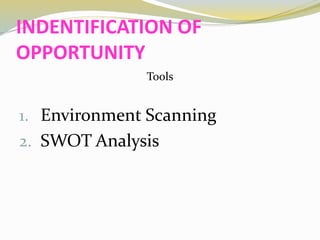
INDENTIFICATION OF
OPPORTUNITY
Tools
1. Environment Scanning
2. SWOT Analysis
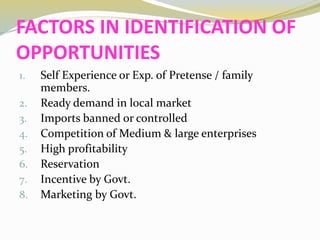
FACTORS IN IDENTIFICATION OF
OPPORTUNITIES
1. Self Experience or Exp. of Pretense / family
members.
2. Ready demand in local market
3. Imports banned or controlled
4. Competition of Medium & large enterprises
5. High profitability
6. Reservation
7. Incentive by Govt.
8. Marketing by Govt.
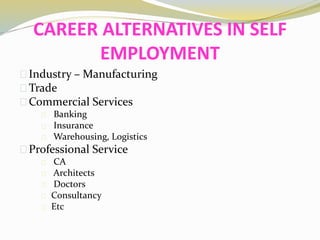
CAREER ALTERNATIVES IN SELF
EMPLOYMENT
Industry – Manufacturing
Trade
Commercial Services
Banking
Insurance
Warehousing, Logistics
Professional Service
CA
Architects
Doctors
Consultancy
Etc
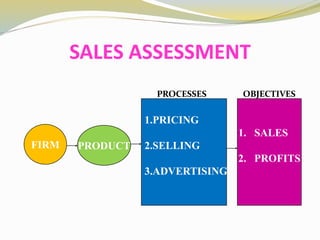
SALES ASSESSMENT
PROCESSES OBJECTIVES
FIRM PRODUCT
1.PRICING
2.SELLING
3.ADVERTISING
1. SALES
2. PROFITS
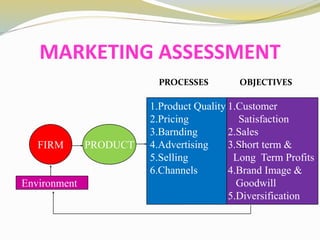
MARKETING ASSESSMENT
PROCESSES OBJECTIVES
FIRM PRODUCT
1.Product Quality
2.Pricing
3.Barnding
4.Advertising
5.Selling
6.Channels
1.Customer
Satisfaction
2.Sales
3.Short term &
Long Term Profits
4.Brand Image &
Goodwill
5.Diversification
Environment
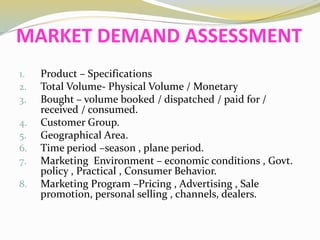
MARKET DEMAND ASSESSMENT
1. Product – Specifications
2. Total Volume- Physical Volume / Monetary
3. Bought – volume booked / dispatched / paid for /
received / consumed.
4. Customer Group.
5. Geographical Area.
6. Time period –season , plane period.
7. Marketing Environment – economic conditions , Govt.
policy , Practical , Consumer Behavior.
8. Marketing Program –Pricing , Advertising , Sale
promotion, personal selling , channels, dealers.
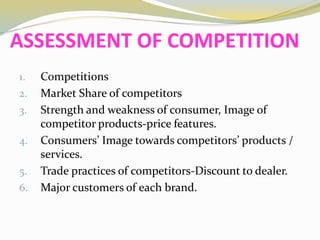
ASSESSMENT OF COMPETITION
1. Competitions
2. Market Share of competitors
3. Strength and weakness of consumer, Image of
competitor products-price features.
4. Consumers’ Image towards competitors’ products /
services.
5. Trade practices of competitors-Discount to dealer.
6. Major customers of each brand.
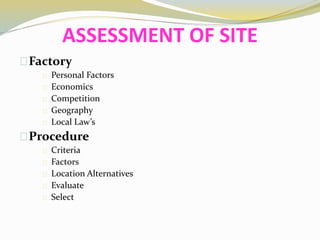
ASSESSMENT OF SITE
Factory
Personal Factors
Economics
Competition
Geography
Local Law’s
Procedure
Criteria
Factors
Location Alternatives
Evaluate
Select
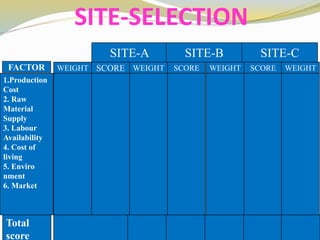
SITE-SELECTION
FACTOR WEIGHT SCORE WEIGHT SCORE WEIGHT SCORE
1.Production
Cost
2. Raw
Material
Supply
3. Labour
Availability
4. Cost of
living
5. Enviro
nment
6. Market
WEIGHT
SITE-A SITE-B SITE-C
Total
score
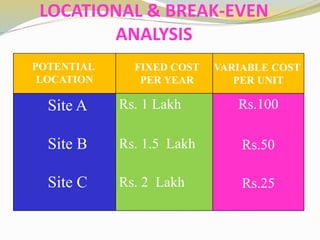
LOCATIONAL & BREAK-EVEN
ANALYSIS
Site A
Site B
Site C
Rs. 1 Lakh
Rs. 1.5 Lakh
Rs. 2 Lakh
Rs.100
Rs.50
Rs.25
POTENTIAL
LOCATION
FIXED COST
PER YEAR
VARIABLE COST
PER UNIT
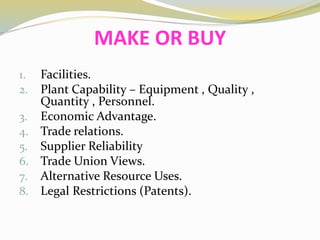
MAKE OR BUY
1. Facilities.
2. Plant Capability – Equipment , Quality ,
Quantity , Personnel.
3. Economic Advantage.
4. Trade relations.
5. Supplier Reliability
6. Trade Union Views.
7. Alternative Resource Uses.
8. Legal Restrictions (Patents).
ASSESSMENT OF PRODUCTION
PROCESS
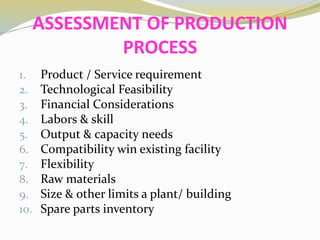
1. Product / Service requirement
2. Technological Feasibility
3. Financial Considerations
4. Labors & skill
5. Output & capacity needs
6. Compatibility win existing facility
7. Flexibility
8. Raw materials
9. Size & other limits a plant/ building
10. Spare parts inventory
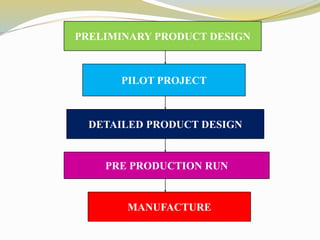
PRELIMINARY PRODUCT DESIGN
PILOT PROJECT
DETAILED PRODUCT DESIGN
PRE PRODUCTION RUN
MANUFACTURE
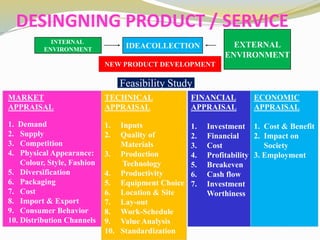
DESINGNING PRODUCT / SERVICE
INTERNAL
ENVIRONMENT IDEACOLLECTION EXTERNAL
ENVIRONMENT
MARKET
APPRAISAL
1. Demand
2. Supply
3. Competition
4. Physical Appearance:
Colour, Style, Fashion
5. Diversification
6. Packaging
7. Cost
8. Import & Export
9. Consumer Behavior
10. Distribution Channels
TECHNICAL
APPRAISAL
1. Inputs
2. Quality of
Materials
3. Production
Technology
4. Productivity
5. Equipment Choice
6. Location & Site
7. Lay-out
8. Work-Schedule
9. Value Analysis
10. Standardization
FINANCIAL
APPRAISAL
1. Investment
2. Financial
3. Cost
4. Profitability
5. Breakeven
6. Cash flow
7. Investment
Worthiness
ECONOMIC
APPRAISAL
1. Cost & Benefit
2. Impact on
Society
3. Employment
NEW PRODUCT DEVELOPMENT
Feasibility Study
10 COMPETENCIES FOR
ENTREPRENEURIAL SUCCESS:
Major competencies that contribute towards top
performance to entrepreneur
Integrity - the entrepreneur has a clear sense of values
and beliefs that underpin the creative and business
decisions that they make; and that influence the
actions they take, particularly when in difficult or
challenging circumstances
10 COMPETENCIES FOR
ENTREPRENEURIAL SUCCESS:
2. Conceptual Thinking - the entrepreneur is
prepared to use fresh approaches; comes up with crazy
ideas that may just work, leading to radical change or
significant improvements; and takes time to listen to
new ideas without pre-judgement
10 COMPETENCIES FOR
ENTREPRENEURIAL SUCCESS:
3. Risk taking - the entrepreneur understands that
risk taking means trying something new, and possibly
better, in the sense of stretching beyond what has been
done in the past; and that the constant challenge is to
learn how to assess choices responsibly, weighing the
possible outcomes against his/her values and
responsibilities
10 COMPETENCIES FOR
ENTREPRENEURIAL SUCCESS:
4. Networking - the entrepreneur understands that
networking is a key business activity which can
provide access to information, expertise, collaboration
and sales; and that careful planning and preparation
helps achieve desired results
10 COMPETENCIES FOR
ENTREPRENEURIAL SUCCESS:
5. Strategic Thinking - the entrepreneur understands
and values the planning process, thinking and
planning over a significant timescale; recognizes
external trends and opportunities; and is able to think
through any complex implications for the business 6.
Commercial Aptitude - the entrepreneur keeps up to
date with developments in the sector; seeks out best
practice; and identifies and seizes opportunities that
are not obvious to others
10 COMPETENCIES FOR
ENTREPRENEURIAL SUCCESS:
7. Decisiveness - the entrepreneur resolves issues as
they arise; does not get bogged down in analysis
during decision making; and responds flexibly to deal
with changing priorities
8. Optimism - the entrepreneur persists in pursuing
goals despite obstacles and setbacks; operates from
hope of success rather than from fear of failure; and
sees setbacks as due to manageable circumstance
rather than a personal flaw
10 COMPETENCIES FOR
ENTREPRENEURIAL SUCCESS:
9. Customer Sensitivity - the entrepreneur builds trust
and long term relationships with customers; generates an
expectation of high level of customer service; and regularly
exceeds customer expectation
10. People Focus - the entrepreneur creates common
purpose with colleagues through shared vision and values;
walks the talk; sees and values the best in others; builds the
total capability of the immediate and wider team; and
always considers the principles of inclusiveness in planning
and dealing with others
?

Entrepreneurial competencies, By Dr. Parul Chotalia

  • 2.
    MEANING: COMPETENCY Competency: formsof business-related expertise Basic business competency: understanding the organizational and business processes of a firm
  • 3.
    MEANING: COMPETENCY Competency isa bundle of skills and technologies that enables a company to provide a particular benefit to stakeholders For example, At Sony – benefit is pocketability core competence is miniaturization At Times of India – benefit is on time delivery core competence is logistics management At Motorola–benefit is un tethered(rope) communication core competence is wireless communication.
  • 4.
    MEANING: COMPETENCY Determination competencies:skill identified with the energy and focus needed to bring a business into existence Opportunity competencies: skills necessary to identify and exploit elements of the business environment that can lead to a profitable and sustainable business
  • 5.
    Resource competencies: theability or skill of the entrepreneur at finding expendable components necessary to the operation of the business Time Information Location Financing Raw materials Expertise MEANING: COMPETENCY
  • 6.
    MEANING: ENTREPRENEURIAL COMPETENCY Entrepreneurial competencymeans the area of expertise, skills, ability, efficiency, updated technology regarding organizational and business processes of a firm.
  • 7.
    PERSPECTIVES OF COMPETENCY Identifyingexisting competency Establishing competence acquisition agenda Building competency Deploying competency Protecting and defending competence leadership
  • 8.
    ENTREPRENEURIAL COMPETENCIES INITIATIVE SNATCHES OPPORTUNITY PERSISTENCE,ASSERTIVE, PERSUASIVE, SELF CONFIDENCE, INFLUENCE INFORMATION SEEKING CONCERN FOR HIGH QUALITY COMMITMENT EFFICIENCY ORIENTATION, MONITORING SYSTEMATIC PLANNING PROBLEM SOLVING CONCERN FOR WORK AND EMPLOYEES CUSTOMER ORIENTATION
  • 9.
    TO BE CONSIDEREDCOMPETENCE A SKILL MUST MEET THREE TESTS 1. Customer Value: Competencies are the skills that enable a firm to deliver a fundamental customer benefit. 2. Competitor Differentiation: A capability must also be competitively unique power trains is a competence at Honda which has never been so at Ford. Honda’s ability to produce some of the world’s best engines and power trains does provide customers with highly valued benefits of superior fuel economy, zippy acceleration, less noise and vibration.
  • 10.
    TO BE CONSIDEREDCOMPETENCE A SKILL MUST MEET THREE TESTS  3. Extendibility: A competitive is truly core when it focus the basis for entry into new product markets. SKF, the world’s leading manufacturer of roller bearing has competencies in antification, precision engineering and making perfectly spherical devices. In order to achieve extendibility, SKF must be capable of manufacturing the round, high precision recording heads that go inside a VCR, most of which are now manufactured by Japanese firms.
  • 11.
    RISKS OF IGNORINGCOMPETENCIES Opportunities for growth will be turned down. Ignorance of competencies may weaken the enterprise The lack of competence perspective can make a company dependent on outside suppliers for core products. A company focused only on end products may fail to invest adequately in new competency that may constrain growth in the future. The new entrants in the area /competitors may lag the growth of the company.
  • 13.
  • 14.
  • 15.
    FACTORS IN IDENTIFICATIONOF OPPORTUNITIES 1. Self Experience or Exp. of Pretense / family members. 2. Ready demand in local market 3. Imports banned or controlled 4. Competition of Medium & large enterprises 5. High profitability 6. Reservation 7. Incentive by Govt. 8. Marketing by Govt.
  • 16.
    CAREER ALTERNATIVES INSELF EMPLOYMENT Industry – Manufacturing Trade Commercial Services Banking Insurance Warehousing, Logistics Professional Service CA Architects Doctors Consultancy Etc
  • 18.
    SALES ASSESSMENT PROCESSES OBJECTIVES FIRMPRODUCT 1.PRICING 2.SELLING 3.ADVERTISING 1. SALES 2. PROFITS
  • 19.
    MARKETING ASSESSMENT PROCESSES OBJECTIVES FIRMPRODUCT 1.Product Quality 2.Pricing 3.Barnding 4.Advertising 5.Selling 6.Channels 1.Customer Satisfaction 2.Sales 3.Short term & Long Term Profits 4.Brand Image & Goodwill 5.Diversification Environment
  • 20.
    MARKET DEMAND ASSESSMENT 1.Product – Specifications 2. Total Volume- Physical Volume / Monetary 3. Bought – volume booked / dispatched / paid for / received / consumed. 4. Customer Group. 5. Geographical Area. 6. Time period –season , plane period. 7. Marketing Environment – economic conditions , Govt. policy , Practical , Consumer Behavior. 8. Marketing Program –Pricing , Advertising , Sale promotion, personal selling , channels, dealers.
  • 21.
    ASSESSMENT OF COMPETITION 1.Competitions 2. Market Share of competitors 3. Strength and weakness of consumer, Image of competitor products-price features. 4. Consumers’ Image towards competitors’ products / services. 5. Trade practices of competitors-Discount to dealer. 6. Major customers of each brand.
  • 22.
    ASSESSMENT OF SITE Factory PersonalFactors Economics Competition Geography Local Law’s Procedure Criteria Factors Location Alternatives Evaluate Select
  • 23.
    SITE-SELECTION FACTOR WEIGHT SCOREWEIGHT SCORE WEIGHT SCORE 1.Production Cost 2. Raw Material Supply 3. Labour Availability 4. Cost of living 5. Enviro nment 6. Market WEIGHT SITE-A SITE-B SITE-C Total score
  • 24.
    LOCATIONAL & BREAK-EVEN ANALYSIS SiteA Site B Site C Rs. 1 Lakh Rs. 1.5 Lakh Rs. 2 Lakh Rs.100 Rs.50 Rs.25 POTENTIAL LOCATION FIXED COST PER YEAR VARIABLE COST PER UNIT
  • 25.
    MAKE OR BUY 1.Facilities. 2. Plant Capability – Equipment , Quality , Quantity , Personnel. 3. Economic Advantage. 4. Trade relations. 5. Supplier Reliability 6. Trade Union Views. 7. Alternative Resource Uses. 8. Legal Restrictions (Patents).
  • 26.
    ASSESSMENT OF PRODUCTION PROCESS 1.Product / Service requirement 2. Technological Feasibility 3. Financial Considerations 4. Labors & skill 5. Output & capacity needs 6. Compatibility win existing facility 7. Flexibility 8. Raw materials 9. Size & other limits a plant/ building 10. Spare parts inventory
  • 28.
    PRELIMINARY PRODUCT DESIGN PILOTPROJECT DETAILED PRODUCT DESIGN PRE PRODUCTION RUN MANUFACTURE
  • 29.
    DESINGNING PRODUCT /SERVICE INTERNAL ENVIRONMENT IDEACOLLECTION EXTERNAL ENVIRONMENT MARKET APPRAISAL 1. Demand 2. Supply 3. Competition 4. Physical Appearance: Colour, Style, Fashion 5. Diversification 6. Packaging 7. Cost 8. Import & Export 9. Consumer Behavior 10. Distribution Channels TECHNICAL APPRAISAL 1. Inputs 2. Quality of Materials 3. Production Technology 4. Productivity 5. Equipment Choice 6. Location & Site 7. Lay-out 8. Work-Schedule 9. Value Analysis 10. Standardization FINANCIAL APPRAISAL 1. Investment 2. Financial 3. Cost 4. Profitability 5. Breakeven 6. Cash flow 7. Investment Worthiness ECONOMIC APPRAISAL 1. Cost & Benefit 2. Impact on Society 3. Employment NEW PRODUCT DEVELOPMENT Feasibility Study
  • 30.
    10 COMPETENCIES FOR ENTREPRENEURIALSUCCESS: Major competencies that contribute towards top performance to entrepreneur Integrity - the entrepreneur has a clear sense of values and beliefs that underpin the creative and business decisions that they make; and that influence the actions they take, particularly when in difficult or challenging circumstances
  • 31.
    10 COMPETENCIES FOR ENTREPRENEURIALSUCCESS: 2. Conceptual Thinking - the entrepreneur is prepared to use fresh approaches; comes up with crazy ideas that may just work, leading to radical change or significant improvements; and takes time to listen to new ideas without pre-judgement
  • 32.
    10 COMPETENCIES FOR ENTREPRENEURIALSUCCESS: 3. Risk taking - the entrepreneur understands that risk taking means trying something new, and possibly better, in the sense of stretching beyond what has been done in the past; and that the constant challenge is to learn how to assess choices responsibly, weighing the possible outcomes against his/her values and responsibilities
  • 33.
    10 COMPETENCIES FOR ENTREPRENEURIALSUCCESS: 4. Networking - the entrepreneur understands that networking is a key business activity which can provide access to information, expertise, collaboration and sales; and that careful planning and preparation helps achieve desired results
  • 34.
    10 COMPETENCIES FOR ENTREPRENEURIALSUCCESS: 5. Strategic Thinking - the entrepreneur understands and values the planning process, thinking and planning over a significant timescale; recognizes external trends and opportunities; and is able to think through any complex implications for the business 6. Commercial Aptitude - the entrepreneur keeps up to date with developments in the sector; seeks out best practice; and identifies and seizes opportunities that are not obvious to others
  • 35.
    10 COMPETENCIES FOR ENTREPRENEURIALSUCCESS: 7. Decisiveness - the entrepreneur resolves issues as they arise; does not get bogged down in analysis during decision making; and responds flexibly to deal with changing priorities 8. Optimism - the entrepreneur persists in pursuing goals despite obstacles and setbacks; operates from hope of success rather than from fear of failure; and sees setbacks as due to manageable circumstance rather than a personal flaw
  • 36.
    10 COMPETENCIES FOR ENTREPRENEURIALSUCCESS: 9. Customer Sensitivity - the entrepreneur builds trust and long term relationships with customers; generates an expectation of high level of customer service; and regularly exceeds customer expectation 10. People Focus - the entrepreneur creates common purpose with colleagues through shared vision and values; walks the talk; sees and values the best in others; builds the total capability of the immediate and wider team; and always considers the principles of inclusiveness in planning and dealing with others
  • 37.